
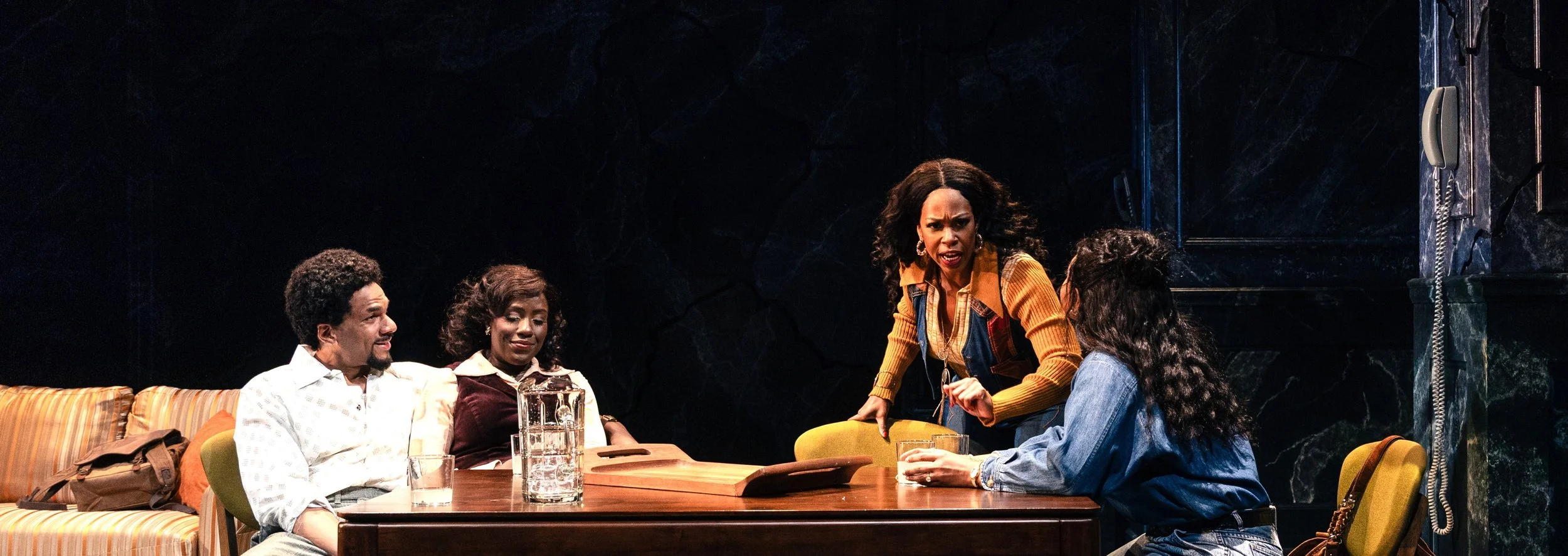

From left: Biko Eisen-Martin plays Edwin and Crystal Lucas-Perry is Helen in Christina Anderson’s the ripple, the wave that carried me home.
Water can be a source of life, recreation, and freedom, but it can also carry painful histories of exclusion and struggle. In Christina Anderson’s the ripple, the wave that carried me home, water becomes the foundation of a family’s fight for racial equality and a daughter’s journey toward understanding her past. Directed by Tiffany Nichole Greene, the production brings together a talented ensemble and imaginative scenic design for an intimate exploration of family relationships.
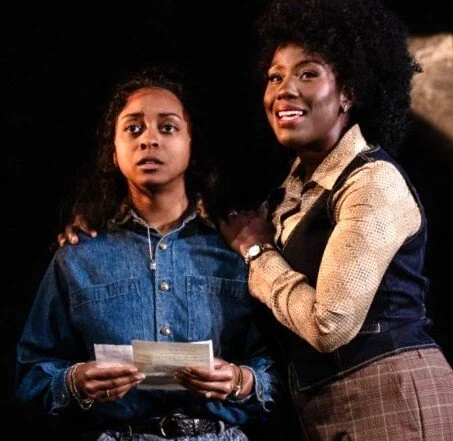
Helen counsels Janice (Alana Raquel Bowers) in the Playwrights Horizons’ production. Photographs by Marc J. Franklin.
Set primarily in 1992, with memories reaching back through earlier decades, the play centers on Janice (Alana Raquel Bowers), a Black woman living in Ohio who is drawn back into her family’s history of civil rights activism in Beacon, Kans. Her parents, Edwin (Biko Eisen-Martin) and Helen (Crystal Lucas-Perry), devoted much of their lives to challenging racial segregation and discrimination at public swimming pools. Their efforts helped advance access for the Black community, but the struggle has left lasting tensions within the family.
Janice struggles to establish an identity separate from her parents’ activism. Her relationship with Edwin is particularly strained, as his commitment to the cause sometimes leaves little room for his daughter’s independence, as when she balks at attending a discrimination trial:
Janice: I don’t want to go to the trial.
Edwin: How could you not want to be a part of this? My discrimination lawsuit against these pool clubs is finally getting its day in court. ... This case going to trial is the first real win we’ve had in years.
Janice: It isn’t my fight, daddy.
Their disagreements eventually lead to a rupture, leaving Janice to confront unresolved feelings about her father and the sacrifices made in the name of social progress.
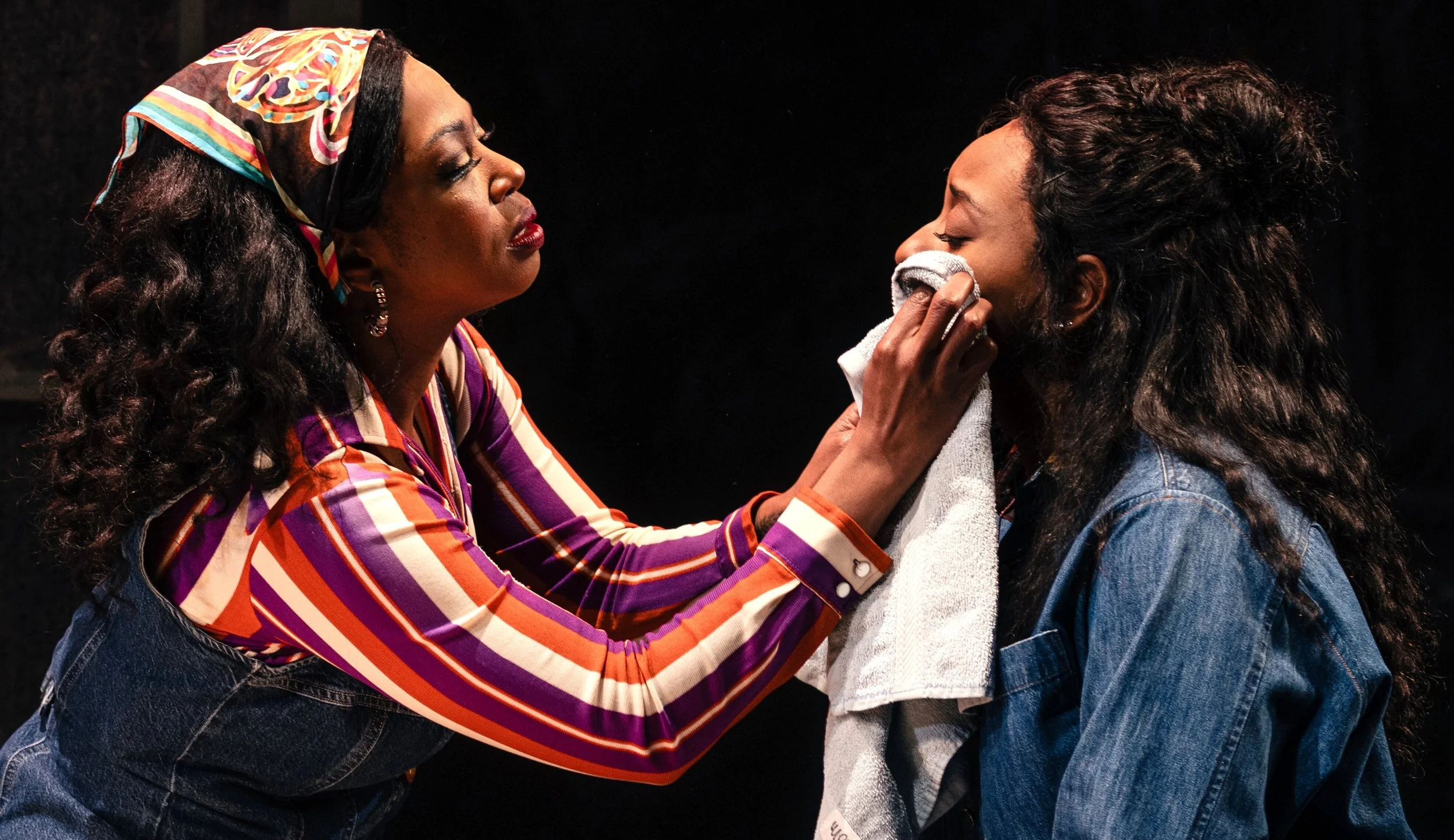
Aunt Gayle (Marinda Anderson) consoles Janice.
Anderson explores the ways political struggles extend beyond public victories and into private lives. The play considers what one generation passes down to the next, whether through inspiration, obligation, or emotional wounds.
Bowers anchors the production with a confident and nuanced portrayal of Janice, capturing both the character’s youthful defiance and her adult uncertainty. Particularly effective is her ability to transition between different stages of Janice’s life without using exaggerated mannerisms.
Eisen-Martin brings conviction to Edwin, portraying a man whose dedication to racial justice is inseparable from his identity. His interactions with Janice reveal the tension between a father’s determination to create a better world and a daughter’s need to define that world for herself. Lucas-Perry offers a compelling presence as Helen, whose participation in the struggle and role within the family reveal another dimension of the sacrifices associated with activism.
Edwin: If we win this case, we won’t have to fight any more. It’ll be a huge victory for every Black person in Beacon. …
Helen: We can’t win the game they designed, Eddie. As soon as we catch up, the rules change.
Marinda Anderson brings an infectious energy to her dual roles as Gayle and the Young Chipper Ambitious Black Woman. infusing the latter character with an upbeat spirit and playful humor.
The production is visually impressive too. Scenic designer Lawrence E. Moten III transforms the stage through transparent movable panels that evoke the boundaries of a swimming pool. Projections depicting water enhance the illusion, while adaptable furnishings allow the setting to shift between domestic spaces and memories of the past. The design is both practical and evocative, providing a visual continuity that complements the play’s movement through time.
Lap Chi Chu’s lighting contributes to the aquatic atmosphere, particularly through the use of blue-green illumination that reinforces the presence of water. Rodrigo Muñoz’s costumes help distinguish the different periods and characters.

Janice and Helen represent generations seeking equality in the ripple, the wave that carried me home.
Despite its considerable strengths, the production does not always achieve the emotional resonance its subject matter warrants. Anderson’s narrative encompasses decades of racial discrimination, activism, family tensions, and personal reckoning, yet the richness at times there are moments of considerable historical and personal importance without the emotional immediacy they should deliver.
Nevertheless, the production finds a particularly satisfying resolution in its closing moments. As Janice, Helen, and Gayle enter the pool together, their laughter introduces a welcome sense of lightness after generations of conflict and sacrifice. Water, once associated with exclusion, struggle, and painful memories, becomes a place of shared joy and renewal. The image conveys what the family has spent much of the play searching for: an opportunity to move beyond the burdens of the past without forgetting them.
the ripple, the wave that carried me home runs through Nov. 29 at Playwrights Horizons (416 West 42nd St.). Evening performances are at 7:30 p.m., with matinees at 2:30 p.m. on select dates. For tickets and more information, visit playwrightshorizons.org.
Playwright: Christina Anderson
Director: Tiffany Nichole Greene
Scenic Design: Lawrence E. Moten III
Costume Design: Rodrigo Muñoz
Sound Design: Christopher Darbassie
Lighting Design: Lap Chi Chu
