

Two Hearts That Beat As Two

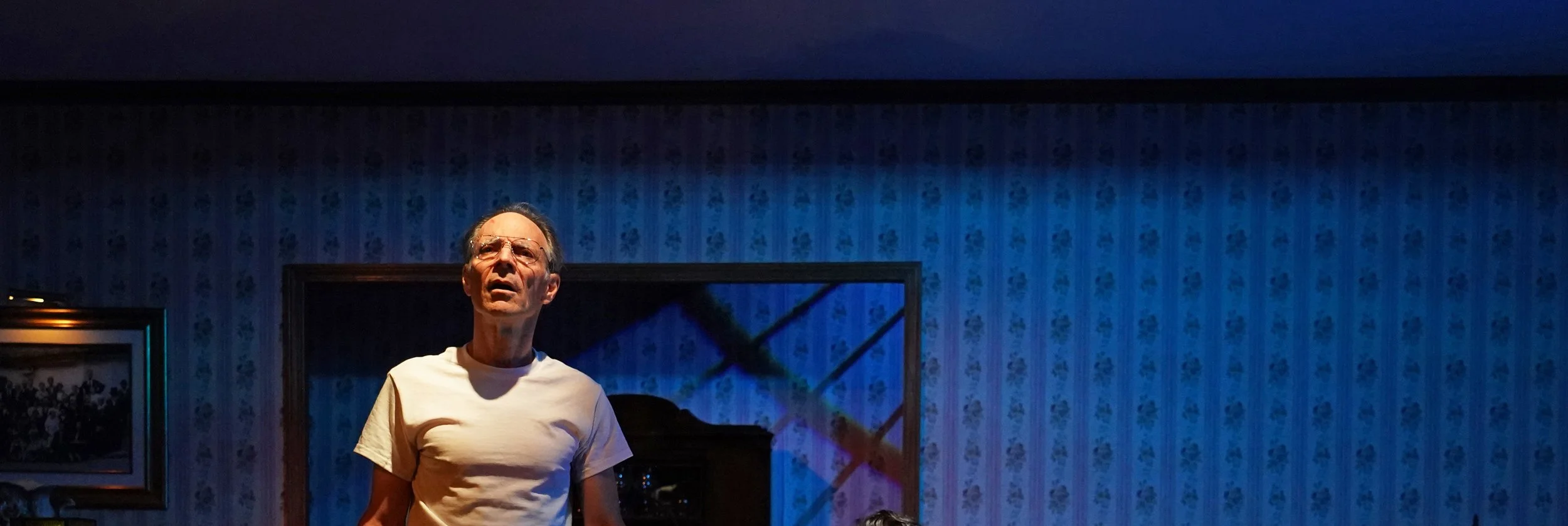
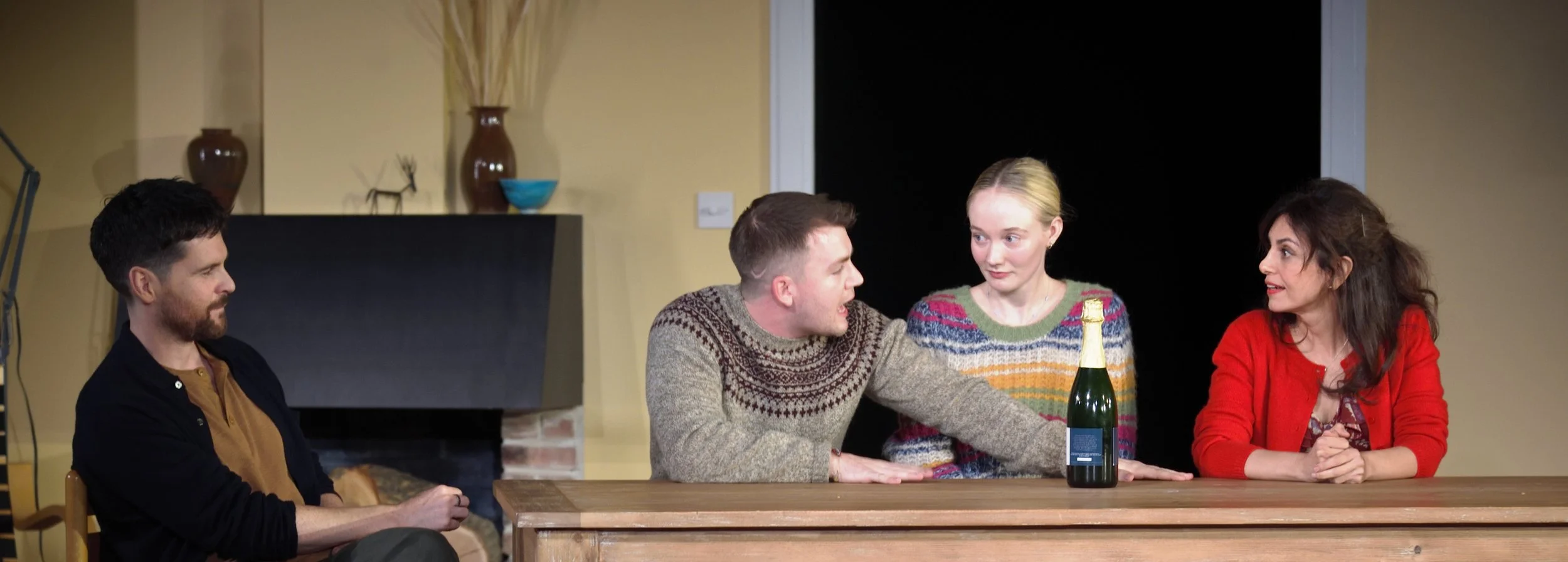
In real life, a relationship requires two parties being connected to each other in order to work. Onstage, however, three parties must be in sync to portray a successful relationship – the two lovers as well as the audience. Edward and Allison, the two characters whose on-and-off romance provides the heart of Victor L. Cahn’s new play, Embraceable Me, may be able to get under each other’s skin, but they have a much more difficult time reeling the audience in. As envisioned by Cahn, Edward (Scott Barrow) and Allison (Keira Naughton) are really more like chess pieces than characters; the audience is familiar with their story and the moves these two will make. We first meet them at Edward’s New England country house. Several years after college graduation, both have made headway in their respective careers and have moved on with other love interests after an intense but abortive relationship that saw them progress from friends to significant others to exes.

However, a connection remains, even as Allison tells Edward that she has gotten engaged to a man she has known for mere months. It’s clear that Edward, while rarely the aggressor in his interactions, still carries a torch, and that Allison is testing to see if any interest remains. What follows then is a series of flashbacks to the belabored milestones of their relationship, partially reenacted by the two actors, partially dictated directly to the audience. Embraceable documents the stops and starts in their relationship as told in both flashback and narration.

But this whole journey is rather moot. It is a fait accompli that they believe they belong together and will ultimately end up with each other, so the play’s action feels both foreordained and inconsequential. A romantic dramedy such as Embraceable can still survive even if the plot provides short shrift. All that’s needed is convincing chemistry between the two leads.

Unfortunately, in this case, Edward and Allison feel mismatched, due in part to Cahn’s undernourished writing and also in part to the actors on board. Barrow does more heavy lifting. It is a mature performance. Edward is certainly a milquetoast, a vulnerable and passive intellectual, but his portrayer manages to make Edward’s frustration with his parents harrowing in addition to suggesting a normal male sexual appetite lurking beneath his docile exterior. We also get to watch him grow as his scenes continue. While he makes it clear that he would love to live with Allison, he also makes it clear that his life has taught him that he could live with or without her.

Naughton, who has proven her ability to command the stage in such previous shows as Hunting and Gathering and the Rivals, has a more difficult time shading in her character’s subtext here. In comparison to Edward, Allison has to drive the scenes. She asserts herself in scenes as the more driven of the two, but the performance feels too guarded. Several emotional scenes involving a medical scare for herself and the loss of a family member feel threadbare, lacking the digging required in order to portray attendant emotions like fear, weakness, or, most importantly, dependency. Meanwhile, Naughton should have let loose far more in a different flashback scene in which she humiliates Edward in front of his graduate school colleagues out of jealousy.

As a result, though the audience may be told repeatedly of it, they never actually feel a deep bond between Edward and Allison, let alone a love connection. Director Eric Parness seems to have been more engaged with the show’s technical elements, some of which impress more than others. Sarah B. Brown’s set uses the small space of the Kirk Theater effectively, providing several distinct spaces to represent various locations. Nick Moore’s sound design, on the other hand, calls too much attention to itself, distracting more than providing convincing ambient noise. And the transitions between the narration to the audience and the dialogue-driven scenes should be more seamless.

Barrow proves he is certainly a performer to watch, but Embraceable lacks both charm and conviction. I couldn’t help but wonder at show’s end if Edward and Allison stay together because they feel it is their characters’ destiny or simply because there was never anyone else around.

Click for print friendly PDF version of this blog post

You Jump, I Jump

The Oldsmobiles may take place on New York’s Manhattan Bridge, but it has nothing to do with cars. Instead, journalist-playwright Roger Rosenblatt’s slight, two-character comedy at The Flea looks at a married couple in their twilight years who have decided to jump into the East River before their bodies – and, perhaps, minds – begin to betray them. Yet, when dealing with two characters (literally) on the edge, it’s best for their play to have some as well. Oldsmobiles is a comedy, but it is hard to tell exactly where Rosenblatt, whose work also includes the eccentric Ashley Montana Goes Ashore in the Caicos, intends for his play to fall on the humor spectrum. Is this merely dry humor, or is it sentimental? Is it a dark comedy, or something more absurd, along the lines of David Lindsay-Abaire? His choices render the play safe and rather hollow, leaving it to director Jim Simpson, The Flea’s founder and artistic director, and his winning cast to shade in some necessary humanity and provide it with some bite.

Nonetheless, Oldsmobiles engenders some additional questions from the onset that linger beyond the show’s curtain call. For instance, though the audience sees only the couple, the Oldsmobiles themselves have opted to turn their demise into a media free-for-all, having contacted the press to alert them to their imminent double suicide. Why would such a seemingly low-maintenance couple turn a personal decision into such a circus? Such commentary about the media’s role in tragedy would likely feel out of place, not to mention redundant in this play.

Not that Rosenblatt even has time to shoehorn that in his barely hour-long play. Instead, we watch as the couple, smartly played by Richard Masur and Alice Playten, snack and reminisce on the bridge as reports and morbid onlookers (including a school field trip) gather below. But their conversation sounds largely inauthentic. They discuss how they met (as Olympic athletes in 1964) and where their children live (or think they do), but these are conversations that couples with the intimacy of decades together don’t need to have; they’re expository, meant to give the audience information, but done in an inelegant way.

These conversations also beget another question. At times, both husband and wife (referred to in the script only as “He” and “She”) have apparent lapses in memory. He forgets that he is retired and misremembers words; She forgets that her son is married. Is this supposed to be a cute gambit? An inside joke the two play on each other? Or is it the beginning of Alzheimer’s disease, a term brought up once but dismissed instantly? Treating that idea with short shrift is a mistake; if it has played a role in their decision to end their lives, that needs to be fleshed out. It also alters the show’s tone, which works best at its more darkly comical (case in point: their stunt draws such a crowd of boats in the water that they run out of river into which they can plunge).

Something unquestionable in Oldsmobiles is that both actors breathe an enormous amount of believability into their roles and their relationship with each other. Masur underplays his part; one gets the impression that there is real frustration underlying his choices, even if we never learn the source. Playten, meanwhile, walks a tougher tightrope, since her character is the one less convinced their choice is the right one. Regardless of Rosenblatt’s material, though, the two are always convincing as a perfect fit of a couple.

I credit Simpson with a large degree of that. His direction is a case of both sense and sensibility. He steers Oldsmobiles clear of melodrama while never ignoring the fact that these are dignified human beings who have made a choice, even if the audience questions how careful their contemplation has been. Jerad Schomer’s smart set, simulating the bridge, also deserves mention.

Oldsmobiles would function better as part of a bigger piece. I would rather see it as one of several segments in a review of Rosenblatt’s oddball work. That way, I would be able to gain a greater understanding of his tone and diversity as a playwright and clarify this view from the bridge.

Click for print friendly PDF version of this blog post

Theater of the Fantabulous

Before I start I’ll just say this - my review might be tainted by the fact that the star of the show kissed me on the lips in the last scene… We ask ourselves what our goals as theater artists are. What do people expect us to do in this day and age? Some want entertainment, others look to be moved. Some come to watch an idea processed in a new way, to return for an evening to something concrete and physical in the midst of the digital age. Aristotle said theater should “delight and instruct.” Others have said that a play should drive people to political action. Or just to join a few people’s consciousnesses for a couple hours in a space – to create community. Nowadays it seems that often an audience wants to see an artist's process, to watch him work through his issues in front of them. In The Lily’s Revenge Taylor Mac and his grandiose crew of 40 performers and 80 collaborators provide all of the above.

They have plenty of time to do it, too, in the five hours (not a typo) of this fantabulous saga. What allows for these five hours to not feel long is the sensible way in which the evening is structured. There are three long intermissions, with activities, a dance floor and a bar. There are five different parts to the play, each helmed by a different director, and as such a new artistic feel every time you come back into the theater to watch the next part. Each part is of a slightly different genre, ranging from a poetic Theater of Flowers (perhaps a nice definition for the entire evening), to dance theater, to video, to Japanese-influenced morality tale.

What makes it all gel is that it never feels like high art. While each one of the beautiful, outrageous costumes (reason enough to come to HERE Arts Center to see the show) is a work of art by itself (design by Machine Dazzle), and the musical accompaniment (composed by Rachelle Garniez), the singing of the actors, and the movement of the dancers are all graceful and strong, Mac makes sure to keep his crew firmly on the level of his spectators. Even when the play addresses grand philosophical questions – the basic setup of the plot is a contemporary comment on Heidegger – it does so with an American simplicity that keeps everyone feeling included. How could you not when the actors’ dressing room turns into a disco at every intermission? Or when you walk into the bathroom and find Taylor serenading you with a ukulele as you urinate?

Theatricality aside, the evening deals with the question of marriage. The writer, it seems, has struggled with this one, so much so that he needed five hours to express his feelings about it. In one of the Kyogens, or intermission activities, audience members are invited to let their rage out on a specific marriage related issue. They are handed a stick and get to pound an inflated rubber doll with name-tags like “gay marriage,” until the doll gives in and stops trying to rise back to her feet.

The story the play tells is about a lily (played by Taylor Mac with his usual magnetism) who decides to become a man in order to marry a woman. The woman (Amelia Zirin Brown) gives him the course of the play to succeed or she will marry her other suitor (Frank Paiva), a plain heterosexual male that sings the memorable line: “I think of pornographic images when I make love to you.” The lily then goes on an epic journey, meets other flowers, makes her way to Ecuador and all the way back to the woman, only to realize she (or rather he at this point) would rather not.

Mac makes his peace with marriage by the end of the play, but the demons must be exorcized along the way. The third part of the play, directed and choreographed by Faye Driscoll, is a powerful wedding nightmare expressed brilliantly through the movement of six talented actor/dancers. This part brings back a character from the first part of the play, the villain of The Lily’s Revenge, Curtain, the God of Longing and the son of Time. In this scene Curtain (a delightfully Wonderland James Tigger Ferguson) shrinks from an entire wall to a red napkin (barely) covering his penis.

The Curtain does make a resurgence in the final part of the play, but only to lose to Lily’s here and now, as the entire cast gathers on the stage to make merry, and Taylor Mac himself appears, this time not as a flower, and speaks to us earnestly as a person (if you’re lucky you might get kissed too - sit in the front row if you want it, further back if you don’t). Then this five hour community disperses, and we each carry our little thoughts and joys away.

The Lily’s Revenge is the type of show that New York City makes, and makes New York City. Just as Mr. Mac is paying tribute in his work to the downtown greats of the 1970’s Theater of the Ridiculous, so will theater artists in this city’s future be building upon his theatrical contributions for years to come.

Click for print friendly PDF version of this blog post

Holier Than Thou

“It’s 1401. They don’t burn women anymore!” That’s the funniest of many funny lines in Heidi Schreck’s otherwise quite serious medieval-period Creature. It’s spoken by John Kempe (Darren Goldstein), whose wife, Margery (Sofia Jean Gomez), claims that, among other things, Jesus has appeared to her wearing purple robes. The actors in Creature pull off a monumental feat by convincing us that their characters are relevant not only to the year 1401, but to our world as well.

Margery Kempe actually existed. She lived in Norfolk, England from 1373-1438 and published what many believe to be the first ghostwritten (she was likely illiterate) autobiography in the English language. Part Shakespeare, part Wayne’s World, Creature is a tour de force, complicated, rich and thought provoking on too many levels to count. Ms. Schreck, the 2009 Page 73 playwriting fellow, utilizing familiar and ancient themes like superstition and sacrilege, has woven together an utterly original play, as communicative to our age as to an earlier one.

When we meet her, Margery is a new mother in the midst of a crisis. Uneducated, yet highly intelligent, brimming with desire and imagination, she becomes convinced that demons have possessed her soul and begins acting appropriately wacky. She’s “cured” after her vision of Jesus, but that’s not the end of her strange behavior; in fact, it’s just beginning. Her husband, John, a levelheaded, pragmatic brewer, adores her for her physical beauty and can’t understand why she won’t be content as a simple housewife. Feeling sinful and convinced that she’s answering God’s call, Margery avoids her husband’s amorous advances and seeks to know her creator, meeting, along the way, two holy men who quickly become enamored with her. One of them is a devil.

Despite weaknesses of the flesh, Margery aspires to join her heroes: women recognized as visionaries and sought after for their holiness. Audacious in her demonstrations, Margery prays loudly in public and boldly wears white (considered heretical for married women). If Margery were alive today, she would have her own reality show. She’s in a competition, trying to outdo others renowned for their saintliness. All the while, the countryside buzzes with talk of witches. Local women use animal bones to cast spells on their enemies. The authorities are burning “lollards:” those who believe that the church is an unnecessary conduit to salvation. Margery skirts dangerously close to accusations of witchcraft.

Yet, Margery is often hilariously naïve, believing that she can simply will herself onto the path of sainthood. Learning that a contemporary, Juliana of Norwich, has followers who bring her food, she states to her advisor, Father Thomas (Jeremy Shamos): “I’d like to live in a little house and have my followers bring me food. Though it depends on what kind of food they bring. I love honey cakes.” Margery even seeks advice from Juliana (Marylouise Burke) herself, an old woman who has lived in one room her entire life, meditating and avoiding temptations of the senses. Juliana has become something of a legend, and basks in her fame, even signing certificates that one can use as protection from accusations of heresy.

Temptations, for Margery, come in many forms, including that of a devilish, stuttering young man (Will Rogers, oddly playing almost the same character he played last year in Edward Bond’s Chair) who follows Margery to her praying spot and strikes up a conversation with her, ultimately attempting, in a roundabout way, to seduce her into hell. Though she (barely) resists his overtures, she is tainted.

All the actors are outstanding, but Mr. Shamos turns in a particularly strong performance as Father Thomas, a repressed middle-aged priest who at first disbelieves Margery and tries to shrug her off. This changes when, appealing directly to his vanity, the manipulative Margery mentions that she has spoken with Jesus about him. Reeling him in like a fish, she tells him that God is pleased with his servitude and that he will die in seven years, a good man.

Ms. Gomez’s performance is utterly convincing as the tortured and possibly mentally ill Margery, moving in the blink of an eye from hysteria to sadness and back again. Through her, Ms. Schreck examines what it means to be “holy,” showing the difficulty of separating the earthly from the otherworldly. Can someone ever truly claim to be “pure?”

Set designer Rachel Hauck and costume designer Theresa Squire work beautifully together to paint a convincing period piece, shrouded in darkness. The Ohio Theater’s almost cathedral-like space, spookily dotted with candles, is the perfect place to house Creature. Veteran director Leigh Silverman wisely moves out of the way of these extremely talented actors—all of whom understand exactly what they’re doing with this complex script— and lends a light but deft touch to the proceedings.

Creature does everything right, managing to be historically fascinating, loaded with depth and entertaining, all at once. I recommend it to anyone who relishes compelling new theater.

Click for print friendly PDF version of this blog post

The War at Home

Down Range, written by Jeffrey Skinner and directed by Trish Minskoff, is not a traditional war story. This is not a play solely about the glory – or about the horrors – of life on the battlefield. Rather, it lets the war experience unravel from the homefront perspective, presenting its audience with the effects of war on military families. The play poignantly depicts returning war veterans and abandoned army wives and widows, reminding us all that the pain and suffering wreaked by war are not contained by the borders of any war zone. The story moves back and forth through time. Early on, we learn that Doc, one of the two soldiers that the play focuses on, has died. Frank, his best friend and fellow soldier, must accompany his remains home. On the journey, Frank is visited by Doc’s ghost, who pulls him out of this present moment and back into the past. From here, the piece operates as a memory play, showing us war scenes and domestic scenes alike. The central emphasis for the play is the bond of friendship that develops between the two men and their respective wives.

The play is marked by moments of great poetry. In particular, the direct audience address monologues from Doc and Frank about the war are moving. Disappointingly, the piece is a bit inconsistent; some of the “real life” scenes of domestic bliss and marital drama do not ring as true as the more abstract poetic moments.

The lighting, designed by John Tees, III, is worthy of note in its own right – it is evocative, creating a mood for the piece from the moment the audience enters the theater space and sustaining an all-encompassing theatrical experience from there. The light cues smoothly take us in and out of each moment, making the slippages through time seem natural and effortless. The lighting design also works beautifully with the compelling set, which is neither altogether realistic nor entirely minimalistic. The set suggests where the characters are but maintains a war motif throughout. These individuals are never free from the war, no matter where they go.

The story could benefit from some streamlining. The plot, centering on a fairly complex narrative about the intersections of these four lives, could be simpler. The events are told in and out of linear time, as previously mentioned, which is, on occasion, difficult to follow. The performances are all fine; of note is Steve Sherman who plays the CAO, a character not directly involved in the social drama of the two couples. Sherman effectively evokes the strict rules and regulations of a life governed by military dictates in the way he enacts his duties on stage with precision and concentration.

Despite some flaws, however, Down Range is poignant and relevant as well as provocative and effective. This is a play about the realities of military life and about the human effects of war. The final scene is both shocking and touching and it leaves an impression that will not soon be forgotten. This is important theater; it carries reminders about what war is like for those who truly live it everyday. It is a story that deserves to be heard.

Click for print friendly PDF version of this blog post

Estrogenius Festival Turns Ten As It Celebrates Female Voices

A host of theater festivals around the city spotlight various groups, from fight artists to Latin American performers. The Estrogenius Festival, to provide another example, celebrates female artists, and is among the more successful festivals of its kind – it is currently in its tenth annual season.

Estrogenius was founded by Fiona Jones, who is also one of the founding partners of manhattantheatresource. “I kept looking at all the under-utilized female talent around me,” she says, “and felt I had to do something about that.” The festival’s mission is to provide creative opportunities to female artists, ranging from the emerging to the seasoned professional, in a variety of disciplines.

Jen Thatcher, co-executive producer of the festival, agrees that Estrogenius exists “to celebrate the under-served voices of female artists and to encourage men to explore interesting, complex female voices and narratives.” The first festival, in 2000 ran for two weeks, consisting of a program of ten short plays, music, and a visual art exhibit. Jones “has inspired all of us and provided a woman-friendly artistic environment in which we could all work,” said Kathleen O’Neill, who directed a show in Week Three of this year’s festival, and has worked with Estrogenius since its inaugural season.

By now, however, Estrogenius has evolved into a five-week-long festival. Each of the first four weeks features a different program of five plays each. The final week is the Estro Encores week, which features audience favorites from the first month of the festival.

In addition to the short plays, there are also evenings of Sola Voce (solo pieces), a visual art show, pre-show music on the Windowbox stage, two evenings of GirlPower (featuring works written and performed by teen actors), two performances of Women in Motion (a dance component), and two evenings of Voices of Africa, which benefits Nigerian girls’ education. Voices of Africa is part of a collaboration with the Peace Corps Niger, the Young Girls Scholarship Program & Pangea, in which New York area performers recite poetry, music and prose of Nigeria. All proceeds from Voices of Africa go to the Young Girls Scholarship Program. Thus far, Estrogenius has sponsored the education of 27 girls in Niger, a west African country where the literacy rate among women is less than 8%.

Thatcher explained the submission process. “We accept open submissions from around the world. For the short plays, we typically receive hundreds of submissions.” Reader panels of at least three people then review the submissions, score them, and present their recommendations to the producers. The recommended pieces – which Thatcher says she considers the Estrogenius “finalists” – are then reviewed by each week’s producer and assistant producer, who make the final selection of plays to be included in their week of programming, “with an eye to offering a smorgasbord of styles and themes in each week,” according to Jones.

From the top recommendations, each producer chooses five plays for her specific week. “Every submission is carefully considered and every submitting artist gets a response,” said Jones. “We are frequently complimented on our rejection letters, if you can believe it!” This year saw 200 submissions, with 50 finalists and, ultimately, 20 selected pieces. According to Jones, over the years they have had submissions from 35 states and five countries.

In the spirit of diversity, Estrogenius is also no Lilith Fair tour. “Men are a huge part of Estrogenius,” Thatcher said. “In the first place, there are tons of male acting roles. Secondly, each year since the festival’s inception, we have had at least one play written by an ‘honorary chick,’” she went on to say. “We love the fact that there are men out there writing great parts for women and we want to be sure they’re encouraged!”

“Since 75% of the professional theater in the United States is driven by men, we felt it was important to encourage men to explore their female voices,” Jones added. She said that the only distinction is that “men have to submit material appropriate to a celebration of female voices, while plays by women can be about anything.” Jones also explained that the panel reviews submissions on a gender-blind basis. There are three short plays penned by men in this year’s lineup.

More than gender, it seems clear that the one common thread among all Estrogenius participants is the passion they all share. O’Neill cites the camaraderie and connection to the “artistic development of so many people” as the aspects she loves best about it.

“In every Estro festival there have been the exquisite moments that only live theater can give, where the immediacy of the actor transports the audience,” O’Neill continued. “What a celebration! It is what New York City is all about for all of us.”

More information about the Estrogenius festival can be found here: http://www.estrogenius.org/estro/index.html

Click for print friendly PDF version of this blog post

Now Ya See It, Now Ya Don’t

Nietzsche once said, “Love is blind; friendship closes its eyes.” In Disillusioned, a new play by Susan Hodara, we find a little bit of both. The touching two-act drama explores the decade-or-so-long relationship between a solitary aging magician, Bernie, and a tween-age runaway orphan, Jane, who latches onto him, and whom he ultimately legally adopts. As the play opens, Jane often plays hooky and lingers around Bernie’s building, which contains his magic shop, workshop, and living quarters, begging to become his onstage assistant. However, while seemingly a natural performer, Jane is nervous and suffers from stage fright, so Bernie suggests she take on the persona of a blind girl, and they work out routines for her wearing dark glasses, so that she can feel more comfortable by no longer “seeing” the audience. The ruse works, they start to become a team (in more ways than one), while Jane begins to live her life, at least to outsiders, as though she were blind. The moody tone of the piece, with direction by Noël Neeb, does evoke the feeling of their private world within a world, echoed in the simple space containing just a few key set pieces and familiar magic props, created and stage managed by Andi Cohen and Dalia Garcia. Most of the action centers on Bernie and Jane, and a deep buffer grows between that safety zone and their audiences (and later, the whole world) beyond. The use of prerecorded voiceover sequences also elicits a bit of distance from the immediate action, and elegantly allows space for some of the play’s deeper narratives to come through. While their relationship is well-drawn, ranging from that of (switchable) parent-child roles, to partners, to intimate companions, it's not completely clear how they actually relate to their audiences, as those scenes are not shown. Are they really master showmen, delighting and amazing whoever comes to watch? Or are they just barely drawing a crowd? Certainly as the property and Bernie’s health decline, (and the business in general?), the latter seems a safer assumption.

The magic tricks, lighting effects (designed by Jamie Roderick), and slight-of-hand flourishes are colorful touches in a piece that at times could risk becoming maudlin. Thankfully, there’s some humor and distraction to possibly prepare viewers for the more tragic moments, even though the second act begins to feel overwhelmingly depressing with no signs of a reprieve until the almost-too-late final moments. Also towards the end, it becomes a bit unclear just how many years have passed, and we wonder if we’re now witnessing a full-out Grey Gardens-type of scenario. In Act 2, as Bernie continues to falter, Jane’s heretofore affected blindness has unfortunately become a reality, but of course it’s her continued chosen separateness from the outside world, rather than her disability, which feels so much more debilitating. The idea that one’s “biography becomes one’s biology” (a là medical intuitive Caroline Myss) seems to be enacted here, and while Jane's predicament is certainly ironic and allegorical, her isolation doesn’t seem quite as readily overcome as the play’s ending might suggest.

However, Disillusioned is an unusual and captivating love story with sensitive and playful performances by both Georgie Caldwell as Jane, and Eric Powers as Bernie. Keith Manolo Embler portrays two other key characters, the first a tender and bittersweet portrayal of Ian, a young man in love, while the second seems a bit more difficult to discern as written. (Also with perhaps not enough stage time to fully develop.) Another excellent player is Hans, a gorgeous black bunny who plays Max, the ubiquitous magician’s rabbit and previous sole companion for Bernie prior to Jane’s arrival. Here, Hans makes his New York stage debut, and appears truly aware and fully engaged in his scenes, hitting all his marks (aided by Powers' and Caldwell's excellent handling) and charming the audience. Now if only there were an Obie category for best bunny rabbit...

Click for print friendly PDF version of this blog post

Irish Ayes

Watching the Pearl Theatre’s splendid production of The Playboy of the Western World, one can sense why J.M. Synge’s masterpiece is so seldom produced. The many good roles require several strong actors working at a high level. The balance of tragedy and comedy is tricky: Synge resisted most attempts to soften his lines. And the language must be delivered uniformly and lucidly in an Irish brogue, so even the unfamiliar words—“She’s above on the cnuceen, seeking the nanny goats”—help make the dialogue sing. And sing it must. As the playwright says in his preface: “In a good play every speech should be as fully flavored as a nut or apple, and such speeches cannot be written by anyone who works among people who have shut their lips on poetry.” Happily, the actors at the Pearl seem to have marshaled not only their best diction skills but inspiration from their relocation to City Center Stage II to pull off Synge’s high-wire act. The production is an auspicious debut in their new home.

The story is simple. A young man, Christy Mahon (Sean McNall) arrives in an old shebeen (tavern) in the lonesome west of Ireland, and after prodding by the curious natives, he confesses to killing his father with a loy (a kind of spade). The inhabitants, enraptured with the notion of anyone bold enough to slay his father, hail him as a hero. He strikes the fancy of Pegeen Mike (Lee Stark), whose own father, Michael (a wary, blustery Bradford Cover), owns the shebeen. They give him shelter and a job as the pot-boy, much to the consternation of Pegeen Mike’s betrothed, Shawn Keough (Ryan G. Metzger). And Pegeen soon finds a rival in the neighboring Widow Quin (Rachel Botchan), whose husband died from a stabbing she inflicted, and who is now looking for a new mate.

Meanwhile, Christy, constantly embellishing his story to enhance his bravado, becomes the toast of the village and finds himself not only acclaimed, but an actual hero, winning all sorts of country games, like donkey races. Then his father arrives, not dead at all, and suddenly the townspeople turn against him for not being a murderer.

The echoes of Synge’s inspirations are as disparate as Sophocles and Shakespeare. The killing of the father is half the Oedipal story, of course, and when the cowardly Shawn Keough is hustled out the door to battle Christy, there’s an echo of Twelfth Night, when Sir Andrew Aguecheek and Viola are hustled into combat.

J.R. Sullivan’s precise direction maintains the delicate balance of comedy and perversity in the story. He has also allowed some quiet emendations to the text to help his audience: Pegeen’s declaration that “there’s a great gap between a gallous story and a dirty deed” has become “gallant story.” No one is likely to riot, as the 1907 audiences did, over the sexual overtones to the word “shift,” yet Sullivan pinpoints the rigid prudery of the period by including a fleeting, smart moment as Christy, all alone, touches his shoes to those of Pegeen Mike as if he were a naughty adolescent.

However, the designers have pulled back from the darkness Synge envisioned. Harry Feiner’s rustic set of benches and bar, adorned with brown earthenware jugs, tends more toward a country coziness than drab desperation. Stephen Petrilli has not lighted it realistically (for a room with only a small window and a tiny hearth, and perhaps a fourth-wall window to let in light), but with warmth and clarity. M.L. Dogg employs an uillean pipe to evoke the sound of rural Ireland, so there's an undeniable charm to the whole that belies the hopelessness and misery that spur the local imaginations to mythologize Christy's deed.

Nonetheless, the performances are of a high order. Sean McNall is perhaps a bit too smiling and easygoing in the first act for the wary, embittered young man unexpectedly embraced by everyone, but he grows into a fine Christy. Lee Stark is a lively and lovely Pegeen, charming and callow and flirtatious. In an expertly judged comic performance, the lanky Metzger blends bewilderment, cowardice, piety, and lovesickness in just the right amounts for Shawn. Rachel Botchan as the Widow Quin avoids the trap of coming off as merely a troublesome busybody; she’s a 1907 cougar, to be sure, but one feels her loneliness and her underlying need for self-preservation.

Joe Kady is a formidable, growling old bear as Christy’s da. Even the trio of giggling teenage girls—Ellen Adair, Stephanie Bratnick, and Julie Ferrell—pull off the trick of being individuals as well as a Greek chorus with spontaneity, high-octane energy, and aplomb.

Considering how rare any production of The Playboy is, this is a welcome opportunity to revisit Synge’s glorious poetic achievement. Who knows when it will come around again—or be as well done?

Click for print friendly PDF version of this blog post

Roars of the Greasepaint

Inventing Avi (and other theatrical maneuvers) is yet another comedy revolving around theater people and how egotistical and ruthless and wacky they can be. The authors, Robert Cary and Benjamin Feldman, try to avoid sitcom humor with some success: a lot of the play draws more from the archetypes, old gags, disguises and switched identities of comedies by Plautus and Terence, including a final surprise . Ultimately, though, the elements don’t come together as smoothly as they should. The story is narrated by David Smith (Stanley Bahorek), a playwright and self-described “run-of-the-mill boy from Denver” who works for a producer, Judy Siff (Alix Korey), as an assistant. David, as he advises the audience, “sometimes...has trouble with structure.” He hops around in modern flashbacks, from the moment his play Inventing Avi is being honored, back to his early days working for Judy, to her teenage years, filled with sibling rivalry.

Working as Judy’s assistant, David can’t persuade her to take a look at his new play about people who deny the Holocaust occurred. He’d like her to produce it, but she’s having trouble with her current offering, Electrifying Ethel, a play about the Rosenberg trials “told through the lens of musical comedy.” The estimable Korey lends her sharp comic timing to a double stereotype: the dumb blonde and the inept producer (Judy makes Max Bialystock look like David Belasco and gets the full quotient of laughs from the many funny lines.

When David meets Amy, a Kinko’s copy girl (Havilah Brewster), she recognizes his name from having copied his script called Six Million Lies, about those who deny the Holocaust occurred. As it happens, she’s also an actress. She and her scene partner, Ben, are working on Top Dog/Underdog. (The comedy is rife with theatrical “in” jokes.) In a far-fetched coincidence, Amy also happens to be an assistant to Judy’s long-estranged sister Mimi Rose, a daytime soap opera star, who sits on the board of a foundation that hands out money to Jewish playwrights. Amy resolves to help David in return for a part. As for Ben (Juri Henley-Cohn), he’s going to be the stand-in for David, an Israeli named Avi Aviv, in order to get the foundation’s grant.

The authors wring a lot of humor from political correctness, and manage to have it both ways: “I am a great supporter of Latina writers, many of whom are unwed mothers or in prison,” says Judy, simultaneously demonstrating humanism and innate prejudice. Thankfully, Korey’s Judy is likable because she’s so earnestly dumb yet essentially decent. Mimi Rose, as played by Emily Zacharias, is less manic but more of a monster, and in Mimi’s exchanges with her maid Astrud (an acidly deadpan Lori Gardner, right in the mold of the servant who’s smarter than the mistress), the authors deftly build the humor and reveal character, with gag lines topping one another.

“Unlike Judy,” Mimi tells David, “I could have been another Streep, but my career was suddenly derailed by the birth of my child.” “What do you mean, ‘derailed’? asks Astrud. “Your son is adopted.” Mimi: “Alright, Astrud, enough! Look, why don’t you go put away your cot so we can eat in the dining room tonight?”

Occasionally, however, even Mark Waldrop’s production can’t skirt a measure of discomfort in the way the authors use Jewish stereotypes. Perhaps satire is intended as both sisters are determined to de-semitize themselves, but it doesn’t feel like satire (unless it's a general comment on Jews in show business). Judy has bleached her hair and looks like a WASP. Mimi has shortened her surname from Rosenblatt to the neutral “Rose” and had a nose job.

The actors do a creditable job with the material, though the pudding-faced Bahorek is a bit bland as David. Homages to other plays crop up (there’s a shameless steal from The Producers when David mentions a Tony to lure Mimi to his project). The whole is played on Ray Klausen’s set of backdrops and floor projections of David’s script, and platforms that appear to be piles of paper with deckled edges, all given a ghastly pink and purple color scheme by Brian Nason’s lighting. Despite the talent involved, and a good share of one-liners, Inventing Avi feels neither substantial nor fresh.

Click for print friendly PDF version of this blog post

Keeping House

Founded after World War I as a means of creating industrial design to compliment modernist lifestyles, the Bauhaus school of design was ultimately shut down by the Nazis, who were suspicious of its modernist innovations. Yet the impact of the Bauhaus movement didn't end there. Its legacy takes center stage in Chance D. Muehleck's new play, which examines the Bauhaus movement through multimedia performance. Much like its subject matter, bauhaus the bauhaus, produced by The Nerve Tank at the Brooklyn Lyceum, is a thoughtful, well-researched project that demonstrates keen insight into contemporary life. In the tradition of the Bauhaus school, Nerve Tank's creativity compensates for the uneveness of this experimental work. As the audience files into rows of folding chairs in the raw, open space of the Lyceum, the ensemble cast, dressed in white lab coats, neon gloves and wigs, paces across the floor. Their short, staccato steps become a dominant choreographic trope of the performance, which employs both precision of movement and stylized absurdities. The company does not always strike a desired balance between discipline and goofiness; often one quality overwhelms the other. When the balance is achieved, it creates a terrific dynamic that contributes to some of the production's strongest moments, as when one performer delivers a clever House that Jack Built inspired poem ("This is a wheel that becomes a bed that...") while a second performer executes a series of movements in conjunction with the rhyme. Neither pantomime nor wholly abstracted, the choreography grants the poem a transmutable embodiment. It's a prescient dramatization of a design aesthetic which aimed to create physical forms to support modern behavior.

As the Lyceum's current resident company, Nerve Tank fully inhabits the space. Under Melanie Armer's direction, little energy is lost to the Lyceum's distant ceilings or the playing space's excess areas. In keeping with Bauhaus emphasis on streamlined design and a lack of ornamentation, stage designer Solomon Weisbard has created a single, three-tiered white structure in the back of the playing space on which performers stand and images are projected. Video by Shawn X. Duan is also, at times, projected onto the brick walls and the Lyceum floor, further inhabiting the space by creating multiple focuses of attention. Perhaps more significantly, given the theme of the production, the video points to cultural shifts from industrial to digital design. Sound designer Stephan Moore likewise plays with the contrast between digitized and industrialized ontologies through his use of musique concrète, electronic music which looks beyond traditional instruments for compositional material. In that sense, though digital rather than industrial, the sound design parallels Bauhaus ideology, which advocated the exploitation of available resources by skilled craftsmen.

Muehleck's script weaves together a lot of diverse material, with text ranging from an M.A. thesis on Bauhaus performativity to copy from an Ikea catalog. Armer keeps the mood light and the pace up so that the collage of scenes shifts easily from one to another. A central irony of bauhaus the bauhaus lies in its skilled use of postmodern playwrighting techniques (collage, pastiche, repetition, nonlinear plot) to critique a school of design synonymous with modernism. That's an interesting answer to the play's question of legacy.

For more information on The Nerve Tank and bauhaus the bauhaus, see our Off the Cuff interview with Melanie Armer here.

Click for print friendly PDF version of this blog post

Hard Times in Hell's Kitchen

Two massive electrical outages during two very different decades provide a conceptual framework for J. Anthony Roman's Blackouts, currently being produced by Swandive Studio at Center Stage. The play, an exploration of the problems of addiction, family, and responsibility, has serious flaws yet manages to pose a few interesting questions. Blackouts' first act presents two married couples, Eddy and Sarah and Janice and Phil. Eddy is an artist who dabbles in cocaine while in the throes of creation. While Phil gives up his fly-by-night lifestyle in favor of a steady but unrewarding career, Eddy stakes his entire future on one gamble, quiting his job and betting on success as an artist. When his endeavor ends badly, Eddy descends into addiction, throwing his life and his family away during a blackout in 1977.

The second act picks up the family's story a generation later, in 2003, with Eddy and Sarah's adult son James living in the same Hell's Kitchen apartment with his wife Evy and newborn son. Roman's script falters with this second family, turning James and Evy's relationship into a reflection of his parents'. The impulse to show the generational effect of addiction is admirable, but the second half of the story comes across as a pale imitation of the first. The trajectory of the act is telegraphed from the moment that Evy enters and pours herself a glass of wine. Worse, in the final moments of the play, Roman shies away from James' dramatic and difficult decision to save himself by walking away from his alcoholic wife.

Nevertheless, Roman's script does some things very well. His writing has an almost filmic quality, full of short scenes which combine to form a portrait of his characters' lives; this is most effective in a powerful first act "montage" of scenes depicting Eddy's descent into the hell of addiction.

Roman also creates some solid characters. Sarah, for instance, is admirably drawn. Her final confrontation with her fleeing, drug-addled husband is heartbreaking and believable. The strength of her text is aided by a strong, understated performance by Jamie Klassel, who doubles in the second act as the appealingly goofy Cyan. Phil, strikingly portrayed by Zachary Fletcher, is a compelling foil to Eddy, and Lisa Snyder's flirtatious and materialistic Janice has such a strong personality that it would have been interesting to see more of her. Although Max Woertendyke is appealing as both Eddy and James, he tends to rush through his monologues, making his characters somewhat difficult to follow in their most pivotal moments.

Director Jill DeArmon's production is solid and exceptionally well-designed. Set designer Jen Price Fick has created an attractive urban apartment for the action, complete with exposed brick, grungy gray carpeting, and a cutaway wall which offers a view across the courtyard to the apartment of Eddy and Sarah's next-door-neighbors and best friends. The set is well-designed and the transformation from the first act to the second clearly depicts the different means and interests of the two different generations of inhabitants. Unfortunately, the intermission scene shift took an ungainly 30 minutes, much longer than seemed necessary.

The costumes, designed by Hollie Nadel, were solid, as was the lighting design by Joshua Rose, who created a highly realistic effect of headlights passing the apartment's street-front windows. Shane Rettig's sound design deserves a special nod; he provided believable street sounds which, when the city was plunged into the blackout, slowly turned into the frenzied honking and traffic noises of impending gridlock. He also managed to provide the show with a reasonably believable cooing baby.

Although the second act of Blackouts is disappointing, the play does divert and -- with the addition of appealing performances and strong design -- is a decent evening of theater. Hopefully, Roman will continue to explore these characters and concepts in his future work.

Click for print friendly PDF version of this blog post

Searching for a Promised Land

Next Year in Jerusalem, written by Dana Leslie Goldstein and directed by Robert Bruce McIntosh, is a realistic portrait of the American Jewish family in the twentieth century. The play encompasses two interlocking storylines: the contemporary tale of an elderly Abraham Mendel and his interactions with his two grown daughters, and the memories of his escape from Poland in 1939, his time fighting for Israel, and his decision to immigrate to the United States. Abraham finds himself in a difficult bind: he is torn between the pull of Jewish tradition and the increasingly modern lives of his children, the reserved Rachel and the flamboyant Faustine. The power of Abraham’s Jewish history, identity, and tradition is at the heart of the drama and gives the play its real poignancy and soul. Abraham, like Tevye before him, must weigh the value of tradition against the importance of family. In so doing, he must reevaluate what he loves most – that which is right in front of him in the form of his family or that which he left behind in his promised land.

This preoccupation with the force of tradition is movingly manifested in the Seder scene. Anna, Abraham’s now-deceased wife, is seen at the back of the house as she was 50 years ago, carrying candles and singing in Hebrew. As she approaches the stage, the contemporary family is revealed and Abraham’s young granddaughter shares in the rite, reading the customary questions of the Haggadah. This simple staging evokes the complexity of this ritual. As distant as one may personally feel from these deeds, they are what tie the current generation to their ancestral past as Jews. These practices are done because their parents did them before them, and their parents before them.

Burt Edwards gives a strong performance as Abraham Mendel. He is both sympathetic and at times tyrannical, as any old-school father may seem. Jake Robards, who plays both Abraham as a young man and the Israeli lawyer that Abraham brings home as a suitor for Faustine, is exceptionally well-suited to both roles. The choice to double these roles throws into relief the similarity between Faustine and her father – a fact that is a potential cause of their constant conflicts.

The family drama has highs and lows; some of the scenes between Rachel and her husband Lee add little to the overall narrative. The central story arc – that of an old man facing his own mortality in light of an ever-changing world – is at times heartwrenching. Its easy to get lost in, to face this family’s pain and, in so doing, one’s own family heartaches. The play ends with a toast, a kind of celebration, despite some darker moments in the play’s second act. Each year at Passover there is similar joy in the remembrance that the Jewish people were delivered by G-d. And there is hope: next year in Jerusalem.

Click for print friendly PDF version of this blog post

Little Girl, Big Show

Laura Ingalls Wilder’s long life on the frontier certainly provided her with plenty of storytelling fodder – enough, at least for eleven novels and ten television seasons. And yet somehow, when many of the early highlights are compressed into one piece, as they are in Little House on the Prairie – The Musical,” currently playing at the Paper Mill Playhouse, the work feels oddly lacking. It is likely that the creative team of this family-friendly musical relies too heavily on fans of the long-running television incarnation, which starred Michael Landon as Pa Ingalls and then-child star Melissa Gilbert as protagonist Laura, to be the chief audience. Well, Gilbert may be all grown up, but she’s still attached to the Prairie. Now, she plays Ma Ingalls, a much slighter role, but one that nonetheless is designed to draw in nostalgists.

I say this because the show does very little to stand on its own. Despite a long out-of-town tryout process – Prairie has already played the Guthrie Theater in Minneapolis and has replaced much of its original book and score – the show still plays as though it is in draft form. Rachel Sheinkin replaced Pulitzer Prize-winning playwright Beth Henley, the original scribe who first helped shape the musical, and perhaps some of her narrative grace notes went with her. (Donna di Novelli provides the lyrics.) The current result plays mostly as a checklist of boldface events from the early novels.

I say “current” because I firmly believe that Prairie still has plenty of room to grow. It certainly isn’t lacking in talent, particularly in the form of Kara Lindsay in the leading role of Laura, a precocious young tomboy. Over the course of the show, Laura learns to mind her parents and schoolteachers, support her family when older sister Mary loses her sight, make amends with nemesis Nellie Oleson, feels the joy of breaking through to schoolhouse pupils, and even finds a love of her own (there’s little mystery as to who the lucky guy might be when the talented Kevin Massey first appears as Almanzo Wilder.) Lindsay, who is also a terrific singer, ably plays beneath her real age, and gradually bridges Laura’s maturation in ways the episodic script doesn’t provide for her.

But what the show cannot do is delve into the culture of the lifestyle it sets out to portray. Director Francesa Zambello erred in similar fashion with her last show, the musical adaptation of The Little Mermaid. Both shows impress as spectacles, but offer less beneath the surface. The technical elements are there, but they lack inspiration. Similarly, Michele Lynch choreographs several professional ensemble numbers, but they feel rote and do little to enhance the story.

As a result, one never feels the hardship of prairie life, even as a raging fire destroys the Ingalls’ wheat prospects, nor does the viewer get the chance to fully grasp the details of the Homestead Act that grants the Wilders and the other settlers their right to sojourn to the unsettled Dakota territory in the first place. Instead, the audience is stuck watching them from afar, as events befall the Wilders in too fast and frequent a manner. The view gets a little better in Prairie’s slightly protracted second act, when Laura comes into her own as both teacher and woman; one hopes that this storytelling sensibility will work its way into more of the show as it continues its run.

Nonetheless, Alessa Neeck and Carly Rose Sonenclar hold their own with the material as Laura’s sisters, and Loprest acquits herself well as the mischievous Nellie. Steve Blanchard is a solid Pa Ingalls. In fact, the weakest link in this musical chain is actually Gilbert herself. The actress handles her dialogue with the ease of a pro, and proves she can dance with the best of them during the show’s curtain call, but her talk-singing though the show’s eleventh-hour number, “Wild Child,” leaves a bit to be desired.

Still, there is nothing in Prairie that cannot be improved with some effort. The Ingalls’ journey is one worth taking, and hopefully, one that will continue to improve in time.

Click for print friendly PDF version of this blog post

Night of the Living Drag

Wedged in the oh-so-narrow crevice between obnoxious schlock and sublimity lies The Diary of Anne Frankenstein, an at times horrific piecemeal of 50’s horror tropes, Nazi Germany, and drag dazzle presented by Theatre A L’Orange. It’s also sharply staged, cunningly written, and frequently disturbing in its hilariousness. Set in the secret laboratory of a German castle (designed to a B-Movie T by Chesley Allen) in 1945, Anne weaves an unsettling tale of a botched Nazi experiment, wherein Dr. Frankenstein’s buxom Aryan superwoman Anne is born with… well… a little something extra. Banished to the castle’s attic for years with only a sassy talking diary to keep her company, Anne’s chances at freedom and love increase when her long lost creator returns to his old lab, with the reanimated head of Adolph Hitler in tow. After two foppish Americans show up looking for lodging, the whole affair spins into kitschy, chaotic madness of the best kind.

As mentioned above, Anne might have ended up as a mere pastiche of plot elements from Hedwig and the Angry Inch, Rocky Horror Picture Show, Frankenstein, and, yes, The Diary of Anne Frank – but playwright Ilya Sapiroe’s clever script fuses the spirits of these various sources (and genres) in a quite agreeable way. The device that houses Hilter’s reanimated head, for instance, gives an appropriately retro-horror vibe, and simultaneously renders the Fuehrer as a gibbering idiot. Another particularly nice convention, well handled by the game director Elizabeth Elkins, is the personification of Anne’s diary, as portrayed by the deliciously laconic Lavinia Co-op. The vampy Co-op wears an oversized open book headdress, pops in like the Cheshire Cat, and cajoles Anne into compromising situations. It is also worth noting that there are several amusing musical numbers by Kevin Cummines.

The play’s overall success obviously owes much to Mimi Imfurst, the celebrated drag queen who plays the childlike, but occasionally baritone Anne. The way that Imfurst bounces giddily after graphically disemboweling a victim elicits a strange blend of awkward sympathy and humorous disconnect. At times, the audience is meant to root for Anne, yet at other times we are meant to fear her. Like all the other mash-ups provided by Sapiroe’s farce, Imfurst gregariously milks this imbalance to hysterical effect.

Joseph Beuerlein, Geoffrey Borman, Ryan Feyk, Jessica Caplan, and Eric Jaeger round out the willing cast, with Feyk’s decapitated goofball Hitler and Borman’s gangly terror Fritz leaving the most lasting impressions. As an ensemble, the cast in general excels at whatever singing, role swapping, and shenanigans are required. It’s always nice to see a cast have a good time with material, and this makes a bizarre, unquantifiable show like Anne that much easier to enjoy.

As a final note, I want to address the title, The Diary of Anne Frankenstein, specifically. It is a title obviously constructed for maximum offense and one that hopes to draw a crowd based on morbid curiosity alone. There are those who will be supportive of this audacious move and those who will be flabbergasted. On two occasions I avoided referring to the show by name, for fear of being dragged into some unfortunate discussion of appropriateness with someone from the latter camp. That said: mission accomplished Mr. Sapiroe. You both piqued my interest and made me embarrassed to say why.

Click for print friendly PDF version of this blog post

Misery, Love, and Company

If InProximity Theatre Company’s second production doesn’t match the success of their inaugural, Orange Flower Water, it’s nothing to do with a sophomore jinx. The five-member cast, along with the sterling designers, do pretty well by Nicky Silver’s downbeat story of unrequited love, but the play seems to have been chosen more for the wide range of emotions it allows the actors to display rather than for its coherence. Silver, who can be one of the funniest writers around (The Food Chain, Raised in Captivity), sets up some amusing situations in the first half of The Maiden’s Prayer, but even then things proceed a bit choppily. At the wedding of Cynthia (Laurie Schaefer) and Taylor (Josh Clayton), Cynthia’s brassy sister Libby (Jolie Curtsinger) gets drunk and disorderly. Libby dated Taylor for three weeks and was in love with him, but Cynthia, in her eyes, stole him away. Meanwhile, Taylor’s boyhood friend Paul (Jonathan Todd Ross) becomes enmeshed in the family squabble. The gay Paul is a serial dater, and humor arises as his friends struggle to remember who the current flame is. But Paul’s character deepens, and he becomes the anchor for the story, as Cynthia miscarries and setbacks occur to change everyone’s lives.

Director Terry Berliner finds the laughs in the first half, provided mostly by Ari Rossen, initially as several of Paul’s dates, but primarily as Andrew, a trick who won’t leave and who speaks periodically in monologues to the audience. (Other characters also have monologues, which advance the story by fits and starts.) When Paul ends up moving to avoid Andrew, there’s a flash of the unrestrained loopy comedy that is Silver’s trademark, but it’s only momentary: what prevails is an inconsistency of tone.

The inventive Berliner has mounted the play in traverse, and James J. Fenton provides an outdoor patio and weatherbeaten, paint-stripped arbors, trellises, and backyard gates, supplemented with extraordinary detail by family photographs and rusted wire bric-a-brac. Fenton encompasses both halves of the audience into the setting: behind one tier of seats is the shingled wall of the house; behind the other is a backyard fence. At times the set serves as Paul’s apartment or a restaurant, and it’s lighted carefully by Cory Pattak not only to provide the appropriate atmosphere but to distinguish the swiftly changing scenes on the small stage.

Strangely, Berliner has simply ignored some aspects of the text that should have been altered. References to Taylor’s blond hair (Clayton is decidedly a redhead) and a childhood tetherball court “under this tree” where there’s a fence make no sense. And if Cynthia tells Taylor to return a tricycle he’s assembling, it ought not to look like something from a salvage sale.

With so many colors to play, the actors prove generally adept but have occasional weak points. Clayton starts out as a bland love object (in addition to Taylor’s wife and sister-in law, Paul has had a bit of a crush on him since their childhood), but his character has little to do except be overprotective, and since “he never loses his temper,” he registers as an annoying noodge. Late in the play the actor comes on strong with frustrated affection and enervation, stumbling just a bit in a crucial drunk scene, where he alternates moments of startling immediacy, as he seems almost asleep on his feet, with boilerplate drunkenness.

Early on, Schaefer’s Cynthia is a nice, smiling counterpoint to the jealous sibling Libby insists she is, but there’s no way to sympathize with her behavior in the second half of the play (without, perhaps, having suffered post-partum depression oneself). The brassy Curtsinger comes on too strong at first, and her Libby doesn’t garner much sympathy—and loses some laughs—but eventually she settles down and in her quieter scenes she’s more effective. Yet Libby gains sympathy partly by default, because Cynthia’s behavior becomes more reprehensible, particularly in the slogging second half, where Silver ratchets up the angst level to soap opera.

Ross is a steadfast Paul—loyal friend, sex object, wry sidekick, and reluctant mediator, and he carries off all those roles successfully, a solid touchstone for the chaos whirling around him. Ultimately, though, the actors are let down by the script with its arbitrary plot twists and its obvious message—unrequited love is painful and messy, but one can recover. There’s a great deal of talent at InProximity, but one hopes the next project matches it to a worthier script.

Click for print friendly PDF version of this blog post

Story of a Life

The deal made at the outset of Mac Rogers’ Viral is a fairly morbid one: Meredith wants to end her life, and has found a trio of people eager to help her do so in a dignified way. That Rogers treats this subject manner in a straightforward manner instead of undercutting it with humor or playing it for pathos is the first clue that this polished show knows exactly what it is doing. Amy Lynn Stewart is the enigmatic Meredith. We never learn the whats and whys about her, her background, her sorrow, or why she feels the best course of action is to commit suicide, and yet this uncertainty doesn’t matter. In Stewart’s hands, Meredith is a three-dimensional woman. Whatever happened in her past to make her opt to cut short her future is her business. We’re just lucky to witness her in the present.

Colin (Kent Meister) and his roommates must also feel lucky to encounter Meredith. His girlfriend, Geena (Rebecca Comtois) finds her online, on a “painless suicide” site. The two of them, along with Geena’s brother, Jarvis (Matthew Trumbull), are looking to recruit a subject willing to let them record her committing suicide on camera. Though the three, who are also roommates, plan to sell the video, profit is not their chief interest. The three find aesthetic beauty in the willful passing from life to death.

Director Jordana Williams does a tremendous job steering the show from start to finish. There isn’t a wasted moment, and Rogers’ excellent script escalates appropriately. (Viral is playing as part of the FringeNYC Encore Series, after winning the festival’s Outstanding Play Award, Rogers’ third in five years.)

She is also blessed with a sterling cast. Stewart is amazing – even while adjusting to Colin and Geena’s world, her Meredith never fully gives herself away. Meister is terrific as Colin, who is so blinded by his mission that he forgets how to deal with people properly. Comtois radiates insecurity as Geena, and Trumbull engenders sympathy as the ne’er-do-well Jarvis. Additionally, the two demonstrate such chemistry that it is easy to believe they might be siblings. Jonathan Pereira is also spot-on in a late role as a film distributor.

Viral is an honest work that offers plenty to think about. I hope to see it reach more people in another incarnation soon.

Click for print friendly PDF version of this blog post

Brotherly Love

John Ford's titillating play 'Tis a Pity She's a Whore is a controversial work which plumbs the depths of incest, adultery, vengeance, and murder. Originally produced in the 17th century, Ford's sex- and gore-filled story about the love affair of a pair of siblings may seem slightly less sensational in our tabloid-centered modern world. Nevertheless, Toy Box Theatre Company's recent rendition is a solid, well-acted and well-designed production which definitely diverts. Ford's play follows the illicit love of Giovanni for his comely sister, Annabella. Unable to suppress his feelings, Giovanni confesses his passion to her. She reciprocates at once, consummating their relationship and rejecting all her other suitors. When Annabella's pregnancy forces her to marry the playboy Soranzo to cover up her transgressions, a cycle of betrayal and vengeance begins which can only end with a large pile of dead bodies.

Toy Box Theatre Company is offering a trimmed-down version of 'Tis a Pity She's a Whore which nevertheless clocks in at a hefty two-and-a-half hours. The loss of a single subplot doesn't harm the thrust of the story, but the trimmed cast of characters does lead to some improbable redistributions of lines, most notably when a regular friar suddenly has the authority to banish foreigners from the city.

This production is grounded by solid performances from the cast, particularly by Andrew Krug as Giovanni and Jessica Rothenberg as Annabella. Krug, intense and gaunt, handles Ford's verse well, while Rothenberg skillfully manages her character's transition from hopeful young love to despair. Their chemistry is particularly good during their touching first kiss.

David Michael Holmes is excellent as the slippery Vasques, a servant of Soranzo who dabbles in double-dealing with Hippolita (Sarah Hankins), Soranzo's enraged former lover. Hankins's jilted woman is particularly strong, as she finds both the anger and the vulnerability in her character. She's equally good as Putana, Annabella's nurse, who is complicit in her master's incestuous affair. The goofy Michael Nathanson is a memorably comic Bergetto, a dim-witted and self-centered suitor who is only too glad to be rejected by Annabella so he can pursue another, more humble mistress.

Director Jonathan Barsness stages the show fairly well, particularly succeeding in tension in the scenes between Annabella and Soranzo and between the two sibling-lovers. His only missteps – a few too many scenes are played in profile and a sex scene staged on the floor, where the action is difficult to see – are mitigated by the brilliant twist he cooks up for the final moments of the play. Strange miracle of justice, indeed!

The costumes, designed by Jennifer Paar, are lovely. Giovanni's striped sweater and jeans are perfectly complemented by Annabella's color-coordinated Catholic school-girl outfit, while Soranzo cuts a handsome, wealthy figure in a gorgeous blue and paisley robe. Bergetto's improbably bright outfits are standouts and immediately define his character.

The handsome and functional set design by Gian Marco Lo Forte also deserves a nod: 'Tis a Pity... is performed in a simple, three sided black box created from one black curtain and two purple walls with black wainscoting. Two long, table-height cubes pull out from the walls for fairly quick transitions and allow for a surprising number of different set configurations. The blood-red chandelier which hangs center stage is a particularly nice touch.

The lighting design by Simon Cleveland is attractive, though there were a few scenes when the center of the stage was notably in shadow. The live music, provided by Colonna Sonora (Brady Bagger, James Sparber, and Christian Serramalera), is a welcome and pleasing addition to the show. Despite the occasional flaw, Toy Box Theatre Company's production of 'Tis a Pity ... would be a pity to miss.

Click for print friendly PDF version of this blog post

(Video) Diary of a Madman

The inelegant, sweating, hyperventilating Franklin Elijah White (Richard Lovejoy) is desperate to tell us something of immense import. The frantic meteorologist employs a slide show of natural disasters and their aftermaths to demonstrate how the weather will some day destroy each of us, one by one. While playwright Stephen Aubrey effectively communicates Franklin’s mania, The Dark Heart of Meteorology ultimately fails to transcend the pitiable Franklin's befuddled fog. Franklin intimately understands the weather’s malevolence: his own father (also a meteorologist) and mother were struck by lightning and injured on their wedding day, and the weather relentlessly stalked them for the rest of their lives. To Franklin, these were shots across his own bow; he’s convinced that he’s doomed. The Dark Heart of Meteorology is a kind of Final Destination with the weather as the stalking, unstoppable predator (“See the sun? It hates us!”). The weather with a capital “W” is Franklin’s breathless obsession and serves as the metaphor for love, isolation and death. The unstated but bathetic realization of the play is that it’s not the weather that’s going to get Franklin; it’s his psychosis.

Mr. Lovejoy frequently overacts Franklin’s neurotic preoccupations and his klutziness. Franklin drops papers like an absent-minded professor and trips over himself, à la Chevy Chase. Yet, he isn’t a clown; he’s mentally ill. And what he finally tells us, as revealed in his late father’s mysterious manuscript, the title of which is that of the play, is disappointingly banal: entropy is our natural state. We’re all going to get it in the end, so enjoy life while you can. And, by the way: good luck with all that.

Stephen Aubrey’s script has hilarious moments of improbable, bizarre humor. In the fifth grade, Franklin’s father took him on a hot air balloon and the two steered at tornadic clouds. White’s great-great grandfather, the “personal meteorologist” for General William Tecumseh Sherman, died when a freak gust of wind blew a cannonball back into his face. Similarly, each in his family’s long line of meteorologists has been victimized by the weather. Unfortunately, Mr. Lovejoy doesn’t quite maximize the punch of these absurd comic gems; they frequently fall a bit flat.

Like the luckless rock band, Spinal Tap, Franklin goes from fame to lame during the course of the play. Fired by his network after an on-air breakdown, he’s soon delivering his apocalyptic slide show in the basement of a place called The Greater Star Apostolic Church. He’s spiraling downward in a funnel cloud all his own and nothing, he believes, can stop that fall.

The best parts of The Dark Heart of Meteorology involve clever visual interludes by Aubrey and video designer Alex Koch that chronicle Franklin’s psychic dismantling; his video blogs become increasingly weird and ominous. Franklin’s last “lecture,” a poignant slide show backed by Kepi Ghoulie’s eerie acoustic version of his song “Stormy Weather,” encapsulates, better than Franklin himself, what Mr. Aubrey is trying to communicate through his faltering, stuttering, and sometimes nonsensical hero: that, for some, life will be short and terrible, but we should never cease trying to help and protect each other, in spite of the potential for horror.

It’s easy to invent a character that’s not quite sane. It’s harder to make his insanity resonate with the rest of us, to unearth brilliance or even community in madness. Mr. Aubrey has done a great job of illustrating Franklin’s psychosis, yet Franklin has little to convey to us other than his pathetic urgency and crippling paranoia. This flaw is not aided by director Jess Chayne’s seeming uncertainty about whether this 60-minute show is a comedy or drama; in the end, it winds up being a bit of neither.

Click for print friendly PDF version of this blog post

offoffonline Congratulates 2009 IT Awards Recipients

On Monday September 21, 2009, the IT Awards (New York Innovative Theatre Awards), together with host Julie Halston, announced the 2009 recipients at the Fifth Annual IT Awards Ceremony at New World Stages.

Highlights included Nilo Cruz's presentation of an Artistic Acheivement Award to Maria Irene Fornes and a screening of footage from a soon-to-be-released documentary about her life and work. Materials for the Arts received a Stewardship Award for their years of providing much-needed supplies to the Off-Off-Broadway theater community.

The Brick Theater, Inc. was awarded this year's Caffe Cino Fellowship Award. Jillian Zeman was presented with the first-ever Outstanding Stage Manager award for her work with Astoria Performing Arts Center's production of Ragtime.

A special shout-out goes to offoffonline Staff Writer Johnna Adams, whose play Angel Eaters was nominated for Outstanding Full-Length Script.

Congratulations to all those whose theatrical achievements and contributions were honored this year. We look forward to seeing more of your work.

For more information about the IT Awards and a complete list of winners, visit their official website www.nyitawards.com.

Click for print friendly PDF version of this blog post

Less Is More

With all the theatrical marvels that modern technology can create, it is easy to forget that at its core, effective theater requires very little: an actor, an audience, and a good story to tell. Fiasco Theater's current production of Cymbeline is an excellent exemplar of how to create great theater with the most minimal of means. Using just six actors, a specially-designed trunk, and a trimmed version of William Shakespeare's words, the company creates an intelligently performed and thoroughly diverting production. Cymbeline, a rarely produced late work, is a romance filled with disguises, lost children, mistaken identities, and a love story which seems fated to be tragic, but has a happy ending. The elderly British monarch of the title, manipulated by his evil second wife, strikes out when his daughter and heir, Imogen, marries a honorable but low-born Roman named Posthumus Leonatus. Upon his exile to Rome, Posthumus makes a wager on his wife's virtue and is misled by his unscrupulous opponent into thinking Imogen compromised; enraged, he orders her death. Eventually, the action of the play moves to Wales where a battle between the Britons and the Romans results in reconciliation between the lovers and a reunion between Cymbeline and his two long-lost sons.

Fiasco's adaptation cuts the text down to a fast-paced two hours and fifteen characters and adds a whimsical a capella preshow announcement and several folksy, entertaining musical numbers. The trims work well, although it was difficult to track who was portraying whom during the first moments of the final scene, when nearly all the characters show up to contribute to the play's resolution. That stated, considering that a mere five performers portray fourteen of the characters, it's impressive how clearly and quickly they could establish their current identities.

Part of the credit for that clarity goes to the elegant direction by Noah Brody and Ben Steinfeld, who also performed in the piece. Scenes were staged simply, yet with good composition and a surprising use of a few, well-chosen scenic elements. This Cymbeline is staged in a plain, white-walled room with nothing more than a couple of wooden cubes and a large, versatile trunk which was designed and built by Jacques Roy. Yet, the trunk becomes a kind of magic box of tricks, transforming seamlessly into a ship, a throne, a cave, a pool table, and a bed, among other things.

Whitney Locher's tasteful, two-toned costumes in brown and cream give the company the unified look of a chorus while simultaneously proving flexible enough to indicate different characters through minor adjustments. Imogen and the Queen's costumes are particularly successful; the former, a flattering-floor-length number with a split over-skirt, transforms into Imogen's boy disguise, while the latter, a saucy short dress on the wicked Queen, becomes a large-pocketed country frock merely with the removal of a belt. Sound, sometimes in the form of foley-style effects, is performed by offstage actors on a plethora of musical instruments, including a horn, guitar, banjo, recorder, a wind-chime and a set of pool balls.

In fact, there are very few flaws to be found in this Cymbeline. Perhaps at the beginning, the actors speak a little faster than was comfortable for the audience, and actress Emily Young's voice is drowned out by the musical accompaniment when she sings solo in the second act, but these minutia do not detract from the quality of the whole production.

The true reason for this production's excellence, however, is the work of the cast. It is clear that all six cast members – graduates of the Brown/Trinity Rep. Consortium – have benefited from their training. They clearly understand how to perform Shakespeare, making the complicated text into living thought for their characters. Jessie Austrian is radiant as the spirited, star-crossed Imogen, while Steinfeld is creepily charismatic as Iachimo, milking his scene in Imogen's bedroom for every laugh. Brody as Posthumus tears through an excruciatingly misogynistic monologue, but his obvious pain from Imogen's apparent betrayal makes this uncomfortable scene riveting. Although Andy Grotelueschen rushes through his first scenes as Cymbeline and Cloten, he hits his stride as a cringing chemist who foils the Queen's machinations by passing off a sleeping potion as poison. The cast is rounded out by Paul L. Coffey as principled servant Pisanio and Young, whose languid Queen is a suitably wicked stepmother.

When a production has what Fiasco Theater's Cymbeline does – uniformly strong performers, an elegant concept, solid direction, and a diverting text – there is no need for technology. The work stands proudly on its own.

Click for print friendly PDF version of this blog post