

Class dissed and dismissed

If a professor so intolerant that his rage is literally murderous doesn’t sound like the subject of comedy, then you aren’t living in the world of Eugène Ionesco. Enthusiastically residing in this deranged place are the cast of and the creative team behind The Collective’s production of Ionesco’s play, The Lesson . With the actors’ giddy insanity, the play becomes a comedy of ridiculous proportions that, while excessive compared to the wit of Ionesco’s text, effectively conveys his criticisms. By downplaying the darker notes, this production limits the social commentary in a play that mocks pedants. The Lesson is an increasingly bizarre exchange between an egomaniacal professor and his young student. A simple lesson turns malicious when the pupil has difficulty understanding her teacher. With characteristically destructive arrogance, the Professor dismisses his maid’s warning: “philology leads to calamity.” The Collective cheekily begins the show saying, “some people never learn.”

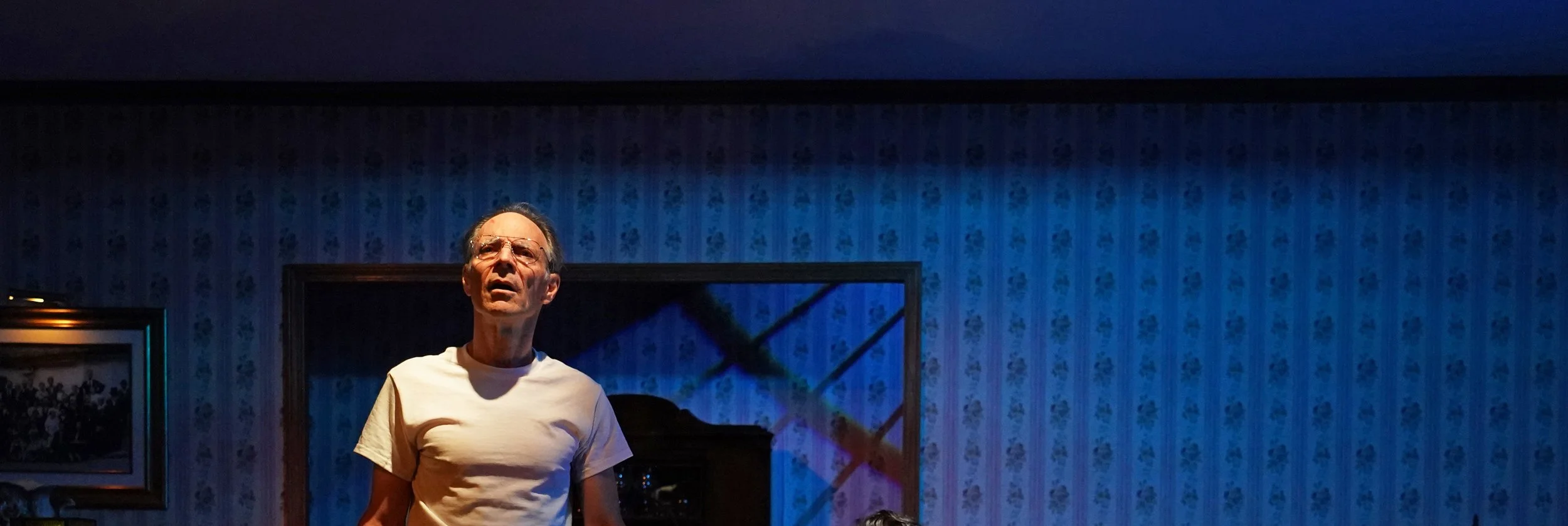
The production is enjoyable largely because of the hilarious portrayals by a talented cast, particularly Robert Grant as the Professor. Grant’s towering stature is a funny joke in itself (one echoed in the large shadows he casts on a gray wall). From the moment he enters the stage through a door frame that barely accommodates him, clad in knee-high black boots and a military jacket, he draws laughs. The decision to dress the Professor in military getup, instead of Ionesco’s requested cloak and skullcap, shifts the play’s indictment of power from the religious to the political. It is also a more blunt parody of a certain personality type.

The Professor dwarfs his pupil, played by the petite actress Rachelle Wintzen, dressed in a schoolgirl’s perversely sexual outfit. Initially, a strange dynamic sets the pair on equal footing—they are both very awkward—but the Professor’s dominance is soon clear. In the wake of his deep Germanic voice (the kind often used when mocking academics), the pupil’s squeaks sound more childish. From the start the Professor’s intentions seem less than pure; he rubs his hands like someone anticipating an acquisition.

Though the production attempts to work with the play’s sexual insinuations, given the over-the-top comical performances, the Professor’s sexual advances are funny rather than lewd. Instead, Grant’s exaggerated gestures and voice highlight his character’s immaturity and impetuousness. His relationship with his maid, played by Elizabeth Steinhart, similarly demonstrates his weaknesses. Though Steinhart is too young and attractive to be a matronly servant, her booming voice matches Grant’s, and she holds her own. Steinhart does a fine job with a character whose motivation is the least understandable. The maid is the only one who relates cause and effect, but she does not stop calamity.

The play takes a dark turn when the pupil begins to suffer from a toothache. The Professor grows louder and more threatening as the pupil becomes meeker and wearier. The lesson climaxes when his rage, combined with his exhilaration, lead him to stab his pupil. During this exchange the stage lighting (by Randy Harmon) assumes a more lurid vibrancy. In this light, the tension and speed of the escalating dialog become palpable; the sweat on the Professor’s brow glistens, as do his large teeth and wild eyes. When he releases his rage by striking the student, it is shocking, but expected.

The Professor’s transformation is strange in Ionesco’s play, but the turn in this production is less comprehensible. Since the overall tone is light, the Professor is never sinister, and his final actions seem too impossible to be taken seriously. Sometimes the production seems hesitant to explore the character’s darker qualities. For example, whereas Ionesco calls for the Professor to twist his pupil’s wrist, The Collective’s bouncy Professor timidly grabs her ponytail.

The humorous interpretations of the cast are reinforced by Jessica Forsythe’s direction. Forsythe uses the sitting and rising of the Professor and pupil to mimic the seesawing shifts in power. Mostly, she allows Grant to dominate the stage, as he does the lesson. Additionally, Forsythe wisely uses a sparse set. The large table/desk presents a formidable obstacle between the professor and his pupil, and acts as a second stage and prop. In one scene, when his student correctly answers a series of questions, the Professor grasps one end of the table with exceeding exhilaration, while at the other end she shrieks with corresponding excitement.

As strange as the dialog and plot often seem, the appearance of a Nazi armband is a reminder that a familiar world can be just as senselessly brutal. In the microcosm of the Professor’s apartment his behavior is comical, but for a society that laughs at his intolerance the implications of the unlearned lesson are disquieting. Even if such dark themes are only touched upon in this production, Grant’s performance alone makes the show worth watching. Considering that The Lesson is The Collective’s first production, it’s exciting to think about how the group will apply such fierce energy to other works.

Click for print friendly PDF version of this blog post

Shock and Words

What else can be done with sex on the stage? Over the years, former “codes” about and attitudes towards sex have slowly fallen away or changed, leaving the modern stage an open playground for whatever sort of coupling a theater company or director can imagine. It seems nothing can generate a reaction of interest or wonder concerning sex anymore. Werner Schwab's The Round of Pleasure , based on Arthur Schnitzler's scandalous, banned (in 1920) play La Ronde , takes sex to a new place, a place where sex becomes almost irrelevant. La Ronde was composed of ten scenes, in which five men and five women swapped sexual partners, passing syphilis to each other. The structure of The Round of Pleasure mimics that of its precursor, although syphilis is gone, replaced by a chunky language and a sense of divorce, both among the ten characters and ultimately in the audience. The characters in Schwab's play wear either screw off or otherwise detachable sex organs. Occasionally, two characters will have sex while standing on opposite ends of the stage, each quaking and shaking in such a way that, divorced from the act associated with it, their actions become unnerving. The disembodied, dislocated couplings provide a backdrop for a play that shakes the conventions of its society, without rising to the point of critiquing it.

Schwab's characters speak a language which is at once familiar and unfamiliar. Michael Mitchell's translation takes into account the numerous grammatical mistakes, made up words (German being a language in which one can take several nouns, attach them to each other, thus and create a new compound), and archaisms found in Schwab's German. On stage, it is unclear whether the characters know what they are saying or not, and this is intentional. It is also occasionally difficult to make out what the characters are saying. Yet, while the words may sometimes float by unparsed, the incomprehensibility adds to the play instead of detracting from it. What the characters say is not as important as how they say it or what they are doing while they say it.

As the words pour almost controllably out of the characters' mouths, it is clear what it is each wishes to achieve in their encounters with one another. Power lies at the base of each coupling. A prostitute convinces an executive that her services are on the house and then, after the deed is done, expects payment. A landlord shoves his tenant's head under water, sticks his penis in her underwear, and afterwards her only response is “Ok, but no water at the next performance.” Do these people enjoy their sexual liaisons? The answer seems irrelevant.

Ildiko Nemeth's direction and Julie Atlas Muz's choreography ensure that meaning is conveyed at all times. Movement based interludes show the characters preparing and unpreparing for their scenes. The opening features the entire cast donning their genitalia and various costumes, over top of a basic white uniform, covered in white ribbons, which suggests at once an image of both straitjackets and zombies.

Despite its rather crass theme and crude language, a sense of beauty emanates from the production. The set, designed by Ms. Nemeth, Jessica Sofia Mitrani, and Joel Grossman, literally sparkles. Luxurious fabrics are draped across a bed stage right, and dragged across stage, draped over various characters as the scenes change. Over top of their white unitards, the women wear gold accented dresses or silky black lace.

The various visual and aural elements of The Round of Pleasure assure an enjoyable show for anyone seeking an evening of sensory stimulation. In the end, the show is not so much about sex as about the ways in which people manipulate and are manipulated, whether by other people or by the words they are forced to use.

Click for print friendly PDF version of this blog post

Rock On

Arpeggio is not a musical, it is a “play with music,” and yes, there is a difference. In a musical the characters break into song, in Arpeggio they break into rock ballads created by Alec Bridges. The play aspects demand that the audiences stay quietly in their seats, applauding respectfully when appropriate. The musical aspects urge the audience to stand, scream and whistle, especially towards the end when the onstage band turns the show into a rock concert. Still, referring to David Stalling’s Arpeggio as a play with music would only be acknowledging what it is on the surface, and if there is anything this story teaches you, it is that one must look below the surface. At its heart, Arpeggio is a tight, well-plotted psychological thriller in the same vein as nail-biting films, Fatal Attraction and Single White Female.

The play begins in a tiny New York City apartment decorated with only a couch, table, and bookcase, as the current owner, Zeb (Andy Travis) does not believe in TV’s, stereos or any other appliances that create noise. His little monastery is shattered when his new room mate Gerry (Allison Ikin) moves in with boxes of CD’s featuring her favorite male vocalist Tobin Grey (Jonathan Albert). Gerry owns dozens of life-sized Tobin Grey posters and an extensive collection of audio disks she recorded at each of his many concerts. But her obsession is more than just a crush; Gerry claims to be Tobin Grey’s secret girlfriend, explaining that he asked her to move to New York to be closer to him.

Ikin is perfectly cast as the ideal roommate. She has a shy, disarming smile, a cute bobbing ponytail, and an easy-going, laid back manner. Even as her darker side is slowly revealed, Ikin manages to preserve Gerry’s innocent, girlish charm, making her nearly impossible to distrust.

Gerry’s celebrity heartthrob, Tobin Grey, is more than just a poster in this plot. He shows up in person, not as a narcissistic celebrity, but as a regular guy who just likes making music. This rocker has a gentler side, which he demonstrates in a speech about the misconceptions his female fan base have of him. He sounds more sad than pleased to admit that he breaks a lot of hearts when young girls mistakenly believe he is looking at them when he performs his romantic ballads live.

We learn that Tobin Grey’s greatest talent is his ability to execute arpeggio notes on his guitar. Arpeggio, Gerry explains to us, is a musical term that refers to single notes being played in quick succession rather than all at once in a chord. When you play the notes separately you can hear the special sound that each one makes. Play them in a chord and the notes lose their unique, individual quality.

This explains why we do not see Gerry’s true nature until her world has crumbled around her. She uses Zeb’s hectic circle of friends and lovers to disguise her real self, but as this group dissolves so does her protection. When Gerry finally goes solo she is surrounded by a band, under a spotlight, and in front of a microphone where she delivers a somber, beautiful rock ballad just as powerful as the one she idolizes Tobin Grey for singing.

Apreggio may not be strictly about the music, but Stallings uses it in all the right ways to enhance the plot. The songs do not puncture the story but rather weave naturally into the fabric of its central themes and characters. Integrating a rock soundtrack into a psychological thriller is an ambitious combination, but it works -- except for the fact that you won’t know whether to leave the theatre discussing the story or jumping out of your seat to dance to its final notes.

Click for print friendly PDF version of this blog post

Richard Reflects, Brilliantly

"I do mistake my person all this while," the future King Richard III (Michael Cumpsty) reflects after railroading his murder victim's wife into marrying him literally over her husband's dead body. "Shine out, fair sun, till I have bought a glass, / That I may see my shadow as I pass." Renaissance superstition held that devils cast no shadow, so Richard needs a mirror to assure himself that he is not really a devil. In Classic Stage Company's production of Richard III, Cumpsty's Richard's reflections are brilliant, in a variety of ways. The set, by frequent Kulick collaborator Mark Wendland, literally surrounds Shakespeare's famous sociopath with illuminated looking-glasses. The performance space is paneled with mirrors and illuminated by gigantic crystal chandeliers, which are reflected in both the mirrors and a gleaming, slick floor. Oana Botez-Ban's costumes combine sleek, timeless shapes with evocative colors. Groups are color-coded. For example, the princes in yellow; Richard's brothers and sister-in-law wear blue. The bereaved women who blame Richard for their menfolks' deaths wear shiny black-and-grey gowns that capture and reflect the chandeliers' glaring light. Despite being surrounded by reflective surfaces, however, Cumpsty's Richard and the court strenuously try to avoid seeing themselves as they are.

Cumpsty and Kulick's informed, unpretentious directing makes this a non-patronizingly accessibleRichard. Hand gestures accentuate a few of the script's most opaque archaisms, such as "moiety,'' and when the dialogue mentions offstage characters, we see them. For example, the play opens with Richard facing the upstage mirrors, and turning to contemplate his brother Edward IV, who stands frozen, also reflected, wearing the crown and embracing a red-velvet-garbed mistress.

When Richard says that his "winter" is "made glorious by this noble son of York," he gestures to his brother. Later, when Edward mourns their middle brother, Clarence, murdered at his apparent demand by Richard's treachery, the king crosses to the "Tower" mid-speech and embraces his dead sibling, while the court looks on.

Cumpsty plays Richard as a believable three-dimensional being, not a snarling caricature. His disarming affability seems dangerously genuine. Cumpsty’s casual, chatty delivery of the early soliloquies is more compelling than Sir Ian McKellen’s famous interpretation in Richard Loncraine’s 1995 film, and makes room for a huge change in persona when Richard finally lets his act fall apart.

Cumpsty’s Richard jokes with his enemies, and induces the audience to brittle nervous laughter. In one of the staging's most psychologically spot-on moments, Richard III presents his grieving sister-in-law, whose brothers and sons he has killed, with his superficially charming request to marry her one remaining child. Helpless and asked for a response, she laughs -- as in Chekhov's phrase -- through tears. Her reaction for once exposes Richard's absurdity. It is a laugh of dissent.

Among a strong cast, the other standout performance besides Cumpsty's is that of another bereaved dissenter, the former Queen Margaret, as played by Roberta Maxwell. Marching across the space like a general on the battlefield and delivering her "prophecies" with biting, confident lucidity, Maxwell reveals "Mad" Margaret as a surprisingly sane woman in a mad world.

Only the "prophetess" Margaret knows the real extent of Richard's destructive potential. When the women of the court crawl to her, demanding to learn how to "curse,'' Margaret gives us a haunted but patient orator and mentor figure. Maxwell's Margaret and Cumpsty's Richard are equals and opposites. Once as ruthless as him, she now sees herself in him as if in a carnival trick-mirror.

One weak point was the decision to distribute flags printed with Richard's insignia, a white boar, to the audience during Richard's election by the people of London. The passing of bunches of flags from spectators on the aisles to the middles of the rows was a distracting hassle. In order to participate in the flag brigade, this reviewer had to look away from the stage. While gazing at fellow spectators to see if any concerned citizens would refuse to hail Richard of Gloucester (yes, some did) this reviewer momentarily paid no attention to the impassioned speech that Buckingham (Michael Potts) was giving to the London populace. Directors as genuinely innovative as Kulick and Cumpsty need not rely on gimmicks.

Cumpsty and Kulick’s Richard III is the first production in Classic Stage Company’s Fortieth Anniversary Season. It will be a hard act to follow, but demonstrates why, unlike Richard, Classic Stage Company has enjoyed such a long and happy reign.

Click for print friendly PDF version of this blog post

No Winners Here

“It’s so cutting edge it’s practically illegal,” one character says of the play they’re working on in Bingo With the Indians. “It’s like diamond-edged, Mom. That’s about as close as you can get to naming it.” Bingo, written and directed by Adam Rapp, indeed deserves credit for its bold style. The problem with plays that have edge, however, is that they can occasionally leap off them. With all its unbridled electricity, Bingo runs in many directions without ultimately choosing one.

The play is powerfully aggressive in every way. Its language revolves around cruel fighting or chilling manipulation, its movement is explosively violent, and its characters are malicious to the core. In fact, Bingo has such a confrontational tone that it occasionally feels like a direct assault on the audience. This is not unintentional. As the plot centers on three members of a struggling East Village theater company, the line between reality and drama is consistently blurred.

The “company” – director Dee, actor Stash, and stage manager Wilson – are trying to scrounge some funds for their latest production. Their solution: steal the cash from a small-town New England bingo game. The New Yorkers don’t take kindly to the local atmosphere and despise the theatrically impaired townies.

The unfortunate outsider who comes into their motel room is Steve, a sheepish 19-year-old whose parents own the place. He, it turns out, is “secretly interested” in theater and dreams of living in the big city like his visitors. Stash is merciless toward Steve, taunting him, roughing him up, and eventually stealing his watch.

The poor teen is so lonely that he still craves his bullies’ friendship. As Steve, Evan Enderle is absolutely fantastic. Thanks to Enderle’s perfect body language (hunched shoulders, anxious bouncing) and tone (every statement comes out like a hesitant question), Steve practically sweats a palpable blend of desperation and vulnerability. Watching him get bullied is tragic and emotionally draining. Most, it seems, for Enderle: at curtain call, the actor looked absolutely exhausted.

The play really hits its stride when Stash and Dee go to pull off the heist, leaving Steve and Wilson in the room. Wilson gets the amateur actor to read a script with him – one that happens to include nudity. Thanks to Rob Yang’s restrained performance, Wilson’s sexual manipulation of Steve is at once deeply disturbing and freakishly academic. Enhancing the interaction, Yang speaks in the kind of deadpan voice that’s usually reserved for psychiatrists or conscience-lacking serial killers (think Kevin Spacey in Se7en).

The other characters lack this depth, and the play’s poignancy (and point) seems to wither away after they return. They trade barbs that might make Mamet blush, but their dialogue and personalities become grating when they don’t go any further from there.

Since the only compassionate character is someone who works outside the theater community, it would seem that Rapp is making a point about how a life spent playing pretend might detach someone from reality. The three company members in Bingo assume new identities with names such as “Big Daddy” and hide in their new characters, betraying previous promises with disclaimers like, “I was acting. That’s what we do in the theater.”

However, it’s hard to imagine that working in theater would make anyone as ruthless as Bingo’s thugs. A bloody attack (a “company fight call”) that comes toward the end is inexplicably brutal – even by the angry standards established by earlier scenes.

Things spiral out of control from there, thanks to a bizarre Native American song and dance, and a rambling monologue.

The final lines, directed at the audience (returning to the play’s exploration of reality vs. theater), are a clever reprisal of earlier dialogue between Wilson and Steve. The latter commands, “Smile…Unsmile.” With its seesawing between dark comedy and all-out nihilism, it’s never quite clear which expression Bingo With the Indians wants us to make.

Click for print friendly PDF version of this blog post

Laughter is the only medicine

Watching an evening of theater inspired by Bertolt Brecht could potentially be an exhausting and perplexing experience. Brecht’s concept of epic theater, according to which a play should provoke rational self-analysis and critical perspective, can inspire formal innovation, but also plays that are difficult to watch. Indeed, Brecht wanted the audience to think independently, and to effect social change. The Brooklyn Playwrights’ Collective is at an early stage in its project to write plays influenced by its favorite playwrights in alphabetical order; they are currently considering the work of Brecht. Their production, Beyond Brecht , includes plays that often attempt to mock classical theater (i.e. non-epic) and its reliance upon narrative and emotional stories, but which fail to provide inspiration for critical analysis. The influence of Brecht is most clear in the staging and structure of the plays, which use his devices for disrupting the illusions of storytelling to highlight the deliberate construction of a drama. These innovations include narrators that directly comment upon plot, interaction with the audience, self-conscious songs that break the flow of plot, and explanatory placards.

The first play performed, Fulana , might inspire independent thinking if the message was not so obvious. In Felipe Ossa’s play the title character is the embodiment of a capitalist agenda: an eager immigrant in a whorishly attractive French maid costume. The pitiful abuse of such persons is made clear, but is complicated by the abusive response of the oppressed. In the role of Fulana, Marisel Polanco carries herself with self-awareness and self-possession. Despite her assertiveness, the play’s plot and tone give little reason to doubt the crushing power of the American way of life. The narrative follows a familiar arc and the actors adhere to the stereotypes represented by their characters. The play hardly prods deeper consideration of the themes it introduces.

The second play, The Pithecanthropist (by Ed Malin), is the most energetic and philosophically engaging play of the evening. Using an overly self-conscious play-within-a-play it demonstrates the artifice of drama. In the play the leading character argues against romantic notions in favor of Darwinism. Played with impressive dryness by Chris Arruda, Prosper is a foppish intellectual who renounces the Romantic by donning an ape costume. That witty lines and an exaggerated accent creep through the mouth of an ape mask makes the device hilarious. To prove his theory, the self-proclaimed Pithecanthropist stages a drama that mocks knightly romances. Despite the uncharacteristic confusion of its characters, the story ends happily, undermining the argument of the play’s producer. It is a story with a mind of its own: the love of the characters brings resolution and mutiny against the creator.

The concept is strong, but constant campy jokes detract from the cleverness of the play. In particular, the rap songs are parodies so ridiculously bad that they are nothing more than that. Though the play mocks overwrought romances, it follows a reliable plot. Perhaps it represents a counter-argument to Brecht, making fun of the notion that drama could be used for political purpose. However, if the play did not include flights of illusionist fancy, there would be little left.

Some enjoyable use of Brecht comes in the interpretations of his concept of the “separation of elements.” In some of the plays, particularly The Resistible Rise of Fatlinda Paloka (by Marcy Wallabout), the actors deftly shift roles and registers. Playing an uptight Southern couple, Nick Palladino and Siobhan Doherty alternate between Seuss-like rhyming and carefully accented spite. Their bitterness is directed at the abrasive immigrant Fatlinda Paloka, whose eccentricities are humorously exaggerated by Erin Leigh Schmoyer. The acting is excellent, and the play is funny, but the underlying metaphor is hard to find. In a conclusion which arrives abruptly, Fatlinda’s blindly infatuated husband explicitly states a moral. That the meaning or purpose of this lesson is so unclear detracts from the play's better qualities.

A play with clearer direction, but less interesting style is Lucky in Love , written by Erin Browne. In a gesture to Brecht, placards list the action in each scene, but add little to the play. Several short scenes tell the story of unrequited love between female friends. The placards underscore the play’s dull straightforwardness. The characters and scenes aren’t fleshed out enough for the viewer to care, and the dialogue isn’t sufficiently meaty for contemplation.

The final play, “Sauté Your Face” (by Jerry Polner), consists of a good single punch line joke: a cooking show for ex-dictators in which instruction is command and brutality is art (or fruit salad). Mark Blackman energetically repeats the Generalissimo’s catchphrase, “I am great. You are crap,” but by the fourth time it is clear the joke has run its course. Fortunately, the playwright, unlike a self-loving dictator, knows when to cut things short.

In all of the plays the influence of Brecht’s formal contrivances is clear, but the underlying morality or the push for audience reflection is lacking. The plays don’t stimulate critical consideration of American society; rather, they highlight the difficulties in using this structure to interpret modern social problems. Though there are attempts to give “rational” purpose to these stories by acknowledging the artifice of the presentation, they are basically classical dramas. The commentary is too often an indictment, or the issue at hand too vaguely defined, to spark debate. If attending the show, expect to laugh some, but don’t expect an evening of provocative theater.

Click for print friendly PDF version of this blog post

NOT JUST ANOTHER FACE IN THE CROWD

"They are the exact same color as my eyes. How impressive is that?" says no-nonsense businesswoman Ellen (a skilled and nuanced Esther Barlow) as she delights in a pair of earrings gifted to her by an anonymous suitor. "I am going to marry this person one day - I swear to God." Such is the tenuous conceit on which hinges this sometimes quite funny play executed by a thoroughly likeable cast. Can Jenny, the beautiful and seemingly ditzy lesbian lawyer-to-be (energetically played by Jennifer Laine Williams) win over workaholic Ellen by playing secret admirer? Can she get Ellen to see that she is the right "human" for her and not the right man she expected?

To the cast’s credit, they wring a great deal indeed from this questionable plot with the sheer exuberance of young actors who like to entertain and give themselves over fully to the job. It helps that the script is peppered with good one-liners.

Smitten Jenny is aided in her Cyrano-like pursuit by Ellen’s close confidante and gift-planting officemate Peter (Philip Graeme). Peter’s family seems to weigh heavily on his mind and impinge upon his daily life. Between a dotty cat-loving sister (camped up by playwright and actress Kate Hewlett) engaged to a witheringly shy boyfriend (Dustin Olson), and a lousy relationship with his cold and homophobic father, it’s a wonder Peter has time for his boyfriend of the same name (and numerous name-gags) Peter.

But, as Ellen’s romance in absentia blossoms (devoid of any connection to sparked real-life encounters with dreaded Jenny-of-the-Coffee-Shop), Peter must ask her if she is finally ready to surrender her rigidity and face her fears.

Fear is a topic discussed at length in the play. All of the characters are introduced (and brought back for intermittent monologues) via a 12-step meeting device -- where they confess their deepest fears (dogs, cats, infertility, being alone forever...with cats)to the audience. This technique is partially effective (and even, at one point, quite startling) yet can occasionally feel contrived.

Director Robin A. Paterson uses the stage well, as scenes shift easily from Ellen's office, the local coffee shop, and the 12-step style meeting of which the audience is a part.

For all the perpetual chatter about deep-seated fears, one might expect Humans Anonymous to be heavier and more probing than it actually is. The play is not a serious opus on the fear of homosexuality, and although it touches lightly on that nerve, lightly -- as in lighthearted fun --is the operative word.

Humans Anonymous succeeds mainly on the strength of the chemistry and timing of Williams & Barlow (both fine actresses) and the playwright’s sense of humor, which periodically bubbles over the top. It’s a good choice for a young crowd looking for an enjoyable night out at the theater.

Click for print friendly PDF version of this blog post

Doing the Math

Math has never been the sexiest subject, but in David Auburn’s superb play Proof, the study of numbers anchors a fascinating, almost voyeuristic, look at a splintering family. The play nabbed both the Tony Award and Pulitzer Prize in 2001, and the Astoria Performing Arts Center has produced an earnest, if not thrilling, revival of this razor-sharp drama. Each potent scene takes place on the back porch of a typical family home in Chicago, and we meet Catherine after midnight on her twenty-fifth birthday, sulky and slugging champagne straight from the bottle as she talks with her father, Robert, a famous and unrivaled mathematician and professor. But what appears to be a typical domestic scene quickly twists when Robert reminds her that his funeral is the following day. The play, like Catherine, hovers alluringly on the cusp of this madness. Is Catherine simply drunk and hallucinating? Or does she resemble her father—who eventually deteriorated into dementia—in more ways than in her prodigious mathematic ability?

Besides her father, who appears both as a ghost and in flashbacks, Catherine is joined by her tightly wound older sister Claire, who flies in from New York for the funeral, and Hal, one of her father’s graduate students. Claire is eager to put things in order, sell the house, and drag Catherine back to New York, while Hal is itching to get his hands on the stacks of notebooks in Robert’s office. Catherine assures him there’s nothing there, but he’s looking for a diamond in the rough—one last stroke of genius from Robert’s faltering faculties. When Hal plucks a potentially groundbreaking proof from the pile, the question of exactly what it is—and who wrote it—throws the trio into further distress.

Auburn deftly positions his characters as if they were numbers in a complex equation, aligning and shifting and repelling them to create explosive conflict. “She’s not my friend, she’s my sister,” says Catherine of the fussy Claire, and the sisters’ tumultuous relationship is particularly riveting. It’s the electrifying push and pull of two diametrically opposed (yet related) personalities: Catherine, who gave up going to college to care for their father, is bitter about her sacrifices and yet shattered by his death, while Claire, jealous of the intellectual aptitude shared by her sister and father, overcompensates by trying to take care of her intractable sister.

In this solemn production, intense musical passages underscore and drive the transitions between the scenes. These original compositions, by Jeffrey Campos, place the rumbling chords of a piano and the moaning of a cello into furious counterpoint—the instruments rub up against each other in both harmonious and dissonant patterns, much like the relationships that percolate in each scene.

Michael P. Kramer contributes yet another fantastic set to APAC (his designs for Picasso at the Lapin Agile and A New Brain were similarly sumptuous), this time creating a cozy yet damaged domestic zone, complete with picture windows and peeling paint. Lighting designer Erik J. Michael adds even more depth to the set, from the warm golden lamplight within the house to the eerie shadows from the trees. Like the bars of a prison cell, these dark slim slivers seem to trap Catherine in her anguished world.

Director Tom Wojtunik also seems to get ensnared—in the rapid-fire delivery of Auburn’s dialogue. He has elicited composed performances from his actors, but in many scenes—particularly the opening father-daughter conversation—the actors trade lines with a breathlessness that effectively locks down emotion and steamrolls over much of the humor. There’s snap and vigor in these pithy exchanges, but they often blot out the dimensionality that makes these characters so interesting.

For example, Catherine’s tough-as-nails exterior is shaded by a very real vulnerability—namely, her fear that she will end up like her father. She resists her sister’s help, but she’s eventually seduced by the goofy Hal, who manages to cut through her spiky shell. As played by Catherine Yeager, however, this Catherine is all blunt edges. Infusing her performance with noxious sarcasm, Yeager turns Catherine into something of a cartoon, rolling her eyes out at the audience after nearly every line. Her most poignant moments come in a flashback in which she tenderly cares for her father—here, she finds the varied layers that would give Catherine much-needed complexity in the other scenes.

Catia Ojeda turns in a poised and refreshingly witty performance as Claire, and Richard Vernon makes a believable, if slightly too easygoing, Robert. (One gets the feeling that the nutty professor would be a bit more idiosyncratic.) Richard D. Busser fares best as the industrious Hal; he brings a winning, loose-limbed charm to the nerdy student who is determined to be cool, at least cool enough to impress his advisor’s brilliant daughter.

At its best, Proof peers in on family strife with the irresistible intimacy and immediacy of eavesdropping; when these actors stop “performing” and allow Auburn’s writing to take fire, their charged conversations transform their lives, and the math, into compelling—even sexy—equations.

Click for print friendly PDF version of this blog post

Cracks in the Facade

Harrison Williams’ Glass Houses is a Rubik’s Cube of a play, a multi-layered and entertaining work of drama, the action of which is punctuated by mini-lectures from one of the main characters, Bill, a marine biologist who explains in painstaking detail his research on the fascinating Venus Flower Basket, the self-referenced metaphor of the play. The Venus Flower Basket, we are told, is a silica-based sea-sponge found in the deep waters around Japan and the Philippines. The sponge, assimilating surrounding minerals to build its glass-like structure, forms a symbiotic relationship with tiny shrimp, usually two, sometimes three or more, which it traps forever, housing, feeding and protecting them from predators in exchange for their own waste products, which it then uses to support itself and sustain its perfect crystalline biosphere. The play’s characters, as you might guess, are likened to the shrimp (um…except perhaps for the waste product part). Because the metaphor is so obvious as the central conceit of the play, it is wisely revealed right from the very start. Such self-referential analysis could quickly become tiring to an audience but, miraculously, it doesn’t, thanks to strong performances from all four actors, particularly Randy Anderson playing the campy Nick and Brian Morgan as Bill. Nick and Bill, a couple living together for more than six years, invite Nick’s former lover, Mike (DR Mann Hanson) and Mike’s new fiancée, Stef (Stephanie Farnell-Wilson), to their Hoboken apartment for dinner, and present them with an engagement gift: a nearly perfect specimen of a Venus Flower Basket. Add to the mix a few bottles of wine and the fact that Mike has never disclosed to Stef his relationship with Nick, and it’s all an easy recipe for fireworks. Fireworks do ensue. Not only is Nick still in love with Mike, but we learn that he also has an interesting association with Stef as well.

Ultimately, the play asks, “Who are the poor shrimp in this drama?” Are they Mike and Stef, embarking together on a potentially troubled life due to Mike’s bisexuality? Are they Bill and Nick, trapped in a false relationship where Nick longs for someone he can no longer possess? Are they Mike and Nick—is Mike really in love with Stef or is he in denial about his true sexual orientation? Is marriage the trap? Are relationships, straight or gay, snares by definition, quagmires of compromise? Mr. Williams suggests that all of us are trapped in some way—we all construct glass houses from our fragile beliefs about ourselves and others, denying a truth here—lying to others there—and when a crack forms in that house, whether self-inflicted or as a result of a stone thrown by another, we realize just what brittle, delicate creatures we really are. All this makes for compelling and worthy theater. At the play’s climax, Nick and Bill engage in a tense and uncomfortable confrontation that would make you turn away if the acting wasn’t so riveting.

Like mastering the Rubik’s cube, there’s always a logical and inevitable conclusion, and the play’s ending is forced, all of its pieces wrapped up too tidily. But, like the cube, the real action is in the confusion and the endless possibilities, and Glass Houses offers much for the audience to ponder about the fragile structures we build for ourselves.

Click for print friendly PDF version of this blog post

Minimalist Horror

Henry James’s ghost story “The Turn of the Screw” has intrigued generations of readers as well as artists. British composer Benjamin Britten turned it into an opera. The 1898 story was also filmed (and retitled The Innocents) with the late Deborah Kerr as the governess sent to Bly, a remote country estate, to care for the niece and nephew of a London bachelor who has become their guardian. Jeffrey Hatcher’s 1999 stage production is a bare-bones tour de force for two actors that takes some structural liberties but preserves the frissons. Among the tweaks Hatcher makes is to assign all the secondary roles, including that of Mrs. Grose, the housekeeper, to the male actor and to make Flora, the niece, so shy that she doesn’t speak at all. The play therefore elevates Miles, the young boy, to the center of the battle between the governess and the phantoms. The whole is performed without scenery or costume changes. Still, in Don K. Williams’s beautifully directed production, James’s story feels distilled rather than downsized.

Hatcher’s play compresses the action into seven days, announced like a diary by Melissa Pinsly’s young, callow and romantically infatuated governess. Hatcher introduces the possibility of her repressed sexuality in the first scene, with subtle humor and yet more sexual innuendo than James could employ. “I need a woman,” announces Steve Cook’s uncle to the prospective governess, referring to the job of raising his wards. And when she agrees to the stipend, he says, “A satisfied woman, our very goal in life.” After she accepts the position with barely contained excitement, he notes dryly, “I have seduced you.”

The great critic Edmund Wilson pointed out in his 1938 essay The Ambiguities of Henry James (just republished in a collection by Library of America) that it wasn’t until 1924 that a canny critic noticed that only the governess sees the ghosts. The question of whether they are real or figments of her overly romantic imagination and a repressed sexual infatuation with the uncle enhances the eeriness of the tale. (Both the film and the opera include visible revenants.) Hatcher’s treatment adds a weirdly incestuous element, establishing the intentions of the male and female ghosts, Peter Quint and Mrs. Jessel, to inhabit the bodies of the innocent children and be reunited.

Once at Bly, the governess (who goes unnamed, as in the story) meets Mrs. Grose, and the sightings begin. Pinsley negotiates the various mood swings of the governess—from elation to apprehension to an almost evangelical hysteria and determination—very well. Cook, dressed in a frock coat for all his characters, differentiates them vocally or, in the case of Miles, by adding a sullen hunching to his shoulders.

Gorgeous lighting from Karl Chmielewski adds immeasurably to the mood. He creates deep shadows upstage that the characters draw back into, and from which the ghosts materialize in shadows, insubstantially. Chmielewski also uses sidelighting in a noirish way, and his choice of colors, notably indigo and amber, is just as evocative in setting the right tones for scenes.

The actors add most of the sound effects. Cook, for example, announces the time of a chiming clock. They make creaking noises and whooshing noises, and occasionally Hatcher contributes to the atmosphere of dread a stunning line like “The house hissed of snakes.” Although the narrative slackens occasionally, the play builds to a wild, insane climax, more effective than James’s sturdy prose evokes on the page.

The original story begins with a framing device, but James drops it by the end. Hatcher, however, returns to it, and we learn what happens to Flora and the governess. The coda is dry, black, and ironic, and leaves little doubt that the governess is a figure to beware.

Click for print friendly PDF version of this blog post

The (Devilish) Assault of Reason

In the preface to his universally adored novel The Screwtape Letters, Christian author C. S. Lewis claims that “there are two equal and opposite errors into which our race can fall about the devils. One is to disbelieve in their existence. The other is to believe, and to feel an excessive and unhealthy interest in them.” Now the author’s own “unhealthy” interest in devils and their practices has inspired the Fellowship for the Performing Arts’ sublime stage production at the Theatre at St. Clement’s; the only excess of which is the team’s intense delight in reinventing of Lewis’ text for a new audience. For the unfamiliar, Lewis’ deviously clever novel is comprised of thirty-one letters from a learned demon named Screwtape to his bumbling nephew Wormwood, who is attempting to win a mortal’s soul over to the “father below.” As it turns out, things are very academic in this Oxford Fellow’s vision of the netherworld. Every demon must graduate from an institution known as the Tempters Training College before heading to Earth to harvest souls for demonic consumption. Screwtape, now retired after an illustrious career, serves as his naïve nephew’s mentor in the art of steering human thoughts away from “the enemy” and (unknowingly) toward eternal oblivion.

When Screwtape was first published in 1942, Lewis’ keen insights into religion, war and the general state of the world served as a piercing reprimand to worldly cynics and devout believers alike. One can’t ignore the implications of mounting a production like this in the current climate of religious schism. A morbid curiosity might lead some contemporary audience-goers to consider what Screwtape would have to say about partial-birth abortion, for instance. The devil only knows.

This stage version by Jeffrey Fiske and Max McLean presents a complete and compelling depiction of Lewis’ snarkily astute narrative. Each letter to Wormwood is dictated by Screwtape (played by McLean) and dutifully transcribed by his demonic secretary, a necessary and helpful theatrical convention named Toadpipe (played by Karen Eleanor Wight). This allows Screwtape to strut about his study without vanishing into the physical business of writing, which is something that might have meant Loveletters-esque damnation for the piece. Undoubtedly, Fiske and McLean have performed some generous cutting and pasting of Lewis’ text. Most notably, their edits energize the last twenty minutes of the production.

Fiske directs Screwtape in a broad, fantastic style, calling to mind the quixotic milieu of film directors such as Terry Gilliam and Tim Burton. The advantages of adapting the text and then directing the adaptation are clearly evident; all of Fiske’s stage conventions seem to have been custom built into the narrative. For instance, the process of sending and receiving letters involves Toadpipe scaling a serpentine ladder that extends the full height of the stage and waiting for a bolt of energy to pulse into a suspended mailbox. This theatrical Rube Goldberg is just preposterous enough to add a dash of necessary sorcery to the piece, but is executed so unpretentiously that it enhances Lewis’ text without distraction.

Fiske is fortunate to have this far-fetched exhibition rendered by capable artists like scenic designer Cameron Anderson, light designer Tyler Micoleau and sound designer Bart Fasbender. When you hear the words “one-person show,'' the expectation for technical design is (perhaps unfairly) very low. Imagine the glee in discovering that this one-person show takes place on an intensely raked stage cantilevered above a pool of fog, that it builds atmosphere with appropriately disturbing soundscapes in every scene and that it occasionally elicits mesmerizing explosions of lightening and hellfire. More importantly, the technical wizards implement this sensory icing with honors.

Of course everything hangs on Max McLean, who assails Lewis’ text with more politician than perdition. It is fitting that Screwtape frequently cites “jargon” as the best tool in a devil’s repertoire, because McLean’s ruthless command of the language alone proves enough to entertain. Even the demon’s exaggerated pronunciation of his own name betrays the aristocratic zeal of a Charles Dickens villain: “SKAH-ruuuue-WAH Tay-PAH!” McLean is less convincing, however, when the script calls for Screwtape to descend into bestial fury. Some of these snarling moments teeter on the brink of parody, but thankfully McLean always quickly reverts to his droll center. As the significantly lower-caste demon Toadpipe, Ms. Wight carries out her role’s growling and bone-gnawing with undomesticated charisma.

This disarming production of The Screwtape Letters, perhaps the most interesting piece of reverse-psychology in literature, will no doubt provoke the same theological musings among contemporary intellectuals that Lewis intended half a century ago. We must ask ourselves: are cynical pride and dismissive self-delusion really the “gradual path” to Hell?

If so, a lot of us are probably… well… screwed.

Click for print friendly PDF version of this blog post

Glamour in a Gumshoe

From the wholesome adventures of Nancy Drew to the neo-noir high-school high jinks of TV’s Veronica Mars, the girl gumshoe has carved out a solid niche in popular culture. In Kelly Link’s fantastical short story The Girl Detective, the title sleuth doesn’t have a perky name—adept at solving tricky cases and nabbing criminals, the Girl Detective is on the hunt for her missing mother, whose name (she suspects) may very well be the same as her own. And to say it out loud might just be bad luck. Under the inspired vision of director and adapter Bridgette Dunlap, the Ateh Theater Group has revived its acclaimed production of The Girl Detective for the Crown Point Festival. As in its 2005 adaptation of Aimee Bender’s The Girl in the Flammable Skirt (another collection of surrealist short stories), The Girl Detective presents an enchanted dreamscape filled with charged ideas, vivid colors, intriguing premises, and precious little solid ground. Dunlap has an acute eye and an undeniable talent for riffing on the bold, eclectic, and downright bizarre; even when this production loses a bit of its steam, it still keeps us looking for what might be just around the next corner.

The production blares to life in a colorful montage of bodies writhing to a jazzy, frenetic beat. The Girl Detective (the haunting Kathryn Ekblad, in a pretty blue dress and headband that evoke Alice in Wonderland) gracefully breaks up fights, returns purses to their rightful owners, and generally makes the world right.

But all is not right in her own world. Ignoring her father’s pleas, the Girl Detective has stopped eating. Instead, she visits—and devours—people’s dreams. Slipping through the subconscious world, she’s on the lookout for her mother, who vanished when she was young. Is her mother dead? Or on vacation? And why won’t anyone speak of her? When she gets wind of a story about tap-dancing bank robbers, the Girl Detective suddenly feels like she might be on the right track.

As they create designer Emily French’s appropriately minimalist sets, the energetic ensemble scurries on and off the stage, and it is through their direct address that we learn the most about the Girl Detective, in both what she is and what she is not. “The Girl Detective doesn’t care for fiction,” one character remarks. But, “she feeds her goldfish,” adds another.

Still, despite this accumulation of random facts—and the insights of the Guy Detective, who sits in a tree to “detect” the Girl Detective—the wispy central character remains mysterious and hazy, as does the plot. The story extends from “real” life into the underworld, but there’s not much to distinguish these settings (which may be the point). Ultimately, the Girl Detective’s quest gets a bit lost in the weird and wonderful tapestry that surrounds her.

Dunlap provides an often captivating animation of Link’s story, and she crams a vibrant assortment of styles—including tap and swing dancing—into the narrative. These sequences are polished and pulsating, but they often linger too long, and the overall pacing of the show drags at times. Ill-placed, shadowy lighting further obscures the production.

Clearly, the ever-elusive Girl Detective, that master of disguise, is meant to be a metaphor for our search for what we’ve lost. But the story—and this production—doesn’t have enough punch or snap to jolt us out of our apathy. It does, however, form a lovely, if somewhat spacey, meditation on loss, which is becoming a familiar theme on New York stages, from The Civilians’ pithy musical Gone Missing to the lyrical grace of Sarah Ruhl’s Eurydice. These productions, along with The Girl Detective, explore loss from stylized, wacky angles—here’s hoping they ultimately find their way to more solid ground.

Click for print friendly PDF version of this blog post

Paper Soldiers

In the second scene of this Gulf War play, four soldiers, lost in their tank, alternate between panic and story-swapping. The tank driver shares a surefire tip to get lucky with a girl: take her to an off-off Broadway play, “20 bucks a ticket... the plays suck... but it’s really dark and you can score a hummer in the back row.'' I hope someone scores here because the average theater-goer isn’t likely to be otherwise much rewarded by this play. The subject of Guns, Shackles & Winter Coats is veterans’ post-traumatic stress disorder; it’s a vital and timely issue and theater offers an ideal form to explore it. This production tries its earnest best with a Gulf War veteran staggering between news-charged sets: from an unhappy home to a flashbacked battle zone, thence to a VA hospital, and finally to a homeless encampment in a New York City park. It’s a good conceit, this looking back to the still-unresolved fallout of Bush Senior’s war to emphasize the crisis of the current Bush’s reign of destruction and its direct effect on individual soldiers. But the main character here, Sgt. John Brown, is hardly an individual; his persona is as generic as his name. (Any allusion to John Brown the abolitionist is too obscure to identify.)

Sgt. Brown’s journey across the stage is driven by sad formula, unenlivened by the stale dialogue of a CNN anchor on weed (Anderson Cooper trying to channel Abby Hoffman?). Played by Chris McGuire, Brown struggles to communicate with his wife (Abigail Ziaja) in various classic scenes of alienated partnership. The origins of Brown’s sense of guilt and isolation become clear in a long, loud flashback scene where his substance abuse and poor judgment cause the death of his three subordinates (Alfredo Diaz, Richard Essig, Robbie Rescigno). Blasting battle sound effects are one of the especially painful elements of this play; their combination with the shouted agonies of Sgt. Brown throughout the performance had this reviewer reaching for earplugs.

Poor Brown flunks out of the VA hospital, where he fails to impress Dr. Elsinore Zinn (Evelyn Voura) with his symptoms of Gulf War Syndrome—she isn’t buying it, or she doesn’t have space or funds for him, it’s not altogether clear in what way she is negligent. The doctor boots him out of the hospital at the same time his wife boots him out of her life. Brown has no choice but to join the Vietnam vet panhandler (Jeff Lyons) who opens the play in his homeless camp in the park. Eventually, Brown is even exiled from the camp.

Like the script and the direction, the actors’ performances are earnest and heartfelt but largely undeveloped. Alfredo Diaz stands out with strong vocal command and Chris McGuire manages to bring an energetic physical presence to difficult solo hallucinatory convulsions.

Guns, Shackles & Winter Coats tackles a tough and significant subject and deserves credit for that but I’d rather hear directly from the individual soldiers who inspired it than from their cut-out stand-ins.

Click for print friendly PDF version of this blog post

Romero & Juliet

The Bard had it coming. All of the elements of Twelfth Night are perfectly suited for a zombie horror interpretation: morbid language, contagious insanity, and near-comical ignorance. The most enjoyable aspect of the Impetuous Theater Group's adaptation, 12th Night of the Living Dead, is that they not only take this unique approach, but pull it off with a stunning degree of commitment to the original work. Unlike the bloodbath that unfolds onstage, playwright Brian MacInnis Smallwood's adaptation is more like careful surgery than wild hacking, as he extracts only absolutely essential and appropriate parts. The synopsis generally remains the same: Viola disguises herself as a male, Cesario, creating a bizarre love triangle between herself, the lovelorn Orsino, and the mourning Lady Olivia. All the while, the show's pranksters, Sir Toby Belch, Sir Andrew Aguecheek, and Maria, down some wine and taunt the stiff steward, Malvolio.

Though Smallwood cuts many lines (nearly all of Viola's: as the first zombie, she's reduced to grunts and squeals for the entire show), what remains is strikingly smooth. He occasionally adds fresh updates to fit his subject (when Feste, the fool, exclaims "as if thy eldest son should be a fool; whose skull Jove cram with brains!" a nearby zombie echoes, "braaiiins!") and assigns some lines to different characters, but his version impressively uses most of Shakespeare's own words to tell a completely different tale.

In this interpretation, a giant green meteor has struck Viola and Sebastian's ship, pulling the vessel down and dragging the siblings apart. Viola washes up on the shores of Illyria, looking a bit pale and, well, different. She walks with a heavy limp and carries herself in a sort of post-lobotomy fashion. Apparently, the meteor has infused her with an insatiable appetite for human flesh – a hunger that is passed onto each of her victims.

One of the most amusing things about watching a Shakespearean comedy is feeling privy to an issue that the characters keep missing. In Twelfth Night, it is their failure to see beyond the gender disguises. This inability to notice unusual realities is also what made the recent zombie comedy, Shaun of the Dead, so amusing. Like the people in that film, the untouched (that is, still human) characters in 12th Night… start out dangerously blind to the plague that's overtaking those around them.

As Sirs Toby and Andrew, Timothy J. Cox and Benjamin Ellis Fine are fantastic aloof fools, giggling and gamboling amidst the bloody scene. Fine portrays Andrew as an amusing kind of man-child with a nice blend of cockiness and cowardice. One moment he’s declaring a duel, the next he’s crying and rocking himself as he’s cradled in a friend’s arms.

Much of the show's hilarity surfaces when Shakespearean eloquence collides with the grit and gore of cult horror. As our Viola snarls and growls at the gate to Olivia's estate, and even bites Malvolio, Olivia's response (lifted directly from the original) becomes absurdly understated: "you began rudely."

The entire cast superbly navigates the unusual territory of spilled intestines and iambic pentameter. Tom Knutson makes Malvolio's transformation into a zombie a particular treat, as the conservative servant gradually loses his rigidity with progressively slumping posture and increasingly breathy, broken speech.

Special effects help the show blend dialogue fit for a production at The Globe with visuals fit for a zombie film by George A. Romero. Increased levels of gore are seamlessly woven into the story. The creepily comical flirting between Olivia and Viola-as-Cesario is a good example. Unaware of the present danger, Olivia takes the zombie Viola's aggression for passion and becomes quite attracted to her attacker.

Even when the zombie bites off her finger, Olivia is not deterred. In a clever spin on Shakespeare's original – which has Olivia sending Cesario a ring as a token of affection – this version has her sending the entire severed appendage.

The production's only weakness is its complete devotion to creating chaos. Often, the zombie groans completely drown out the dialogue. At other points, the action is so widely distributed across the stage that it's impossible to focus. The house, for example, actually has a bar to the side of the main stage. While it's a fitting setting for Toby and Andrew, the bar is located so far from the center that most of the audience cannot see it.

Although the plot centers on disorder, the success of this mash-up rides on its tight organization and nice balance between different genres. In one of show's best scenes, for example, zombie characters pause to have a "chat." While they groan at each other, they hold their lines on cards. The scene is funny and unique, as zombies are traditionally uncommunicative. Leave it to Shakespeare fans to find a way to give pop culture's most ineloquent monsters a method of articulating their thoughts.

Click for print friendly PDF version of this blog post

Lost in the Funhouse

Before launching into “The Dreams of Laura Bush,” one of two-and-a-half monologues that constitute Wake Up!, Karen Finley took a moment to describe herself. As she walked from the downstage podium to the upstage desk, arranging papers and garments beneath a camera that projected image onto a screen behind her, she proclaimed: “I’m Joan Collins with a conscience.”

“I’m Britney Spears with an education.”

“I’m Liza Minelli with a Happy Family.”

These descriptions got laughs, of course, but none of them captures who Karen Finley is or, more accurately, who she presents herself to be.

After entering to applause on the night I saw her, Finley made some casual remarks to the audience, dedicating the evening’s performance to her students. Because the space is small, she had no need of a microphone, but a loud fan in the back of the audience area made it difficult to hear her. When someone complained she stepped forward and apologized, asked if the fan could be turned off, suggested that people move closer (“Oh here, this is an excellent seat,”) etc. After going through this apparently spontaneous exchange, however, Finley reassured us that we wouldn’t have any problem hearing her now that she was about to begin in earnest.

She was right. As she launched into her prologue, a short monologue about a woman who seeks out amputee veterans for sexual trysts, her voice was rich with chest resonance and easily filled the room. Was her somewhat discombobulated entrance, her initially timid voice, her attempt to quiet the room and bring the audience forward just an act, then? Or her occasional self-deprecating remarks about not being “that good an actress?” Figuring out how to read Karen Finley as a performer and as a persona are a significant part of the experience of watching Wake Up!

The two monologues that make up the body of this performance are “The Dreams of Laura Bush” and “The Passion of Terri Schiavo.” For the first of these, Finley speaks as our current First Lady, presenting pages from her personal dream diaries. The dreams range in subject matter from Condoleeza Rice having an affair with the President to Laura organizing a fictional “Dependent Film Festival” in Crawford, Texas, to a fragmented reimagining of Saddam Hussein’s hanging, to a sexual fantasy about Tony Blair. Other “dreams” are less cohesive or are just partial glimpses of images. The pages from the dream journal are drawings and sketches that Finley arranges on a desk and that are projected onto a screen behind her. The dreams form a house of mirrors of the Bush administration and of our current national moment.

In “The Passion of Terri Schiavo,” Finley steps in and out of several characters, each of them projecting their personal narratives and causes onto Schiavo’s body. Some of it is moving, some of it is funny, and some of it is intentionally offensive. The common thread between these voices is that all of them, under the guise of caring about Schiavo, are really airing their own passions, their own fears, their own guilt, looking to an image of a dying woman to be their information-age messiah. “I’ve never met her,” one of the characters says, “but I love her.” Ultimately, Finley conludes, "Terri needs her own reality TV show."

Despite Finley’s image as a polarizing figure, a reputation born from her famous court battle with the NEA in the early nineties, there is very little polemicism on display in Wake Up! Instead, it is a show by and about someone who is trying to make sense of our baffling political and cultural present. I was neither as taken with the performance as the woman to my left (another reviewer), who laughed uproariously for most of the evening, nor as puzzled as the man to my right (my guest for the evening), who wasn’t sure what to make of Finley at all. Instead, I felt a sympathy for an artist trying to work in a narrative form when the world she’s portraying seems to have lost its coherency. However, whether you love her, hate her, or are not sure what to make of her, you will leave Wake Up! with little doubt that there is no other performer quite like Karen Finley.

Click for print friendly PDF version of this blog post

Fear Factor

Halloween is in the air, and in the spirit of the year’s scariest holiday comes Greg Oliver Bodine’s Wicked Tavern Tales, an adaptation of three terrifying Edgar Allan Poe stories. Bodine’s adaptation keeps most of Poe’s original work intact with only a few cuts and alterations to compress the tales into three short works that flow together well, with each one delivering its own special jolt of horror. The product of these edits is not a watered down text, but a celebration of all things spooky. Wicked Tavern Tales has a certain thrill ride quality about it; even the entrance to the theater resembles the inside of a creepy Disney ride. Walking through a dark curtain, audience members will find themselves standing in a long, dimly lit hallway guiding them towards two towering wooden doors. Outside these doors hangs an ominous sign reading, ''Wicked Tavern.''

Staging the play in a century-old venue such as Manhattan Theatre Source provides many wonderful possibilities for establishing a haunted atmosphere. The wooden floors are naturally creaky and the red brick walls legitimately worn by time. The candles and lanterns that illuminate Gregg Bellon’s eerie, dark set do not take us into another time, but deeper into the one in which this room was actually built.

The chills are racing up your spine even before Narrator/Barmaid (Libby Collins) appears onstage to signal a start to the action. She answers the audience as if we have just asked a question, a question regarding our desire to hear a ghost story. Collins holds a lantern towards the crowd to light various faces and inquire as to how well they know their friends/neighbors/husbands/wives. She asks, because the characters in Poe’s three short horror stories, The Cask of Amontillado, The Tell-Tale Heart, and The Black Cat, met their demise at the hands of those they trusted.

The Tell-Tale Heart is arguably one of Poe’s greatest known works, and the opportunity to see it performed live is a treat you won’t find in a Halloween bag. Nancy Sirianni plays the crazed narrator, Ms. Moore, a woman driven mad by the evil-looking left eye of her charge, Old Man (Michael Patrick Collins). Sirianni captures every tick and nuance of the memorable character Poe constructed; she is pleasant and attentive to her employer and cheerfully frank about her justification for plotting his murder. When she hears his terrified beating heart the theatre flashes red and the sound grows louder and louder, drawing us all into her world of madness.

The Cask of Amontillado also focuses on a grisly act of murder, this time at the hands of a jealous, scorned lover named Montressor (Kevin Shinnick). This piece is hindered by some period-specific language integral to the story’s foreshadowing that sometimes gets lost in the dialect. Fortunately, Shinnick and Ridley Parson, who plays Montressor’s friend, Fortunado, appear to sense this hurdle and compensate for it with many hand gestures and exaggerated facial expressions to indicate when something sinister is afoot. As Montressor proceeds to commit his final act of violence, it becomes disturbingly clear where the story is headed.

The night of horror concludes with The Black Cat, a segment filled with so many gruesome acts that one can see why it was saved for last. There is no topping the maniacal unwinding of Alfred (Ridley Parson) who matter-of-factly narrates the story from his cell on death row.

With these elements of horror, Wicked Tavern Tales is fun enough to exist solely as a holiday fare, but the eloquence of Poe’s language elevates it to something more. This play is not merely about shock value as the writing leaves you with thoughts and feelings to contemplate afterwards. However, you may want to hold off on such contemplation until after you have turned on all the lights.

Click for print friendly PDF version of this blog post

Island of Pain

Sophocles’ Philoktetes is the only extant play on a story mentioned in Homer’s Iliad; it was tackled by Aeschylus and Euripides as well. Their versions are known because of 1st-century criticisms by Dion Chrysostom, who compared them. Each of the ancients gave the story his own spin, just as MacArthur Award winner John Jesurun does in his version, parts of which date from the 1993 and the first Gulf War. For instance, Sophocles alone features the character of Neoptolemus, Achilles’ son, who is brought by Odysseus to the island of Lemnos to fetch Philoktetes and his bow and arrows. Without the archer and his weapon, which belonged to Heracles, the Greeks cannot take Troy. But Odysseus abandoned Philoktetes (usually spelled “Philoctetes,” and accented like “catastrophe”) on the voyage out, because the warrior was bitten by a poisonous snake; the suppurating wound in his foot stank so bad that the Greeks marooned him. That betrayal means Odysseus needs Neoptolemus to cozy up to the castaway and trick him into helping them.

Jesurun, who also directed and designed the set, eliminates the Chorus and other characters. On a bare stage lighted with generally soothing projections on the floor and the upstage wall—a sparkling swimming pool, tree branches swaying in the breeze, clouds floating by—the three antagonists meet and talk in this updated version. Philoktetes is isolated in a hotel on Lemnos, having been kicked out of the hospital on the other side of the island. The action is “an autopsy conducted by the cadaver,” the hero announces to the audience.

The plot here plays a poor second fiddle to Jesurun’s vivid language. The words veer from startlingly lyrical to crude vernacular. At times they have the beauty of a dark psalm:

“If I give you a brain full of black blood, You will rejoice and thank me for it, If I give you a three-headed son, You will jump for joy. If I give you testicles of salt, you will rejoice. If I rain thalidomide on your people, You will rejoice and thank me.”

But frequently this elliptical poetry just piles up frustratingly. “Jesus, make me into clear water,” says the suffering bowman. “Can’t you see I am covered in white powder, a toppled minaret, armless and close to starvation, lost in a sea of ventriloquy, the lithium at the end of the tunnel.”

The mention of Jesus is no accident. Religious words like “temple,” “transgression,” “crucified,” “salvation,” and “cross” recur, along with “hammer and nails.” But Jesurun blends Christian and pagan beliefs confusingly. “For we are blessed among women,” says Philoktetes, who claims to have been transformed into a woman on the island. Early on, though, he notes that he was self-born, and moreover, “My first-born son was my lover, born of me and only me.” Much of it sounds familiarly Greek, like Zeus shape-sifting to fornicate with Leda or Danaë. And late in the play comes a scene that echoes both St. Peter’s denial of Christ three times as well as Judas’s betrayal. Neoptolemus asks Philoktetes for a kiss twice, and Philoktetes asks Neoptolemus for one as well. The homoerotic scene has resonances of the garden of Gethsemane, but which is the Judas and which St. Peter is unclear.

That kind of muddle is unfortunately typical of this frequently inert play, which loses a listener in thickets of oblique dialogue and situations. The plot involving the bow, which is crucial in Sophocles, is dispensed with quickly; the language is the primary interest to the writer-director.

That’s reflected in the casting. The actors, dressed (by Ruth Pongstaphone) in dark, contemporary civilian clothes, have not been cast in a realistic way, but for their delivery of the language in clear diction and incantatory phrasing. Louis Cancelmi, for instance, is far too hale and handsome to be a battle-hardened soldier, wasting from disease for a decade, and the willowy, questioning Neoptolemus of Jason Lew doesn’t look like he has Achilles’ DNA. Will Badgett does lend Odysseus some of the harshness and taciturnity of a military man, but their common talent is to handle the language with restrained intensity that provides some dramatic tension. The primacy of language isn’t so bad if Jean Racine is writing the dialogue and the dramatic situations are clear, but here it misfires badly.

Click for print friendly PDF version of this blog post

Down To Earth

There are two stories going on in The Boycott. One features its writer, producer and one-woman star, Kathryn Blume, as herself, discussing her feelings about the general lack of attention shown to global warming and the little things Americans do every day that unknowingly harm the environment. The other story is the synopsis of a madcap screenplay that Blume wrote about a woman named Lyssa Stratton, who is campaigning for all women to go on a sex strike until the country takes global warming seriously. Blume originally wrote the screenplay with Hollywood stardom in mind (''dream casting: George Clooney'') but realizing the impracticality of this endeavor, decided instead to re-enact key scenes from the screenplay in front of a video camera and post the finished product on youtube. The Boycott interweaves personal monologues from Kathryn Blume’s actual life with her solo re-enactment of the youtube screenplay.

The result is a story that has way too much going on. Global warming is a real and pertinent issue and Blume has a lot to say about it, but her clear, heartfelt statements of the facts are more compelling than her frenzied re-telling of the fiction.

The story’s most passionate monologues are the ones that come from the depths of Bloom’s own experience; seeing a yoga center guzzling energy when their building is conducive to operating exclusively on solar power, and people in the supermarket who couldn’t care less whether their groceries are bagged in paper or plastic. There is a small tidbit about a time when Blume overheard a group of businessmen intelligently discussing global warming issues over dinner. The despair she feels at hearing their conversation end, ''basically, we’re screwed,'' drives her point home more than the entire retelling of the silly screenplay.

The screenplay, which reads like a mix between Austin Powers and Al Gore’s An Inconvenient Truth, suffers from too many personalities, many of which are too similar to be distinguishable. Blume switches from one character to the next by turning her head from side to side, but often her voice does not change enough for us to know who is who. She sounds like she knows what she is talking about, but the multi-character dialogue is recited at such a fast pace that it is hard to catch the gist, let alone the words.

This is a shame considering that Blume has some interesting knowledge to impart. When she sheds the screenplay and slips back into her own skin she is able to cleverly and comprehensibly articulate the damage we are doing to the environment, the most horrific example being the way our pollution has changed the way the planet looks from space.

During these scenes she often adopts a very casual tone, addressing the audience as if they are guests in her living room. In some instances, this laid back approach is cute and effectual, such as the scene where she turns on the house lights, waves at the audience and asks them to say hello to her camera. But when the tossing of a prop offstage goes awry she halts the narrative to giggle, ''Whoops that worked better in rehearsals.'' When the tone gets this informal it calls attention to the fact that we are watching an actor, not a character, and that takes us out of the story.

But all delusions of youtube fame and Hollywood grandeur aside, The Boycott has its heart in the right place, and when Bloom stops pretending to be five people at once and sits solemnly in a chair to deliver a slow, thoughtful speech about the Armageddon that awaits us if we don’t change our polluting ways, the message really hits home.

Click for print friendly PDF version of this blog post

Back From the Future

Having seen, or, rather, heard, Radiotheatre's I>The War of the Worlds and The Island of Doctor Moreau, I eagerly anticipated another installment in their current H.G. Wells Science Fiction Theatre Festival -- The Time Machine, now playing at 59E59 Theatres through November 4th. The climax and ending of this adaptation of Wells' 1895 classic The Time Machine, written and directed by Radiotheatre's chief innovator Dan Bianchi, packs a chilling punch. However, the whole is not up to Radiotheatre's usual level of suspense and immediacy, on account of a frame-and-flashback structure that situates most of the play in the hero's past experience.

The set-up takes its time, with the Time Traveller (Jerry Lazar), a mad scientist whose grief for his late wife is his life's unhealable wound, puttering about his living room in the company of three rather nondescript friends. He invents the Time Machine. They don't believe him. Finally, the moment we are waiting for arrives: the Traveller tests the Machine, with himself in the driver's seat.

Moments later, the Traveller returns. He has come from the very distant future, to tell a story of high drama from beyond the end of human history. Unfortunately, a lot of the danger is a bit minimized by the fact that the Traveller has returned safely to the past -- obviously racked by post-traumatic stress, but alive and physically well.

The one future character who is differentiated enough to invite concern, love interest Theena, is passive and communicates nonverbally, albeit like her counterpart Weena in Wells's prose.

More frustratingly, Theena is played not by a live voice (like Lota in Radiotheatre's Moreau), but by pre-recorded sounds. They are great, surreal sounds, by the masterful Radiotheatre regular Wes Shippee, but they still combine with Theena's limp pathos to make her seem something less than human. Or, given her uncertain Linnaean classification, something less than a sentient creature.

This dramaturgical structuring makes it seem as if the Traveller's travels, narrated by him in the past tense, are part of the past, not the future. Of course, that paradox is part of Wells's and Radiotheatre's point, and supports the play's exploration of the effect of the possibility of time travel on speculation about deterministic versus fatalist concepts of history.

The action picks up when the Time Traveller reveals that he is not through with travelling, and finds that his friends remain skeptical about his vision of the future. The end of the play is scary -- especially because it is more scientifically possible than almost any other science fiction conceit with which I am familiar.

In short, if you love Wells, "The Time Machine," or the sci-fi or horror genres, this dramatization will prove enjoyable. So program your own Time Machine for an evening before November 5th and blast off to 59E59.

Click for print friendly PDF version of this blog post

Those Pesky Martians

In 1938, Orson Welles directed a radio theatre adaptation of H.G. Wells's classic sci-fi horror novel The War of the Worlds. Some people turned on their radios in the middle of the broadcast, mistook the story for an actual news report on an actual, present, invasion of hostile Martians, and panicked. It seems silly, until you see, or, rather, hear, award-winning New York performance art company Radiotheatre's newest adaptation of The War of the Worlds, written and directed by Radiotheatre's chief innovator Dan Bianchi. The voice of the newscaster, reporting, he says, from the site of the Martian touchdown in Port Jefferson, Long Island, sounds hauntingly like an actual 1930s radio journalist. The sound effects easily suggest visuals, and the story is as horrific as in the original.

Radiotheatre's signature performance style -- on-book readings accompanied by vividly evocative, masterfully layered sounds effects and rousing, movie-score instrumental music -- makes the piece emotionally engaging and viscerally chilling while appearing a blatant theatrical illusion.

While communicating what all the fuss was about back in 1938, this adaptation also incorporates some distinctly modern, specifically post-9-11 touches. Its main concern is not how the humans resist the aliens as how the horror of murderous invasion changes them, causing widespread panic and making the nameless, Everyman hero, voiced by Frank Zilinyi, do something that, before the landing, would have seemed unthinkable. Part of Radiotheatre's HG Wells Science Fiction Theatre Festival, The War of the Worlds plays at 59E59 Theatres in repertoire with three other Radiotheatre pieces.

The cast wears a uniform of nondescript black clothes, and the set is almost as noncommunicative: a backlit sign that says "Radiotheatre," a pile of pseudo-antique travel trunks, a few portable flashing lights, and, enshrined on top of one of the trunks, a small photo of Orson Welles. The sound effects, on the other hand, are complex, paramount, and perfect. The Martians' mechanical walking "tripods" tramp into and out of earshot, their sinister machinery whirring, squeaking, and shrieking. Our hero runs through muck, cracks open creaky wooden doors, and scurries around his hiding places. Pounding music heightens the adrenaline rush and signals the approach of the dangerous Martians, and dangerously panicked people. Kinder music underscores the return of daylight, peace, and hope.

The large ensemble bring several distinct human characters to life. Supporting Zilinyi are Peter Iasillo as a Martian-shocked soldier who fantasises about a resistance movement based on the behaviour of New York City's rat population; Elizabeth Burke as the hero's rather naive wife; Cash Tilton as an ineffectual Senator; and Patrick O'Connor as an eccentric medical researcher.

Most compelling is the versatile R. Patrick Alberty, double-cast as the lone radio journalist who keeps reporting even when he fears he is the last human alive and an obnoxious minister who can't decide if the Martian's bright death ray is Satan or a vengeful yet radiant God.

Comparisons with the recent War of the Worlds film, starring Tom Cruise, are inevitable. The play engages with the issues of psychology, philosophy, and ethics that Wells incorporated into his tale; issues that the movie completely ignores.

Radiotheatre's The War of the Worlds concludes with an epilogue that alludes strongly to the world of the original broadcast, and the threat of imminent war that, in 1938, was anything but fantasy. This play should appeal to a range of audience: fans of science fiction, fantasy, horror, and American cultural history, but also anyone for whom daydreams and nightmares prove engrossing pieces of theatre.

Click for print friendly PDF version of this blog post