
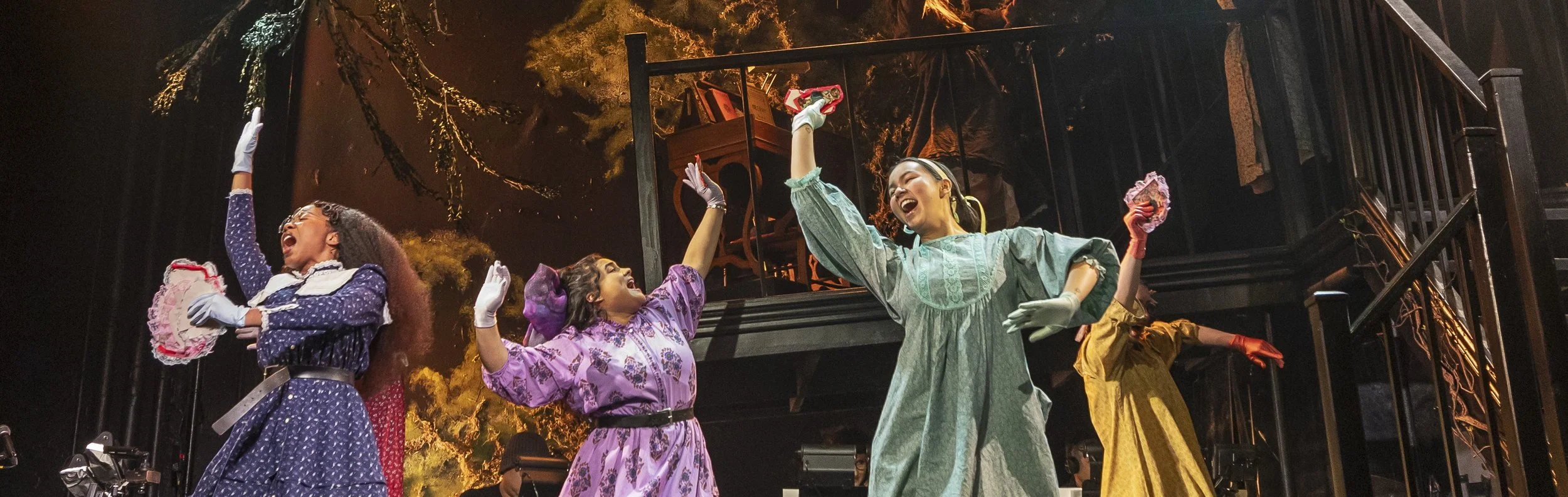
Splatter-Fest

It might be the goriest interpretation of Aristotle yet. As the narrator, Brother Blood, explains the healing power of performance through catharsis (“When done properly, art can be used like surgery to extract the cancer from our collective psyches”), he demonstrates his theory on a poor, seemingly lobotomized victim, pulling out organs and entrails in a flash of blood and wild smiles. The problem with The Blood Brothers Present: PULP, a series of three short plays interwoven with several vignettes, is that there are just too many surgeons around the operating table. With five directors and five playwrights who seem to have differing visions, the show is inconsistent and disorganized. Though it pays homage to 50’s horror comics, its vibe is more thrown-together than throwback.

The series’ flaw is that it fails to devote itself completely to this genre. It’s a shame because when it does dive headfirst into the pulp world, and brings the comic book pages to life, the effect is quite thrilling. The first and last plays, Mac Rogers’s Best Served Cold and James Comtois’s Listening to Reason do a good job, crafting interesting back stories so that there’s suspenseful drama mixed with the gory payoffs. In language, pace, and tone, each feels like a tale from an earlier time. Both, for instance, have a derisive narrator (Brother Blood) whose all-knowing background commentary gives the plays an old-fashioned radio hour feel.

Both stories focus on plausible horrors: a jilted lover who’s come to gun down a homewrecker in Best Served Cold and the inner monologue of a serial killer in Listening to Reason. They also contain the strongest performances, including Anna Kull’s furiously heartbroken avenger in the former and Jessi Gotta’s superbly subtle turn as a disabled victim in the latter.

In a recent interview on NYTHEATRECAST, the show’s creators said that these two pieces were actually adapted from pulp horror comics, while the middle play, Qui Nguyen’s Dead Things Kill Nicely, is an original work. This changeup is quite obvious, as it disrupts the tone and pace set so well by the story that precedes it. Dead Things not only skips the effective narration, but also has a far goofier quality that detracts from any semblance of scary.

Nguyen’s piece has some of the evening’s funniest lines (a debate about the existence of zombies is amusing, thanks to the Grandma Addams-esque Stephanie Cox-Williams) and a fantastically gruesome finish (multiple decapitations! Evil Dead-style chainsaw hands!). However, the play’s refusal to take itself seriously as a story leads to an inability to take itself seriously as a production: with British accents that are distractingly bad and dialogue that often feels like it’s merely filler between jokes or violence, the play is too sloppy to be successful.

On the other hand, PULP’s production team has obviously put a lot of effort into special effects, which they execute exquisitely. All of the stories share a common love of gore, and while the splatter-fest is not quite at the bring-a-poncho level, severed limbs and slit throats abound. Even the most ridiculous cases of slit bowels or skinned backs look impressively realistic.

Another enjoyable aspect of the production is its soundtrack, which includes wonderful original music by Larry Lees as well as surprising offerings from familiar names. From the evil carnival-sounding suite that opens the show, to two wordless vignettes set to perfectly appropriate songs, the music is a delight. One short piece, about a camper who transforms himself into an insect, is told through the comically creepy song “Bugs” by, as I was later amused to learn, Pearl Jam.

With Halloween around the corner, PULP is written for those who crave a good bloodbath each October. But if such audiences are really looking to satisfy their fright fix, they might have better luck finding catharsis at the nearest haunted house.

Click for print friendly PDF version of this blog post

About a Boy

Sex is natural. Repression is bad. Ignorance is dangerous. Poverty is deadly. Patriarchy is oppressive. These and other less-than-revelatory assertions are at the heart of Good Heif, a coming-of-age tale with an avant-garde patina that is currently enjoying its premiere as part of the New Georges 2007-2008 season. Unfortunately, generally strong staging and admirable performances cannot save the text from its undercurrent of condescension and self-congratulation.

Formed in 1992, New Georges' mandate is to encourage the work of female theatre artists. Over the course of fifteen years, the company has produced a number of notable premieres and helped to launch the careers of an impressive array of aspiring playwrights. Given the company’s mission statement Good Heif is a self-consciously playful selection, as its narrative is structured around the sexual awakening of an adolescent male. The trials of a pubescent male in a patriarchal society, as rendered by a playwright and a director who are both women and presented by a famously feminist theatre company: this seems to have all the makings of a provocative, subversive piece of gender-political theater.

Instead, Brooklyn-based playwright Maggie Smith has written about “men” in a generalized “rural” setting, constructing the rural male as “other” in a way that feels dismissive and often mean-spirited. “If only these idiot characters of mine could see what I and my laudably sophisticated/liberated audience see, they would stop oppressing the earth, themselves, and each other,” she seems to say. To be fair, Smith is apparently aiming for something “universal” here, but universalizing often results in the reductive rather than the enlightening, and her play is no exception.

Good Heif is set on a vaguely defined barren landscape, rendered by set designer Lauren Helpern to look kind of like the cracked-desert photograph on the cover of Midnight Oil’s 1987 Blue Sky Mining. The characters dig into the dry earth, although they do not seem certain what it is they are digging for, and it is later revealed that they fear and suppress the rare instances of water bubbling to the surface. Off in the distance are trees with leaves, and what should be the promise of a more fertile life, but the desert locals demonize that place, calling it “over thar” and suspect that may be where the “divul” makes his home.

Lad (Christopher Ryan Richards) is alarmed to find that his body is changing and asks Pa (John McAdams) if he is becoming a man. The most visible sign of Lad’s impending manhood is the show’s primary visual gag: his persistent erection. Pa advises Lad to relieve his sexual longing with a heifer until he can find a suitable woman, and equates sex with digging into a hole in the ground. Ma (Barbara Pitts) is not to be told about these changes in her son; she is a hard-working but sickly woman and such news might push her over the edge.

Lad meets a mysterious feminine creature (April Matthis) who may or may not be the devil his parents have warned him about. She is from “over thar,” and while she doesn’t know what sex is either, she is far more open to finding out, and to exploring both Lad and the world with an open curiosity. Culture clashes, exorcisms, beatings, and coming-of-age ensue.

Director Sarah Cameron Sunde has crafted a visually compelling production and worked with her actors to create a cohesive and consistent ensemble. The performers in general are disciplined and energetic, committing to the seamless and concrete realization of this rather abstracted world. The program notes mention that Good Heif has had a long rehearsal process and incorporated a variety of techniques, and the admirable ensemble work onstage demonstrates the benefits of such a process.

All of this praiseworthy work, however, cannot obscure the intellectual laziness of the text. Smith has tried to infuse her play with a great deal of humor, but all of the jokes are ultimately at the expense of her characters. The audience are invited to laugh along with her as she chastises their ignorance and stubbornness; their fears are shown to be destructive, yes, but are also presented as so ridiculous and unfathomable that we simply judge their actions rather than seek solutions for change.

Publicity materials for Good Heif state that Smith’s “language is spare, simple and straightforward” but that “the life beneath the language is complicated, gnarled, and dangerous.” This may very well have been the intent of the play and the production, but there is little “complicated” or “dangerous” about inviting the audience to pat themselves on their backs for their enlightened views while laughing scornfully at those who live in fear of themselves, of each other, and of the world around them.

Click for print friendly PDF version of this blog post

The Return of Beebo Brinker

Beebo Brinker, the sulky, sexy, tortured and maddening butch heroine of Ann Bannon's 1950s lesbian pulp novels, lives in Greenwich Village. New York's oldest elevator operator, Beebo keeps a low profile when the cops raid the bars, but every femme in the Village knows her, or wants to. Bannon called her a cross between movie star Ingrid Bergman and athlete Johnny Weissmuller. For Bannon's readers, Beebo served as a tour guide to the strange, wonderful New York lesbian subculture and a fantasy lover. At the same time, Beebo's dark, violent, man-emulating and self-hating side revealed the dark side of Bannon's books: their persistent undercurrent of internalized homophobia. The Village is a great place to live, they suggest, but a girl would have to be a martyr to live there -- or else very, very brave. Beebo and her world are resurrected with eerie accuracy in Kate Moira Ryan and Linda S. Chapman's The Beebo Brinker Chronicles, a stage adaptation of several of Bannon's books. Part pulp romp, part exploration of cultural history, the play concentrates on a love triangle between Beebo and two very femme women, estranged sorority sisters and lovers Laura Landon (what a romance-novel name!) and Beth Ayres, nee Cummings.

Laura comes to Greenwich Village to forget about Beth, who dumped her to marry a man. While Beebo falls for Laura, Beth resolves to leave her husband and children and travel cross-country to New York to find Laura and pick up where they left off.

Meanwhile, Laura's friend Jack, a forty-something gay man sick of deluding himself that rent boys love him, relies increasingly on Laura for platonic companionship. Soon, he is asking her to share his loneliness.

Yes, the characters are walking stereotypes. Jack is a particularly egregious example. However, the production garners laughter and exudes pain because Leigh Silverman's direction renders the entire world similarly melodramatic and unreal. The mise-en-scenes look ripped from the covers of Bannon's books. Laura (Marin Ireland) looks down, arching her back like a wilted sunflower, as straight roommate Marcie (Carolyn Bauemler) lounges on a bed, exposing one garish pink Doreen bra strap and turning her body downstage as if aware of an audience. Beebo (Anna Foss Wilson) leans against a wall in the bar surveying the scene with an intense gaze, fitting easily into the roles of both spectacle and voyeur.

Rachel Hauck's versatile minimalist set is dominated by a platform that functions as several beds and floors. This leaves it to Theresa Squire's costumes to establish the period. They do, with clarity, finesse, and fun, but without going overboard into parody or kitsch.

Beebo is suited up in men's style trousers and shirts and severely brushed-back, apparently Brylcreem'd hair. A few striking touches: tall boots and a red velvet vest, emphasise her beauty and iconoclasm, but also her tragic drive to control her world and its other women.

The other girls wear such 1950s staples as crinoline-stuffed skirts, belted sweaters, and pointy, bulky bras. Marcie in particular seems to have got her fashion sense from Jean Harlow and Marilyn Monroe.

The actors make up in technically precise character-acting for the characters' absence of depth. Each has a clearly defined walk, stance, and voice. There are two standouts, however. One is Bauemler in the sharply contrasting roles of Marcie, scary vamp Lili, and worldly, cynical romance novelist Nina Spicer, an homage to Bannon herself. The other is Wilson. Beebo spends much of the play merely watching the other characters, surveying her domain, but Wilson builds into even this a rage at her world that bursts through the cool exterior at just the right moments. Paradoxically, it is the fantastic Beebo who, of the play's principal characters, ultimately appears the most complex and self-contradictory, which is to say, the most genuinely human.

As a play with lesbian characters at front-and-centre, The Beebo Brinker Chronicles is a rarity in New York theatre, even off-off-Broadway. It is a great piece of cultural archaeology and often riotously funny. At the same time, it is a play about people caught between difficult realities and often more difficult fantasies. They try to see through a maze of prejudice and self-denial to find out who they really are, and find the courage to live by the truths they discover.

Click for print friendly PDF version of this blog post

Gunning for Hamlet

Mercy Thieves takes its title from a line in Hamlet describing a ship of pirates as “thieves of mercy,” an apt evocation of the brutal main characters, but this play owes more to Quentin Tarantino than to Shakespeare. The characters are ostensibly derived from Hamlet but what purpose this serves the story or the character development is unclear; one gets the feeling that the author has sought to lodge a weak plot in a canonic framework. Nevertheless, thanks to very strong performances and well-written dialogue, this gangster comedy achieves moments of high art and entertainment. We are introduced to the characters as we enter the theater: on the low-lit, curtainless stage the two players sit side by side, accompanied by a pair of legs stretched out on the floor from behind a bar. This pre-scene doesn’t do much to inform the plot, but the two main actors’ postures and attitudes already begin to establish their characters: Nick Stevenson as the smoldering DJ and Jeremy Waters as the ecstatic Mike. Both will be superb in their renderings of idiosyncratic hit men.

What structure there is in the plot is hopskotch: one step forward, two hops back fill us in on preceding stages in the story which, if played out chronologically, would reveal how empty the storyline is. The play traces one night in the lives of Mike and DJ, two hired thugs who have been given a mission: to find Harry. Harry proves to be elusive (he never actually appears onstage), and the two set off on a journey across Australia, unearthing and killing off their old friends and colleagues in their search. What Mercy Thieves really amounts to is a series of character sketches expressed through high and low-tech media and prop manipulations: from the large video screen backdrop where certain scenes unfold cinematically, to flashlight-driven chase numbers.

Director Craig Baldwin has done some interesting work in creating context for the frequent time and media shifts and in his efforts to convey violence and action on a small stage using simple means. Unfortunately, the overall effect is inconsistent and awkward. There are several car scenes that feature DJ driving a floating steering wheel while Mike fiddles with the radio dial or philosophizes. The two are seated in chairs behind an overturned table as the car. The effect is of two vaudevillians in a Model-T - not exactly noir. There is more vaudeville to come when Mike and DJ mime killing techniques; maybe this is a cool concept and it’s just poor miming, but the result is embarrassing.

Where the manipulation of time and context works, it works beautifully. The finest scene in the play is between Harry’s mother, Pru (brilliantly played by Victoria Roberts), DJ and Mike. DJ recalls his visit with Pru to Mike, as it actually unfolds. Mike asks questions from the future and, from the past—from her chair upstage—Pru rolls her eyes at Mike or gives him a cool stare. This simple treatment of gazes and stage positions succeeds where the props and screens collapse into gimmickry.

Throughout the play the level of performance is outstanding. Nico Evers-Swindell is excellent as he shifts between three characters; his Jimbo is one of the highlights of the play. Emma Jackson does a juicy “Sharon the Tart” and Paul Swinnerton is a perfect pub man, among other characters. Jeremy Waters dominates the stage with his explosive yet affable, murderous yet sensitive rendering of tender, homicidal Mike. Mercy Thieves may be on its way to Hollywood (the screenplay has been optioned), but it’s hard to imagine anyone but Mr. Waters in this role. The same could be said of the entire cast.

Click for print friendly PDF version of this blog post

IT Awards Spread the Wealth as They Expand

Off-Off-Broadway celebrated itself at the third annual New York Innovative Theatre Awards. The ceremony, affectionately known as the IT awards, took place on September 24 at the Fashion Institute of Technology's Haft Auditorium, with more than 700 nominees and supporters in attendance. Though the ceremony, hosted by actress Julie Halston, included politicians (New York City Councilwoman Christine C. Quinn) and Tony-winners (Anika Noni Rose of Caroline, Or Change), the focus of the evening fell squarely on the shoulders of the hardworking artists who have entertained the Off-Off-Broadway community in the last year.

Unlike last year, when the production of To Nineveh swept most of the categories, the awards this year were spread out among multiple productions. Three shows -- CollaborationTown's 6969, LaMaMa Etc.'s Dancing vs. the Rat Experiment, and Rising Phoenix Repertory's Rules of the Universe -- walked away with three awards apiece. Additionally, three honorary awards were given out, to Doric Wilson, a founding father of the Off-Off-Broadway scene; to Alliance of Resident Theatres/New York (A.R.T./New York); and to Rising Phoenix Repertory, which won a $1,000 grant as part of the Caffe Cino Fellowship award.

It was a big night for Daniel Talbott, who accepted the Caffe Cino award and also received the Outstanding Director award. "It's weird, since I'm an actor, but I have really bad stage fright when I have to speak in front of folks without a play to hide behind," he explained, after admitting to being shocked when he won the second award. Talbott praised the Rising Phoenix company. "The award honors everybody that's part of Rising Phoenix Rep and all the folks who worked on the show...We only had four or five days to put it up, and everyone was dedicated and on board from the beginning in every single way. It's a show I am really proud of."

Max Rosenak, an IT recipient for Outstanding Actor in a Leading Role for 6969, also praised his show. "The play is by far the most interesting play I have gotten to work on, and the part of John is the most fascinating character I've gotten to play. I knew from the first line of the first reading that it was going to be a really special experience, and it was. My scene partner, Ryan [Purcell] was fantastic to work with." Rosenak added that "it feels wonderful to be told that I did a good job. That's a rare experience."

Dan Safer was a double winner for both Outstanding Choreography/Movement and Outstanding Production of a Performance Art Piece for the innovative Rat Experiment. "Winning for choreography means a lot to me," he said, "because what Witness Relocation does falls outside of traditional categories, and there are purists who say what I do is 'not dance.' There was a lot of debate from critics, etc, when we did the show, on that subject. It was great to be recognized for making dances.

Additionally, he provided one of the evening's highlights by bounding up on stage on a piano bench that flipped over, though he emerged unharmed. "Can you imagine if I had knocked all my teeth out? Given what our work is like, I think it was actually quite appropriate that I did that." Safer also praised the LaMaMa company for their support.

One winner was not present during the ceremony. Susan Louise O'Connor was the recipient of Outstanding Lead Actress for the silent concerto but was busy performing at the New York Musical Theatre Festival. She found out that she won via text message during her show's intermission. "I'm so freaking honored to receive this award," she said later on. "I think the IT awards are such a great way to draw attention to and celebrate Off-Off Broadway."

Indeed, the reach of the IT Awards has grown impressively from each year to the next, with last year's inclusion of shows produced in Queens and this year's acceptance of shows produced in Brooklyn. One of these shows, Gallery Players' Urinetown: The Musical, was the recipient of the award for outstanding Production of a Musical. As the community continues to call attention to its own, everyone comes away a winner.

Click for print friendly PDF version of this blog post

Chromosomes in Conflict

Although Rebekah Brunstetter’s new drama is subtitled "A Lady Play," the main character is Trevor, a hunky surfer played with artful cluelessness and earnest charm by Jeff Berg. Trevor is given to saying “rad” and to declaring that he’s on a God-directed mission; he's going to “solve all the problems in the world. One by one.” But first he has to finish his philosophy class. The play, a loosely connected series of vignettes, examines women’s relationships with men through Trevor, a sort of universal hookup. Brunstetter writes, as Swedish playwright August Strindberg did, with a sense that the two sexes will always be in disharmony. Her women, who vary in age, size, and race, all come off as needy or resentful. But since Trevor exhibits some of the obvious male shortcomings that women have complained about through the years, this is to be expected. He’s no good at commitment or remembering birthdays, and he often behaves like an irresponsible child, although he is a gentle lover and good in bed. Unlike the fierce competitors in a Strindberg play, both sides here start out enervated. Sexual satisfaction is possible, but there’s little emotional connection.

As Trevor’s liaisons are examined on April Bartlett’s simple set of a low central platform for indoor scenes and a green stage carpet for outdoors, the play straddles realism and absurdism. It veers from touching to wildly implausible, and from drama to comedy, with most of the humor at the man’s expense. (It’s unclear whether this schizoid aspect is the result of having co-directors, Isaac Byrne and Diana Basmajian.)

Brunstetter’s first scene, though, is contrived and off-putting. Anna, a child of 11, sings to herself a song with the line, “Gonna shed your placenta.” Anna is that old theatrical cliché, a child knowledgeable beyond her years, and she has gleaned information about her mother’s sex life that includes fellatio and periods. (Anna’s information supposedly comes through eavesdropping, although she knows more than the CIA would if mom’s bedroom had been bugged.) But when Anna yells, “I got my period! I’m on the rag!”—really, is it possible that she overheard that? Whose mother ever says that?

Rachel Dorfman exhibits patience and openness as Anna’s mother, but the character is plain creepy. She makes weird, jealous comments on her 11-year-old’s beauty and also barks instructions like “Don’t look directly at me. It burns.” It’s akin to watching Britney Spears playing mother to JonBenet Ramsey.

Brunstetter is more successful with Diane, a plump policewoman who claims to be 34 and much older than Trevor, who’s 25 (although the age difference between the actors is invisible). Diane is a decent woman but awkward, and Maggie Hamilton invests this crucial role with shy self-consciousness and a poignant vulnerability. She meets Trevor as he’s about to chalk a message on a wall; Diane acknowledges that she also used to write on walls. The implication is that Diane's wild spirit has been tamed. Diane and Trevor begin an unlikely affair, although Trevor has other women.

One of them is Joanne (Darcie Champagne), a cosmetician who meets Diane in a park and gives her a makeup lesson. And another is Georgia (Lavita Shaurice), a woman who periodically performs at a poetry slam on an open mike. Trevor has damaged both of them as well, although neither registers as strongly as Diane. Late in the play Trevor encounters an older woman, Mona, who’s both hilariously insane and truly frightening, and is played by Ellen David with the panache of Ruth Gordon. The scene also gives Berg the opportunity to show he can play fear and vulnerability and that his casting isn’t entirely based on the frequently displayed results of gym time and protein shakes.

The damage that men inflict on women is a meaty subject for drama, but Brunstetter’s approach is ultimately too loosely structured and too erratic in its tone to rate as either realism or absurdist satire.

Click for print friendly PDF version of this blog post

Gangster Rap

It seems that, nowadays, the twentieth century is not to be looked to in reverence, or wonder, but in mockery. Plays that take place in a fixed point in recent time satirize the look and mindset of the era (a la Xanadu), and an original piece set in days of not-too-old makes as much of a statement about then as now." Grayce Productions' latest, Say Your Prayers, Mug!, puts a little too much effort into the joke and not enough faith in the material, resulting in a slightly forced show. In Say Your Prayers, Mug!, writer/co-director/actor Todd Michael dallies in two eras: New York in 1954 and in 1935. As he and Thom Brown portray Dottie Haines and Skip Rayburn, the glamorous married co-hosts of a '50s morning movie program, they seethe with dysfunction, stir up jealousy, and shamelessly hawk the products of their sponsors.

Their interplay is interspersed with scenes from the titular '30s gangster drama, in which police sergeant Dan Gargan tries to put away Sonny Rocco and his gang while also trying to resist the wiles of no-nonsense broad Platinum Kane. Their patter is stuffed five ways to Sunday with the rat-a-tat-tat slang of the era. (Playwright Michael clearly knows his way around a colloquialism.)

All of this winking self-awareness becomes wearying as the show wears on, especially since there are a few genuinely funny moments when bits of dialogue are played straight. Anyone who's ever seen a film that takes itself too seriously knows how humorous something can be when it's not trying. Granted, by writing something that could be deliberately construed as pompously amusing, one is trying - but not as hard as an actor affecting an overdone ethnic accent or a male performer playing too much the bitchy female. (For a master class in period acting by a man in a woman's role, see anything starring Charles Busch.)

Notable in the cast are Jimmy Blackman as Sgt. Gargan and Jill Yablon as Platinum Kane. Blackman's Humphrey Bogart-esque hangdog face and straight man delivery mostly triumph over the style of the piece. Jill Yablon has the requisite smoky voice and icy blonde demeanor of the love interest, and could pass for an actress of the era.

The show is set in a theater but relies too heavily on a theatrical style. Characters enter and exit awkwardly, rather than "appearing" in the way that they do on TV and in the movies. If style parody is the game, why not mimic the rigid blocking of single-camera films, or rely on the multi-camera staginess of the television program?

Besides the great use of jargon in the movie script, the one other aspect of the homage that is executed flawlessly is the costuming. David Zwiers has put together a great selection of glad rags, particularly Dottie Haines' fuschia dress and nightclub singer Kitty De Villiers' blue polka-dot number. All of the ladies' wigs are also perfectly selected.

The current trend in pop culture is that "sincerity is the new irony." It's now socially acceptable to admire something or someone outright, with a commentary-free homage. Were Say Your Prayers, Mug! to allow itself to be as sincere and as adoring as it clearly wants to be, the show would become more than a snarky look at our past, and instead be a sentimental look at ourselves.

Click for print friendly PDF version of this blog post

Too Close for Comfort

Presenting challenging material onstage takes a certain amount of finesse. When discussing shows of this nature, one uses phrases like "selling" or "putting over" a concept to acknowledge the persuasiveness that is needed. It's important to respect the playwright's motives in creating this world while also respecting the audience's sensibilities by not sensationalizing the material any more than is warranted. In Wendy MacLeod's The House of Yes, the audience meets the Pascal family from suburban D.C.: single mother Mrs. Pascal and her children, the high-strung Jackie-O and college dropout Anthony. They are preparing for Thanksgiving, an oncoming hurricane, and the return of Marty (Jackie's twin brother) from New York with a surprise guest - his fiancee, Lesly.

This close-knit clan has seemingly little respect for boundaries or social mores, and harbors very dirty secrets indeed. But how does a director introduce them and their lifestyle in a realistic way while also giving the audience permission to be shocked and skeptical?

Samsara Theatre Company tries to play it safe in their production, now running at the Roy Arias Theatre. The actors are subtle, the sets are simple and the costumes are mild. But by underdoing it, the show loses all edge and comes off two-dimensionally. The text has a sense of Tennessee Williams as played by the Kennedys, but its lush theatricality is missed by all by Maire-Rose Pike, who, as Jackie-O, comes closest to connecting to the world of the play.

Pike's mellow voice and polished attractiveness suit her role, and while she seems a bit unfocused at the beginning, she finds her bearings as the show goes on. Of course, as the recipient of the most delicious lines in MacLeod's script, Pike is given ample opportunity to shine.

The other actors come off as flat, or affected, or wooden, or a combination thereof. There is no chemistry between the characters, making it unclear why Jackie-O and Lesly are so devoted to Marty, why Anthony is smitten by Lesly, and why anyone is protective of Jackie-O.

Director Jason Kane, perhaps fearful of chewing up the scenery in their intimate theater space, curbs these performances when he should have drawn them out. The actors also seem to have blocking issues, resulting in a broken wine glass at one performance that had theatergoers concerned about potential injury to two cast members during the climactic scene.

According to the program, Samsara Theatre Company has been formed to showcase the talents of its cast and crew. Certainly, The House of Yes, with its small ensemble and daring subject matter, is a good vehicle for this aim. It's unfortunate that this production did not allow itself to be bold enough to meet the company's goals. How can you expect to stand out from the crowd if you insist on blending in?

Click for print friendly PDF version of this blog post

Poise and Prejudice

When staged on stage and screen, the stiff, formal dances that anchor many of Jane Austen's novels pull the characters through elliptical shapes that turn and revolve, threading them through various configurations and couplings. Hands (barely) touch and gazes (intensely) lock, but eventually—in a coy foreshadowing of the ebullient conclusion—everyone ends up with the person to whom he or she is best suited. For the most part, Emma sticks to the standard Austen formula: the heroine circles around her somewhat inscrutable true love, the requisite pratfalls ensue, yet all is resolved in the end. Joel Alden's musical reinvention of Emma (a selection of this year's New York Musical Theater Festival) is, for the most part, an enormously satisfying success. Briskly directed by Terry Berliner, the first act zips along with a graceful economy that would have made Austen proud, but in the second act, when the knotted conflicts begin to unwind, the action becomes a bit bloated. Still, an exquisite cast—led by the enthralling Leah Horowitz in the title role—makes this latest bit of Austen entertainment a delectable treat, especially for die-hard Austen lovers.

Like many of Austen's best-loved heroines, Emma is a woman ahead of her time: intelligent, witty, and fully capable of "forming her own opinions." What distinguishes the formidable Miss Woodhouse from the rest of the lot is her self-anointed gift for matchmaking. After successfully pairing off her governess, Emma takes the orphaned, lower-class Harriet under her wing. Through lessons in "posture, poise, and patience," she is determined to transform Harriet from country bumpkin into a fitting candidate for "a gentleman's wife." But Emma, so confident in reading the romantic patterns of others, is unable to see how she herself fits into the mix. She advises Harriet to pursue the solicitous clergyman Mr. Elton, while she sets her sights on the rakish Frank Churchill. Of course, things don't turn out as planned, and her old family friend Mr. Knightley hovers in the wings, patiently waiting out Emma's games so that he might make a proposition of his own.

Alden's score is well suited to his Austen endeavor—the songs are charming, if melodically repetitive, and they spool out harmlessly like the revolving wheel on a player-piano. He's written some nice harmonies for the strong-voiced cast, and he gives Horowitz ample opportunity to show off her floaty, silvery high notes in Emma's many solos.

But, without a doubt, the strongest music comes in the more animated characters' songs. As Emma's endearingly dim friend Miss Bates, Terry Palasz turns in a masterful comic performance in the peppy patter song "Jane Fairfax Wrote a Letter" (punctuated by the rhythmic snoring of her elderly mother, Mrs. Bates).

Likewise, the defiant "A Lady Stands Before You" is a spectacular showcase for the fantastic Kara Boyer. She brings such warmth and personality to the ever-agreeable Harriet that you never stop rooting for her from the moment she enters the stage. As the dependable Mr. Knightley, John Patrick Moore gives a refreshingly understated performance. Only Jesse Lawder and Ben Roseberry, as the sought-after Churchill and Elton, push the comedy schtick a bit too far.

It's quite a feat that Horowitz manages to hold her own among the superlative supporting players, and she makes the perfect Emma. A strong, fearless actress, she enacts Emma's cunning schemes with a subtle smirk and an artfully cocked eyebrow.

The spare production features clever props and costumes, including miniature houses that double as trunks. Berliner's direction is appropriately cheeky at times, with winks toward more modern conventions. I did find the anachronism of the men's costumes—jeans with period jackets and boots—a bit distracting.

As the calamities are slowly ironed out, the production loses the crispness of Austen's prose, and certain fuzzy plot points could be more clearly explicated in the last half-hour. Specifically, the secrets behind Churchill's bad reputation and the consequences of Emma's bad behavior toward Miss Bates are never clearly articulated.

Although I've read Austen's novels (and seen many of the films), this was my first time watching a stage adaptation, and there's much to be said for the experience. The live animation allows us to witness the full sting of Emma's grossly entitled behavior—her self-serving social conscience, her rather pompous demeanor, and her attempts to control Harriet ("She's almost the lady she has always wanted to be"). As a musical, Emma makes us privy to the visceral drama of class distinctions that, even through the alchemy of romance, stand firm. In Austen, personalities may clash and still make fine matches, but social spheres and pounds per year too often determine whom you can dance with.

Click for print friendly PDF version of this blog post

Land of Plenty

In Sharyn Rothstein's A Good Farmer, a widowed farm owner named Bonnie (Chelsea Silverman) befriends a bright, young Mexican immigrant, Carla (Jacqueline Duprey), who has been working illegally on her farm for seven years. The play focuses on Bonnie's unenviable predicament, one that many farmers face with every major crop season: the need to hire cheap labor to farm the land, and the knowledge that no legal citizen would work for such low wages. Like most farmers in the area, Bonnie employs about a dozen illegal immigrants, gives them coffee in the morning, and carpools their kids to school, but pays them poorly and works them to the bone. Rothstein spends most of the play trying to humanize Bonnie, perhaps in an attempt to make her a protagonist in our eyes. But it doesn't feel right. It is hard to sympathize with a woman who knowingly exploits her workers, never gives them a day off, and then wonders which she fears more: seeing her fellow PTA moms captured, interrogated, and deported by Immigrations and Custom Enforcement or losing her crops if there is no one around to harvest them.

Most of Act 2 takes place in a flashback, where we meet Bonnie's good-humored but dying husband, David (Gerald McCullouch), and learn the hard luck details of Bonnie's life that have led her to reluctantly hire illegal workers. But the play spends too much time on this subject while a truly sympathetic character like Carla falls into the background, as does the overall issue of illegal immigration.

The playbill features an interview with Rothstein, where she says, "I wanted to write a play with a very smart, very strong woman at its center." She accomplished as much through Carla. She is intelligent, saucy, determined, and smarter than Bonnie, proving in many instances that she knows the world much better than those who are running it.

We are told that Bonnie and Carla are supposed to be friends, "best friends," according to the play's blurb, but that seems unlikely given the master/servant dynamic of their relationship. Duprey conveys that uncertainty in her acting; when she speaks to Bonnie, her tone is always cordial but never sincere. Her laughter is polite, almost strategic because she can see the way it makes Bonnie think that she might not be such a slave driver after all. When the two fight, Duprey's voice is strong and direct. She never loses her temper but often clenches her jaw as if she is biting her tongue.

There is a wonderfully telling scene where Bonnie first offers Carla the job of being a caregiver for her terminally ill husband, adding, only when pressed, that the job pays nothing and offers only food and lodging. When Carla balks at the offer, Bonnie snaps back, saying that she is being greedy and selfish to request anything in her position and that she should take what she can get and be grateful for it. A friendship laid on this foundation can only be a rocky one at best.

So who is the true villain in all of the illegal immigration controversy? Is it the government, which says you must be a legal citizen to work in this country? Is it Immigrations and Custom Enforcement, which rounds up immigrants who have been here for several years to send them back to the place they fled from? Or is it the farm and factory owners like Bonnie who knowingly hire illegal immigrants because they know they can work them harder and pay them less than someone with workers' rights?

A Good Farmer touches upon, but never fully explores any of these questions.

Click for print friendly PDF version of this blog post

The Contents of Her Purse

The lights come up on a young man shaking a can of shaving cream. In the first of three shaving scenes, he gazes at himself in an invisible mirror positioned at about the third row of the audience and begins, with panache, to apply the foam to his nearly hairless chin. In each of the three scenes, due to a different interruption, the razor does not meet skin, and the foam is swabbed off with a towel. This disrupted act of self-observation and newly formed habit provides an ideal initiation to a terrific play about adolescent consciousness: David Holstein's True Genius, directed by Jill Sierchio. This is the story of a troubled 19-year-old boy's (Scooter) evolving relationship with his mother (Margaret), his imaginary younger brother (Jeffrey), his late father, his alcoholic therapist (Dr. Foyer), and his love interest (Lila). Dr. Foyer is called upon to help Scooter and his mother negotiate the father's emotional and intellectual legacy, but it's in the shrink's waiting room that the important work unfolds: Scooter meets the divine Lila, another teenage patient, who will draw him out of his delusions and fears. Props like the shaving cream, in the hands of this outstanding cast, organize the plot development and emblematize the emotional resonance of the characters' interactions.

A young girl unpacks her purse: a teen magazine, a pack of gummy worms (one bite, one thrown on the floor), a wallet, trinkets, a spoon, and a hammer (more on the hammer later). By the end of the play, Scooter, Lila, Margaret, and Dr. Foyer have all been unpacked, the contents of their psyches shaken out and dumped on the floor; picked through and eventually restored; inventoried but jumbled back into the dark chaos of the purse.

The boy and girl talk to one another's reflection in the shaving mirror from the opening scene. Staring at the "mirror" in perfect pantomime, Lila raises one arm and then the other, giggles in delight, then ducks to Scooter's other side. She lifts his left arm, then he sweeps his right hand around to cup her face and turn it toward him, away from the mirror. This animation of the adolescent conflict of self-regard and the attraction to the other risks heaviness, but these movements are so deftly choreographed and poignantly performed that the audience members become mirrored adolescents themselves.

These two young actors are remarkable in their own right, but it is a happy coincidence of styles and skills that brings them together on this stage. Perry Tiberio's performance as Scooter is coiled with explosiveness and craves the cool, irresistible charm of Regina Myers's Lila. These are beautifully crafted teenagers; it's hard to believe these actors have only a few years' distance from the age they portray. It's also a testament to their creative maturity that they have understood those years so well, so soon.

In the world of True Genius, adults are feckless but powerful; their whims have devastating consequences. Nancy Evans's performance as Margaret nails the adolescent's vision of a mother: alternately commanding and cajoling. Ken Scudder does his best to account for the makeup of the weakest character, the therapist, by veering between a boot camp counselor and a needy failure. The effect is cartoonish, but it works here because what we come to understand by the end of the play is that we have been transported to Scooter's exaggerated adolescent world: we have come to inhabit his "memoir"—the notebook he carries throughout the play.

So, in the same way that we can appreciate the sweet, shambling appearances of the imaginary younger brother, we see the therapist as a pathetic drunk and the mother as the all-powerful holder of secrets and keys to our fate. But in this version of his own story, Scooter finally contrives to extract a new truth from his mother, one that somehow transforms her into a more docile figure who, at the conclusion, promises to "cook more and take better care of you and the house." The abruptly happy ending is justified if we attribute authorship to Scooter. If, however, we choose to address Holstein as the author, we might prefer a less tidy conclusion.

To return to the hammer: It is in Lila's bag and is never put to use, never explained. There it is, on the cover of the playbill, but, to my knowledge, it's never accounted for in the play's action. This, I believe, is as it should be. Who can explain all the hardware in anyone's psyche? Why try to force the delicate ferocity of family and romantic relationships into reductive clarity? I found myself wishing that the imaginary brother, who disappeared when Scooter and his mother had their breakthroughs, would pop back out again at the end, hammer in hand, to break another garden gnome. (You'll have to see this play!)

Click for print friendly PDF version of this blog post

Dark Magic

The legend of Dracula, as created by Bram Stoker in his 1898 novel, has captured international attention for over a century and inspired retellings in a variety of media, most notably film. But the book, to be honest, is a bit of a mess. It is unclear who the protagonist is, as the naïve Victorian lawyer Jonathan Harker dominates the first half of the story, while his wife, Mina, plays the leading role later. Stanton Wood's adaptation The Night of Nosferatu, produced by Rabbit Hole and directed by the brilliantly innovative Edward Elefterion, deals with that duality masterfully. Wood turns Stoker's structural problem into a brilliant metaphor for the title character's (after)life of "boundary crossing," which makes him attractive to the boundary-constrained Mina. Previously presented by Rabbit Hole as two plays, the work is even stronger as an amalgam of conflicting halves.

That is not just a metaphor: in the combined piece's first act, the actors all wear black, and it deals primarily with Mina's mental exploration of Nosferatu's castle and confrontation with the vampire, as she telepathically follows Jonathan on a business trip to Transylvania. In Act 2, they wear white, while Nosferatu becomes a stranger in the exposed world of Mina and Jonathan's society and invites Mina, incarcerated in an insane asylum, to break boundaries with him.

This reviewer was mildly annoyed by one aspect of an otherwise insightful script: the constant declarations, in the first part, that Romania is a country of darkness and superstition, where ghoulies make themselves right at home but human beings would not want to visit. Having been there and seen some remarkably innovative theater in the city of Sibiu's annual International Theater Festival, I think that Stoker's assumption needs some rethinking.

Most of the cast are veterans of Rabbit Hole's productions of the two parts. The major exception is the role of Mina, now played with a lot of steel and passion by Tatiana Gomberg, who, last year, shone as another Gothic heroine in Theater 1010's Northanger Abbey.

Matt Cody reprises his wonderful Midtown International Theatre Festival performance as Nosferatu. The tall actor's stooping walk, gratingly gritty voice, alternatingly threatening and pained expressions, and undercurrent of empathy make for a truly memorable performance. Cody's mannerisms allude to legendary actor Max Schreck's in F.W. Murnau's 1922 film Nosferatu, but never merely mimic. As Harker, Paul C. Daily's Dudley Do-Right normalcy and naïveté contrast sharply with Mina's growing self-awareness and increasing identification with Nosferatu.

The humans' costumes are simple but effective, with the women's skirts suggesting the late-Victorian silhouette without going all out in period decoration. Nosferatu wears a long black overcoat that accentuates his hunched back. His hands and face are caked in white makeup, his ears are pointy, and his fingers are elongated into sharpened points, just like Schreck's. At the right moments, he and the other vampires display the obligatory weird teeth.

As in the previous presentations, the set consists of a black curtain. There are no props, and no recorded sound effects. The actors create the play's world with mime, manual and oral sound effects, and the creepy amber glare of hand-held lights. The revelation of Nosferatu in his coffin is accomplished by merely jerking back the curtain to reveal Cody, with artificially extended bleach-white hands crossed on his chest and a wide-eyed, open-mouthed expression.

With mise-en-scene like this, Wood, Elefterion, and the cast make powerful dark magic. Rush to see it before the sun rises and it disappears.

Click for print friendly PDF version of this blog post

Jeeves on Sunset Boulevard

The exclamation point in the title of this comedy is a good indicator of what's to come: strong emphasis delivered to otherwise pale material. The sparkling dynamism—perfectly executed exclamation points—of Gerrianne Raphael's performance as Gloria Desmond infuses an atmosphere of excitement into the formulaic plot, a mystery-comedy set in the 1930s. A mysterious stranger is invited to the elegant country home of aging film legend Gloria Desmond, where he encounters a lovely young countess, a substitute butler, and a priceless necklace. All the elements are in place for a Wodehousian adventure, and thanks to some strong performances, audiences won't be disappointed if like, this reviewer, they are devout P.G. Wodehouse fans. It's a great satisfaction to see a melodramatic doyenne like Bertie Wooster's Aunt Agatha, "the one who chews broken bottles and kills rats with her teeth" (Wodehouse), come to life on the stage. Raphael's Gloria Desmond spins even weak dialogue into gold; every pose and verbal flourish is on the mark.

While the other performers are at risk of being outshone by the radiance of Raphael's performance, Marnie Klar and Adam Raynen largely rise to the demands of their roles as the imposters Lady Fortescue and Alfred the Butler. Klar manages to be alternately goofy and elegant as the occasion demands, while Raynen offers a consistent performance as an amiable butler—overly consistent, because the dual identity of his character offers missed opportunities for a more complex portrayal of the butler's criminal side. Harold Busby (Davis Hall), the mysterious stranger, is comically creepy in wig and fake moustache, props that nearly steal the show in the final scenes.

Playwright Norman Beim also directed, and some of his decisions seem to stem from a desire to compensate for the flatness of his dialogue and story arc. Some of the play's best moments revolve around sound effects: a dinner gong followed by jolting sounds that cause the characters to flinch compulsively; a dramatic strain of music that accompanies each mention of the Mandarin Necklace. But even these moments are formulaic—funny because they are somehow familiar from television effects?—and when the chorus from Carmina Burana fills the theater, the last crutch is in place.

The high point of the script unfolds when the mysterious Harold Busby confronts the butler and Lady Fortescue about the Mandarin Necklace. A game of throw-and-catch—or one-sided fetch—ensues with an exchange of aliases between Busby and the butler: "Willy the Weasel?" "Louis the Louse." "Louis the Louse?" "Winnie the Pooh." Lady Fortescue throws one in, "Spot the dog."

This verbal give-and-take will be echoed by the physical comings and goings of the necklace in later scenes. A nice conceit, but somehow I felt, once again, a sense of déjà vu. The danger of relying too heavily on formula is that everything becomes fraught with cliché. Especially within the confines of such a recognizable vehicle as a screwball Sunset Boulevard.

Click for print friendly PDF version of this blog post

Punk'd

A show with a negative word in its title, like the verb used in the New York Musical Theater Festival's Love Sucks, risks having its title turned against it if the show is subpar. But the only thing that sucks about Stephen O'Rourke and Brandon Patton's punk-rock retelling of Shakespeare's Love's Labours Lost is that the show's run ends on Oct. 6. This is a brash, thrilling new musical that deserves an open-ended run downtown with wild, adoring crowds. Set in the East Village in the 1970s, the show follows two bands: the all-boy Molotovs and the all-grrl Guttersnipes. Band leaders Big Joe (Molotovs) and Patti (Guttersnipes) try to put music before mating by placing a limit on the amount of times a band member can have sex with someone in order to ward off rehearsal-killing relationships. When the groups cross paths and boy meets girl (times three), love blooms, and it's up to the others to convince former pals turned bitter rivals Big Joe and Patti that they're meant for each other.

The stage features a full band setup and a blue/gray brick-esque backdrop tagged with graffiti and a picture of the Bard. Moveable pieces are brought in for more elaborate locations. However, the most impressive sets in this show are the ones done by the bands. Most of the actors are in bands and/or write music, which lends believability to their performances. Any audience members arriving late to the show who walked in during the Molotovs's first number, No More Girlfriends, could not be faulted for believing they had walked into a concert by mistake, as the band's chemistry and precision seem the result of years, not weeks, of rehearsals.

Of course, great music would (one hopes) be a given in a show like this. What was really surprising was how romantic and sweet the courtships were, even as they started from a base of mutual physical attraction. When Big Joe tries to turn on the charm around Patti, it's played out more naturally and adorably than in any rom-com, chick flick, or cutesy-named love story genre that comes to mind.

Actors Nicholas Webber and Rebecca Hart really bring it in these roles, and are excellent frontpersons for their groups to boot. (It should also be noted that Heather Robb, as the love 'em and leave 'em Kate, has a great rock voice, acts her role brilliantly, and is smolderingly gorgeous.)

Couples, if you're looking for an alternative to the standard dinner-and-a-movie date, consider paying a visit to Hell's Kitchen this weekend to see this show. Producers, if you're looking for an alternative to yet another over-exposed theatrical chestnut, consider paying to remount this show in a gritty, below 14th Street venue. Love Sucks rocks.

Click for print friendly PDF version of this blog post

A Touch of Frost

The creators of the zany musical The Yellow Wood have nabbed Robert Frost's classic poem "The Road Not Taken," splashed it with vivid surrealism and a quirky score, and spliced it into the life of an insecure Korean-American teenager. Sound a bit confusing? In their admirable attempt to give musical life to Frost's hallowed abstractions, Michelle Elliott and Danny Larsen have constructed a frothy surrealist show that eventually meanders into meaninglessness. Even before he heads off to school, Adam is smothered by choices. Will he take the time to memorize that poem for his English class? Will he sit with his little sister at lunch? Will he take his Ritalin? The answer to the last question, in particular, makes "all the difference" to Adam's day, and from the moment he hits school, reality dovetails with the bizarre. Are these dream-like sequences, which connect loosely to stanzas from Frost's poem, induced by Ritalin withdrawal? Or are we merely witnessing the fragmented thoughts of an ordinary, overly imaginative boy?

Frequently overwrought and definitely overlong, The Yellow Wood, part of this year's New York Musical Theater Festival, doesn't provide satisfying answers to these questions; nor are the questions posed very clearly. Instead, the scenes and songs unfold like a hazy (and lazy) mirage, grounded only by a handful of pitch-perfect performances from a terrific ensemble cast.

As the fidgety, troubled Adam, Jason Tam is a bundle of charm and energy. When the lights go up, he immediately explodes into a fiery monologue, which evokes the athleticism of the skateboard he clutches. His testy relationship with his overachieving but lonely sister, Gwen (the outstanding Yura Takara), is the production's highlight—their antagonistic relationship is lined (just barely) with love, providing a much-needed web of realism in this overly abstract plot. And as Adam's buddy, the irreverent Casserole, Randy Blair brings down the house (and the school cafeteria) with the powerhouse song "Tater Tot Casserole."

The Yellow Wood finally drowns in the many questions it poses. Why does Adam deny his Korean heritage? Will he become class president and lead the "nerds" to control the school? And as for the production itself, is it an anti-Ritalin tract, a celebration of overactive imaginations, or a theatrical experiment? By the time the piece ends, in a spate of warm and fuzzy self-empowerment, the oversimplified, reductive message only makes the rest of the show more confusing.

In the program notes, director and producer B.D. Wong writes that he saw the show as "a particularly psychedelic outlet to my rampant creative impulses." In his New York directing debut, Wong, an accomplished performer on stage and screen, clearly revels in this wacky material. He makes inspired use of yellow umbrellas and less successful use of an overhead projector in the spare production, but even clever technical twists are not enough to rescue this murky project. In this case, some roads are better left untraveled.

Click for print friendly PDF version of this blog post

Friends & Neighbors

The neighbors have just dropped by. They've brought Shiraz. And brownies. Sound good? It's not. They've also come with a mission to destroy your childhood and completely upend your entire life. They have a creepy demeanor that borrows equally from Mister Rogers and David Lynch. They know everything about you—even about your old imaginary friends. Such is the case when Hank Mountain and his pal Vera arrive to torment Kathleen Clarkson, a teenager whose family lives in a Midwestern "McMansion." Unfortunately for Kathleen, her parents are too distracted playing host to their friends, talking about paninis from Panera and projectors from Sony, to be concerned about these mysterious visitors. As a result, the guests place the entire household under their spell, until only Kathleen and two fellow teens are left in a transformed world to figure out just what happened.

While audiences might also find themselves scratching their heads after Have You Seen Steve Steven?, the play's sharp writing and natural flow make it a pretty enjoyable mystery to tackle. With subtle nuances and complex characters, it's one of those rare shows that manages to be surreal without being ridiculous, and it deserves an additional viewing to explore its every intricacy.

Ann Marie Healy's script has a firm grasp on familiar subjects, which keeps it from spiraling into experimental theater no-man's-land. Too often, a surreal play expends so much energy on creating a wacky world that it neglects to convincingly capture human emotion. Healy succeeds here by crafting a splendidly bland setting for her bizarre ideas. Before Hank and Vera arrive to shake things up, the play initially unfolds as an interesting rumination on generation gaps.

Frank and Mary Clarkson are throwing a dinner party to catch up with their friends the Dudleys, who've brought along their slacker son and a foreign exchange student whom they've "ordered." With vocabularies lifted from store catalogs and owner's manuals, as well as a complete inability to listen to their children and some of the worst sweaters since The Cosby Show, the adults come off as tacky, ignorant, and materialistic.

So it's no surprise that when they discuss the future with the kids (romance, college), the youngsters recoil. Kathleen and the Dudleys' son, Thomas, would much rather reminisce about their childhood days spent searching for their imaginary dog, Steve Steven. Kathleen repeatedly states that she is "not ready" and doesn't want to grow up and become her mother. Perhaps this is what Peter Pan would've sounded like had J.M. Barrie lived in franchise-conquered suburbia.

With deftly controlled pacing, the gap between the grown-up and the growing is further distinguished. Unlike their parents, who speak in rushed, definitive statements (even their questions seem to contain answers) and frequently talk over each other, the teens speak slowly and suspiciously, as if doubting everything they're hearing—and perhaps a bit of what they're saying too.

The best examples of this juxtaposition are Kathleen and her mother. As Kathleen, Stephanie Wright Thompson speaks in a sort of slow, questioning drone—always the deep, dry counterpoint to the adults' bubbly sopranos. Alissa Ford's Mary, on the other hand, has the bright eyes and chipper voice of a Disney cartoon character constantly on the brink of breaking into song.

It's the parents' oblivious nature that allows them to be so easily entranced when Hank and Vera crash the party. Kathleen and Thomas, however, sense something's up. Thomas even thinks he first saw Hank in a nightmare. The visitors show a real eerie interest in the teens, and confess that they've come to set their imaginary childhood pooch free.

As Hank, Matthew Maher is a restrained breed of creepy: a soft voice, an unsettlingly delayed sense of timing, and a personality that switches from charmer to bully in a blink. In addition to chilling, Hank's odd behavior makes for some of the play's funnier moments. When the scrawny Thomas (Brandon Bales) attempts heroics, his awkward commands, and even more awkward efforts at self-defense, are hilarious. In one fabulous scene, he discovers that hurling vodka at an intruder and shouting "Begone!" doesn't help the situation—it just causes someone to cry over stained flannel.

As time goes on, the visitors' origins grow only murkier. Are they real neighbors? Demons of doom? Mere metaphorical devices disguised in knit caps and snow boots?

These aren't the only questions that linger ambiguously at the play's conclusion, and audiences might leave feeling at once intrigued and frustrated, with only a handful of clues pointing to what may have occurred. Yes, it puts us in the same position as the bewildered teens, but it's important to remember that the characters aren't smiling as the lights go out.

Click for print friendly PDF version of this blog post

Amateur Theatrics

At the heart of most satire is a begrudging affection for the object of its pointed wit. So it is with Austentatious, a musical set within the insular world of community theater. The show's creators pay tribute to the egotism, misguided instincts, adorable amateurishness, and, yes, the abiding passion for theater that characterizes nonprofessional productions. That the show is able to poke gentle fun at the ridiculous while also being sublimely funny speaks to the considerable abilities of its cast and creative team. The Central Riverdale Amateur Players are set to work on their first show since John, the group's driving force, left for a flashy directing gig at a regional theater. The resulting power vacuum has left pretentious, pathetic Dominic helming domineering dancer Emily's unorthodox version of Jane Austen's Pride and Prejudice. Emily's re-imagining, which features dance-offs, exotic locales, and oversimplified dialogue, has been aptly rechristened Austentatious.

Inexplicably, only four people show up for the one day of auditions, with a fifth (David) there to read with his actress girlfriend (Lauren). Emily claims the role of Elizabeth Bennett, for which she competes against petite blonde Lauren and Jessica, the group's regular/eternal supporting role player. (All of the actresses are dreadful, but Emily's intimate relationship with Dominic gets her the part.)

Bookish David's understated line reading and romantic soul win him the role of Mr. Darcy, much to his surprise, and the ire of Lauren, who is cast in the smaller role of Elizabeth's younger sister Lydia. Jessica's choice of monologue—that of an elderly woman—again relegates her to the sidelines, as elder sister Jane. Stoner twentysomething Blake, coerced into auditioning by his social worker, gets cast as Mr. Bingley simply because "there aren't enough guys."

Overseeing this group is Sam, the no-nonsense stage manager who gave up on acting after a scarring experience in a college production. She comes to rehearsals early, leaves late, and makes sure that, despite the writer/director clashes over script changes and clog dances, the ship sails smoothly into port (i.e., opening night). But even Sam has difficulty keeping up with the increasingly outlandish revisions to Austen's book, particularly because of her devotion to the source material. (Hilariously, Dominic considers that to be "the movie," which we presume to be the most recent version, starring Keira Knightley.)

In its depiction of community theater antics, the script gets two things wrong that would greatly help in establishing reality at the top of the show. As the actors wait for auditions to start, we do not get a strong sense of who knows whom. Community theater groups are traditionally tight-knit, and a relatively small circle of people goes out for shows on a regular basis. Auditions are all about friends from previous productions reuniting, evaluating strangers on their abilities based on their looks and preparedness, and gossiping about their rivals.

Playing into this would seem to be an ideal way for the writers to establish exposition, character, and past history in a very economical way. It could be done as part of the interjectory recitative in the show's opening number, "Audition."

The other detail that did not ring true was the small number of auditioners. While it makes sense to keep the cast small in order to develop each character's arc—which is done very successfully throughout the show—an explanation of the poor turnout is needed. There could be a clearer line about people turning their back on the group after John left. (This is hinted at in the second scene, which is too late.) Who has ever seen an audition with a turnout of fewer than a dozen people?

Fortunately, the script is propped up by bouncy songs, unexpected and funny lyrics, and a game, talented cast. Former Avenue Q puppeteer Stephanie D'Abruzzo (Sam) is the most believably unglamorous actress playing a stage manager I've ever seen, and the song "I Manage" seems to have been tailor-made to showcase her strong, emotion-soaked voice. The other standout is Stephen Bel Davies, whose dithering Dominic gets some of the production's funniest lines. (Presented with a tap-dancing number in a scene, he recalls that the original version was "more mouthal and not so leggy-tappy.")

All of the actors have wholeheartedly embraced their characters' talent levels and shrunk or outsized their personalities to match. Their conviction is so strong that it's almost a shock to read their professional bios in the program!

For the show's ambitious players, their goals range from a good run to fame and fortune on a larger scale. The goals for the production's creators are less clear. This is a diverting, crowd-pleasing piece that would do well in limited runs at small houses in big cities with a theater culture. Despite its similarities to Noises Off!, which has run twice on Broadway, it doesn't have the presence to command a large commercial venue. But, to borrow the title of the Act I closing number, perhaps scoring a run at the New York Musical Theater Festival is "the next best thing."

Click for print friendly PDF version of this blog post

Electric Euripides

Prospect Theater's ingenious, energetic production of The Rockae is another outing for the company's stalwart composer-lyricist, Peter Mills. Based on The Bacchae, The Rockae follows Euripides's original closely but adds its own spin. As you might guess from the title, Mills has chosen the rock idiom for his show. Broadway purists may object—and there are times, especially early on, when the vocal screeching and loudness means straining to understand the lyrics. But on the whole, Cara Reichel's superbly directed production works very well indeed, and the melodies are varied and pleasing.

To refresh your myth memory, know thee that the god Dionysus is outside Thebes, having traveled from "Eastern lands" to gather more converts to his cult. His mother was Theban: Semele, the granddaughter of Zeus. His father was Zeus. Dionysus's aunts, Agave, Autonoë, and Ino, still live in Thebes, where Agave's son Pentheus has assumed the kingship from his grandfather Cadmus, who has retired and handed over power, as unwisely as did Lear.

A rock band plays upstage as the action unfolds on a simple set. Sarah Pearline's only scenery is a tubular-metal structure with a raised platform that serves as prison and the mountain of Cithaeron, where the bacchantes gather. David Withrow's costumes conjure a louche, erotic world, finding a modern parallel to the bacchanalia in The Rocky Horror Show. He draws on a palette of black, chartreuse, and purple, along with tassels, fringes, lace, and netting. The scene where Pentheus puts the women in chains and they sway and pull on them looks like an after-hours club on the Lower East Side (I'm assuming).

As Dionysus, the god of wine, Michael Cunio is given very little to wear: leather straps crossing a bare, glitter-flecked torso, dangerously low hip-hugging black pants, and, initially, a blond woman's wig. His Dionysus is licentious, confident, sly, homosexual, and just plain fun, particularly matching wits with Mitchell Jarvis's arrogant, immature Pentheus. Jarvis smoothly underplays the struggle between the king's urge to maintain control and his innate curiosity about what the women of his city are up to, and Pentheus's final seduction by Dionysus is perhaps the juiciest scene in Mills and Reichel's witty book (as well as in Euripides).

As Dionysus cunningly baits Pentheus, the latter inches toward inevitable cross-dressing to spy on the women, and finally puts on women's clothes. "You're doing it all wrong!" exclaims Pentheus to the soldier helping him. "On this side my dress falls smoothly to my ankle, but over here it's all crooked."

All the performers seize their chances and run. In a song called "High on Cithaeron," Matt DeAngelis, in the bit part of a herdsman, delivers a tour de force performance describing the rites of the women in Mills's evocative lyrics: "Some buckled snakes around their waists/As they were getting dressed./While others suckled young gazelles/And wolf cubs at their breast." Three women (Jaygee Macapugay, Simone Zamore, and Rashidra Scott) sing as a trio of maenads, while Meghan McGeary's enraptured Agave joins her sisters Autonoë (Laura Beth Wells) and Ino (Victoria Huston-Elem) in another trio.

In a show about revels, dance is crucial, and Marlo Hunter's hyperkinetic choreography draws on the hair-throwing references in the text, giving the maenads head-tossing moments along with frenzied jumps, kicks, and slides. A number called "Abandon" is flavored with East Mediterranean sinuousness, in keeping with the lyric—"The kind of justice that prevails/Will not be weighed on Western scales"—as well as the origin of the cult in the East.

The musical falters only when Euripides does: There's an extended anticlimax involving Agave and Cadmus that's faithful and necessary, but it drags. Still, the talents on display here deserve notice.

Click for print friendly PDF version of this blog post

True Lies

Whoever said that honesty is the best policy must not have lived in Chantbury, London, during the 1930s, a time and place where honesty was often suppressed in favor of creating a world where marriages are perfect and everyone is your friend. This is the setting for Dangerous Corner, J.B. Priestley's soap-operatic comedy about the hidden love, lies, and betrayal that exist beneath the surface of picture-perfect lives. Dangerous Corner first opened on Broadway in the early 1930s after undergoing several rewrites following its original London production. It is presented here with all of the original dialogue restored, though it is hard to imagine Priestley tampering with such a seamless, tense story. Each excuse, glance, and flighty character gesture is a carefully constructed building block in a mystery surrounding the apparent suicide of a vibrant young man named Martin.

From the benign opening you would never guess you are about to be engulfed in a whirlwind thriller. Four well-dressed women sit in an elegantly decorated drawing room exchanging polite, but ultimately dull, after-dinner chitchat. Two of them, Betty (Jaime West) and Freda (Karen Sternberg), are married to successful partners in a publishing firm, while a third woman, Olwen (Catherine McNelis), seems content being single as long as she is part of their tight-knit group.

Later the men enter in suits and ties, tease the women, and help themselves to bottles of liquor. To add to the occasion, Freda casually offers cigars from a musical cigarette box to her guests, not realizing the life-changing conflicts this innocent gesture is about to ignite. All of the ensuing revelations can be traced back to this box, given to Martin the night he killed himself. Those who recognize the box must have been at his house on the day of his unexpected death, though no one has ever said as much before. Sensing that something is amiss, Martin's brother Robert (Chris Thorn) drops his manners and turns the party into an all-night interrogation.

Once the finger-pointing begins, the play turns into a deliciously enthralling melodrama of brash accusations and outlandish confessions. McNelis is the first actress to produce mascara-smudging tears in the midst of a passionate scene, instantly adding to the story's delight. If the actors acknowledged the outrageousness of the situation in their performances, the humor would be lost. It is their total and sincere investment in this material that pulls us into their wild world and makes us care about the outcome.

The theme of false truth and dirty secrets is heightened by the costumes. Sternberg makes great use of Freda's ability to deliver silencing cold looks and biting commentary while sashaying across the room in a glamorous studded evening gown. Justin R. Holcomb, understudying the role of Charles Stanton in this performance, is entirely convincing as an impeccably dressed businessman who easily announces shocking sins to his colleagues without ever losing the smile on his face.

By the end of the day, honesty has been utterly proved to be the worst of all policies, but in case there is still any doubt, Priestly rewinds the story from its emotional end to its benign beginning, showing us what would have happened if a popular radio tune had distracted the guests from discussing the musical cigarette box. The results are so radically different that it leaves you wondering about the benefits of telling the truth, and whether we, like these characters, would be better off just keeping it to ourselves.

Click for print friendly PDF version of this blog post

High Art, Domestic Strife

The famous artist who has incredible charisma and an outsized ego, a master at his craft while a failure as a human being. That familiar type is the fascinating main character in Irish playwright Thomas Kilroy's play The Shape of Metal, which opened at Dublin's Abbey Theatre in 2003 and is now receiving a belated U.S. premiere at 59E59 Theaters. But in this case, the he is a she. Nell Jeffrey, played with terrific verve by esteemed stage actor Roberta Maxwell, is an ailing 82-year-old sculptor whose work is being put on permanent display in a national museum—and a self-described "bit of a beast" when it comes to "niceties" like people's feelings. The play, directed by Broadway stage veteran Brian Murray, turns on the confrontation that Nell has with her middle-aged daughter Judith, who visits seeking answers about the long-ago disappearance of Grace, her mentally unstable sibling. Grace, who appears only in flashbacks and dream sequences, vanished 30 years earlier after her mother quashed her romance with a mechanic from the nearby village.

The Shape of Metal works as a suspense drama complete with a buried family secret that, when revealed, is both surprising and plausible (no small feat). But what makes the play noteworthy is the richness of its three female characters, particularly the formidable Nell, and the combustible, dueling emotions that fuel their clashes with each other. If the characterizations have a flaw, it is that these women are revealed only through their interactions with each other, making for some gaps.

The quality of acting in The Shape of Metal is outstanding. Julia Gibson endows the levelheaded Judith with both heart and intelligence as she ricochets from frustration and rage to concern and empathy with her mother. Molly Ward brings Grace to life with luminescent power.

But it is Maxwell who steals the spotlight as the hard-charging and acerbic artist. Nell berates new artists for their acceptance of mediocrity and recoils from the slightest sign of failure in herself and others. With shades of Lear, she grandly predicts her impending death while scorning the indignities of aging, including memory loss. In her exchanges with Judith, she is, by turns, self-righteous and pensive. Maxwell brings such zest to the part that she doesn't convincingly convey Nell's physical and mental impairments. Her rapid half-step shuffle, for instance, seems more jig than feebleness.

Murray decided to keep the play's Irish setting, though nothing in the plot demands it in the way that the work of fellow Irish playwrights such as Brian Friel and Conor McPherson does. It's an unfortunate decision since all three actresses, particularly Gibson, slip in and out of convincing Irish accents.

Set designer Lex Liang pulls off the illusion of a massive, garage-like artist's studio on a stage that is diminutive even by Off-Off-Broadway standards. In fact, the entire design team is top-notch, doing work that is in service to the play's needs and never flamboyant.

The Shape of Metal, which refers to Nell's favored material for sculpting, offers grist for reflection on the relationship between art and life, the nature of modernity, and the claims and limits of family. Nell, who spends a lifetime trying to create finished objects, ultimately comes to understand that failure is human, that perfect form is never attainable. The Shape of Metal is a case study for such a life philosophy. Far from perfect, it is yet a work worthy of attention and regard.

Click for print friendly PDF version of this blog post