
Reviews

Richard II

Richard II feature image

Gregory Doran’s production of Richard II at the Brooklyn Academy of Music is a thunderous start to “King and Country,” the umbrella title for Shakespeare’s histories of three consecutive kings, Richard II, Henry IV (in two parts) and Henry V, visiting from the Royal Shakespeare Company, where Doran is artistic director.

Perhaps “thunderous” is not the right word, since David Tennant’s Richard is never shown at war, but is a frivolous and arrogant ruler as the play opens. He holds himself imperiously aloof in the early scenes, clutching his orb and scepter, but Tennant also finds much humor in the flawed character. The play turns on family relationships, and in describing his cousin, Henry Bolingbroke, the actor terms him “my father’s brother’s son” with slight hesitation between the words, as if Richard is saying to himself, “I’ve got to get this tricky part right.”

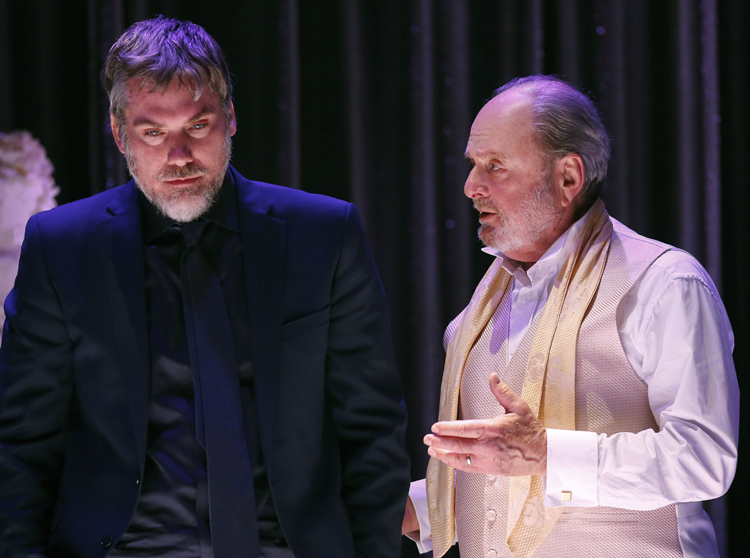
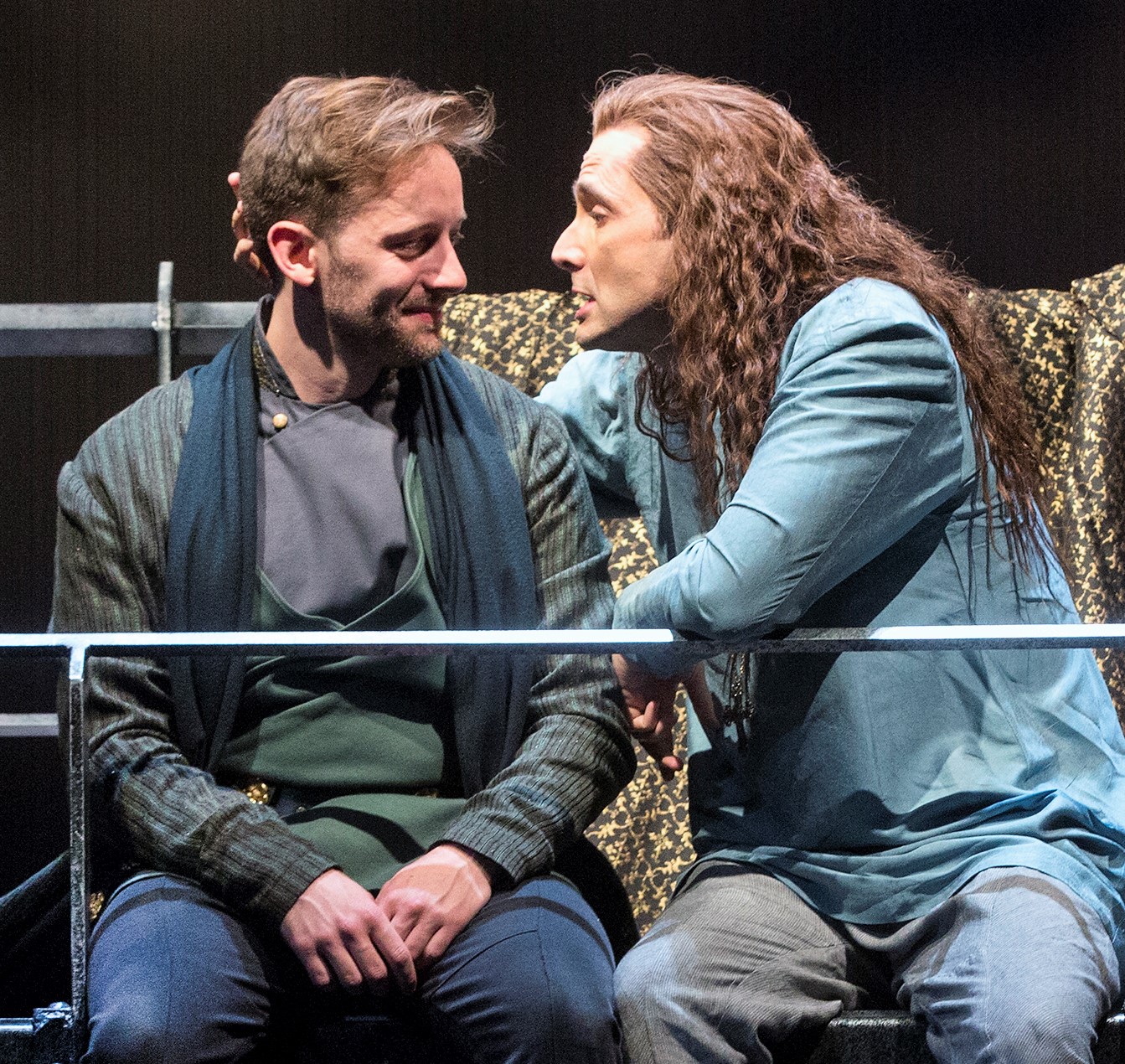
Jasper Britton (left) is Henry Bolingbroke and Matthew Needham is his son, Harry Percy, aka Hotspur, in Richard II. Top: King Richard II (David Tennant, right) with Sam Marks as Aumerle.

Jasper Britton (left) is Henry Bolingbroke and Matthew Needham is his son, Harry Percy, aka Hotspur, in Richard II. Top: King Richard II (David Tennant, right) with Sam Marks as Aumerle.

In order to fund wars to subjugate the Irish, Richard plans to tax the rich. With Bolingbroke banished for feuding with another noble, and his father, John of Gaunt, dead, Richard seizes the inheritance that belongs to his cousin, and goes off to war, where he is unaware of a rebellion at home: Bolingbroke has returned from exile to claim his inheritance and is likely to depose Richard. At the center of the play is the issue of divine right: does the king rule as God’s representative on Earth? Is everything he does God’s will?

Doran plays up the notion of Richard as a divine figure with costume supervisor Stephanie Arditti’s white robe that gives Richard, with very long hair, the look of Christ. The language of Christianity is threaded throughout: “balm,” “water” and “Pilate.” In a climactic scene, Richard himself calls his eventual killer “Judas.” (It’s a key change from Shakespeare, where Richard is slain by Sir Piers Exton, an assassin; this murderer is closer to home.)

The other key relatives in Richard II besides the short-lived John of Gaunt (Julian Glover), who delivers the speech about “this earth, this realm, this England” thrillingly, are the Duke of York, the last of seven sons and also Richard’s uncle, and his son Aumerle (Sam Marks), who becomes Richard’s cousin-with-benefits in Doran’s reading—the homosexual subtext is more forthright here but not unheard-of. Oliver Ford Davies plays the Duke of York with a booming voice, by turns denouncing his nephew Bolingbroke and then backing off. Torn between believing the king is chosen by God, yet finding his regency while the king fights in Ireland is undermined by men with troops, he finally says, “I am neuter” in a great Shakespearean pun.

There is a brief appearance, too, by Harry Percy (Matthew Needham), who will become known as Hotspur by Henry IV, Part 1 and is already clearly a man of action and sinew, albeit a bit dim.

Britton (right) with Sean Chapman as Northumberland. Photographs by Richard Termine.

Britton (right) with Sean Chapman as Northumberland. Photographs by Richard Termine.

Richard II is all verse, and is spoken commandingly here. Tennant raises the pitch of his voice as the lightweight king. His delivery of “For God’s sake, let us sit upon the ground/And tell sad stories of the death of kings” is beautifully staged—his dwindled retinue all sit, although it’s clear their butts are unfamiliar with the Earth. When Richard then takes off his crown and contemplates it, the parallel of Hamlet looking at Yorick’s skull is unmistakable. (Some critics viewed Tennant’s Hamlet in 2008 as the best since Laurence Olivier’s; this New York debut is mandatory for anyone who regrets missing that.) The crown itself is used again when Tennant spars wittily and cleverly with Bolingbroke. He takes it off and holds it out to his side. “Seize the crown,” Richard tells Bolingbroke, and then, in the tone of coaxing a dog to fetch, “Heee-re, cousin.”

With the language on display, the primary feature of Stephen Brimson Lewis's set is a catwalk that descends at times for Richard’s court appearances; projections, including a white stag and a bloody moon, add color. Trios of trumpeters and plainsong singers in the side balconies provide considerable aural texture, while the smell of incense is an unexpected addition of medieval atmosphere along with Tim Mitchell’s tenebrous lighting.

Any quibbles are minor. Occasionally a character lowers a voice and a word or phrase is dropped. Leigh Quinn’s Queen is passionate and speaks clearly, but one wishes her power of projection were as strong as her acting.

Overall, though, Doran has created this 14th-century Shakespearean world with great precision, attending not just to Tennant’s towering performance, but to tiny moments: the forgetfulness of Jane Lapotaire’s Duchess of Gloucester, the dry joke cracked by a lady-in-waiting and the chilling prophesies from a minor character: “The pale-faced moon looks bloody on the earth/And lean-looked prophets whisper fearful change.” This Richard II is curtain-raiser to what promises to be a landmark visit.

The Royal Shakespeare Company’s Richard II plays in repertory with Henry IV, Parts 1 and 2, and Henry V, through April 21 at BAM Harvey Theater (30 Lafayette Ave. between Ashland Place and St. Felix Street in Brooklyn) through April 29. Tickets start at $35 and are currently on standby for this performance. Visit www.bam.org/theater/2016/richard-ii for information on availability or the day-ticket lottery.  

Click for print friendly PDF version of this blog post

Uganda Comes to New York City

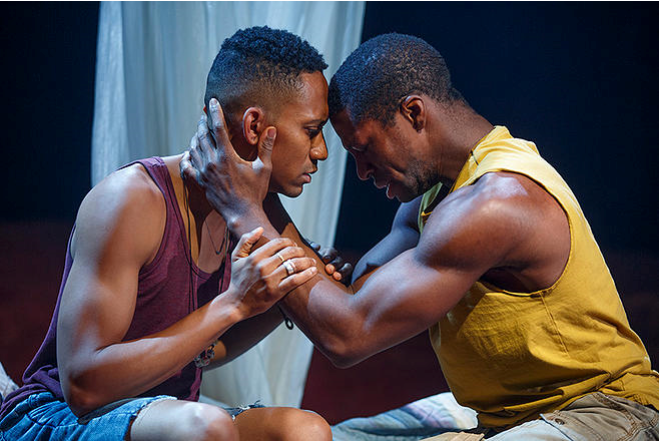
In 2005, Griffin Matthews made the nearly 7,000-mile journey from the skyscrapers of New York City to the hills of Uganda to become one of the many American volunteers looking to “find themselves” and “change the world” by building schools in Africa. Now, Matthews stars in a musical about his journey and in doing so, brings the lives of those in Uganda to a New York City stage. Sound a little cliché? Perhaps it is, but Invisible Thread is a feel-good story brought to life by a clever script, catchy score, uplifting message and talented cast.

Co-written by Griffin Matthews and real-life partner/composer Matt Gould, Invisible Thread began as a piece titled Witness Uganda which won the Richard Rodgers Award for Musical Theater in 2014. Griffin was a struggling actor booted from his church’s choir for being gay when he made the decision to leave his boyfriend Ryan (Corey Mach) behind to sign on as a volunteer. Instead of simply extolling this decision, Invisible Thread calls into question the reason that people perform altruistic deeds in the first place. Is it to help others or to help ourselves feel good? And does the motivation really matter if there is good coming from it?

Matthews & Luwoye

Through self-deprecating humor and witty lines, both Ryan and Griffin acknowledge their somewhat stereotypical problems. “Imagine, a gay in the tenor section!” Upon arriving in Uganda at the compound where he will be building a school, Griffin meets a woman who is ironically named Joy (Adeola Role). She has built up a wall to protect herself from the constant stream of volunteers who she has learned she will never see again despite their promises. Griffin also meets Jacob (Michael Luwoye), Joy’s brother who works at the compound. They quickly form a bond and Jacob reveals what is really going on with all the schools the volunteers are building. Pastor Jim, who we never meet, immediately sells them for a profit once the volunteers leave.  

Looking for answers, Griffin follows Jacob to the market, where he encounters and befriends four teenage orphans—Ronny (Tyrone Davis, Jr.), Grace (Kristolyn Lloyd), Eden (Nicolette Robinson) and Ibrahim (Jamar Williams). Discouraged by the news that his volunteer efforts with the school will result in no real change, Griffin decides that he will instead teach these four teens and Jacob in an abandoned library. As things progress, Griffin realizes that he may be in over his head. His relationships with the students and his determination to make a difference strengthen despite the obstacles.

Kids

Throughout the musical, contemporary songs mix with ones of a more Sub-Saharan styling but all are catchy and moving. The choreography by Sergio Trujillo and Darrell Grand Moultrie complements the music wonderfully and adds an energy and power to the performance that is further enhanced by stunning, soulful vocals from the ensemble. A dirt stage is slightly mismatched with the two projection screens, calling attention to the differences between New York City and Uganda.

Diane Paulus directs a talented cast with Role delivering a standout performance as Joy. Mach does what he can with the role of Ryan, though the character seems somewhat less developed than it could be and appears to be an evolving piece in the script based on previous iterations of the production. The climax in the second act seems somewhat muddled, though everything comes together in the end, perhaps too perfectly to properly portray the complicated topics addressed. Invisible Thread is a production which is clearly a result of passion and purpose but it manages to avoid becoming preachy or self-promotional.

Invisible Thread is playing at Second Stage Theater (305 West 43rd St. between 8th and 9th Aves.) through December 27. Tickets range from $69-$125 and can be purchased by calling 212-246-4422 or visiting www.2st.com

Click for print friendly PDF version of this blog post

O Most Dread Dane

Austin Jones (left) plays Horatio, and Peter Sarsgaard plays Hamlet and in the Classic Stage Company’s production of Hamlet.

If you have seen Hamlet several times and are likely to be bored with a straightforward rendering, then perhaps the Classic Stage Company’s new modern-dress production, directed by Austin Pendleton, is the one for you. It’s full of bizarre ideas to a fault.

Where to begin? Well, one of the great revenge tragedies no longer has a hero who kills his enemies. This Hamlet is not directly responsible for the deaths of Laertes or Claudius. In the duel between Hamlet and Laertes, the latter cuts Hamlet with the poisoned rapier, then lays it down on the floor. Hamlet charges him like a bull; they wrestle; and Laertes accidentally rolls on top of his sword and wounds himself on the poisoned tip. As for Claudius, the action of Hamlet stabbing the king is omitted. After Gertrude lies dead, Hamlet hands the king the poisoned cup and commands: “Here, thou incestuous, murderous, damnèd Dane/Drink off this potion.” Claudius, berated into suicide, quaffs the drink.

Glenn Fitzgerald (left) is Laertes, and Harris Yulin is Claudius in director Austin Pendleton’s production.

The one person this Hamlet does kill is Polonius, but that’s an accident. Still, weirdness is injected here too. Polonius’s ghost walks out from behind the arras, crosses the stage, and then exits. By comparison, the Ghost of Hamlet’s father—a character who actually has lines—is invisible in this production. Invisible ghosts have been used in tandem with dialogue spoken on tape, but here the Ghost’s words are eliminated as well, as if it were entirely in Hamlet’s imagination (although Francisco, Bernardo, and Marcellus speak of seeing it). And Ophelia’s ghost appears unexpectedly to hover around her own gravesite. So extra-textual ghosts are real, but Shakespeare’s real Ghost doesn’t exist?

If Pendleton has a concept, it appears to be that Hamlet is insane from the get-go, that his imagination is working overtime. That might explain why an uncut, multi-tiered wedding cake sits upstage, some two months after "the funeral meats did coldly furnish forth the marriage table.” Either the clean-up crew has been on strike, or it’s a symbol weighing on Hamlet’s diseased mind.

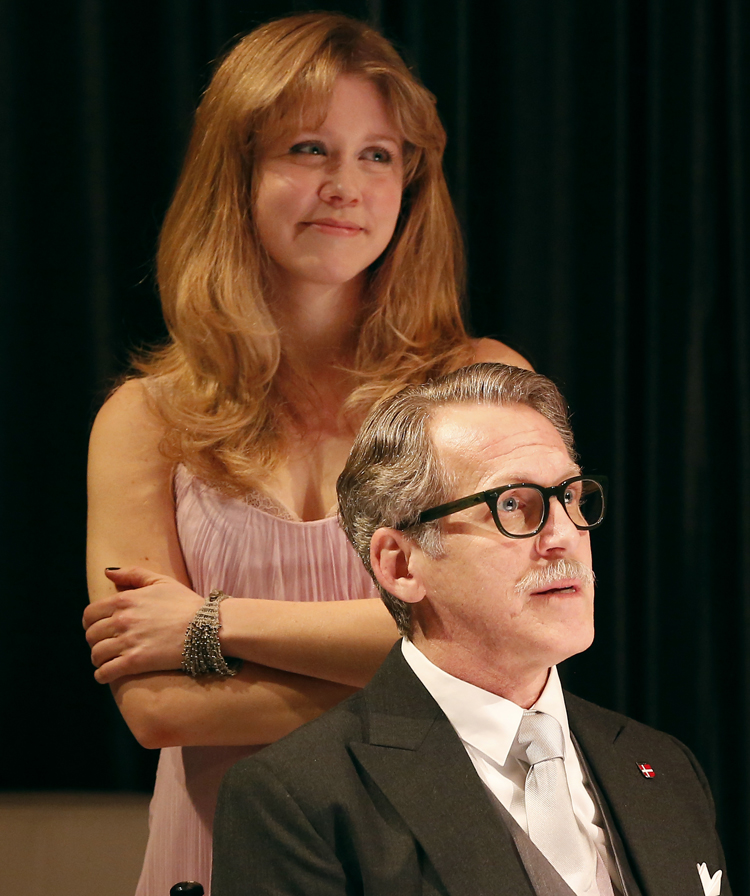
Lisa Joyce is Ophelia, and Stephen Spinella plays her father, Polonius.

Still, troublesome ideas can sometimes be overcome by outstanding acting. But Peter Sarsgaard seems determined to sledgehammer the meter of the verse into little pieces. Actors such as John Gielgud, accounted one of the great 20th-century Hamlets, and directors such as John Barton have advised that if one follows the scansion of Shakespearean verse, it will buoy the actor and the sense will reveal itself. Sarsgaard doesn’t, and he sinks like a stone. He puts in pauses every three words or so. On “a little more than kin … and less than kind,” the delay kills the pun. Moreover, his delivery is so halting throughout that one suspects he hasn’t got the words down. Certainly he’s not letter-perfect in the crucial “To be or not to be,” and lyricism is repeatedly sabotaged.

Gielgud, who directed Richard Burton in the role on Broadway, wrote in Stage Directions that “a Gertrude older than 50 must surely be unconvincing on the stage.” Pendleton has chosen Harris Yulin and Penelope Allen as Claudius and Gertrude. With the Internet at one’s fingertips, it gives nothing away to say that both are in their eighth decade. When Yulin’s skillfully spoken but lethargic Claudius tells Hamlet he wants him to stay at court rather than leave for Wittenberg, you might suspect that it’s because he has his eye on Hamlet as a caregiver.

Sarsgaard as Hamlet confronts his mother, Gertrude (Penelope Allen). Photographs by Carol Rosegg.

Pendleton’s casting repeatedly creates inconsistencies. Hamlet’s school chums, Rosencrantz and Guildenstern, are considerably younger, and Rosencrantz (Scott Parkinson) doubles as the Gravedigger, even though Jim Broaddus, an actor closer to the right age who is superb in smaller parts such as the Player King, would have been more apt. Glenn Fitzgerald as Laertes has a resonant voice and a presence that make one wish he had more to do. Unfortunately, although Hamlet claims to be “fat and scant of breath,” Sarsgaard is clearly in good shape. It’s Fitzgerald’s Laertes, supposedly an athletic and practiced swordsman, who is carrying a few extra pounds.

Ultimately, it’s Stephen Spinella’s Polonius who feels like the best-rounded character. He’s a dapper, instinctively shrewd courtier with warm feelings for his family. Still, the play isn’t called Polonius—though in the hands of Pendleton and Sarsgaard, it’s not so much Hamlet either. 

The Classic Stage Company production ofHamletruns through May 10; evening performances are at 7 p.m. Tuesday through Thursday and Sunday, and 8 p.m. Friday and Saturday. Matinees are at 3 p.m. Saturday and Sunday. Tickets are $65 and may be purchased by visitingwww.classicstage/.org.

Click for print friendly PDF version of this blog post

More Ado in Harlem

The Public Theater presentation of Much Ado About Nothing, with a starry cast performing in the bucolic setting of Central Park's Delacorte Theater, is likely to be among New York City's most sought after tickets. Up at the 133rd Street Arts Center, What Dreams May Co. Theatre and Queens Players are currently offering another Much Ado, hardly publicized but well worth a visit. In a perfectly ordered New York City, the masses of would-be theatergoers who fail to score seats for Much Ado in the Park (and those unwilling to sacrifice a day to waiting in line for free tickets) would find their way to Harlem to see the handiwork of 14 unknown actors, directed by Nicole Schalmo, in a tiny, second-floor auditorium with a minimum of scenery and equipment.

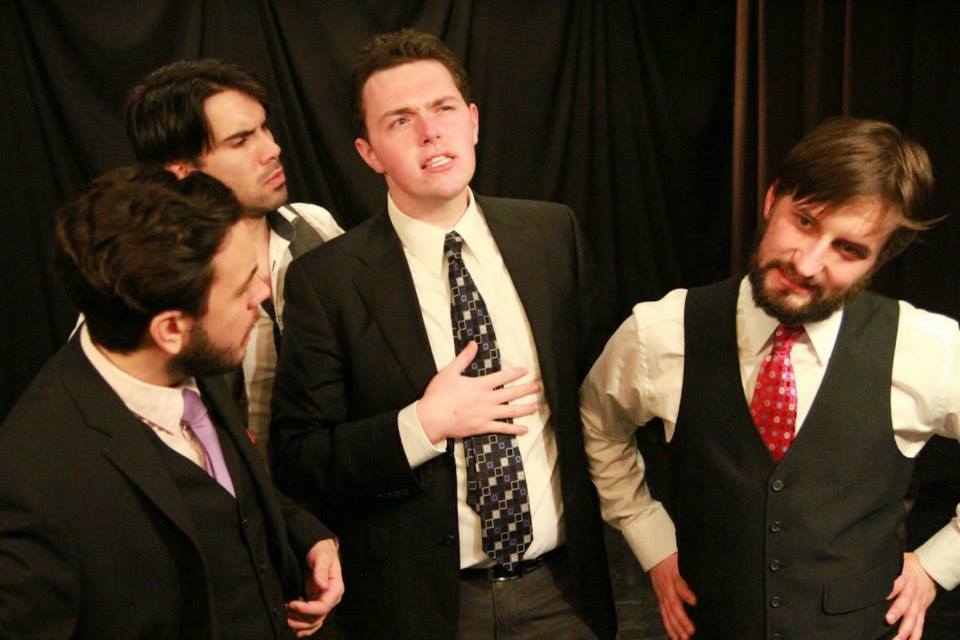
Much Ado About Nothing is a rowdy mixture of the silly and the serious. The central plot comes from classical Greek literature via 16th-century Italian sources — Ludovico Ariosto and Matteo Bandello — and Edmund Spenser's English epic The Faerie Queene. The story concerns Claudio (Gregg Ellson), just home from war, who spurns his bride, Hero (Christina Sheehan), at the altar. Hero is virtuous, but circumstantial evidence, contrived by the toxic Don John (Jonathan Emerson), suggests otherwise; and Claudio has been taken in by Don John's scheme. Hearing Claudio's harsh accusations, Hero faints away; her father, Leonato (Rafael Svarin), claiming she's dead, concocts a plan to clear her name and punish Claudio's arrogance. Things are dire until a band of bumbling rustics — constable Dogberry (Kenny Fedorko), his sidekick Verges (Nathan Beagle), and two officers of the municipal watch (Kate Fallon and Meghan Blakeman) — unwittingly thwart Don John's conspiracy.

There isn't much that's plausible about the misunderstanding between Claudio and Hero or what follows it; and, based on that implausibility, W.H. Auden has declared that Much Ado is "not one of Shakespeare's best plays." Yet throughout the past four centuries, this relatively dark comedy has been a crowd-pleaser. Its popularity is due, in large measure, to the subplot in which Hero's cousin Beatrice (Aimee Marcelle) and Benedick (Gonzalo Trigueros), a military comrade of Claudio, are tricked into falling in love with each other. The opinionated, sharp-tongued Benedick and Beatrice are among Shakespeare's most vivid creations; and Auden aptly describes them as “the characters of Shakespeare we’d most like to sit next to at dinner.”

The youthful cast handles both verse and prose with confidence and brio. Fedorko, adept at low Shakespearean comedy, makes Dogberry a highlight of the proceedings. Emerson, a forceful, nuanced Macduff in the What Dreams May Co. Macbeth last December, does what he can to lend verisimilitude to a one-dimensional role; his Don John is an exuberantly villainous cartoon, enormous fun to watch but inexplicably malevolent.

As in most productions of Much Ado, the evening belongs to Beatrice and Benedick. Shakespeare uses the reluctant lovers as tools to skewer the conventions of courtly love; Marcelle and Trigueros (presumably guided by Schalmo) ensure that Beatrice and Benedick are always emotionally complex and convincing. Marcelle is a striking comedic presence, compellingly vivacious without upstaging her compatriots. She's well-matched in raillery and romantic chemistry by Trigueros's Benedick. The pair navigate a credible, touching transformation from prickliness to devotion. 

In addition to being the production's director, Schalmo is responsible for costumes and, with Emerson, for the lighting design. She has transferred the action of the play from Renaissance Messina to a small town in the American Midwest. This conceit, applied with a light touch, works very well for a story of deception, backbiting and intrigue; and it frees the actors of anxiety about speaking Shakespeare's lines in their natural accents. 

Schalmo and her self-assured cast keep the action moving at a swift, consistent pace and make the most of the modest dimensions of the 133rd Street Arts Center stage. With no design fripperies to distract the audience, the production is focused throughout on the humor and beauty of the Bard's text. The simplicity of this Much Ado turns out to be a formidable asset.

Much Ado About Nothing by William Shakespeare, presented by What Dreams May Co. Theatre, in association with Queens Players at the 133rd Street Arts Center (308 West 133rd St. between St. Nicholas Ave. and Frederick Douglass Blvd. in Harlem), runs Thursdays, Fridays and Saturdays at 8 p.m., and Saturdays and Sundays at 3 p.m. through June 21. Tickets: $18. For tickets, visit www.brownpapertickets.com/event/495842 or call 1-800-838-3006.

Click for print friendly PDF version of this blog post

In Relative Distress

In Relative Distress

Charles Busch’s fizzy new work, The Tribute Artist, is really light summer fare, but since it has shown up to make this brutal winter a lot cheerier for a couple of hours, who’s going to complain? In his latest outing, Busch, who usually plays female characters, is Jimmy Nichols, a gay drag performer—or, as Jimmy prefers, “tribute artist”—who has been canned from his longtime job at a Las Vegas revue. The solid comedy he has constructed is rather like Charley’s Aunt for the 21st century, with nods to Arsenic and Old Lace and Weekend at Bernie’s.

Click for print friendly PDF version of this blog post