
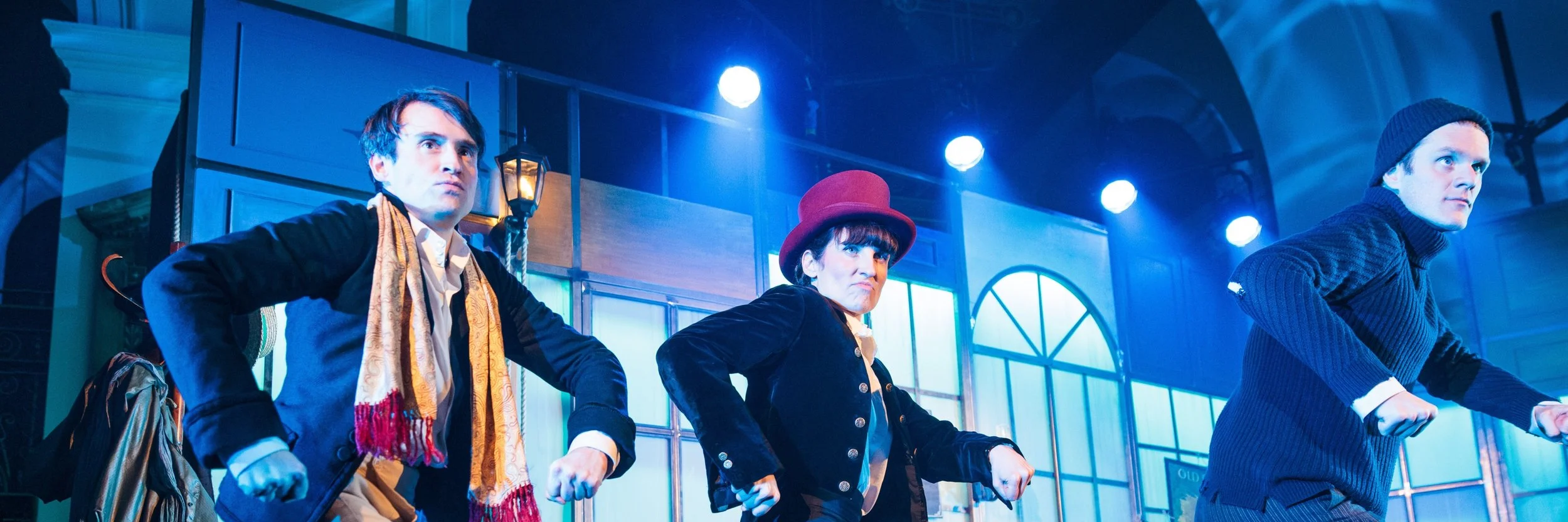
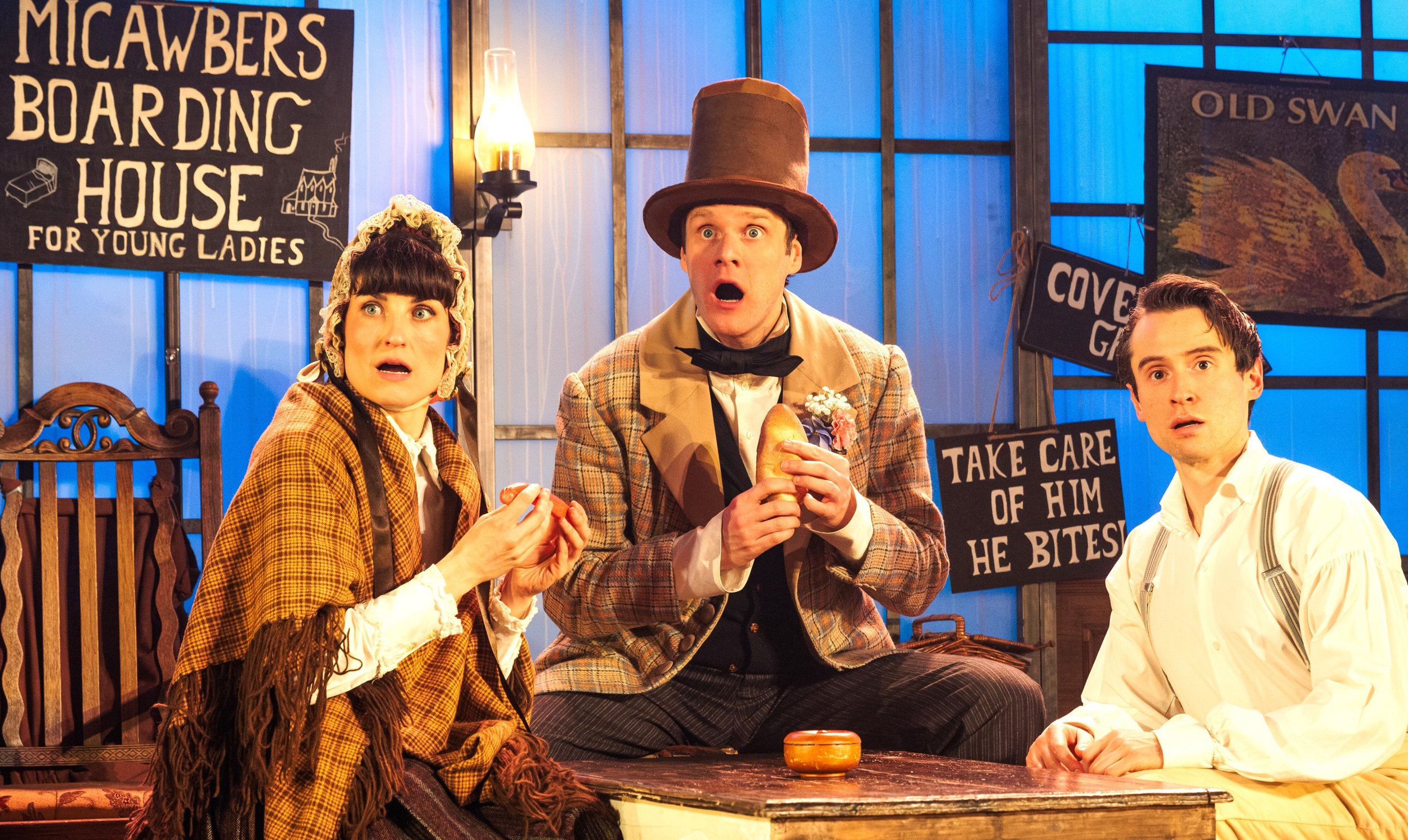
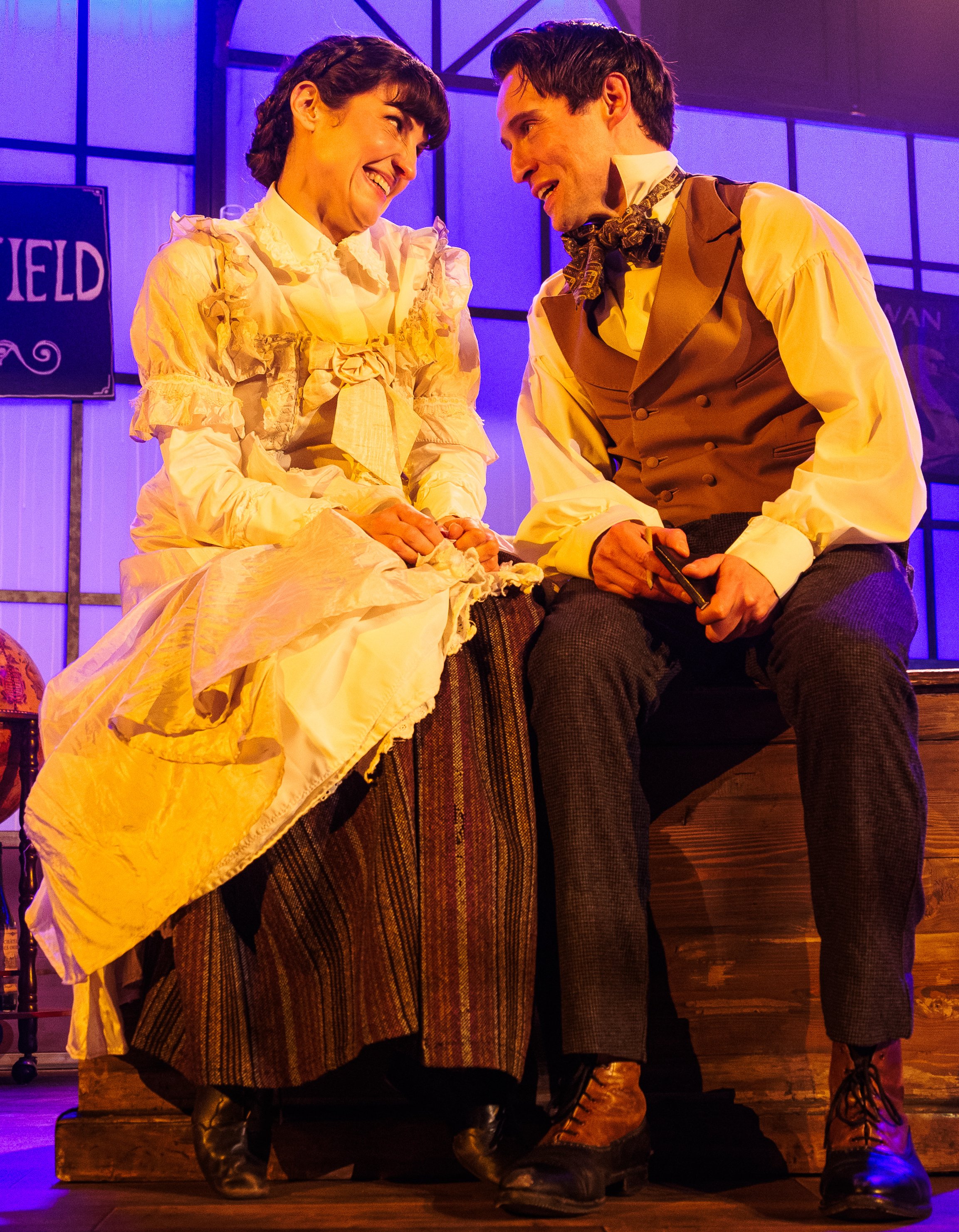
David Copperfield (Eddy Payne, right) has lunch with the poverty-stricken Mrs. Micawber (Louise Beresford, left) and Mr. Micawber (Luke Barton) in the Guildford Shakespeare Company’s production of Charles Dickens’s novel.
Abigail Pickard Price’s production of Charles Dickens’s David Copperfield may not include all the great characters of the 800-plus pages of the novel, but her exciting adaptation (with Sarah Gobran and Matt Pinches) for the Guildford Shakespeare Company is not to be missed.
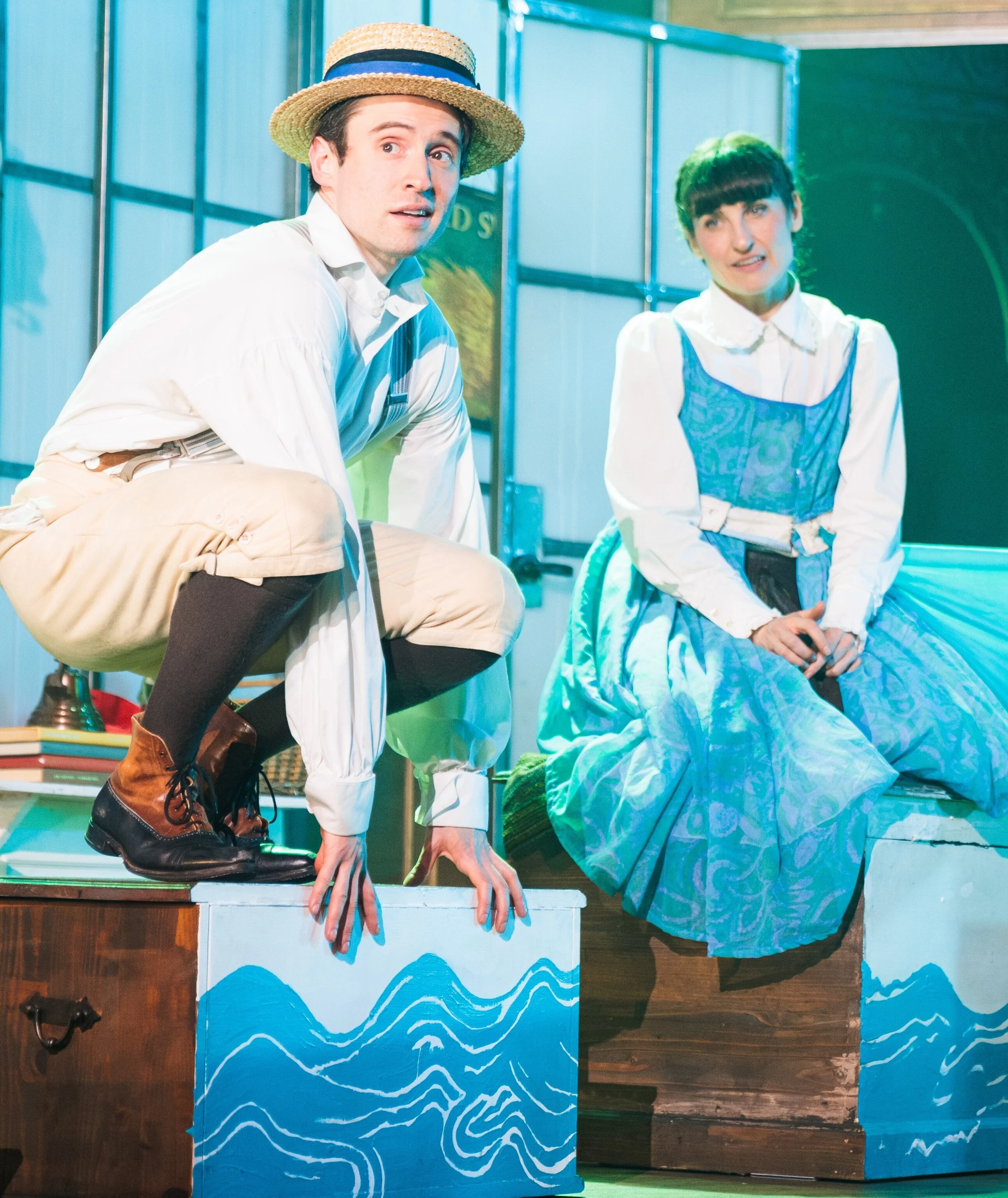
David (Payne) finds a young playmate and friend in Little Emily (Beresford) at Yarmouth.
The condensation of the masterpiece is skillfully done. From the sudden appearance at David’s birth of his man-hating great-aunt, Betsey Trotwood, the action hurtles forward. As Betsey awaits the delivery of a girl, she receives the periodic reports of the housekeeper Peggotty: “Peggotty? Do you mean to say, child, that a human being has gone into a Christian church, and got herself named Peggotty?” But the birth of a boy disappoints her. “My great-aunt, the first and only Miss Betsey Trotwood,” Eddy Payne’s David narrates, “vanished like a discontented fairy and never came back.”
David’s adored mother marries the chilly Mr. Murdstone, who drives his wife to an early grave, then sends off David to boarding school, where he encounters the cruel headmaster Mr. Creakle and a charismatic fellow student named Steerforth. Then he is put to work at a dead-end job in London, all before he is a teenager—echoing Dickens’s own childhood experiences. Foreseeing a life of penury and misery, David flees to Aunt Betsey, who rescues and adopts him, raising him with the help of her possibly mildly autistic housemate, Mr. Dick, whom she regards as an oracle.
As in all Dickens novels, characters come and go. Studying in Canterbury, David boards with Mr. Wickfield and meets Wickfield’s daughter Agnes. Through the years he maintains a friendship with them and also with Peggotty, her brother, and Ham and Little Emily, the children of their dead siblings, who all live in Yarmouth in the remains of an overturned boat—“the most delicious retreat that the imagination of man could conceive,” says Payne’s slightly built, calmly centered David, who narrates his story and also participates as the hero. The vivid characters he meets are all embodied by only two actors: the tall, strapping Luke Barton and the petite Louise Beresford.
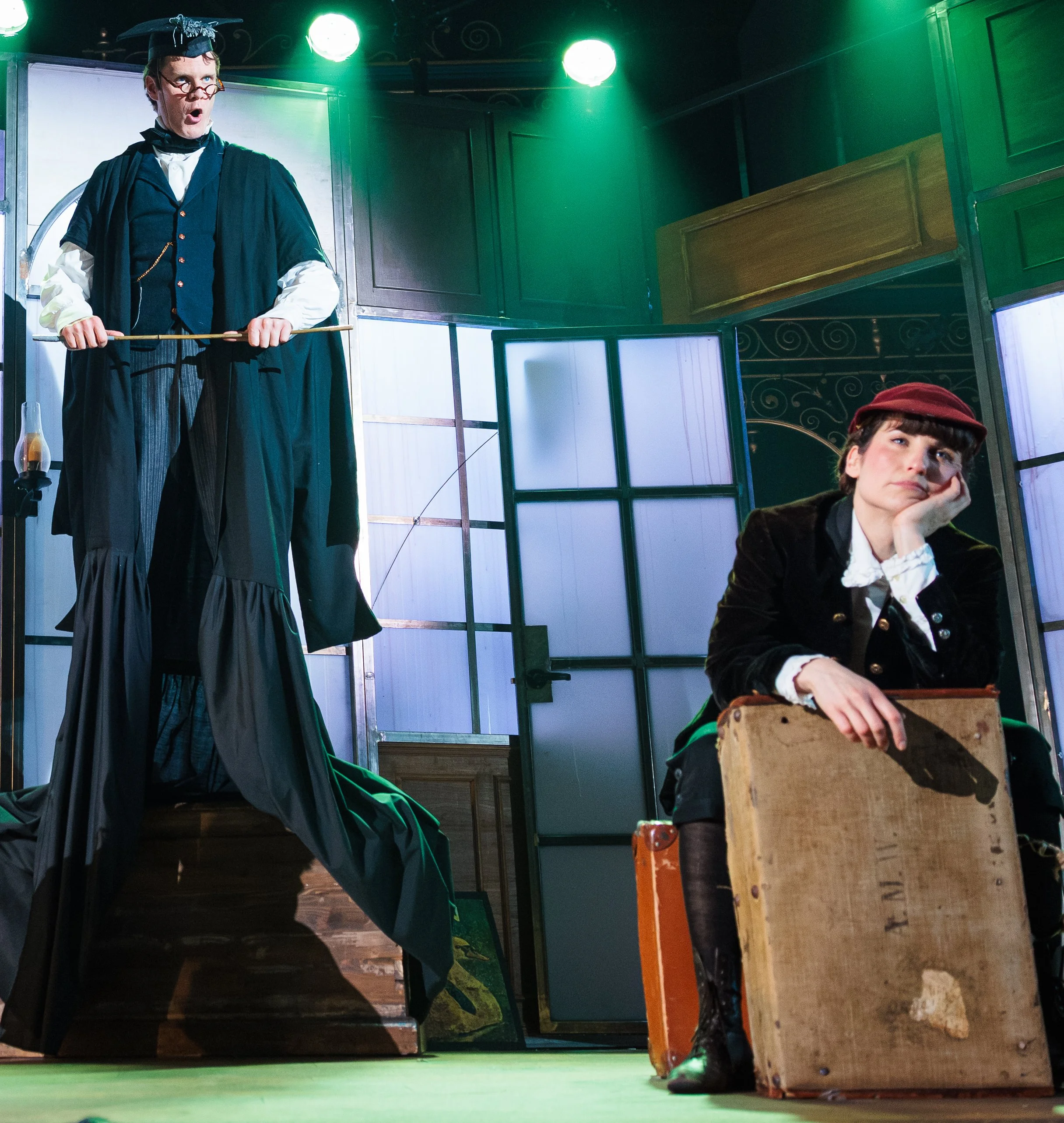
Mr. Creakle (Barton) presides brutally over a boarding school where David is sent and where he meets the charismatic Steerforth (Beresford).
David struggles through life to find out who he really is, a challenge underscored by his having a variety of nicknames: to his aunt he is Trotwood Copperfield; to his first wife, Dora, he is Doady; and Steerforth calls him Daisy. The painfulness of his early years leads to some callowness in his attachments. David has a habit of being seduced by appearances and misunderstanding who people really are, from the haughty Steerforth to the socially aspirational Emily. Price’s script softens the intensity of that flaw.
Price also directs the show with unbounded theatricality, using, for instance, a tiny puppet theater for David’s dinner with Mr. Spenlow, Dora’s father (a puppet), who finds David’s love letters to Dora and abhors their secret engagement. When he declares that David will marry her “over my dead body,” the outcome is both grim and hilarious.
The period clothes designed by Neil Irish and Anett Black are not only colorful but at times serve to replace actors. The grim Murdstone exists only in apparel held by Barton, while the iconic blue dress worn by Little Emily dwindles to the garment alone in a lively dance sequence.
There are inevitably small disappointments. Not every juicy character has survived Price’s cutting, including Miss Murdstone and David’s school chum Traddles. And Uriah Heep makes a less forceful impression than in the novel.
David woos the flighty Dora Spenlow, who becomes his wife. Photographs by Harry Elletson.
Barton has the hardest part as the financially strapped Mr. Micawber, made indelible by W.C. Fields in the 1935 MGM film. Barton is certainly a better-looking Micawber, and his delivery preserves the melodrama of lines like “The worm is at his work” (about Heep) while avoiding the florid vocals of Fields. His success is helped by the fully rounded performance of Beresford as Mrs. Micawber, who has not just undying devotion but perhaps, quite credibly, a bit of lust for her husband, as she declares, “I shall never leave Mr. Micawber!”
Barton also fills the shoes of the seafaring Ham perfectly—as well as the flustered Peggotty. He is a terror as Mr. Creakle at the boarding school and is equally noxious as Mrs. Steerforth, a composite of Steerforth’s arrogant mother and her poisonous companion, Rosa Dartle.
The whole journey, including the thrilling climactic shipwreck scene at Yarmouth, is breathtaking and unforgettable.
The Guildford Shakespeare Company’s David Copperfield runs through June 28 at 59E59 Theaters (59 E. 59th St.). Evening performances are at 7 p.m. Tuesday through Saturday; matinees are at 2 p.m. Saturday and Sunday (and on Thursday, June 11). For tickets and more information, visit 59e59.org.
Adapted by Abigail Pickard Price, with Sarah Gobran & Matt Pinches, from the novel David Copperfield by Charles Dickens
Director: Abigail Pickard Price
Set Design: Neil Irish
Costume Design: Neil Irish & Anett Black
Lighting Design: Mark Dymock
Sound Design: Matt Eaton
If you enjoyed this review, please click on the Like icon below.
