
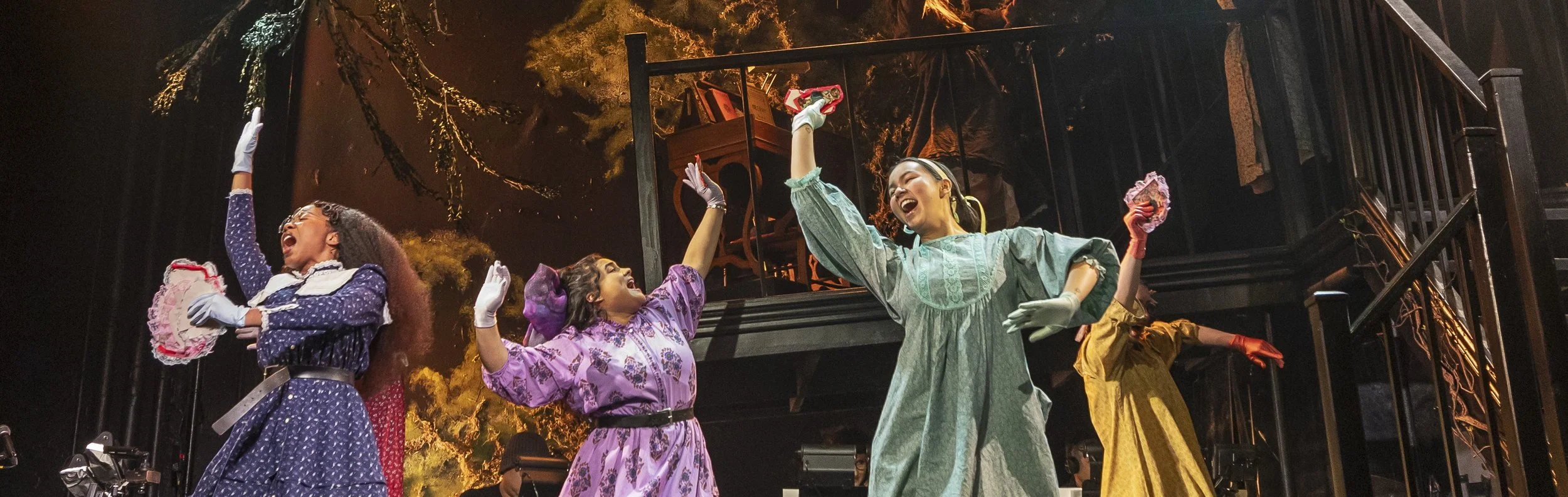
Musical

Funniest Mother Around

I am not Jewish, and I am not a mother. Fortunately, neither condition is a prerequisite for attending—or enjoying—25 Questions for a Jewish Mother, Judy Gold's entertaining one-woman show at Ars Nova. What first drew me to this production was not Gold's reputation, which I recognized, but the reputation of the credited writer, Kate Moira Ryan. I'd never seen one of her plays, but I had seen her name mentioned again and again in relation to downtown theater, and I wanted to become familiar with her work.

After watching this show, I still don't believe I've seen a Kate Moira Ryan play. That is, this production didn't look like a play. Instead, I felt as though I were in a small cabaret, set up with only a chair and a microphone, watching Gold perform her life's story, along with the stories of the Jewish mothers interviewed for this project.

The influence of Ryan, director Karen Kohlhaas, and the show's designers was undetectable throughout the hour-plus production. Gold's performance seemed well practiced, but never scripted or staged. The others clearly supported her, and the result appears effortless and polished.

Part standup routine, part autobiography, and part investigative performance, 25 Questions has Gold introducing us to the larger-than-life character of her mother and wondering why exactly she is the way she is, leading her to ask whether she's likely to turn out the same way. In order to better understand her own mother, Gold and Ryan pose 25 questions to Jewish women—all mothers—from a variety of backgrounds.

For the performance, the stage is divided into thirds. All interview questions are asked and answered stage left. Stage right is reserved for excerpts of standup comedy routines, while the narrative is told from center stage. We hear the question asked, followed by a recorded voice indicating to us the number of children, occupation, and level of religious observance (Orthodox, Reform, etc.) of the mother we are about to meet. Taking a seat, Gold then re-enacts that mother answering her question.

The questions ranged from the expected (what typifies a Jewish mother?) to the universal (what is your biggest regret?) to the very specific (how do you feel about the way women are treated in your religion?). Each question illustrates Gold's story, a tale that begins with childhood and charts her adolescence, her early career, her identity as a gay woman, and, finally, her introduction to motherhood. The questions worked well as transitions and advanced the narrative without losing touch with its premise.

Gold is probably best known to audiences as a comic, and her ease in front of a crowd is instantly apparent. Her deadpan delivery is perfect for the wry tone of the material she performs. She morphs well into each interviewee; she was able to inhabit them physically instead of relying too much on the standard comedy technique of impersonation. There was not a particularly wide range of characterization, since all the interview subjects were female, and I would have preferred knowing the age of each woman Gold portrayed, as these details were only occasionally referenced in their answers. When they were not obvious, I had some trouble differentiating between a 45-year-old and someone older.

I also struggled to differentiate new mothers, mothers of young children, and mothers of grown children. While these details weren't needed to understand the responses, I often got distracted trying to figure out which category each mother belonged in.

Just past the halfway point, the show seemed to lose its quick pace when Gold's story shifted to 9/11 and her run-in with the U.S. Homeland Security Department. However, the connection to her mother remained constant, and when, at the end, Gold herself answers one of the interview questions, we realize that she too is a Jewish mother. This is never a fact that she hides; she makes a point of mentioning it at the beginning of the show. But until the audience sees her sitting in the interview chair—no longer affecting another's posture or voice—she still seems slightly distanced from this world.

Many of the questions in this project could be asked of any woman, because they deal with basic gender-identity issues and the relationship of motherhood to modern society. Gold's goal is to explore these areas in her own life. She poses serious questions and receives serious answers, but balances them beautifully with humor and a winking self-deprecation. One interviewee, when asked for the best advice she had received from her mother, declared it was optimism. Through Gold's energetic performance, this optimistic spirit pervades the show, and I left feeling happy, hopeful, and with an overwhelming urge to call my mother.

Click for print friendly PDF version of this blog post

Good Neighbors

Nowadays, actors are not content simply to be told what to do and say. Their discontent frequently leads them into the more powerful roles of writer and director. Sometimes they are looking for different means of self-expression. Sometimes they want to explore careers that don't end at age 50. And sometimes they just feel they could do the jobs better than the current crop. Jeff Daniels, known mostly for his film work, has been writing shows for his Michigan-based Purple Rose Theater Company for the past 15 years, a fact that the average moviegoer (and even theatergoer) may not know. But what's most surprising about his theatrical work is not that he's doing it but that, if Apartment 3A is any indication, he's doing it so well.

Producers Lisa Dozier and Traci Klainer are presenting Apartment 3A at the ArcLight Theater, a classic proscenium stage within a church and a fitting location for this spiritually minded piece. When the play opens, public television employee Annie Wilson moves into the titular apartment after catching her boyfriend "in bed" (or, really, on a table) with another woman. Her self-sought isolation in the new building is shattered by Donald, her nosy but well-intentioned neighbor across the hall. He pushes Annie to engage with the world and the people around her, including Elliot, a co-worker who's desperately in love with her. What Annie needs most is to discover her faith in the world so she can find her faith in love.

Amy Landecker's Annie is private, sarcastic, and introverted, but also very passionate, funny, and smart. Landecker makes sense of the open and hidden areas of the character's personality while at the same time hinting at further complexity. And her interactions with the other actors crackle with life and intensity.

As the quirky and faithfully married Donald, Joseph Collins finds a way to keep "nonthreatening" from being boring. And Arian Moayed invests Elliot with a boyish energy that becomes sexy once Annie, and the audience, catches on to his deeper passions and eccentricities.

Set designer Lauren Helpern has created an apartment set that most young audience members would find nicer than their own dwellings, with dark-wood floors and a lovely, powder-blue paint job. A projected TV logo on the wall and the conversion of the kitchen into an editing room transforms 3A into Annie's office, a very effective solution for streamlining the scene changes.

Daniels's script pops with witty exchanges that are neither too smart nor dumb for the room; every joke worked, even in a crowd that ranged in age from 20's to 70's. When the tone shifted from comic to serious, the author's words and the actors' delivery made for seamless transitions.

Valentina Fratti's assured direction kept the action moving along while allowing for the kind of pauses that occur naturally in awkward situations. The most refreshing aspect of this production was its polish—a rare and beautiful thing in Off-Off-Broadway theater.

Daniels has earned much praise recently for his acting in the indie film The Squid and the Whale. While no one would want to keep a gifted actor from doing good performances, one hopes that as a playwright he'll continue to turn out moving, character-driven plays like this one. Who knows? Perhaps one of these days he'll be better known for his side career than for his day job.

Click for print friendly PDF version of this blog post

Psycho/Sexual

Nelson Avidon's new play, Girl in Heat, now at the Michael Weller Theater, isn't so much a fresh skirmish in the war of the sexes as it is a recap of the conflict's main themes. She's crazy; he's horny. Mind games and clumsy flirtation—the former by her and the latter by him—unsurprisingly ensue. It's tempting to dismiss the piece reflexively, the same way you would wave a hand at a friend telling you something you already know. And if Girl had been cast any differently, this might indeed have been the best way to salute both its coming and its passing. But someone, either Avidon or director Robert Walden, had the good sense to cast Avidon himself and the wonderful Cheryl Leibert. What might otherwise have been as erotically charged as a student essay on Freud becomes, in their hands, less a two-dimensional map than a light sketch of familiar territory. In their best moments—the ones where they are man and woman, instead of "man" and "woman"—you can practically smell the pheromones in Avidon's script.

Given the general lawlessness of the gender war, it's a welcome comedic touch to stage this particular tussle in a lawyer's office. (The richly convincing set is by Maya Kaplun.) Joseph (Avidon) is a litigator coming up for partner in his firm and a married man. Marilyn (Leibert) is a young temp in the last hours of her summer employment. After everyone else in the firm has left for the night, she invites herself into his office for her particular brand of face time with the boss. The erotic tête-à-tête that follows alternates between playful Eskimo kisses and brutal, emotional head butting.

The imbalance is clichéd. He has everything to lose—wife, job, future—while she has nothing, not even (surprise, surprise) her sanity. But underneath its conventions, Girl is entertaining for spotlighting the irrationality at the heart of the human mating dance, particularly on the male end: just how much abuse and manipulation will a man put up with when the carrot of sex hangs, he thinks, just within his reach? The question is practically a part of testosterone's chemical composition.

And if Joseph is any indication, the answer is: quite a lot. Marilyn begins to break him down almost before she's opened his door, mostly through an aggressive insincerity that Joseph is too libidinous to take offense at. As she asks after an exceptionally nasty mood swing, "We're playing games, aren't we?" "Sure," he responds, perhaps a touch too lightly. "Well," she presses, "where's your competitive spirit?"

Elsewhere, after one of her more disconcerting maneuvers, Joseph is left to gawk. "Where did you come from?" he asks, to which Marilyn will only offer, "From reception." Leibert is a torrent of inappropriate emotion; it's a pleasure to watch her sweep the buffoonish Joseph away.

For his part, Avidon uses his wonderfully expressive face to chart Joseph's slow slide backward—as he submits himself ever more fully to Marilyn's wiles—until he has landed squarely in his long-past teenage years. "This is what I thought sex would be like before I had sex for the first time," he giddily confesses while Leibert looks on at him with inscrutable, cold eyes. She is his captor. He is the willing captive. Avidon is cheekily walking us through the Stockholm syndrome of the dating man.

It's a shame, then, that Avidon the writer doesn't walk us as far as we could go. Girl is only two-thirds of a decent play. Questions about what effect the various secrets and bodily fluids swapped by the pair will have on both their lives—in his case, professionally as well as personally—are brought to a fever pitch, only to be abruptly tied off in a nice, writerly bow. A little messiness can be a virtue, however. If Girl in Heat needs to be tied off at all, I would have preferred a tourniquet.

Click for print friendly PDF version of this blog post

Trash to Treasure

Welcome to Objeté, the trash heap of the imagination, where bits of wood, tools, toys, and antique furniture litter the landscape, left to rot in a forgotten wasteland. Produced by the Cosmic Bicycle Theater and the creative genius of the multitalented Jonathan Edward Cross, the show is a visually stunning feast for the eyes that springs to magnificent life in an explosion of childlike abandon and brilliant imagination. Equal parts puppet show and Dada cabaret, it offers pure magic that will enchant children and stir to life the sleeping child within those older. Discarded objects populate the world of Objeté, telling the tender story of Johnny Clock Works (aka Jonathan Edward Cross) and his assistant, Emmy Bean. Johnny longs to experience the world, to fly away, but he remains confined to his little corner of the world with his faithful friend by his side. As the delightful twosome bring the forgotten denizens to life with a mixture of humor, hope, and music, the audience witnesses a wonderful transformation as waste becomes raw materials and decaying debris turns into living beauty. An old grandfather clock lays eggs. An enamel coffeepot becomes a belligerent man. The blades of a fan form wings to fly. An eggbeater and copper mold take the shape of a dancing chorus girl. An antique trunk becomes a boat.

Imagination gives way to Johnny Clock Works's story amidst the backdrop of a silly cabaret. Emceed by a gruff-talking, cigar-chomping baby marionette, the cabaret features a pair of Abbott-and-Costello-style prosthetic legs. Surmounted by fake teeth, the legs tell bad jokes while a sexy dancer, made up of shapely legs, an antique clock, and a red boa, cancans the night away. The cabaret comes to a conclusion with a heavenly chanteuse, in the form of an angelic baby-doll marionette, who sweetly sings herself to sleep. With the help of Emmy, Johnny finds his way through the trash heap into his imagination and beyond, fulfilling his dream to fly off and see the world.

Cross's imagination is nothing short of breathtaking. As writer, director, designer, puppeteer, and star, he displays a talent matched only by his boundless dedication to his craft. His inspiring vision culminates in a hypnotic 50-minute production that is often intriguing, always amusing, and genuinely wonderful.

The radiant Emmy Bean lights up the stage. Never saying more than a half-dozen words, she uses her body and facial expressions to create a fully realized character of affecting depth and humor. With her incandescent smile and sad eyes, Bean is a delightful foil to Cross's fumbling hero.

With this show, Cross has created a vivid reality out of a capricious fantasy. Talking babies, dancing clocks, and a dreamscape of poetic magic await the audience at every turn. Objeté will captivate both children and adults with its whimsical journey into the heart of dreams.

Click for print friendly PDF version of this blog post

On the Front Lines

The International Federation of Journalists recently issued a report documenting that 150 journalists and media staff died in 2005, the most ever recorded in a one-year time period. This statistic should debunk the old notion of the glamorous life led by war correspondents, if it has not been proved archaic already. But what this document does not touch on—and what the evening news neglects to report—is the price paid by the thousands who do survive. Safety, a new play by award-winning British playwright Chris Thorpe, aims to shed light on this disturbing situation. Safety is the second part in a trilogy of plays that examine various aspects of the human experience in response to violent political conflict. It is the dark and complex tale of Michael (David Wilson Barnes), a British war photographer renowned for his iconic global images in the late 20th century. He is an absentee husband and father who has trained himself to see the world through a lens—an occupational hazard of sorts. This allows him to remain at a safe distance, not only from the violent images he documents but also from his own family. But when a stranger named Sean saves Michael's young daughter from drowning while Michael was standing only feet away, he is forced to re-evaluate his roles as a journalist, husband, and father.

Thorpe's play, under the superb direction of Daisy Walker, maintains a heightened level of intensity throughout. This intensity is echoed in designer Kevin Judge's stark, white minimalist set, which doubles as a hotel room and Michael's living room. The set is startling in its emptiness, and in essence represents the dichotomy between the disturbing acts Michael has witnessed and the void it has left in him. The fact that the living room is without any family photographs—and he is a photographer—and that it also serves as the place where Michael carries on an affair with a journalist further illustrates this point.

On this blank canvas, the talented ensemble cast, led by Barnes, delivers compelling performances all around. They clearly relish playing the complex characters Thorpe has created. None are very likable, but none are despicable either. They are human and real.

Michael's wife, Susan, has given up on him and on their marriage. She used to be dazzled by his job and loved hearing about his adventures, but now she is disillusioned by the toll it has taken on her family. Katie Firth plays her with a dejected reserve that enables her to maintain a sense of strength and dignity.

Sean, played by Jeffrey Clarke, at first appears awkward and weak when he comes to the couple's house for dinner. He brings a jar of peanuts as a present, arrives soaking wet, and feels completely out of place in the upscale surroundings. This causes Michael to underestimate Sean's inner fire, a result of serving time in jail. He scorns Michael for his inablity to save his daughter and for his photographs that chronicle death without making an attempt to preserve life. Clarke's performance makes believable the young man's transition, in the course of one evening, from being feeble to being in control.

Susan Molloy plays the other woman in Michael's life. She is a features writer and celebrity interviewer who meets him on assignment and becomes infatuated more with his lifestyle than with their relationship. Susan is Michael 20 years ago, eager to take on the world and naïve about the cost.

But the show belongs to Barnes and his controlled performance as the conflicted photographer. Michael unapologetically embodies the contradictions of those in the profession and the difficulties they face. Barnes's performance--part blowhard, part masochist, part weakling—is equally unapologetic, and honest and raw. Perhaps for the first time is his life, Michael is exposed. After his daughter's near tragedy, he is forced in front of the camera without his weapon of choice—the lens—to rely on. Barnes skillfully captures the unfamiliar sense of vulnerability that Michael experiences.

Thorpe writes in his program notes that Michael "and those who do the job in the real world are unquestionably brave, committed, and necessary." Safety allows us to begin to understand the psychological and emotional price that these men and women pay. A finely crafted play that is of the moment, it is one of those important works that will change the way you look at the world.

Click for print friendly PDF version of this blog post

Quixotic Reveries

If you crave minimalist, character-driven drama where playwrights construct complex yet coherent plots, actors invest themselves in the psychology of their characters, and directors have a totalizing style and vision, then the sublimely subversive group with the officious-sounding name the National Theater of The United States of America is not for you. On the other hand, this troupe of merry pranksters offers "maximalist" experimental spectacle driven by myths and metaphors, arresting images, and restless slapstick and vaudeville. While their plays don't always add up, that's often beside the point—or, perhaps, that is the point: theater is not supposed to be an equation. The sum of their disparate parts—which includes influences as diverse as Dada cabaret, big Broadway extravaganzas, and the twilight zones of Sam Shepherd and David Lynch—always seems happily greater than the whole.

Their newest creation, ABSN: RJAB (Abacus Black Strikes NOW!: The Rampant Justice of Abacus Black), is their first to be performed in a "legitimate" theater space, P.S. 122, though some of their members have been working together since 1997.

Abacus is a parable about the stubborn quixotism that is necessary to pursue one's artistic calling in the face of technocratic philistines and corporate zombies who devour brains. At least, that was my reading of it.

To say that this theatrical event is "about" anything besides its own exuberant theatricality (and the sharing of experience that is its prerequisite) raises the very notion of theater that this group challenges. What makes theater unique as an art form is not plot or characters or a unifying vision but those momentary and too-often elusive experiences of participation in an event that is potentially transformative because it has the immediacy and liveliness of human interaction in a community.

After a purposefully alienating welcome by the show's impresario, the actors construct not one but two stages in the process of a dance sequence set to deafening glam rock. The first is a Coney Island-like sideshow proscenium arch, while the second is a small, slightly elevated "black-box" stage, which lurks behind it. Most of the action, however, takes place between these two frames. Narrators on the proscenium describe the 600-year journey of Abacus Black, an aging knight in search of the lost City of Gold, then reveal vignettes of this story behind the curtain while they strike poses as caryatids.

An impromptu third stage even appears at one point for a mock puppet show, which ends with the largest puppet flipping to become a costume for a character that is part sun god, part scarecrow, and part Texas chainsaw massacre. Later, near the end of his journey, Abacus himself transforms into a human marionette.

One of the most striking scenes occurs when Abacus wraps his legs like a knapsack over the shoulders of a disbelieving yet loyal shaman figure who plays Sancho Panza to Abacus's Don Quixote. The shaman carries Abacus on his back so they may continue their mythic quest. Distant wolf howls pierce the static noise of surf in the background, while a smoke arabesque forms a golden, apparitional aura around a plywood cutout of a saguaro.

The story, however, is quick to break down for poignant philosophical fillips, such as "this was in olden times when knowledge brought people together." The story is equally ready to serve up pointlessly surreal songs—one memorable number might be described as a zombie picnic with Mephistopheles meets The Sound of Music.

Although the dance numbers have more panache than precision and one can hear less than half of what Abacus says in his inaudible, synthesized wheeze, the faults of the production do not prevent it from being an odd sort of triumph. It succeeds as conceptual theater—where the concept is to have fun, and to take the risks that fun entails.

The troupe's frenetic energy is catching. Backstage, I imagine the sound and light crews were equally busy multitasking to provide all the smoke-and-mirror effects.

The last—and most lasting—image of the play depicts the decrepit Abacus sitting on his throne (which has turned into a cage), as if his mythic quest ended with him being a sideshow freak, his sallow face illuminated by a small florescent light. The cage is wheeled backward, and his face recedes slowly into the void of history even as he lives on as the Ancient of Days.

The National Theater's method is truly collaborative: each of its members writes, acts, directs, and lends whatever other skills he or she has to the production. This difficult, though not untenable, democratic ideal permeates their performances, too. In their depiction of the continual metamorphosis of the self, from private hallucinatory revelation to public spectacle within the shared space of theater, they may be doing something truly experimental—appealing beyond traditional downtown theater audiences.

Click for print friendly PDF version of this blog post

Big Chill

"I come in the cold, wintry night, chilling everything in sight," croons a menacing Mr. Cool to a freezing child named Irene Bobbin, who's on a mission to deliver a dress in a blizzard. Brave Irene is the latest play to come out of the innovative Manhattan Children's Theater, a company that consistently meets its goal of providing quality entertainment for children and adults alike. Written and adapted to play format by William Steig, Brave Irene is a beautifully realized production that chills your spine and melts your heart. Designer Cully Long provides instant shivers with his frosty set. A giant white snowflake is painted across the pale blue floor of a dim living room, framed by snowy white trees and dangling icicles. In the room's center hangs an elegant pink dress fit for a princess, clearly out of place in its meager surroundings.

The play opens with Irene (Heather Weneck) eagerly watching her mother, Mrs. Bobbin (Maura Kirzon Malone), put the finishing touches on the dress, which we learn is intended for the Duchess's ball. Mrs. Bobbin is a rosy-cheeked mother, pleasantly resigned to her lot in life designing clothes for balls she can only watch through a window. Irene takes her mother's role in the Duchess's ball preparations very seriously, and when Mrs. Bobbin falls ill, Irene instantly volunteers to deliver the dress in her place.

The first courageous step of her journey is tiptoeing out of her cozy, candlelit home and into the bitter night. Once outside, Irene stands alone, hugging a pale green dress box to her chest while the wind whistles around her. It is not long before the wintry elements emerge to slow her progress. Three mischievous Snowflakes (Christopher Kloko, Perryn Pomatto, and Britni Orcutt) circle her in black and white dress suits while she gleefully attempts to catch them.

The fun ends when the wind picks up and the Snowflakes' aggression increases. They bellow, "Go home, Irene," shoving her back and forth between them, wrestling the box from her arms, and finally waving the dress before her horrified eyes. "We're taking all your dreams away," they say, before disappearing into the darkness.

Irene sinks to her knees crying, as all her mother's long hours stitching and hemming the gown have amounted to nothing. Weighted by her failure, she trudges on, hoping to plead her case to the Duchess so she will know the Bobbin family tried to make good on their responsibility to her.

Weneck's portrayal of Irene is sweet and touching, especially in the understated way she conveys her fear with worried, darting eyes as if registering for the first time the dangers that lurk outside her mother's home. We feel for her helplessness in the face of the elements, especially Mr. Cool (Pomatto), who circles her like a schoolyard bully with rolled-up sleeves and a confident swagger. Irene's desperate attempts to fight him off involve countering all his icy whisperings with thoughts of warm things. When Mr. Cool hisses, "Turning blue," she defiantly responds, "Barbecue!"

But her true inspiration comes from the Trees (Orcutt, Pomatto, and Kloko), stunningly costumed with shimmering white branches tied to their arms and crowning their heads. When Irene is lost, frostbitten, and swallowed by the night, the Trees tell her in a tender song that "love will carry you through the darkness." Thinking of her mother, Irene plows on.

Joan Cushing's upbeat musical lyrics give the play the colorful touch it needs to comfort children as Irene's situation worsens. At the same time, adults in the audience are likely to appreciate the complexity of her obstacles, along with the strong but simple moral she learns when overcoming them. Children will certainly see a heroine and kindred spirit in young Irene. She is a small girl who, when confronted by a large, cold world, fights against the odds to prove to all her doubters that one does not need to be big in order to be brave.

Click for print friendly PDF version of this blog post

Domestic Politics

The perpetual urge to rearrange furniture suggests emotional unrest, and when the curtain rises on Lovely Day, we find Fran arranging and rearranging the beautiful objects in her well-decorated living room. This ongoing reconfiguration works as a brilliant metaphor in Leslie Ayvazian's trim and thoughtful domestic drama. On Fran and Martin's anniversary, their 17-year-old son, Brian, returns home with the news that a military recruiter has visited his school. As the couple discusses this new development, they begin to pick at the veneer of their relationship, exposing layers of emotional disconnection. The resulting action brings political subjects into highly personal focus. "It reminded me of what's there," Fran explains, after moving a set of cumbersome bookshelves, and the Play Company's incendiary production unearths both old resentments and shocking surprises in a seemingly comfortable marriage.

Martin, a successful designer, is the family's breadwinner, while Fran's painting career seems to have leveled off. She now fills her time meeting with "the group," which turns out to be an assembly of peaceful demonstrators. When Brian offhandedly mentions the military recruiter's visit, she reveals to Martin that while he was away training to be an officer in the Vietnam War early in their marriage, she was secretly attending war protests.

Martin complains early on that their "politics have diverged," but suddenly it appears that their beliefs have been widely disparate all along. Confronted with their son's potential involvement in the Iraq war, Martin and Fran find themselves at war in their living room, with words as their weapons.

Accomplished actress Blair Brown (a Tony Award winner for her performance in Copenhagen) makes her New York directing debut with Lovely Day, proving that she is just as adept offstage as on. She allows the action to build at a very controlled pace, and the couple's arguments unfold with an authenticity that is staggering in its precision and tension. David Korins's warmly hued set works as the perfect upper-middle-class battlefield, enhanced by the convivial glow of Paul Whitaker's lighting design.

Ayvazian develops her dialogue with David Mamet-like briskness and Edward Albee-esque viciousness, and the inclusion of domestic elements (the sound of Brian practicing electric guitar in his upstairs bedroom, the couple's planning and execution of a party) only magnifies the severity of the couple's disputes.

The play investigates the rather naïve assumptions we make about those closest to us, as well as how familiarity and unfamiliarity can exist so inauspiciously in a relationship. For while Martin and Fran can communicate in a nonverbal language all their own, often anticipating a response or simply grunting or gesturing, they have remained complacently ignorant about each other's deepest values and ideals.

Deirdre O'Connell and David Rasche are perfectly cast as the sparring couple, and their airtight rapport should be required viewing for acting students. O'Connell captures Fran's artistic eccentricity and earnest conviction, while Rasche gives a thoroughly compelling, subtle performance as the rather turgid Martin. Both characters are flawed, but both are sympathetic—having no clear winner always makes an argument more interesting to watch.

As young Brian, Javier Picayo makes the most of his limited stage time, convincingly portraying the natural gap that widens between parents and their teenage children. It's never clear exactly where Brian—who would rather play his guitar than consider his future—stands on the topics that have divided his parents. And this may be the most powerful statement of all. While his parents may passionately argue, it is Brian who will ultimately have to face the consequences of the country's actions; whether by the country or his parents, his future seems to have been decided for him.

"Words are what we have," Fran avows, and Ayvazian's script shows the destructive and illuminating ways in which we grip onto our words and our ideals. In Lovely Day, neither playwright nor director shies away from exposing the costs and compromises of domestic negotiations. The political and intimate are bound to intersect, and this very topical production will undoubtedly leave you thinking for some time to come.

Click for print friendly PDF version of this blog post

Play Back

Did he or didn't he? Should he or shouldn't he? Will she or won't she? These questions broadly describe the major dramatic issues at the heart of Stephen Belber's Tape, playing at the Abington Theater and the inaugural production of the Underground Artists Theater Company. The company's mission statement says Underground Artists seeks to "illuminate new works and resurrect the old." Tape has been resurrected, but the experience is not entirely illuminating. The play's setup reunites old high school friends Vincent and Jon in a Motel 6 in Lansing, Mich. Vincent has made the trip to see Jon's film premiere in the Lansing Film Festival. Small talk gives way to Vincent's true motive in catching up with Jon after ten years: Vincent wants to know if Jon date-raped his high school sweetheart.

A heated argument leads to a tape-recorded confession of guilt. But before Jon can appropriately respond to this breach of trust, Vincent hits him with an even larger surprise: Amy, the girl in question, is on her way to the motel.

Jay Pingree's economical scenic design works well with Kogumo Dsi's lighting to lock the audience in the motel with Jon and Vincent. The Abingdon Theater's intimate, three-quarter thrust stage is appropriately used to show that no one is getting out of this room until a resolution is reached.

Jayson Gladstone (Vincent) and Benjamin Schmoll (Jon) present a persuasive portrait of a friendship that has been long smoldering with jealousy. Vincent is clearly the more dominating character in terms of stage presence and volume, but Schmoll gets a lot of mileage out of struggling to match his partner's intensity and intentions. Jon is like an ignored sibling: with a friend like Vincent, it's no wonder he became a filmmaker, since apparently that's all he could do to be heard. Randa Karambelas adds a logical center to the threesome as Amy, by fully embracing her character's prosecutorial side. She doesn't hesitate to render judgment immediately and emotionlessly on her two high school loves.

Tape is a study of the complex mechanics of guilt and responsibility. The text of Belber's script leaves little room for embellishment, and it would be a disservice to try to force a broad concept on the piece. That said, director David Newer fails to present a vital or unique staging. The argument between Jon and Vincent reaches its peak very early in the play and fails to rise or fall with any variation afterward. Newer directs in long strokes of "anger" and "remorse" without allowing the actors to explore the more intricate tones. The script's strength should be enough to carry any production, yet here the play never lives up to its multifaceted potential.

Instead, this production feels like a conservatory scene study, performed before a live audience. Each of the three actors is given his or her moment of focus. Schmoll's awkward apology to Karambelas for the rape, Gladstone's realization that his interference has further complicated the situation, and Karambelas's defiant gambit when she pretends to have both men arrested—these defining moments radiate with humanity in the hands of these actors. Here, the script is used as an educational tool to reach these moments for the cast, but nothing more. As a result, the play never gets its moment.

For those unfamiliar with previous stage and film versions of Tape, Underground Artists' production will serve as a good introduction to the material and to the questions Belber asks about digging up old skeletons. If the goal in producing this script was to provide an able vehicle for the freshman company's actors, it succeeds. But if Newer and his cast's intention was to perform a revealing "resurrection" of the play for new audiences, perhaps they should have left it undisturbed until they could present a more adventurous production.

Click for print friendly PDF version of this blog post

Poet in Exile

Governing bodies have a long history of silencing their critics. In The Art of Love, an opinionated but unsatisfyingly passive piece, playwright Robert Kornfeld examines how the Roman poet Ovid's innocent gibes at his fellow man's sexual proclivities earned him a spot on his government's hate list, and ultimately cost him his freedom and happiness. A famous writer and ladies' man, Ovid has been banished to the Greek colony of Tomis, where he has spent most of his days in his own company. After many months, he's decided to make a public appearance, where he'll discuss his famous book The Art of Love and present a performance on the circumstances surrounding his exile from Rome. Some of the townspeople gather to speak with him and end up being figures in the quietly engaging and sorrowful presentation of his past.

The Roman emperor Augustus, plagued with a wayward and immoral daughter and a cold, post-menopausal wife, can't get no satisfaction. He is at odds with his own morality, forced to uphold a public policy of zero tolerance toward sexual misconduct while needing to take a lover on the side to make sure he has sons to continue the line of succession. Augustus believes Ovid's works, with their playful talk about rape and adultery, are poisoning the minds of the Roman people, especially his daughter, as well as undermining the state. Ovid's only powerful champion is Augustus's stepson Tiberius, who begins to be seduced by politics and power plays once he is in line for the throne.

Through it all, Ovid's one source of strength and comfort is his wife, Fastina. For her, he has given up all thoughts of extramarital conquests, and he dedicates his life and writing to their love. His interactions with her in his performance/memories attest to how he misses her more than anything else in Rome.

James Nugent does great credit to the law-trained, romance-obsessed Ovid. His ability to answer directly the questions he wants to answer—and to dance around the questions he would rather avoid lending an opinion to—was enjoyable. There's a rationality to Ovid's passion, so that it wasn't weepy and feminine but a truthful and masculine emotion.

Tom Thornton's Augustus certainly has the gravitas and bearing of an emperor, possibly because he is also the director and people naturally deferred to him. But there were times when he took a bit too long with his speeches, and the pacing suffered from the director not directing himself. It was interesting to watch Stephen Francis take the future emperor Tiberius from a misfit stepchild to a calculating ruler. And as Fastina, Laura Lockwood radiated loveliness and intelligence.

Special mention (and great acclaim) must be given to set designer Mark Mercante, who took advantage of the soundstage-sized playing space and bedecked it with a marvelous interpretation of ancient Italian architecture. It's always refreshing when the proper budget and time are given to set design, as it often gets short shrift in Off-Off-Broadway productions.

Since there were no blackouts to signify scene changes, the lighting designer had the challenging task of keeping things visually interesting in order to hold the audience's attention. While Alex Moore did a nice job illuminating sections of the stage to define the boundaries of the scene's playing area, Thornton's staging was a little demure. This was particularly the case in the first act, when endless exposition and speechmaking slowed down the action. (Higher stakes and more energetic performances enlivened the second half of the show.)

Obviously, exile is missing from our country's punishment playbook; otherwise, people like Michael Moore and Jon Stewart would be missing from movie theaters and television. But censorship is still alive and kicking and making trouble for "troublemakers." It's good to be reminded that it is not a new phenomenon, so we can enjoy our current liberties and know what would be sacrificed if they were taken away.

Click for print friendly PDF version of this blog post

Rites of Passage

When Navin, an Indian college student, opens his mouth to speak, it's hard to resist laughing at his thick Calcutta accent. Sadly, this is exactly what the American media have primed us for: Indian accent equals stereotype, cheap humor, caricature. But thank goodness for Rajiv Joseph, the bright, young playwright whose magnificent play, Huck & Holden, is enjoying a first-rate world premiere at Cherry Lane Theater's studio space. Joseph's writing has the smarts and sophistication to rip away stereotypes while revealing his characters' raw humanity. With simple storytelling, he deftly constructs Navin's coming-of-age story with comedy, pathos, and a distinct emotional core. This is theater at its finest, and theater that matters.

It'd be easy, of course, to portray Navin as a clichéd fish out of water who stumbles onto the American college scene, discovers drinking and debauchery, and forsakes his straight-laced past. Of course, there are the requisite lost-in-translation moments (Navin asks a friend, "How many times are you making love in your life?"), but lucky for us, Joseph grounds these comic moments in something more meaningful. He gives Navin room to wrestle with his inhibitions, toy with his temptations, and negotiate a new identity in a foreign land.

A dedicated engineering student, Navin (Nick Choksi) goes to the library in search of the book Huck & Holden for his required English class. There is, of course, no such book—Navin has mistaken the paper's topic (the literary protagonists of The Adventures of Huckleberry Finn and The Catcher in the Rye) for a book title. There, he meets Michelle (Cherise Boothe), a voice major with a work-study library job.

The two quickly strike up a friendship, and when Michelle discovers that Navin is still a virgin (saving himself for an arranged marriage back in India), she vows to shatter his polite, polished shell. She invites him to her boyfriend Torry's (LeRoy McClain) fraternity party, and Navin's evolution begins.

Michelle is African-American and a lapsed Catholic, which provides a dynamic foil to Navin's strict Hinduism. Navin is determined to live by the "the rules"—the norms and behaviors that will reward him in his life back in India. But as Michelle shares how she has created her own system of values, the two characters share moments of connection almost poetic in their lyric simplicity. In short, Michelle helps Navin learn how to carve out a life all his own.

The inclusion of two supernatural figures gives this romantic comedy a twist. Like so many college boys before him, Navin begins to idolize Holden Caulfield while reading The Catcher in the Rye, and Holden springs to life in the form of Singh (Arjun Gupta), who was the cool kid in Navin's private school in India. Singh becomes an anti-conscience character, encouraging Navin to take more risks. And near the end of the show, the Hindu goddess Kali (Nilaja Sun) appears as part of Michelle's consciousness (blame it on overexposure to Kama Sutra).

A stellar cast and superior production team bring the script fervently to life. Choksi gives a star-making performance as Navin; he is a compelling, controlled actor, and he contributes a natural grace to a very complex comic and dramatic arc. Boothe gives tremendous heart to Michelle's up-and-down emotions, and she finds a myriad of inflections in the expression "Daaaamn."

Gupta shows smooth confidence as Singh, and McClain's charismatic take on Torry is so infectious you wish he could be onstage more often. And in her fierce, no-holds-barred portrayal of the monstrous goddess Kali, Sun very nearly steals the show.

Director Giovanna Sardelli keeps the action moving at a crisp pace, but she also gives Navin the necessary space and time to think through his actions. The production team proves that mastery lies in the details. Regina Garcia's functional set features rows of rotating bookshelves, literally framing the proceedings in the acquisition of knowledge (or books); Pat Dignan's lighting beautifully captures natural light filtering through a windowpane; Rebecca J. Bernstein's costumes capture both Navin’s finicky taste and the disarming spectacle of Kali; and Bart Fasbender's punchy sound design keeps the energy up during the quick set changes.

Everything in this highly polished production cries out for mention, but at the heart of it all is Joseph's taut, masterful script. Resisting a happy ending, Joseph leaves us on a precipice right alongside Navin, but this uncertainty somehow feels like the happiest possible ending of all. The journey toward self-definition may be messy, but in Huck & Holden it's definitely worth the bumpy ride. And by the end, don't be surprised if you forget about the accent.

Click for print friendly PDF version of this blog post

Anatomy and Psychology

Soleil hates thongs. Devon can't stand to be objectified by her rugby-playing boyfriend but doesn't understand why her cousin Rebecca thinks she's such a prude. Rachel is hoping that the drastic, mood-altering side effects of her new birth-control regimen will soon wane so she and her boyfriend can wallow in the pleasure of unprotected sex. Elissa resents her father for being such a great role model.

And Jennifer is moments away from performing her first on-camera nude scene and needs her best friend, Katy, to support her decision to go through with it.

These women are angry. They are young, too. Some are clad in low-rise jeans, while others slink around the stage in miniskirts, corsets, and silk robes. Each one wears her emotional issues on her sleeve—or garter belt, as the case may be—and each one is a character in Matt Morillo's collection of monologues and one-acts, Angry Young Women in Low-Rise Jeans With High-Class Issues.

Devon Pipers acts with manic fervor as the reluctant Jennifer in the show's finale, "The Nude Scene." She preens for the camera like a ridiculous peacock before abruptly halting the production so she can down a few shots of whiskey to get comfortable. Her onscreen lover, Barry, spends time between takes pumping iron to ensure he appears plenty sweaty, while the second-rate director tries to keep the production from descending into mayhem as the understated cameraman Kristoff clashes with the overstated Katy.

"The Nude Scene" is brilliant. The stakes are set high from the outset, and Morillo's script keeps the audience guessing whether Jennifer will actually doff her top. Every flubbed take leads her closer to going all the way before ultimately finding yet another reason not to. First, Katy is running late, and Jennifer just can't do it without her friend's reassurance. Then Barry, played by a hilariously dull Major Dodge, manhandles Jen's breasts and whispers suggestive catchphrases in her ear.

From Thomas J. Pilutik's performance as hack director Spencer to Jessica Durdock's lusty interpretation of Katy and Jason Drumwright's mute-yet-furious Kristoff, the cast members who surround Pipers counterpoise each other perfectly. Different conflicts between different people arise at every turn in the script. Moments of calm are broken by outbursts of hysteria. One character storms onto the set the same moment another character storms off. Every joke is fast and funny, consistently topped by the gag that follows. It is nearly impossible to find a reason not to laugh at this ingenious farce.

Unfortunately, the same blitzkrieg attack isn't nearly as effective in the four shorts leading up to "The Nude Scene." Whereas Jennifer appears to be a conflicted and complex individual, the other women in Angry Young Women come across as erratic, one-dimensional figures.

As Soleil in "My Last Thong," Jessica Durdock cuts off her thong...while still wearing it. The daughter of hippies, Soleil finds thongs vulgar, sexist, and more than a little bit uncomfortable. Moreover, she can't believe her bra-burning mother could go from not shaving her armpits to trimming her bikini area and sporting a thong. She is disgusted that her 12-year old niece shaves her bikini area. And while Soleil does provide some amusing observations on women's body-maintenance routines, the monologue comes across as more of a rant than a character study. It isn't long before the monologue begins repeating its points, dulling the humor of jokes that weren't exactly side-splitters the first time around.

"Playtime in the Park" and "The Miseducation of Elissa" suffer from the same problems, repeating themselves frequently and airing complaints without any apparent purpose other than to complain. "Unprotected Sex" stands out somewhat from the others, but only because hockey fans Brian and Joe (Dodge and Thomas J. Pilutik, respectively) provide the audience with a reason to ignore the hormone-saturated caricature that is Rachel.

The cast also seems to be hyper-directed, gesticulating wildly and speeding through their dialogue without taking much time to even breathe between lines. As a result, the tongue-tied actors misspeak more than once.

Still, laughs are to be had throughout the production. Angry Young Women is an entertaining show, questioning the ideals of what women want to be, what men want women to be, and what both men and women are willing to do to get what they want. The first four skits prove to be a fun distraction, but "The Nude Scene" is worth the price of admission by itself, a truly great piece of theater.

Click for print friendly PDF version of this blog post

Les Misérables

According to the myth of the starving artist, one must endure misery for the pure joy of making art. It's a romantic idea, to be sure, but what happens when merely surviving isn't enough? In LMNO Theatre Company's production of The Understudies, Jeff Bedillion's playful "flirtation" with Jean Genet's The Maids, a pair of starving artists decide to stage a rebellion. The understudies, Ami (Maiken Wiese) and Evadne (Stefanie Eris), plot the demise of the star, Donna (Jennifer Susi), who is the diva of divas—demanding, high maintenance, cruel, and spoiled.

Although this is meant to be the tragic story of Ami and Evadne, in the end, oddly enough, it's easier to sympathize with the villainous Donna. Whether or not this was Bedillion's intention is unclear, but his script leaves us little opportunity to root for his underdogs. Instead, in the midst of a rather overwrought and unbalanced production, a seemingly heartless character wins our hearts.

Likable or not, Donna's understudies certainly suffer for their art. Ami and Evadne live like sardines in a tiny apartment, toil away as understudies (glorified tech crew) for a thankless director, and spend the wee small hours of the morning performing in their "safe place," a late-night cabaret show emceed by a drag queen. They also have their respective backstage dramas. Ami frolics in the light booth with the stage manager, while Evadne has recently accused their director of sexual harassment.

But their lives, at least by their estimation, are finally about to change. They begin to enact a fantasy in which Evadne (played by Ami) fights with Donna (played by Evadne) to the death. Although they always stop before its completion, they decide to kill Donna with a cup of poisoned tea. But, as so often happens, circumstances conspire against them, finally suggesting that destructive personalities often destroy themselves.

Genet based The Maids on an actual event in the 1930s in which two maids killed and mutilated their employers. Bedillion smartly extends this conceit to theater, where hierarchies abound. When repressed and beaten down, he proposes, those at the bottom of the totem pole will eventually plot their rise.

Unfortunately, Ami and Evadne aren't written or performed with enough humanity to make the story work, and their game of charades rambles on interminably in the first scene. While Bedillion has penned a pleasing style of elevated dialogue, the female fighting too often devolves into petty and shrill scream-fests, and it's difficult to see the dimension in these understudies.

Ironically, it is when Bedillion tries to be his most melodramatic that he (perhaps unwittingly) creates moments of emotional truth. And as (prima?) Donna, Susi steals the show with her stunning dressing-room scene, employing superb comic timing and stylized characterization in her mercurial tirades. She unveils Donna's emotional neediness, and when she expresses her wish to "take off the mask" and be an understudy herself, the result is poignant, even more so when it is followed by a gale of manic laughter.

Bedillion channels Genet by evoking a French mood, beginning with his use of marvelously gritty Edith Piaf music. Anna Peterson's well-defined lighting contributes to the foreboding atmosphere; her exquisite illumination of a taxicab's interior is a particularly haunting touch. With its exposed brick walls and darkened basement, Under St. Marks is the perfect venue for a piece exploring the sinister corners of humanity.

In addition to The Maids, The Understudies echoes another powerful piece of drama, last season's The Pillowman, in which the line between fantasy and reality was horrifically blurred. While that territory could be more artfully explored in The Understudies, Bedillion's inquiry into the debauchery of fame, celebrity, artifice, and, of course, theater raises intriguing questions about the price we pay for our art and the hierarchies in which we live. Ami laments, "We're lucky enough to survive, but not quite lucky enough to live." And if living is the goal, sometimes surviving just isn't enough.

Click for print friendly PDF version of this blog post

Perchance to Dream

"And by a sleep to say we end / the heartache and the thousand natural shocks..." (Hamlet). You would go to sleep too. You would sleep if your husband yelled at you constantly in unintelligible corporate-speak. Or if your stepdaughter said she would cut off your hand in order to gain entrance to public housing. Or if it snowed salt. What would you do then? You would sleep.

With What Then, Rinne Groff has written a truly innovative dramatic farce about marriage, a reflection on dreams, and a frightening premonition of environmental degradation. As the play begins, somewhere in the not-too-distant future, Diane, a middle-aged accountant, quits her job to spend more time at home, asleep on her kitchen countertop. Diane is no narcoleptic; she is instead what her husband Tom calls a "champion" sleeper. In her dreams, she becomes increasingly involved in a somnambulist fantasy about being an architect and creating the perfect housing project, replete with amphitheater, community garden, and velvet people mover.

Tom, the eternal realist, chastises Diane for quitting work and spending all her time sleeping to create her illusionary edifices. Diane reminds him that her new "profession" is just as elusive as his, since the vaguely ominous, environmentally devastating corporation that he works for is more concerned with creating acronyms and circular professional jargon ("You saw the Public Forum for the Public?") than creating actual products.

Meanwhile, Tom's daughter (and Diane's stepdaughter) Sallie, a drug-addled opportunist who would attempt murder for the sake of an apartment, convinces her boyfriend, Bahktiyor (or, to his friends, Tom—let's call him Tom 2), to steal Diane's blood as she sleeps. Sallie plans to use the fluid to pass a blood test so she can be eligible for government-subsidized housing.

While attempting to abscond with the hustled hemoglobin, Tom 2 inadvertently wakes Diane. She shares with him the idea for her marvelous structure. Entranced by her vision, Tom 2 quickly falls in love with her. He abandons Sallie and her scheme and soon becomes Diane's co-conspirator, traveling with her through consciousness and unconsciousness, becoming an architect of dreams and helping her build, as it were, castles in the air.

It's no surprise that they turn to sleep, given the nightmarish scenario that Groff has conjured. Dust storms, government-issued gas masks to be worn in the living room, massive global warming, and dried lakes are just a few of the treats awaiting us in this post-apocalyptic setting.

Two musical numbers add an implausible yet humorous note, though admittedly the first one drags a bit. The first whimsical number, "What Then," comes just after Sallie, in a frenzied tantrum, attempts to kill Tom 2, her now ex-boyfriend. The song is a catchy little ditty that, given its place after such a serious scene, shows the profound range of emotions in the play. The second number, "Sorry for Myself," makes great use of a Fisher-Price children's microphone, highlighting the playfulness that's evident throughout the production.

Director Hal Brooks, after recently ending his Pulitzer-nominated stint as director of Thom Pain, brings a revelatory quality to the play, finishing scenes on twists instead of inevitabilities, imbuing reality with a tinge of the fantastical, and schlocking up the farcical.

Long-time Clubbed Thumb member Meg MacCarthy plays Diane as if she were in a daze, which, given the part, a kind of sleepwalker among the awake, is exactly right. Husband Tom, played by Andrew Dolan, is good but somewhat stiff. Merritt Wever boldly attempts the difficult part of Sallie (who changes drastically throughout the play), though she often seems daunted by the challenge. Piter Marek, as the immigrant boyfriend-cum-dream-builder Bahktiyor, delivers a solid performance, at once playful and tragic, and displaying a great degree of depth.

If what dreams may come are anything as sweet as What Then, then keep dreaming.

Click for print friendly PDF version of this blog post

Love Lost

Is it better to have loved and lost than to have never loved at all? This philosophical question is raised in The Black Bird Returns, a dramatic love story playing at the 45th Street Theater at Primary Stages. Co-written by Alexis Kozak and Barbara Panas, the play focuses on former lovers Kat (Panas) and Cliff (David Walters), who quickly move to rekindle their old flame without giving much thought to the feelings of their current partners. This creates an obstacle that the script has trouble overcoming. We know that Kat and Cliff are truly in love with each other, but they convey this in such an unsympathetic manner that it is often hard to root for their happiness.

Kat's boyfriend, Roger (Douglas Lally), feels pushed away to the point where he glumly asks, "How would you rate me, as a B- or a C+?" When Kat hesitates, he probes, "Am I even on the honor roll?" Meanwhile, Cliff treats his trusting, pregnant wife, Amanda (Julie Jenson), like excess baggage. On a date, Kat asks him, "Are you single?" He counters, "Do you need me to be?"

Deep into Act I, in a desperate, melodramatic moment, Cliff confesses to Kat that he is dying of cancer. This would cast him in a softer light if he chose to inform his doting wife as well. Instead, he goes along with her pillow talk about what a good father he will be, never once hinting that he might suddenly and inexplicably drop dead before the birth of their child.

His affair is unmasked when a fateful day arrives and Kat is forced to call an ambulance from his house. When Amanda confronts Kat about her relationship with Cliff, she is coldly dismissed. Here, Amanda earns our heart with her pained, desperate pleas to know more about her husband's secret life, especially regarding his mysterious friend Tom. Kat folds her arms and refuses to tell the grieving widow that Tom is a beloved blackbird they once fed on a mountain.

The blackbird is a meaningful symbol to Kat and Cliff and comes from one of their last happy days together before the romance dwindled. And so, during an outing with Roger, Kat returns to these mountains to find the piece of Cliff she thought she had lost.

At this point, a spiritual moment is set to unfold when a loud, jarring noise suddenly fills the theater. It is an umbrella repeatedly opening and shutting in the tech booth to represent the flapping motion of a blackbird's wings. The sound effect may have the best of intentions behind it, but when amplified by a microphone it sounds less like an approaching bird than a winged dinosaur. It drowns out the low, tearful dialogue uttered by Kat as she tries to maintain the somber mood.

Fortunately, the play is armed with strong acting to hook you where the characters may not. Cliff may have a sleazy nature, but Walters has a sweet, boyish charm that shines through the dialogue. There is such a deep sincerity to his "I love you" that we almost forget he is saying it twice a day to two different women.

Lally is also a magnetic force as Roger, Kat's berated boyfriend. A lingering moment in the play is his crushed expression when Kat hollers at him for innocently cooing at a blackbird. His enthusiasm at spotting the bird sounds so genuine that it hurts to see how quickly it fades at the sound of his girlfriend's sharp voice.

Perhaps the doomed relationship story here is more about Roger and Amanda, the dejected lovers of Kat and Cliff. They know their relationships will always pale in comparison to their partners' first loves, but they both try hard to make things work. In this story they come off as good people who have been deeply hurt and are unloved by those they want badly to please. With luck, the next time the blackbird returns, it will be for them.

Click for print friendly PDF version of this blog post

Ye Gods!

What is satire? According to Wikipedia, it's a style of writing that "exposes the follies of its subject to ridicule...using irony and deadpan humor liberally." M. Stefan Strozier has written The Whales with the intention of turning a mirror onto New York theater and taking it to task for its indulgences, lazy productions, and liberal ideas. But though his views may be fashioned into an often thoughtful, Aristophanes-like satire, its presentation and performance is hampered by indulgent scenes, a lazy production, and half-formed ideas, which destroy the subtle irony and deadpan humor. In the play, the hermaphrodite god Dionysus is displeased with the current state of drama, particularly in the Big Apple. After some brainstorming with her Maenads, Dionysus sends them to find a crazy playwright to write a new show for a dramatic competition. If it is deemed good, the playwright will enjoy great rewards (including an Apple Mac laptop). They find their champion in Harry Alton, a former playwright and currently a homeless schizophrenic who lost his livelihood by writing a play called Hang All the Hippies at High Noon.

After the Maenads visit Harry and his fellow homeless lunatics in dreams, Harry goes about working on a new play for the competition. He meets a starry-eyed NYU drama student named Melissa, who suggests that they get someone to produce a reading of the work. Their plans are thwarted by Joanna Higginbotham, a member of the theatrical establishment whose ideals are the antithesis of Harry's.

Soon they are in the presence of the Whales, who are sent by Dionysus to judge the competition. But instead of a duel between the plays, the Whales call for Joanna and Harry to debate their viewpoints, with each trying to make a case for his or her goals and rules for today's theater.

Sadly, Strozier felt the need to jazz up his honest critique with unnecessary rap duels and dance breaks, and to people his script with tired stereotypes. If a character is presented as schizophrenic, he doesn't need to say things like "I am not crazy, everyone else is crazy" to get the point across. This is especially true in a protagonist; how can the audience believe in a hero who says such unbelievable things?

Instead of playing out the satire in a deadpan fashion, the actors chew up the black-box theater, and too many pregnant pauses kill the show's pacing. Perhaps Strozier would've been better off getting an outside director to exert some discipline over the staging instead of directing it himself. The promotional materials for The Whales boast of its large cast. But when one person is onstage speaking and a dozen other people are also there, carrying out their own objectives, fidgeting, and so on, the words are lost and the number of people is a detriment, not an asset.

It seems the big point that Strozier is making is that there should be better theater, that people shouldn't spend lots of money for lackluster Broadway shows, and that the liberal artistic elite is mostly to blame for the sorry state of the arts. But other than vague suggestions about critics and publishers loosening their stranglehold over their industries and being open to new things, no other ideas (certainly no original ones) are put forward to fix what the playwright says is so broken.

The ability to question institutions and to incite change is an important right to have and to exercise. However, there must be responsibility in carrying it out. The message itself is not only significant; so is the way that it's delivered. This is especially true when engaging in intellectual battles, such as a call for better New York theater. If one cannot bring a superior, or at least equal, product to the table, then it is no longer necessary or relevant. Rather, it is only so much more detritus in an already litter-strewn arts scene.

Click for print friendly PDF version of this blog post

American Anomie

Richard Maxwell's plays resemble the paintings of analytic cubism, a style marked by a monochromatic, fractured collage of everyday three-dimensional objects reduced to two-dimensional squares and circles. Likewise, by breaking down and flattening our colorful American idiom into its component parts of straight talk and roundabout prevarication, Maxwell's plays help us observe the essential shape of our concerns and the undercurrent of anomie that belies our speech's animation. As important as analytic cubism was, however, its heyday was deservedly short-lived. The pleasures of such deliberately dull and angular compositions quickly fade because their appeal is almost entirely cerebral. Similarly, Maxwell's work, while an important step, is merely that: a step—it trips up if it stays put. Unfortunately, his current play, The End of Reality, malingers in its deadpan monologues until they finally succumb to the malaise of ambivalence that is their subject.

Five security guards on night watch struggle to relate to one another, and to a silent intruder in their midst, with various methods of coping with their boredom, helplessness, and fear. The images of an institutional lobby, a sterile corridor, and a motionless computer lab are projected by security cameras onto a video monitor. We are in the guard tower of a postmodern Panopticon, but, ironically, it's the guards themselves who are simultaneously anaesthetized and scared out of their wits.

Even if something happened, the guards, unlike police, are not supposed to fight. The florescent lighting imperceptibly flickers. Otherwise, there is a rigid monotony to their existence. The guards talk at—not to—each other about sports, the weather, their weekends. Without such talk, their vulnerability would be too palpable. However, their disconnected speeches, gauche pauses, point-blank stares at the audience, stylized male gestures, nervous repetitions, offbeat slang deconstructed in slow motion, and overwhelming lack of affect—even when describing situations that demand poignancy or paroxysm—betray them: they are faithless and afraid.

When the intruder arrives, it's as if such horror had been half longed for because it gives their lives dramatic moment. It's a kind of solution. They can finally utilize their skills and achieve the purpose of so much waiting. But, then, the conflict with the intruder seems to parody itself—the fight becomes an overly theatrical mockup of kung-fu movies.

Once detained, the intruder sulks in the center of the room: massive, silent, at the mercy of unknown forces—a living symbol of their anxiety. Yet their lives go on around him as usual with macho posturing, flirtations between the sexes, unconvincing sermons from the boss, and minor family crises. Nothing changes. Their situations, however, have been put into absurd relief: the dreadful has already happened, and—like Beckett's clowns—they can't go on, but do.

The play succeeds when it separates its characters' banal speech from their genuine feelings so that the heavy undertones of grief and longing break apart from the clichés they spout so fluidly. For example, the stop-and-go speech of a tough-guy veteran telling a female newcomer about his collection of Jordans and "Lil' Homies" (tiny figurines of urban stereotypes) reveals both his lack of self-awareness and his inner desperation, and it is a moment at once hilarious and heartbreaking.

Too often, though, the characters drone on in monotonous, disjunctive monologues. The characters don't seem to know where they want to go, their speech meanders, and, consequently, the audience begins to lose interest. Ultimately, there is not enough variety or enthusiasm in their dry, uninflected voices to sustain our attention for long swathes of soliloquy. When the characters engage in dialogue, on the other hand, their punctuated rhythms and extended pauses embellish the banal discourse so we can hear their alienation, not unlike the faint, hollow buzz of monitoring devices along the corridors.

The large, black stage engulfs the characters, while the sharp, white canvass backdrops convey the blankness of their yearning.

One shares the characters' uncertainty over whether their story is comically realistic or bleakly absurd. Or a tragedy, perhaps, about how the unserious levity with which we proceed with our lives undercuts the very matters of deadly earnestness that are at stake in them, even though, in the face of such existential nightmares, we have recourse to little else except these exchanges of shopworn trivialities to stave off hopelessness.

In the end, the image of a character who avoids reality by clinging blindly to his faith, talking incessantly of angels and ecstasy, is upstaged by a kneeling woman behind him who has been literally blinded by her fear. She reaches out her hands, imploring, while the personification of their terrors stalks off into the world.

Much like cubist portraits, it's as if Maxwell has put his characters under a strobe light, each threadbare trope of salvation shattered, frozen, and recognized for its inadequacy. Those brief flashes in the remorseless dark, however, are too inadequate even for their own designs.

Click for print friendly PDF version of this blog post

Once Upon a Time

In recent decades, literary scholars have fastened on fairy tales as a key to unlocking the mysteries of the national psyche. Fairy Tale Monologues: Fables With Attitude, in a sometimes wickedly funny and subversive production staged by Point of You Productions, takes this premise and runs with it, reimagining these age-old stories as miniature psychodramas and endowing the inhabitants of Fairyland with modern identities and motives.

Directed by Jeff Love, the play consists of 10 segments, each running roughly eight minutes. One by one, in no apparent order, fancifully dressed fairy-tale characters, including King Midas, Tom Thumb, Snow White, and Goldilocks, take their turn on the stage, which is sparsely adorned with a signpost and a rectangular box, and tell the audience their stories.

The press release promises that the fairy-tale characters will "tell you what really happens when their story ends. Is it truly 'Happily Ever After'?" But writer Paul Weissman does more: he relays each tale's aftermath but also reimagines the tale itself as well as the events preceding it. With few plot links between the tales, each monologue succeeds or fails on its own merits, which makes for an uneven evening.

In the funniest sketch (the only one that's not a monologue), Hansel and Gretel, two wide-eyed, doughy German children dressed in lederhosen, explain where they were last night to their stepmother (whom we neither hear nor see). Gretel's attempt to present a plausible alibi is undermined at each turn by Hansel's interjections about candy-cane houses and witches, propelling the girl to concoct in exasperation the fairy tale's twists and turns. Triumph swiftly turns to frenzied denials when their stepmother informs them that she's just been on the phone with Rapunzel's mom, who presented a different version of events. Love and Alyssa Mann offer precisely synchronized, pitch-perfect portrayals of the not so innocent kinder.

The other standout monologue of the evening is delivered by the Big Bad Wolf, played by the brawny Gerard J. Savoy with just the right combination of piqued pride and smarminess. The wolf argues half-convincingly to the audience that he's gotten "a bad rap." A construction contractor and father of "a couple of litters," the wolf recounts how he was unfairly exiled for burning down the houses of the three pigs (for whom he cannot conceal his contempt) and later found companionship with Granny until Little Red Riding Hood—a self-absorbed teenage grandchild—enters the picture.

Weissman and his actors get off some good laughs, with Goldilocks as a masquerading, gender-bending bandit (Love); Tinkerbell (Marlise Garde) and Snow White (Melanie Kuchinski Rodriguez) as spurned lovers; and King Midas as the amoral, gold-mongering ruler who does not see any tragedy in his golden touch.

But when Weissman tries to go deeper and become serious, he ironically becomes shallower. The change in mood is jarring for the audience and is not justified by stories that genuinely tug at the heart. Weissman, as actor, falters in his earnest portrayal of Pinocchio as a young man who mistakenly thought he could win his detached father's love by becoming human. Even more of a drag on the evening is David Holt's Tom Thumb, who loses his uniqueness when he grows up—and grows ordinary in stature.

The final monologue should rightfully be delivered by the commitment-phobic dreamboat, Prince Charming (Johnny Blaze Leavitt), given how it neatly circles back to the opening, when Snow White confesses how she is in jail for poisoning the prince in a fit of jealousy. Instead, the evening concludes with an unfortunate thud, courtesy of Sleeping Beauty (Cassandra Cooke), who awakens from a long sleep as an iPod-toting, tiara-wearing jogger who fondly remembers her prior life as a nasty, self-absorbed princess.

Despite its ups and downs, Fairytale Monologues shows that children's fairy tales can be the source of great humor, and an artful mirror of the human condition.

Click for print friendly PDF version of this blog post

Age Against the Machine

The four vignettes that make up Michael Smith's new piece, Trouble, now playing in the Joe Cino Theater at Theater for the New City, are not unlike the four elements: watery in places, sometimes laboriously sodden, occasionally breezy with offbeat musings, then suddenly fired with bitchy wit. The choppiness is reassuring in a way. With his reviewing for The Village Voice in the 1950's and 60's, Smith is widely considered the man who legitimated Off-Off-Broadway; it's nice to see that he has retained some of the amateurish charm that is the form's hallmark. Running through the center of the four loosely related sections—the way a river runs through manmade borders—is the aging but still formidable Tess Byerson (Kathryn Chilson), New York City's new commissioner of art and culture. Like any aging river, Tess may sport a few more wandering curves than in yesteryear, but she has lost none of the force of her current. She makes this fact clear in the opening scene, set in a Chinese restaurant during a press barrage: "Look at the pictures. Every single one, I'm not just smiling, I'm radiant. I can't fake that."

Self-love, though, is inelegant. Smith's concern here is not with unchecked ego but with the delicacy of ego in its slow dance with time. Glamour inevitably fades; time eventually leads the waltz. What else could justify Tess's very next line: "But then what?" Indeed, what could justify the next, most successful part of the evening, as Tess and her aide, Dickie (Alfred St. John Smith), head out to the studio of artist Sandy Morphol (the brilliant Jimmy Camicia) for a visit as part of her hard-won commissionership?

After spending a tense few minutes in an elevator that doesn't appear to be moving, Tess and Dickie emerge into the "sweatshop," where the Andy Warhol stand-in lords over his models like a god. (The enmity many Caffe Cino veterans hold for Warhol and his posse is the stuff of Off-Off-Broadway legend; I can only think that Smith's affection for the long-defunct coffeehouse helped sharpen his pen to such a gleeful point here.)

So it is that Smith is at his best with a target in his sights, and Morphol's exploitive temple proves to be excellent ground for some of his strongest material. For instance, when Tess discovers that she is being videotaped while models copulate in the background, she is indignant. It's left to Dickie, a fan of Morphol's, to smooth the burgeoning rift:

Tess: I don't do porn. Dickie: But you look divine today. I mean it. This is one of your best days. You're like a love goddess presiding over the orgy. Athena never looked so good. Tess: You're sweet to say so. Now will you get the [expletive] out of my frame?

Such nimble jiu-jitsu is rarer the further from this scene we travel. Like Tess, we begin to feel the wheel of time slowly turning; for an audience member, needless to say, this is more fun as a dramatic theme than as a hard fact. When we get to the final vignette, which takes place between Tess and her previously unseen lover Randy (Dino Roscigno) in a jail following his arrest, whatever comic energy Smith once mustered has dissipated into the cavernous, dark air of the Cino. All that's left is an unfocused attempt at pathos, as Tess realizes she is no longer wanted.

That Smith also directed the piece may have something to do with this dissipation into fuzziness—what he couldn't sharpen as a writer he certainly couldn't improve with staging, if he could see that anything needed improving at all. Still, as anyone who's contemplated the paradox that is King Lear knows, to write about age and aging requires remarkably youthful vigor. With Trouble, Michael Smith shows that he may be technically a little long in the tooth, but when he sets his mind to it, those teeth can still deliver a wicked cut.

Click for print friendly PDF version of this blog post

Escape From the Psycho Ward

From the moment Randle Patrick McMurphy bursts into Nurse Ratched's ward, all jovial and sassy because he's been committed here rather than sentenced to prison, you just know there's going to be trouble. The psychiatric ward, dedicated to the rehabilitation of "the weak," operates on a set of unspoken, unwritten rules that McMurphy, a poster child for the anti-establishment, thinks he can ignore. But as this time-honored classic unfolds, McMurphy's protest against the passive-aggressive bullying that Nurse Ratched has perfected on her charges is no match for her arsenal of literally mind-altering medical procedures. But for all his antics and aggression, McMurphy isn't really the protagonist here. He's a vehicle of change, a sacrificial lamb of sorts for Chief Bromden, who, during the course of One Flew Over the Cuckoo's Nest, is brought out of his deaf/mute shell and escapes the ward under the cover of night. Physically, Chief Bromden is a hulking figure, but mentally he's a child haunted by conversations with his father, who, we later learn, became a "small man" when he sold the family land. Bromden, who has inherited this curse of mental smallness and fragility, is shoved and bullied by staff aides and generally ignored by everyone else.

The attention McMurphy shows Bromden pays dividends and awakens the man from a waking dream. It is Bromden who lifts the box filled with electrical wiring when McMurphy could not, and it is Bromden who casts the final vote to allow the men to watch baseball on TV. McMurphy exemplifies for him, and for all the men to a lesser degree, what it looks like when freedom takes the form of all-out rebellion. When Nurse Ratched plays her ace and has McMurphy lobotomized, we understand that McMurphy's tale is a cautionary one. Not all of the patients will ever muster the courage to leave, but at least they understand that leaving—and living—is a viable option.

The Charlie Pineapple Theater Company, making plays in Brooklyn's Williamsburg, far, far from Broadway's madding crowd, does a commendable job with this production. At a little over three hours, it could be shorter and probably will be, once the fairly good ensemble cast gels a bit more. George Stonefish is a well-cast Chief Bromden, making the disparity between his physical and mental presence believable.

Among the crazies, Michael Snow is Dale Harding, the voluntary admit and president of the Patients Council who is hiding from his sexuality. Snow plays Harding compassionately, steeling him against the pain of living with a razor-sharp wit and a finely attuned self-consciousness. Brian Leider and Christopher Franklin, as the stuttering Billy Bibbit and the amped-up Cheswick, are also a treat to watch. Both commit wonderfully to their characters and give the at times lagging production some of its much-needed energy.

In order for Cuckoo's Nest to work, the leads must communicate their utter hatred for each other with every breath. Nurse Ratched, a pent-up dominatrix in disguise if there ever was one, is a mistress of order and protocol. Sadly, Cidele Curo's performance leaves much to be desired—she neither projects strength nor that just-under-the-surface lust for strength that can electrify the clash between her and her charges. And as McMurphy, Jerry Broome seems to be acting under the influence, or perhaps the weight, of Jack Nicholson's performance in the hard to forget 1975 film. That said, there are worse things than a rehashing of that performance, but much of the ensemble work deserves a fresh and fully realized McMurphy to guide them.

Overall, this is one loony bin we shouldn't mind being locked up in for a few hours, just as long as we, like Chief Bromden, can escape once the going gets rough.

Click for print friendly PDF version of this blog post