

Musical

A Day in the Neighborhood

"If life ended tomorrow, I'd still have my memories and dreams," says Alex Law, a flashy Puerto Rican poet who has resided on Avenue B since the 70's. He is the guest speaker for a series of plays at the Metropolitan Playhouse known as Alphabet City, a unique and ambitious endeavor by the theater's artistic director, Michael Bloom. Bloom sent his actors out to Avenues A, B, and C in the East Village on a mission to find the characters that define this quirky section of Manhattan. The actors were then instructed to observe and take notes on their chosen character's story and transform it into a monologue. Alphabet City III focuses solely on those who reside on Avenue B.

The setting is sparse: wooden crates and planks make up the stage, while a noise resembling that of a dripping water pipe provides the only sound effect. The theater is small for intimacy purposes, and the actors take advantage of this by frequently jumping into the audience and speaking to them directly.

At times this approach brings you closer to the story by creating the illusion that you are chatting with the character over coffee. Other times it is uncomfortable to have someone leap off the stage, lock eyes, and speak directly to you in a forceful tone. The balance is a precarious one. English Photographer (Tod Mason) affably converses with the audience, whereas a tightly wound Care Provider (Mario Quesada) comes too close for comfort, screaming questions in your face with such intensity, you uneasily wonder if you should answer.

Deborah Johnstone gives an absorbing performance as a Parisian man named Billy Lyles, who notes the erosion of camaraderie on the avenue. He speaks of a time when residents talked on the streets, picked up tabs at diners, and enjoyed the thriving art scene as a group. Over the years he has watched hip jazz clubs descend into moneymaking machines that want you to buy a drink or get out. He sits on the street trying to connect with his neighbors, sadly resigning himself to accept that times have changed and people don't talk anymore.

Regardless of whether a particular character is worthy of focus, most of the actors are talented enough to carry their stories with wit and charm. There are problems, however, with the clarity of Quesada's monologue that his energetic and impassioned performance cannot overcome. It is never entirely clear which, and how many, characters he is playing at a given time. This is disappointing, because Quesada has several great lines and touching points to make. The problem is that you do not know which person he is playing when he makes them.

Though this production has some wrinkles that need to be ironed out, the Alphabet City series on a whole should be commended for the bold steps it takes in trying something different. The East Village has a rich history, and this play proves how easy it is to pull someone off one of its street corners and find a story fit for a theatrical monologue.

Since these actors have nothing to work with other than a blank stage and a spotlight, they are forced to capture the intricacies of the person they are portraying, down to every twitch, cough, and stutter. It's a difficult feat to accomplish, and during the play's run the actors, themes, and monologues regularly change, so there may be times when the actors fall short of delivering pitch-perfect performances. But even then it's worth the price of admission to watch someone try to fully inhabit the mind, body, and spirit of a stranger he just met on the streets of Alphabet City.

Click for print friendly PDF version of this blog post

Birds Not of a Feather

Despite Axis Company's insistence that each of the four installments of its serial play Hospital 2005 is self-contained, the three short plays that make up the third episode are manifestly uneasy bedfellows. The umbrella conceit of the evening is flexible enough to be intriguing: having fallen victim to an avian flu pandemic sweeping in from the Far East, one lonely, anonymous man (roles are not attributed) slips into a terminal coma and spends the last few days of his existence wandering the troubled back alleys of his own mind. The problem is that, as the play wears on, these back alleys start to feel ever more disturbingly like little more than run-of-the mill tangents. The piece begins promisingly enough: a slickly professional short film projected onto a large screen at the rear of a blank stage chronicles the man's last day or so before his collapse. We begin with his morning ablutions, then follow him to his day job, where a persistent and worsening cough irks his co-workers, and then back to his home, where his rapidly deteriorating condition forces a repairman to call the Centers for Disease Control and Prevention.

Finally, as he slides into the coma, we watch his ghostly form step out of his body and see the hospital gown-clad actor physically enter the stage. What the man steps into, however, is the issue.

Of the three sections, the first is the most relevant to the man's recently changed circumstances. As he takes stock of his strange, new surroundings, a small gaggle of barefoot people dressed all in white enter from stage right

Click for print friendly PDF version of this blog post

The Cat's Meow

What do you get when you mix crooked cops and sequin-gowned transvestites with conservative politicians and an upcoming presidential election? The answer is Go-Go Kitty, GO!, a delightfully wacky gender-bender musical playing at the Lucille Lortel Theatre as part of the New York International Fringe Festival. When a beloved drag queen named Po-Po is involved in a suspiciously timed car crash minutes after fleeing from the stage of the Club Fuzzy Gimbal's Twist-o-Rama, her two friends Wanda (Kim Ders) and Sugar (Erin Quinn Purcell) vow to avenge her death. Wanda and Sugar are not your usual heroines. Dressed in leather shorts, high-heeled go-go boots, and beaded bra tops, they call themselves the Go-Go Kitties. They ride motorcycles, swagger into bars, dance at the club, and break more than a few hearts and bones while doing so.

But beneath their tough leather exteriors are two loyal friends who will stop at nothing to find out what happened to Po-Po, even if it means risking their own lives. They know that the conservative senator of Washingtonville who hopes to run for president, Thomas Patrick McDonald (Vin Knight), is somehow involved in the murder, especially since he mysteriously faints at the mention of Po-Po's name. Unfortunately for the Kitties, McDonald's top presidential aide, shifty-eyed Dick (Marc Aden Gray), will go to great lengths to protect his boss's reputation.

The story is told through a series of playfully loony scenes leading up to a moment of truth where McDonald must come to terms with his role in Po-Po's accident. In the meantime, the Kitties save the life of an old man at a gas station after a flirtatious glance from Sugar gives him a heart attack. They also expand the horizons of McDonald's preppie teenage daughter, Peggy (Nicole Fonarow), at Busty Bronco's Roadhouse, where she has her first encounter with casual sex and hallucinatory drugs.

Each set is elaborately constructed with clever cardboard props that inspire fresh rounds of laughter when presented. To add to the set's uniqueness, Go-Go Kitty, Go! provides authentic smashing noises every time a cardboard wine bottle or a bottle of Jack Daniel's is thrown to the floor. Sound effects punctuate much of the play's comic scenes, such as when the Kitties fight the bad guys kung-fu style and drums emphasize the force of their kicks and punches.

Yet there are some deep truths and touching lines beneath the layers of satire. At Busty Bronco's Roadhouse, Peggy McDonald discovers she has a desire for self-expression that her restrictive environment has shamed her from indulging in. Her father the senator also looks deep within himself to find out who he is, as opposed to what his political advisers want him to be. What he finds is a surprise too precious to reveal.

Purcell and Ders have a wonderful chemistry as Sugar and Wanda, respectively. You sense that they share a history, having had other adventures before, and there will be many more to come. Gray gives a fine performance as Dick, who is intent on upholding morals though he scarcely hides the fact that he has none himself.

He plays well off Knight, who is instantly likable as the puny presidential nominee pulled in every direction by his family and political team. When McDonald's aides attempt to toughen his public image by sending him to the podium in a camouflage coat and boxing gloves, his expression is so riddled with terror that you don't blame his opponent, President Schwartzenberger, for calling him a "girlie man."

There is something contagious about this play's energy, which had the audience consistently clapping and howling at the songs, jokes, and political jabs. The story has a great climax, with a twist ending you will not see coming. Go-Go Kitty, GO! provides a much-needed release from today's grim headlines. The play allows us to transcend reality for just a little while, with the promise that in its world you are guaranteed a happy ending.

Click for print friendly PDF version of this blog post

Endgame in Vermont

Toby makes the prospect of being a stereotypical out-of-work New York actor kind of O.K. It's an ingenious play about two old friends, both named Toby, who find themselves in a never-ending production of Beckett's Waiting for Godot that is being financed by a wealthy and conspicuously absent producer. "You'd think the backwoods of Vermont would have gotten its fill of Waiting for Godot after four months," complains the short, round, angry Toby Donally. "But no. We're still ticking." To which the taller, lankier, mellower Toby McDonell replies, "Maybe they just appreciate good theater up here."

McDonell's optimism could hardly be farther from the truth. The audience, never robust and fewer than 10 a night, has begun to trickle in, and both Tobys wonder when this gig will end its run.

Though not strictly existentialist, the premise is a comically bleak one that seems to have no end in sight. When seven Alzheimer's patients attend a matinee, two of them fall asleep, and one has the gall to die during Donally's monologue. "Seven audience members come in," he gripes. "Six leave. That's got to be some kind of record or something."

Playwright Anthony P. Pennino has a knack for dialogue that does not seem forced, even though the situation borders on the absurd. We believe that the Tobys, who have been friends since they met during "orientation week [their] freshman year at college," find women to sleep with by systematically making their way through the town's small phone book.

Timothy J. Cox and Phillip Bettencourt play off each other with ease and grace, and at their best moments they remind us of the tag-team duos

Click for print friendly PDF version of this blog post

Monster Mash

Everyone knows vampires are sexy. From Byron to Buffy, vampires have been the glamorous provocateurs of our imaginations' underbellies: lithe and wan and languorous after their catnap with mortality, they always strike a cool, devil-may-care attitude amidst their bloodthirsty lusts. Dance With Me, Harker proves that the undead know how to get down and dance, too. While remaining faithful to Bram Stoker's classic, writer and director Eileen Connolly has entirely revamped Dracula into a multimedia extravaganza that emphasizes the sultry "vamp" in "vampires." The show proceeds by way of a sampler platter of camp theatrical forms: it is by turns fashion show, ballet, striptease, opera, drug-induced fantasia, puppet theater, school lesson, mockumentary, ballroom dancing, oversized chess game, booming discotheque, hypnosis-by-swirling-umbrella, and poetry both high and low.

As if all of this weren't enough, there is also plenty of the requisite necking and sucking. In fact, the opening sequence begins with an entirely naked woman writhing sensually, her back to the audience. She is loosely wrapped from the waist down in translucent plastic. Off to the side, a senile nun sits crocheting a long, red scarf while she mumbles the rosary.

A video projection of a scientist comes on to remind us of the facts we must remember when dealing with nosferatu

Click for print friendly PDF version of this blog post

In the Cards

First off, let's get one thing straight: If you're going to tell the story of your life, you better remember your lines. Unfortunately, Kimberlee Auerbach had to call for her lines not once but three times during the performance of her one-woman show, Tarot Reading: Love, Sex, and Mommy, that I attended, where next to me sat a prompter wielding a flashlight and a script. Tarot Reading is ostensibly the tale of a 32-year-old woman's struggles to find an empowered sense of self- and sexual enlightenment in the face of her family's eccentric and often excessive demands. There is even a "lesson" at the end: After recounting the myriad tribulations of junior high, three failed relationships, and two near-death experiences, Auerbach concludes, "I know myself, and everything's going to be OK."

In reality, however, the show only convinces us that its protagonist has a painful lack of self-awareness. When the tarot card reader, projected onto a video screen behind her, tells Auerbach that she will not be playing with a full deck, there seems to be little recognition of what this may imply.

At another moment in the piece, Auerbach replays her 15 seconds of fame as a teen model in a commercial for Le Clic, an instant camera produced by a company her father ran. In another segment, her mother, projected onto the screen in all her botoxed glory, hisses that she turned down a scholarship from the Yale School of Drama. The privileged Auerbach appears entirely consumed in a culture that consumes, locked in schlock, unable to gain any critical distance between her self and the insecurities she might have parodied.

All of her problems have readymade solutions. When she gets crabs from a one-night stand, she simply goes to the pharmacist; when she catches a mysterious numbness from a flu shot, she visits the doctor and her ailment goes away. This, along with a few humdrum relationships, is what ignites Auerbach's epiphany about how she will overcome life's adversities. My friend quipped when we left the theater, "Worse things have happened to me

Click for print friendly PDF version of this blog post

Perverted Pleasure

Offensive. Appalling. Dirty. Vulgar. Inappropriate. Obscene. The Banger's Flopera: A Musical Perversion embodies all those qualities and one more: brilliant. The brainchild of Inverse Theater Artistic Director Kirk Wood Bromley, with exhilarating music by John Gideon, The Banger's Flopera is playing at the Village Theatre as part of the 2005 New York International Fringe Festival. It is not to be missed. Flopera updates John Gay's 18th-century play The Beggar's Opera to perversely dizzying heights. The beggars, hookers, and crooks of the 18th century are replaced with modern-day pimps, gangsters, porn stars, and pop stars. The story revolves around the infamous Mac "Macky" the Knife, here a pornographer and gangster, and his band of degenerate, sexually ambiguous misfits. As Mac cheats, steals, and murders his way to death row, he falls in lust with the pure, pubescent Polly Peacock. Their twisted Romeo and Juliet story mirrors society's obsession with a corrupt culture and government.

Nothing is sacred as playwright and lyricist Kirk Wood Bromley pushes the envelope, lights it on fire, and then throws gasoline on it. Bromley is a master of language, stringing together his words into a poetic menagerie of double entendres, alliteration, and onomatopoeia. His world is so bizarre it defies reason, and it breaks all the rules of conventional musical theater. The story's heroine, Polly, sings a beautiful, yearning ballad while seated on a toilet, and the toilet later serves as a conduit for a love song between Polly and Mac.

The music is transcendent. John Gideon's exceptional, 16-song score includes rap, rock, torch songs, power ballads, and traditional Broadway fare with a demented twist. The obligatory group dance number is a lasciviously naughty anthem about the depraved joys of porn (as performed by a group of adult movie stars), while the finale climaxes (literally) against the backdrop of an execution. The music is brought to vivid life by Nate Brown, Taylor Price, Brad Gunyon, and Gideon himself.

The gifted cast of 17 operates as if they were a single unit. Everyone stands out and works with such conviction and passion, the audience quickly realizes it is witnessing the birth of something special. Joe Pindelski as Mac gives a star-making performance, and the two-hour-plus show lives and breathes off his every move. His voice is part leading man, part monster rock balladeer, and entirely inspiring. April Vidal as Polly transforms herself from precocious pop tart to naughty nymphet in the blink of an eye. Her precise comedic timing is matched only by her gorgeous, "my God can she sing" voice.

Dan Renkin and Anni Bruno tear up the stage as Polly's protective parents, Jonathan and Mimi. On a mission to save their virginal daughter from Macky's defiling deflowering, Renkin and Bruno play their stereotypical "Mom" and "Dad" roles with an over-the-top abandon that's a giddy delight.

Catherine McNelis as porn star Loosy Brown manages to make you laugh and breaks your heart even as she never loses her skanky core. John McConnel, Lydia Burns, and Randall Middleton generate countless laughs as Mac's band of malevolent misfits.

Ben Yalom directs this revelation with fiendish delight. He never loses sight of the story or its dark message, effectively directing the cast of 17 to intelligent, polished performances. The inspired set by Jane Stein captures Bromley's depraved world perfectly, proving itself to be versatile and efficient as each of the three weathered, metallic set pieces creates more than a dozen different settings. Karen Flood's costumes are a spark of creative genius, particularly her anatomically correct porn-star attire.

While the second act is slightly disjointed and perhaps a few minutes too long (particularly the 11th-hour political diatribe), The Banger's Flopera is a celebrated journey of epic proportions. It leaves one feeling exhausted, excited, and wanting even more.

Click for print friendly PDF version of this blog post

Strong Man

Hercules in High Suburbia will definitely prove to be one of the high points of this year's New York International Fringe Festival. Produced by Watson Arts Project and playing at the Mazer Theatre, the show incorporates music, Greek drama, and high comedy to dazzling effect. Based on Euripides's Heracles, this tongue-in-cheek send-up of high society and married life transplants the Greek mythological hero and his family to the modern-day gated community of Thebes by the Sea. It opens with Hercules's wife, Megara, awaiting her husband's return after a three-year absence (he was off filming his television show, natch). On the day of Hercules's return, Megara and her family are evicted from their kingdom by the community's president, Lycus. Chaos, comedy, and the real legend of Hercules ensue.

Mary Fulham has provided a delightfully witty framework to highlight Paul Foglino's exceptional music. With a nod to Greek mythology, she perfectly captures the travails of contemporary suburban life, creating a whimsical script with inside jokes and farcical send-ups. Foglino has composed a superb score that has depth, texture, and endless humor. His music artfully spans every genre, from country to soul to Elvis-style rock 'n' roll.

The cast is sublime. Led by the luminescent Ellen Foley as Megara, each member of the six-person ensemble shines. Foley demands attention as her bold, brassy voice soars, and she attacks each number with gritty determination. Hercules in High Suburbia also allows Foley to delve into her theatrical arsenal, proving she is a skilled actress, a deft comedian, and an incomparable singer with a knockout voice.

Dana Vance proves herself a formidable force as she effortlessly takes on multiple roles to hilarious effect, whether dressed as a police officer, in pink fur and horns, or as a mad dominatrix. She even takes a two-minute role with a half-dozen lines and turns it into a comedic tour de force.

Postell Pringle embodies Hercules's strength and bravado to a tee, ably supported by his rich, soulful voice. The very amiable Hal Blankenship provides pitch-perfect support as Hercules's father, Amphitryon. Dan Matisa as Zeus and Neal Young as Lycus inhabit their characters with comedic conviction and delightful abandon.

Hercules in High Suburbia only falters in its staging and transitions. Fulham directs her actors to play everything at the edge of the stage, never allowing them to fully realize their space. And the otherwise excellent musical numbers don't get their full due under Fulham's lukewarm direction.

A hysterical musical comedy that is equal parts social commentary and Greek tragedy, Hercules in High Suburbia attains Olympian heights. In the end, all that's missing is more songs for Ellen Foley to sing.

Click for print friendly PDF version of this blog post

Hurts So Good, Ja?

Some critics do everything in their power to craft a review from which no one can pull a quote for marketing purposes. Others, though they may not admit it, yearn to see their name emblazoned under an exclamatory phrase on a city bus or in a theater company's season brochure. I have been neither of these thus far in my reviewing career, but be forewarned. The following review of Soir

Click for print friendly PDF version of this blog post

Dating Games

The New York International Fringe Festival has many types of shows. There are solo shows written by and starring a person who's gone through hell and back. There are multimedia pieces that have the tendency to illuminate or enervate. Then there are the "hyped" shows, usually featuring a semi-celebrity in its cast or a pop culture reference in its title, or possessing some intangible quality that translates into an "it factor." Fluffy Bunnies in a Field of Daisies was one of the festival productions singled out by several publications as being a hot ticket. But unlike Silence! The Musical (based on a hit movie) or Bridezilla Strikes Back! (a one-woman show based on the writer/performer's experiences on the reality-TV series Bridezillas), which are also big sellers, Fluffy Bunnies has built its word-of-mouth solely on the success of its stage show in California. Besides a lot of sex talk, it is not as gimmicky as one would expect. In fact, writer/director Matt Chaffee has created a pleasant way for twenty- to thirtysomethings to spend 120 minutes at the theater.

The four main characters (Tommy, "Baby Boy," Nick, and "Re"/Jennifer) spend some of their time on abysmal dates and the rest of it recounting said dates over beers at the bar where Jennifer works. Chaffee has got around the "show, don't tell" problem with retelling events by showing the person on his date but having him turn around to comment to the other three at the same time.

Their problems are familiar but still amusing: Baby Boy (Samuel Bliss Cooper) doesn't like women with a past, Nick (Richard Gunn) is hung up on an ex who is clearly just interested in having a good time, and Tommy (Chaffee) and Jennifer (Jenna Mattison) bicker and counsel the other two rather than go on their own dates (or go out with each other).

Comedy ensues in the realistic, peppy banter among the four friends and in the characterizations of the dates. Baby Boy's first date, Yvonne, is lovely, strange, and not too bright, and freaks him out by moving too fast. (Sangini Majmudar does an excellent job playing the nuances of Yvonne's neuroticism and challenges the audience's sympathies with a sniffle or a well-timed crazy outburst.) Nick's obsession with Tessa is made all the more ridiculous by Jackie Freed's vacuous, sex-crazed (but believable) performance.

Though at times the foursome talks a bit too fast for informal conversation, they have a great ease with one another that really helps sell the show and their group relationship. Mattison's sassy girl-next-door, Chaffee's sarcastic Everyguy, Gunn's hunky but clueless romantic, and Cooper's insecure wannabe player represent the whirlwind that is modern dating, in all of its permutations.

Most important, the audience really got into it, with some members commenting that they'd seen the show several times. And isn't inspiring people to see some theater what the Fringe is all about?

Click for print friendly PDF version of this blog post

Voting Her Mind

Electra Votes strives to be relevant. But in its attempt to show the way power corrupts, how leaders with power destroy, and how history inevitably repeats itself, the Blunt Theatre Company's production never rises above a narrow platform of preachy banalities. Written by Sheila Morgan, who also stars as the title character, Electra Votes modernizes the classic tale of Electra, her brother Orestes, and their hated mother, Clytemnestra. The play takes place in an unnamed, present-day, oil-rich, quasi-Middle Eastern country besieged by war. (Sound familiar?) Electra broadcasts to her countrymen on World Democracy Radio, rallying against the injustices of "the false king" Aegisthus (George Bush) and his quest for money (oil) and power (world domination).

When the exiled Orestes returns, he and Electra take revenge against their country's oppressors. A newsreel of current events featuring President Bush and images of the Iraq war serve as the narrative for this multimedia event.

Playwright Sheila Morgan, actress Sheila Morgan, and their collaborative creation (Electra) share a very crowded soapbox, blurring the line between reality and fantasy. When the actress, in the character, speaks the words of the playwright, all three fail to provoke thought and just settle for self-righteous condescension. With Electra poised as the voice of the common person, her lengthy, partisan monologues alienate rather than persuade her audience.

For all the script's faults, Morgan is nonetheless an engaging and passionate actress. Her commitment to her role is compelling, as is her belief in the project. But her passion and dedication only make you wish she had better material to play.

Cidele Curo as Clytemnestra makes a small role memorable with her deliberate, menacing deliveries and wild eyes. In her craziness, Curo is the perfect foil to Morgan's volatile Electra.

Rhonda Dodd's pedestrian direction keeps the action moving, although she fails her less-experienced actors in moments of complexity. Costume designer Virginia Tuller's creations evoke a sense of East meets West with a coming together of old and new. She outfits Electra in feminine khaki war fatigues with a Middle Eastern flair. Clytemnestra wears a sexy, blood-red gown that foreshadows her destiny.

Morgan clearly has a strong and valid opinion about the current presidential administration and the Iraq war, but she squanders her opportunity to present it by overplaying her hand. In her attempt to make people think and to effect change, good ideas get lost in anger. It's the equivalent of using an atom bomb to deliver a warning shot.

Click for print friendly PDF version of this blog post

Tables Turned

"Life's a bitch, and then you marry one." Actress Cynthia Silver watched in horror as this phrase was used on national TV to describe her wedding. Eleven million people witnessed snippets of her trip to the altar, mostly featuring moments where she cried over her reflection in a fitting-room mirror and burst into hysterical tears on a New York City street corner. Reality TV turned the happiest day of Cynthia Silver's life into a joke, but now it is her turn to tell the story. With her unique and witty one-woman show, Bridezilla Strikes Back, currently playing at the Flea Theatre as part of the New York International Fringe Festival, Silver delights audiences by giving her traumatic experience a humorous spin.

Silver first appears onstage in a puffy wedding dress appallingly decorated with a humongous white bow at the neckline. Her face is a scowl, and when she opens her mouth, the sound of a monstrous, mechanical roar fills the theater. This entrance assures the audience they are not about to hear yet another "woe is me" tale. Silver does not dig for sympathy, nor badmouth those who betrayed her. On the contrary, she is mostly complimentary toward the reality crew that shadowed her daily activities. Though they later stabbed her in the back, at the time they were filming she considered them her close friends.

Before reality TV turned Silver's life upside down, she was living in a studio with her fianc

Click for print friendly PDF version of this blog post

Bad Blood

On the Kentucky side of the Tug River Valley separating the state from West Virginia, towering Appalachian Mountains serenely overlook acres of land that were once drenched in blood. Tourists flock to this century-old location, not for the picturesque view it offers of the beautiful Appalachians but for the folklore surrounding the area's former inhabitants, the Hatfields and McCoys. Feud: Fire on the Mountain, currently playing at the Village Theatre as part of the New York International Fringe Festival, chillingly recreates the lives of these two famously feuding families without sparing the tense audience any of the gory details. Writer and director Creighton James asks the audience to "jump into the world we have created for you" and "open your senses to the sights and sounds of the period." With the atmosphere he has created, this is easily done.

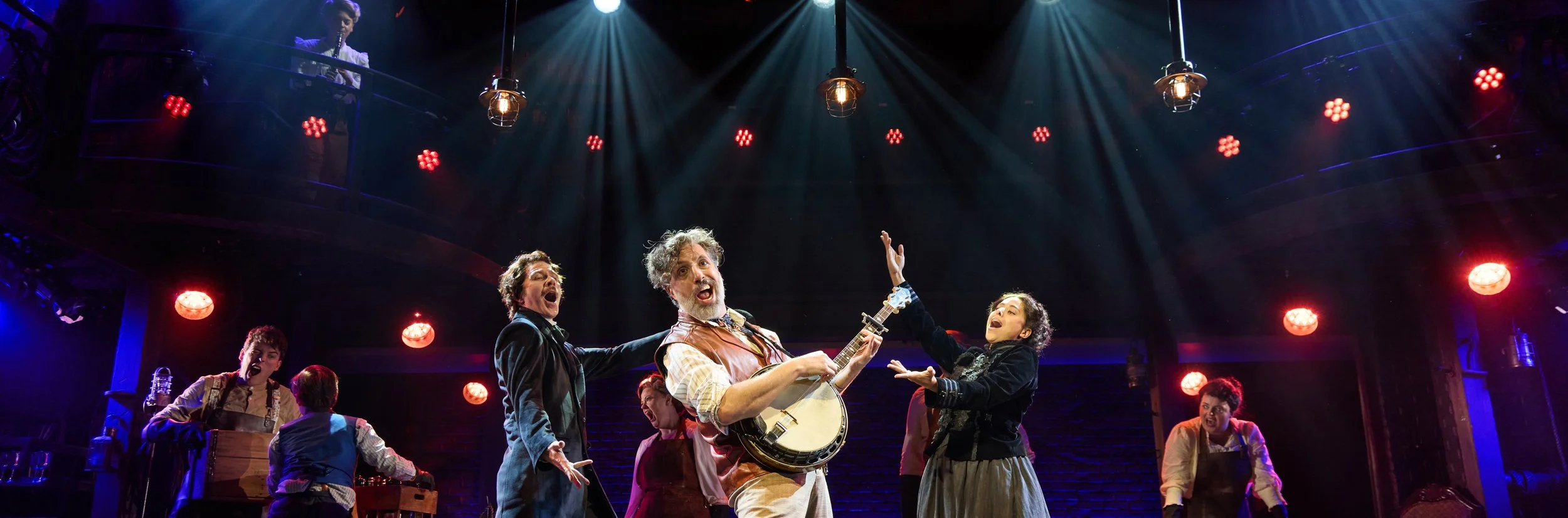
The men walk about in stained, untucked shirts, hopelessly wrinkled pants, and ratty shoes covered in dry mud. They rub their dirt-smudged faces with dirt-smudged hands while running handkerchiefs across their greasy, sweat-soaked hair. The McCoy and Hatfield kitchens both contain wooden tables held up on tree stumps, and their surfaces are covered with roasted chickens, jugs of water, and iron pots. Tiny saplings covered in red bandanas surround the McCoy home, while autumn leaves adorn the floor. In the background a live band, consisting of a banjo, fiddler, and guitar player, strums country and bluegrass music reminiscent of what mountain families might have played over a century ago.

The Hatfields and McCoys have interesting and intricate dynamics that define their respective families. On the surface they appear very different, but when threatened they react the same. Both clans are fighters, ready to stand up for their siblings; stare down their neighbors; and lynch, stab, whip, maim, or shoot dead anyone who threatens their kin. (Those sitting in the first few rows should be warned that a loud, smoky shootout will be taking place above their heads, and they might want to sit a little farther back.)

But those who can stomach the tension and bear the noise should sit as close to the stage as possible. The climax is a visual extravaganza of sound, light, and special effects coming together to turn the theater into a bloody battlefield between two families beside themselves with homicidal rage. Red light bathes the room, smoke pours eerily from the stage, and gun-wielding Hatfields and McCoys fire at one another from all corners of the theater.

The performers are excellent at both maintaining and escalating the suspense. Valentine McCoy (Keith Conway) is a terrifyingly loose cannon, while his brothers Paris (Gary Patent) and Sam (Scott Price) are so nervous with a weapon that you are never sure what they will do. The McCoy patriarch, Ranel McCoy (Will Brunson), is frustratingly passive in the face of his family's violent showdown, in sharp contrast to the Hatfield patriarch, Anse (Arthur Lazalde), who is unnerving in the cold and collected way he points a gun. However, it is little 7-year-old Alifair McCoy (Jaclyn Tommer) who can send the calmest heart aflutter when she innocently shuffles across the stage to examine a trigger-happy Hatfield boy with childlike amusement.

The Hatfield and McCoy feud is so wrapped up in myth that it is hard to pinpoint exactly what started a neighborly quarrel that spanned years and left approximately 13 people dead. Over the years the story has been told so many times that fact has blended with fiction, stripping the tale of all but one undisputable truth: violence breeds violence.

After experiencing the hatred and carnage in Feud: Fire on the Mountain, audiences might be moved to peacefully resolve their own conflicts before they escalate. This historic and true story is an alarming realization of what can happen when loving thy neighbor fails on a spectacular scale.

Click for print friendly PDF version of this blog post

Small Town's Dark Secrets

Missouri-born Lanford Wilson, a pioneer of the Off-Off Broadway movement in the 1960's, has emerged as one of the theater's most cogent chroniclers of American life. In Book of Days, one of his best works, he combines the moral currency of Arthur Miller with the narrative finesse of Tennessee Williams. Thanks to New World Theatre, a new Off-Off Broadway theater company, New Yorkers have an opportunity to see a well-crafted production of this 1999 drama if they missed the New York City premiere, which was part of the Signature Theater's 2002-2003 season devoted to Wilson's work.

The evening opens with the 12-member cast reciting in choral fashion anodyne phrases about their fictional small town of Dublin, Mo. It is a device that recalls the stage manager of Our Town, but we soon realize that we have wandered far from Thornton Wilder territory.

The play, intelligently directed by Robert A. Zick Jr., unfolds as a series of vignettes. Each is framed by a date and a descriptive phrase

Click for print friendly PDF version of this blog post

Da-Da-Da

In the wake of the Great War, conventional formulas of theater were left bombed out, shattered, charred, and shrapnel-flecked: the continent of Europe lay about like a vast corpse. The old aristocracy, in its spastic death throes, ushered in an age of material and mechanical splendor. Popular culture was born. An atmosphere of giddy anarchy glistened in the dim light of Parisian cabarets

Click for print friendly PDF version of this blog post

Manhattan Puppetry

Eliza's Window, Natalie Burgess's captivating puppet play with music, illustrates how children's theater can edify even as it entertains. The hourlong play, being staged on Saturday afternoons through August by Paper City Productions in Manhattan Theatre Source's tiny second-story theater near Washington Square Park, is unapologetically moral without coming off as preachy, thanks to its wry humor and generosity of spirit.

The play follows the puppet Eliza, a depressed, wheelchair-bound girl whose well-to-do parents have recently split up, as she gradually learns from a parade of wise animals and spirits that money and what your friends think of you are less important than discovering your own song and appreciating the unique music that others make.

Creator and director Burgess, who spent three years at the Central Park Zoo as a performer, songwriter, and puppeteer, manages also to demystify music and music making for kids. As one of the musicians instructs Eliza about composing a song, "It's as easy as 1-2-3-4."

Eliza's Window can be enjoyed by the entire family. Burgess does not talk kid talk. She rightly assumes that children will stick with a compelling story that is imaginatively rendered and well paced, even if some of the jokes and big words go sailing over their heads en route to the parents in the audience.

The play might not travel well, however, since so much of the story is New York-centric, whether it's the running subplot about Pale Male, the Central Park red-tailed hawk, or Eliza's suggestions that the turtle looking for the "pond of plenty" check out Rockefeller Center, and that the rabbit seeking a garden head to a certain basketball arena.

Every element of the play has been carefully conceived, crafted, and executed, from the whimsical set design and puppets to the engaging songs. Burgess and the three other cast members

Click for print friendly PDF version of this blog post

Rethinking the Bard

In a summer season full of Shakespeare, it's important to discern the reasons behind a theater company's choice of Elizabethan programming. Some groups produce the Bard so they can offer challenging acting roles and easily marketed entertainment. At these shows, you can expect the text and tone to be traditional, so the audience's enjoyment of the piece is based on an appreciation for the story line and its execution by the actors and director. At the other end of the spectrum are the groups that go high-concept, believing that Shakespeare's tales could be better expressed through a change in time period, place, circumstances, etc. With these shows, their success largely rests on how well the group integrates its vision into the show's framework while also proving that the change was a valid one. (Good leads cannot save, or excuse, a Hamlet performed on a spaceship.)

The CRY HAVOC Company calls its current season the 2005 Season of Questionable Distinctions. Their productions are "focused on issues of the intersection of gender and culture

Click for print friendly PDF version of this blog post

Much to Say About Nothing

There is something inherently selfish about doing a one-woman show. Of course, most people perform them because they have something rather important to say

Click for print friendly PDF version of this blog post

Critical Connection

Anne Fizzard has cooked up a fanciful comedy that takes aim at the class of people who take aim at Broadway plays for a living. Good Opinions lightheartedly chronicles several months in the life of Adele, a good-natured coat-check girl/entertainer who

Click for print friendly PDF version of this blog post

This One's a Killer

"Laugh-out-loud funny" is a term used far more often than it is applicable, but it proves quite fitting in the case of Pulling Teeth, the macabre new play currently being mounted by WorkingMan's Clothes Productions at the American Place Theatre. Audiences will find themselves chortling quite audibly over and over again during this dark comedy, seemingly at the most offensive of moments. But that's precisely what Brandon Koebernick, a promising novice playwright, wants his audiences to do. His subversive combination of romance, black humor, and suspense is not unlike one of those meals served at fast food restaurants: instantly and thoroughly satisfying, but perhaps a little heavier than expected, with an extra kick that stays awhile.

Koebernick has indeed found a perfect patron in WorkingMan's Clothes, a production company geared toward encouraging new talent and presenting a host of different voices and styles. But his anonymity should not last much longer. Teeth positions him perfectly to join playwrights like Craig Lucas and David Lindsay-Abaire

Click for print friendly PDF version of this blog post