Musical

Flashback

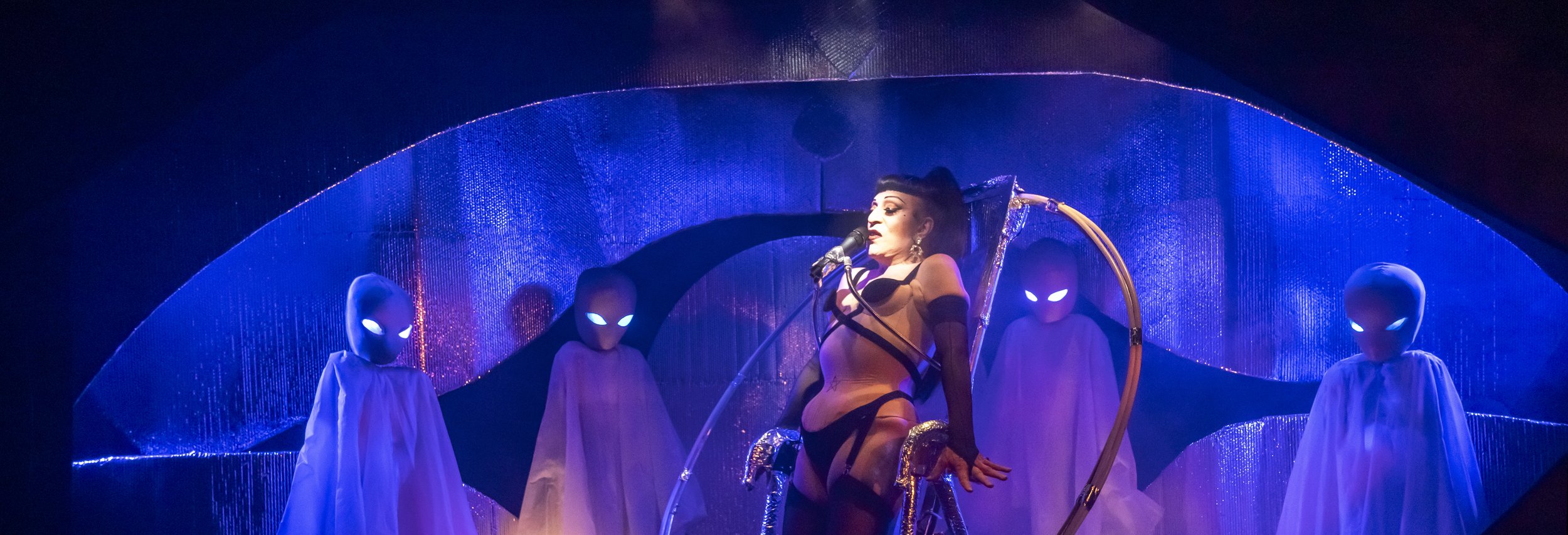
In Brooklyn's refreshingly roomy St. Ann's Warehouse, the Wooster Group is remounting its 1999 creation House/Lights. The city's champion of the avant-garde has temporarily abandoned its snug Manhattan home, and, while the breathing room is welcome, one cannot shake the feeling of being dead-bolted into an asylum. A conflation of Gertrude Stein's 1938 play Doctor Faustus Lights the Lights and Joseph P. Mawra's 1964 "lesboitation" film Olga's House of Shame, this 75-minute multimedia trip takes the audience on a mind-searing journey through sound, space, psychology, and sex. One of the Wooster Group's founding members, Kate Valk, plays both Stein's Faustus and Mawra's Elaine in a seductively manic performance. The nimble and gorgeous actress defies age, time, and space

Click for print friendly PDF version of this blog post

School Days

Ask anyone if he or she has ever heard the story Miss Nelson Is Missing, and you will most likely be answered with a gasp of recognition followed by a wistful sigh of "I loved that book." Originally published in 1977 by Harry Allard, Miss Nelson Is Missing is a book that has been passed down from one generation to the next, and now to yet another crop of youngsters in the musical adaptation playing at the Tribeca-based Manhattan Children's Theatre. Since this story comes with a dedicated built-in audience, there is very little a theater can do wrong in the retelling of it. The remarkable thing about Manhattan Children's Theatre is just how much it manages to do right. The stage resembles a quaint, little storybook town, with a green, pink, and yellow ice cream store next to a bright pink police station. The scenery's centerpiece is the schoolhouse: a brick building with white doors that unfold into a classroom complete with a chalkboard, a map of the world, and four little desks.

While this silly, colorful story expertly caters to the toddlers in the audience, it gives more than a few winks of acknowledgement to the adults who accompany them.

For example, when the soft-voiced, rosy-cheeked, angelic elementary-school teacher, Miss Nelson, attempts to engage her unruly students in a history lesson, she is horrified that the children cannot even answer the question "What is the name of the president?" One pigtailed student guesses, "Dick Cheney?" A boy with a spitball-stuffed straw dangling from his mouth answers, "Arnold Schwarzenegger!" Just when Miss Nelson thinks the lesson cannot go any worse, a third boy cries, "Martin Sheen!"

Desperate to regain the attention of her four sweet but dizzyingly hyperactive students, Miss Nelson takes matters into her own hands and turns up "missing." In her place she sends a "substitute"

Click for print friendly PDF version of this blog post

Love and War

A deer slowly bounds across the wide-open stage and finds a spot to rest and feed. Dark, percussive music plays as the animal is spotted by a man hunting in the woods. He very slowly, silently removes an arrow from his quiver, pulls backs, and shoots. The arrow pierces the deer's chest, and it shakes and struggles in pain until it finally falls dead to the ground. The man is King Agamemnon, and little does he know that this small act will displease the gods and set off a tragic chain of events for himself and the whole of Greece. The opening of Theodora Skipitares's Iphigenia burns a powerful and haunting image into the minds of the audience. What's more remarkable is how this effect is fashioned by Bunraku puppetry, a traditional Japanese art form. The deer is carefully manipulated by three performers

Click for print friendly PDF version of this blog post

Lost in Space

The dangers of creating a piece of theater through collaboration are as numerous as the potential rewards. When the process works, the result is an organic fusing of many different artistic voices into a single, overarching vision. As with a choir, the power and nuance of such a synthesis can be staggering. When the process fails, however, what emerges is a disastrously confused and meandering hybrid of intentions, divided and unable to stand. Unfortunately, The Astronomer's Triangle, the latest communal effort from CollaborationTown, now playing at Studio 5, runs afoul of many of the process' snares and offsets these with too few of its benefits.

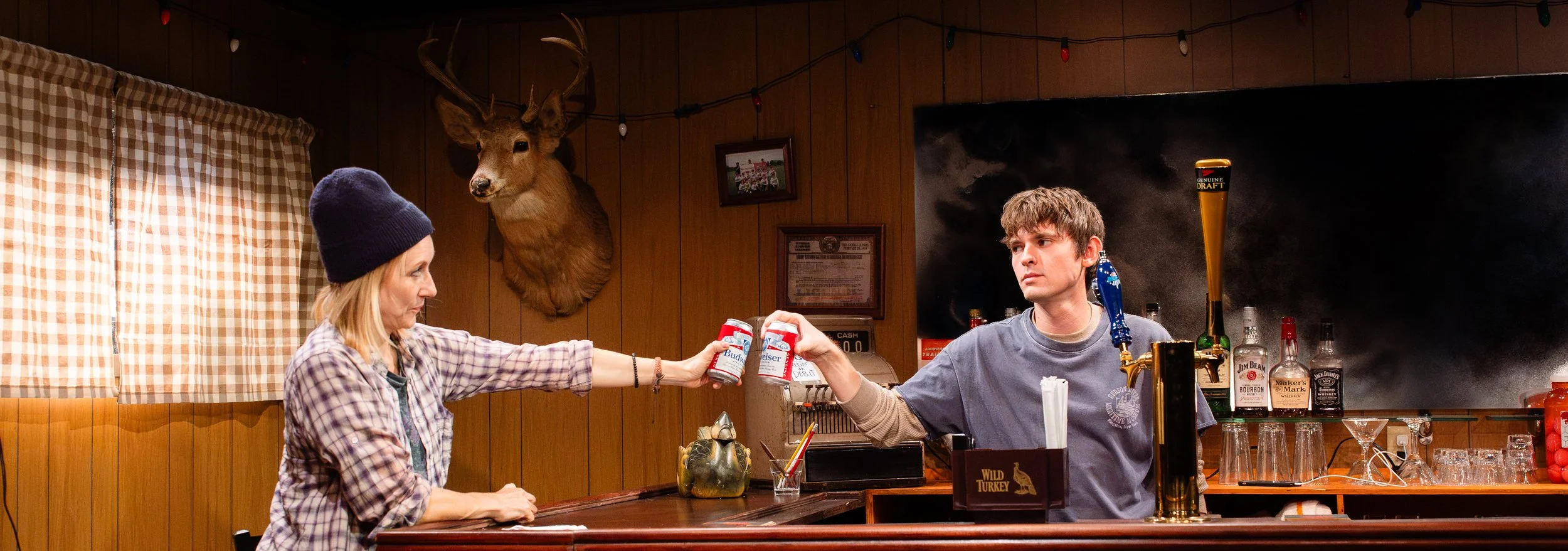
Our narrator and protagonist is a prim cartographer (Jordan Seavey) who professes that things as intangible as love can be mapped. He has devoted himself to the welfare of an old friend (Geoffrey Decas), an astronomer despondent over his failure to cull from the stars clues about life's origins. In the breaks between forcing his astronomer friend to get out of bed and eat, the cartographer manages to strike up a relationship with a quirky local waitress (Boo Killebrew), who claims she communicates with her own private star.

When pressed, the cartographer learns that this star occupies not only part of her body

Click for print friendly PDF version of this blog post

Standards Change

Eastern Standard

Click for print friendly PDF version of this blog post

Southern Gothic Solo

Angela Forrest is a great performer. She is funny, expressive, and, at times, even captivating. In her one-woman show, Profile of a Saint, she portrays 10 characters and never leaves the audience guessing who is who. When she is in character

Click for print friendly PDF version of this blog post

Life Under Occupation

The West Side Theater is slightly dank and musty and not at all inviting. At one point, midway through the show, the lights in the theater suddenly go out, and the crashing sound of bombs exploding interrupts the silence. It transports you to another, much darker world. It is nighttime in Iraq. There is no water, no electricity, only candlelight. It is powerful and real. We know the politics, see the pictures, and hear the rhetoric. Americans held hostage, Iraqi protests in the street, and gunfire in Fallujah. The war in Iraq has raged in one form or another for nearly three years, leaving hundreds killed, thousands injured, homes destroyed, businesses burned, and a country liberated. We all know the story.

But what we do not know is the whole story, and it is one that needs to be told. The Six Figures Theatre Company, in adapting the "Girl Blog From Iraq"

Click for print friendly PDF version of this blog post

In Limbo

Your body is lying on a lumpy mattress in a hospital bed hooked up to loud beeping machines via various tubes. A pump breathes artificial air into your dormant lungs. Family members stand at your bedside berating themselves for not saying "I love you" enough, or fighting over your inheritance while they stare at your limp figure. Your body is in that bed, but your soul is not. You are not dead; you are not alive. You are "between worlds." Such is the fate of the characters in the Chekhov Theatre Ensemble's ethereal and intuitive production of Eric-Emmanuel Schmitt's tragic Between Worlds. A nearly bare set is enclosed by two walls joined to form a corner. One wall contains an exit labeled A for "accidental," and the other has a similar exit leading to Corridor D for "deliberate."

In the center is an elevator, through which enters a young man, Colin (Patrick Jones), unaware that he has just crashed into a tree at 100 miles an hour. He is greeted by two hooded assistants who don't speak but are able to tell him that he is to take up temporary residency in the "hotel." And this is just the beginning of a day or so at a place that houses people between life and death.

The Two Worlds Hotel is presided over by the elegant but icy Dr. S., played coldly but with just the right amount of tenderness by Jennifer Shirley. Other guests include the saucy cleaning lady, Jesse, portrayed in full raunchy glory by Andrea Seigel; a not-so-clairvoyant Magus played not so subtly by T. Scott Lilly; and an uptight Chairman of "the Board," portrayed by Max Evjen.

Prior to the second act, the hotel is visited by a regular guest, the innocent Laura, played by an illuminating Sara Barker. Laura has been wheelchair-bound for years and uses her trips to the hotel as a chance to escape the paralysis that has troubled her on earth. As Colin begins to understand the nature of the hotel while falling heavily for Laura, the other tenants anxiously await their fates, which will be determined by the elevator that has brought them there. When it is their time, they will be called to the elevator. If they are to survive, the elevator will bring them down to earth. If they are to die, the elevator will travel up. In the meantime, they must wait and contemplate the lives they have led.

Between Worlds tackles quite a few heavy subjects, namely death, the afterlife, destiny, depression, knowledge, sanity, and second chances. Since the play never gives any concrete answers to these questions, the audience is forced to draw their own conclusions, even regarding the outcome of Colin, who closes the play as he steps into the elevator and awaits his fate.

The play is ripe with witty and sometimes poignant one-liners, such as Colin's remark to Dr. S., "I never thought death would have such good legs," and Dr. S.'s scornful, "Using alcohol. The method [of suicide] used by cowards." The dialogue has a very natural, Mamet-esque feel to it, but the play itself is more in line with European playwrights like Heiner Muller, who use fantastical ideas and strange theatrical conventions, such as the mute assistants and the ambiguously gendered Dr. S. Director Ragnar Freidank's German background surely contributes to the avant-garde feel.

The acting is consistent and realistic across the board. The best dialogue takes place in the rushed exchange between Laura and Colin just before he is to be cornered into the elevator. He feverishly asks her simple, seemingly mundane questions about herself so that he may remember her when he is gone, and she replies just as excitedly, causing his exit to be indefinitely postponed. In fact, each time a guest enters the elevator and the doors close, there is a moment when we hold our breath to wait for the result, which is not always what we expect.

Overall, Between Worlds has a sort of unfinished feel to it, as if a small something has been lost in the translation. The play confronts death with such brazenness that you can only wish that you'll never end up a guest at the Two Worlds Hotel. Even so, the polished acting and intriguing subject matter turn the two hours into a visit worth making.

Click for print friendly PDF version of this blog post

Historical Crossroads

Seasoned by the French Revolution and the Napoleonic wars, Paris of the 1840s was, not unlike 80 years later, a magnet for artists, intellectuals, and radicals from across Europe. It was a decade when the world was out of balance: a crisis of the old society coincided with a crisis of the new, spawning great political and cultural ferment. Among those drawn to the city in that decade were three lions of 19th-century German history: Karl Marx, Richard Wagner, and poet Heinriche Heine. Working in the tradition of such cerebral, history-minded playwrights as Michael Frayne and Tom Stoppard, American literary critic and essayist Jonathan Leaf imagines the interaction of these three men in The Germans in Paris, an intriguing though tendentious play about the dueling of men and their ideas that is based loosely on actual events.

In fact, two actual duels

Click for print friendly PDF version of this blog post

Teenage Monkey Business

Adolescence has never made for particularly pretty subject matter. On television, children usually rapidly age from cute cherub to mature teenager, somehow skipping a crucial stage in the natural aging process. One's naturally changing body only makes an occasional appearance as a subplot on the Disney Channel or WB. And filmdom's closest portrayal of puberty as metaphor remains...Teen Wolf? This is true, and one might expect to find a similar comedic metaphor in Gorilla Man, which just opened at P.S. 122. The latest play by Obie winner Kyle Jarrow is part horror show and part rock opera but all camp, and for rather lowbrow humor, director Habib Azar has assembled a high-caliber company. There aren't very many lessons to learn along the way, but ultimately it is a not much different animal from the aforementioned film and its sequel.

Jarrow (onstage as the Piano Player) narrates this musical, with Perry Silver (the Drummer) helping him reference the show's own plot devices and genre elements. Fourteen-year-old Billy (Jason Fuchs) awakens to find he has started growing immense amounts of fur on the back of his hands. When he confronts his mother (a wonderfully game Stephanie Bast), he discovers that he is actually the product of a tryst between her and the Gorilla Man (Matt Walton), a hirsute beast with a penchant for gruesome murders. Billy learns that it is his destiny to follow in that path. When she is unable to kill her son, Mother, as she is known, casts him out.

Billy runs into several interesting people in this darkly comic, Wizard of Oz-like bildungsroman. These characters include a fortuneteller, a politician, a prison guard, a truck driver, and a vagrant, all portrayed by Burl Moseley and Nell Mooney. These characters, Jarrow instructs the audience, serve to teach Billy about such topics as forgiveness, fate, fear, failure, and fatherhood.

But whether taken merely on a surface level or as metaphor, Gorilla, with its not-quite-artful song lyrics and instructional storytelling, lacks oomph in the message department. The play hits on the notion of individuality, of loving who you are and not trying to run away from it, but never delves particularly deep into that idea.

Only at play's end does Jarrow provide any kind of resolution, in arguing in favor of free will over both nature and nurture. He espouses the idea that Billy does not necessarily have to succumb to his father's murderous fate. But the play just ties a nice ribbon at the end, directly telling its audience that it believes in free will more than the formative forces of genetics and one's upbringing. It would have been more impressive had Jarrow demonstrated this theme a little more consistently throughout the show.

Additionally, while it was a smart choice to limit the production to one act

Click for print friendly PDF version of this blog post

Shooting Up the Charts

There are two basic camps in the debate over art's purpose. The first, basically idealist, argues that art should enlighten. The artist's sacred duty is to present the truth of our reality, or, at the least, the truth of the artist's reality, no matter how bleak or brutal. The second camp, however, tends more toward escapism. It contends that reality in all its misery is ever-present. Why use art to deliver a second dose of it when art is the only means most people have to momentarily step out of it?

In Marc Spitz's new comedy, The Name of This Play Is Talking Heads, now playing at Under St. Marks, the two factions again take up this never-ending skirmish. The difference here, as opposed to the debates that ceaselessly appear in publications and programs devoted to the arts, is that one of the two parties has the added rejoinder of a loaded firearm.

The battlefield, appropriately enough, is the studio of a TV music channel where a typically vapid segment, called the "Top 100 Most Rockatrocious Moments in Rock History," is being taped. (Think of such watersheds of vulgarity as Jerry Lee Lewis marrying his teenaged cousin, or the revelation that Michael Jackson's penis is multicolored, to use just two of the examples Spitz himself cheerily points up.)

The idealist thrown into this escapist stronghold is Pete (Brian Reilly), a writer for Headphones magazine. Initially under the impression that he has been invited on the show to share his knowledge of music and the culture surrounding it, he is quickly disillusioned when he sees the channel's staple comedian, Frankie (Matt Higgins), being force-fed his opinions by Tom (James Eason), the show's director. However, Pete's disillusionment quickly gives way to outright rebellion

Click for print friendly PDF version of this blog post

Bountiful Harvests

In the Carpathian Mountains of Ukraine, a winter solstice ritual has survived, one that has existed since before the rise of Christianity. A special meal is made consisting of 12 dishes, all meatless and dairyless, and is proffered to any human, animal, or spirit (living and dead) who wishes to join in the festivities, in the hopes that the next year will be healthy and the harvest successful. The master of the house repeats his invitation three times: "If you don't want to come and taste all our delicious dishes, if you won't come when we invite you, then don't come when we don't call you!" This ritual, along with the songs and incantations that accompany it (called koliadas), was studied by director Virlana Tkacz for the past two winters in Ukraine. The result is the Yara Arts Group's Koliada: Twelve Dishes at La MaMa. The piece integrates these traditional songs and practices with contemporary texts and theatrical techniques, generating an engaging and resonant evening of performance.

The imagery and themes of Koliada can be quite beautiful and moving. Anyone with a sense of family ritual and heritage will be taken in by the opening, during which an older woman, a matriarchal figure, prepares her meal, mutters to herself what has yet to be done, explains how she creates a dish, and sings quietly to herself the koliadas traditional to the occasion.

The design of the show, by Tkacz and Watuko Ueno, is simple and brilliant. They have taken the first-floor theater at La MaMa, a very deep space, and used it lengthwise, allowing for busy, expansive action. There is also little audience seating, making the event extremely intimate and involving. The paper-thin back wall of the set contains faint images of vegetables and grains, and also creates mysterious shadows made by company members moving behind it. A series of three long wooden tables make up the furnishings, evocative of Leonardo da Vinci's "The Last Supper" (coincidentally enough, the setting of a Passover seder, the meal of the Jewish holiday that involves cooking a large amount for family and friends, as well as inviting any outsiders, along with the prophet Elijah, to partake if they wish).

The cast members then weave their way through 12 vignettes, meditations on the food, ritual, and renewal through poetry, movement, and song. The company members portray all the different figures that inhabit the ritualistic space: townspeople, spirits of animals and storms, and the recently deceased.

The staging doesn't do justice to the poetry by Ukrainian writer Serhiy Zhadan, however. Poetry is an extremely tricky art to translate to the stage, in terms of both direction and performance. The company simply doesn't give this beautiful text the reverence it deserves, which often makes it seem anachronistic and incongruous with the action. The different dimensions of the group's exploration don't mesh well in general, but this makes the poetry in particular stick out and suffer.

But the koliadas, especially when sung in the original Ukrainian, are charming and haunting. A special treat is Ukrainian musicians Ivan Zelenchuk and Dmytro Tafiychuk, who accompany the cast at times with their voices, fiddle, and an amazing mountain horn called the trembita. The two musicians, who are working to preserve and document the koliadas in their town of Kryvorivnia, are a tremendous complement to the piece.

Toward the conclusion of Koliada, the wooden tables are pushed right up to the audience, and the company welcomes you to their home. You are even invited to try some kutia, a sweet dish containing wheat, poppy seeds, and honey. This great feeling of familial belonging makes for a warm finale.

Ultimately, the traditions and ideas behind Koliada: Twelve Dishes are far more intriguing than the performance itself, but the themes and imagery that the performance conjures up make it a unique and touching theatrical experience.

Click for print friendly PDF version of this blog post

Beauty Is Skin Deep

Stunning. Illuminating. Touching. Powerful. These are just a few of the words that come to mind when describing the experimental dance piece Skins, playing at the historic La MaMa Theatre. Even without specific characters or a linear plot, Skins tells an amazingly human and compassionate story through its unifying themes about body image, self-expression, and the societal pressures that shape and change us. This piece is based on the poetry of Elizabeth Ingraham, whose work has also inspired a series of life-sized female "skin" sculptures that can be seen hanging in La MaMa's lobby. Throughout the play, a compilation of Ingraham's poems is recited over a sound system as the words come to life onstage through music, dancing, light, and scenery.

Between poems, the dancing is underscored by hypnotically beautiful music performed live

Click for print friendly PDF version of this blog post

Faith and Dreams

Faith is an awfully open-ended subject on which to base a play. Faith in God, faith in relationships, faith that human beings are essentially good

Click for print friendly PDF version of this blog post

Hero Worship

Kevin Augustine's puppets are incredible creatures. Their intricacies are many, with fine facial features and clever physical manipulations that lend them a super-reality. Their carefully chiseled, slightly askew contours make them simultaneously disturbing and melancholic. And with the fine-tuned coordination of Augustine and his fellow puppeteers (Laura Emmanuel, Sophie Nimmanit, and Matthew Riggs), the characters come to life in an astounding manner. Add to the list of characters a luminescent butterfly and a book that attempts to fly from its reader's hand, and Augustine has created a magical world in which anything goes, a world particular to puppetry and to Augustine's work in particular.

This is what makes the shortsightedness of Big Top Machine such a shame. Augustine is one of the greatest puppet artisans working today, but the text of the piece is ultimately uninteresting and banal. The story revolves around Stan (Augustine), who, in an effort to escape his estranged wife and alcoholic tendencies, does what almost everyone has considered doing at one point or another

Click for print friendly PDF version of this blog post

Rethinking Shakespeare

Many half-finished quotes that have adhered to my mind through the years were first introduced in Macbeth. Lines like "Is that a dagger...," "Out, damned spot...," or "Tomorrow and tomorrow and tomorrow..." offer a good reason to revisit Shakespeare's play. In a new twist, C.A.G.E. Theatre Company's production has set it not in the usual medieval Scotland but in Scotland in 2005. At first, this version seems to be a smart route for director Michael Hagins to take. The space at the Impact Theatre in Brooklyn is rather small. On a stage of that size, the production team does not have the luxury of elaborate sets and costumes that would take up an enormous amount of space. Before the lights dim, the audience is introduced to three ladies

Click for print friendly PDF version of this blog post

Love Those One-Acts

Like a vacation fling, a one-act play can either be long remembered for its delicate and thrilling touch, or quickly forgotten should it go awry. But when you've got six back-to-back one-acts, all dealing with the transient nature of love, chances are good that at least one will leave a lasting impression. Scenes From a Distance, the fourth production at the Jan Hus Playhouse, was a foolproof rendezvous before the actors even took the stage. The evening featured three one-acts ("English Made Simple," "Bolero," and "Seven Menus") by comedic genius David Ives and three more from playwrights Mary Miller ("The Ferris Wheel"), Sean O'Donnel ("I Just Wanted to Say"), and the 2005 recipient of the John Steinbeck Award for Literature, Joe Pintauro ("Fur Hat").

Though Ives's name likely brought in much of the audience, it was Pintauro's "Fur Hat" that generated the most guffaws. Director Elaine Connolly seemed aware that this might be the case, as the one-acts were lined up like a strategic baseball roster. "The Ferris Wheel" got the evening off to a solid and competent start, "I Just Wanted to Say" and "Bolero" were only meant to get on base, and "Fur Hat" grand-slammed.

"Fur Hat" is the story of a chance meeting in a university caf

Click for print friendly PDF version of this blog post

Deal With the Devil

Don Juan in Chicago begins with Don Juan in his 16th-century Spanish castle mixing potions and chanting Latin in hopes of conjuring up the Devil, until he is interrupted by his faithful servant, Leporello. Concerned about his master's well-being, Leporello attempts to convince Don Juan to give up his intellectual pursuits in favor of wining, dining, and women. But the not-yet-legendary lover harbors no concern for momentary desires of the flesh. A 30-year-old virgin, Don Juan has only one thing on his mind: immortality. With immortality, he surmises, it would be possible to discover the answers to all of life's questions, and he would take his place as the greatest of all history's thinkers.

Upon eventually succeeding in bringing Mephistopheles to the mortal plain, Don Juan declares his heart's desire, and the Devil agrees to give Don Juan (and unlucky Leporello) life eternal, with one condition: that Don Juan agrees to seduce a different woman every day before the clock strikes midnight. The deal is sealed in blood, and thus begins Don Juan's legendary sexual escapades. Comedic antics and dramatic moments ensue as four centuries of lies, love, and infidelity eventually culminate in one chaotic evening.

As the title character, Michael Poignand displays a wide range of talents as he transforms himself from the na

Click for print friendly PDF version of this blog post

Deadly Games

The cloudy difference between fantasy and reality is the subject of Jeff Tabnick's new play, I Found Her Tied to My Bed, an hourlong one-act about the fine line between true romantic love and ritualistic murder. Lounging around a set dominated by nothing more than a large bed, two young female roommates play games of love and death, pressing each other's buttons until they have no choice but to make their fantasies a reality or look elsewhere for someone to share the rent with. This spare but affecting production, playing every Wednesday night at Under St. Mark's until the end of the month, examines a not-so-healthy relationship between two roommates, sometime lovers, and occasional murder accomplices.

"I'm not a lesbian. I'm a killer," says Jan (played by the severe Shannon Kirk), a rebellious nurse at a retirement facility, who has taken to amusing herself at work by speeding up the turnover rate at the facility's critical wing. A pair of damp cloths her only tool, she views herself as something between an avenging angel and an agent of mercy, killing in a seeming act of euthanasia only the sickest patients

Click for print friendly PDF version of this blog post

The Obscenity Heard 'Round the World

When used correctly, the profane actually serves a very sacred social function, one that is too often lost in the shock of the profanity itself: it forcibly tears away the veil of unthinking habit and empty tradition. In this sense, French playwright Alfred Jarry was a master of the profane. Indeed, his finest creation, the infamous Pa Ubu of the play Ubu Roi, is nothing but a vessel for all that Jarry considered base and cowardly in humanity. (Appropriately enough, Ubu's famous first line in that play is simply, "Puh-shit.") Yet Elizabeth Swados's sharp new musical Jabu, based on Jarry's life and using healthy portions of his Ubu play cycle as illustration, shows us just why this high priest of blasphemy is still so sacred to modern theater.

From his childhood in Laval, France, in the late 1800's through his bohemian life in Paris and a rather messy self-destruction

Click for print friendly PDF version of this blog post