

Musical

Tennis, Furniture and the Afterlife

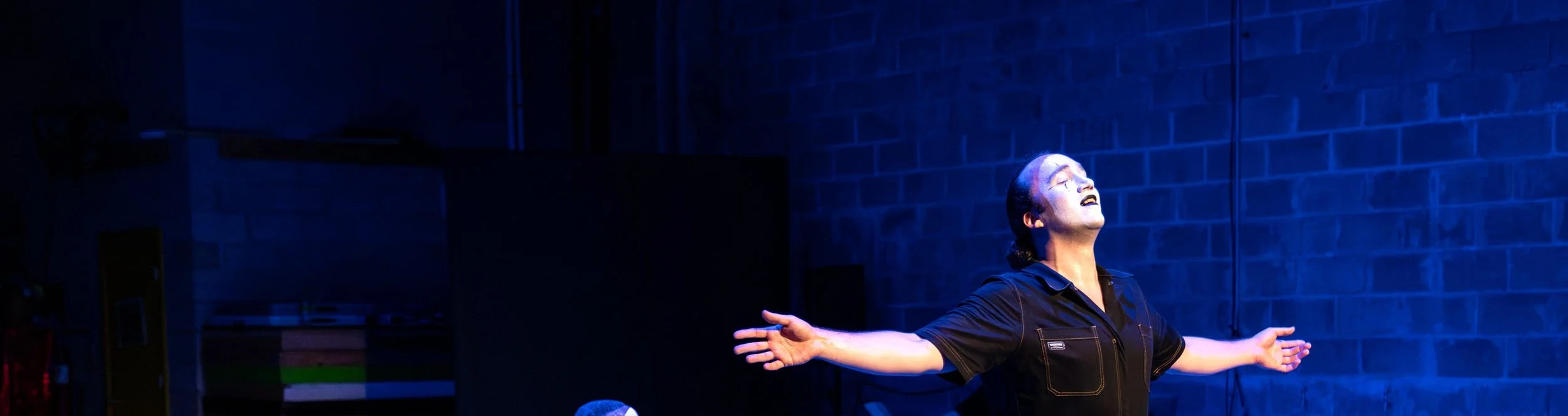
Hell Meets Henry Halfway is an ambitious attempt to bring Polish author Witold Gombrowicz's gothic pulp novel Possessed to the stage. Ambitious, as well as unprecedented. As the show's program states, "Pig Iron's version of the text is the first stage adaptation of any of Gombrowicz's novels in the English-speaking world." At the center of this unconventional story is Henry Kolavitski, a much-abused secretary waiting for his sickly patron, the Prince, to pass away so that he can inherit a fortune. Henry calls upon the diseased Dr. Hincz to discern how much longer the Prince has left to live. He also hires a tennis coach to entertain his jaded wife, Maya. Observing this all is Jon the ball boy, a happy-go-lucky simpleton.

Playwright Adriano Shaplin wrote sheer poetry for dialogue, and the actors indulge themselves, questioning, "What did oxygen ever do for me? What kind of favor is gravity?" and posturing, "If sleep is the cousin of death, I want to meet his brother." The language is thick, though the meaning of the words is never obscured, thanks to the actors' direct performances. Gabriel Quinn Bauriedel, as tennis coach Marian Walchak, delivers his lines with anger and futility in his voice while Sarah Sanford, as Walchak's student and potential lover Maya, communicates as much with her body language as she does with her voice.

Dan Rothenberg's direction combines with Sarah Sidman's lighting design to create numerous beautiful moments. In the opening scene, Dr. Hincz sits atop a train, his silhouette all that is visible to the audience. The manor's tennis court where the characters scheme and vie for power is lit in sections, resembling a chessboard.

But the true star of the show is a piece of furniture. A versatile armoir serves not only as the set's main piece, but as a brilliant character actor as well, changing from a simple closet to a doorway, a train, a table, two bedrooms, a bathroom, a tree and a gallows pole.

However, armoir aside, the play's greatest strengths serve as its biggest weaknesses. Rothenberg directed his cast with such careful choreography that the first half of the play often feels more like a picturesque slide show than live theatre.

The play also relies too heavily on its own poetry. Although the cast delivers beautiful monologue after beautiful monologue, the first half of the play drags on from a complete lack of action. In fact, Jon the ball boy comments on this during the Act II prologue, telling the audience, "This is when things get serious. No more stalling. No lolly-gaggin' and draggin' your feet."

And Jon is right. From that point on, the play devolves from poetry and silence into sex-fueled, greed-driven, murderous chaos. Though the second act does capture the audience's attention better than the first, it also lacks the eloquence of the first act and the resulting contrast leaves the play feeling uneven.

In spite of these flaws, Pig Iron Theatre Company succeeds in creating a deconstruction of the darker side of human nature. Horrible at times and hilarious at others, Hell Meets Henry Halfway provides a unique and thought-provoking experience. For any theatergoer looking for an entertaining show beyond the ordinary, this production delivers.

Click for print friendly PDF version of this blog post

Communication Breakdown

With a play entitled Electra Speaks (v.2), we are primed to wonder what it is that she has to say. But this smart and mordantly funny drama instead dissects the neuroses and self-protective behavior that can sabotage genuine communication, particularly for women. The inverse of the serial-character solo show so in vogue these days, talented young playwright Laura Camien's new play--a sequel to Volume 1, which I did not see, that can stand alone--has five actors play shifting facets of the same young, single woman in her fitful quest to say what she means and mean what she says. The conceit underscores the play's notion of identity as fluid and opaque.

Even as Electra uses words to deflect, bluff and conceal--anything but communicate--the play, under the astute direction of Emilia Goldstein, itself delights in wordplay (

Click for print friendly PDF version of this blog post

SHAKESPEARE VS. SID: A Battle to the Death

What would happen if Shakespeare and Sid Vicious had a baby? Although this question triggers some rather disturbing images, their unholy offspring might look something like Titus X, a lovingly loud interpretation of Titus Andronicus told through the tunes of punk music. While the production dismisses nearly all of the Bard's text, it successfully revels in the bloodlust and revenge that drive the original play. The cast takes the stage to the overwhelming strains of an electric guitar, a bass guitar, and a drummer, who pummel their instruments with grace and vigor throughout the show. Although the band is top-notch, they are also REALLY LOUD. Fortunately, free ear plugs are distributed before the show, and I must recommend that any future audience member who wants to retain most of their hearing take a pair, just in case.

The show begins with a rousing, guitar-fueled chant of "Titus, Titus!" and some expositional dialogue that is difficult to hear. Luckily, the situation becomes clear upon Titus' (Peter Schuyler) entrance. He is a war hero returning from battle victorious, with Tamora (Bat Parnas), the queen of the Goths, as his slave. The emperor Saturninus (Joe Pindelski) takes Tamora as his bride and thus, enables her to wreak revenge upon Titus for the murder of her own children. Her two surviving sons kill the emperors' brother and frame it on Titus' offspring. They also rape his daughter Lavinia (Amanda Bond) and cut off her hands and tongue to silence her. Titus feigns madness for awhile but eventually kills the criminals, baking them into a pie and forcing Tamora to eat her own sons. A rash of killings ensue, leaving nearly everyone dead in a gory bloodfest.

The complicated plot translates poorly to punk music, which is by nature loud and indecipherable. But Titus X is more musical theater than punk opera, and the play increasingly resorts to spoken scenes and sung dialogue. While I felt a little disappointed at this tempering of the genre, I have to admit that if every song had been pure punk the story would have been lost. Several rock ballads add to the musical theater feel, and for the most part they slow down the anarchic energy of the show. The major exception to the ballads-are-boring rule is Lavinia's post-tongue solo, sung through a mouthful of blood. To make a tongueless, handless rape victim sing a ballad is sick, wrong, and absolutely hilarious. The other songs that work well are the punked-up screamfests that simplify the plot into a single, selfish emotion. "She Woman" is a great example of that, with lyrics such as "mine mine mine mine mine mine mine mine!" effectively getting the point across. When freed from having to clearly enunciate or hit notes, the performers really get to revel in the shameless self-indulgence that makes Titus X so much fun. Even when the play drags towards the end, the cast's conviction and their flair for the ridiculous keep everyone entertained.

The small performance space of Chashama is used extremely well. While some of the songs are sung straight out to the audience, others are more physical, and the cast never lets a few hand-held mikes stop them from smacking, shoving, and stabbing each other with great fervor. The lighting is also remarkably effective, drowning the stage in intense color and evocative shadow from only a few sources. The costumes add to the fun of the evening, changing quickly as actors shift from one character to the next. Decked out in punk, retro, gothic, and hipster gear, the actors transform Chashama's 42nd street location into St. Marks Place at midnight, and the audience is happy to make the trip.

Each of the actors has their moment of brilliance, but some shine more often than others. Joe Pindelski and Ben Pryor are especially versatile and energetic, and their performance is aided by the fact that they can sing well in the various styles of punk, rock, and musical theater. Pryor also impresses due to the sheer number of characters he portrays, all with great clarity and hilarity. Bond and Parnas both exude a nice stage presence but are unable to deliver on all of their songs. To their credit, every off-key note is held with the (false) conviction that it is the right one, and the bad singing, when it occurs, actually adds to the show's feeling of anarchy and disobedience.

The major problem with Titus X is that it does not really know what it wants to be. While the show starts off as an in-your-face punk explosion, that energy soon tapers off into musical-theater land. This mixed-up musicality was evident in the singing, which sometimes wavered between two styles within the same song. But maybe I am taking Titus X too seriously. Maybe a mixed-up, pointless teenager is precisely what this show wants to be. Its angst is voiced with a lot of heart, and in the end its ridiculousness and inconsistencies actually make it endearing. The show also has a darker side. Titus X takes two things that are often treated with the utmost seriousness--Murder and Shakespeare--and pulls the rug out from beneath them. When we squeal at Lavinia

Click for print friendly PDF version of this blog post

Laughter and Hope and a Sock In the Eye

If you could meet any person, dead or alive, who would it be? We have all been asked this conversational ice breaker at one time or another, perhaps at a party or a less-than-ebullient first date. In Spike Jonze

Click for print friendly PDF version of this blog post

Come on, Feel the Noise

Life among the upper crust is so stressful, no? On stage, at least, being wealthy and idle means having a lot of time to construct elaborate plots and desperate social intrigues. In farce, and in its descendent screwball comedy, the play maintains a frantic pace as it rushes from outlandish situation to even more outlandish situation, with its characters charming their way from one self-created near-disaster to another with breezy quips and witty observations. At least, that is what happens when both genres work well. When they fail, they often disintegrate into a lot of rushing around to no good end, leaving the audience wondering how they muster up the energy to care so much about something so trivial. In A Scrap of Paper , the three-act comedy running at the Greenwich Street Theater, the cast stretches to achieve the kind of giddy chaos that makes the genre work, but their heavy-handed approach smothers the light and airy feeling they are aiming for.

A Scrap of Paper was originally written by French playwright Victorien Saradou in the mid 19th century. Mary T. Boyer, the director and adaptor, sets her version of A Scrap of Paper in the 1930

Click for print friendly PDF version of this blog post

Beware the Risen Woman

The violence of armed revolution has traditionally been the province of men. After all, in nearly every country men hold the levers of power, men make up the armies that exercise that power, and it is primarily men who band together to oppose that power. Yet, as Ken Urban

Click for print friendly PDF version of this blog post

Shock, Awe, and a Lot of Laughs

From the moment you enter the Laurie Beechman Theater, temporary home of the comedy group, Fearsome; you will realize this is not your typical holiday play. Do not expect to find a nice cushioned seat to sit in

Click for print friendly PDF version of this blog post

If Our Shakespeare We've Offended, Think But This and All is Mended

Admit it, it just sounds kind of good, kind of giddily charming, kind of stupid in the best way, and kind of smart in the best way too. And judging from consistently sold-out performances, I know I am not the only one who has been kind of fascinated about it. Why all the hype? Well, in an interesting twist, the buzz comes less from reviews (although reviews have been generally good) or word of mouth (although I am sure that has been good too). On the contrary, the attraction of Dov Weinstein

Click for print friendly PDF version of this blog post

Curse of the Chattering Class

A play about the depression and the precocious mid-live crises of the overeducated socialists and their bourgeois parents just will not work unless the play is funny. Especially if the said depressed socialists and their bourgeois parents are Russian. There is a reason why Chekov had the wherewithal to call his most depressing stage dramas comedies; he understood that spending two hours watching a bunch of self-absorbed rich people complaining about how they never work is an absurd situation, regardless of whether or not the fourth acts were legitimately tragic. However, the necessary combination of the comic, absurd, and the tragic is just not present in this production of Maxim Gorky

Click for print friendly PDF version of this blog post

You Wouldn't Need An Anchor if You Didn't Have a Story

Dan Rather, longtime CBS new anchor, is a monument. Before his recent brush with the faulty records regarding George W. Bush, he was a paragon of media

Click for print friendly PDF version of this blog post

Rock and Parole

Just when you thought The Fringe was over and we could get back to more conventional musicals, here comes Wrong Way Up, a

Click for print friendly PDF version of this blog post

What Do Homosexuals Do With Each Other?

Sex*But is a staged reading running every Sunday night at the Belt Theater. Director Erik Sniedze has assembled a talented cast of men

Click for print friendly PDF version of this blog post

Eat the Taste? Don't Mind If I Do!

Several times during Eat the Taste, I seriously contemplated yelling, "Is there a doctor in the house?" The Barrow Street Theater should consider adding some sort of emergency medical technician to their staff, in addition to ticket-takers and ushers; there is, a very real possibility that, at the end of Eat the Taste, your gut will be busted and your sides permanently split from laughing too hard.

Eat the Taste is the latest venture by playwright Greg Kotis, who wrote the book and co-wrote the lyrics for the Tony Award-winning musical Urinetown. It stars Mr. Kotis and his writing partner, composer Mark Hollmann, as themselves. It takes place several years in the future, at the end of a second Bush administration, as three agents of the Department of Homeland Security and Attorney General John Ashcroft

Click for print friendly PDF version of this blog post

The Transformers

Improvisation as performance is much maligned. That has less to do with the form itself than with the performers. Improv is also seen as good training for serious theatrics, or as a quick laugh a la Whose Line Is It Anyway?. Those multiple and overlapping perceptions need not be so, as demonstrated by the graduates of the New Actors

Click for print friendly PDF version of this blog post

Singin' and Swingin' and Gettin' on the Bus

There is a groove going on uptown at the Harlem School of the Arts; there is rhythm and there is blues, there is soul and there is funk, heck, a couple of times there is even some good old-fashioned musical theater. Buy a ticket and get your booty on the D train. Nominated for seven Tony Awards, including Best Musical, in its original 1971 Broadway production, Ain�t Supposed to Die a Natural Death, the Classical Theater of Harlem tells us, paved the way for the choreopoem, spoken word, and rap music. Legendary impresario Melvin Van Peebles has concocted a great bluesy, jazzy, and above all, poetic paean to a specific time and a specific place�most specifically black urban neighborhoods of the early 1970s.

Ain�t Supposed to Die a Natural Death is about the comings-and-goings of this neighborhood, a pointillist portrait of a community using no drama save its residents� daily lives, no antagonist save a general malaise called "the man." In a series of musical monologues, the residents sing their fears, frustrations, criminations, recriminations, and regrets�all blending together into a unified cry of pain.

(l to r) Carmen Barika and Ty Jones in Ain't Supposed to Die A Natural Death Photo Credit:Carol Rosegg
Photo Credit:Carol Rosegg

But that is not to say it is not any fun.

In the opening scene of the show, Sunshine (the ebullient D. Rubin Green) walks onstage appearing mighty annoyed as he watches something go by, looks toward the audience, and cries "It just don�t make no sense how these corns are hurtin� me!" Sunshine gets on the bus and is joined in rapid succession by his neighbors, running and winding across the stage in a snaky conga line; an exciting beginning, and also the best impersonation of careening public transport this reviewer has ever seen.

That is only one of several songs, of course, and one of several characters; there is a pimp and his prostitutes, a country boy-turned Nation of Islam proponent, a drag queen and an angry lesbian, a convict on Death Row, a sad, fat man, and more. Each character has a song, each character has a moment, and almost all of it is arresting.

(l-r) Rashaad Ernesto Green and J. Kyle Manzay in Ain't Supposed to Die A Natural Death
Photo Credit:Carol Rosegg

There are highlights�the aforementioned Sunshine; the lesbian, Dyke (Tracy Jack) who sings a plaintive song to her unseen lover, pleading that she go to a dance with her; The Con (J. Kyle Manzay), singing to lover, Lilli, the girl he murdered; the crooked Black Cop, gleefully abusing a prostitute on his beat. Perhaps the loudest accolades should go to set designer Troy Hourie, whose urban sprawl of a set is as bleak as the characters' lives.

Some may be put off by the show; as a poem, like Ntozake Shange's Obie award-winning play For Colored Girls Who Have Considered Suicide, When the Rainbow is Enuf, much of what is spoken is often incomprehensible, but as a poem, its chief concern is not content, but tone; to put it more plainly (and to paraphrase Roger Ebert), it is not what it is about, but how it is about it. Like Ain�t Supposed to Die a Natural Death, Mr. Van Peebles� landmark Sweet Sweetback�s Badasss Song (famously "rated X by an all-white jury") is another endeavor remembered more for its attitude than the intricacies of its plot.

The complaints are few, but the biggest is that in the relatively small theater space of the Harlem School of the Arts, director Alfred Preisser chose to have his actors wear microphones. This amounts to gross overamplification, giving the performances a tinny, pre-recorded quality, jarring at 20 feet away. When Wino�s (Ralph Carter) microphone cut out during his performance, the natural sound of his voice energized his song�until the microphone came back on.

Perhaps that is quibbling. Even with the microphones, the alchemy is still there, the music (under the direction of William "Spaceman" Patterson) still jives, and the actors just do their thing.

Oh, yeah.

Click for print friendly PDF version of this blog post

Is It Possible That I Actually Feel a Little Bad for Paris Hilton?

Click for print friendly PDF version of this blog post