

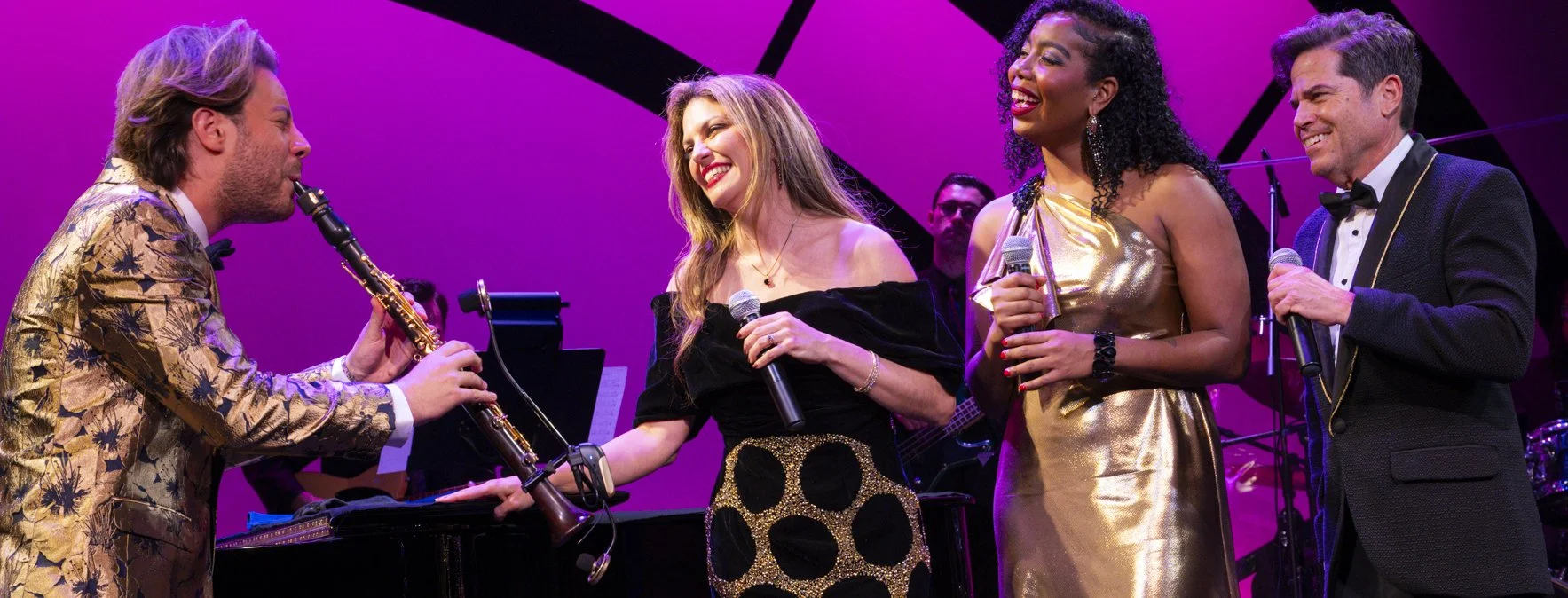
In Act II, Adrian Galante jams with (center to right) Hilary Cole, Ta-Tynisa Wilson, and John Pagano
For nearly 70 years, the songs of Burt Bacharach, one of the most renowned and versatile figures in contemporary music, crossed genres, continents, and cultures. He collaborated with and accompanied the music industry’s finest singers, lyricists, and fellow musicians. Going Bacharach, directed by David Zippel, is a revue of Bacharach’s musical genesis and his many cross-genre innovations.
A co-creation of Adrian Galante, Will Friedwald, Ted Firth and Jack Lewin, the show opens with a rousing medley/overture of some of Bacharach’s chart-topping hits. Most of the quintet—keyboard, guitar, bass, and drums—appear on raised platforms spanning the rear of the stage, but Galante is the conductor and master of ceremonies. As the emcee, he says:
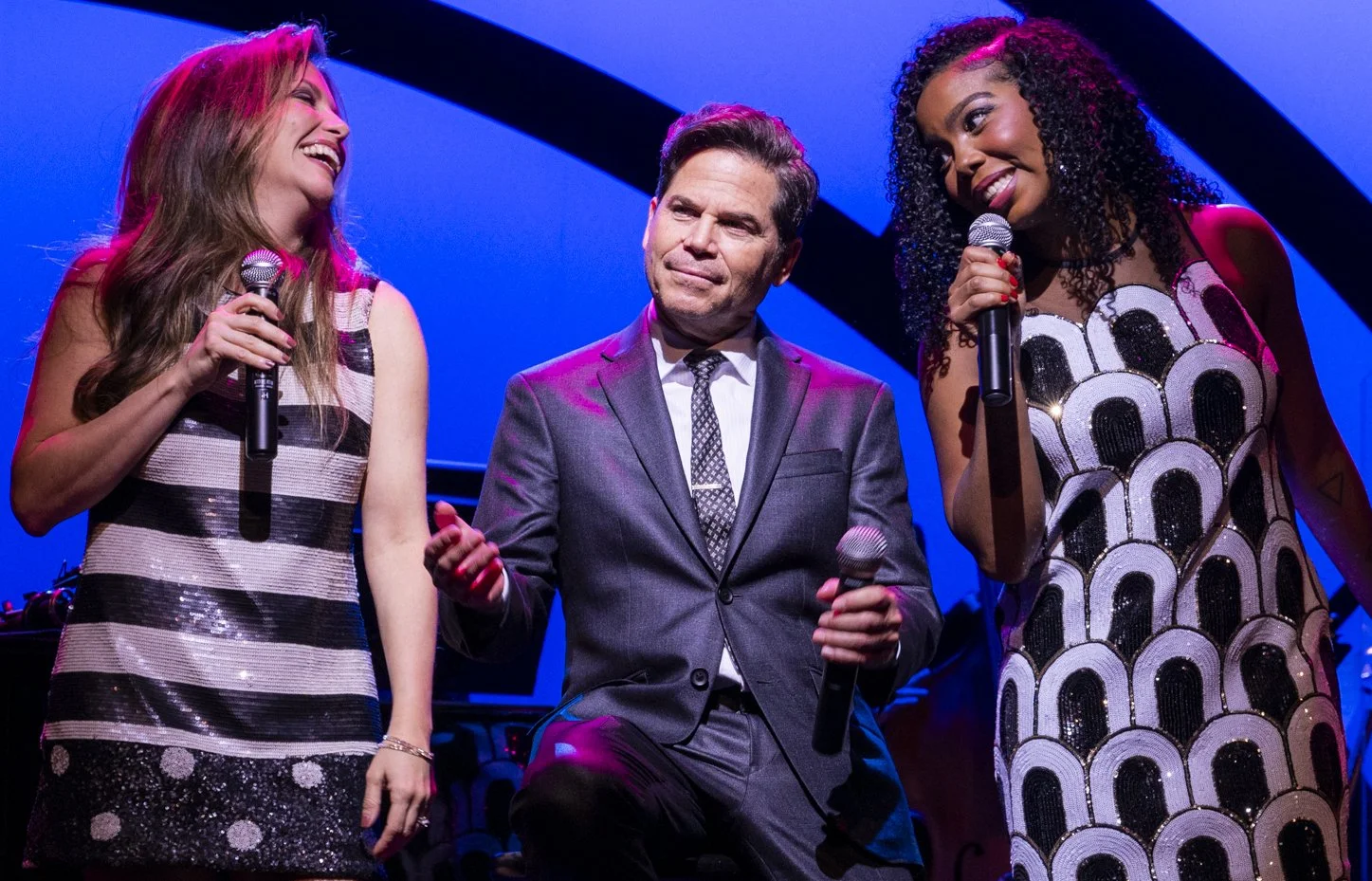
Pagano, longtime lead singer for Bacharach’s tours, joins Kole (left) and Wilson in a romantic ballad.
Burt Bacharach’s music incorporated elements of jazz, classical, traditional pop, Tin Pan Alley, rock 'n' roll, and even soul and funk—and within every one of those styles he sounded like himself, which is something only a great master can do.
Galante was introduced to Bacharach’s work as a child in Perth, Australia, and he is both a classically trained pianist and an innovative jazz clarinetist. He dominates the instrumental numbers with flair, often standing over the keyboard, urging on and energizing the other musicians as he conducts. Whether as entertainer, narrator or accompanist, Galante exudes confidence.
Galante shines in his own solos but offers the three vocalists—John Pagano, Hilary Kole, and Ta-Tynisa Wilson—space to regroup themselves as per each song’s storyline. Pagano toured for 26 years with Bacharach and is likely the best living interpreter of his style (the late enchantress Marlene Dietrich also toured extensively with Bacharach). He sometimes interjects his own narrative about Bacharach’s career path and the composer’s burgeoning fame through the decades. In Pagano’s tribute to Bacharach, he praises the latter’s musical genius and his gratitude for the friendship and the unique opportunity that Bacharach gave him.
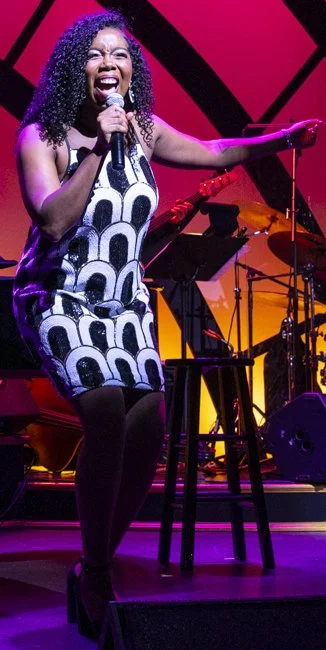
Wilson belts out one of Dionne Warwick’s chart toppers. Photographs by Russ Rowland.
In his role as lead instrumentalist, Galante “refuels” himself just enough to propel him into a passionate accompaniment of the revue’s three vocalists. He dazzles with his clarinet solos.
Bacharach’s most beloved melodies (he wrote more than 500 great tunes, but the ones sung here are primarily the best-known ones) are in great hands with the singers. In between the vocalists’ sets. Kole, an acclaimed jazz singer who started her career as a composer, explains how Bacharach’s work is unusually musically complex. She does this by visually demonstrating this complexity, by counting and tapping out the beats of Promises, Promises, which switches rhythms multiple times. It’s the title song of Bacharach’s 1968 Broadway musical, written with his longtime lyricist/collaborator Hal David; it is the only Broadway show for which the team wrote the entire score.
Wilson is a soulful interpreter of songs that Bacharach wrote for Black singers, as they increasingly generated broader audiences, and were no longer overshadowed by white cover artists. She excels in hits like “Walk on By” and “I Say a Little Prayer,” made popular by Dionne Warwick, and “That’s What Friends are For,” co-written with Carole Bayer Sager, is sung together with Kole and Pagano. Wilson is at ease with the many songs Bacharach composed for Broadway and film, and her duets and trios with Kole and Pagano are indicative of her vocal range and adaptability.
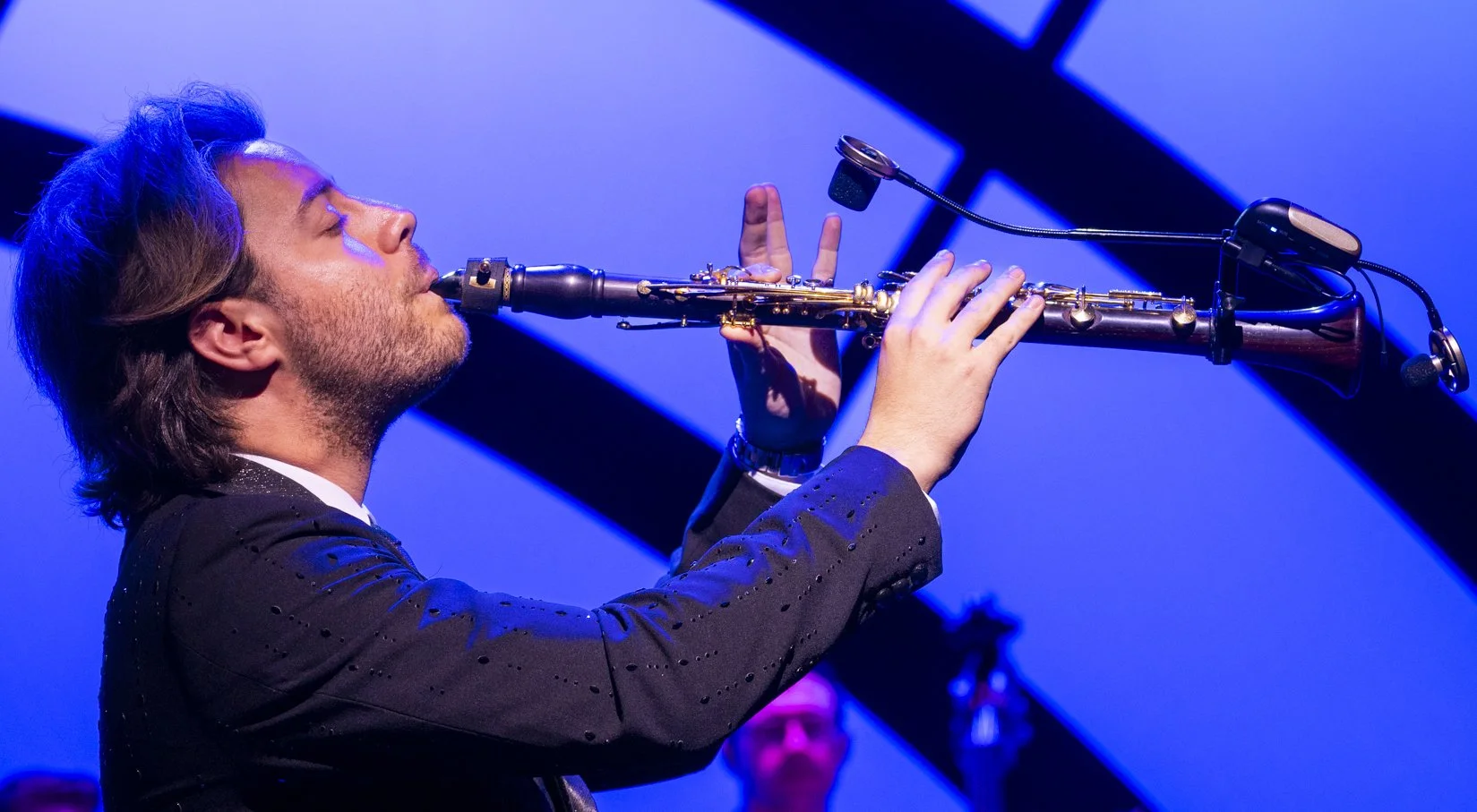
Galante’s expressive clarinet solos showcase Bacharach’s multi-genre hits.
Zippel’s visual acuity, in directing this cabaret-like performance, is spot on. At times, the narration and mood are expansive but less than extravagant, and are also remarkably intimate, like nightclub style. Christopher and Justin Swader’s set consists of overlapping, modernistic pastel arcs resemble reconfigured sections of both bass and treble clefs. It almost suggests that the notes on Bacharach’s sheet music have been lifted off the page and are rising upward. Lighting and sound designer Matt Berman’s pastel-colored gels seem to anticipate the change of mood and performers for each number; consequently, the colors of the backdrop seem to morph, color-wise, as well.
Frank Cazares’s costumes are dazzling, both for maestro Galante and for the way they blend with, and don’t outdo, the color combinations of the vocalists, whose post-intermission garb is accented by bright gold patches and bronze. They complement Galante’s bright, second-act tuxedo, which is more striking than his Act I black tuxedo with gold specks—much less glitzy than the jackets of another famed virtuoso, the late pianist-showman Liberace.
Going Bacharach is a visually and musically enchanting legacy evening that honors a prodigious composer, one who successfully weathered shifting tastes and changing trends in one of the world’s most competitive and sometime brutal industries. It’s a legacy of admiration and love.
Going Bacharach runs at the Marjorie S. Deane Little Theater (10 West 64th St.) through Feb. 22. Evening performances are at 7:30 p.m. Wednesdays through Monday; matinees are at 2:30 p.m. on Wednesdays, Thursdays, Saturdays and Sundays. For more information, or to purchase tickets, call (212) 912-2618 or click here.
Co-creators: Adrian Galante, Will Friedwald, Ted Firth & Jack Lewin
Director: David Zippel
Composer: Burt Bacharach
Sound & Lighting Design: Matt Berman
Set Design: Christopher & Justin Swader
