
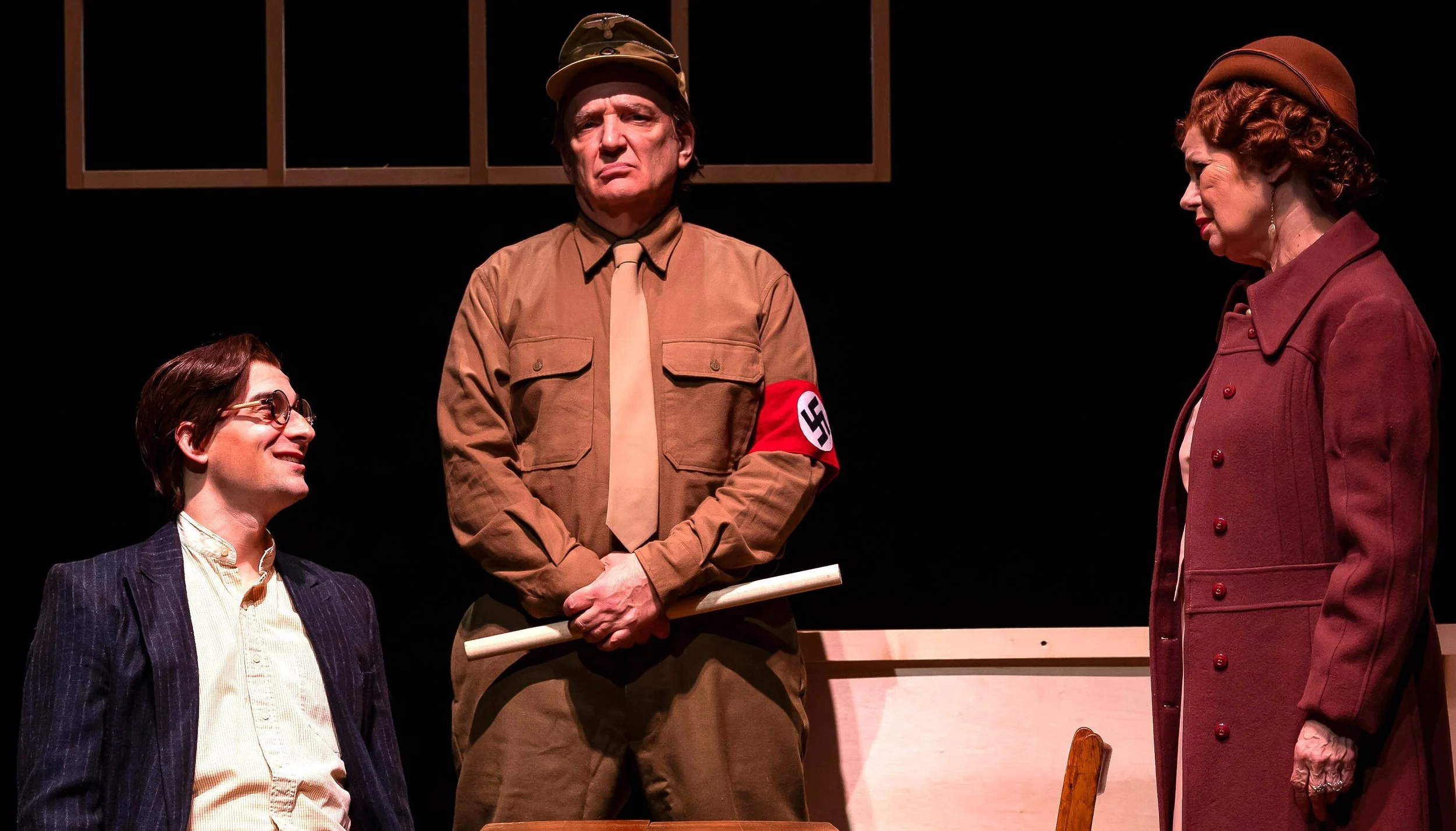
Hans (Daniel Yaiullo) is visited at Dachau by Mrs. Litten (Barbara McCulloh), under the grim watch of a guard (Robert Ierardi).
“My goal is to write plays with exciting stories, smart characters and sharp dialogue. The reviewers report that my plays are full of philosophical ideas. So be it. I’m tired of plays about dysfunctional families and jumbled identities. For me, ideas are more exciting.” So goes the program bio of Douglas Lackey, author of Hans Litten: The Jew Who Cross-Examined Hitler, a new historical drama at Theatre Row. And he’s true to his words, or at least two of them: “philosophical ideas” dominate, sometimes at the expense of character development, tension, and atmosphere. What’s onstage isn’t uninvolving or unmoving, but one is very aware of what’s missing.
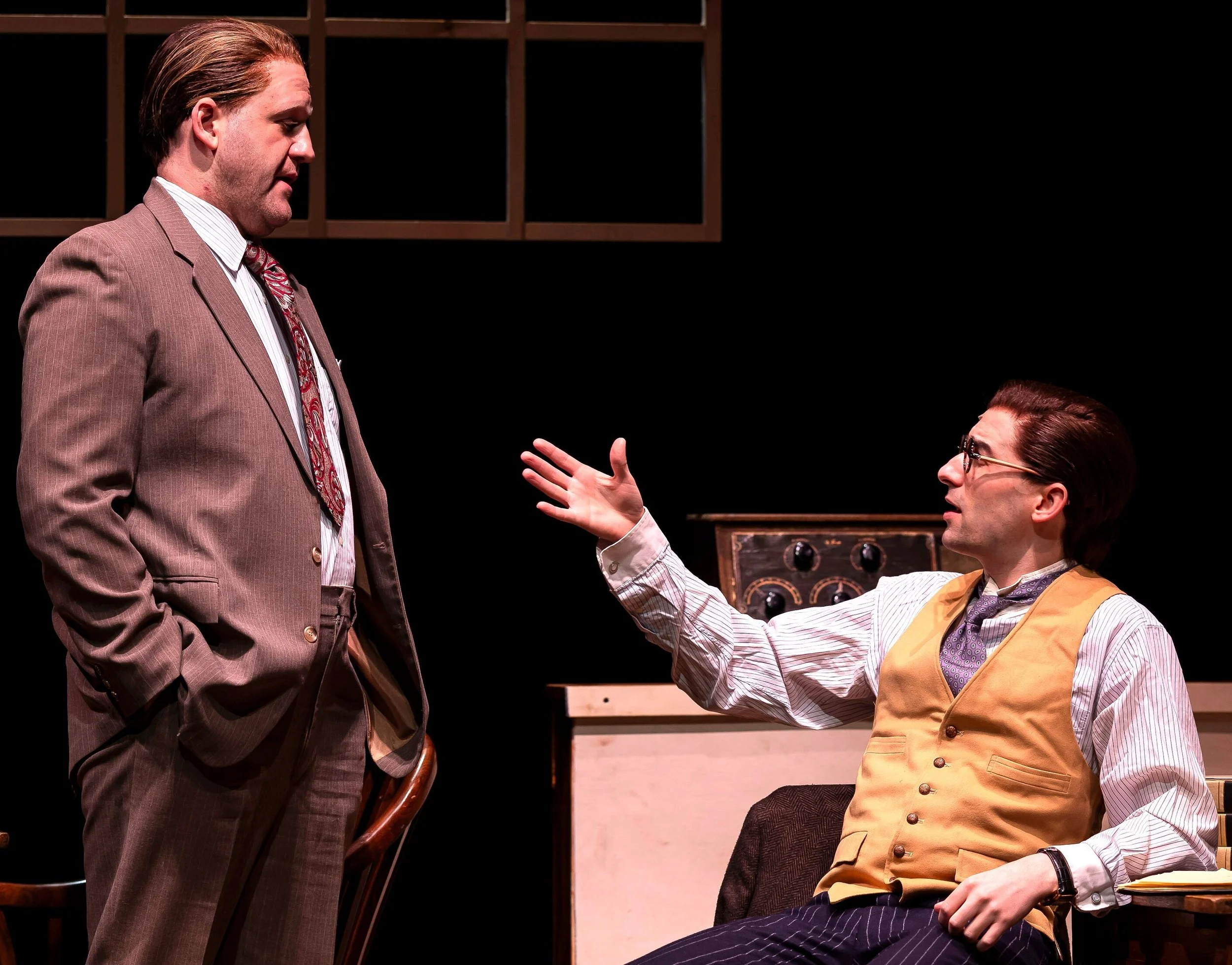
Hans (right) has frequent disagreements with his law partner (Dave Stishan).
It’s a history worth retelling. Litten (1903–38), baptized as a Christian but a self-avowed Jew, yet also at times an avowed atheist, was something of a Renaissance man, fluent in everything from music to art to religion to architecture. Born to a well-to-do Königsberg family, Litten (Daniel Yaiullo) reluctantly gave in to his father’s (Stan Buturla) entreaties to forsake art history and study law, then excelled at the latter. He opened a partnership with Ludwig Barbasch (Dave Stishan), a Communist sympathizer.
The two toiled away at workers’ causes, and then, in 1931, took on a hot case: in 1930, Nazi stormtroopers stabbed workers at the Eden Dance Palace in Berlin, and Litten subpoenaed Adolf Hitler (Zack Calhoon; at one awkward point, his mustache fell off) to testify on whether they were acting on behalf of the Nazi Party. Though Lackey shows a judge sympathetic to Hitler (a commanding Mark Eugene Vaughn), Litten embarrassed and tongue-tied the soon-to-be Führer, who quickly swore revenge. As Hans’s father says, in a line that some audience members gasped at the currency of, “Dictators are always vindictive. They never forget the smallest insult.”
“This Hans is consistently wry, understated, ironic, even after suffering a blinded eye, limp, and fractured jawbone. ”
Plenty to dramatize, then, but Lackey devotes pages to philosophical debate. Communism! Internationalism! Kant, Rilke, Mozart! They’re discussed, and in the latter two cases recited and sung, at length. In the process, Litten himself gets somewhat shortchanged.
He suffered horrendously, taken into “protective custody” (read: West Berlin’s Spandau Prison, then a series of concentration camps, culminating in Dachau), beaten, tortured, driven to suicide. Yet as played by Yaiullo, his demeanor changes little; this Hans is consistently wry, understated, ironic, even after suffering a blinded eye, limp, and fractured jawbone. The real Litten may have been just as lackadaisical, but it doesn’t make for mounting drama. Did he have friends? A sweetheart? Other interests? What became of his Jewish father and brothers, whom his Christian mother tried to hustle out of Germany? Lackey isn’t telling; he’s too busy pouring out all that philosophy.
He does dwell frequently on the family, and some of the best moments spring from that. Buturla is a steady, dignified Litten père. And Barbara McCulloh, as Hans’s doting mom, a role that could easily be overplayed, keeps the emotions restrained and honest (though the parents joking over nostalgic family memories while Hans is interred at Dachau feels off). She’s the only actor besides Yaiullo not to play multiple roles, and the rest of the company—Robert Ierardi, Whit K. Lee, and Marco Torriani (who was absent at the performance I saw; other actors capably took over)—slip comfortably in and out of identities. Lee even plays Kurt Weill, to Torriani’s Bertolt Brecht, in a chance encounter with Litten; he in no way resembles Weill, but he does give out with a lusty “Alabama Song.”
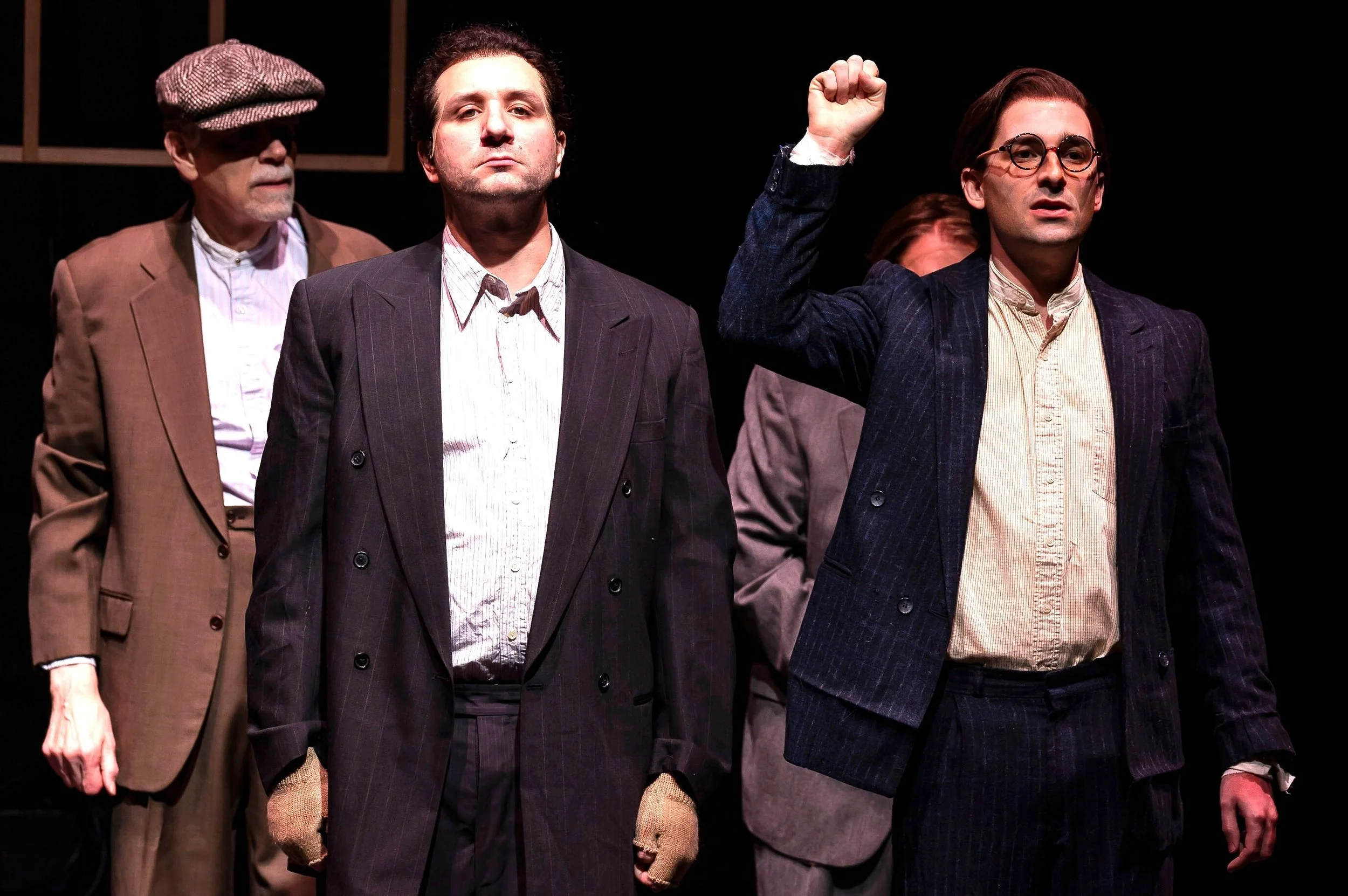
Stan Buturla (left) and Zack Calhoon (with Yaiullo at right) play prisoners in addition to Friedrich Litten and Adolf Hitler, respectively. Photographs by Ben Hider.
The only real mistake director Alexander Harrington makes is staging so much of the action stage left—if you’re on the opposite side of the house, you’re bound to feel cheated. Alex Roe’s scenic design is functional; Anthony Paul-Cavaretta’s costumes include a couple of suits that don’t at all look like the 1930s; and Alexander Bartenieff’s lighting makes a fine show of the Reichstag fire, the Nazis’ excuse for placing Litten in “protective custody.”
There’s an affecting scene of concentration camp inmates serenading Litten with a long song in Yiddish, but it might be more affecting if Lackey just let listeners know what the song is about. While Litten’s story surely bears recounting, such casual stagecraft robs Hans Litten: The Jew Who Cross-Examined Hitler of greater punch.
Hans Litten: The Jew Who Cross-Examined Hitler runs through Feb. 22 at Theatre Five, Theatre Row (410 West 42nd St.). Performances are at 7 p.m. Wednesday through Saturday, with matinees at 2 p.m. Saturday and 3 p.m. Sunday. For tickets and more information, visit hanslittenplay.com.
Playwright: Douglas Lackey
Director: Alexander Harrington
Scenic Design: Alex Roe
Costumes: Anthony Paul-Cavaretta
Lighting: Alex Bartenieff
Sound Design: Abirami Senthil
