
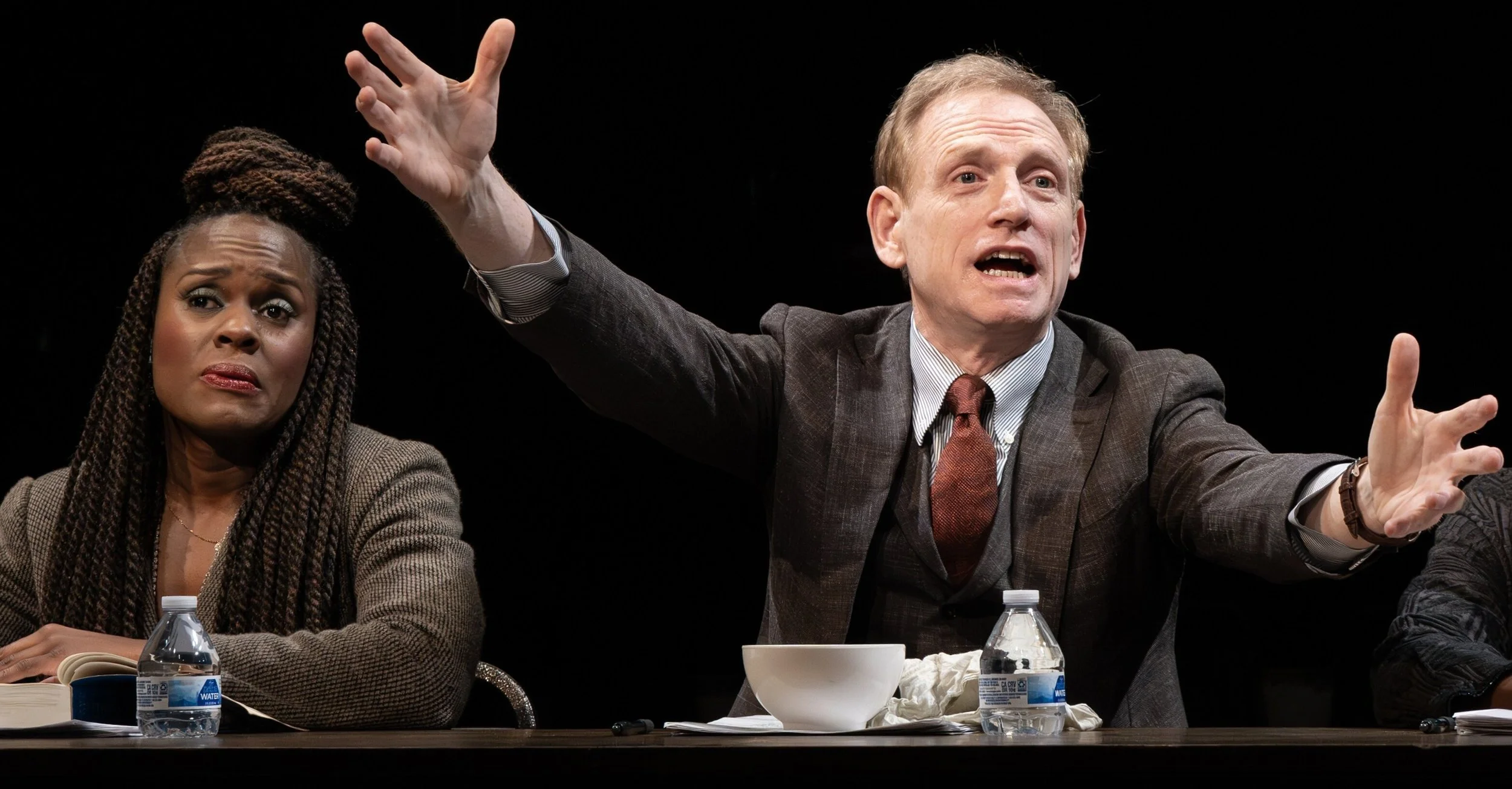
Scott Shepherd (right) plays multiple roles, including the narrator, in Elevator Repair Service’s adaptation of James Joyce’s Ulysses, and is also co-director (with John Collins) and dramaturg. Stephanie Weeks (left) plays eight roles in the production.
Gatz, the signature creation of downtown theater troupe Elevator Repair Service (ERS), included every sentence of F. Scott Fitzgerald’s 1924 novel The Great Gatsby, with each performance running a whopping eight hours (including intermissions and dinner break). At the Public Theater these days (16 years after Gatz premiered there), ERS is offering its take on Ulysses, the ravishingly innovative novel—serialized in 1918, published in book form in 1922—that secured James Joyce’s position as preeminent pioneer of stream-of-consciousness narrative in English. As with Gatz, the script of Ulysses consists entirely of the novelist’s original prose; this time, though, there are numerous elisions, permitting each performance to clock in at a mere two hours and 40 minutes.
Vin Knight plays Leopold Bloom, protagonist of Ulysses, in the Elevator Repair Service dramatization of James Joyce’s immense, stream-of-consciousness novel.
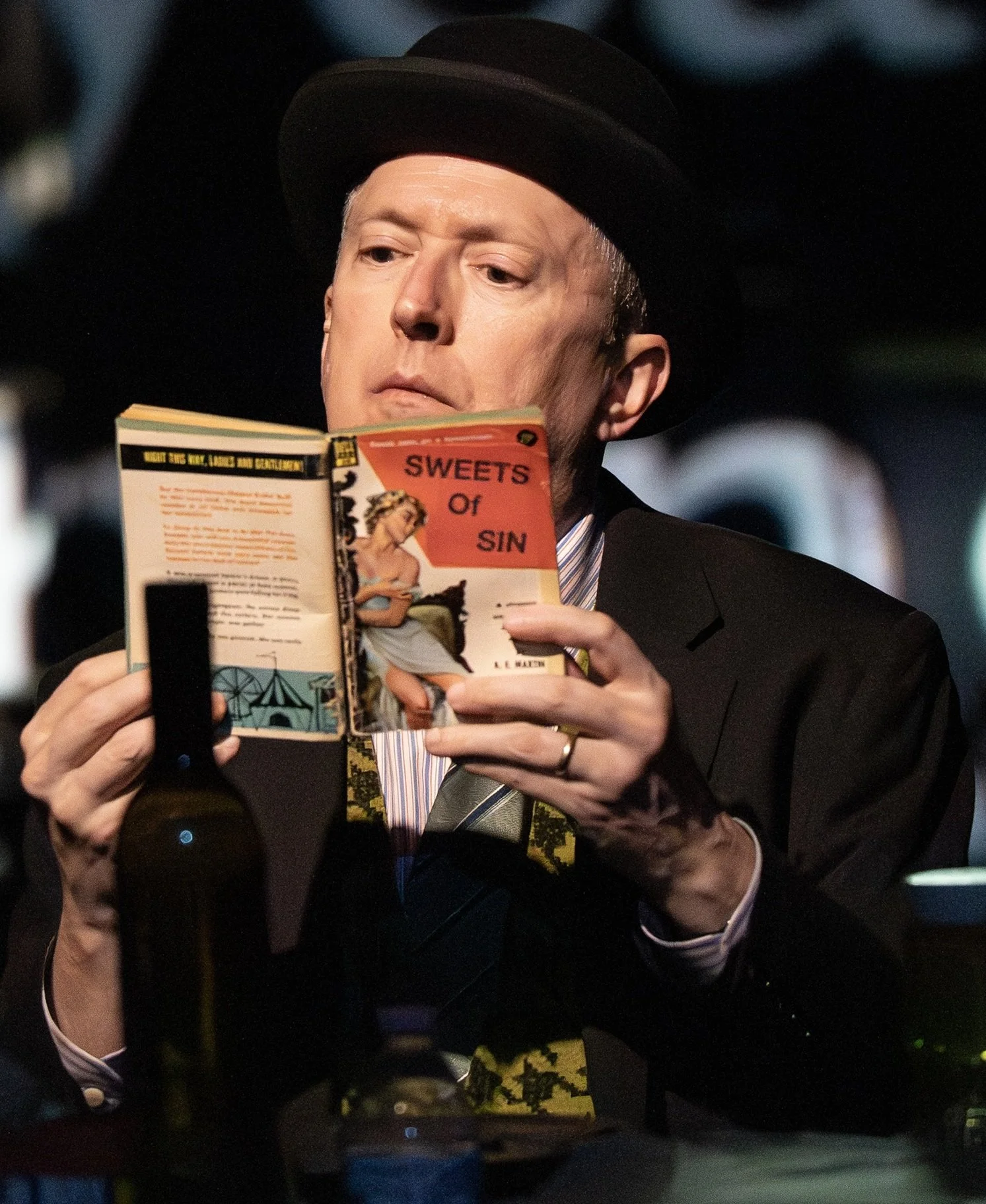
Ulysses takes place on June 16, 1904 (and into the wee hours of the 17th), during which protagonist Leopold Bloom (Vin Knight) wanders Dublin, pursuing business, courting social interaction, and brooding. Bloom is a melancholy ad-space salesman, Jewish on his father’s side, Irish Catholic on his mother’s. He’s married to a professional singer, hot-blooded Molly Bloom (Maggie Hoffman), known in the concert world by her birth name, Marian Tweedy. Though the Blooms live together at 7 Eccles St. in North Dublin (probably the most famous residential address in modernist literature) and share a bed, their sexual relationship has languished over the decade since the death of their 11-day-old son Rudy. On this date, just prior to the summer solstice of 1904, Molly is commencing an affair with impresario Blazes Boylan (Scott Shepherd), her agent. Bloom, surmising what’s afoot, is brooding about his spouse and her new lover.
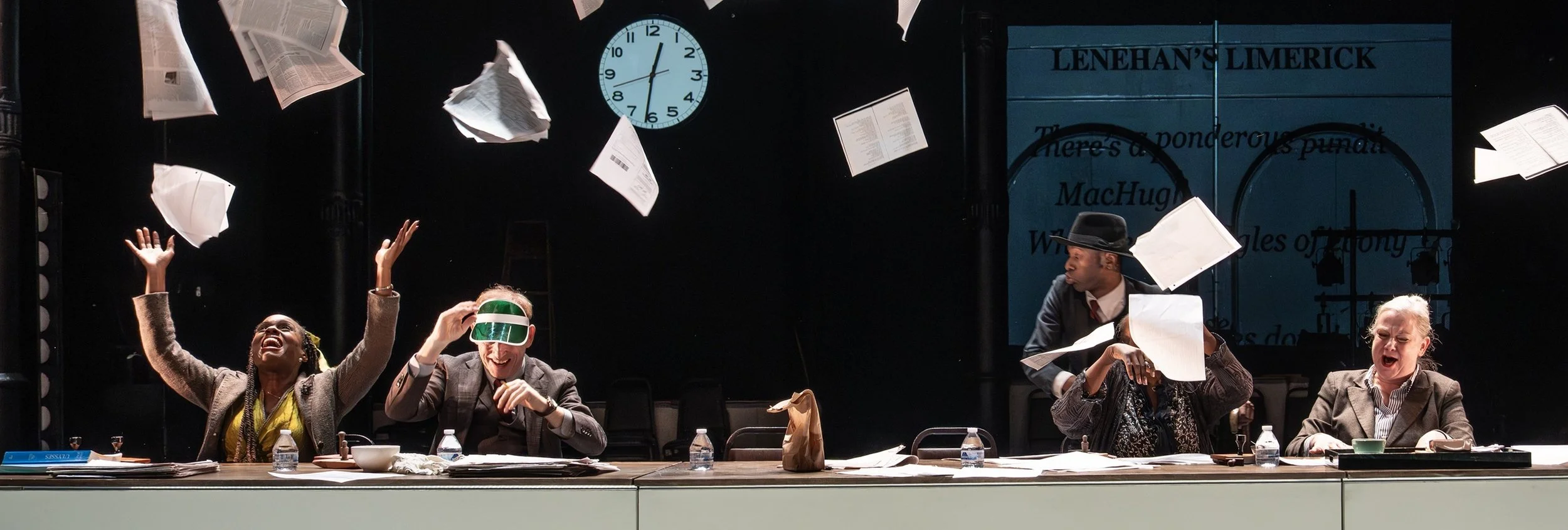
Structurally, Bloom’s Dublin odyssey is modeled on Homer’s epic account of Ulysses’ perilous journey home to Ithaca after the Trojan War. ERS has streamlined Joyce’s massive work efficiently, though some of the cuts seem arbitrary. Projection designer Matthew Deinhart deploys images of fast-scrolling Joycean text to indicate where the many deletions occur; and sound designer Ben Williams provides auditory accompaniment for those projections that is reminiscent of an old-time tape recorder when its fast-forward button is held down.
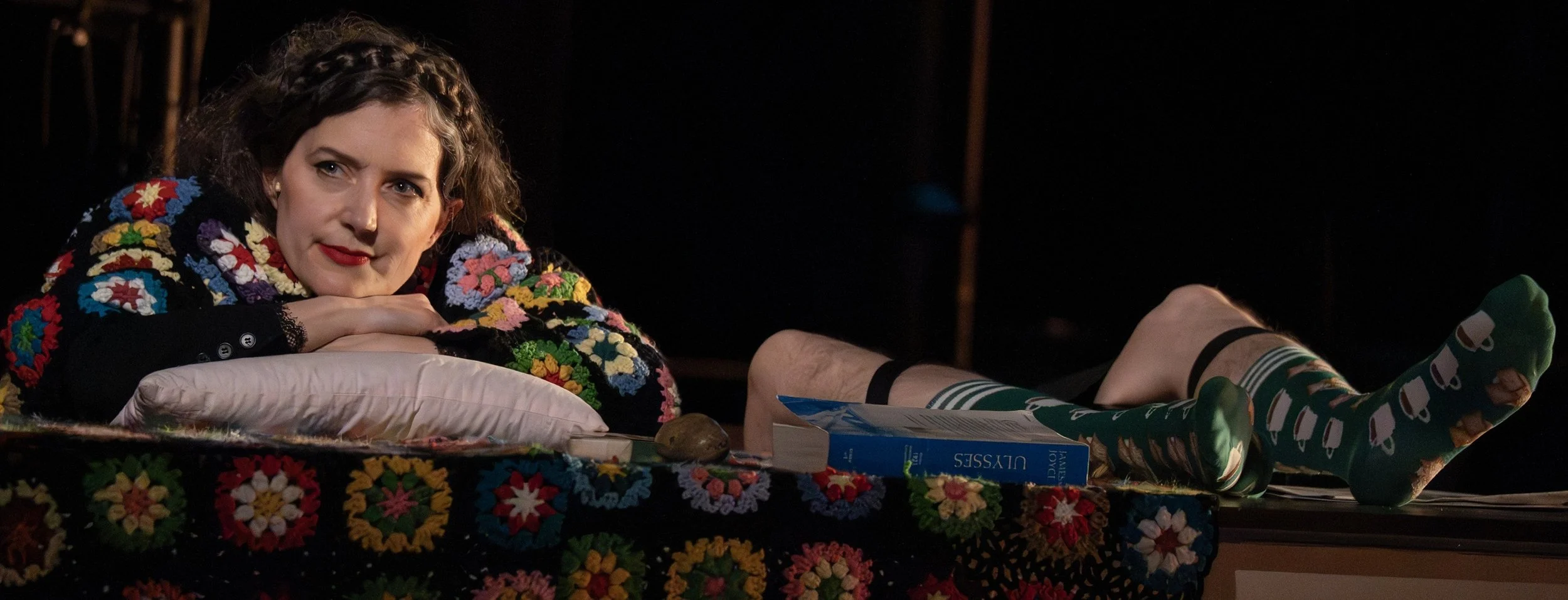
As Molly Bloom, Maggie Hoffman says “Yes!” to life in all its complexity, pleasure, and pain in the final episode of Elevator Repair Service’s presentation of Ulysses at the Public Theater. Photographs: Joan Marcus.
Bloom’s itinerary includes stops at a post office, a cemetery (for the burial of friend Paddy Dignam), the offices of a newspaper, a hotel, and a pub. On a beach, Bloom has a casual erotic interaction with a stranger named Gerty MacDowell (Hoffman, again) that the U.S. Customs Service deemed lewd when copies of the book, published initially in Paris, began coming into the country. While inquiring about a patient at the Holles Street Maternity Hospital, Bloom encounters 22-year-old Stephen Dedalus (Christopher-Rashee Stevenson), the autobiographical protagonist of Joyce’s first novel Portrait of the Artist as a Young Man (1916), who’s socializing with medical-student acquaintances and appears destined for a night of carousal.
Long acquainted with Stephen’s father, Bloom is aware that son and parent are estranged (and, also, that Stephen is mourning his late mother). His paternal nature is aroused by the younger man’s seeming waywardness. Joyce sketches Bloom’s sense of Stephen as an outsider and surrogate for the lost Rudy with pastiche of Le Morte d’Arthur, Thomas Malory’s 15th-century chronicle of King Arthur:
And now sir Leopold that had of his body no manchild for an heir looked upon him his friend’s son and was shut up in sorrow for his forepassed happiness and as sad as he was that him failed a son of such gentle courage (for all accounted him of real parts) so grieved he also in no less measure for young Stephen for that he lived riotously with those wastrels and murdered his goods with whores.
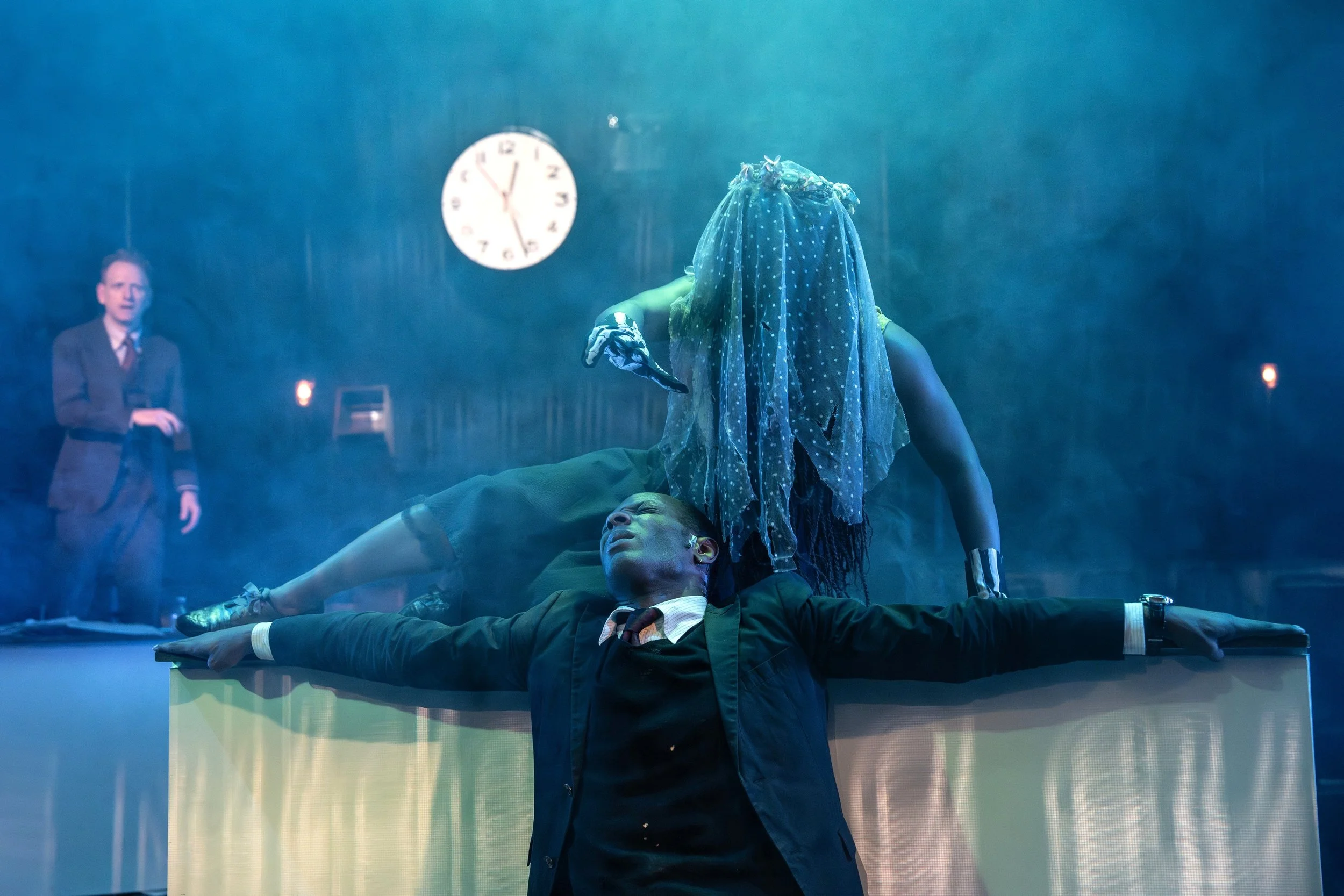
Stephen Dedalus (Christopher-Rashee Stevenson) encounters the shade of his mother (Weeks) during the boozy, nightmare scene in Dublin’s Nighttown, as Shepherd (left rear) looks on.
Bloom and Dedalus join forces for the rest of the story. Knight and Stevenson find ample poignancy in the impromptu friendship of these needy characters. The performance ends with the novel’s most famous episode (arguably the most celebrated instance of stream-of-consciousness prose in all literature), Molly’s internal soliloquy (“… yes I said yes I will Yes”). In Hoffman’s level-headed, slightly bland rendition, this famously sexy passage is an upbeat coda to the chronicle of poor Bloom’s beleaguered day.
As staged by director John Collins and codirector and dramaturg Shepherd, Joyce’s story is somewhat dissociated from Irish culture and historical context. The adaptation succeeds as a celebration of Joyce’s antic imagination and the idiosyncratic spirit of ERS’s determination to bring modernist writers to the stage without turning their works into conventional plays. It’s suitable treatment for an author who said, “The demand that I make of my reader is that he should devote his whole life to reading my works.”
Elevator Repair Service’s production of Ulysses, presented in partnership with Under the Radar Festival, runs through March 1 in Martinson Hall at the Public Theater (425 Lafayette St.). Evening performances are at 7 p.m. Tuesday through Saturday and at 6 p.m. Sunday; matinees are at 1:30 p.m. Saturday and 2 p.m. Sunday. For tickets and information, visit publictheater.org.
Created by Elevator Repair Service
Text: Ulysses by James Joyce
Direction: John Collins (director); Scott Shepherd (co-direction/dramaturgy)
Scenic Design: dots
Costume Design: Enver Chakartash
Lighting Design: Marika Kent
Sound Design: Ben Williams
Projection Design: Matthew Deinhart
