
Drama, Multimedia, Reviews
Edward Karam
On entering St. Ann’s Warehouse for Daniel Fish’s Kramer/Fauci, the entire expanse of the building is visible. The floor is matte black, and on the far wall a bank of lights beams intensely toward the audience, replicating a high school football stadium in Texas. Although the scenic design is credited to Jim Findlay, Joshua Higgason, and Amy Rubin, and the lighting to Scott Zielinski, the importance is the actors, who re-create a 1993 C-SPAN interview with writer (the novel Faggots; the play The Normal Heart) and ACT UP activist Larry Kramer (Thomas Jay Ryan) and Dr. Anthony Fauci (Will Brill), then known as the premier AIDS researcher in the country.

Musical, Reviews
Marc Miller
Anachronisms are a reliable source of fun and surprise in musicals, from the very casting and concept of Hamilton going back to “On any gent who wandered by, she’d pull the Theda Bara eye” (“Cleopatterer,” Leave It to Jane, 1917). But anachronisms have seldom had as strenuous a workout as the one they endure in Slam Frank, the musical at the Orpheum. The work of Joel Sinensky (book) and Andrew Fox (music and lyrics), it aims essentially to resurrect a mid-century classic, burden it with pop culture signposts from a variety of eras, reassess its relevance in these troubled times, and find it wanting. Which it does in an anything-for-a-laugh way, to the point where your sides may be sore from being poked in the ribs so relentlessly.

Musical, Reviews
Stanford Friedman
Warnings about the consequences of global warming come early and often in the Off-Broadway premiere of Nick Blaemire’s 2015 pop musical, Soon. But they are a false flag. This is no treatise on the fragility of the physical world. Instead, it is the study of a young woman’s psyche as she wends her way through what often feels like a traditional romantic comedy only to arrive at a surprising crisis point where she risks drowning in her own emotional meltdown.

Drama, Reviews
Edward Karam
The word belong becomes an obsession for stoker Yank (Jon Beavers) in Eugene O’Neill’s 1922 play The Hairy Ape. Yank has spent his life shoveling coal on a transatlantic liner, and he is the tallest and seemingly strongest of the men doing that work in Ciarán O’Reilly’s engrossing production at the Irish Rep. Yank sees himself as the solid foundation of the entire society, but when a socialite visits the stokehold, it launches him on a downward spiral. He becomes obsessed with the idea that she could look at him only as a “hairy ape.”
Reviews, Mime
Deirdre Donovan
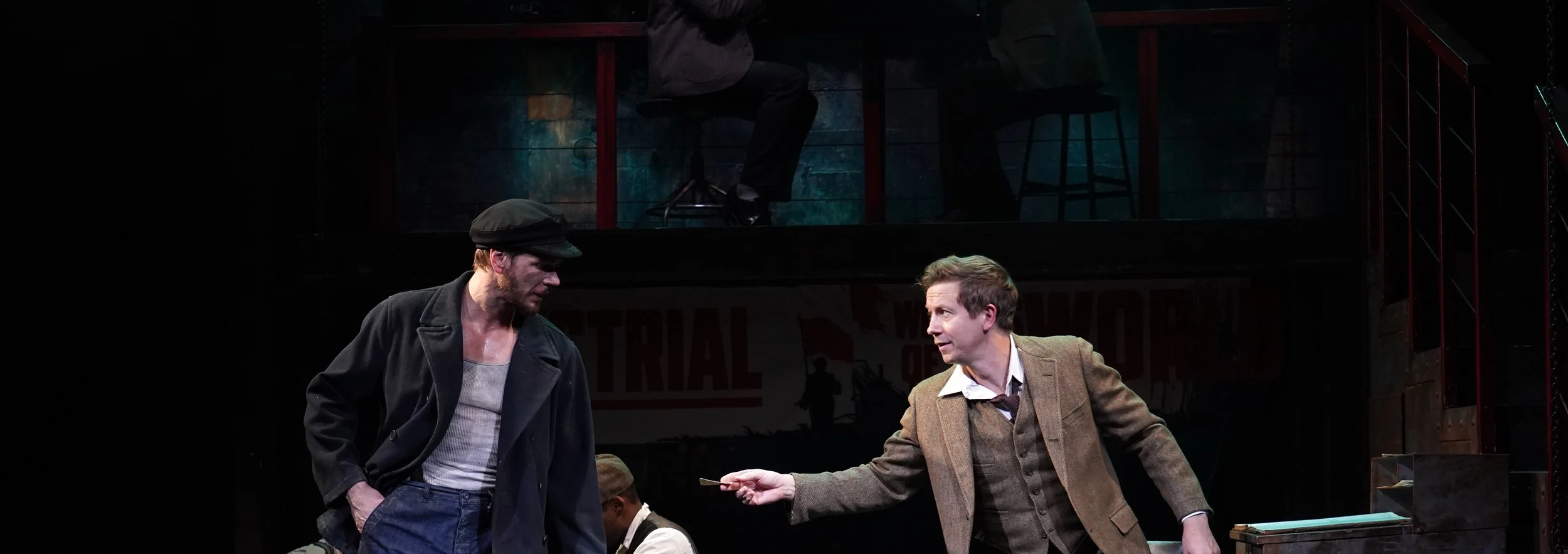
In Myth, directed by Becky Baumwoll, Broken Box Mime Theater transports audiences to a distant planet where two moons illuminate an alien world of strange flora, fauna, and unexpected possibilities. Through the expressive power of the body, the adventurous company uses speculative fiction to explore how we remember, revise, and sometimes forget the histories that shape our present.

Newsletter Block
This newsletter signup form needs a storage option. Edit the block and enter a storage location via the Storage tab.