
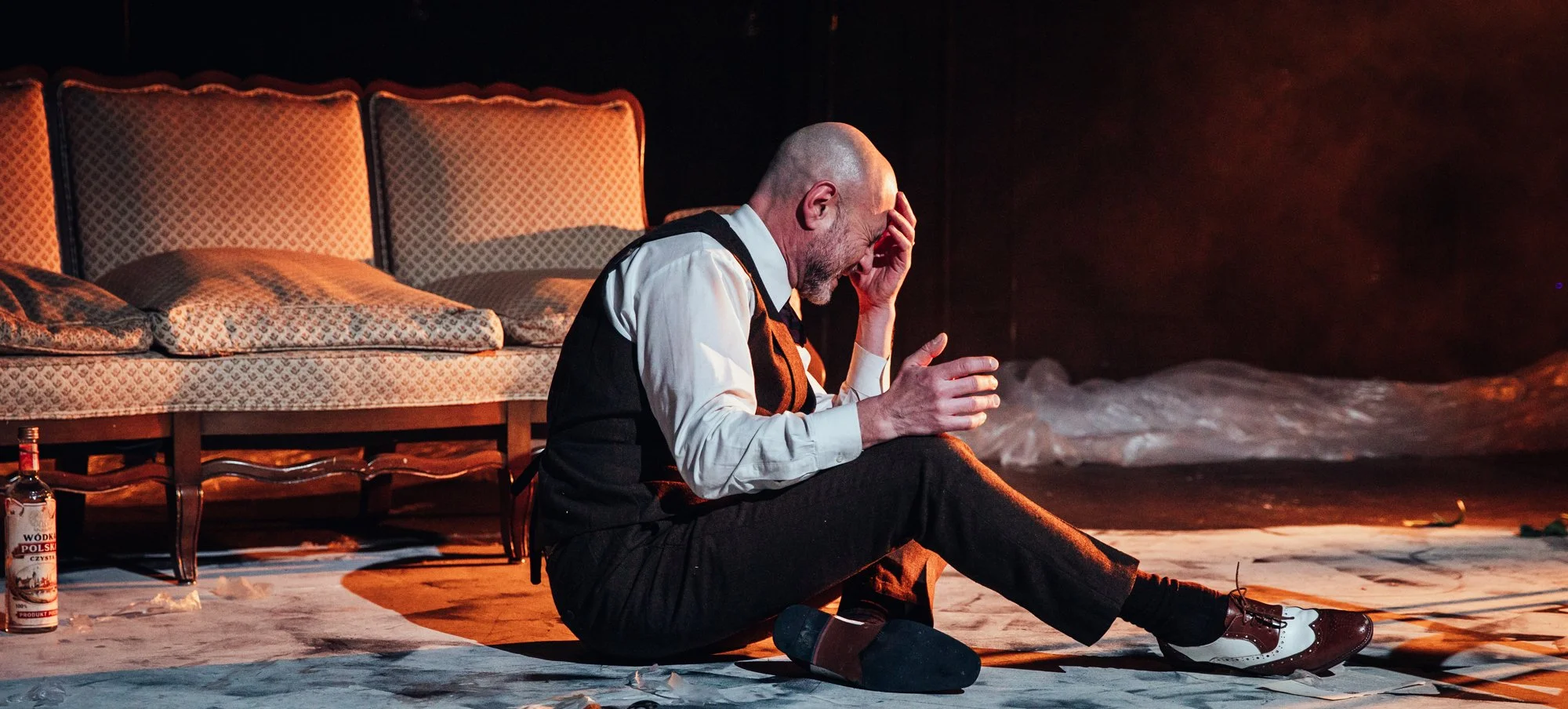
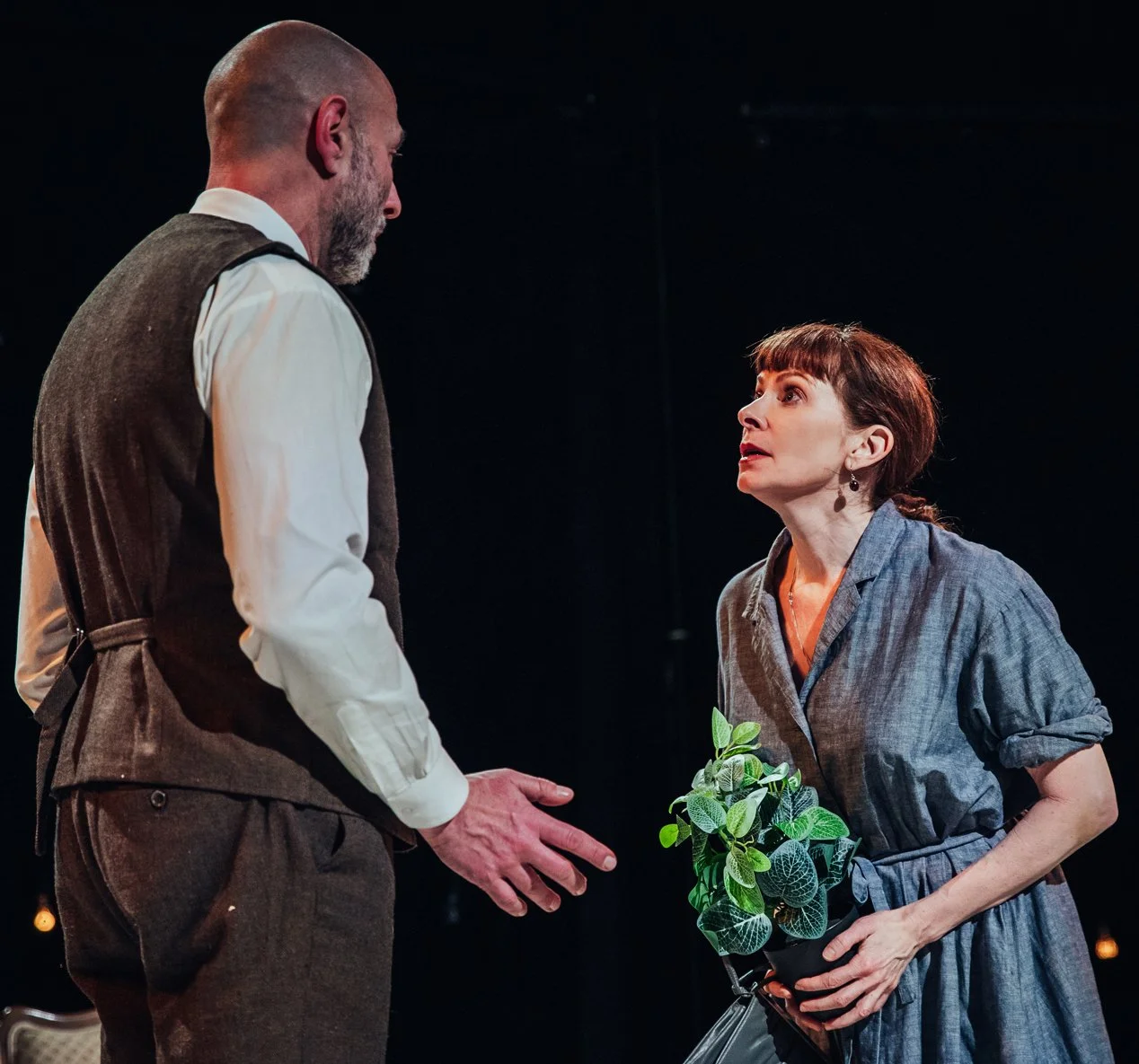
Adam (Roman Freud) and Lydia (Emmy-Award winner Cady McClain) grow fond of each under in Freud’s Beneath the Ice of the Vistula but also butt heads as they get to know each other.
In Roman Freud’s Beneath the Ice of the Vistula, a Polish-Jewish composer named Adam Kobylanski agonizes over a musical composition that he is sure will be a masterpiece. The year is 1939. The Nazi invasion looms on the horizon but is still far enough away that Adam has the time and space to work on his composition in peace.
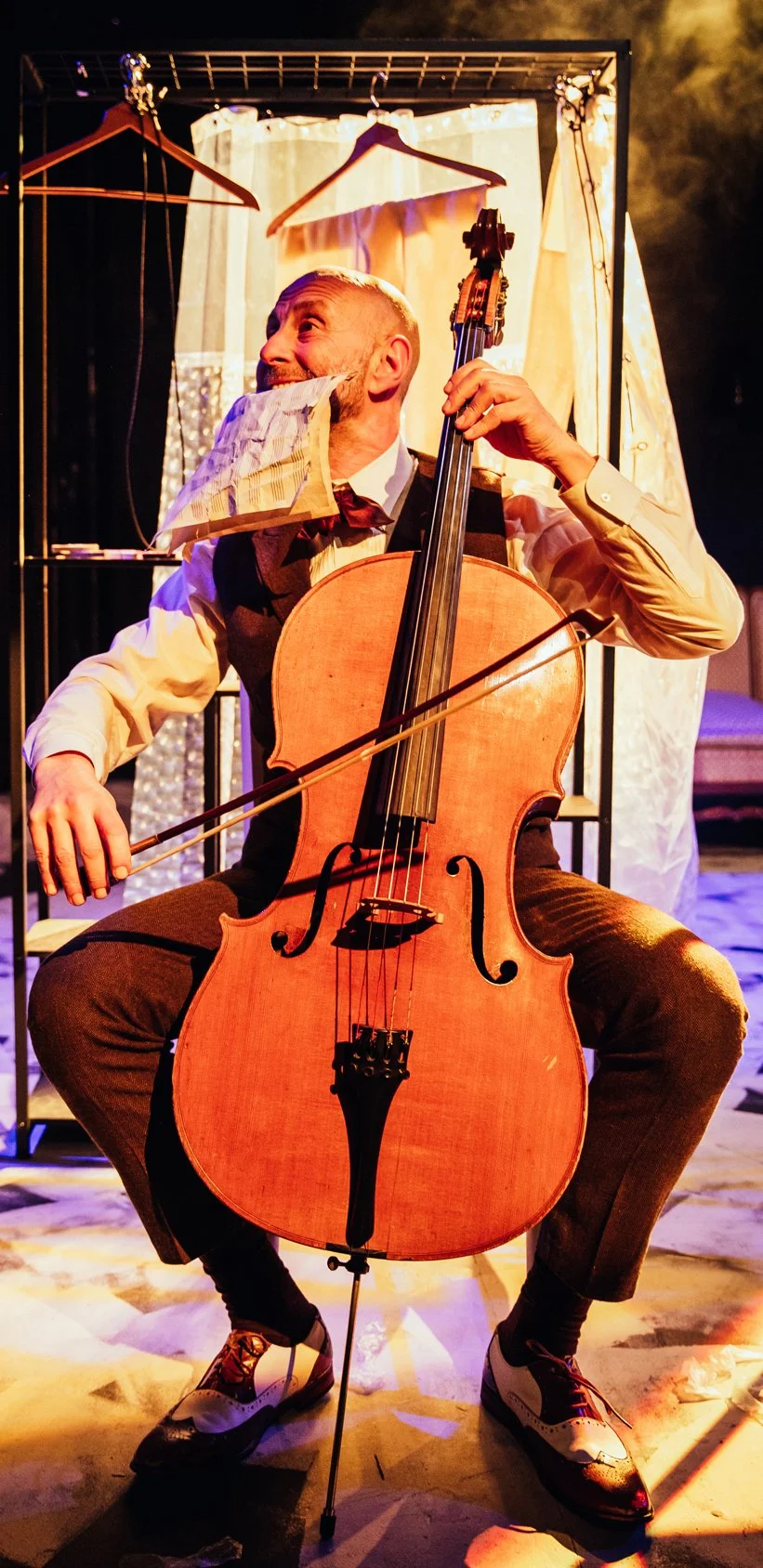
Adam (Freud) is tortured by the pressure he puts on himself to write the next great masterpiece.
To focus on this task, he places a newspaper ad for a cook and cleaner that is answered by Lydia Mazurik (played by Emmy Award–winner Cady McClain). Lydia takes Adam’s eccentricities in stride and willingly agrees to his strange caveat: she will possess the only key to his apartment and lock him inside for three-day intervals.
While she cooks, she hums, bangs pots, and sings, creating a different type of masterpiece in each dish she makes for him. When Adam tastes her fish soup for the first time, he exclaims: “My mother used to say, ‘I’ve put a piece of my Jewish heart into this soup.’ ... Here is the work, here is the soul. But how do you combine them? And here you came for a couple of hours, and here’s the soup—there’s the soul, the skill, and love.”
Lydia: So I don’t understand. Do you like the soup?
Adam: Let me put it this way: I want to play your soup on the cello.
The copacetic rhythm of their lives is eventually disrupted by Adam’s creative block. As he becomes increasingly tetchy, Lydia offers him a blunt critique of his music. She suggests that while his compositions are beautiful, they are missing what she calls the “bull”—the masculine, driving force, like a herd, that is required to make the notes complete. The metaphor is realized moments later when she jumps into his lap. The lights go out, but it’s clear what has happened.
McClean, an American, does a good job with the Polish accent, and Lev Grzhonko (at the performance I saw; he alternates in the part with Freud himself), with his floppy hair and sinewy movements, embodies the tortured artist with fervor. However, character development suffers under the light touch of Eduard Tolokonnikov’s direction and leaves the play with little dramatic action.
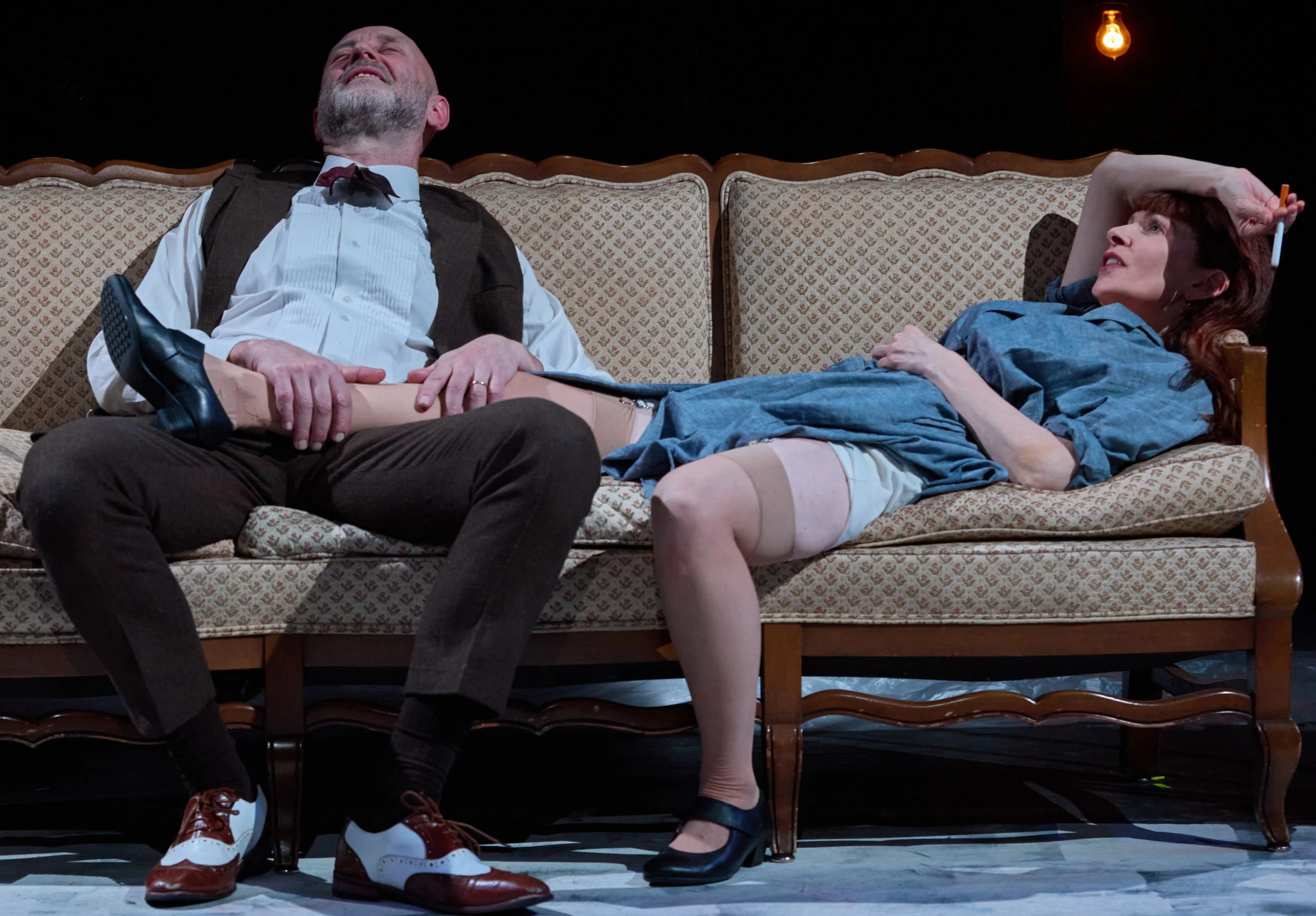
Adam and Lydia are exhausted after an intimate moment that helps to loosen Adam’s creativity. Photographs by Alexandra Vainshtein.
The play is further weakened by the playwright’s hodgepoge of styles, which affects the structure. The work is written primarily as a conventional drama but is punctuated by bizarre dream sequences that take time to set up, don’t move the action forward, and don’t provide the audience with much insight into Adam’s psyche. In these dreams, Brad Fryman appears as various historical composers. In one, Fryman appears as French composer Maurice Ravel, who says to Adam: “I just can’t remember—we discussed this somehow. What do you call a woman whose both holes are very close to each other?” These crude references to women’s anatomy are cringeworthy in today’s artistic landscape.
The phenomenal production design offsets the problems with the text and direction. Zhenya Shekhter’s set brilliantly contrasts domestic neatness with shelves lined with books and kitchenware, and a floor pattern resembling scattered papers, a visual echo of Adam’s creative chaos. Denis Zabiyaka’s sound design gives the play dimension and depth. The lighting, by Hunter Lastberg, is effective in creating drama and suspense, particularly at the end, when little yellow lights dot the back wall like the ones that may appear after a blackout during wartime. Natalia Danilova’s costumes are simple and effective, and the music—cello compositions by Inessa Zaretsky—drifts throughout the play, blanketing it in a softness.
“Lev Grzhonko, with his floppy hair and sinewy movements, embodies the tortured artist with fervor.”
Adam’s arrogance is highlighted by his self-proclaimed importance. He haughtily tells Lydia: “I graduated from the Vienna University of Music and Performing Arts. I am a fairly well-known musician and composer. The piece I’m writing now could turn Warsaw’s cultural life upside down. The entire cultural community of Poland, and perhaps all of Europe, is waiting for it.”
However, as Adam’s fate becomes inevitable, Lydia implores him to run away with her to the countryside where the Vistula, a long river in Poland, runs, and where she can hide him. But Adam refuses to leave. After all, Poland is his home and he is Polish. Many Jews did not want to leave their home, even when it was perilous, and Adam’s final act of defiance—to hold on to all that he knows—creates the one true emotional note in the play.
Beneath the Ice of the Vistula runs through Feb. 28 at West End Theater (263 West 86th St.). Evening performances are at 7 p.m. Wednesday through Saturday; matinees are at 2 p.m. on Saturday and Sunday. For tickets and more information, visit beneathiceofvistulaplay.com.
Playwright: Roman Freud
Director: Eduard Tolonnikov
Scenic Design: Zhenya Shekhter
Costumes: Natalia Danilova
Lighting: Hunter Lastberg
Sound Design: Denis Zabiyaka
