
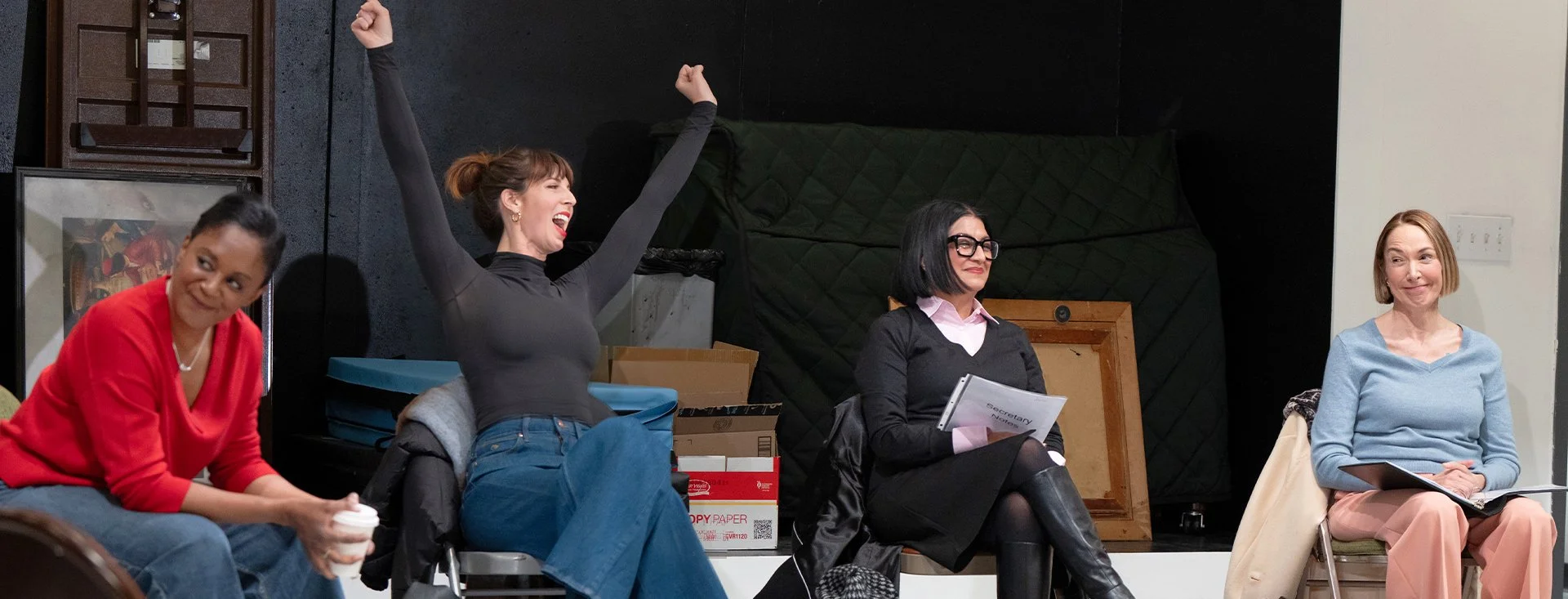
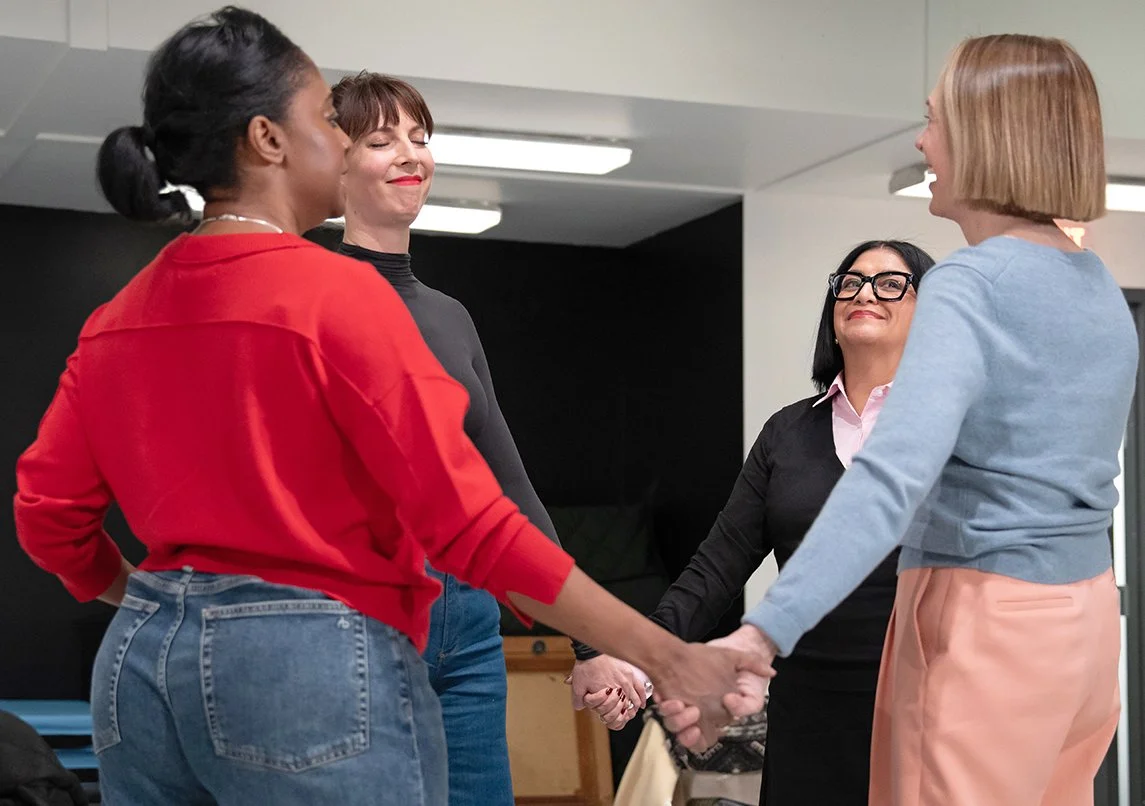
Four members of the Saturday Survivors alcohol-recovery group—from left, April Matthis (Jane), Mallory Portnoy (Janet), Maria Elena Ramirez (Joane), and Elizabeth Marvel (Joan)—say the serenity prayer, in Jacob Perkins’s The Dinosaurs at Playwrights Horizons.
Jacob Perkins’s The Dinosaurs is a meditation on sobriety and female friendship. It unfolds within a women’s and trans-inclusive alcohol-recovery group dubbed the Saturday Survivors, a nod to the day of the week they meet over coffee, scones, and doughnuts in a bland, white, windowless community room with folding chairs (scenic design by dots). Under Les Waters’s direction, the 70-minute play, which features a remarkable ensemble of actors, slides from a naturalistic mode into an experimental one, as time and identity are upended. The experiment, however, proves frustratingly vague rather than provocative.
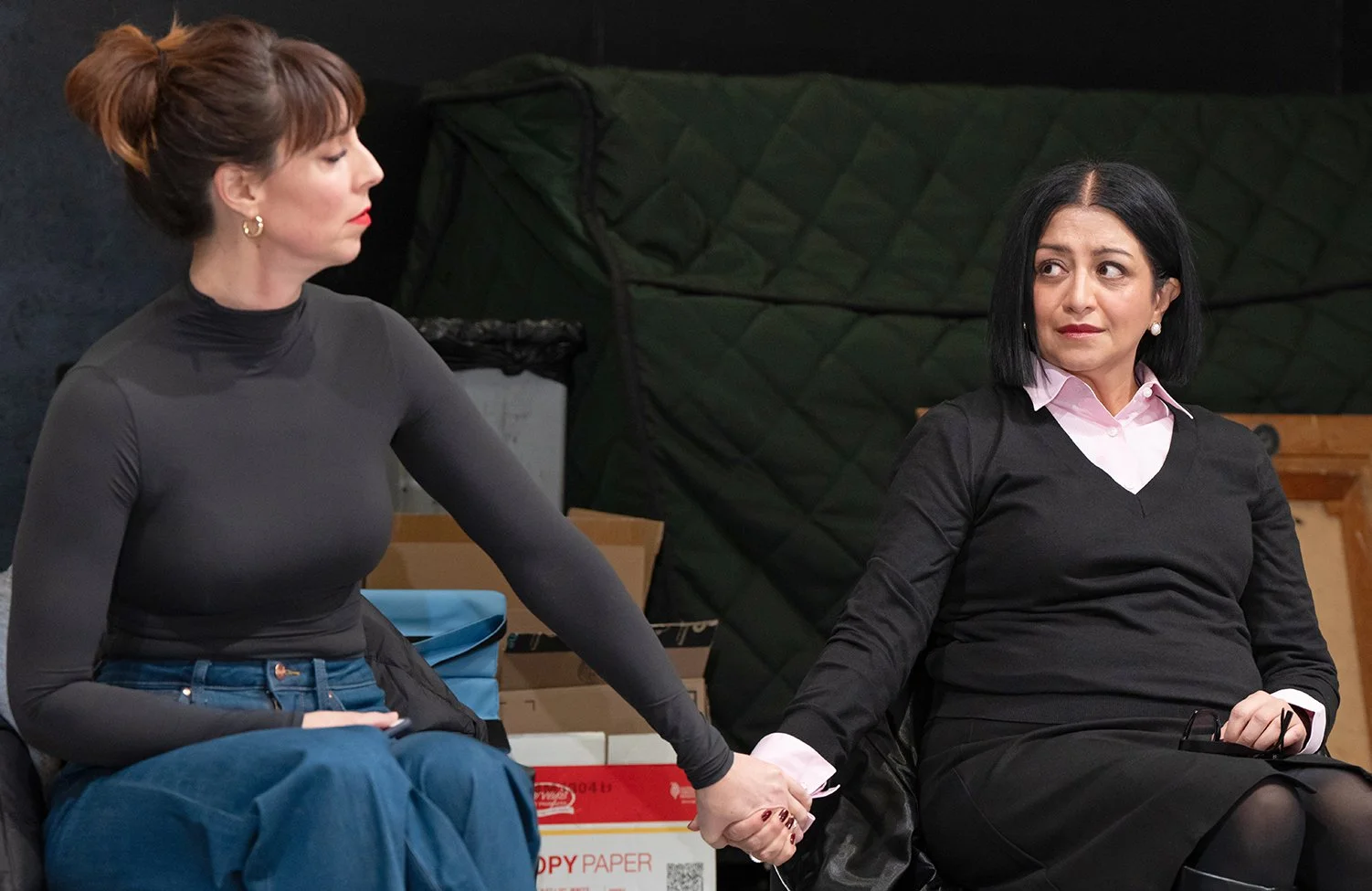
Janet and Joane after an emotional moment in the group. Photographs by Julieta Cervantes.
In addition to being a playwright, Perkins is a clinical mental health counselor, whose work includes substance use and “existential concerns.” Such concerns seem to weigh on Rayna (Keilly McQuail), who goes by “Buddy” and arrives while only Jane (April Matthis), a longtime member of the Saturday Survivors, is present, lost in thought but about to set up the chairs. Jane, who has never met Buddy before, senses her distress and moves the conversation to disarming small talk about baked goods. But Buddy soon begins crying and abruptly leaves; her brief appearance, and disappearance, will haunt Jane throughout the play.
Joan (Elizabeth Marvel) is next to arrive, two paper cartons of coffee in hand, and plenty of instructions to dole out to Jane. Marvel’s portrayal of the stylish, slightly imperious, type-A Joan is a master class in comic precision. Take, for example, her exasperated reaction to the news that the 80-year-old Jolly has been charged with pastry acquisition:
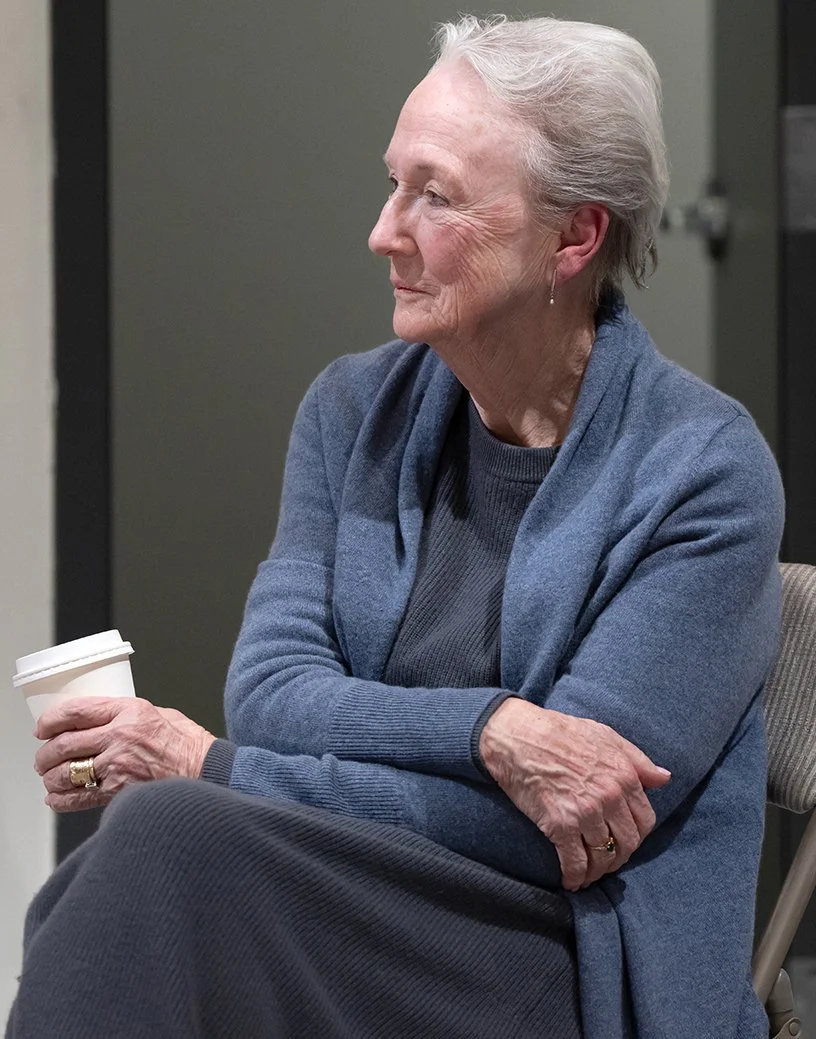
Kathleen Chalfant plays Jolly, who has been in the Saturday Survivors for 47 years.
Joan: I’m sure it’s taking her a decade: fishing out her money, slumping on the counter holding herself up. Meanwhile, there’s a line of impatience behind her balancing, on the brink of tipping over.
Jane. I’m sure she’ll manage!
Joan: [Large exhale.]
Jane. You want me to call her?
Joan: No, Jane.
Jane. K.
Joan: She barely answers calls without a box of pastries—what do you think would happen now?
We later learn that this concern comes from a place of deep affection: Jolly was Joan’s sponsor, and “she loved me back to life,” says Joan. Jolly (Kathleen Chalfant) arrives intact, with pastries and quips at hand, and is followed shortly thereafter by Joane (Maria Elena Ramirez), and then, after the meeting proper is supposed to have begun, Janet (Mallory Portnoy), who soon will have to excavate the entire contents of her purse to locate a ringing phone, much to Joan’s dismay.
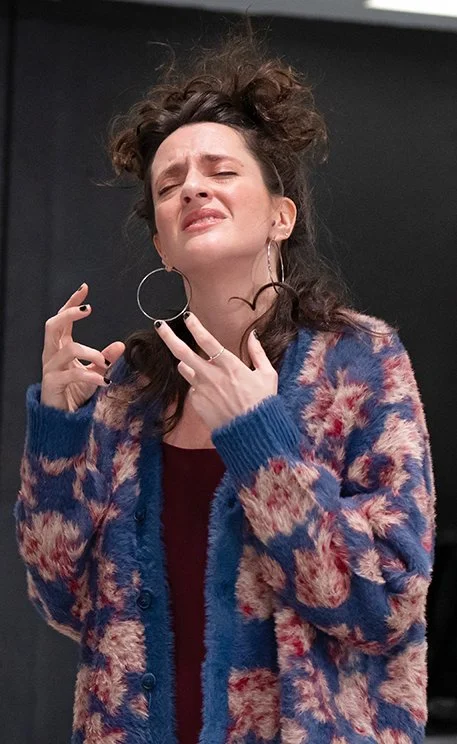
Keilly McQuail is Rayna/Buddy, here singing to herself while alone in the room in which the group meets.
This is the high-water mark of the play: it’s a pleasure to listen to the banter among the group and to watch the dynamics that are subtly developing. The dialogue can drift into self-conscious discursiveness—e.g., an exegesis on the word cupcake—but the performances are strong. Yet when the play shifts to monologues that seem only tenuously connected to their experiences, the narrative momentum stalls—and any sense that we might really get to know these characters is abandoned.
The first real rupture of time and place is intriguing: during a three-minute meditation, suddenly Jane is speaking again with Rayna/Buddy, though everyone else in the group remains in a meditative state. Rayna, who insisted on being called Buddy in the play’s opening exchange, now says, “No one’s called me Buddy in a long time.”
But Waters’s direction seems to favor obfuscation, so further alternate timelines (or identities) are confusingly presented and, more important, don’t appear to add up, other than gesturing toward a vague spirituality that hovers over the play. There is a static clock on the wall, perhaps indicating that time has no meaning, and some characters seem to be both present and absent at certain time markers, such as Joan’s hitting 13 years of sobriety. Also cryptically vague is that Jolly’s apparent slip into senility, demonstrated by her using the wrong names, might actually be a preternatural foreshadowing. (One can’t blame her for name confusion since everyone, herself included, has a name that begins with J, except Rayna/Buddy: Jane, Joan, Joane, Janet, Jolly, which presumably portends something, but what remains unclear.)
The Dinosaurs ends before it ever feels like it has gotten started. Not every play, of course, needs concrete answers to the questions it raises; but this play demonstrates that hinted-at metaphysical mysteries cannot substitute for fully realized characters.
The Dinosaurs runs through March 1 at Playwrights Horizons (416 West 42nd St.). Evening performances are at 7:30 p.m. Tuesday through Saturday, and Sunday, Feb. 22; matinees are at 2:30 p.m. Saturday and Sunday. For tickets and more information, visit playwrightshorizons.org.
Playwright: Jacob Perkins
Director: Les Waters
Scenic Design: dots
Lighting Design: Yuki Link
Costume Design: Oana Botez
Sound Design: Palmer Hefferan
