
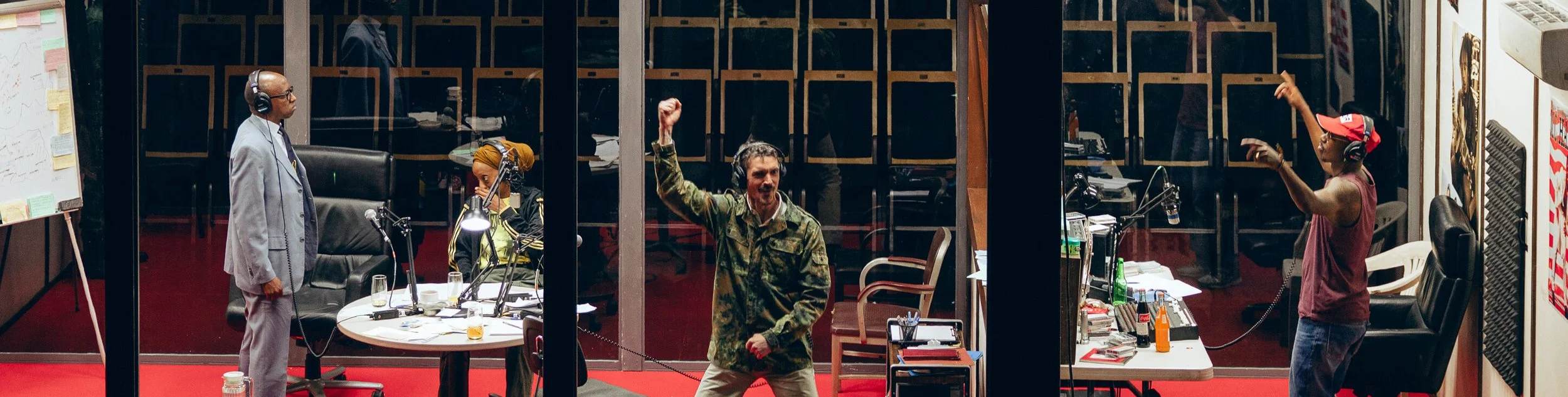
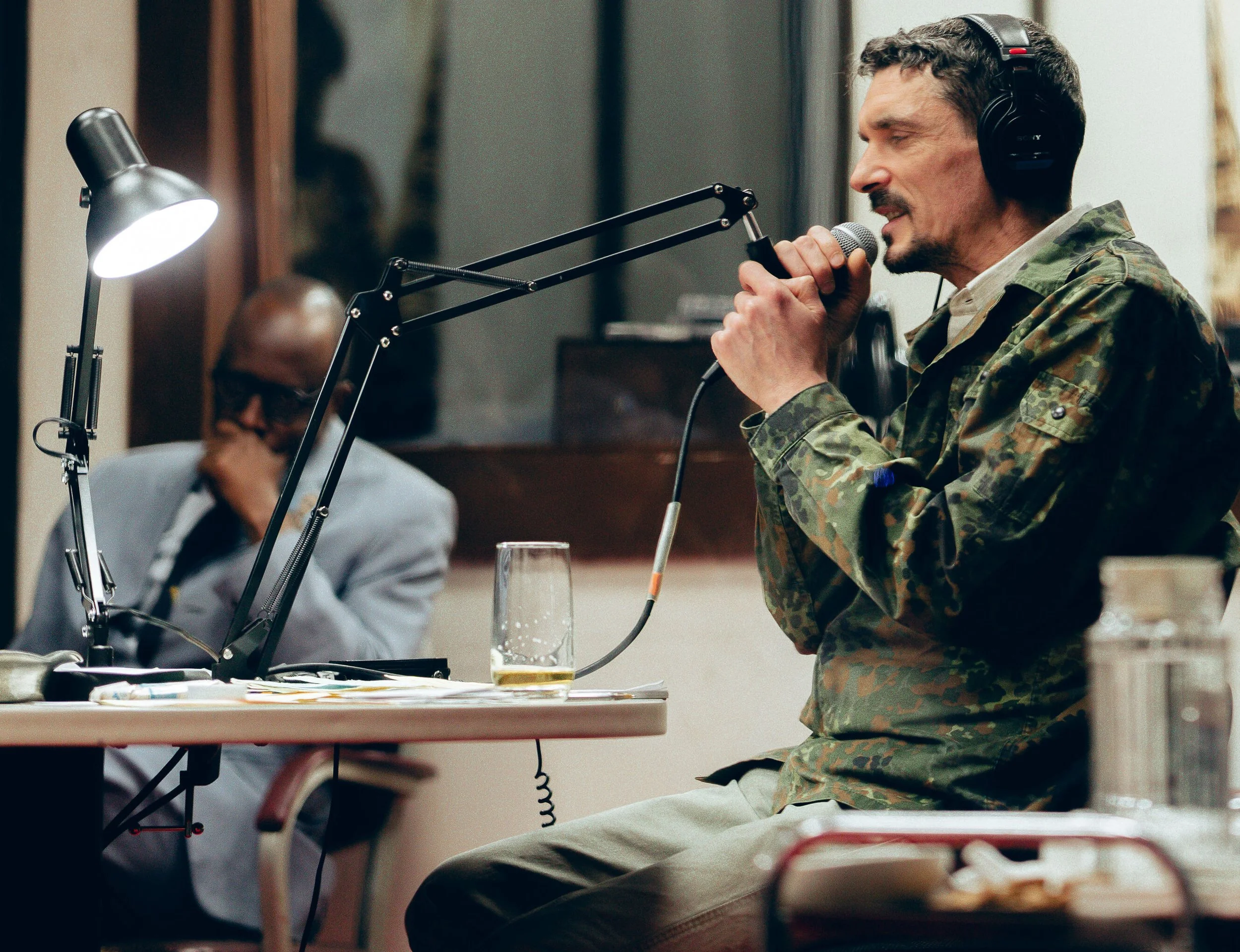
From left: Diogène Ntarindwa portrays talk-radio host Kantano Habimana alongside Sébastien Foucault, who plays one of his co-hosts, Georges Ruggiu, in Milo Rau’s Hate Radio, a docudrama that reconstructs a typical broadcast of Rwandan radio station RTLM (Radio Télévision Libre des Mille Collines) that sparked the 1994 Rwandan genocide.
In Hate Radio, Swiss writer-director Milo Rau turns the stage into a time capsule of terror, reconstructing the Rwandan radio station RTLM (Radio Télévision Libre des Mille Collines), whose jovial hate-fueled broadcasts paved the road to genocide. Listening through headsets as slurs curdle into directives, the audience is left to reckon not only with history’s horrors but with unnerving echoes in today’s media-saturated America.
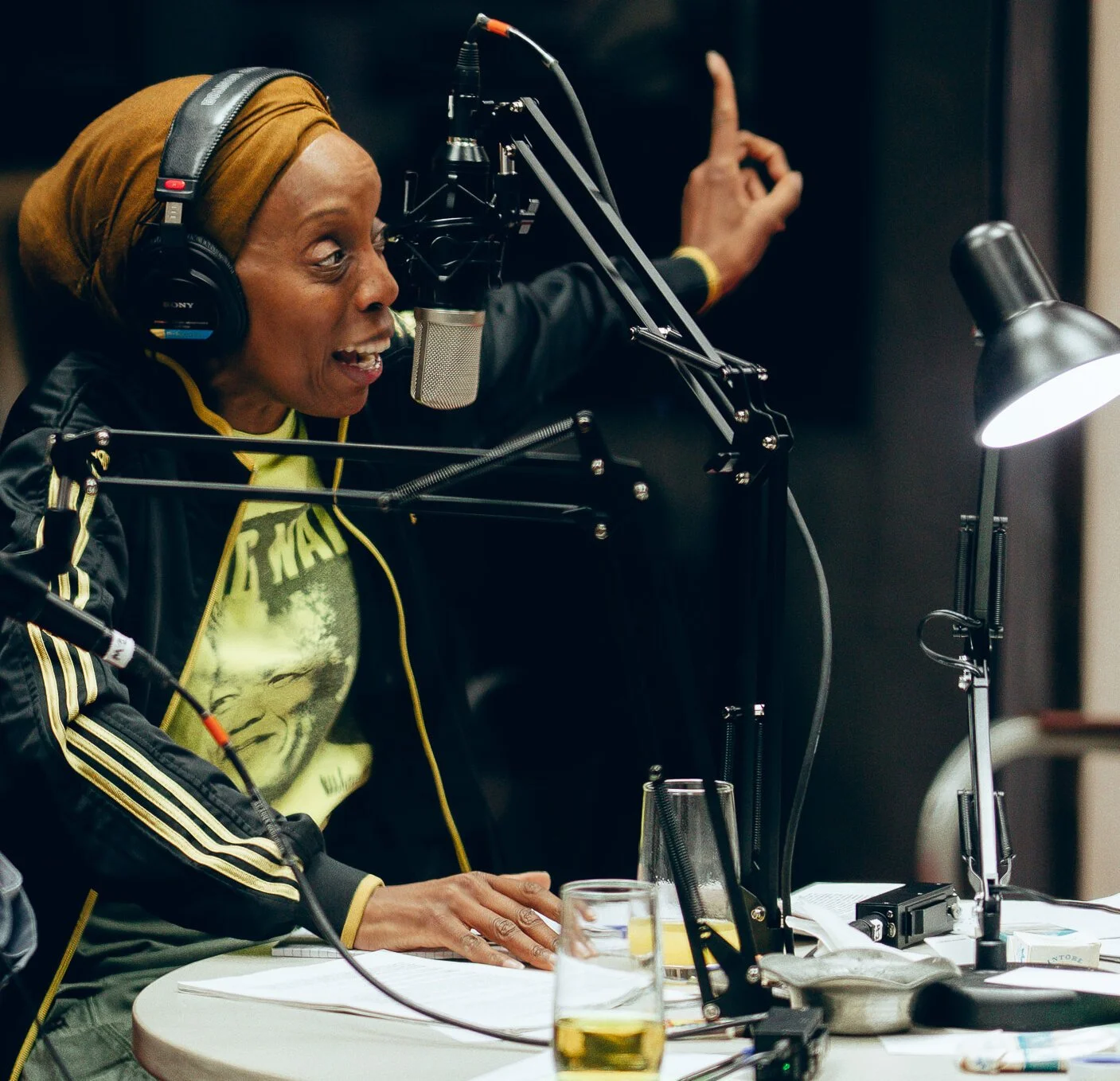
Bwanga Pilipili as talk-show host Valérie Bemeriki on RTLM presents a call-in history quiz to listeners.
Performed in French and Kinyarwanda, the production begins with a sobering contextual prologue, outlining the events that followed the April 6, 1994, downing of Rwandan President Juvénal Habyarimana’s plane—an assassination that ignited the 100-day massacre of Tutsi minorities, Hutu moderates, and indigenous Twa people. Through filmed testimonies projected onscreen, perpetrators and survivors recount their experiences side by side, their words colliding in uneasy proximity and underscoring the human toll behind the rhetoric.
Indeed, each testimony, drawn from archival accounts of the genocide, is disturbing in its grim specificity. Yet their impact is amplified by the production’s use of headsets: as the voices reverberate directly into one’s ears, the sound seems to lodge inside the skull, collapsing any safe distance between listener and atrocity and implicating the audience in the act of reception.
Hate Radio gathers its full gravitas when it pivots from testimony to the meticulous reconstruction of RTLM’s live broadcast. Inside a glass-enclosed studio (designed by Anton Lukas), three hosts—Rwandans Kantano Habimana (Diogène Ntarindwa) and Valérie Bemeriki (Bwanga Pilipili), and the Belgian Georges Ruggiu (Sébastien Foucault), chillingly nicknamed “the white Hutu”—sit at a table wearing headsets and bantering with infectious ease as their conversation ricochets from news to politics, from call-in segments to breezy history quizzes.
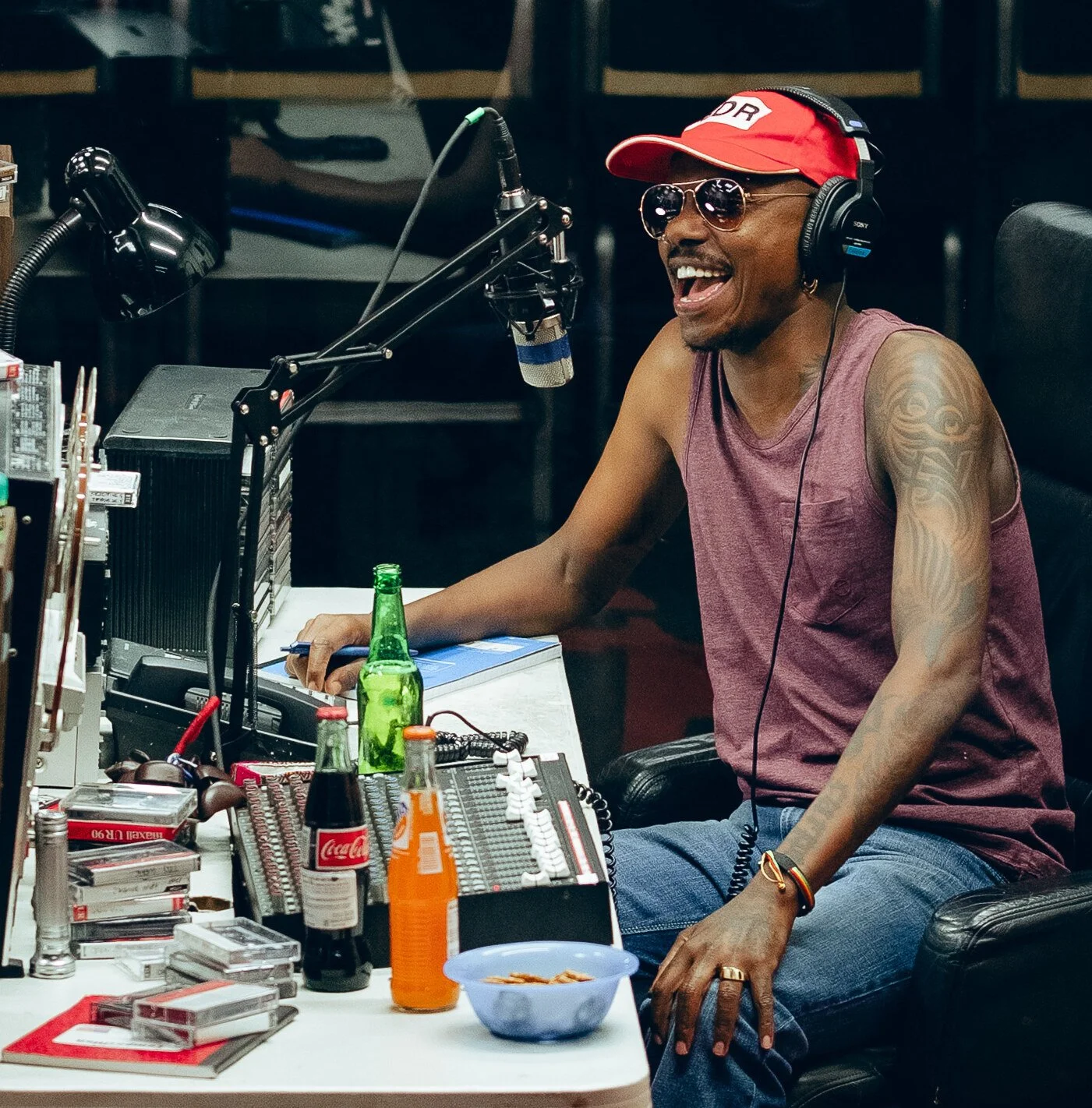
Eric Ngangare plays DJ Joseph at RTLM, often boogying with the talk-show hosts to the beats of the pop selections.
In an adjoining booth plastered with posters of Bob Marley and MC Hammer, DJ Joseph (Eric Ngangare) spins pop tracks such as Reel 2 Real’s “I Like to Move It” and Nirvana’s “Rape Me.” The latter, in particular, underscores the queasy fusion of pop culture and propaganda: between dance breaks and table-tapping exuberance to Western hits, the hosts slip seamlessly into calls for the extermination of Tutsis, the buoyancy of the music sharpening rather than softening the horror.
With the ominous exception of a silent security guard (Sylvain Souklaye) who stands watch in combat fatigues, a devil-may-care atmosphere pervades the broadcast. Ruggiu and Ntarindwa, especially, mock human rights advocates with breezy contempt, repeatedly invoking two names as targets of scorn: Paul Kagame, then leader of the Rwandan Patriotic Front—whose Tutsi-led forces would ultimately halt the genocide—and General Roméo Dallaire, commander of the United Nations Assistance Mission for Rwanda, who remained with a small, under-equipped contingent to protect civilians after much of the international community withdrew. The casual derision directed at these figures reveals how propaganda thrives not only on rage but on ridicule.
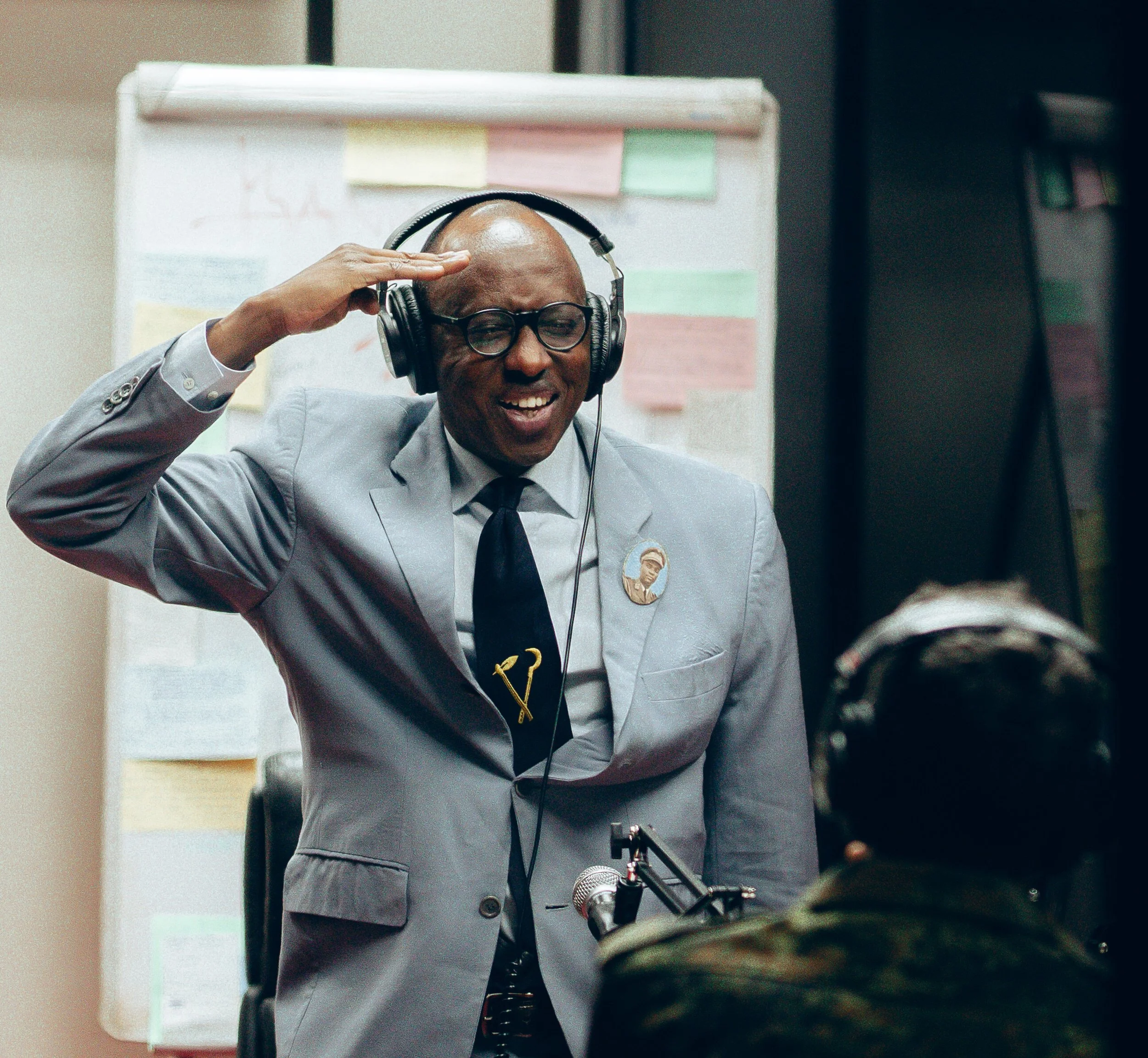
Ntarindwa (left), as hardliner Hutu Habimana, salutes Foucault (right, facing upstage), his fellow talk-radio host Ruggiu at RTLM, one of the most formidable instruments that propagandized the genocide. Photographs by Amir Hamja.
In a director’s note in the program, Rau acknowledges the moral peril embedded in reconstructing the infamous RTLM for the stage, admitting that rehearsals were marked by relentless self-interrogation. “At the rehearsals we asked ourselves over and over—what gives us the right to put RTLM on stage again, and in exactly this way? And even more importantly, what is the point of it all?” The question lingers over the production—and over the listeners.
Nicknamed “Radio Machete,” RTLM demonstrates with terrifying clarity that words can kill—not only by anesthetizing the conscience but also by recruiting the young into its moral freefall. One journalist recalls his final week in Kigali before being evacuated on April 12, 1994:
I was evacuated fairly late, on April 12th together with the last of the journalists. I was already in Paris on April 13th. From the last week I spent in Kigali, I remember one thing in particular: A young boy who rang in to RTLM and asked: ‘I am eight years old. Am I old enough to kill a cockroach?’ And the host, I think it was Kantano, answered: ‘Ah, how cute! You know what, everyone can do it!’
The exchange, grotesque in its cheerfulness, reveals how genocide is normalized not only through ideology, but through intimacy—through a child’s voice met with encouragement instead of horror.
Premiering in 2011 and touring internationally for more than a decade, Hate Radio arrives in the United States not as a relic of distant atrocity but as an urgent alarm. In an age when media ecosystems amplify grievance, reward outrage, and cloak dehumanization in the language of patriotism or entertainment, Rau’s reconstruction feels less like historical reenactment than a diagnosis. The glass booth may seal the actors behind transparent walls, but the warning reverberates far beyond them: democracies do not collapse in a single cataclysmic moment—they erode, broadcast by broadcast, joke by joke, word by word.
Hate Radio plays through Feb. 28 at St. Ann’s Warehouse (45 Water St., Brooklyn). Evening performances are at 7:30 Tuesday through Saturday; matinees are at 2 p.m. Saturday and 5 p.m. Sun day. For tickets and more information, visit stannswarehouse.org.
Playwright & Director: Milo Rau
Scenic & Costume Design: Anton Lukas
Lighting Design: Aaliyah Stewart
Sound Design: Jens Baudisch
