
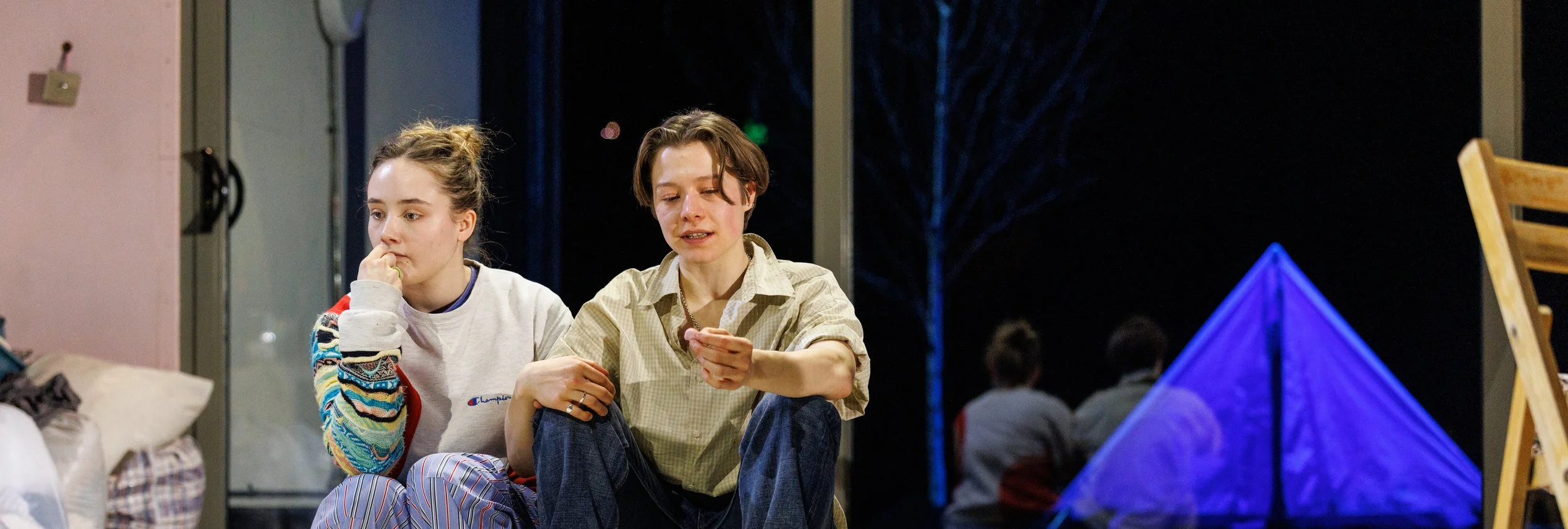
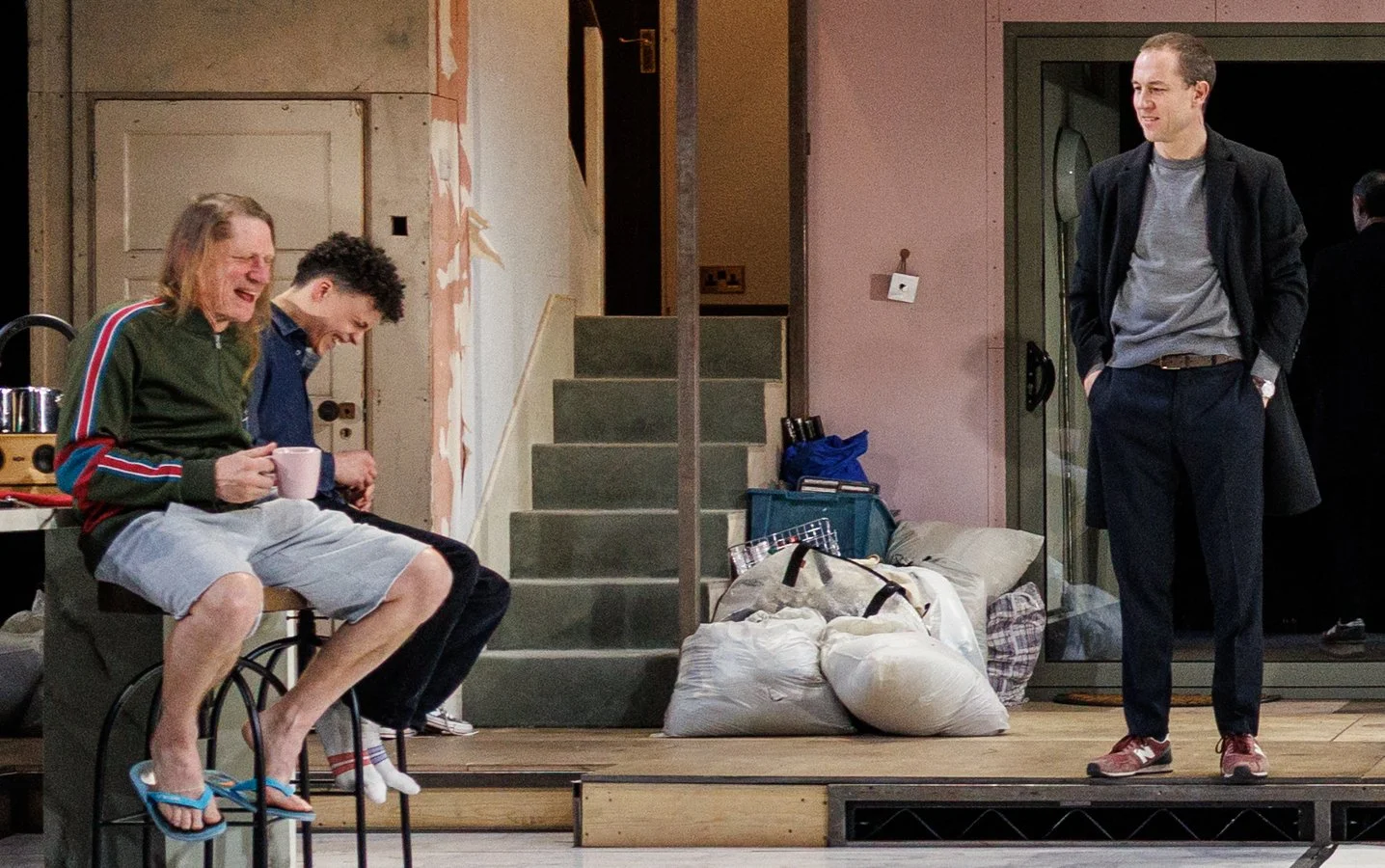
Chris (Tobias Menzies, right) bides time before the ash-scattering ceremony with his new nonbinary stepchild Leni (Lee Braithwaite, center) and old friend Tez (Jerry Killick, left) in The Other Place by Alexander Zeldin at The Shed’s Griffin Theater.
At the outset of Alexander Zeldin’s The Other Place, a funerary urn, unburied but long ignored, sets off a near-nuclear explosion of familial conflict. It’s a humdinger of a beginning; but, as this short, bleak drama proceeds, the motives of the principal characters remain obscure and the twists in the plot, though often startling, can’t conceal the script’s logical lacunae. It’s a striking weakness, since The Other Place is inspired by Sophocles’s Antigone, a compact, laser-focused tragedy that’s intellectually and emotionally satisfying.

Menzies is the toxic Uncle Chris in Zeldin’s contemporary rendering of Sophocles’s Antigone.
The family in The Other Place (surname never mentioned) is headed by Chris (Tobias Menzies), whose brother’s ashes occupy the urn. When that brother, Adam, died by his own hand, Chris inherited the house and became guardian of Adam’s daughters, Annie (Emma D’Arcy) and Issy (Ruby Stokes). Zeldin doesn’t reveal what happened to the girls’ mother (except that she died young) or how long Adam has been gone; but Issy was a small child and Annie was an adolescent (already showing signs of emotional disturbance). Now they’re adults, and the urn, lingering in the house, is testimony to the family’s collective dysfunction.
Enter Annie, long estranged from her uncle and living far away. Returning to her childhood home, Annie meets Erica (Lorna Brown), Chris’s recent bride, and her nonbinary child Leni (Lee Braithewaite), who live with Chris and Issy. Annie is surprised at the extent of the renovations that Chris’s cringe-inducing friend Tez (Jerry Killick) is supervising. A wall has been removed, picture windows installed, and most traces of Adam expunged. Chris wants Adam’s urn out of there, as well, and has scheduled a hasty ash-scattering ceremony in a local park later in the day.
“I don’t want the ashes to leave the house,” Annie declares. “I don’t want them scattered. I want them to remain here, where he wanted to be”—crackpot proclamations, with no rationale and the bizarre implication that this is still her home.
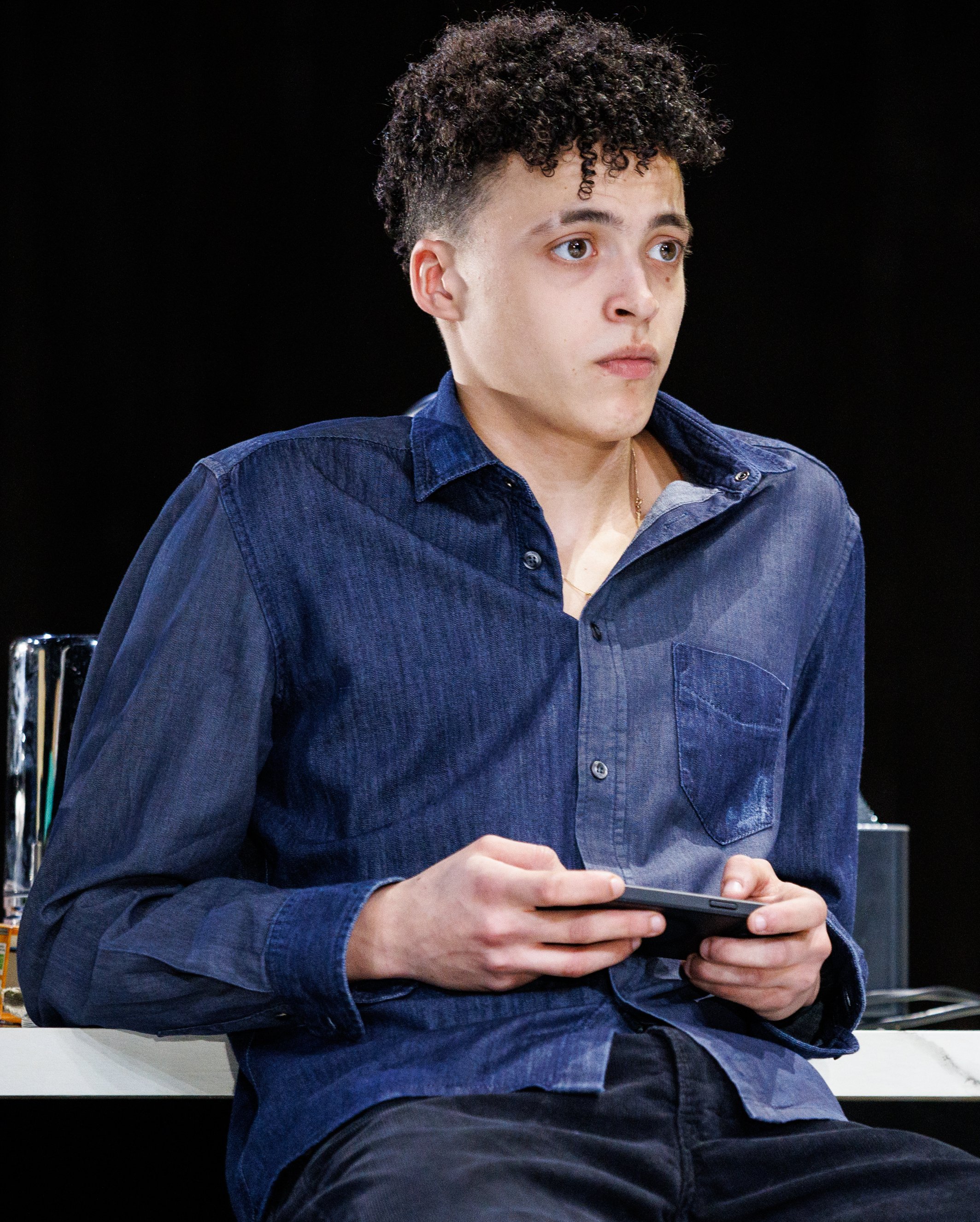
Braithwaite plays Chris’s nonbinary stepchild in The Other Place.
Issy, Erica, Leni, and Tez watch as niece and uncle rage at each other. “It’s not fair that you get to decide on behalf of everyone what happens to our father,” Annie screams.
While nobody’s looking, she purloins the ashes (they’re in a sealable plastic bag), leaving the empty urn for Chris and his scattering ceremony. When her uncle ejects her from the house, Annie erects her father’s old camping tent on the back lawn—it’s “another place” from which she haunts those still in the house until the play’s calamitous, rather confusing conclusion.
The Other Place began performances Off-Broadway just as Oedipus, Robert Icke’s Broadway hit, was closing. Both plays—Zeldin’s from the Britain’s National Theatre and Icke’s from the International Theater Amsterdam by way of London’s West End—are responses of male English writers (both also the directors) to Theban tragedies of Sophocles. No one seems to have disputed the classification of Oedipus as a modern adaptation of a classic text; but, in a program note, Zeldin insists The Other Place “is not a ‘version’ of Antigone or a retelling of it for a modern audience or anything like that.” Instead, he says, the new play is meant to evoke, for 21st-century audiences, the feelings most integral to the Sophoclean characters. That’s a curious—and curiously vague—assertion to make about a play that looks, sounds, and feels (at least until very near the end) like a “retelling of [Antigone] for a modern audience,” comparable (though hardly equal) to Icke’s Oedipus.
Icke has created a compellingly refreshed account of Oedipus Rex, with impeccable narrative logic and relentless suspense. Zeldin, on the other hand, gets tripped up in the inexplicable behavior of deeply disturbed characters, and he struggles with an excess of plot. Seemingly desperate to account for Annie and Chris’s wildly aberrant behavior, he concocts an ugly family secret not derived from Antigone and more in tune with reports on the Epstein files than with classical drama.

Chris’s new wife Erica (Lorna Brown) and his friend Tez are the outsiders in the highly dysfunctional family circle Zeldin’s drama. Photographs by Maria Baranova.
The production values of The Other Place fulfil the promise of its National Theatre provenance, though the staging is wan compared to the multimedia complexity of Oedipus. Under Zeldin’s direction, the cast has jelled as a superb ensemble. The design work—especially James Farncombe’s lighting, Josh Annio Grigg’s sound, and the unyieldingly percussive music by Yannis Phillippakas—lends a viscerally ominous quality to the proceedings that Greek-inspired tragedy ought to have. What’s missing is the organic aura of inevitability that’s integral to Sophocles’ own storytelling. Lacking that, the production limps uphill toward its climax and collapses, dead on arrival, at the dénouement.
The Other Place, co-produced by The Shed and National Theatre (UK), in association with the A Zeldin Company, runs through March 1 at The Shed’s Griffin Theater (545 W. 30th St.). Evening performances are 7:30 p.m. Tuesday through Sunday; matinees are at 2:30 p.m. Wednesday, Saturday, and Sunday. For tickets and information, visit theshed.org.
Playwright & Director: Alexander Zeldin
Scenic & Costume Design: Rosanna Vize
Lighting Design: James Farncombe
Music: Yannis Phillippakas
Sound Design: Josh Anio Grigg
