
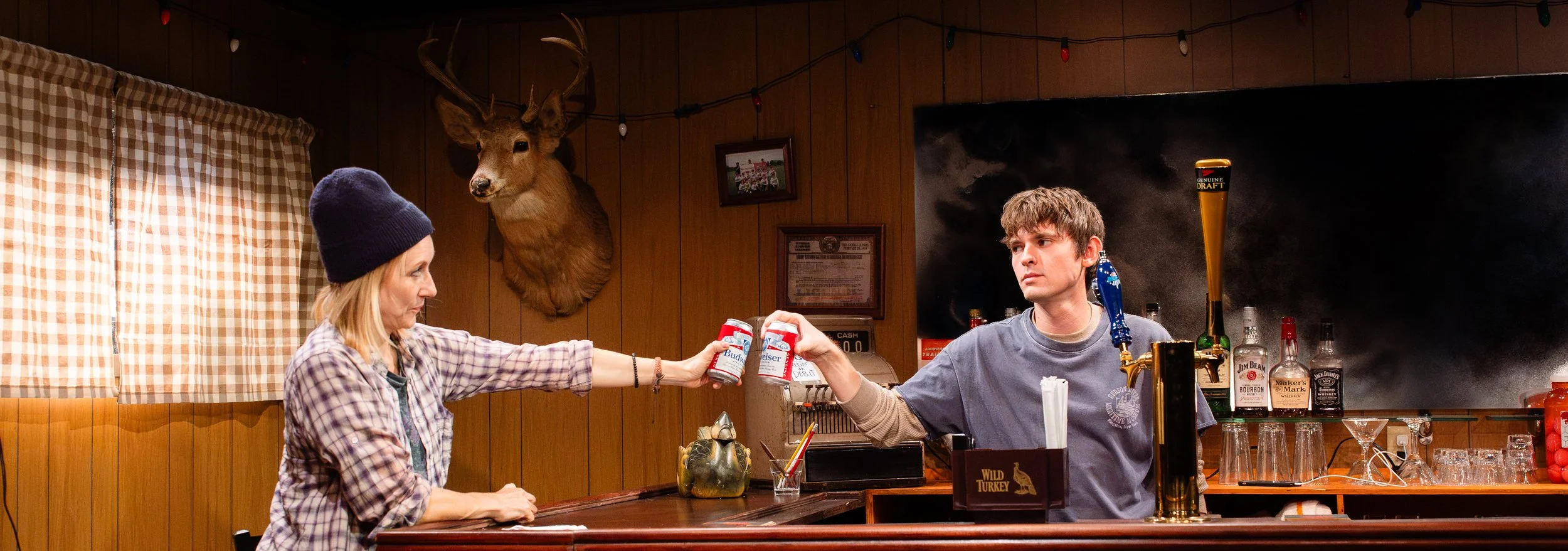
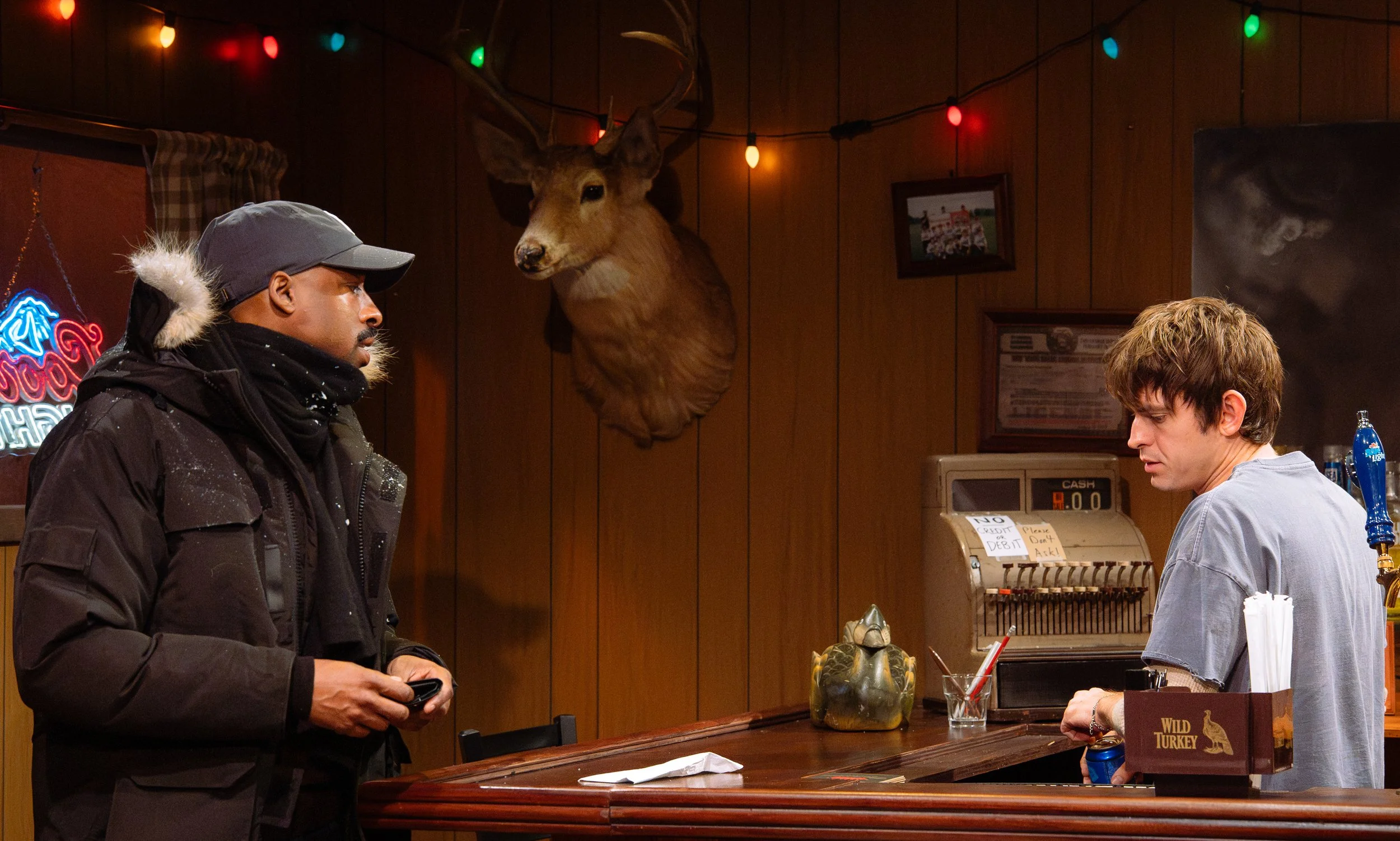
Wesley (Grantham Coleman, left), a wealthy New York City entrepreneur, drops in to a bar on a snowy night, where Joey (Bubba Weiler) is the gatekeeper to a grotesque experience, in Max Wolf Friedlich’s The Holes at the Wild Project.
For the first two scenes of Max Wolf Friedlich’s The Holes, the intrigue builds carefully, as a bartender named Joey Alexander (Bubba Weiler) hangs around his cozy but empty establishment on a snowy night. He soon has a visitor, a man (Grantham Coleman) calling himself “Paul,” who hands him an envelope full of cash and an ID that identifies him otherwise: as someone named Wesley. The cash gains Wesley entrée into the back room of the dive bar—in spite of arriving long after his assigned time. “Next time don’t be late,” says Weiler’s stern Joey, adding, “12:24 is not the same as 11:30.” What is behind that door constitutes a mystery that drives the narrative of The Holes. Friedlich calls his play a “fairy tale,” but the gay-inflected twaddle that follows is a far cry from Hans Christian Andersen.
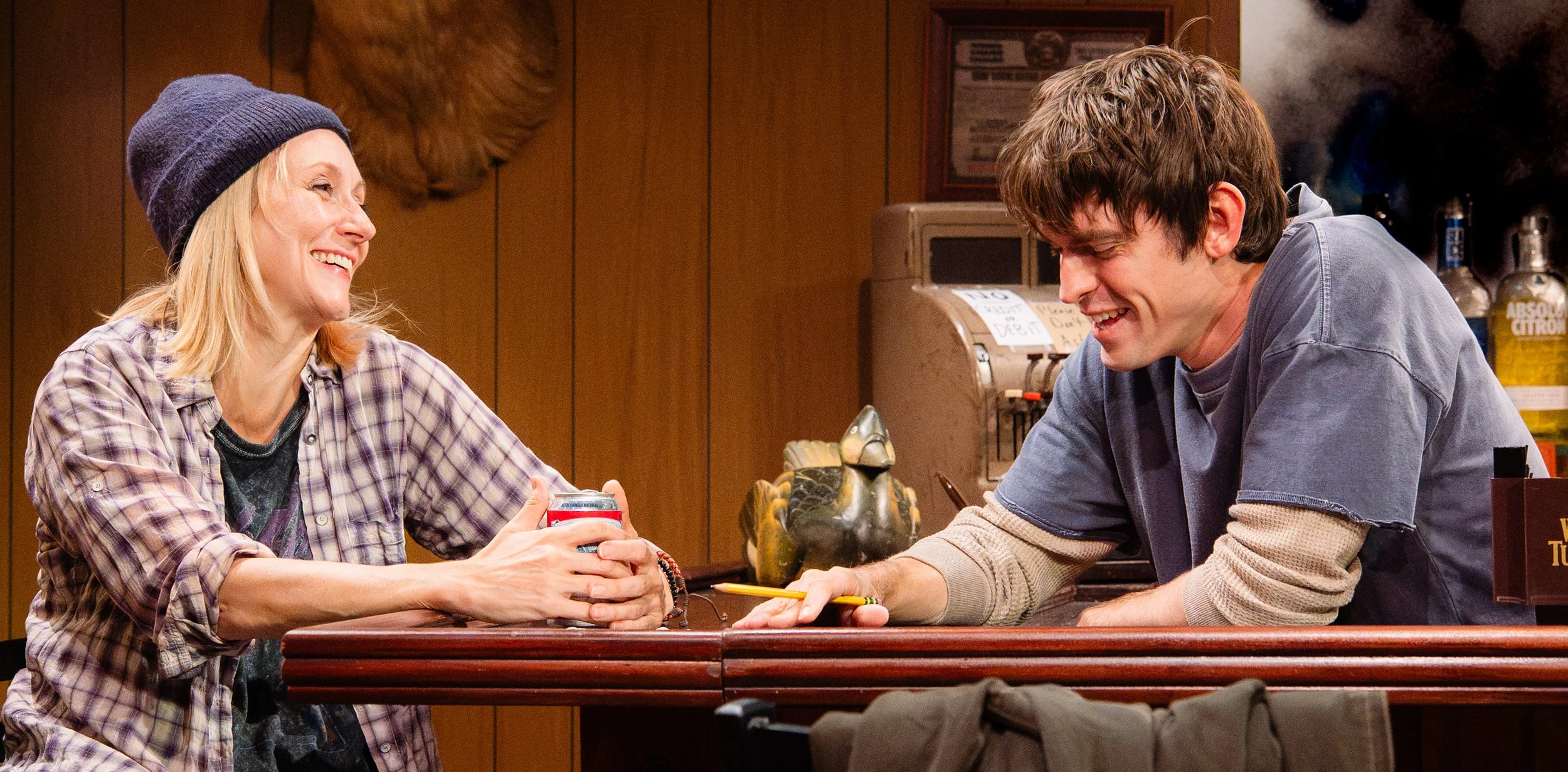
Joey confides often in Martha (Tina Benko), a barfly who loves Joey’s father, Philip.
Things take a jaw-dropping twist some weeks later, when Wesley returns with a proposition. Wesley is wealthy, reputedly from cryptocurrency, and has a wife and kids in New York City, but his visit to the back room in Joey’s bar in Kingston has convinced him to quit his job cold and enlist Joey in a partnership to monetize the experience. What goes on in the back room turns out to be sordid, blasphemous, and as preposterous as Wesley’s abandonment of career and family.
However, Joey, who is tending the business because his father, Phil, is dying of rectal cancer, reluctantly agrees. He resents that Phil won’t take his advice—in fact, Phil gives Joey orders over the phone. Joey shares his woes with Martha (Tina Benko), a burned-out alcoholic who’s in love with Phil. He hopes for some support, but his complaints fall on deaf ears:
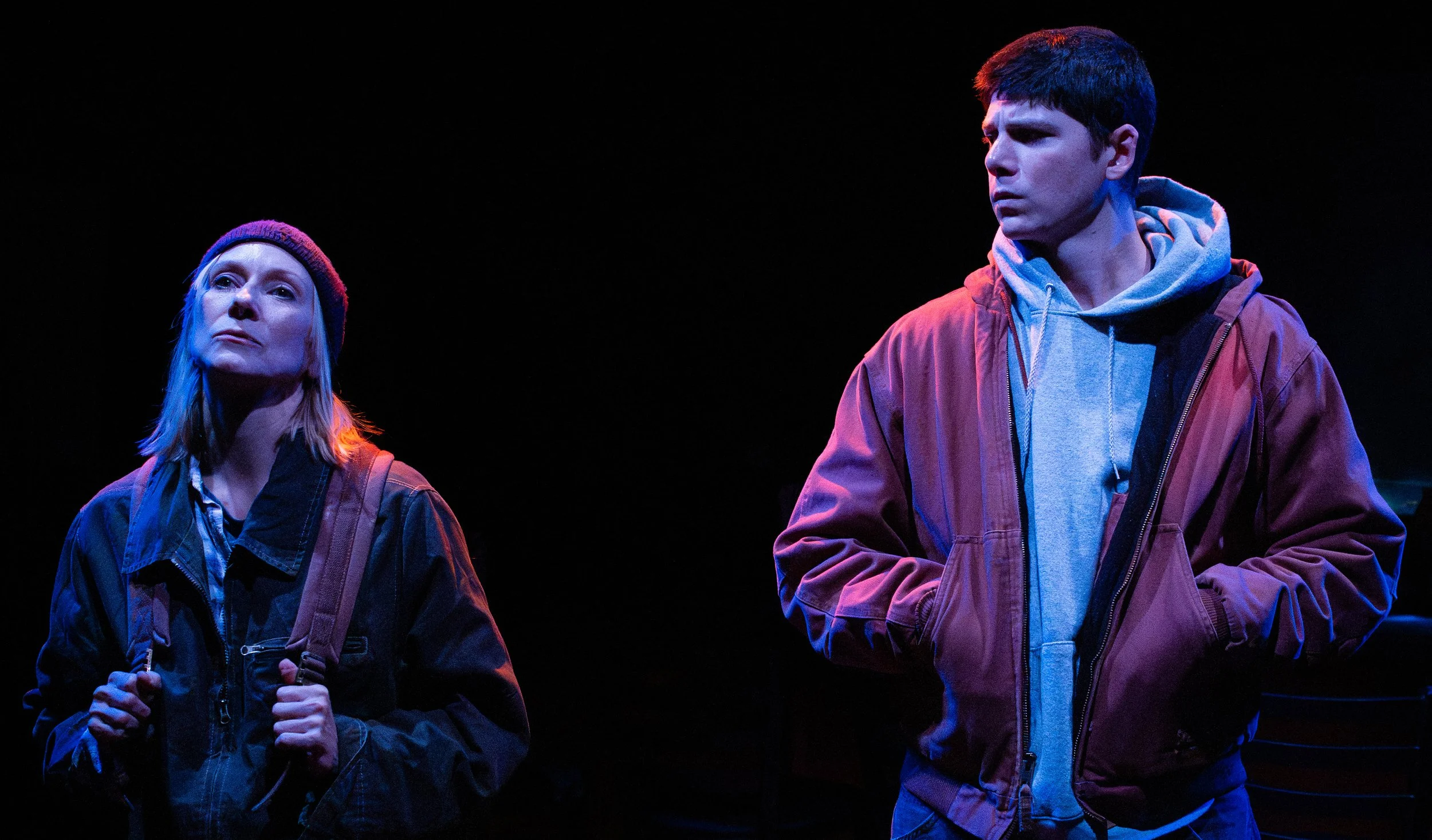
At a bus stop Martha fishes for how much Carson (Jack Mulhern), an impoverished local who works as a security guard, knows about Joey’s establishment.
Joey: My first week back I suggested to him that we like get some actual decent beers in here? Some IPAs, some blondes, maybe just a few things that aren’t generic watery piss. I said, “Hey, maybe we partner up with Woodstock Brewery over in Phoenicia. Those guys are making this amazing local like … Hudson Valley beer.” But my dad’ll just go, “That’s not what real people drink.”
Martha: Your dad knows how to run a business in this city.
In fact, the most interesting characters in Michael Herwitz’s production are a step removed from the moneymaking scheme. Martha is the beneficiary of the best writing, especially a fiery speech about the creation of the Ashokan Reservoir:
Eleven towns gone just so a bunch of New York City pricks could get a glass of our water. Cause that’s what it is—it’s our water gettin’ sucked down 100 miles away while they make us drink that ass-cancer-causing shit out of the Hudson. Our water’s the secret to their famous pizza, their famous bagels—without it it’s just fuckin’ bread, and so they let us get sick. And they let us get poor while they rob us blind.
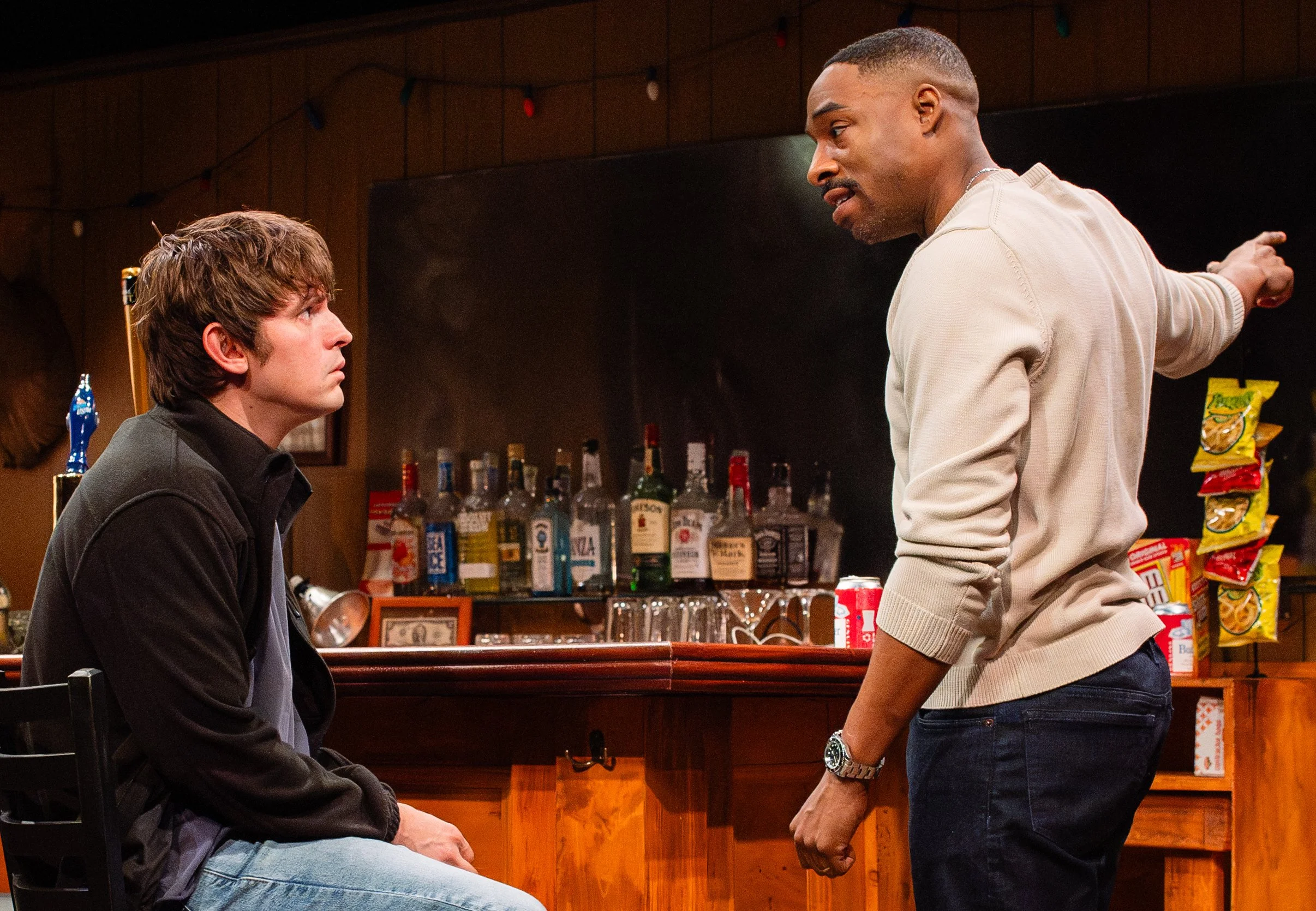
Wesley tries to persuade Joey of the profits if they capitalize on the secret of the back room. Photographs by HanJie Chow.
But class inequality and upstate-downstate tensions are incidental to the main story of the transformational experiences in the back room (the details of which don’t hold up under scrutiny). Wesley converts the bar to Upstate, a private, all-male club for wealthy straight men who arrive in busloads and pay substantially for the mysterious transcendence they encounter—and return home the same night. Yet even though rumors already swirl about the room among locals, no specifics spread after the influx of customers! And the idea that memberships to this club would gentrify Kingston and turn it into a sexual and spiritual destination with spiking prices is laughable.
The actors do their best with the grotesque story, but the primary pleasures come from Martha and Carson (Jack Mulhern), a dim high-school friend of Joey’s who becomes a security guard at the club. Their clashing ideas almost demand a play for themselves. Carson’s response to Martha’s claim that police beat Black people reflects real beliefs (as Martha falls back on the “wisdom” of seniority).
Carson: It’s the bad cops you hear about because it’s like … “cool” to think all cops hate blacks, but
most of them don’t think, like, “Oh, let me be racist to this guy while there’s nobody around.”
Martha: I’m not wrong. I’m older than you.
Carson: Why’re they “choking” people for supposedly no reason if they’re not supposed to? Cops aren’t allowed to hit people unprovoked. They can’t just break the law like that—they’re the cops.
Yet, despite frequently good writing and the actors’ best efforts, the main narrative of The Holes is as substantial as the center of a doughnut.
The Holes plays through Oct. 18 at the Wild Project (195 E. 3rd St.). Evening performances are at 7:30 p.m. Tuesday through Thursday; at 8 p.m. Friday and Saturday; and at 7 p.m. Sunday. Matinees are at 2 p.m. Saturday and Sunday. For tickets and more information, visit thewildproject.org/performances/the-holes.
Playwright: Max Wolf Friedlich
Director: Michael Herwitz
Scenic Design: Anna Grigo
Costume Design: Lily Cunicelli
Lighting Design: Evan C. Anderson
Sound Design: Brandon Bulls
Original Music: Zack Villere
If you enjoyed this review, please click on the Like icon below.
