

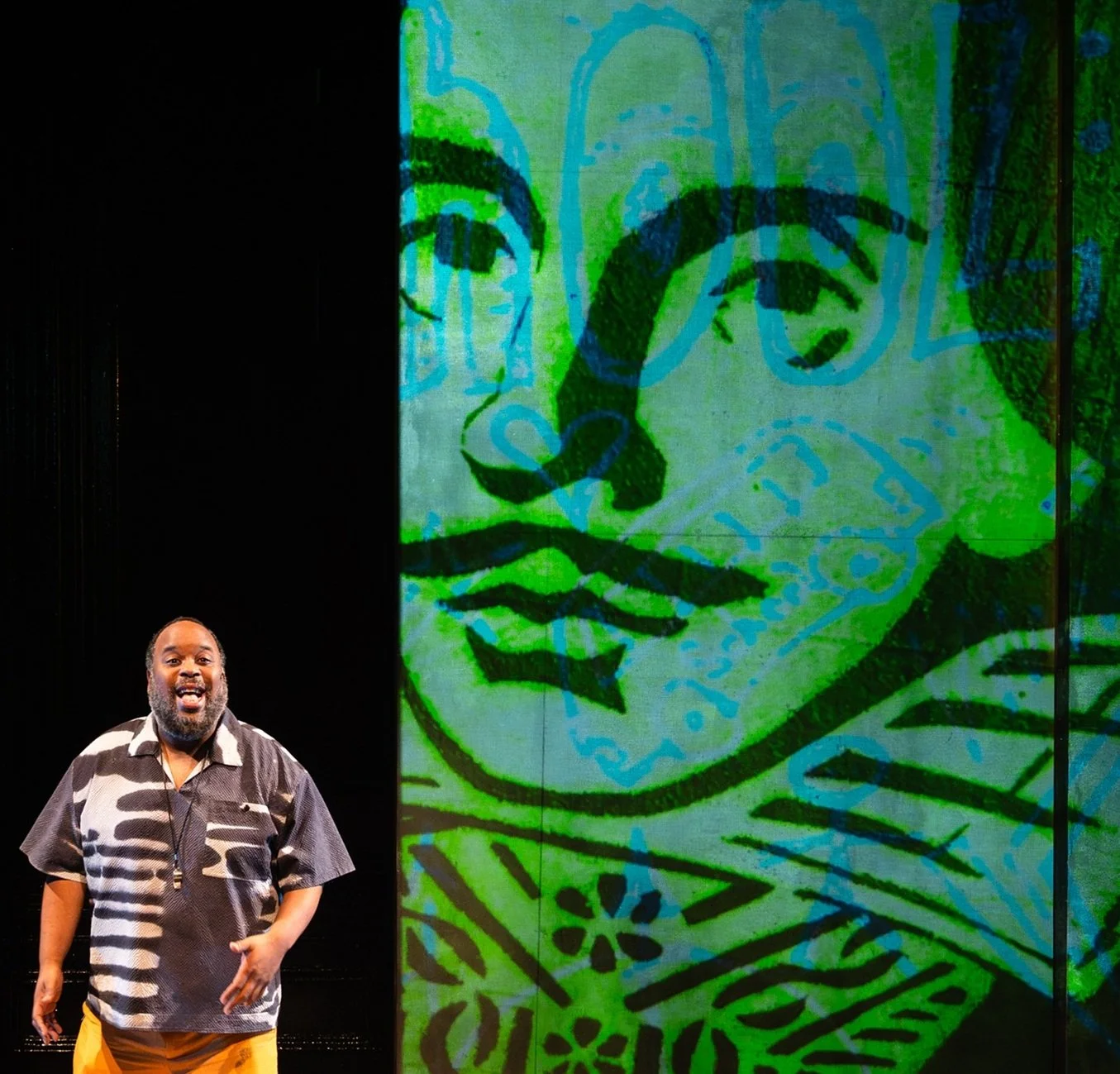
In his autobiographical solo show, Jacob Ming-Trent draws on Shakespeare, rap, poetry, and preaching to chart his journey toward reclaiming his life.
In How Shakespeare Saved My Life, actor Jacob Ming-Trent transforms the search for a place to belong into a riveting celebration of the power of language. Directed by Tony Taccone, this solo performance draws on Shakespeare, rap, poetry, and preaching to chart one man’s journey toward reclaiming his life.
Instead of kicking off with one of Shakespeare’s celebrated speeches, Ming-Trent defines what his show is—and isn’t. Or, as he puts it with a mix of street talk, gospel, and the economic realities of nonprofit theater:
This is no autobiographical tale. This show is testimony. I’m using my stories to shine a light on bigger things. Today you will see a one-man show. I don’t want to be up here all alone. But the American theater don’t got no money, so I’ve got to play all the roles.

Ming-Trent recounts how he discovered Shakespeare by accidentally walking into the wrong classroom and being asked by the teacher to read the St. Crispin’s Day speech from Henry V.
Ming-Trent doesn’t immediately divulge that he has saved the role of cheerleader for his newly appointed “congregation”—so named because we have “chosen to congregate here today.” Breaking the fourth wall, he introduces himself as “Jacob,” asks audience members to greet the person next to them, then instructs us to call out “Play on!” whenever he points to us. After rehearsing the response, he beams, “You got it!” The moment makes the magic of theater feel like something audience members are creating together.
Ming-Trent launches his story in 1992, asking, “What was going on in 1992?” before declaring, “In ’92, America elected its first black president”—as an archival photograph of Bill Clinton playing the saxophone appears. The image complicates assumptions about race and identity. The actor recalls slain rappers Tupac Shakur and Biggie Smalls before projecting a ghostly image of the L.A. riots that followed the verdict in the Rodney King case.
Ming-Trent’s personal story is at the heart of the show. At 12, growing up in a lower-middle-class Pittsburgh neighborhood, he experienced his parents’ separation. His father told him, “Remember what I taught you—best thing for a man to be is a good listener. Listen to a man’s words. Learn to use ya words, a word can save ya life.” His mother then warned him, “This world was not made for you. To them you’re a predator, a robber, and assaulter. Jacob, you have to live your life as though you are permanently in danger.”

An autodidact, Ming-Trent mischievously points out in his show that “acting is the only profession that doesn’t require good grades.” Photographs by Hanjie Chow.
Ironically, that same day he accidentally walked into the wrong classroom and heard a teacher proclaim, “Welcome to Shakespeare class! Clap it up, clap it up! Clap it up! Now shut up!” Watching a student named Billy recite from Coriolanus, Ming-Trent recognized his own predicament in Coriolanus’s response to banishment: “You banish me? Nawwwww, I banish you! Thus I turn my back: there is a woooooorld elsewhere.” He imagines delivering those words to the principal who suspended him. Then the teacher asks him to recite the St. Crispin’s Day speech from Henry V. His first attempt is stiff, but, being urged to “Put your balls in it,” Ming-Trent tries again. His teacher responds, “Way to make a play. That was divine.”
From there, Ming-Trent and Shakespeare became partners. Shakespeare—the “word wizard,” “Stratford scribe,” and “royal rhymer”—doesn’t resolve Ming-Trent’s problems, but gives him resources for navigating them. Dropping out of high school, he attends an acting school that tried to whitewash him, and he joins a crew who argued that Tupac and Biggie were superior to Shakespeare. Yet his cronies ultimately called him the “Black Shakespeare” and gave him a temporary home. A lighter moment comes when Shakespeare helps him woo his first girlfriend, Sylvia, with The Two Gentlemen of Verona: “What light is light, if Silvia be not seen? What joy is joy if Silvia be not by?”

Although Ming-Trent describes his life as “a comedy of errors,” his detours, and hardships have led him to center stage.
Although Ming-Trent has given sterling supporting performances on Broadway and as Falstaff in The Merry Wives of Windsor at Shakespeare in the Park and Bottom in A Midsummer Night’s Dream at the Polonsky Shakespeare Center, stepping into the spotlight presented him a challenge. He meets it with aplomb, his vocal range proving his greatest asset. Whether delivering Shakespeare with hip-hop rhythms, a jazzy beat, or his own syncopations, Ming-Trent is authentic and terrifically entertaining. Audience participation can feel overextended, but never gimmicky, channeling fresh energy into the performance.
As the play draws to a close, Ming-Trent observes that “my life has been a comedy of errors.” But the errors, hardships, and detours have led him to a place: center stage, telling his story on his own terms and inviting the audience to become part of it. A boy discovering Shakespeare becomes a deeply moving testament to transformation, forgiveness, and the power of finding one’s voice.
How Shakespeare Saved My Life plays at The Public Theater (425 Lafayette St.) through October 25th. Evening performances are at 7:30 p.m. Tuesday through Saturday; matinees are at 1:30 p.m. on Saturday and Sunday. For tickets, visit publictheater.org.
Playwright: Jacob Ming-Trent
Director: Tony Taccone
Scenic Design: Takeshi Taka
Lighting Design: Alan C. Edwards
Costume Design: Danielle Preston
Sound Design: Jake Rodriguez
If you enjoyed this review, please click on the Like icon below.
