

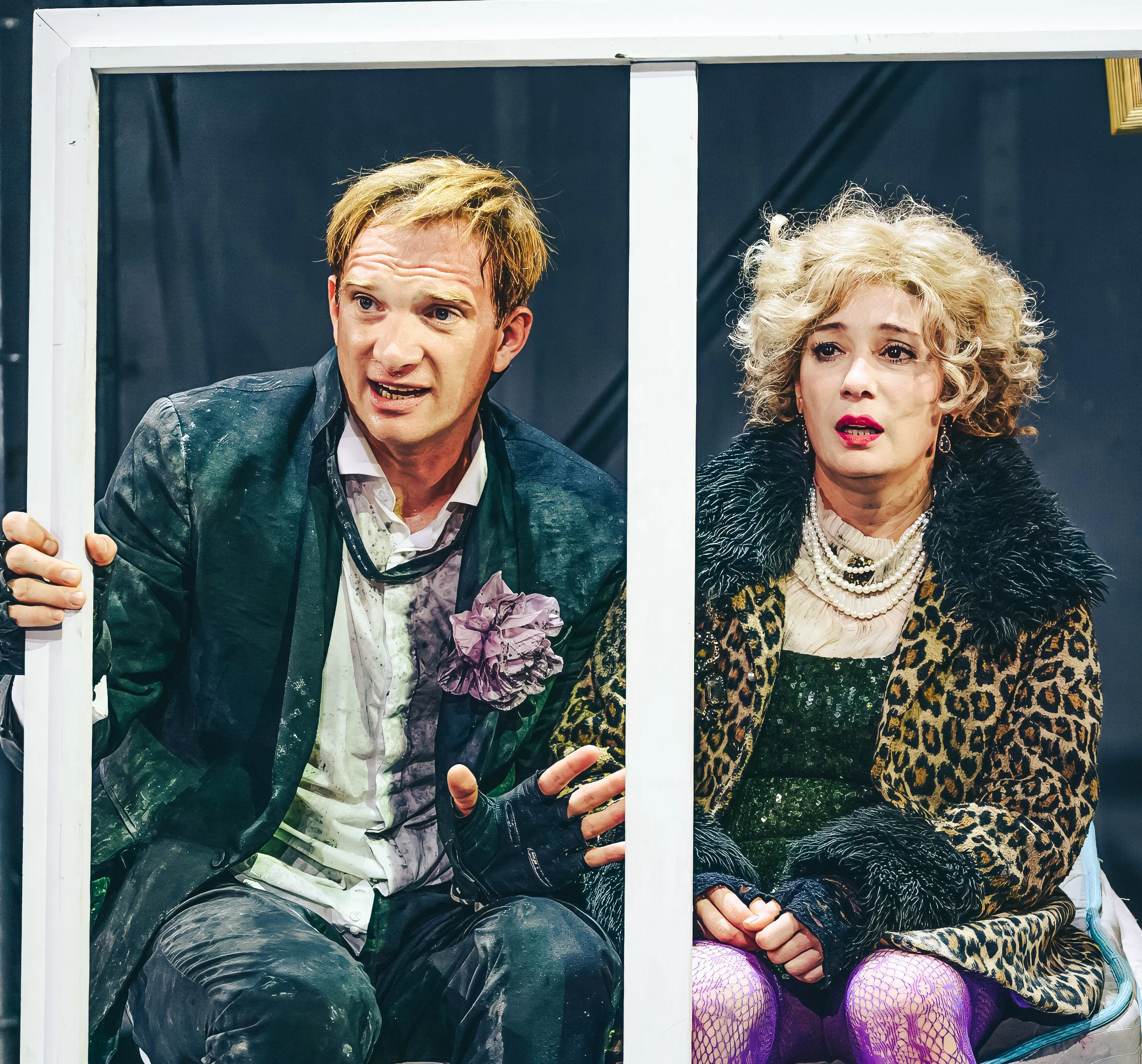
Andrey Burkovskiy (left) and Chulpan Khamatova portray an embattled couple living amid the horrors of war in Igor Golyak’s adaptation of Eugène Ionesco’s Delirium.
Avant-garde playwright Eugène Ionesco (1909–94) traced his love of theater to watching a Punch-and-Judy show in Paris’s Luxembourg Gardens as a child. He was enthralled by the puppets that “talked, moved, clubbed each other,” and the performances represented, he wrote, “the spectacle of the world itself . . . as if to underline its grotesque and brutal truth.” Igor Golyak’s Delirium, an adaptation of Ionesco’s 1962 play Délire à deux (Frenzy for Two), captures this signature blend of slapstick domestic squabbling while highlighting the human penchant for destruction and barbarity.
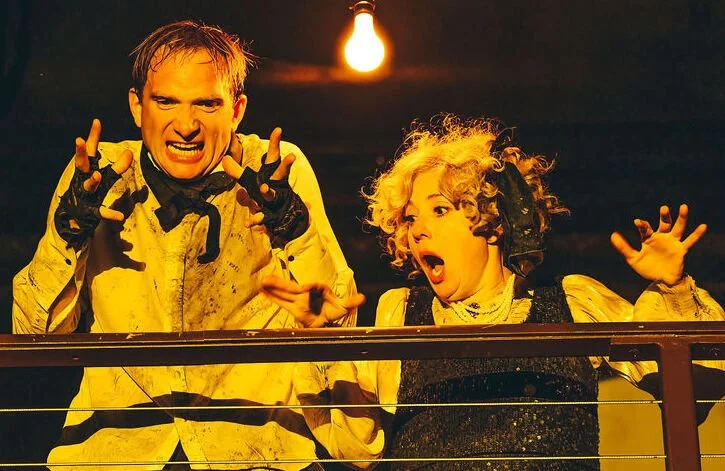
Ionesco wrote, “The human drama is as absurd as it is painful.” Golyak’s adaptation and the performances of Burkovskiy and Khamatova embrace and fully embody that conviction. Photographs by Austin Ruffer.
Though best known alongside Samuel Beckett and Jean Genet as a central figure of the Theatre of the Absurd, Ionesco rejected the label. Instead, he preferred to describe his “anti-plays” as a Theatre of Derision. This is an apt description of Delirium, which pits a longtime couple against each other in a relentless battle over semantics, petty grievances, and old regrets.
Identified only by their pronouns, He (Andrey Burkovskiy) and She (Chulpan Khamatova) both left their former marriages 17 years earlier to be together. “If I hadn’t gotten married,” He says matter-of-factly, “I wouldn’t have gotten divorced. You never know.” Meanwhile, as war rages outside their apartment, they rehash old debates, including the question of whether a turtle and a snail are the same animal. He argues that because snails have horns and turtles do not, they are clearly different species. She counters: “A turtle is a snail that doesn’t show its horns. What does a turtle eat? Lettuce. So does a snail. So it’s the same animal.”
The nonstop bickering is a means of passing time as the world outside crumbles and decapitated bodies accumulate. The characters’ verbal obtuseness also reflects the collapse of social order and a simultaneous linguistic breakdown, familiar motifs in Ionesco’s works. For example, in an extended word game, She expounds:
I look through the chair as I eat my pillow. I open the wall, and walk with my ears. I have ten eyes to walk and two fingers to look. I sit with my head on the floor. I put my derriere on the ceiling. When I've eaten the music box, I put jam on the rug by the bed and have a good dessert.
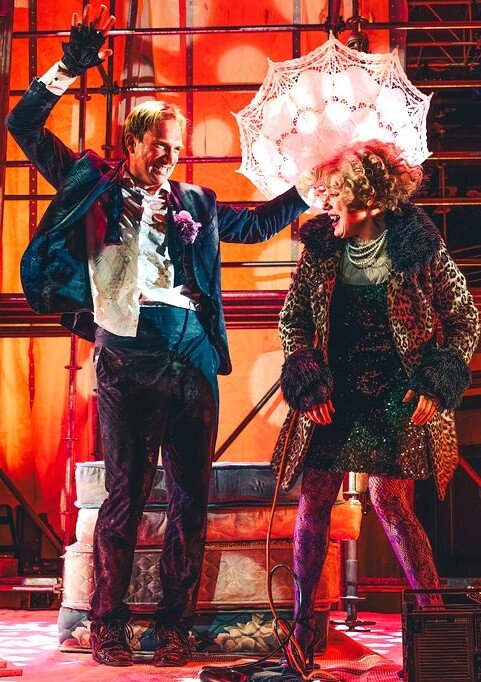
Moments of merriment and unbridled lunacy provide temporary relief from life’s unremitting bleakness.
Golyak’s exquisitely resourceful staging matches the script’s alternating lunacy and ominousness with an emphasis on physical humor and well-timed slapstick. Performed on a set by Jan Pappelbaum and Cecilia Xuetong Feng that incorporates industrial scaffolding, corrugated aluminum panels, and plastic tarps, the production evokes an apocalyptic playground. (Jeff Adelberg’s lighting and Denis Zabiyaka’s sound design effectively accentuate the shifting moods.) An incongruously placed aquarium in the center of the stage contains what amounts to the play’s third character, a large goldfish. Nonchalantly swimming and blithely unconcerned with the foibles of humanity, the fish epitomizes nature’s indifference to people.
Burkovskiy and Khamatova are splendid as the archetypal lovers. Ionesco was inspired by vaudeville and silent films, and under Golyak’s direction, the actors exhibit the comic timing of seasoned and dexterous clowns. They milk laughs from bits with ratty mattresses, a standalone door, window frame, and apartment buzzer. Additionally, they adroitly perform a gag with a drenched hat and wig that recalls the buffoonery of the Marx Brothers. (Sasha Ageeva’s costumes, consisting of tattered formalwear, contribute to the characters’ little-tramp-like personas.)
For all that is wonderful about this Delirium, the play does not rank among Ionesco’s best, and the show’s pungency flags. It lacks, for instance, the trenchant satire of Rhinoceros, and it does not have the sense of urgency of The Chairs, which also has a quarreling older couple at its center. Without sufficient character development, and featuring nearly nonstop wrangling and brutishness, this work of Theatre of Derision transforms into Theatre of Fatigue.
And then comes a moment of grace. Late in the evening, the pair embark on a flight of fancy that takes them to the moon and the sun, and it’s beautifully rendered through Golyak’s imaginative visualization with bubbles and starlight and through Burkovskiy’s entreaties for the audience to whir like an airplane. It’s a lovely sequence, and this Punch and Judy achieve something presumed impossible in their bleak and tedious existence: They provoke empathy.
The Arlekin Players Theatre production of Delirium plays through Oct. 24 at The Space at Irondale (85 S. Oxford St., Brooklyn). Evening performances are at 8 p.m. Monday through Saturday; matinees are at 3 p.m. Saturdays. For tickets and information, visit deliriumnyc.com/.
Playwright: Eugène Ionesco
Adaptor & Director: Igor Golyak
Scenic & Props Design: Jan Pappelbaum & Cecilia Xuetong Feng
Costume Design: Sasha Ageeva
Lighting design: Jeff Adelberg
Sound Design: Denis Zabiyaka
If you enjoyed this review, please click on the Like icon below.
