
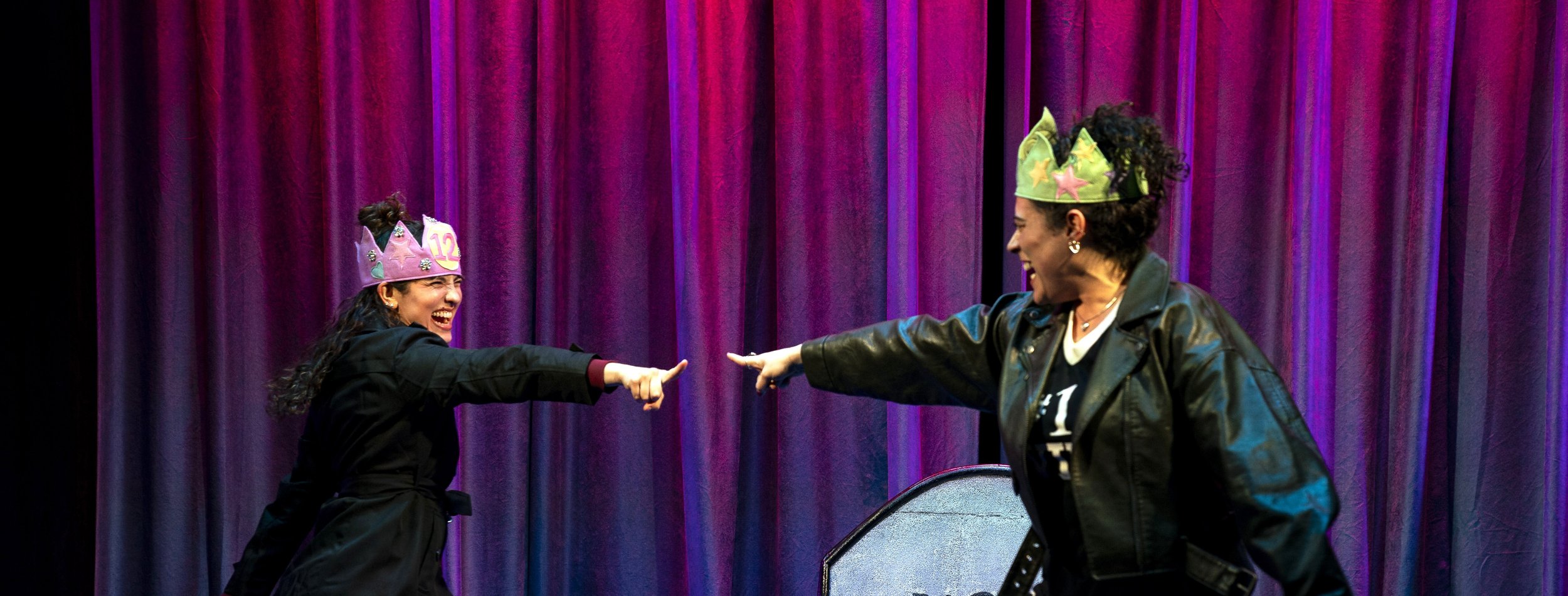
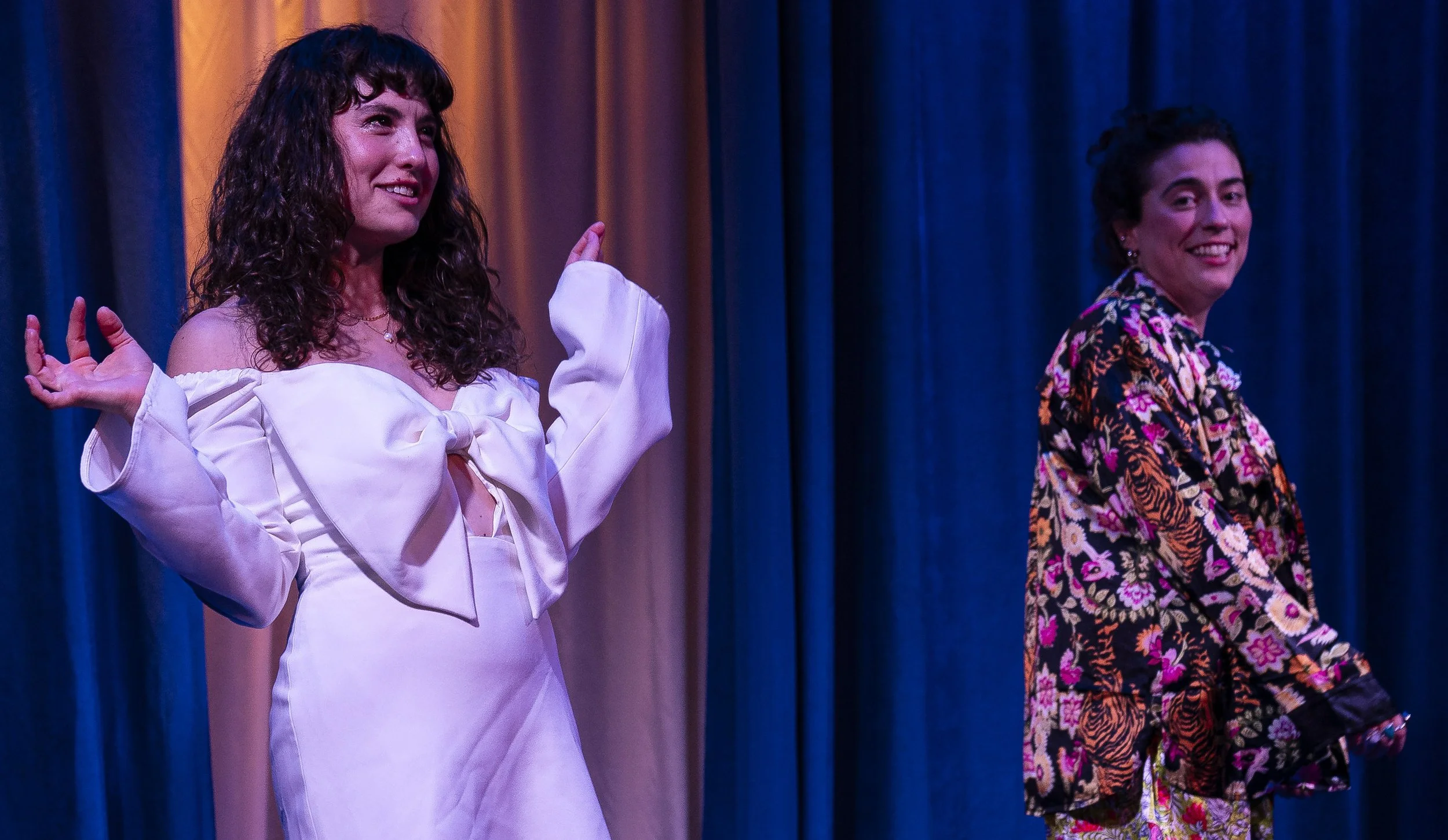
Tedra Millan (left) portrays an inebriated Bianca after her bachelorette party in To Have and To Hold, while playwright Laura Lapidus plays her older sister Kate, who looks on with an uncertain smile.
Although the renowned 20th-century poet W. H. Auden dismissed The Taming of the Shrew as “the only play of Shakespeare’s that is a complete failure,” Laura Lapidus proves there is still plenty of life in the old comedy with To Have and To Hold, her contemporary reimagining that explores sisterhood, romantic love and the difficult business of coming into one’s own. Smartly directed by Zoë Adams and featuring a top-notch ensemble, this 85-minute romp through modern romance is both deliciously entertaining and unexpectedly poignant.
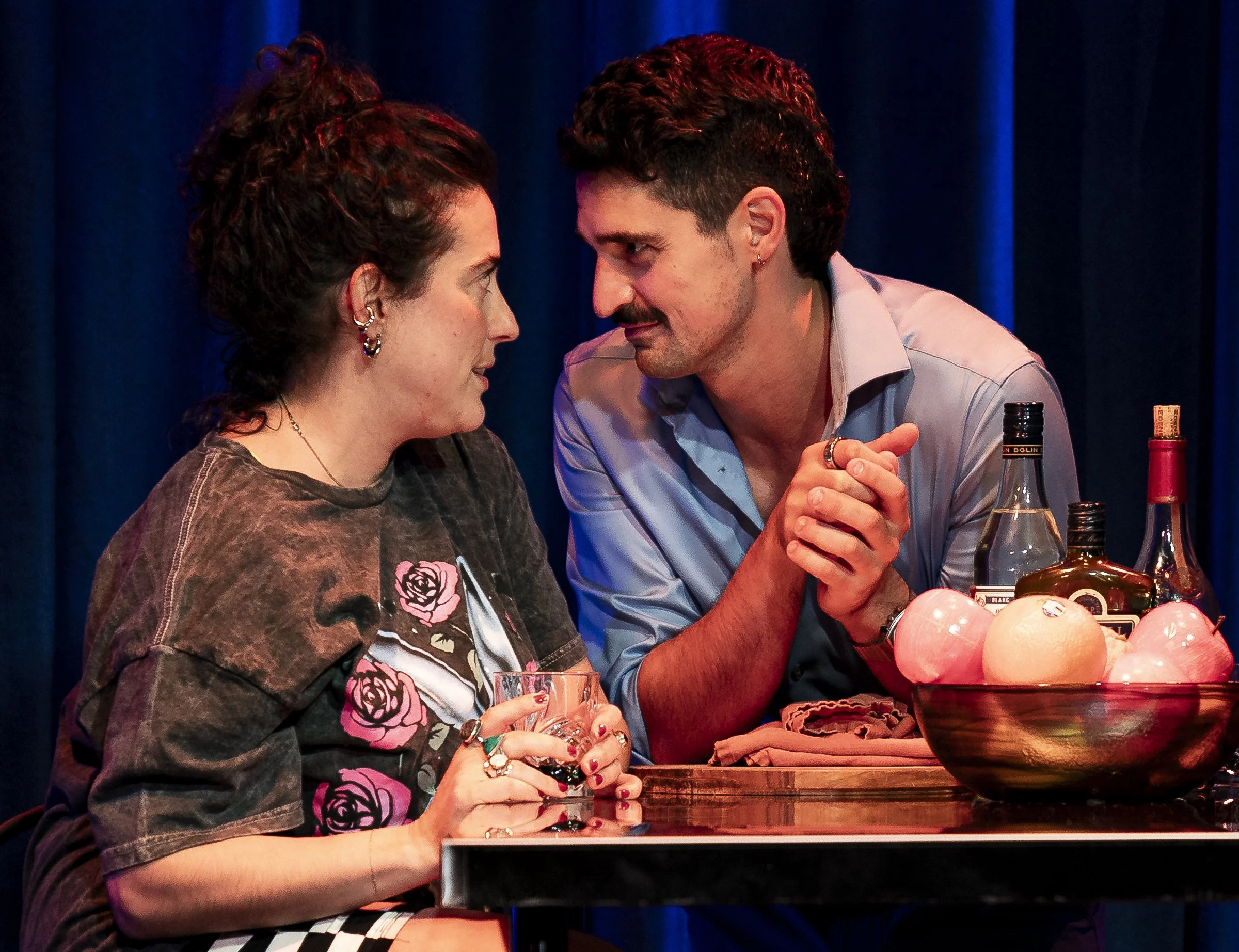
Kate finally consents to visit the home of her lover Peter, (Yuriy Sardonic). Photographs by Marcus Middleton.
Lapidus’s play is divided into nine scenes, with settings that shift from a bridal fitting room to a grocery store, a graveyard, and beyond. Although only seven months elapse between the opening scene and the final curtain, that span is enough for three characters to question—and redefine—their lives.
The story revolves around Kate—the shrew of Shakespeare’s title—and her younger sister Bianca, who has always been her best friend. But when Bianca gets engaged, Kate’s world suddenly seems less certain—and downright scary. Insisting that she will never marry because “matrimony is an instrument of the patriarchy,” Kate clashes with her irascible sister, creating a rift between them. Into this breach enters Peter, a plastic surgeon who becomes obsessed with Kate and courts her tenaciously. Though initially wary, Kate gradually finds herself attracted to this rich, handsome and intelligent man who is smitten with her. Ever so slowly, she begins to reconsider both her worldview and her scathing judgment of men.

Lapidus’s To Have and To Hold, a contemporary reimagining of The Taming of the Shrew, explores sisterhood, romantic love, and the difficult business of coming into one’s own.
From the outset, Lapidus’s plot mirrors Shakespeare, except for the Induction involving the tinker Christopher Sly, which she wisely jettisons. Yet she does far more than transpose Shakespeare’s plot to the present day. Ingeniously, she embeds dialogue and speeches from the original into her modern adaptation, often to wonderfully surreal effect.
Lapidus also invents an intriguing backstory for the motherless Kate and Bianca, adding psychological layers that Shakespeare’s characters lack. Whereas Shakespeare presents their father as a widower eager to marry off his daughters, Lapidus’s father is, according to Bianca in an emotionally charged moment in Scene 1, openly hostile toward Kate because of her outspoken, sarcastic nature: “You don’t shut up, you make a joke of everything, Dad hates you—.” By contrast, the girls’ late mother, who died when they were 13 and 12, emerges as an unsung heroine. A “Shakespeare freak,” she deliberately named her daughters after Shakespeare’s characters, a decision that has prompted Kate and Bianca to contemplate both The Taming of the Shrew and the challenges of being a woman. Their differing interpretations of their mother’s choice reveal the sisters’ contrasting perspectives while underscoring their enduring love for her:
Kate: Nooo! But I mean, that’s why she named us Kate and Bianca! So we could mess up The Taming of the Shrew, have stories that don’t end in fucking. . . . ‘Fie, fie unknit that threatening unkind brow.’
Bianca: No. Mom was a Shakespeare freak, and she named us after those sisters because it gave her a cute excuse to teach us about all of his plays, because she was sad that she never got to be a real professor.
Lapidus gives scant attention to Kate and Bianca’s professional lives, wisely avoiding elaborate biographical digressions in favor of dramatizing the way the sisters change as each encounters the man with whom she will share a future.
If Lapidus uses broad strokes in sketching the sisters’ work lives, yet she is razor-sharp in distinguishing their personalities. Kate closely echoes Shakespeare’s shrew, even behaving like one in the opening scene when she frees a tuft of Bianca’s skin caught in a bridal dress’s zipper and instinctively sucks the spot on her sister’s back. When Bianca cries out, Kate simply replies, “I don’t know, that was just my instinct.” Bianca, by contrast, is more harmonious, although quick to expose the contradictions in Kate’s thinking: “How come, on the one hand, all you talk about is our duty as ‘Women of the Future’ and then, on the other hand, you are obsessed with the tradition of sisterhood?”
Adams’s able direction is best seen in her inventive blocking of scenes. She sometimes has lights “freeze” characters and has them stand apart in pools of light, allowing the audience to decide whose side they are on at that dramatic moment.
The ensemble acting by Lapidus (Kate), Tedra Millan (Bianca), and Yuriy Sardarov (Peter) is better than good. Each performer captures the idiosyncrasies of the character without caricature.
The Taming of the Shrew is one of Shakespeare’s most controversial works, but, thanks to Lapidus’s fresh update, it’s well worth revisiting.
To Have and To Hold plays at Chashama’s 154 Theater (154 Christopher St.) through Sept. 12. Performance dates and times are somewhat irregular and may be viewed, along with other information, at tohaveplay.com.
Playwright: Laura Lapidus
Director: Zoë Adams
Scenic Design: Se Oh
Lighting Design: Yang Yu
Costume Design: Mieka van der Ploeg
Sound Design: Liam Bellman-Sharpe
If you enjoyed this review, please click on the Like icon below.
