
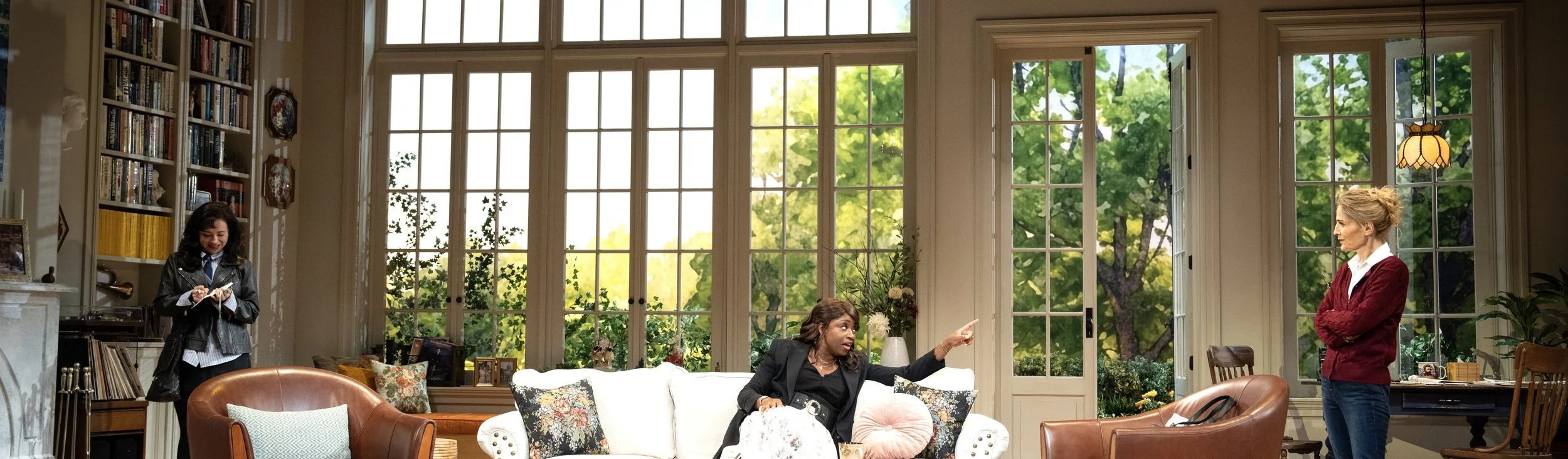

Jean Lichty (left) plays Lyssa Dent Hughes, M.D., whose nomination for U.S. Surgeon General is imperiled by a tax-reporting infraction, and Robert Sean Leonard is her husband, Walter, in the La Femme Theatre Productions’ presentation of An American Daughter by Wendy Wasserstein.
La Femme Theatre Productions, dedicated to “exploring the female experience through classic and contemporary plays,” is presenting the first New York revival of Wendy Wasserstein’s An American Daughter. This largely forgotten play premiered on Broadway in 1997 with a first-rate cast, including the late Lynne Thigpen, who won a Tony Award for her superb performance as the protagonist’s best friend Judith. It closed after a paltry 89 performances. The revival, directed by Sarna Lapine, utilizes post-Broadway revisions by Wasserstein, who died in 2006 at age 55. The script-tinkering hasn’t fixed the problems of the original, and it undermines what Wasserstein accomplished in this not-so-bad high comedy, which, in the late 1990s, was timely and diverting (though it fell far short of the political heft she had intended).
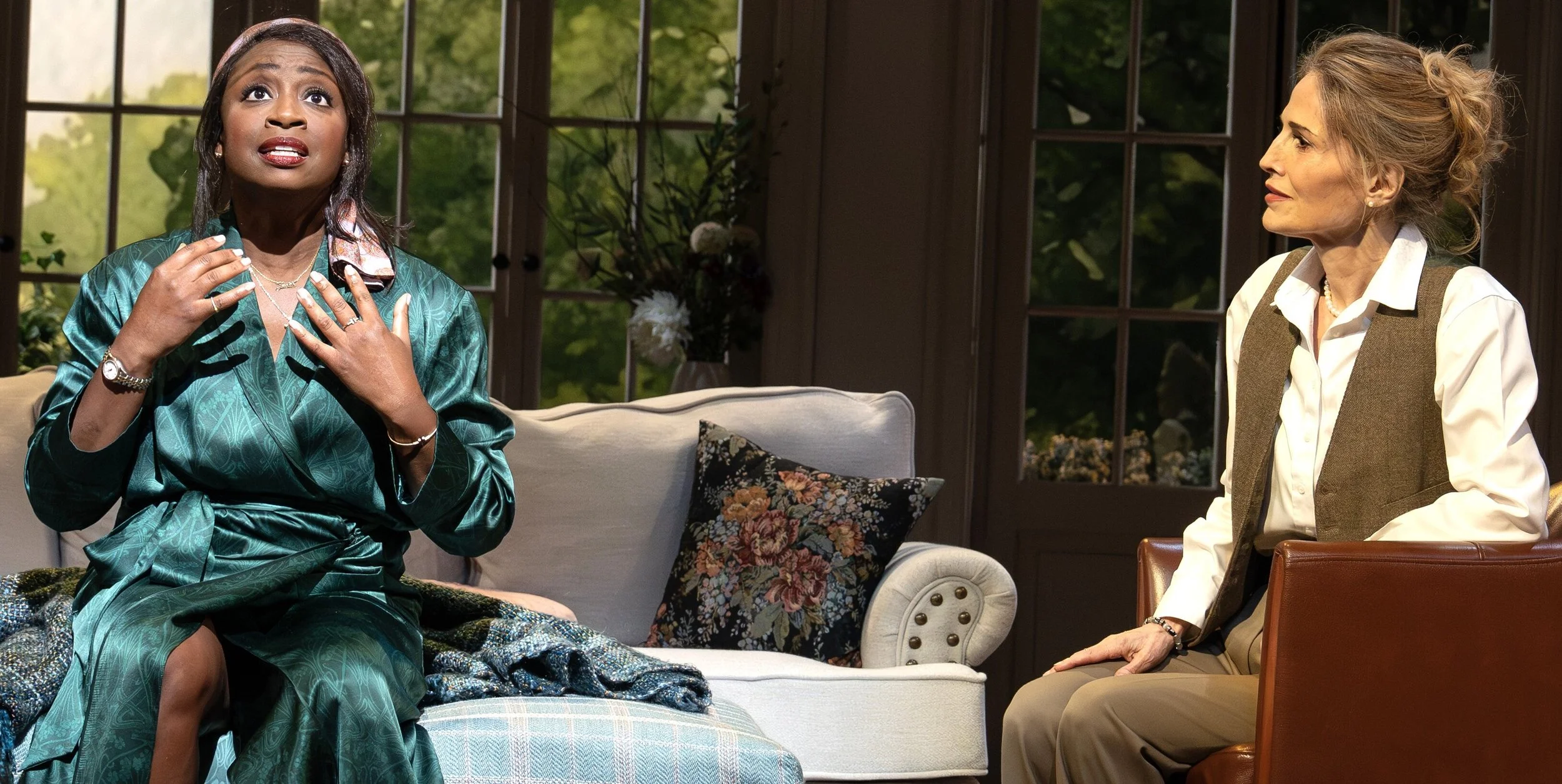
Montego Glover (left) plays Lyssa’s best friend Judith in An American Daughter. Photographs by Joan Marcus.
An American Daughter was inspired by a 1993 brouhaha provoked by news reports that Zoë Baird, President Bill Clinton’s initial choice for Attorney General, had employed undocumented immigrants for domestic services without filing mandatory disclosures and paying Social Security tax. Faced with public outrage about her taxpayer infractions, Baird bowed out of the confirmation procedure, leaving behind her name in the lexicon of Capitol Hill politics (as in “this candidate has a Zoë Baird problem”).
In Wasserstein’s play, the nomination of Lyssa Dent Hughes (Jean Lichty) for U.S. Surgeon General is imperiled because she once failed to respond to a jury summons. Lyssa, a Washington, D.C., physician and health care administrator, says she mislaid the summons and simply forgot about it. Pundit Quincy Quince (Carmen Zilles), in town promoting a new book, defends Lyssa as “a prisoner of her gender”—a self-aggrandizing reference to the title of Quincy’s new book—who “took on so many obligations that the basic necessities of life, like responding to a simple jury form, became overwhelming.” Quincy’s theory (and the thesis of her book) is that “the best intentions in females often become the seeds of their own destruction.”
The public uproar about Lyssa’s nomination is exacerbated when her well-meaning remarks about her Indiana childhood (and, especially, her mother’s ice-box cakes) are taken amiss in the Midwest. “In a week,” Lyssa’s husband, Walter (Robert Sean Leonard), says, “you’ve gone from being a compromise candidate to the soccer moms’ anti-Christ.”
“ The script-tinkering hasn’t fixed the problems of the original, and it undermines what Wasserstein accomplished.”
The play takes place over the course of a week, from the nomination announcement to the implosion of Lyssa’s candidacy. Scenic designer Mikiko Suzuki MacAdams, punching well above ordinary Off-Off-Broadway standards, has created an eye-appealing, “historical but lived-in” parlor for Lyssa and Walter’s posh Georgetown residence: vast windows with a wide, picturesque view of garden and sky; battered-chic furnishings; and the obligatory rolling bar cart. It’s an ideal setting for the arch dialogue of Wasserstein’s Beltway baby boomers.
Four New York stage stalwarts in supporting roles handle the play’s repartee with special comic flair: Dakin Matthews as Lyssa’s father, the senior senator from Indiana; Mary Beth Peil as his wife; Ryan Spahn as a neo-conservative journalist reminiscent of the young Andrew Sullivan; and Chris Ghaffari as the television reporter who outs Lyssa as a jury-duty scofflaw. Try as they may, though, these pros can’t compensate for La Femme founder Lichty’s inert portrayal of Lyssa.
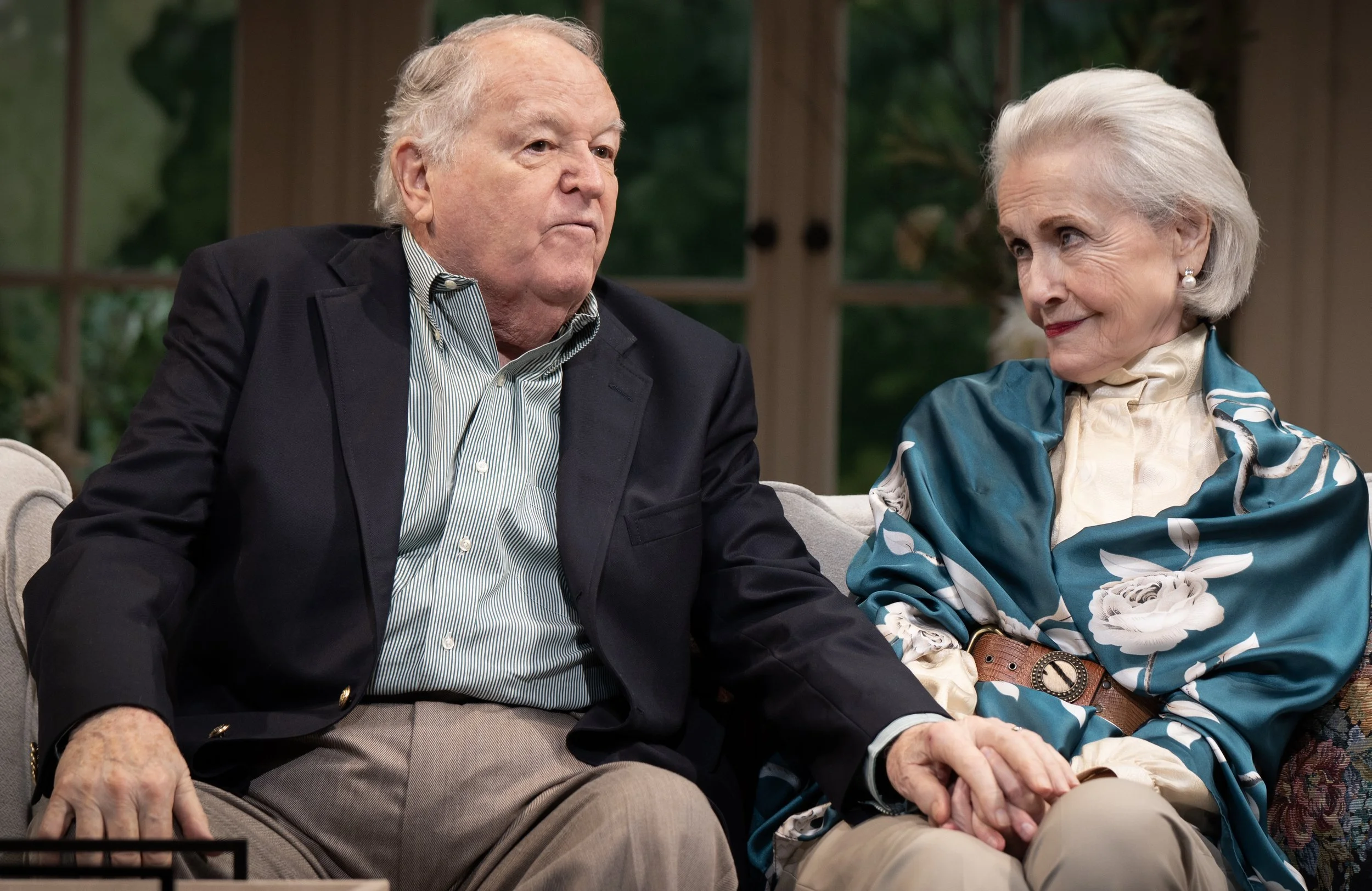
Dakin Matthews is Senator Hughes, Lyssa’s father, and Mary Beth Peil is his wife, Charlotte “Chubby” Hughes.
Wasserstein’s narrative conceit—a female cabinet nominee thwarted by a minor infraction from her past—is a reductio ad absurdum of Baird’s fall from grace. Even in 1997, the plot strained credulity; today, after the U.S. Senate’s cavalier confirmation of numerous unseemly Cabinet candidates, the story’s as quaint as Rebecca of Sunnybrook Farm.
The apex of Wasserstein’s career was The Heidi Chronicles, which won the Pulitzer Prize for Drama eight years before An American Daughter premiered, and featured two characters—Heidi Holland and Scoop Rosenbaum—indelible in baby-boom literature. Although An American Daughter was produced in various places after its Broadway failure and became a Lifetime Movie called Trial by Media, it neither touched a cultural nerve, as Heidi had done, nor yielded characters who embody generational archetypes like Heidi and Scoop.
This revival’s script emendations make the play cumbersome in a way the original was not. A new ending focuses on Judith (Montego Glover) who always seemed to have wandered in from another play but is even more obtrusive here. She’s an intriguingly melancholy character whose IVF story comes from Wasserstein’s personal experience. “Of all my characters,” the playwright wrote, Judith “is the one emotionally closest to me.” If only the fiercely private Wasserstein had given us a play all about Judith, drawing on insights from her own onerous journey to parenthood, rather than the dated, solid-B (or perhaps B+) Beltway comedy currently on view.
An American Daughter plays through Sept. 20 at the Pershing Square Signature Center (480 W. 42nd St.). Evening performances are 7 p.m. Tuesday through Saturday; matinees, 2 p.m. Saturday and Sunday. For tickets and information, visit lafemmetheatreproductions.org.
Playwright: Wendy Wasserstein
Direction: Sarna Lapine
Scenic Design: Mikiko Suzuki MacAdams
Lighting Design: Alan C. Edwards
Sound Design: Darron L. West
Costume Consultant: Risa Ando
If you enjoyed this review, please click on the Like icon below.
