
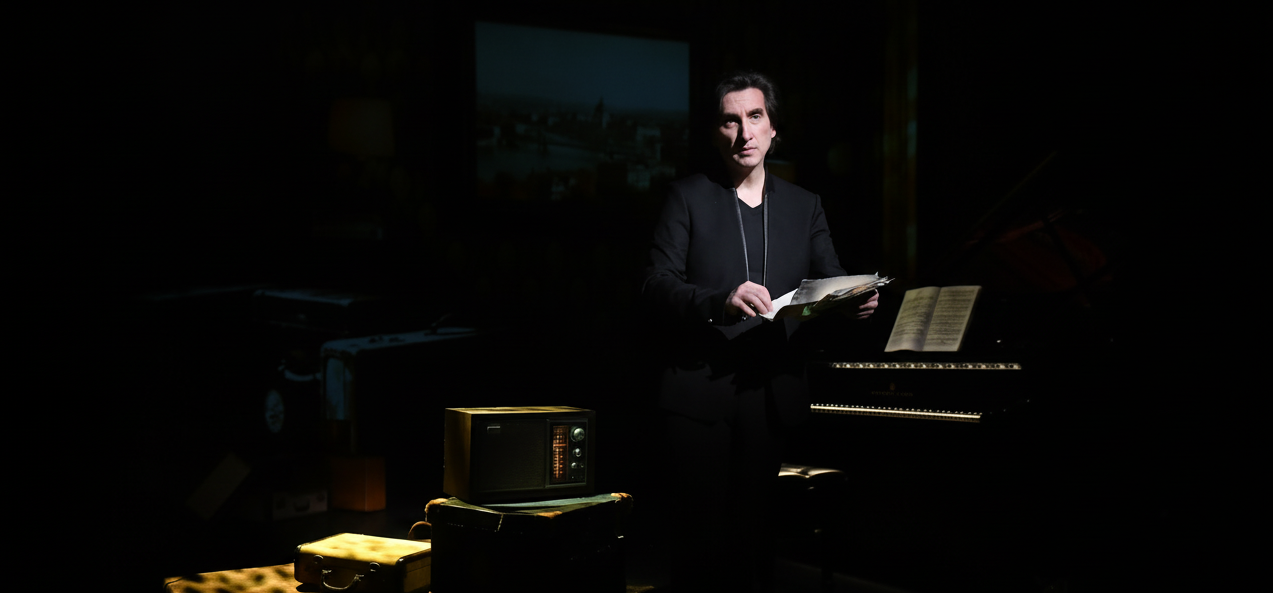
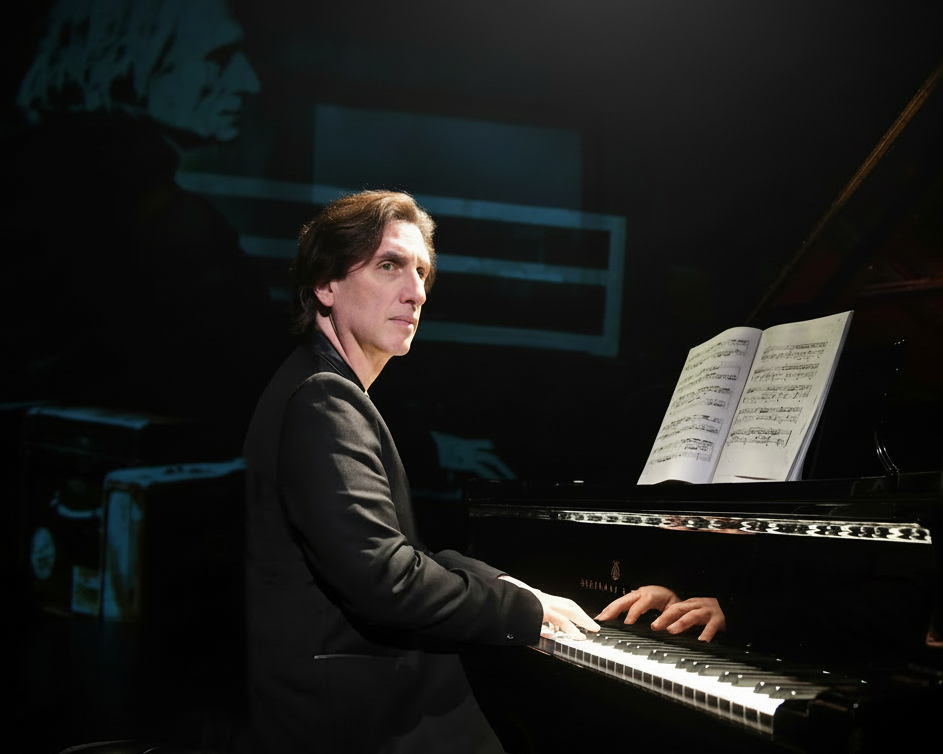
Playwright, composer, and performer Hershey Felder turns his storytelling gifts inward in his solo show Hershey Felder: The Piano and Me.
After spending decades bringing history’s greatest composers to vivid theatrical life, Hershey Felder turns his storytelling gifts inward in Hershey Felder: The Piano and Me. The result is an intimate and deeply affecting autobiographical portrait that reveals how music shaped not only an extraordinary career but also an extraordinary life.
Felder occupies a singular place in contemporary theater. Over a career spanning more than three decades and 6,000 performances, he has depicted such musical luminaries as Beethoven, Debussy, Chopin, Gershwin, Irving Berlin, and Leonard Bernstein, surrounding these iconic figures with a supporting cast of characters that enrich their stories. Yet his artistry extends beyond biographical portraiture. In productions such as Hershey Felder’s Great American Songs, he demonstrates the same gift for forging an immediate connection with audiences, transforming a theatrical performance into a shared celebration of music.
The Canadian-born Felder opens the autobiographical work seated at the piano, introducing himself as both musician and storyteller. But unlike the musical portraits of celebrated composers that have defined much of his career, this deeply personal work was, he admits, “terrifying” to create. Indeed, Felder resisted undertaking it for years before finally “caving,” simply to get the monkey off his back.
“Music becomes more than Felder’s vocation; it is his language of love, grief, and endurance.”
Felder finds his footing by retracing how and when he fell in love with the piano’s 88 black-and-white keys—and by acknowledging the people who helped shape his artistic vision. The poised performer before us was once an overweight child who, as he bluntly puts it, “smelled of boiled cabbage,” which made him the target of taunts from his classmates. Yet at age six, in 1974, Felder also discovered the piano, a hybrid string-and-percussion instrument that mysteriously arrived at his home. He was hooked.
Felder is a winning raconteur as he recalls the piano teachers who helped nurture his musicianship. His first teacher, Evelyn, could be a merciless martinet, but she also provided the foundation on which his artistry would be built. As a child, Felder took naturally to the piano, claiming that “the notes danced on the page” for him. He soon discovered an uncanny ability to read scores and memorize them. When Evelyn scolded him for failing to look at the music as he played, he replied, “I can see it in front of my eyes.”
Subsequent teachers pushed Felder even further. Even when assigned seemingly impossible musical challenges, he plunged into them, driven in part by what he describes as a deep need “to please people.” One of the biggest challenges facing the young pianist involved a weekly car trip for three years from Montreal to New York for lessons with the head of Juilliard’s piano department. That Felder undertook the journey week after week reveals the determination behind the seemingly effortless virtuosity he would eventually bring to the stage.
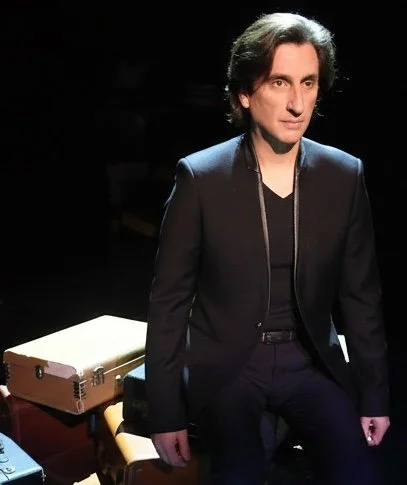
Felder’s play is an autobiographical portrait that reveals how music shaped not only an extraordinary career but also an extraordinary life. Photographs by Hershey Felder Productions.
Music also helped Felder cope when his mother was diagnosed with breast cancer. He recalls turning to Bach, whose music could drown out the sounds of her suffering after radiation treatments. He then performs one of his own compositions, quietly explaining that he wrote it for his “angel of a mother.” Doctors initially gave her only six months to live after her mastectomy, but she survived for another six years—long enough to see her son celebrate his bar mitzvah. In this deeply personal moment, music becomes more than Felder’s vocation; it is his language of love, grief, and endurance.
Although Felder is a natural storyteller, some of the most affecting moments occur when he pauses his narrative to perform Liszt’s Liebesträume, Gershwin’s Rhapsody in Blue, and John Williams’s “Flying Theme” from E.T. Among the most poignant pieces Felder performs is Beethoven’s Für Elise. Felder explains that Beethoven composed the beloved bagatelle after he had become deaf. When Felder first learned this, he says, he was devastated. Yet the discovery also taught him an important lesson: Beethoven was not merely trying to create pretty notes. The music came from somewhere deeper. As Felder puts it, “Music had to come from a composer’s soul.”
Felder also slips into 16 other personas, including his Yiddish-speaking grandparents, Holocaust survivors. He vividly recalls the suitcase they kept packed with a prayer shawl, ready in case someone came to “take them.”
Ultimately, Felder’s own life proves the truth of his words: music can come from the soul. In The Piano and Me, Felder reveals how music shaped his identity, connected him to his heritage, and became the highly personal language through which he continues to tell his story.
Hershey Felder: The Piano and Me plays at 59E59 Theaters through Aug. 23. Evening performances are at 7 p.m. Tuesday through Saturday; matinees are at 2 p.m. Thursday, Saturday, and Sunday. For tickets and more information, visit 59e59.org.
Playwright & Scenic Design: Hershey Felder
Lighting Design: Christopher Rynne
Sound Design: Erik Carstensen
If you enjoyed this review, please click on the Like icon below.
