

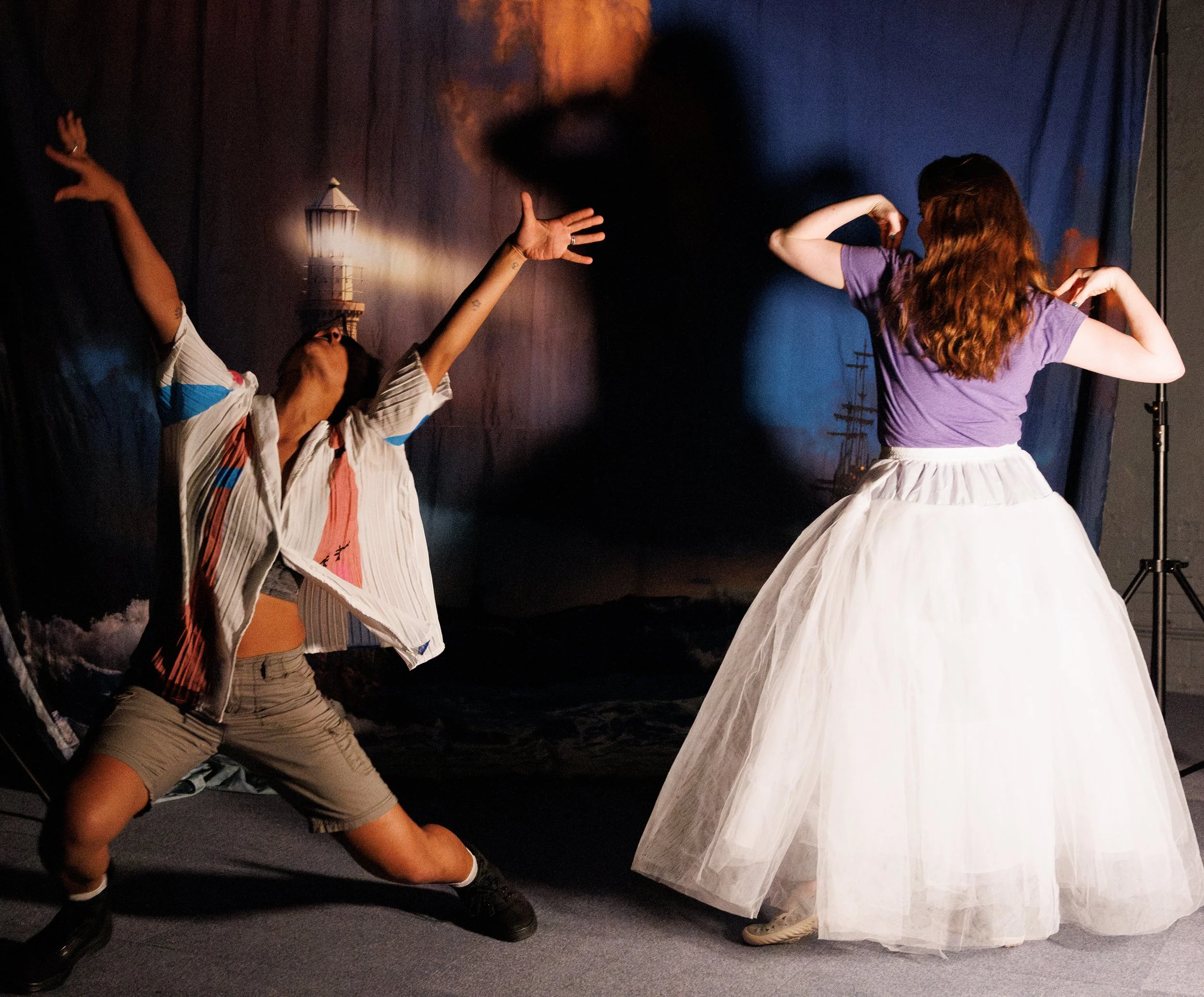
Queen-Tiye Akamefula (left) and Annie Hoeg perform a sequence from the “forgotten” 1943 cult film The Pearl of My Oyster, in Eric Marlin’s What a World! What a World!
Eric Marlin’s What a World! What a World! explores gender identity, drag, and gay love in a dialogue-heavy production that opens on a bare stage reminiscent of a 1970s avant-garde drama. Queen-Tiye Akamefula and Annie Hoeg exchange overripe melodramatic dialogue while moving and posing in tandem, using gestures that recall the 19th-century Delsarte system—back of hand to forehead; arms outstretched—executed with the measured precision of tai chi. The result is alternately intriguing and irritating, but emotionally remote.

Hoeg as Not Charlotte listens to Akamefula as Not Keith explain their attitude to drag.
The language is not so much off-putting as perplexing (the script, entirely in lowercase, is off-putting, and it’s a mark of the actors’ fortitude that they have grappled with such an unnecessary hurdle). The cheesy language is supposedly from The Pearl of My Oyster, an overwrought 1943 film about two lovers, Charlotte and Keith. The campiness of the film causes a clash between Akamefula and Hoeg as the central lovers, Not Charlotte and Not Keith (their rubrics in Marlin’s script). But, the playwright notes, “sometimes the performers are characters and sometimes other characters slip in.” The others are a drag king and a drag queen playing Keith and Charlotte; a queer couple watching the movie; and a queer couple watching a recording of the drag performance. The constant shifts in identity, along with the absence of stable character names, leave the performers functioning less as fully realized people than as mouthpieces for Marlin’s debate over queer identity—a debate that often resembles an animated late-night dorm-room argument.
If there is a redeeming quality, it is Marlin’s gift for poetic language:

Not Keith is a fan of The Pearl of My Oyster, but Not Charlotte is unconvinced of the melodrama’s relevance. Photographs by Maria Baranova.
Not Charlotte: without camp
the world is so serious
it is wickedly serious
and every moment of my day is spent in utter terror
the planet is spinning apart
people fight and die and mourn and starve and wither away
if i only have what is serious
then there’s no hope
only with true inanity
is there a flicker of joy in the world
Marlin has a skill for parody, shown off in arch exchanges of hard-boiled wooing that repeat themselves throughout the play (traditional capitalization and punctuation are restored below for the reader’s benefit):
Not Keith: It’s just not every day you see a fine dame like you come hang with the tough guys.
Not Charlotte: Are you a tough guy?
Not Keith: It’s been said by some.
Not Charlotte: I don’t know if I believe that.
Not Keith: Believe it, sweetheart.
Not Charlotte: Well, lucky for me I know how to a handle a tough guy.
Not Keith: Is that so?
Director Ilana Khanin gradually counters the script’s philosophical density with modest visual elements: a CD player; a skeletal tulle dress (by Megan Rutherford Murray) that stands in for a full costume; a canvas bearing a painting of a lighthouse amid stormy seas that is unfurled for the climax. Shortly after Hoeg (as half of the queer couple) brings on the CD player, Akamefula (as the less femme half) brings in a portable light source that serves as the television. Illuminated by it (lighting by Skye Mahaffie), the queer couple watch The Pearl of My Oyster. Not Charlotte stakes out her position on various subjects in deft quips: “Camp is the observer’s feast of rare delicacies”; “You make this a battle of the sexes. What we’re watching is a fraying of the binary”; “Drag levels all. They are both made grotesque. They are both mocked.”
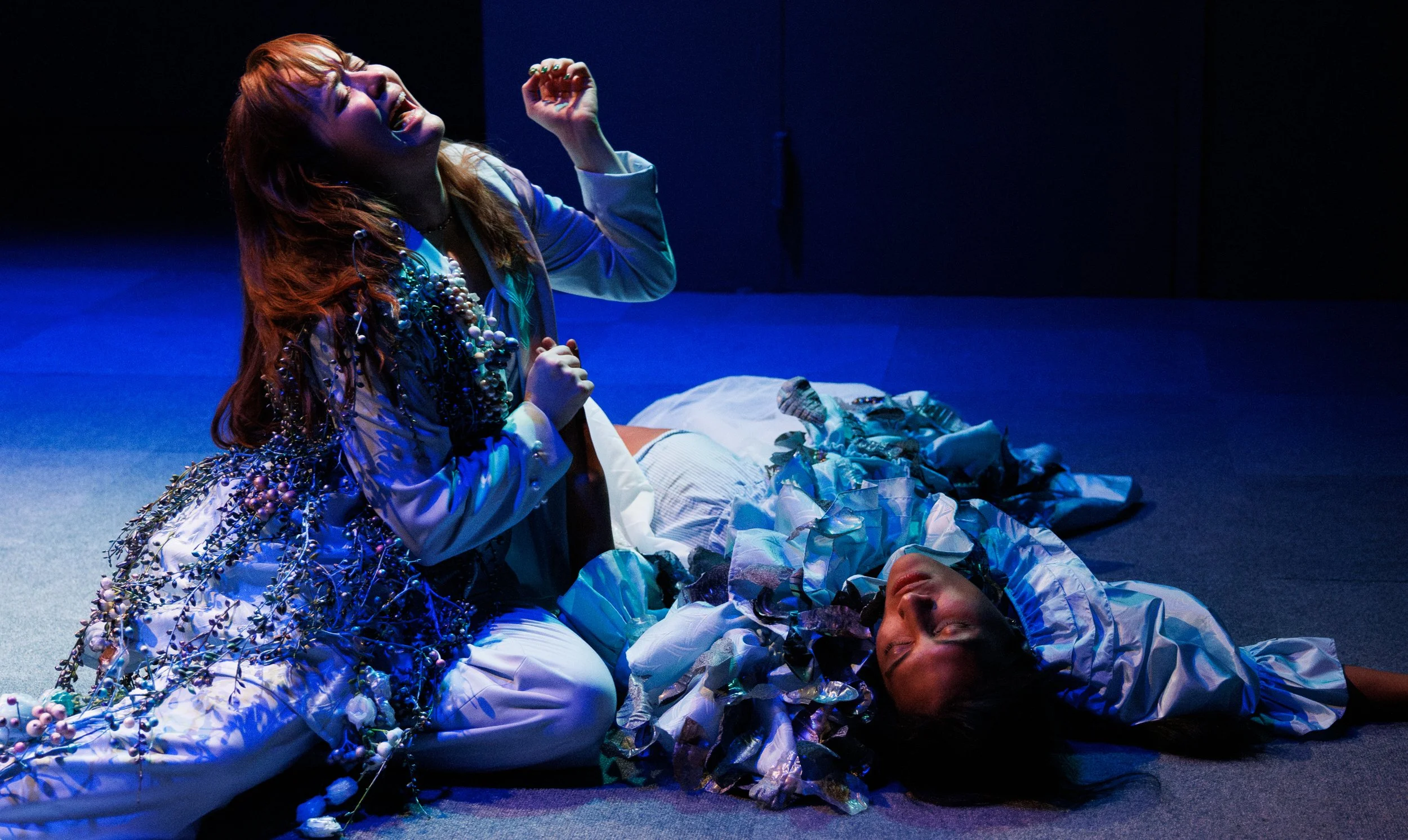
The climax of The Pearl of My Oyster, the bogus movie in Marlin’s play, pays homage to the classic 1940 film The Letter, starring Bette Davis.
Not Keith also finds the stakes high:
I’m all for fraying.
Man woman male female boy girl:
These are bad vicious words.
They are the blood tonic of power.
Burn the words down.
Following who is who at any moment eventually becomes confusing and tiresome, in spite of startling observations. Yet occasionally there is comic relief, as when Not Keith says, “I killed a man, but in fairness, he was a prodigious jaywalker.”
Three-quarters of the way in, a curtain descends and two new characters arrive. One of them (Shatisha N. Bryant) carries a tripod and large placards that explain, finally, what Pearl—an imaginary film—is about: the full character names turn out to be Charlotte Talversen and Keith Butch. Bryant gets some inadvertent laughs in an unscripted mishap, as the tripod collapses and she has to present the cards without it. She tosses them on the floor with noticeable aplomb. Intentional or not, the segment provides genuine spontaneity that stands out from the earnest, intermittently engaging debate around it. One hopes that Marlin’s poetic gifts will merge with sturdier dramatic structures in the future.
Eric Marlin’s What a World! What a World! runs through Aug. 2 at The Tank (312 W. 36th St.). Evening performances are at 7 p.m. Thursday through Saturday and Monday; matinees are at 3 p.m. Sunday (no performances on July 19). For tickets and more information visit thetanknyc.org.
Playwright & Sound Design: Eric Marlin
Direction & Scenic Concept: Ilana Khanin
Costume Design: Megan Rutherford Murray
Lighting Design: Skye Mahaffie
If you enjoyed this review, please click on the Like icon below.
