
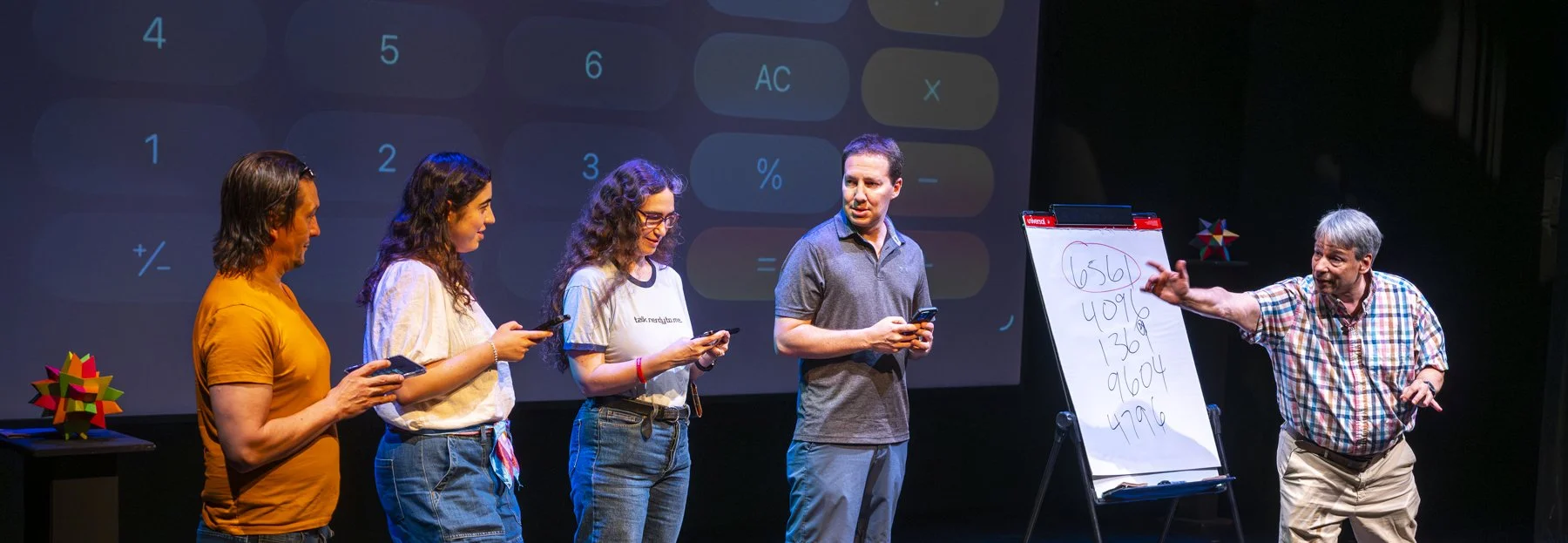
For anyone who has ever believed mathematics belonged exclusively to gifted minds, That Math Show offers a joyful correction. Created and performed by Dr. Arthur Benjamin and directed by Eric Krebs, this lively production reveals the beauty and playfulness of numbers.
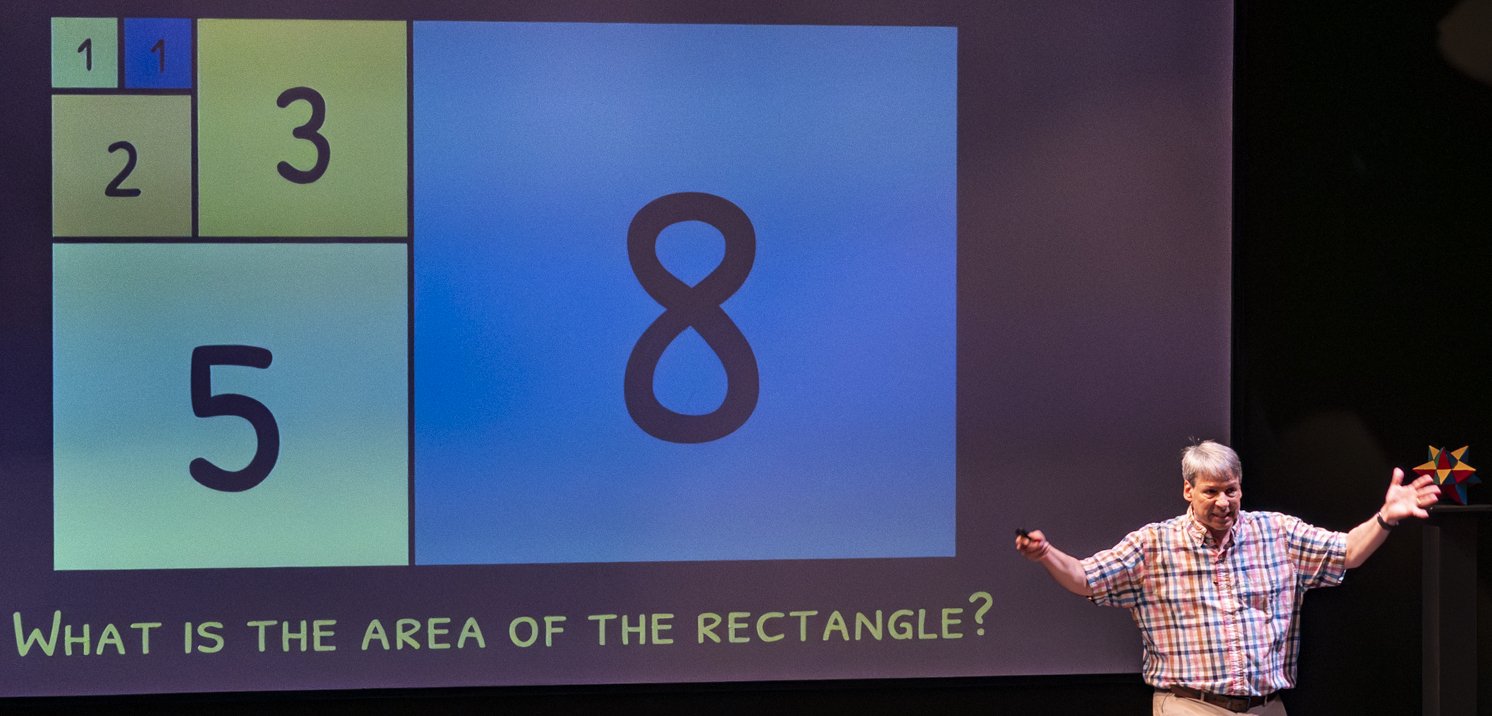
Playwright-performer Dr. Arthur Benjamin reveals the beauty and playfulness of numbers in his new solo play, That Math Show.
Part professor, part showman, part magician, Benjamin is the magnetic presence in his new solo show. Although he is nationally known as a “math-e-magician” and Reader’s Digest dubbed him “America’s Best Math Whiz,” Benjamin doesn’t simply perform for the audience; he invites them to think alongside him.
Before the show begins, Krebs welcomes the audience, made up largely of youngsters, their parents (or guardians), and math enthusiasts. He recalls a young theatergoer saying after an earlier performance, “I hate math, but I love this show!” Although the anecdote naturally serves as a plug for the production, it also captures the show’s greatest accomplishment: transforming mathematics from a source of anxiety into one of wonder.
The show opens with a charming video in which several people are asked to complete the sentence, “Math is…” with the first word that comes to mind. Responses range from hesitant (“Um,” “Oh, man!,” and “Let me think”) to confident, with the final participant declaring, “Powerful.”
As the video fades, Benjamin takes the stage. Introducing himself, he immediately establishes the show’s whimsical spirit by proclaiming that “math is magical” and promising to combine mathematics with magic. Inviting volunteers onstage with calculators, he proceeds to multiply and square numbers in his head—including a four-digit squaring problem—faster than they can enter the figures into their devices.
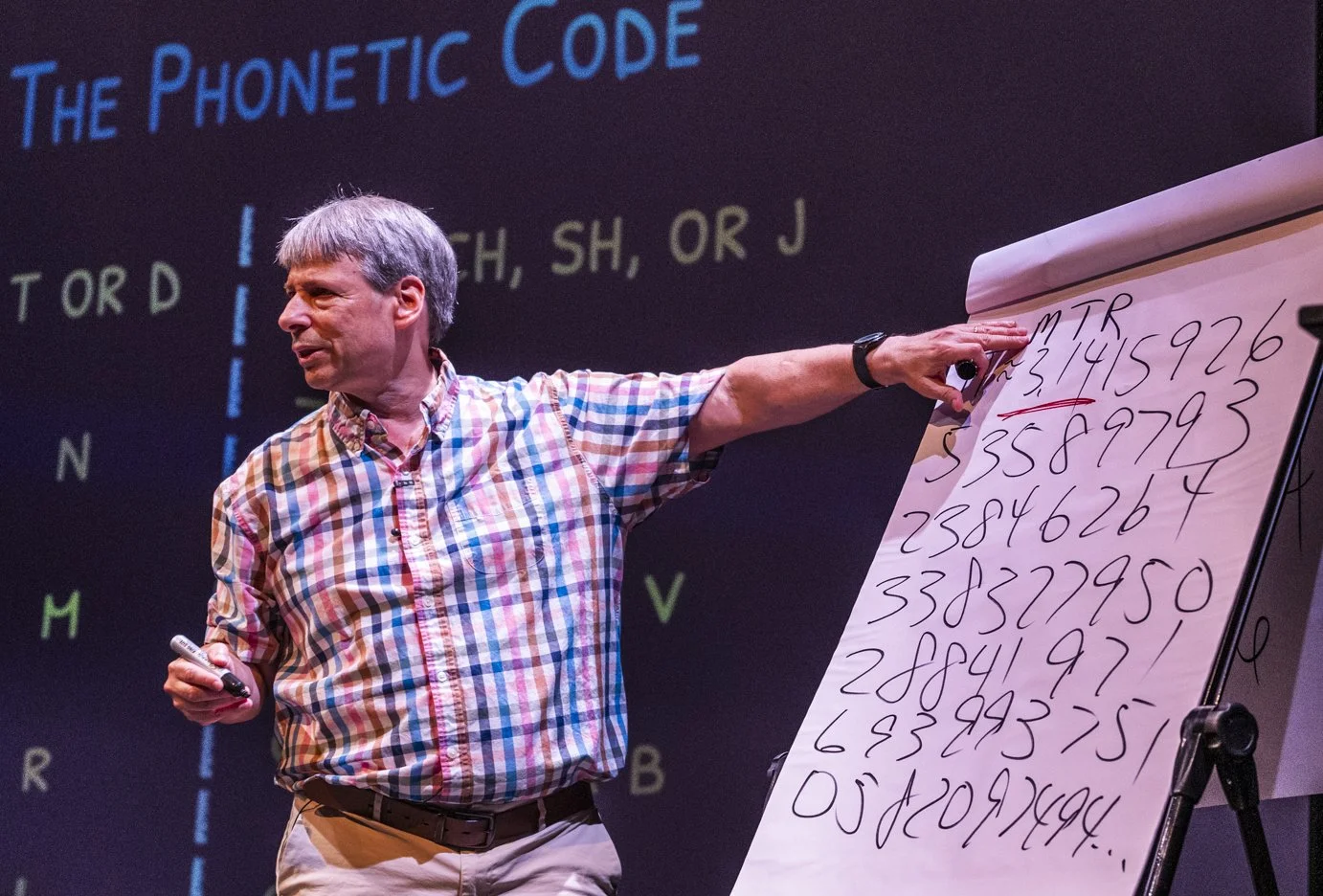
Benjamin teaches audiences how to effortlessly memorize dozens of digits of pi using a phonetic memory system in his new solo show.
Rather than boasting about outpacing audience volunteers armed with calculators, Benjamin emphasizes that the evening is less about showcasing his brilliance than sharing practical techniques for mental math. As he tells the audience, “The point is not how smart I am, but how smart you are.” He traces his facility with numbers to childhood, explaining that after being diagnosed as hyperactive, he devised quicker ways to perform arithmetic that matched his short attention span. Throughout his demonstrations, Benjamin encourages the audience to think differently about numbers by breaking calculations into manageable steps and working from left to right rather than in the traditional classroom fashion.
Benjamin follows with examples that let the audience put his methods into practice. One memorable example involves squaring numbers ending in five. Projecting the calculation onto a large screen, he patiently demonstrates why 25² equals 625, reducing what initially seems like an intimidating feat to a surprisingly logical sequence of steps. Even audience members who lose the thread of the arithmetic seem buoyed by Benjamin’s calm assurance and infectious enthusiasm, making the process feel less like a test of intelligence than an invitation to think differently about numbers.

Benjamin makes mathematics feel less like a subject to be mastered than an adventure to be shared. Photographs by Russ Rowland.
Although audience members may not remember every shortcut Benjamin introduces, nearly everyone remembers a birthday. Using that universal point of reference, he invites volunteers onstage and constructs a “Magic Square” based on their birth dates before demonstrating how mathematics can determine the day of the week on which they were born. Benjamin briefly explains the numerical system, projecting helpful mnemonic tables onto a large screen so the audience can follow along comfortably. The segment draws appreciative “oohs” and “ahs,” but its biggest revelation comes when Benjamin notes that Albert Einstein was born on Friday, March 14, 1879—a birthday that falls on Pi Day (3/14).
The show’s second half explores the Fibonacci sequence and its connection to the renowned golden ratio, as Benjamin explains how these mathematical patterns often appear in nature—from the spirals of a pineapple to the arrangement of flower petals. In doing so, he reminds the audience that mathematics extends far beyond calculation. As he puts it, “Mathematics is not just about solving for x; it’s also about figuring out why.”
Yet Benjamin ultimately succeeds not only with his mathematical wizardry but also with a childlike willingness to sing a playful song about π, set to the tune of Don McLean’s “American Pie,” with Lawrence M. Lesser’s lyrics:
A long, long time ago, I can still remember
How that math sure used to make me smile.
And I knew if I had the chance, I would ace geometry class. . .
But some math books made me shiver –
Dry procedures, all delivered:
Nothing past the rational, and nothing transcendental.
I can’t remember if I cried, reading 3.14159.
But something touched me deep inside
The day I learned of π. So…
That Math Show succeeds because Benjamin makes mathematics feel less like a subject to be mastered than an adventure to be shared. That is no small achievement.
That Math Show plays through Aug. 16 at Theater 555 (555 W. 42nd. St.). Evening performances are at 7 p.m. Wednesday, Thursday, Friday, and Saturday; matinees are at 2 p.m. Saturday and 3 p.m. Sunday. For more information, visit theater555.com.
Playwright: Arthur Benjamin
Director: Eric Krebs
Scenic Design: Peter R. Feuchtwanger
Lighting Design: Joan Racho Jansen
If you enjoyed this review, please click on the Like icon below.
