
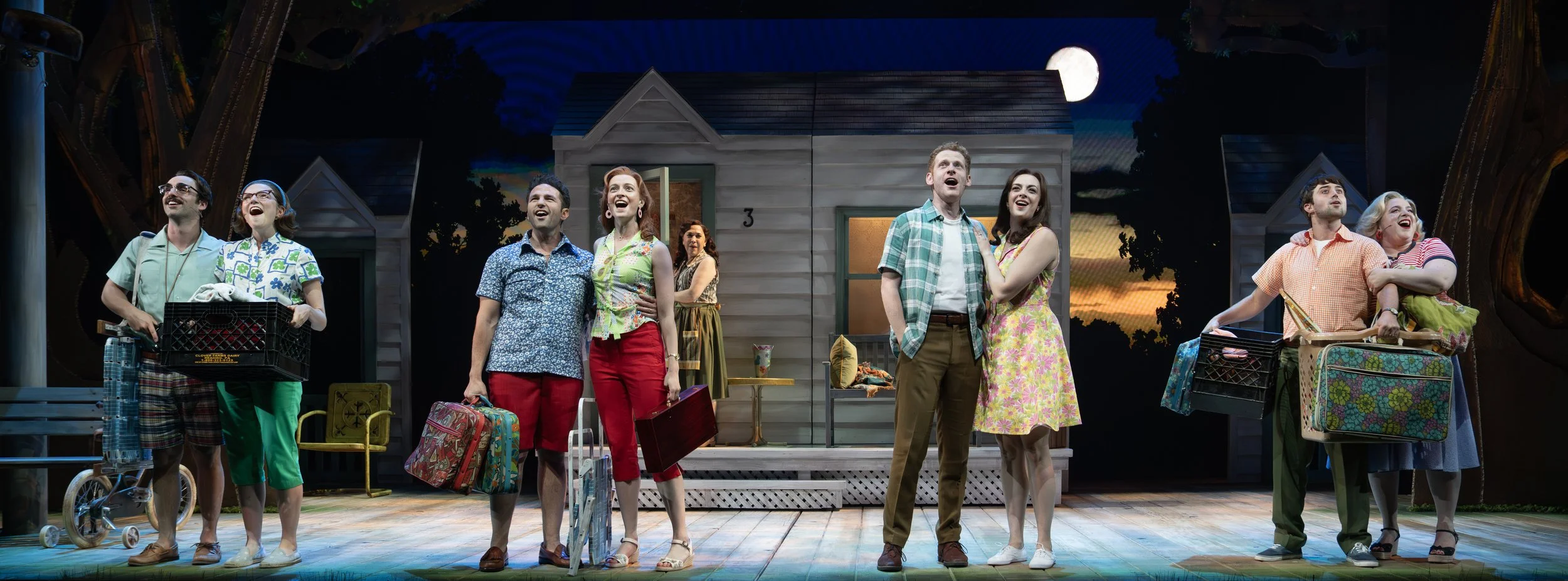
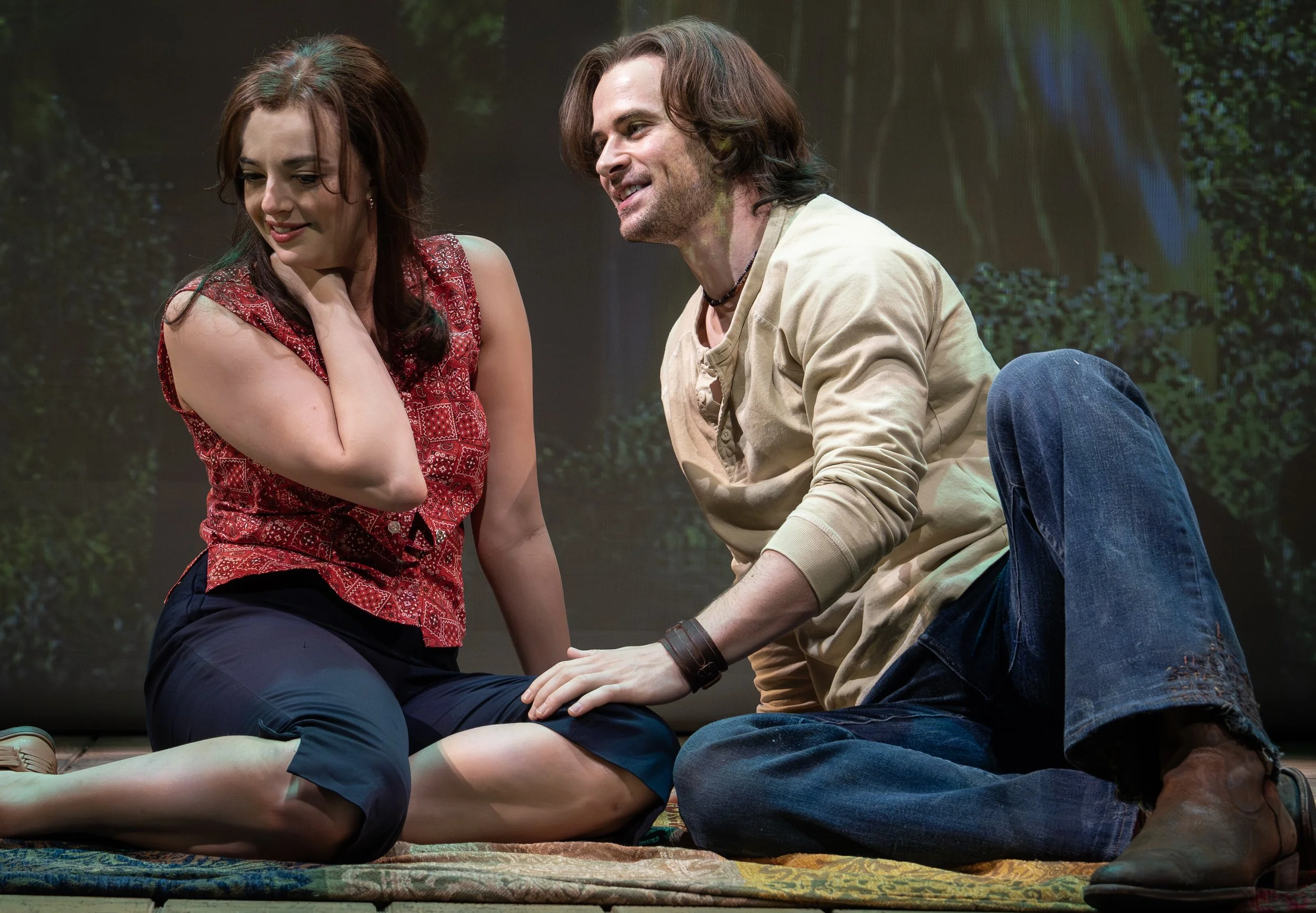
Pearl (Talia Suskauer) falls for Walker (Sam Gravitte), a traveling salesman, in A Walk on the Moon.
Neil Armstrong landed on the moon on July 20, 1969. Less than a month later, the Woodstock festival rocked America’s psyche. The run-up to these landmark events provides the symbolic dissonance for the bighearted and multifaceted new musical A Walk on the Moon. With a score by AnnMarie Milazzo and book by Pamela Gray, this stage version of the 1999 film (also written by Gray) tracks a not-so-happy housewife through a risky voyage of self-discovery, just one short hike away from Max Yasgur’s farm in Bethel, N.Y., and one giant leap from her otherwise square and earthbound life.
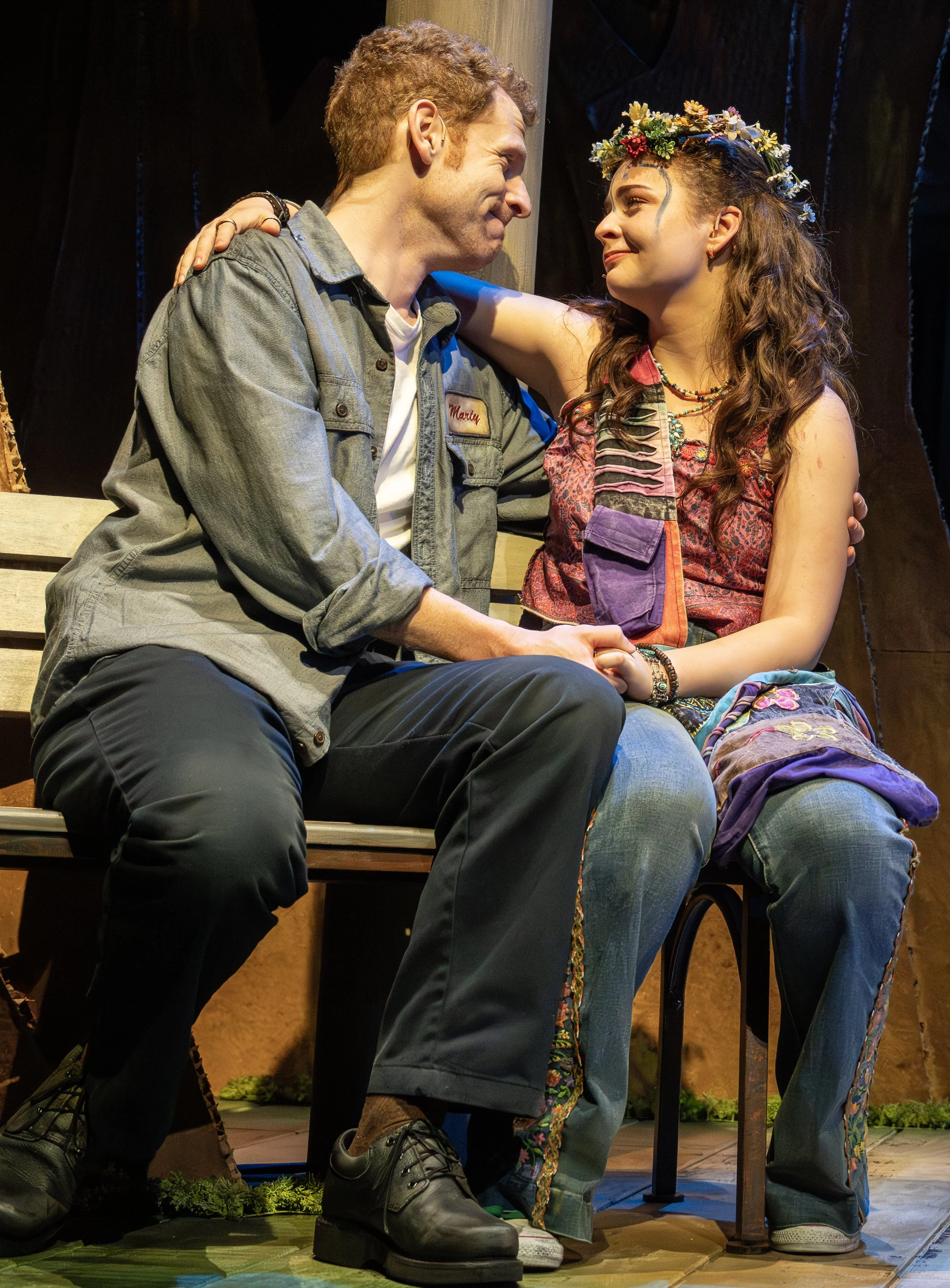
Marty (Max Chernin) comforts his daughter, Alison (Sophie Pollono).
On paper, Pearl Kantrowitz (Talia Suskauer) should be pleased with herself. She has Marty (Max Chernin), her hardworking and devoted husband. She has two healthy children, young Danny and the conscientious 15-year-old, Alison (Sophie Pollono). And she gets to spend each summer away from the drudgery of Brooklyn’s Flatbush Avenue, relaxing with friends and family at a Catskills bungalow colony, the kind of upstate vacation spot where, from the 1930s through the 1960s, Jewish families would set up camp for all of July and August. The husbands would return to their city jobs Monday through Thursday, then speed back to the bungalows to weekend with the wives and enjoy a few cocktails.
But Pearl, basking in the summer breeze, feels the era’s winds of change and fears she is missing out on a better kind of life. After hearing Armstrong in a TV interview, she opines to him in a ballad, “Mr. Armstrong / How did I not know a decade has gone by / And was I even in it?”
Marty is the only man she has ever been with, and she became pregnant with Alison while she was still a teen. As she idles away, playing mah-jongg with the other wives, her itch to escape is palpable. She also is seemingly alone in her feelings. Her best friends are happy enough, or at least too busy raising their families to worry about self-fulfillment. They sing a firm rejection of the ideas of Betty Friedan’s The Feminine Mystique in the rousing, “We’re Girls with Somethin’ to Do”: “Hey Betty / Keep your book cuz we ain’t ready / To find ourselves like you.”
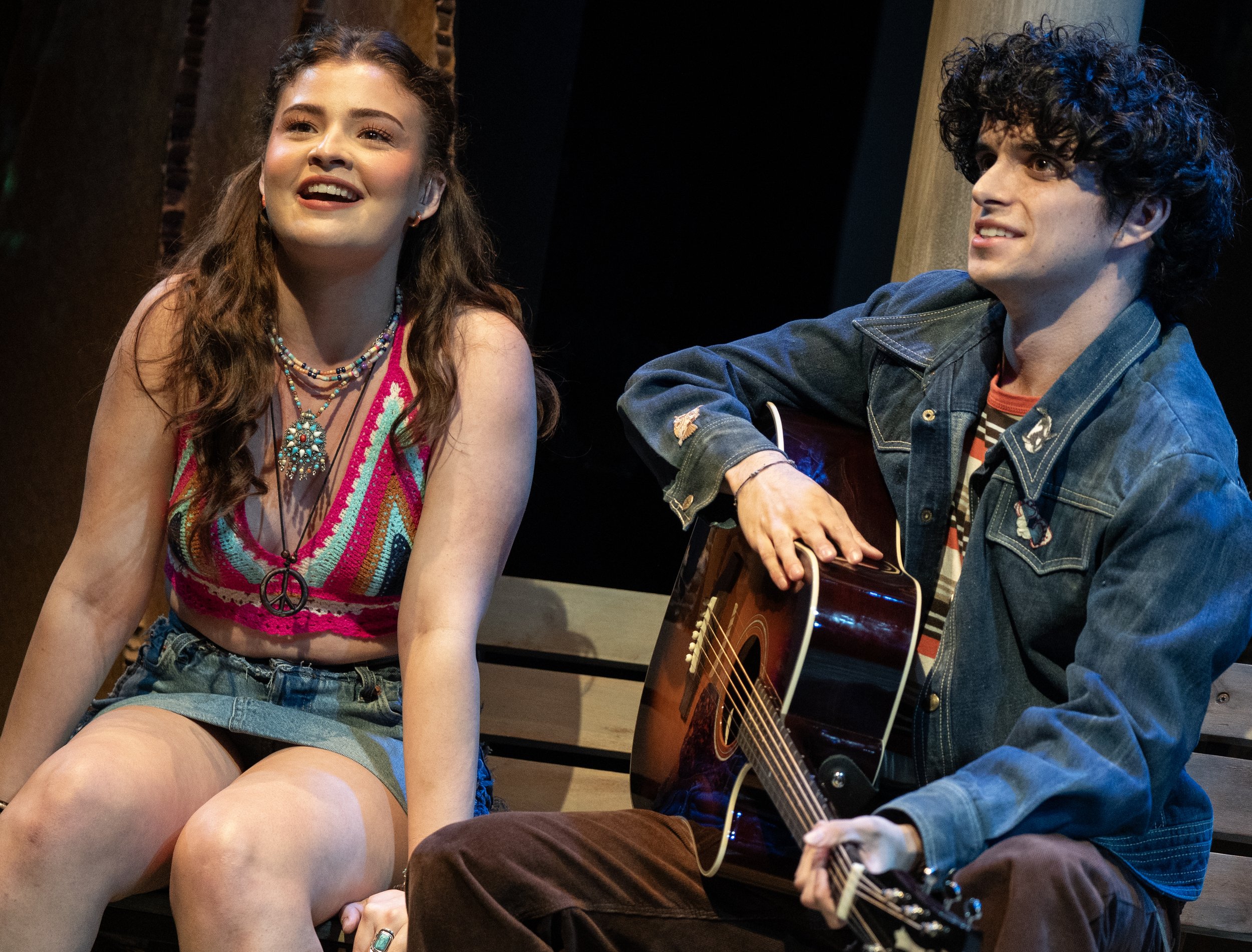
Alison and Ross (Oscar Williams) look toward the future. Photographs by Joan Marcus.
Trouble arrives in the form of a traveling salesman. Walker (Sam Gravitte), as he is described in the script, is “a very handsome, very un-Jewish free spirit,” who sells blouses to housewives and tie-dyed shirts to the ones who have a spark. Pearl is smitten. Armstrong may be landing on the moon, but Walker is suddenly the only landscape she cares about. Marty thinks tie-dyes are ridiculous, but Pearl feels alive at last when she slips one on.
As Pearl struggles with her feelings, her daughter is on a reverse trajectory. Alison is already aware of the world around her, protesting Vietnam and listening to Joni Mitchell. She is just too young to have much of an interior life. Then she meets Ross (Oscar Williams), a handsome boy her age who writes songs (“Hear my guitar play ‘Torture Me Honey,’ / I bought it with my bar mitzvah money.”). A first kiss leads to deeper emotions and a surreptitious adventure at Woodstock, where both Alison and her mom come to terms with their actions.
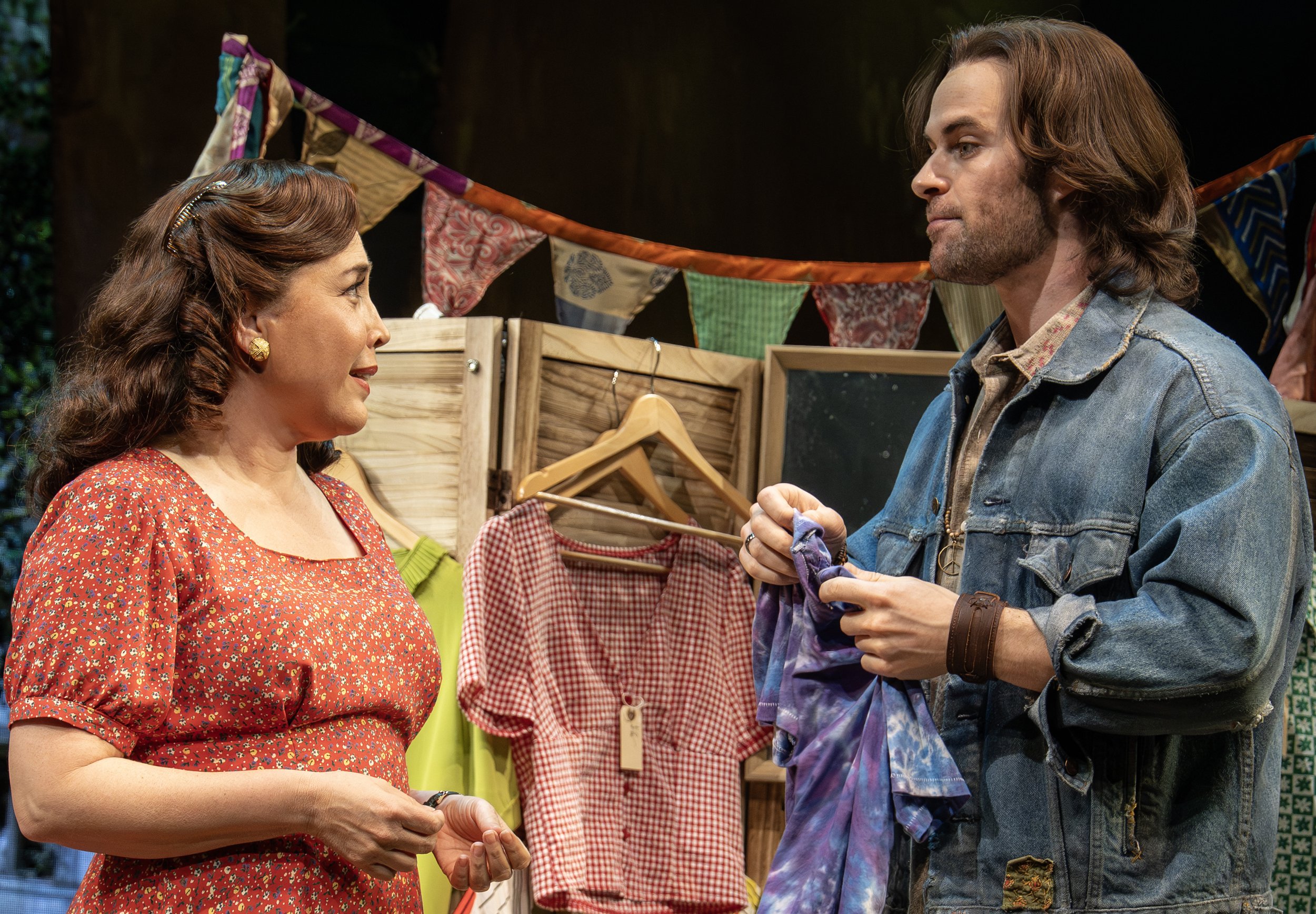
Lillian (Andréa Burns) questions Walker about his merchandise.
Under the direction of Sheryl Kaller, the cast does well in balancing the production’s variety of tones, bouncing from schtick to sincerity, from antiwar sentiment to teenage angst. Milazzo’s score is equally bouncy, with the younger characters’ songs trending toward ’60s-style soft rock, while the adults are boisterous in production numbers that would be at home in a 1950s musical. Scenic designer Tal Yarden’s visual displays are virtually a character unto themselves, featuring scrim projections that turn the stage into cinematic split screens and allow Pearl to be two places at once.
With her sterling singing voice, Suskauer offers a powerhouse performance in a complicated role. A woman who willingly and repeatedly cheats on her husband is a hard heroine to admire, but her inner conflict shines through in a believable and sympathetic fashion. The role of Marty requires a certain degree of blandness, and Chernin does not disappoint, while Gravitte is appropriately inappropriate in his seduction.
In something of an Off-Broadway mini-trend, A Walk on the Moon is the second musical to premiere this month inspired by a 1999 female-forward movie set in the 1960s, following Girl, Interrupted at the Public Theater. If Girl was a moody treatise on illness and loneliness, Moon is a contemplative and upbeat romance with equally powerful things to say about the price of finding, and celebrating, oneself.
A Walk on the Moon plays through Aug. 22 at the Laura Pels Theatre (111 West 46th St.). Evening performances are at 7:30 p.m. Monday through Saturday; matinees are at 2 p.m Wednesday and Saturday. For tickets and information, visit awalkonthemoonmusical.com.
Music & Lyrics: AnnMarie Milazzo
Book: Pamela Gray
Direction: Sheryl Kaller
Choreography: Josh Prince
Sound Design: Justin Stasiw
Set Design: Tal Yarden
Costume Design: Ricky Lurie
Lighting Design: Robert Wierzel
