
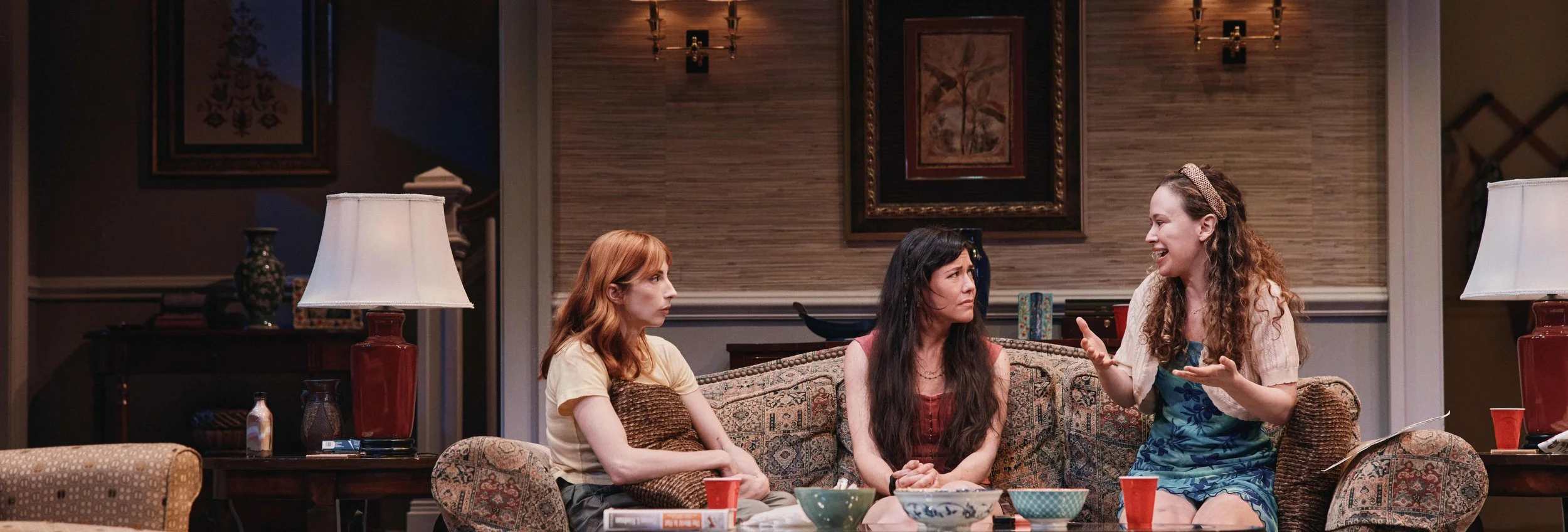

Chaya (Zoe Winters, left), Noah (Eli Gelb) and Emerson (Nate Mann), all standing, look on as Lev (Hale Appleman) shares photos with Alona (Molly Ranson).
The ideals and experiences that bond people together when they are young may be the very things that divide them when they mature. This we learn from the protagonists in Birthright, Jonathan Spector’s play that tracks the lives of six Jewish friends from 2006 through 2024. In each of the three nearly one-hour acts, perceptible changes occur in each character’s priorities and attitudes, at least in part because in their discussions, no topic is sacrosanct.
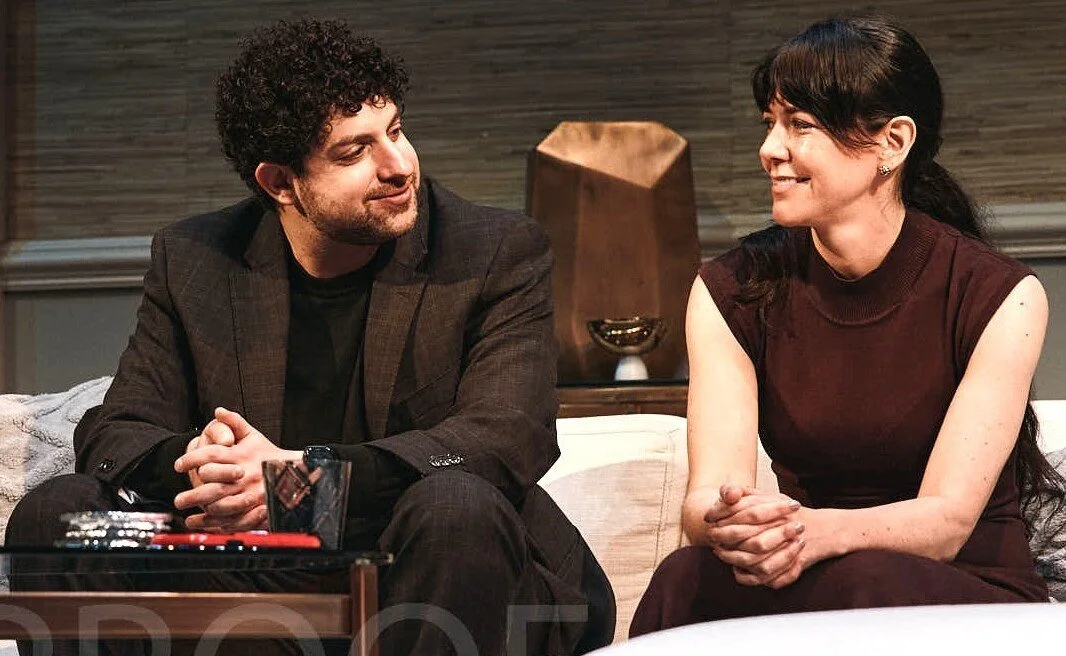
Noah and Chaya discover that they might make a good couple after all.
In 2006, not long after their all-expenses-paid trip to Israel under the auspices of the Birthright program for Jewish foreigners, five newly minted twentysomething veterans of the visit convene at the family home of Chaya (Zoe Winters). They are Izzy (Molly Bernard), Noah (Eli Gelb), Alona (Molly Ranson) and Emerson (Nate Mann). Lev (Hale Appelman), the missing sixth, suddenly turns up at Chaya’s after his incomprehensible disappearance from their trip. As the group’s self-appointed, reconnected and über-energized outlier/wild card, he regales his friends with stories of his solo exploits across Israel and surrounding Arab lands.
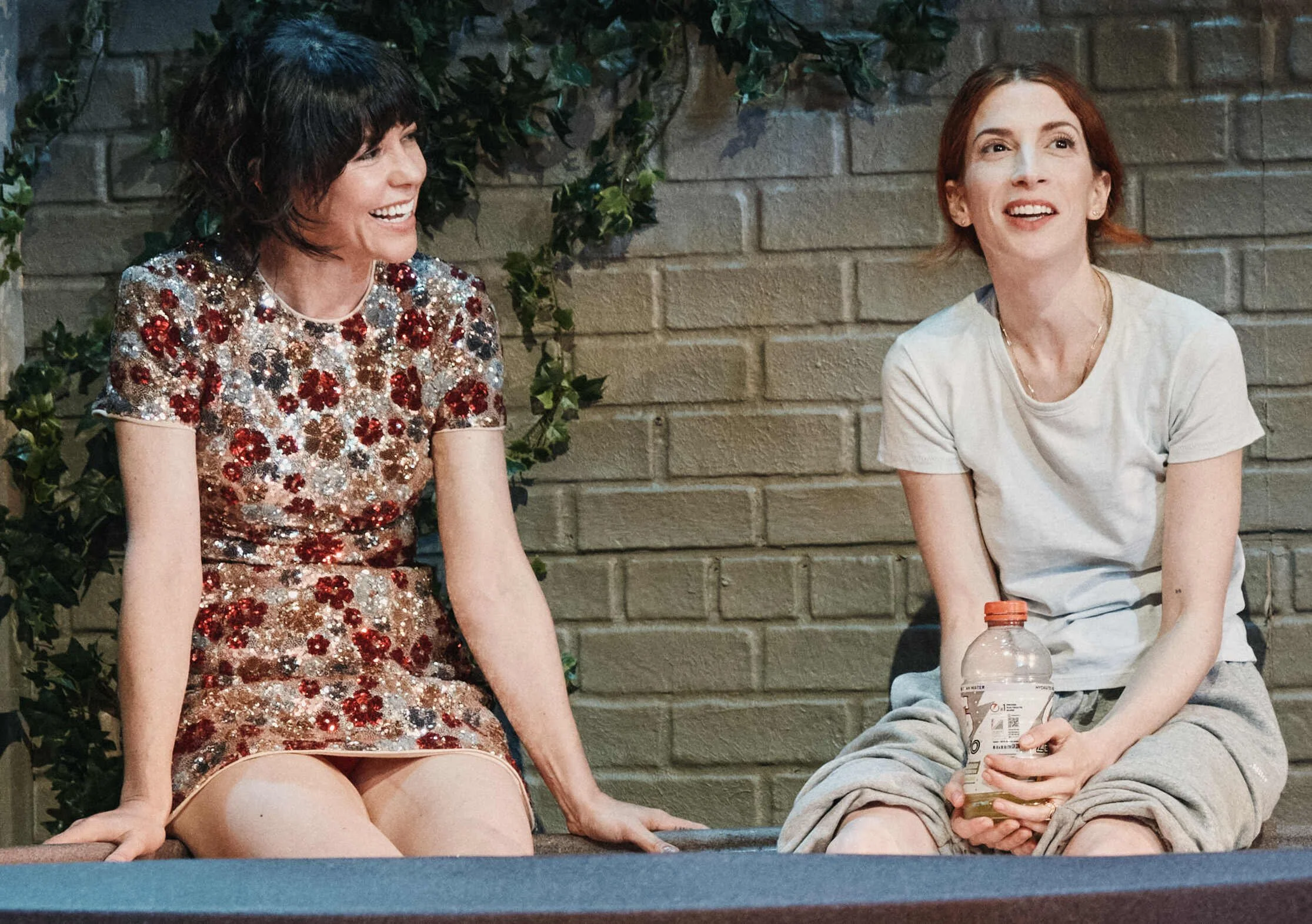
Chaya and Izzy (Molly Bernard, right), relaxing and perched on a hot tub, consider what their futures might look like. Photographs by Emilio Madrid.
The play’s other outlier is Deborah (Liz Larsen), Chaya’s mom, who comes downstairs, plants herself in the middle of the group, and rambles into monologues that are mostly gossip. She is oblivious to social cues, especially the embarrassment that she causes Chaya by her insistence on conveying too much information. Nevertheless, Deborah is, hands down, the quintessential Jewish mother and the one consistent ripple of comic relief in a weighty drama.
The group discusses their diverse reactions to Birthright, designed to heighten their appreciation of Israel, its heritage, and Jewish collective memory. Yet one must bear in mind that they are all still “kids,” with all the attendant frivolity, hype, and giddiness about casual relationships (“hooking up”), and hot-tub forays. Despite this, director Teddy Bergman elicits from his cast an underlying anxiety, in which each actor, all joking aside, reveals a depth of character that informs his or her uncertainties about the future and counterbalances their capricious side.
For Izzy, it is whether to attend Yale Law School or not; for Alona, whether to move to Israel or not; for Emerson, the vicissitudes of his band, All Deliberate Speed. For Lev, there are existential concerns, triggered by his observations of the different ways Israelis and Palestinians are scrutinized at a checkpoint, and the validity of each. He recounts for Izzy the tale of a rabbi who tells a quarreling couple, “You’re right,” and “You’re right.” Then the rabbi’s wife is confounded that both are right.
Lev: And the rabbi says to his wife, you’re also right and the idea is that contradiction and complexity is inherent in Judaism.
Izzy: Two Jews, three opinions.
Lev: Right, cause the idea is like God is more than we can ever comprehend…
Such conversations establish deep future fault lines for all the characters, especially for Izzy, Chaya, and Alona. Yet the group finds some unity in Jewish, especially Sabbath, rituals. In addition, their comments foreshadow the direction that their professional and personal choices will take—regardless of their current impulsiveness.

Deborah (Liz Larsen, left) and Noah look on as Izzy lifts the cover before the blessing of challah bread.
In subsequent decades, the groups’ relationships, marriages, and professions evolve, but inflammatory confrontations arise from Chaya’s not-for-profit work, Izzy’s far-left activism and Alona’s aliyah (emigration to Israel). The seamless ways in which playwright Spector has depicted the friends’ developing lives and their unraveling are reinforced by the cast’s credible portrayals and are the play’s greatest strength. David Bengali’s projections also amplify texts expressing the characters’ tensions and provide a humorous panorama of Deborah and her senior friends.
As tempting as it might be to identify this as a cross between a Jewish remake of Friends and The Big Chill, it is not. Unlike the characters in those works, the birthright fortysomethings are truly soul-searching, both on personal and societal levels, and they represent multiple dimensions of the political and religious spectra. For some of them, social media just exacerbates the gaps among them. Izzy posts a comment that ultimately injures Chaya professionally. The friends are only capable of true unity through grief and the Jewish rituals that acknowledge and structure it.
At the core of the play are the need for questioning, a depth of understanding, and moral accounting that, despite deep differences softened by grief, resolve in a sensitive and respectful way.
Birthright runs at the Robert W. Wilson MCC Theater Space (511 W. 52nd St.) through July 26. Evening performances are at 7 p.m. Tuesdays, Thursdays, and Fridays, and at 7:30 p.m. on Wednesdays and Saturday; matinees are at 1 p.m. on Saturdays and 2 p.m. on Sundays; For more information, or to purchase tickets, call (646) 506-9393 or visit mcctheater.org.
Playwright: Jonathan Spector
Director: Teddy Bergman
Sound Designer: Lee Kinney
Scenic Designer: Scott Pask
Costume Designer: Clint Ramos
Lighting Designer: Natasha Katz
Projection Designer: David Bengali
