
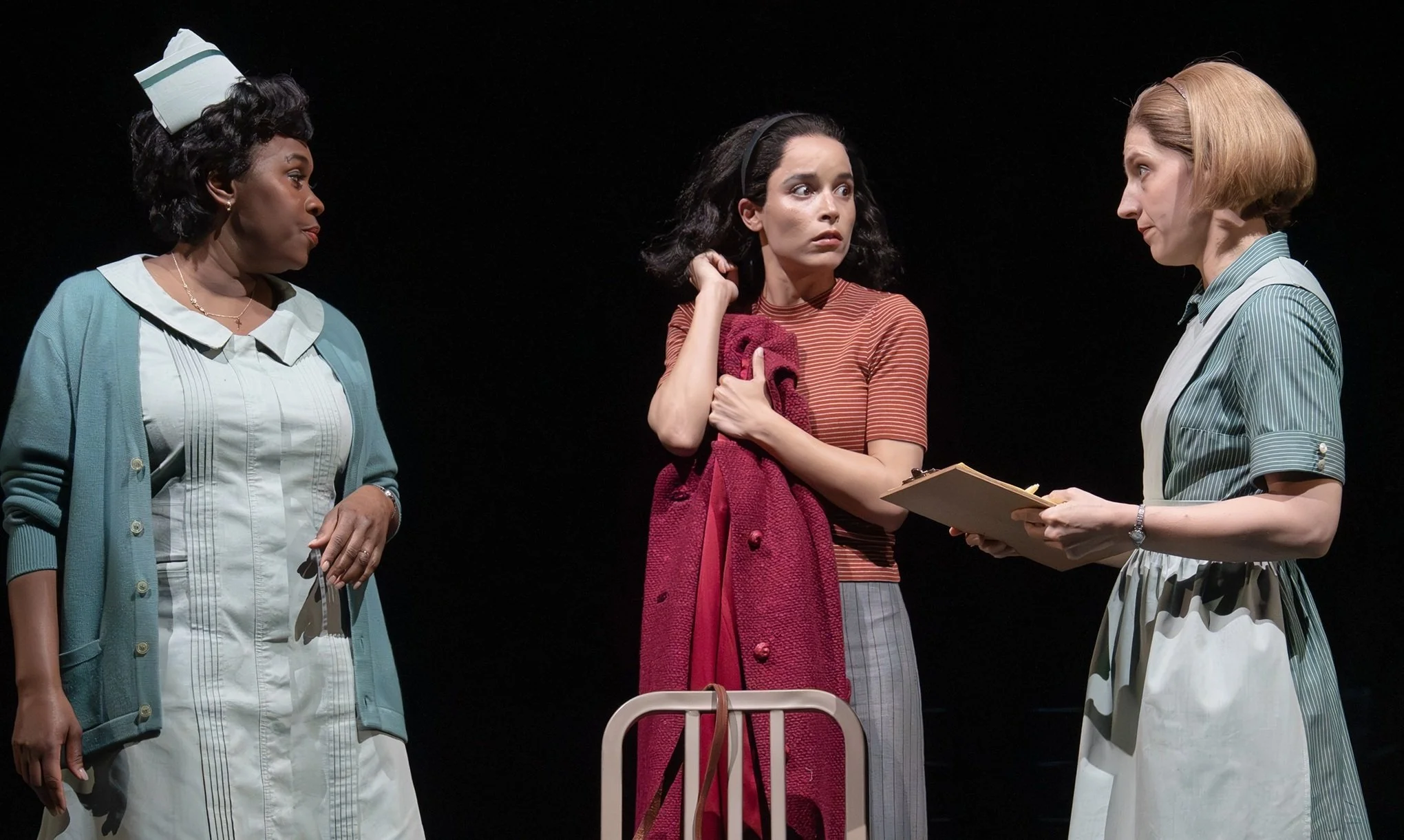
Valerie (Ta’Rea Campbell, left) and Judy (Lauren Jeanne Thomas) attend to their new patient, Susanna (Juliana Canfield), in The Public Theater production of Girl, Interrupted.
Girl, Interrupted comes in a choice of formats. Susanna Kaysen’s 1993 memoir is a flippant quick read with an irresistible neurotic edge. The 1999 movie version features Angelina Jolie chewing the scenery around a quietly intense Winona Ryder. “Queens of the Summer Hotel,” the 2021 album by indie star Aimee Mann, is a collection of songs inspired by the book, its sweet melodies belying the dark undertone of its lyrics. Her tunes were originally meant to serve as the score of a staged musical, and now, after a COVID-era delay, they have arrived at the Public Theater as the backbone of a new work, with Pulitzer Prize–winning playwright Martyna Majok faithfully adapting Kaysen’s story, if not her impudent attitude.
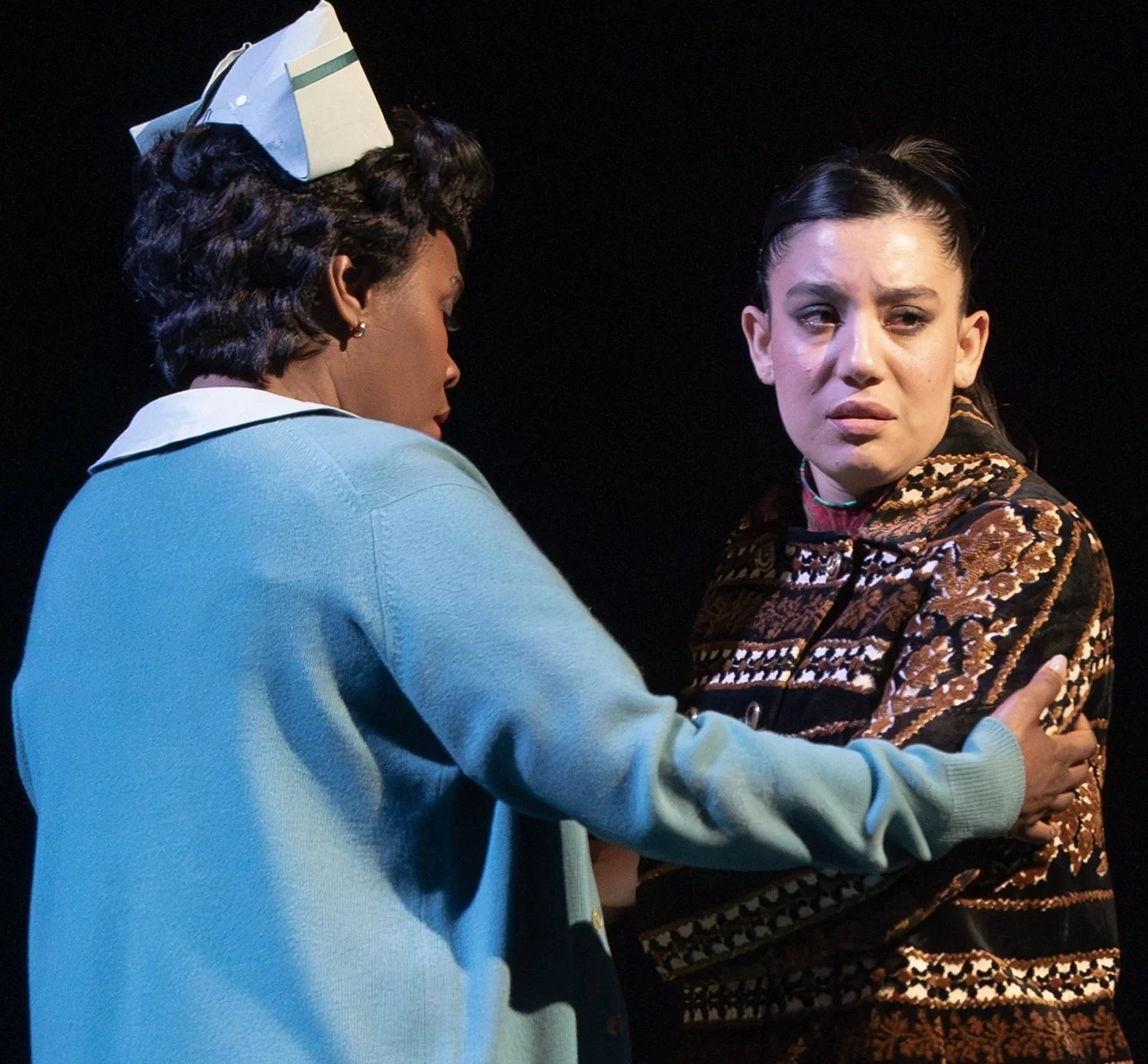
Valerie (Campbell) offers cold comfort to her patient, Tori (Gabi Campo).
The title is a shout-out to Johannes Vermeer’s painting Girl Interrupted at Her Music, with its older man leaning in toward a young woman who faces out to the viewer, sporting a “Can you believe this?” expression on her face. It is a fitting reference for Kaysen’s plight, how, as an 18-year-old, her glidepath to adulthood was obstructed by mental illness, with the men in her life—a high school teacher, a doctor, a boyfriend—all failing her.
In 1967, following an attempted suicide, Kaysen met with a doctor who, after a mere 15-minute consultation, put her in a cab and sent her to McLean Hospital, the mental institution where Sylvia Plath famously received treatment, providing fodder for her novel, The Bell Jar. What was perhaps meant as a 72-hour observation period slides, one lost day after another, into an 18-month stay. What was a voluntary visit becomes a mandatory sentence, where invasion of privacy and mood-altering meds are the norm and the nurses and fellow patients are the only company to keep.
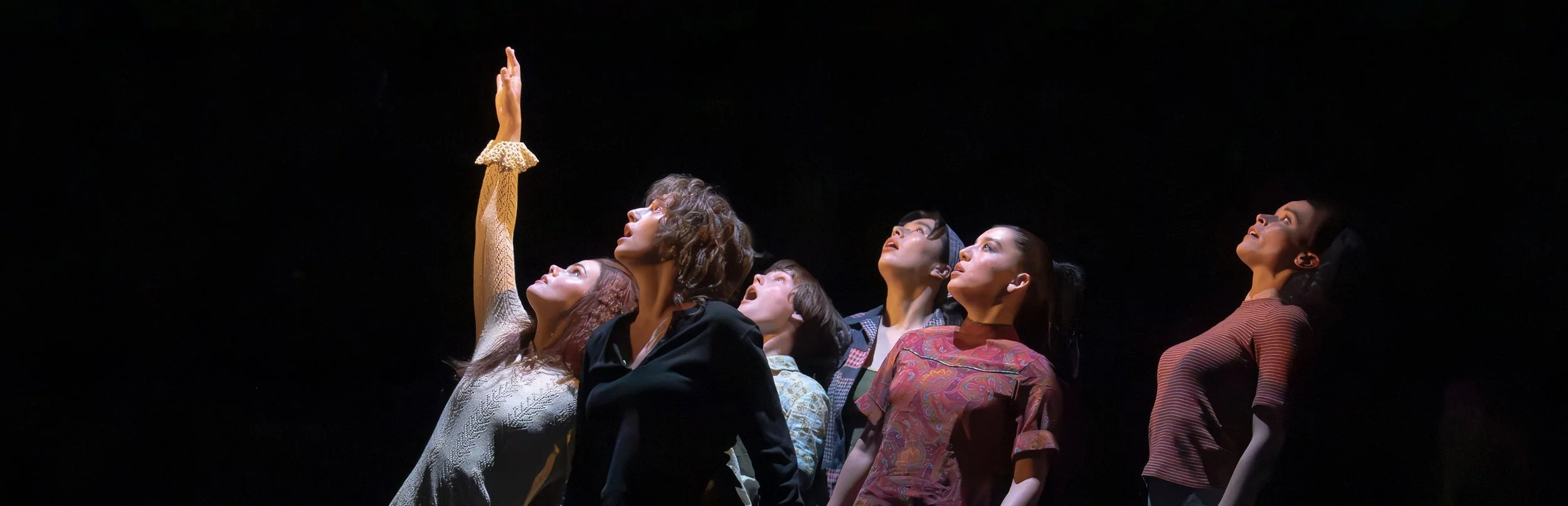
In bringing this tale to the stage, director Jo Bonney and her team avoid any One Flew Over the Cuckoo’s Nest hysterics in favor of a moody and reflective ensemble work. Staged upon an evocative blue-green set, it is a placid lake of a musical, played primarily on stringed instruments, and catching fire when least expected. As Susanna, Juliana Canfield gives a buttoned-up performance that bursts open when the destructive nature of her disorder takes over, then grows more self-assured as she reaches something resembling a recovery. Throughout, Canfield has surprisingly few solo numbers, though she partners beautifully with her hospital roommate, Grace (Mia Pak), in the duet “Robert Lowell & Sylvia Plath,” singing of the famous former patients as well as of themselves:
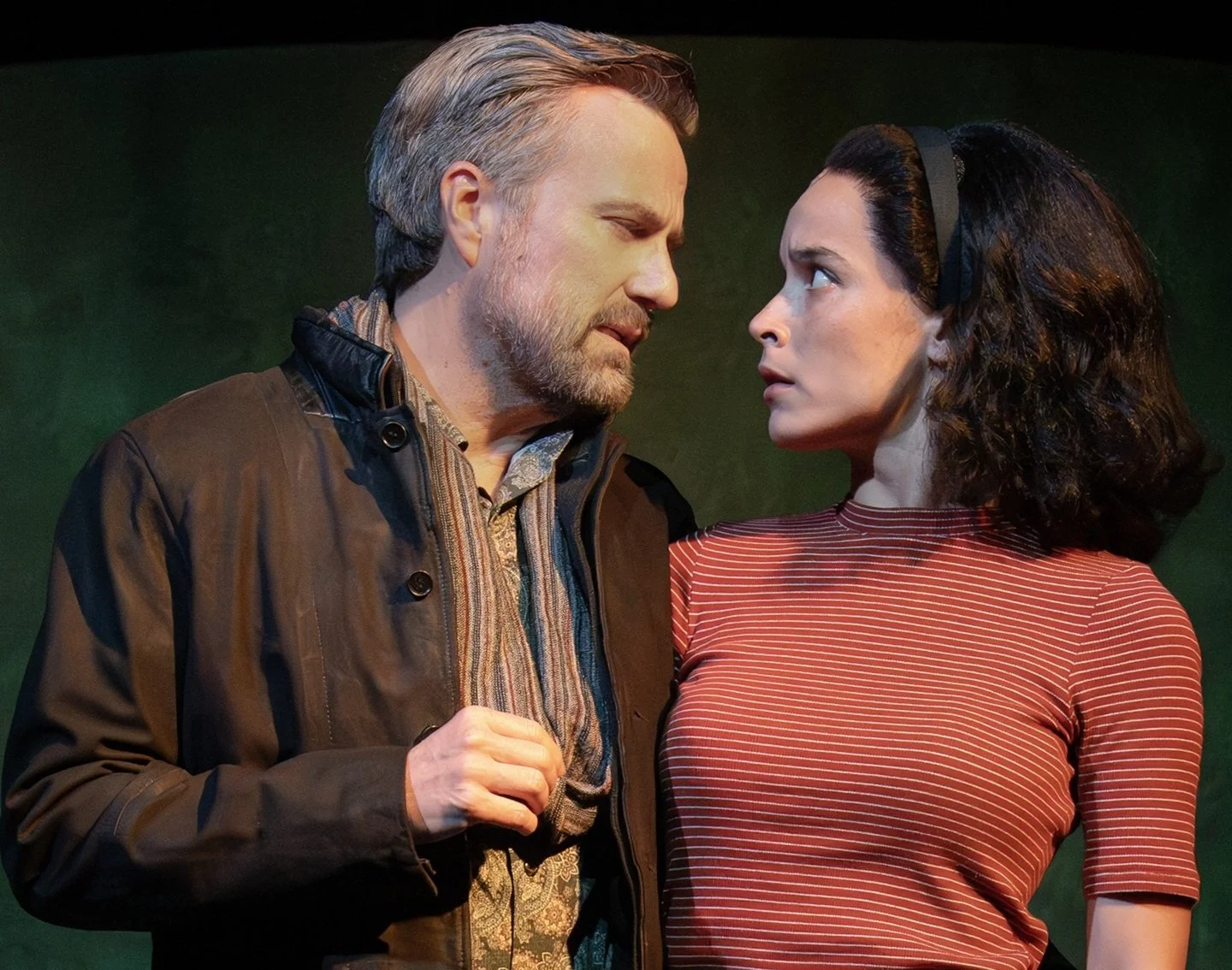
The English teacher (Manoel Felciano) makes an inappropriate move on his student, Susanna (Canfield). Photographs by Joan Marcus.
Now you’re split in two
And each side still isn’t you
And you know how that sounds
But it keeps being true
The catatonic patients aside, Susanna’s hospital peers have meatier roles and songs, but most also meet more dire fates. Lisa, a sociopath who aspires to become a psychopath, is meant to be the dangerous and rebellious instigator of the group. In her stage debut, singer-songwriter King Princess brings out Lisa’s mischievousness but lacks the heat that would otherwise make her genuinely threatening.
Daisy (Katherine Reis) is effectively worrisome due to the contrast between her outward appearance and her inner turmoil. Although she is attractive, she is victimized by an abusive father and a related eating disorder; she measures time by the number of roasted chickens she consumes. Polly, in an endearing performance by Sally Shaw, is trapped in her own skin, having survived setting herself on fire, while Tori (Gabi Campo, heartbreaking) can’t trust herself to be free lest her addiction to amphetamines overrun her best intentions. Meanwhile, Nurse Valerie (Ta’Rea Campbell) tries to maintain order. Although the character was played warmly by Whoopi Goldberg in the expanded role of the film version, here she is unfortunately given short shrift.
There are techniques one can get away with in a 168-page memoir that are trickier to pull off in a nearly two-hour musical. One of them is the use of narration. Throughout the play, Susanna breaks from the action to address the audience in ways that are jarring and at times unnecessary. Further complicating the gambit, these narrative asides seem to be coming from the 38-year-old version of Susanna looking back on her youth, though the difference between the two ages is barely discernible.
The Male Presence, as the show’s single male role is called, also becomes problematic in giving flesh-and-blood actuality to what Kaysen was vigorously trying to disempower in her memoir. Manoel Felciano is appropriately skeezy in the role, but the lack of backstory, especially in terms of the boyfriend whom Susanna will eventually marry, here becomes something missed rather than something celebrated.
Girl, Interrupted plays through July 12 at the Public Theater (423 Lafayette St.). Evening performances are at 7 p.m. Tuesday through Sunday; matinees are at 1 p.m. Saturday and Sunday. For tickets and information, visit publictheater.org.
Music: Aimee Mann
Book: Martyna Majok
Direction: Jo Bonney
Choreography: Sonya Tayeh
Sound Design: Dan Moses Schreier
Set Design: dots
Costume Design: Sarah Laux
Lighting Design: Heather Gilbert
If you enjoyed this review, please click on the Like icon below.
