


John Foster (Joe Tapper, right), here with this landlord Mrs. D’Agostino (Candy Buckley), has come to the big city to find work at the mysterious Emporium department store, in Thornton Wilder’s unfinished play The Emporium at Classic Stage Company.
After Pulitzer Prize–winning plays in 1938 (Our Town) and 1942 (The Skin of Our Teeth), Thornton Wilder, in his remaining 33 years of life, didn’t write another full-length, original play. Our Town, likely the most produced American play of all time, still burns brightly, undimmed by the passing decades. It is, then, no mystery why the allure of The Emporium, an unfinished Wilder play that exists in 360 handwritten pages at Yale’s Beinecke Library, called, Siren-like, to playwright Kirk Lynn, who has undertaken the task of assembling, interpreting, and finishing it. The result is a road full of cracks and bumps, but one that leads somewhere impossible to forget.

The wards of the Retreat for Retired Department Store Workers, from left to right: Mr. Benjamin (Patrick Kerr), Mrs. Frisbee (Mahira Kakkar), and Miss Coley (Eva Kaminsky).
This literary history is described in the play’s preface, written by Lynn and delivered by the protagonist John (Joe Tapper). The theatrical self-awareness is very much in line with Wilder, from his Stage Manager in Our Town to Sabina in The Skin of Our Teeth, and it’s something Lynn plays with throughout. Here, John gives a lyrical account of encountering The Emporium, standing amid Walt Spangler’s scenic design: three wooden tables covered in playscripts, a stylized Beinecke reading room.
When Bernice (Candy Buckley), a sales associate at the Emporium department store, turns John away from the store and also hands him an orphaned baby, she says, “I’ve got terrible nerrs. Thurs feld dor carlicant.” John doesn’t understand, prompting Bernice to reference one of the scripts: “Probably just a smudge or a coffee ring, this script here—it’s all hand-written and a little sloppy in places.” In addition to metatheatrical playfulness, Lynn seems to be reminding the audience of the difficulty of the task he has undertaken.
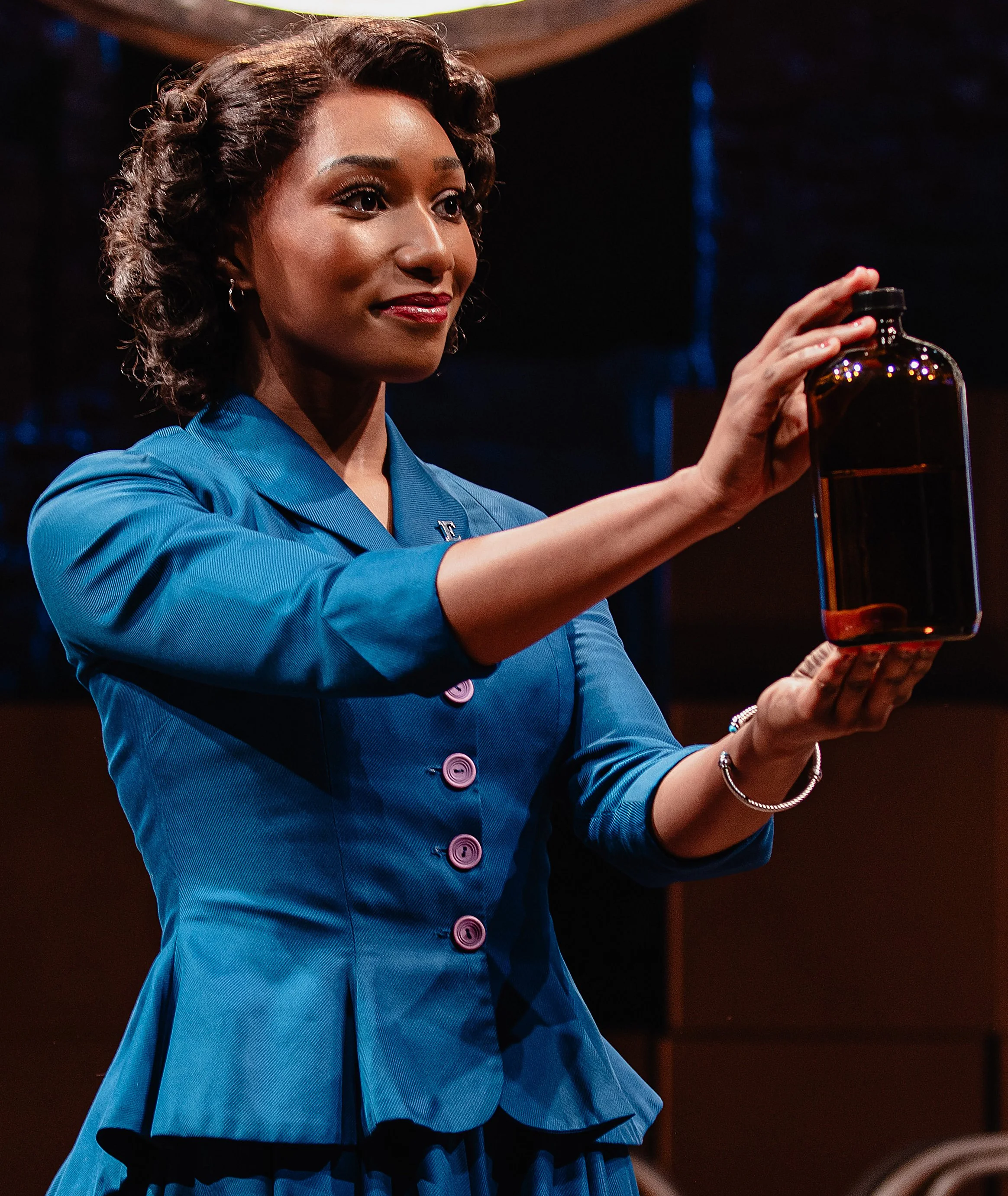
Laurencia (Cassia Thompson), who works at the Emporium and has cryptically been told that she “has been astroclated,” a word she can’t find in any dictionary.
The framework of Wilder’s play is two department stores, the titular Emporium and its rival, Craigie’s. The Emporium is the elusive destination that everyone craves, rumored to offer a “third thing” beyond delayed gratification and pleasure. But its workings are opaque, its mysterious directors communicating only in cryptic messages. Laurencia (Cassia Thompson), for example, is told by the directors in a note, “Your approach has been absolved and astroclated.”
Craigie’s department store, on the other hand, is open for anyone who doesn’t mind a cruel boss and a life of “commerce without the distraction of artistry.” John seems to be on a frustrating quest, with no end in sight, to get into the Emporium. Like everyone else, he must dabble in work at Craigie’s—but resist the temptation to get stuck there for life.
John was an orphan himself (his last name, Foster, the one given all orphans), so knows where to take the baby that Bernice handed him—to the orphanage run by Mr. Foster (Derek Smith) and Mrs. Foster (Buckley). Both Smith and Buckley play numerous roles, but it’s not simply actors doubling; there is a sense that each character they inhabit is somehow a version of the others, lives that repeat in loops and take different paths. Smith’s characters frequently carry a bottled “tincture” that others should resist consuming; at one point the audience is instructed to hiss every time he sips from the tincture.
Added into the mix by Lynn are three wards of the Retreat for Retired Department Store Workers (Mahir Kakkar, Eva Kaminsky, and Patrick Kerr), who hang around “to see a play” and, if the audience wants, to explain the play’s meaning. The audience can vote during intermission to hear a prologue to open the second act, which Wilder sketched out but didn’t write. My audience voted overwhelmingly to hear the prologue: “The Emporium is a metaphor—for ... a life in the arts. There. Happy?”
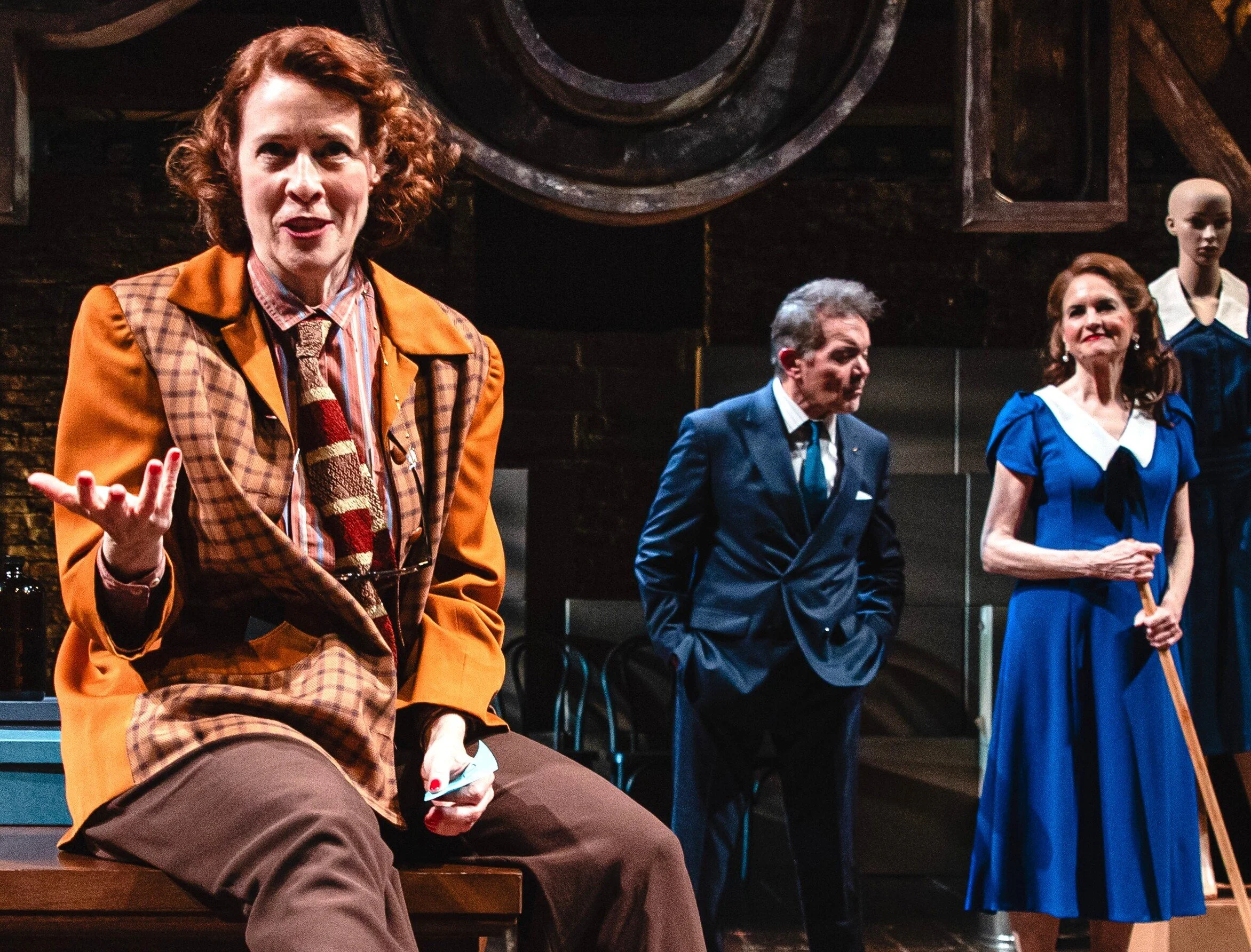
Miss Coley addresses the audience. Photographs by Marc J. Franklin.
But Wilder’s binary, the life of the arts versus the life of secure drudgery, doesn’t portray the creative path as idyllic. As store owner Mr. Craigie (Smith) says, “Here at Craigie’s, we ask only eight hours of your working day. The Emporium asks for your whole life—and when you no longer can serve … they abandon you to decay, sickness, and death. And when you die, only then do they add you to some memorial list, giving you the respect, too late, they never gave you in life.”
At times clunkily allegorical, repetitive, and even grating, with uneven direction by Rob Melrose, The Emporium is also brimming with ambitious ideas. Carried by a strong, game ensemble, it builds to a finale both devastating and—just barely—hopeful. That you might end up with tears in your eyes is a testament to Wilder’s genius and to Lynn’s labors.
The Emporium has its rough edges, but nevertheless emerges as a theatrical experience that keeps unfolding in the mind.
The Emporium plays through June 7 at Classic Stage Company (136 E. 13th St.). Evening performances are at 7 p.m. Tuesday through Saturday; matinees are at 2 p.m. Saturday and Sunday. For tickets, visit classicstage.org.
Playwright: Thornton Wilder; completed by Kirk Lynn
Director: Rob Melrose
Scenic Design: Walt Spangler
Costume Design: Alejo Vietti
Lighting Design: Cat Tate Starmer
Sound Design: Darron L West
