


Jamie MacDougall portrays the Scottish music hall entertainer Sir Harry Lauder in Lauder: Scotland’s Kilted King of Broadway.
Before the age of global pop stardom, there was Harry Lauder—a kilted powerhouse of British music hall and vaudeville whose songs and irrepressible personality made him one of the most beloved entertainers of the early 20th century. In Lauder: Scotland’s Kilted King of Broadway, Jamie MacDougall brings this larger-than-life figure back to the stage with infectious warmth and musical flair that turns biography into jubilant theatrical celebration.
Jimmy Logan’s cradle-to-grave biodrama traces Lauder’s improbable ascent from poverty to international fame. Born Aug. 4, 1870, the eldest of seven children, Lauder left school at 12 to work in the coal mines in the Lanarkshire collieries in Scotland after his father’s death forced his mother to take in laundry to support the family. By 19, however, he had discovered a talent for performance, winning a local singing competition and a gold watch that stirred his appetite for the stage. After touring throughout Scotland and enduring lean years in London, his fortunes finally changed when he was tapped to fill in at Gatti’s Music Hall at Charing Cross.
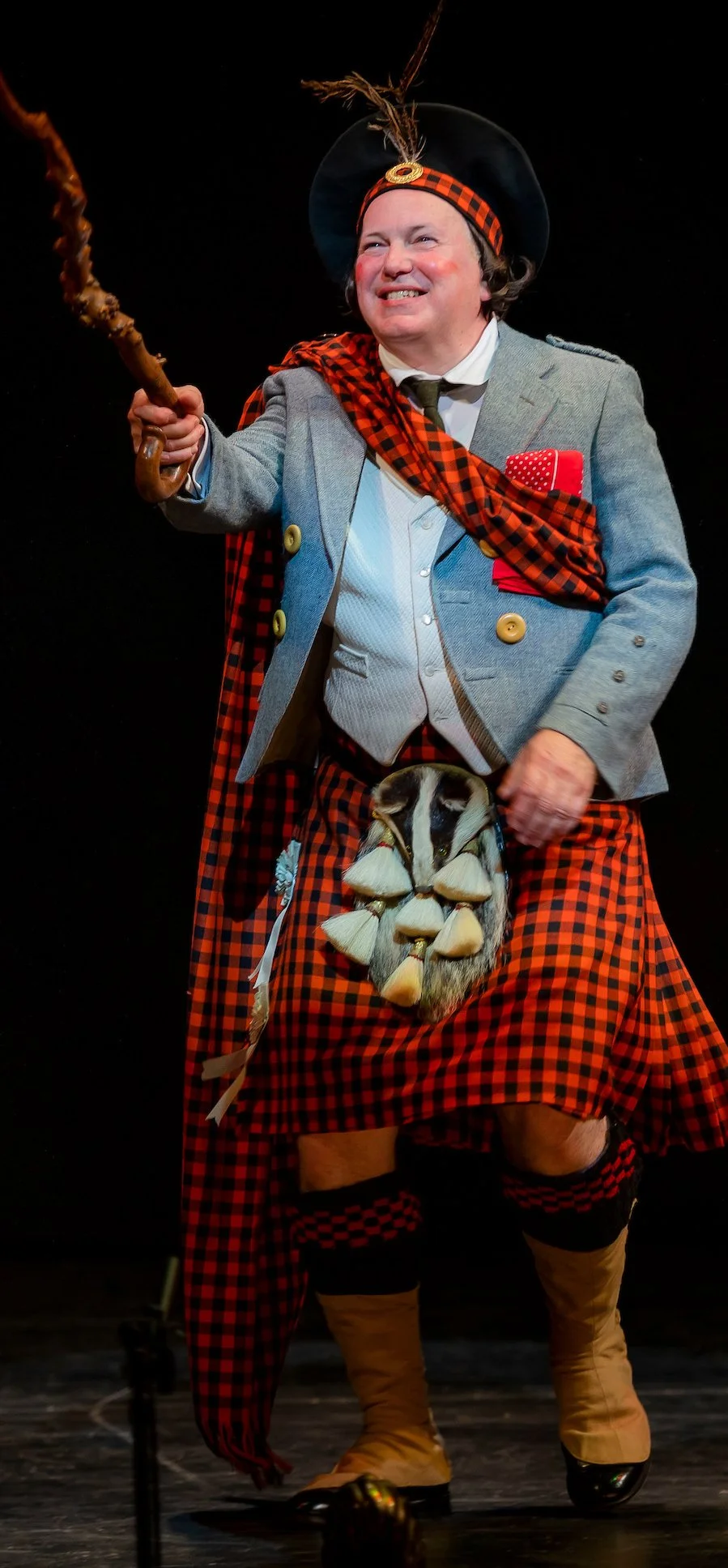
Lauder recounts how the Germans called the Scottish regiments the “Ladies from Hell” because they all wore the kilt.
MacDougall enters from the back of the theater and walks down the aisle toward a grand piano on stage, where Derek Clark performs, his accompaniment giving the production much of its musical vitality. As MacDougal descends, a swelling piano lends his appearance a stirring sense of occasion.
MacDougall bristles at Clark’s marking up his sheet music—pointedly reminding the pianist that the scores cost him “a lot of money” and asking that any notations be made “in pencil rather than pen.” He also displays a shrewd instinct for publicity, crisply spelling out his surname to the press as “L-A-U-D-E-R.” Yet beneath the controlling tendencies lies the keen intuition of a born performer, summed up in his credo that an audience should never be given “a chance to remember they had to pay to get in.”
MacDougall’s portrait reveals the entertainer as a man of many moods, as he shifts from prickliness to charm to theatrical wisdom. Yet it was Lauder’s gift for crafting memorable songs that made him a star. His 1892 Irish character tune “Calligan Call Again” brought him early notice at age 22, but it was the enormous success of “I Love a Lassie” in 1905 that cemented his identity as Scotland’s beloved minstrel. Recalling how audiences once measured a hit song, Lauder wryly observes: “Aye, in those days you could always tell if a song was a hit. The next day all the message boys in the street would either sing it or whistle it.”
Other signature songs follow, woven into the play’s narrative rather than presented as concert numbers. MacDougall teasingly withholds what is arguably Lauder’s most famous tune, “Roamin’ in the Gloamin’” (1911)—a cornerstone of his American tours—until Clark gently prods him to perform it. Also featured are “A Wee Deoch-an-Doris” (1911), the rollicking drinking song Lauder co-wrote with music hall performer Whit Cunliffe that became his international trademark, and the moving “Keep Right on to the End of the Road” (1925), written after the death of his only son, John, in World War I. The latter song, rendered with affecting sincerity, emerges as both a lament and a stirring anthem of perseverance.

MacDougall embodies the pioneering Scottish minstrel Lauder, gripping a gnarled walking stick and spinning yarns about his extensive travels as the highest-paid music hall artist in the world. Photographs by Alan Peebles.
The play’s subtitle is a fitting nod to Lauder’s enduring popularity on Broadway. In one revealing sequence, MacDougall’s ship from England arrived late on the day he had a Broadway engagement. To keep the restless crowd occupied, theater management recruited out-of-work performers off the street, yet the audience still waited for Lauder, greeting him enthusiastically when he arrived. “I walked in at a quarter past midnight—over four hours late,” he said, “and they had waited for Harry Lauder.”
Janis Hart’s set, though deceptively simple, deftly evokes the many locales Lauder traversed during his career: a wicker trunk emblazoned with the entertainer’s surname; a wardrobe rack brimming with various Scottish-plaid garments; a large screen looming across the back wall, used to show footage of Lauder’s funeral on March 2, 1950, when thousands of mourners lining the rain-soaked streets of his hometown of Hamilton, Scotland.
To contemporary audiences, some aspects of Harry Lauder’s music hall persona may inevitably feel old-fashioned, even quaint, yet Lauder persuasively argues for his lasting cultural importance. As the first British performer to sell more than a million records, Lauder helped lay the groundwork for modern popular entertainment, and MacDougall’s engaging performance ensures that this pioneering Scottish minstrel emerges not as a relic of the past, but as a vibrant showman still capable of winning over an audience more than a century later.
Lauder: Scotland’s Kilted King of Broadway plays through June 7 at 59E59 Theaters (59 E. 59 St.). Evening performances are at 7:15 p.m. Tuesday through Friday; matinees are at 2:15 p.m. Saturday and Sunday. For tickets and more information, visit 59e59.org.
Playwright: Jimmy Logan, with adaptations by Kally Lloyd-Jones & Jamie MacDougall
Director: Kally Lloyd-Jones
Scenic & Costume Design: Janis Hart
Lighting Design: David Cunningham
