
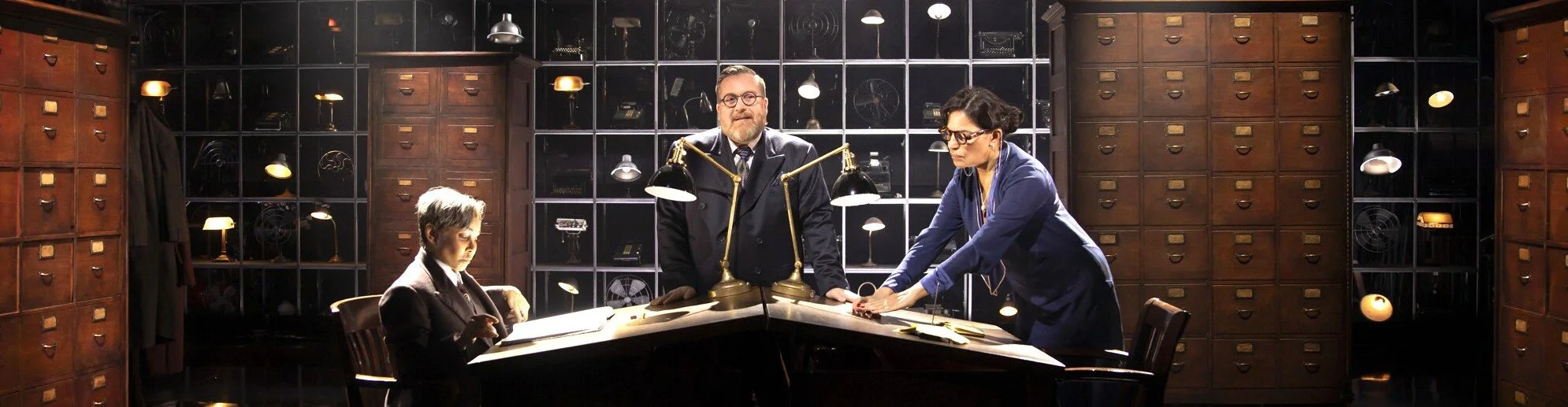
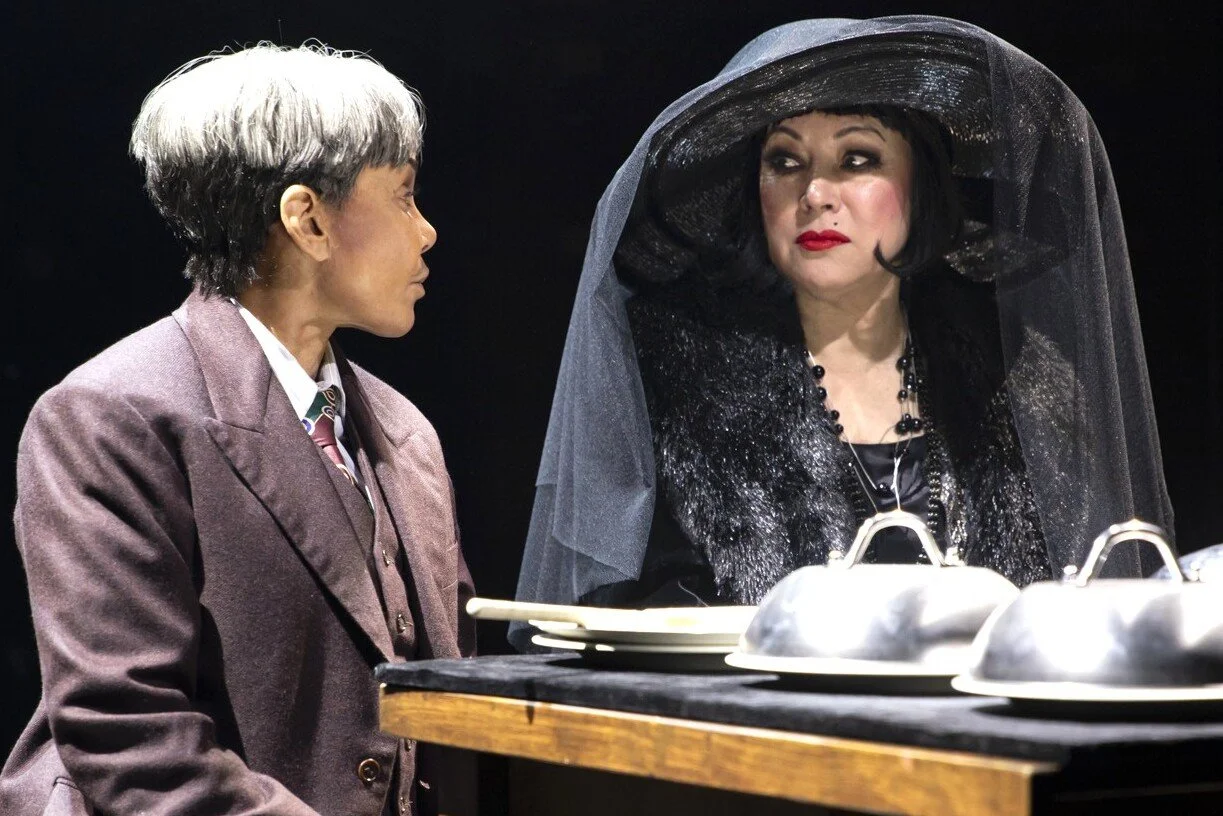
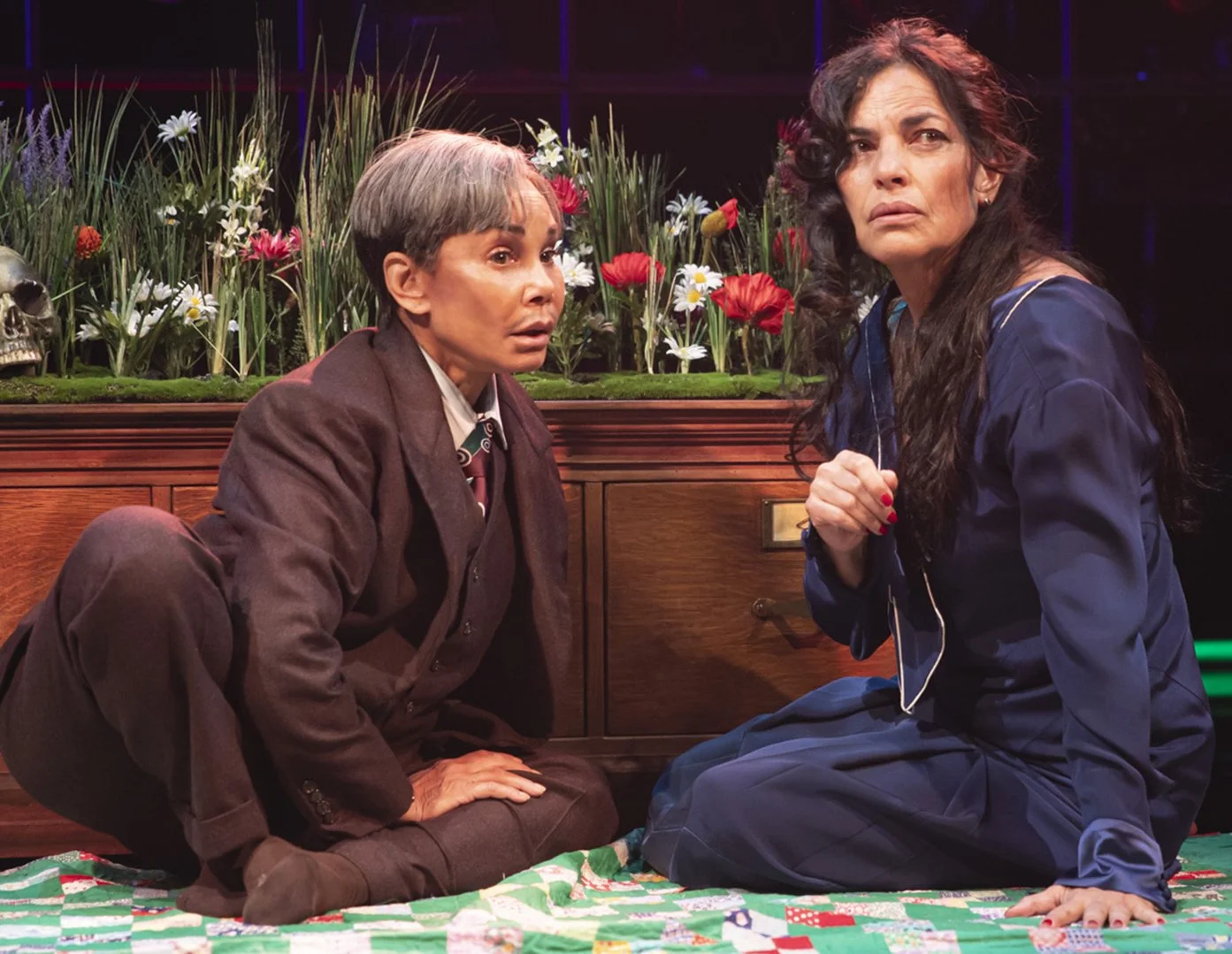
Mr. Zero (Daphne Rubin-Vega, left) gets a prison visit from his wife (Jennifer Tilly) in the revival of Elmer Rice’s The Adding Machine.
Elmer Rice’s The Adding Machine shows surprising vitality after more than a century. Although critic Edmund Wilson disdained the play in 1924 for its “pessimistic heresies” and “effects of ferocious ugliness,” the importance of it did not escape other critics. When Death of a Salesman premiered in 1949, Harold Clurman noted that the theme of Arthur Miller’s play was “not, strictly speaking, new to our stage,” citing Rice’s 1923 work. With Salesman now on Broadway to rehash the shortcomings of capitalism, the New Group deserves kudos for offering a chance to see its precursor.
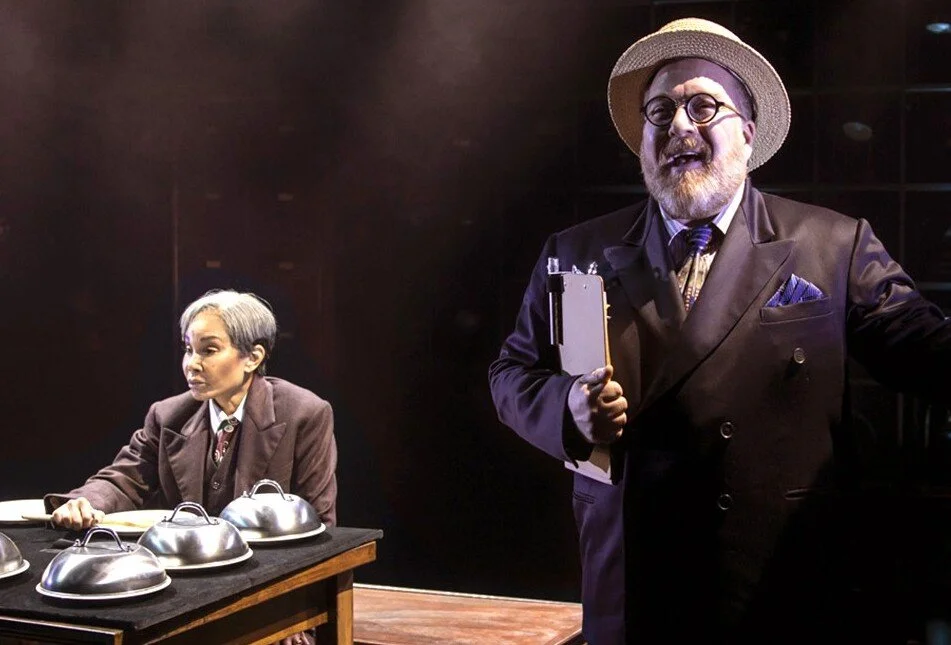
Michael Cyril Creighton (right) plays the Narrator and many other characters as well, as he introduces Zero at work.
Director Scott Elliott’s pared-down production of Thomas Bradshaw’s reworking has only four actors. The “hero” is Mr. Zero, an accountant in a dead-end job, here embodied by Daphne Rubin-Vega in an astonishing cross-dressing coup: her petite frame, gravelly voice, and spiteful words define Zero as a physically puny, ineffectual, toxic male.
Bradshaw has added a Narrator to introduce some of the scenes. Michael Cyril Creighton plays him with a whiff of Orson Welles in his bearded-elegance period. “I’m going to be your host this evening,” he says upon entering, adding with obvious irony: “You are about to witness a heart-warming tale about modern life crushing the human spirit.” He describes the world of the characters as one of “worn-out routines, frayed tempers, and dreams so thoroughly flattened that no one even remembers having them.”
The first scene is in the Zeros’ bedroom. Mrs. Zero (Jennifer Tilly, with a sandpaper delivery) natters to her immobile but alert husband about her dissatisfaction, from housewifery to a female neighbor who undresses in view of their window. Rice’s original ends with “I guess you’d like to sit home every night and watch her goin’s-on.” But Bradshaw supplies further dialogue, pushing Mr. Zero beyond a Peeping Tom and coarsening the play substantially:
A whore like that temptin’ you. Gettin’ under your skin. Imagine my surprise—walkin’ in on my husband, pants around his ankles watching that whore, diddling himself. Talk about sickening. I vomited in my mouth. I had to take a bath to wash off the shame and disgust. … You better keep that thingy in your pants if you know what’s good for you. I’ve put up with a lot, but I won’t put up with that. … Captain Standish doesn’t stand at attention for me anymore, but he sure stood at full attention for that teenage whore in her panties!
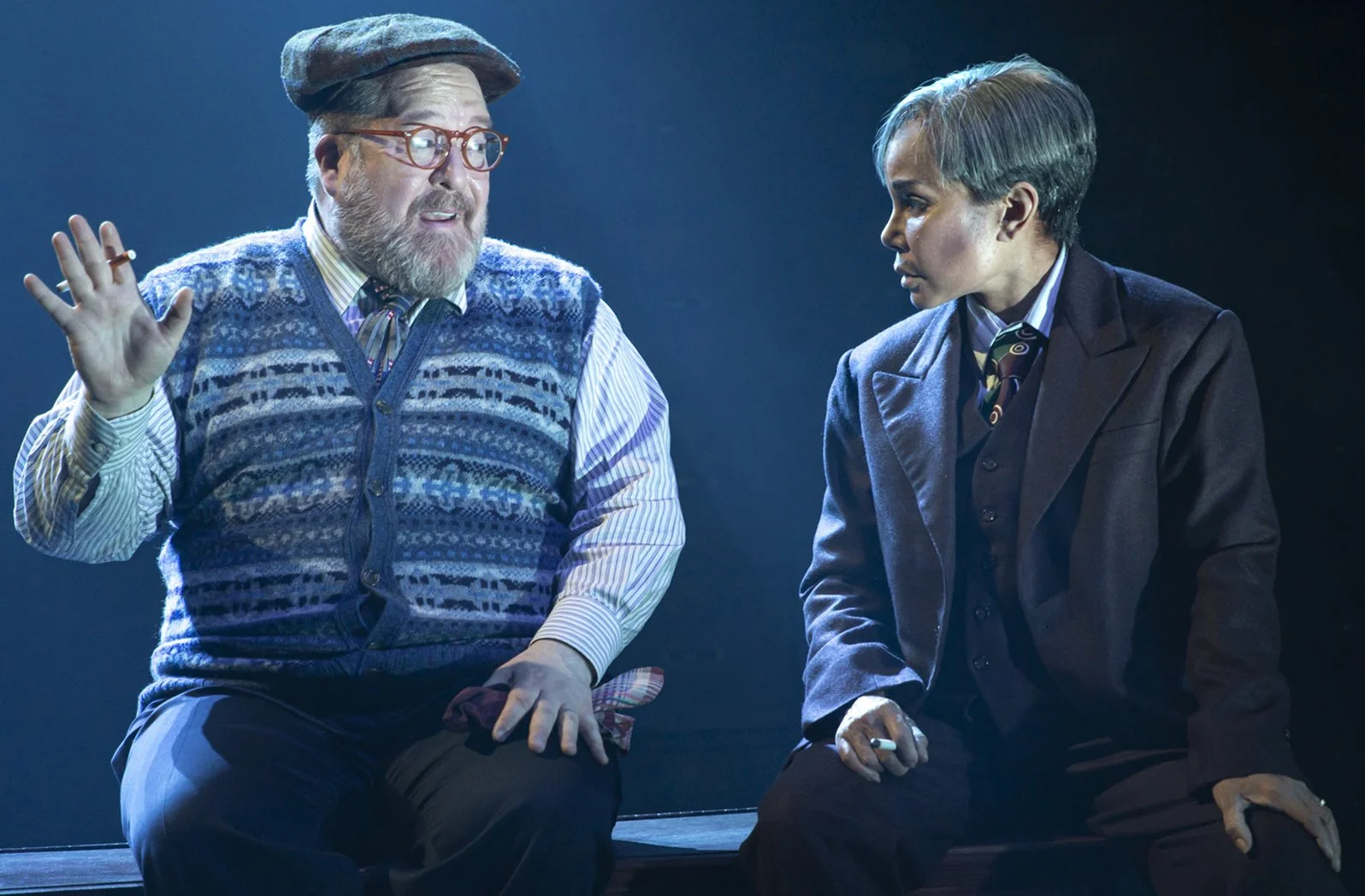
Shrdlu (Creighton) explains elements of the afterlife to Zero over a smoke. Photographs by Monique Carboni.
The added dialogue may not violate the vehemence of Mrs. Zero’s discontent, but it exceeds the boundaries of taste that Rice observed, and it feels superfluous.
At work Mr. Zero is clearly no prize. He abuses his assistant, a frazzled Daisy Diana Dorothea Devore (Sarita Choudhury): “Women make me sick,” he says, launching into badmouthing the one whom he cheated on his wife with—and turned in to the police.
In further scenes Rice shows Zero’s expendability. His boss (Creighton) replaces him with an adding machine. Zero retaliates by killing the boss (offstage); he is tried and executed for murder. Then things get gnarlier. In Act II (the part that “goes off,” as Wilson wrote to F. Scott Fitzgerald), the play swerves into the afterlife, and things turn darker. For the first time, the Narrator says, Zero
Zero has an encounter in the afterlife with Daisy Diana Dorothea Devore (Sarita Choudhury), the assistant whom he mistreated in his earthly existence.
must stand alone with his own thoughts, no routine to protect him, the stillness of the dead forcing him to hear, over and over, this haunting question: Was I ever truly alive?
Inside his grave, Zero listens as overhead the girl he cheated with talks to a guy she picked up:
I used to see him lookin’ in my window, touchin’ himself. He used to look at me like he wanted to devour me. And who could blame him. I’m devourable. His wife is a hag.
After she departs, Zero rises from the grave, and in the afterlife he encounters a nebbishy, guru-like Shrdlu (Creighton, who undertakes all the other parts, though it sometimes generates confusion), a strange denizen of what appears to be limbo. Suffice it to say that Rice throws in some surprises, though on the surface the characters—nagging wife, oppressive husband, devoted but put-upon assistant—are all familiar types. But when Zero learns he has been reincarnated repeatedly, each time as a boob, and it’s about to happen again, he bridles.
“Pull yourself together,” he is told. “You can’t change the rules—nobody can—they’ve got it all fixed. It’s a rotten system—but what are you going to do about it?” A century on, Rice’s attack on the soul-destroying depredations of capitalism feels as pertinent as ever.
The New Group production of The Adding Machine plays through May 17 at Theater at St. Clement’s (423 West 46th St.), Evening performances are at 7 p.m. Tuesday through Sunday; matinees are at 2 p.m. Saturday. For tickets and more information, visit thenewgroup.org.
Playwright: Elmer Rice; revisions by Thomas Bradshaw
Direction: Scott Elliott
Scenic Design: Derek McLane
Costume Design: Catherine Zuber
Lighting Design: Jeff Croiter
Sound Design: Stan Mathabane
Wig Design: Tom Watson
