
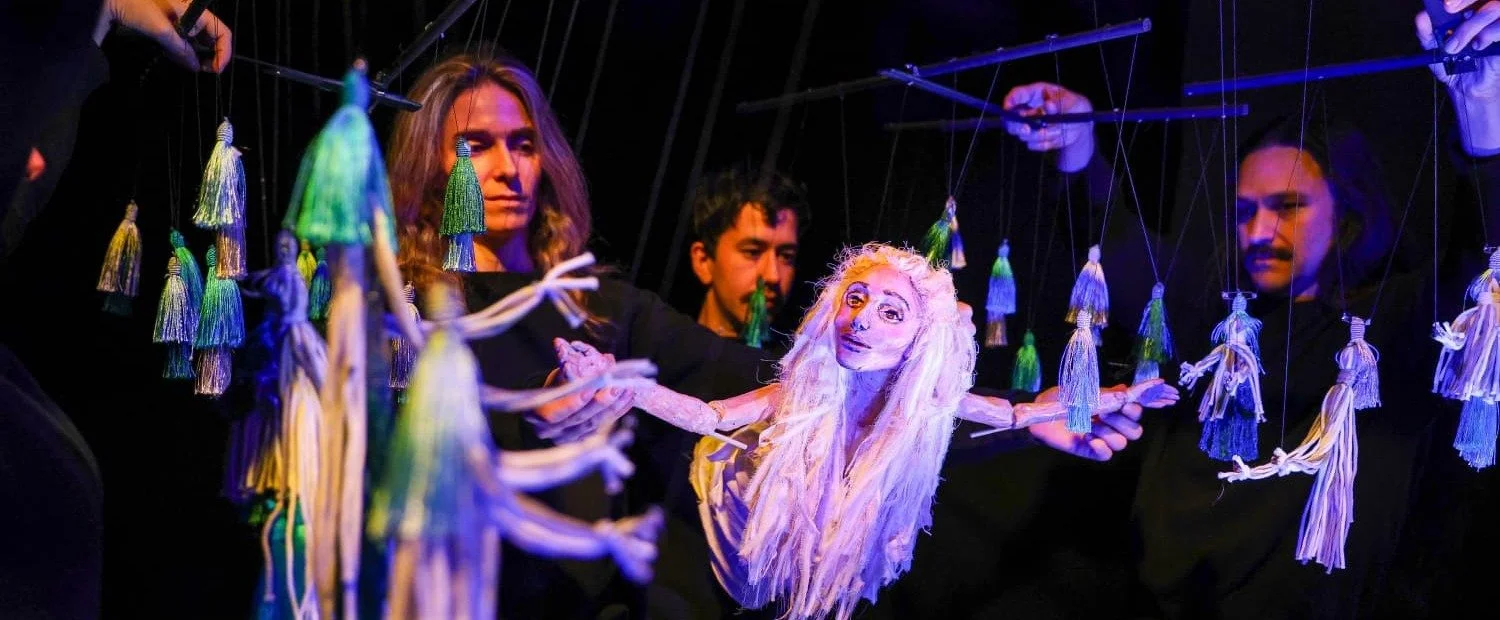
Emily Batsford’s, Cumulo, is a puppet allegory that examines how one reclaims autonomy when life sends one into freefall.
In Cumulo, creator Emily Batsford conjures a visually arresting, nonverbal puppetry work that transforms a simple free fall into a poetic meditation on autonomy and self-reclamation. Inspired by Batsford’s recurring nightmares of falling, the piece asks: how does one assert identity under circumstances beyond one’s control, when stability itself feels elusive?
Although Cumulo unfolds without dialogue, a richly textured sonic landscape permeates the piece, mirroring the shifting moods and psychological states of its protagonist, Plum. Even before the play begins, eerie, otherworldly sounds drift through the theater, establishing unease and subtly drawing the audience into its dreamlike atmosphere.
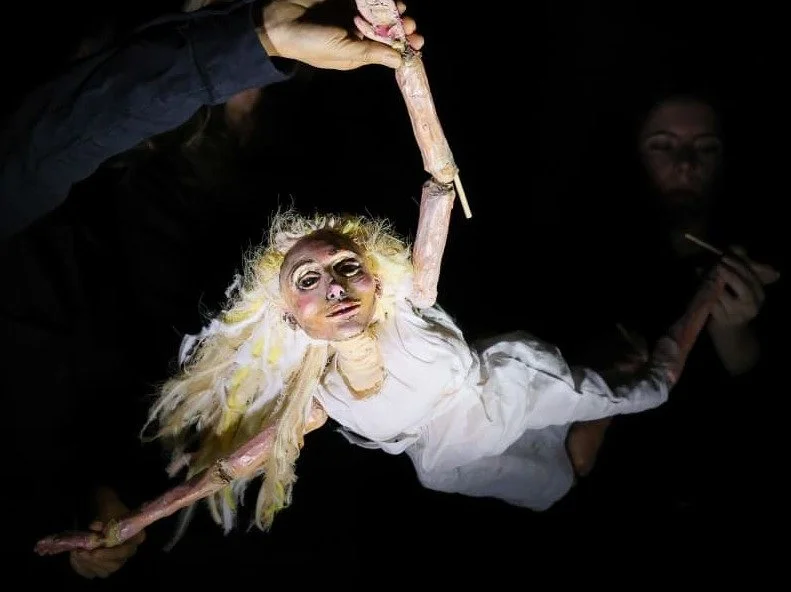
The protagonist Plum encounters various obstacles on a journey to autonomy and self-reclamation in Cumulo.
Cumulo opens with a playful yet enigmatic prelude, as puppeteers wrestle with amorphous, cloudlike forms that gradually cohere into the letters of the title. No sooner does “Cumulo” come into focus than the performers consume the letters as if they were spun sugar—a visual by turns fanciful and faintly ritualistic. Whether read as theatrical mischief or symbolic communion, the sequence proves an intriguing—and disarmingly amusing—gateway into the piece.
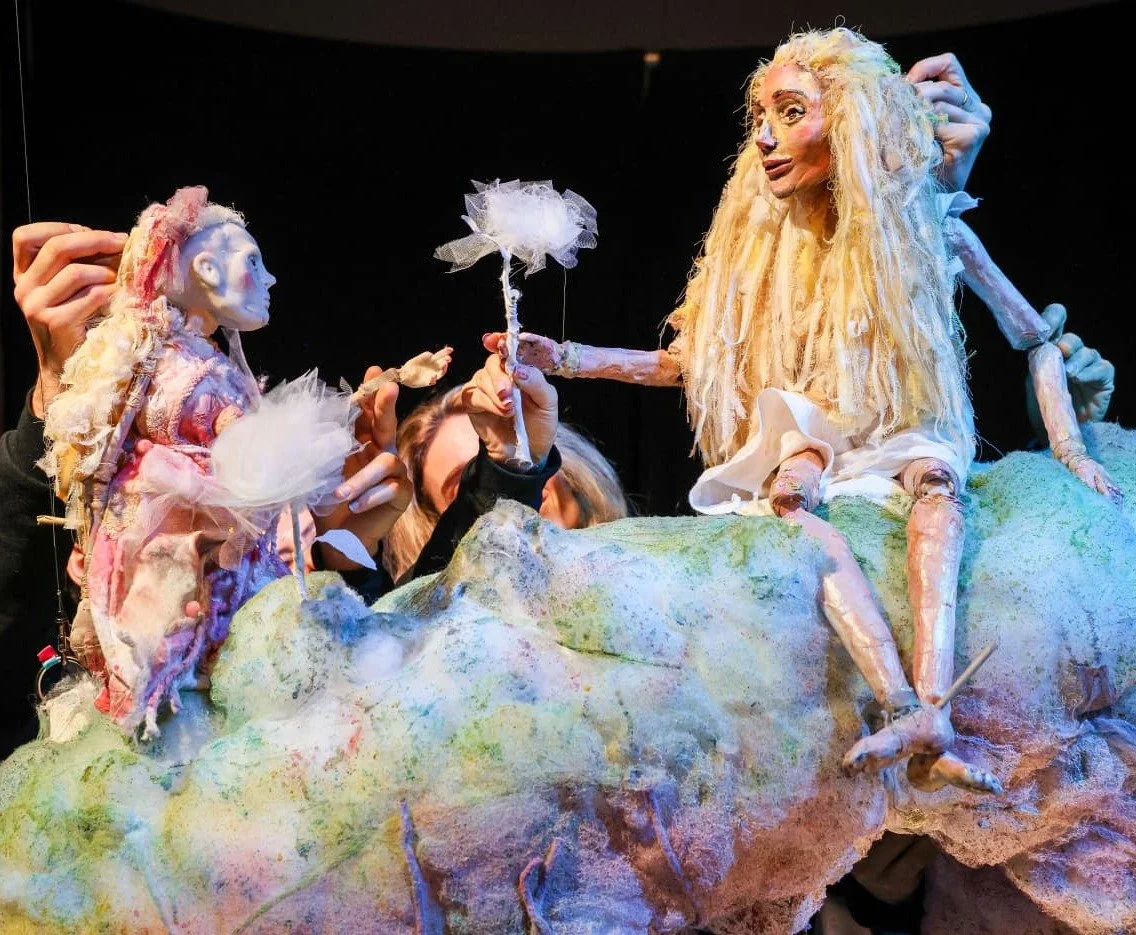
Batsford frames the character’s odyssey within an immersive visual landscape—cotton-candy textures animated by hidden currents of air and a looming mobile of floating cloud islands—that mirrors Plum’s precarious passage toward autonomy. The design does more than dazzle the eye; it actively reinforces the instability and wonder of Plum’s environment. (Audience members who linger can visit a “touch table” in the lobby and handle artifacts from the production.)
When Plum first appears—like a diminutive skydiver—the soundscape shifts from sustained ominous tones to an evolving palette: low rumblings, vacuum-like suction, delicate chimes, bright xylophone notes, and the murmur of water. Together, these sounds function as an emotional barometer, charting Plum’s descent and transformation while deepening the audience’s sensory immersion.
“The production deepens in complexity at its midpoint.”
Whimsical yet edged with menace, Cumulo unfolds as a contemporary allegory about reclaiming agency amid disorientation. Batsford withholds any fixed point of origin or destination—no clear beginning, no visible ground—underscoring that this is an interior journey shaped more by perception and feeling than by geography.
Although Plum has a loosely feminine appearance—long blond hair and a white pinafore—the production uses nonbinary pronouns. Batsford has noted that their exploration of queer identity in the wake of the pandemic informed Plum’s creation, lending the character added thematic resonance.
The production deepens in complexity at its midpoint with the arrival of a second puppet, the Guide, who briefly shepherds Plum through the turbulent skyscape. Roughly the same size as the 22-inch Plum but marked by a sterner expression, she moves with striking assurance—diving from cloud to cloud and returning with ease. Plum greets this presence with surprise, apprehension, curiosity, and wonder. While they have shown aptitude for navigating the terrain, engaging another being introduces a new emotional dimension. Summoning courage, Plum edges closer, and the two make tactile contact, suggesting a fleeting bond. Yet just as suddenly, the Guide vanishes before the piece concludes. Her brief appearance underscores a central truth: guidance may illuminate the path, but reclaiming agency remains theirs alone.
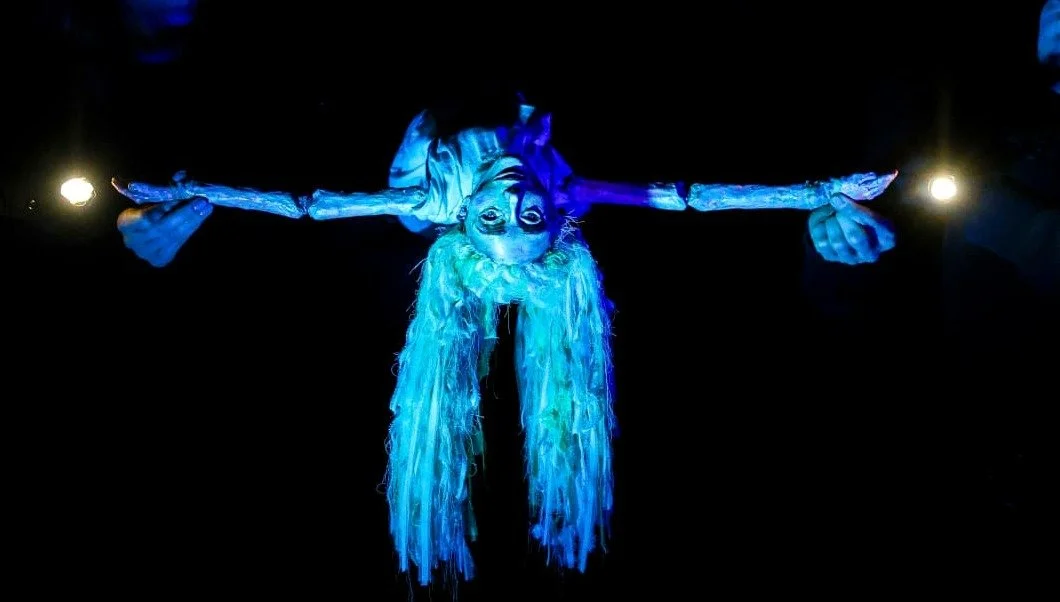
Plum plummets through a surreal skyscape populated by sentient cotton-candy clouds and predatory creatures, embarking on a visceral journey of self-transformation in Cumulo. Photographs by Ken Pao Studio.
Other figures populate this sky-bound world. A menagerie of creatures—emerging from the clouds—attempts to thwart Plum’s progress, heightening the sense of danger. In contrast, the mysterious Rain Queen, fashioned from tassels, yarn, wood, paper clay, and paint, ushers in a tonal shift. Accompanied by chimes and xylophone, she becomes both a catalyst and a harbinger of Plum’s renewal and transformation.
If the production’s sonic and visual elements shape its atmosphere, its true engine lies in the artistry of its five puppeteers—Batsford, Camille Cooper, Gaby FeBland, Takemi Kitamura, and Justin Otaki Perkins. The ensemble demonstrates exceptional precision, expressive control, and stamina, animating Plum and the Guide with clarity and nuance. Their coordination ensures fluid movement as Plum tumbles, dives, straddles clouds, and confronts creatures. Most crucially, they achieve puppetry’s central illusion: life.
Dialogue-free puppetry boasts a rich lineage, from the stylized traditions of Japanese Bunraku, dating from the 17th century, to contemporary works like Parched (featured at HERE Arts Center’s 2026 Puppetopia festival), a cinematic, wordless piece pairing puppetry with live music to explore greed and survival. Cumulo, however, distinguishes itself through its nonlinear “free fall” aesthetic, fusing high fantasy, physical theater, and immersive design to probe autonomy and self-transformation.
In the end, Cumulo lingers less as a resolved narrative than as a sensory impression—an oneiric meditation on vulnerability and self-reclamation. Its wordless form becomes its greatest strength, inviting the audience to inhabit Plum’s free fall. While not every moment lands with equal clarity, its visual ingenuity, sonic richness, and finely wrought puppetry coalesce into an experience that is both haunting and quietly affirming.
Cumulo plays through May 3 at MITU580 (580 Sackett St., Brooklyn). Performance dates and times are somewhat irregular and may be viewed, along with other information, at cumuloshow.com.
Playwright: Emily Batsford
Lighting Design: Allison Costa
Costume Design: Veronica Johnson
Original Music: David Leon
