


Desi Waters portrays the Black abolitionist Sojourner Truth in Karin Abarbanel’s memory play Dust of Egypt.
Dust of Egypt: The Story of Sojourner Truth dramatizes a little-known chapter in the famed abolitionist’s life when, as a young mother, she fought to rescue her 5-year-old son after he was illegally sold down South. Karin Abarbanel’s play turns this legal battle—the first time a Black woman successfully sued a white slave owner—into a stirring portrait of maternal courage and moral defiance.

Cayne, as Adult Bell, and Eliott Johnson, as the slave Robert and her lover, share a rare moment of leisure in Abarbanel’s historical drama, Dust of Egypt. Photographs by Rainer DeLalio.
Although many know Sojourner Truth’s “Ain’t I a Woman?“ speech delivered at the Women’s Right Convention at Akron, Ohio, on May 29, 1851, to primarily white women suffragists and abolitionists, the life of the iconic abolitionist extends far beyond that address, and Dust of Egypt charts its trajectory over the play’s 90-minute running time. Set in the 1860s, this memory play shifts fluidly between past and present, with Truth (Desi Waters) serving as narrator and moral center. From this vantage point, she revisits pivotal moments from her earlier life—first as a 9-year-old enslaved girl named Bell (Jade Cayne), and later as the 20-year-old Bell (also Cayne).
Through these recollections, the audience witnesses Bell being sold on the slave block as a child and later falling in love in her early twenties with Robert (Eliott Johnson), who is fatally beaten by his slaveowner. Still grieving, Bell is forced into a loveless marriage with Thomas (Johnson again), with whom she has five children. In a succession of cruel blows, she watches them taken from her and sold into slavery.
The drama’s emotional core lies in Bell’s struggle to rescue her only son, Peter (Eric Ruffin), illegally sold in New York State and taken down South. With the assistance of a lawyer, Romeyn (Nicholas Louis Turturro), she mounts a daring legal challenge that culminates in a landmark 1828 victory: the return of Peter. In winning the case, Truth became the first Black woman in the United States to successfully sue a slave owner in court.
Director Rhonda Passion Hansome brings a sharp, witty sensibility to the staging, balancing the play’s high-stakes drama with moments of poignant humor. Her versatility is hardly accidental: a veteran comedian, she has been affectionately dubbed the “Nina Simone of Comedy.” Most striking, however, is the Black church energy she infuses into the production—from the recorded gospel music that drifts through the theater before the play begins (sound design by Scott Fetterman) to the commanding stage picture she creates, with Truth’s pulpit dominating the space.

Jade Cayne, as Young Bell, age 9, is put up for sale by Mark McCullough Thomas as the auctioneer who sold her for $100, along with five sheep.
Equally effective are the projections, also designed by Fetterman, which vividly complement the storytelling. Given the scarcity of surviving images from Truth’s historical period, he assembles an array of historically evocative visuals that deepen the narrative context. Most impressive is the courtroom projection—an authentic rendering of the building in Kingston, N.Y., where Truth secured the ruling that rescued Peter.
When it comes to the acting, the cast holds its own, with several performers doubling roles. Jade Cayne delivers a sensitive turn as Bell both at age 9 and in her early twenties. Playing opposite her, Eliott Johnson first appears as Bell’s loving partner Robert and later as her emotionally distant husband Thomas, giving two sharply contrasted performances. As Robert, Johnson introduces Bell to the concept of law, planting a seed that will take root in her heart and mind:
Bell: Who is this Law?
Robert: Law, not a man, Bell! Law is words. Law big! Bigger than any man!
Eric Ruffin convincingly portrays Peter first as a lonely, mistreated 5-year-old and later as a troubled young man scarred by slavery. There is little doubt, however, that Desi Waters, as Sojourner Truth, commands the evening. Radiant throughout, Waters peels back the layers of the activist’s multifaceted personality and feminist vision. Her Sojourner carries no airs about her renown, instead inviting the audience into an intimate reckoning with her past:
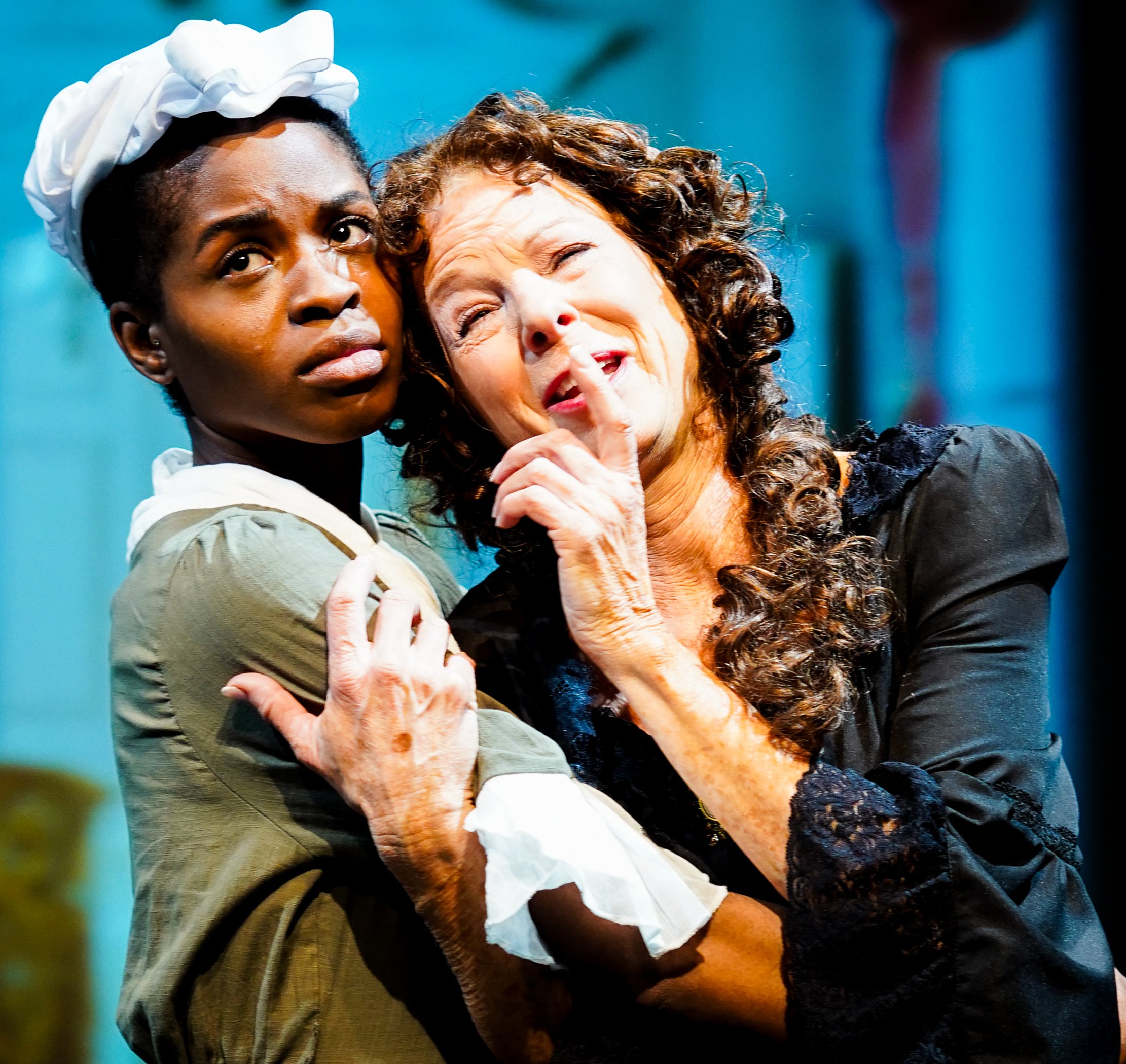
Cayne, as Adult Bell, listens stoically to Jeanna Schweppe, who plays the wealthy widow Mrs. Gedney, whose late husband was a cruel slave master.
Oh, I know you. And you.
Grew up not far from here.
You knew me back then as Bell. Dumont’s Bell. His slave.
That girl, she’s gone.
I’m Sojourner now. Sojourner Truth.
Lord give me that name like a telegraph to the brain.
Then he sent me wandering up and down, stirrin’ things up,
Troublin’ the waters, speakin’ the truth.”
Dust of Egypt is not without its flaws. The transitions between Sojourner’s narration and the dramatized scenes can sometimes feel clunky. Still, this amounts to minor quibbling in an otherwise compelling memory play.
Arriving during Women’s History Month, Dust of Egypt serves as a timely reminder of the extraordinary courage of Sojourner Truth. By illuminating this remarkable chapter of her life, the production honors a woman whose fight for justice continues to resonate today.
Dust of Egypt plays through March 29 at the Sheen Center (18 Bleecker St.). Performance dates and times are somewhat irregular and may be viewed, along with other information, visit sheencenter.org.
Playwright: Karin Abarbanel
Director: Rhonda Passion Hansome
Scenic Design: Emiliano Pares / BB Props
Lighting Design: Maz Sailer
Costume Design: Mary Blackburn
Sound Design: Scott Fettermen
