
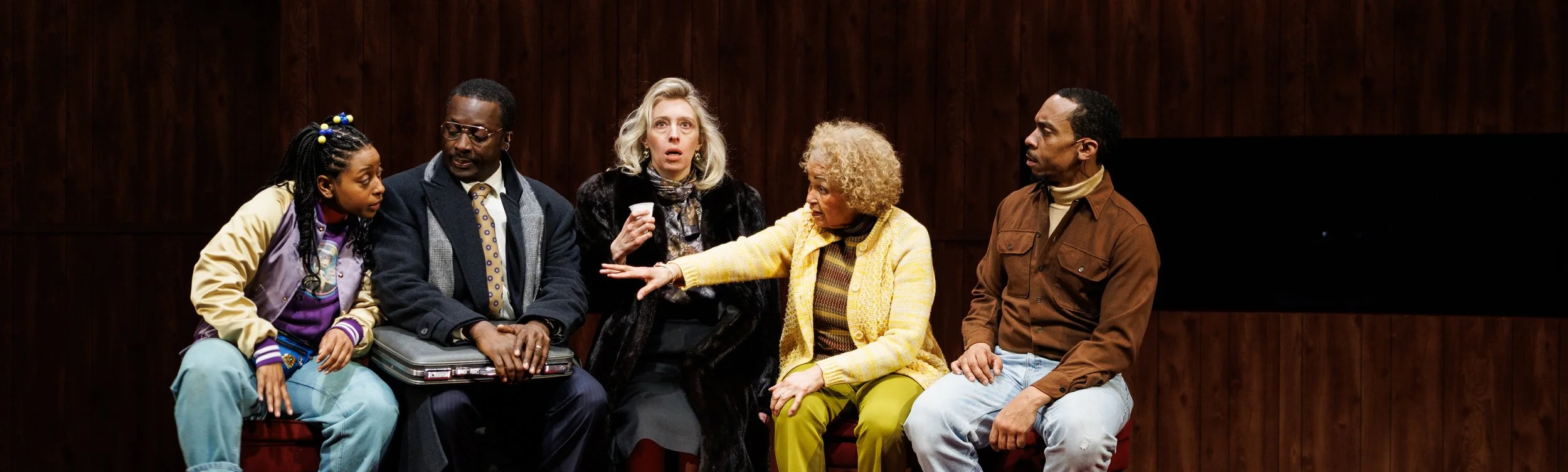
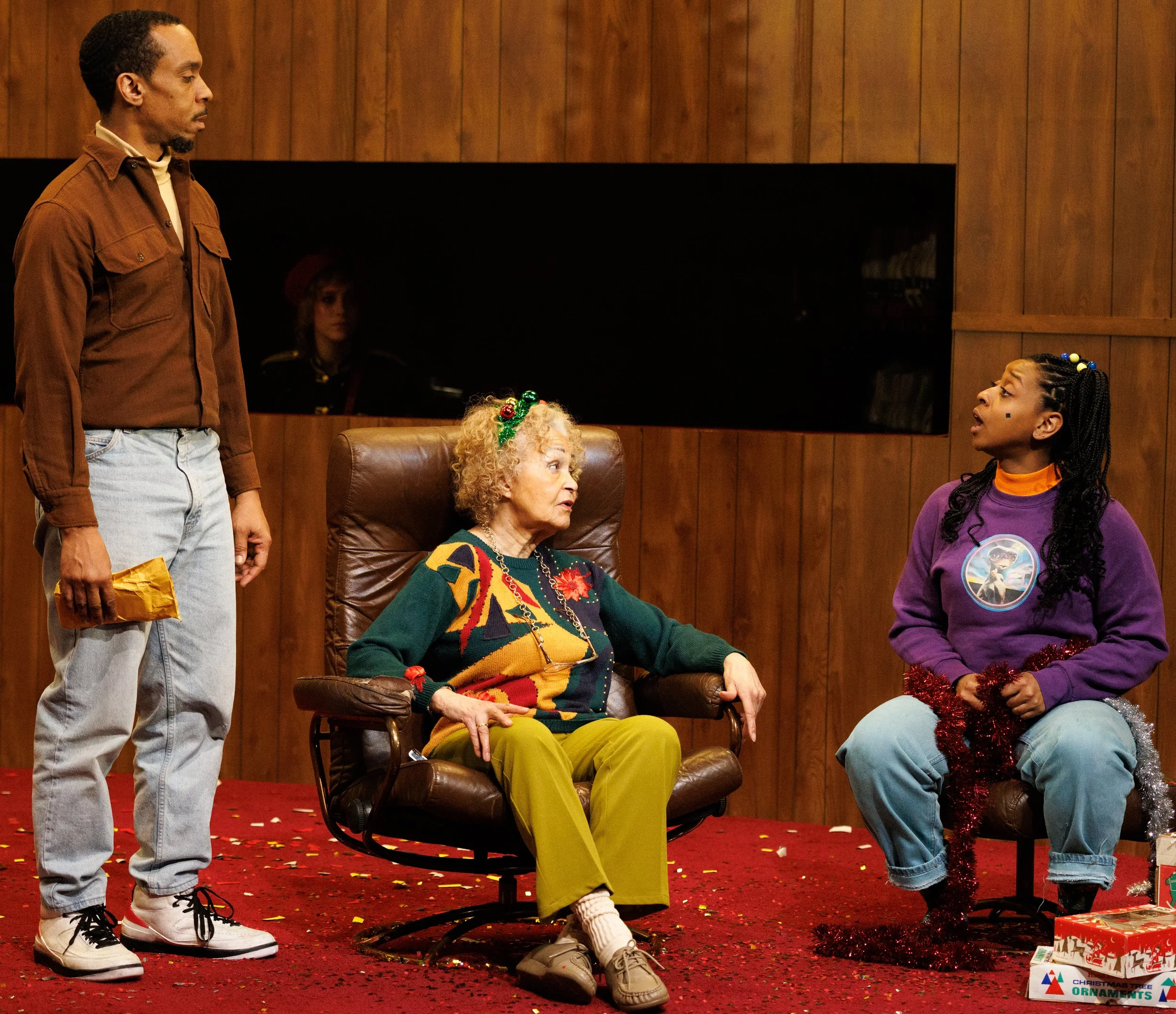
Ten-year-old Meek (Alana Raquel Bowers, right) lives above the family’s business, the Roll-a-Rama, with her father Smooch (Will Cobbs, left) and grandmother Puddin (Lizan Mitchell), in Ro Reddick’s Cold War Choir Practice.
It’s 1987 and the Cold War is in the air at Roll-a-Rama in Syracuse, N.Y. Ten-year-old Meek (Alana Raquel Bowers) lives above the family business with her former Black Panther father, Smooch (Will Cobbs), and grandmother Puddin (Lizan Mitchell). When she’s not shoveling snow in exchange for candy, Meek is occupied with stocking her fallout shelter and singing in a Cold War–themed children’s choir, the Seedlings of Peace, much to her father’s chagrin. This is the world of Ro Reddick’s Cold War Choir Practice. What’s exciting about this play is that it feels sui generis: it’s part farce, part family drama, part surreal global-political meditation, and part musical.
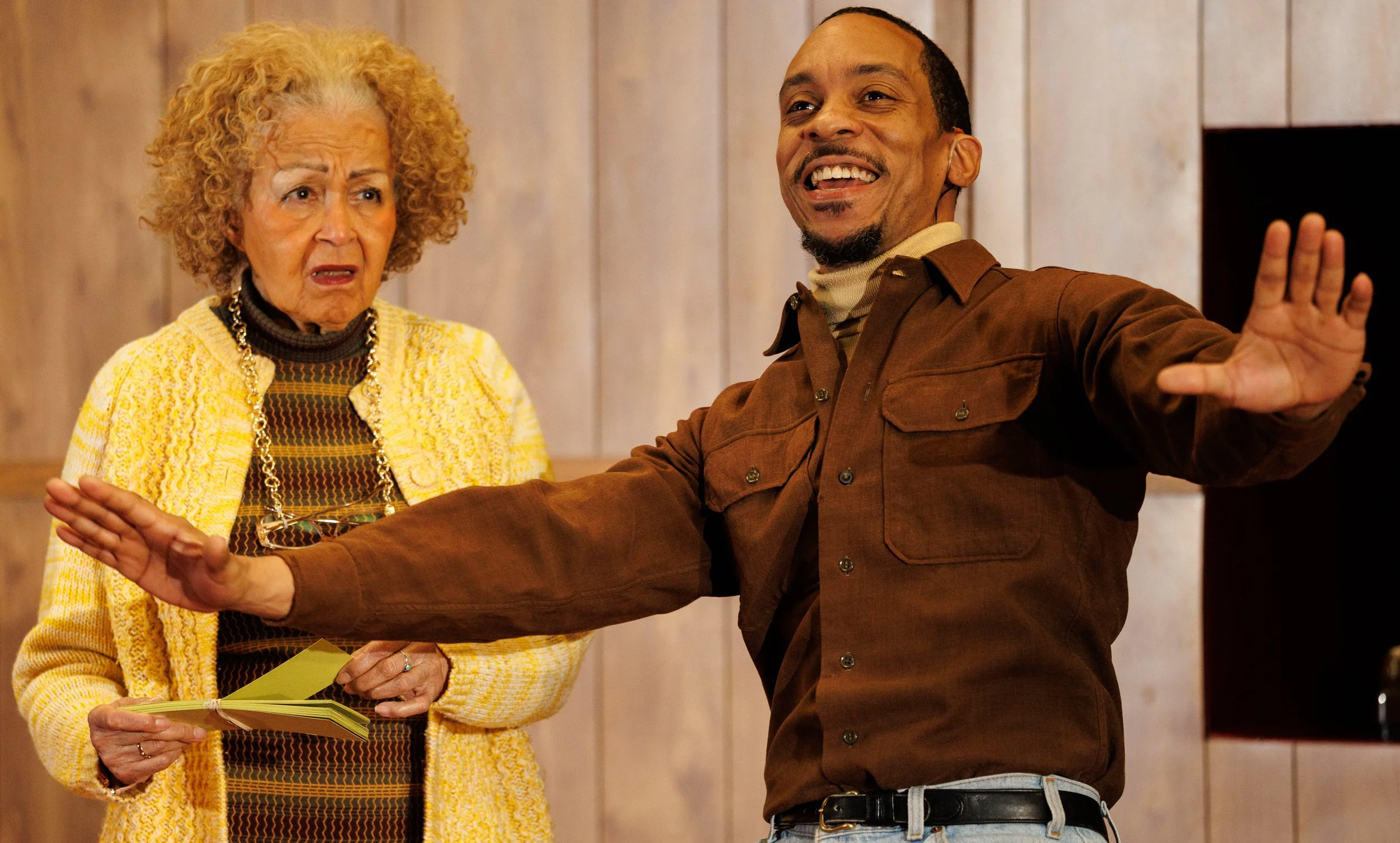
Smooch proposes a business strategy to a skeptical Puddin. Photographs by Maria Baranova.
Smooch reminds the otherwise all-white choir that there are problems closer to home: “We got the FBI bombin’ folks—we got the pigs out in our neighborhoods.” But with an impending meeting in Washington, D.C., between Reagan and Gorbachev, the family will soon be involved in espionage and political intrigue, and the fate of the world may hang in the balance.
In D.C., Puddin’s other son, Clay (Andy Lucien), is the Deputy National Security Advisor, a Black Republican whose politics and condescending attitude toward the family have alienated the passionate Smooch. Clay comes to visit Syracuse with a briefcase filled with supposedly sensitive information that serves as the story’s MacGuffin. He has to get back to Washington, but his wife, Virgie, played with virtuosic comic timing by Crystal Finn, has just been extracted from a cult and is in a semi-catatonic state and needs supervision. Clay is trying to pass things off as normal, but Puddin isn’t buying, as she tells Meeks when they’re alone:
’Cause see your uncle think I was born two minutes past yesterday—actin brand new in the newspaper ’cause he got a job at the White House. Keeping secrets like we ain’t kin. Bringing that spooky looking woman up in here! Let me find out she in one of them cults! ... Puddin’s on high alert!
On top of this, Meek’s Soviet pen pal has sent her a Speak + Spell machine, through which, it turns out, they can communicate. It soon becomes clear that Meek’s correspondent may not be a young girl living in the pastoral tranquility of the Ural Mountains after all, since she takes quite an interest in what’s in Clay’s briefcase and wants Meek to acquire it. Virgie’s former cult—represented by Grace McLean as the ominously named Familiar Face—also wants the briefcase.
The music—the original songs are also by Reddick—comes in the form of three choir members (Suzzy Roche, Nina Ross, and McLean) dressed in red-and-white costumes (by Brenda Abbandandolo), who do play literal members of the children’s choir and other characters, and also serve as a kind of ubiquitous, unhinged chorus. As Reddick describes them in the script: “The Choir is a spooky organism that shapeshifts around the family. They carry the off-kilterness of the world.”
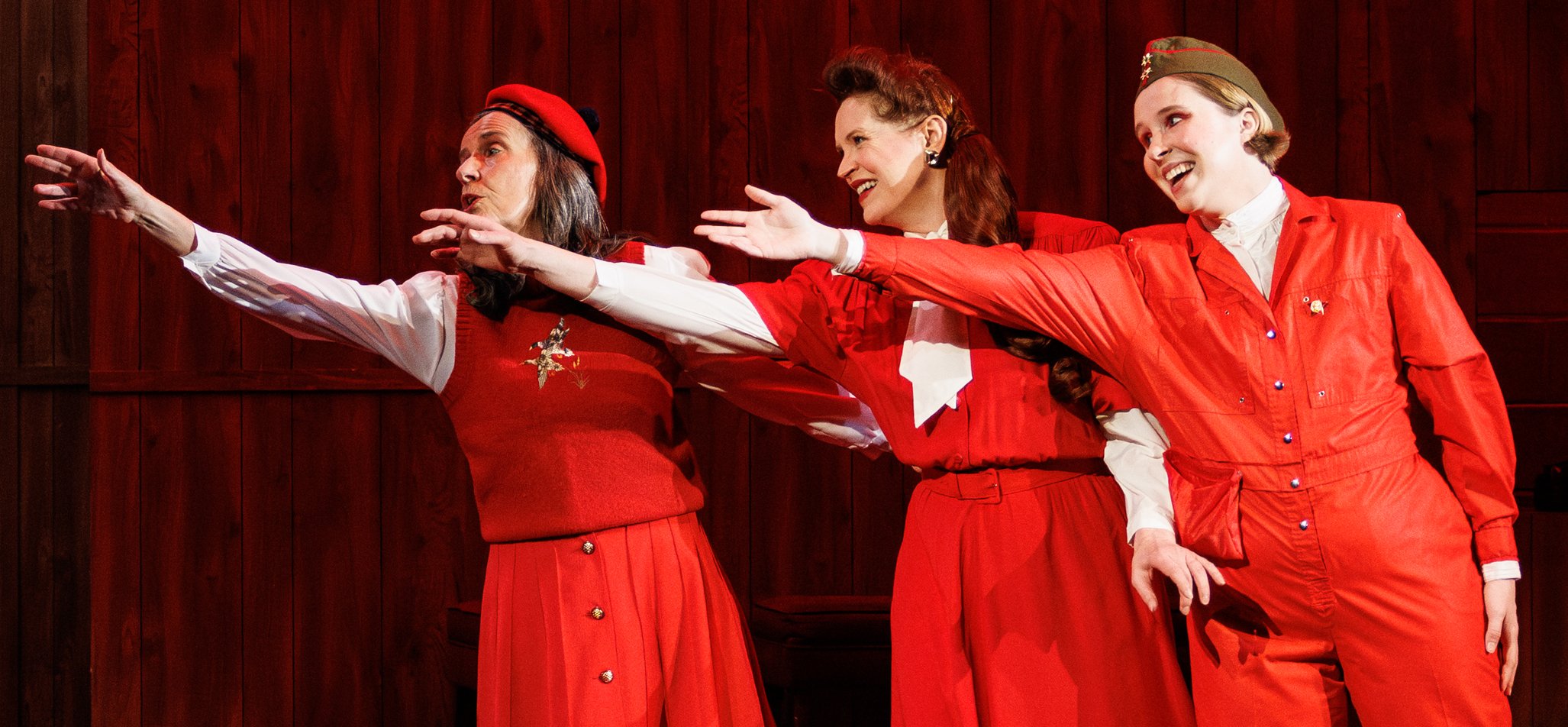
From left: Suzzy Roche, Grace McLean, and Nina Ross are members of a literal choir who also play other characters and serve as a kind of roving, menacing chorus.
The set, designed by Afsoon Pajoufar, on the long stage of the Newman Mills Theater, is the Roll-a-Rama, a red-infused room at times complemented by Masha Tsimring’s red lighting. Scenes take place elsewhere, but visually the audience remains in the skating rink’s world. (No one wears skates, but there are dance-like skating sequences.) It can sometimes be unclear exactly where a scene is meant to take place, but for a play world that is described as “strange and porous,” that is perhaps fitting.
Many of the show’s laughs come courtesy of the note-perfect delivery of the performers, all working at a high level, with special mention for Lizan Mitchell as Puddin and Ross as a choir member and Meek’s pen pal. In fact, each needs only a look, not a line, to elicit a reaction. Less successful is the amount of time spent on zany plot machinations, particularly when the play also tries to wedge in kitchen-sink family drama that feels as though it has wandered in from another show.
Despite a stellar cast and Knud Adams’s finely tuned direction, the play isn’t entirely successful—the production is not quite consistently funny enough for farce, and it lacks the fully fleshed-out characters of good drama. But the performances and the play’s wonderfully off-kilter imagination make Cold War Choir Practice well worth experiencing.
Cold War Choir Practice runs through April 5 at MCC Theater (511 W. 52nd St.). Performances are at 7 p.m. Tuesday through Saturday, with matinees at 2 p.m. on Saturday and either 1 p.m. or 3 p.m. Sunday; there are some Sunday evening performances and some Thursday matinees. For tickets and more information, visit mcctheater.org.
Playwright & Composer: Ro Reddick
Director: Knud Adams
Set Design: Afsoon Pajoufar
Costume Design: Brenda Abbandandolo
Lighting Design: Masha Tsimring
Sound Design: Kathy Ruvuna
