
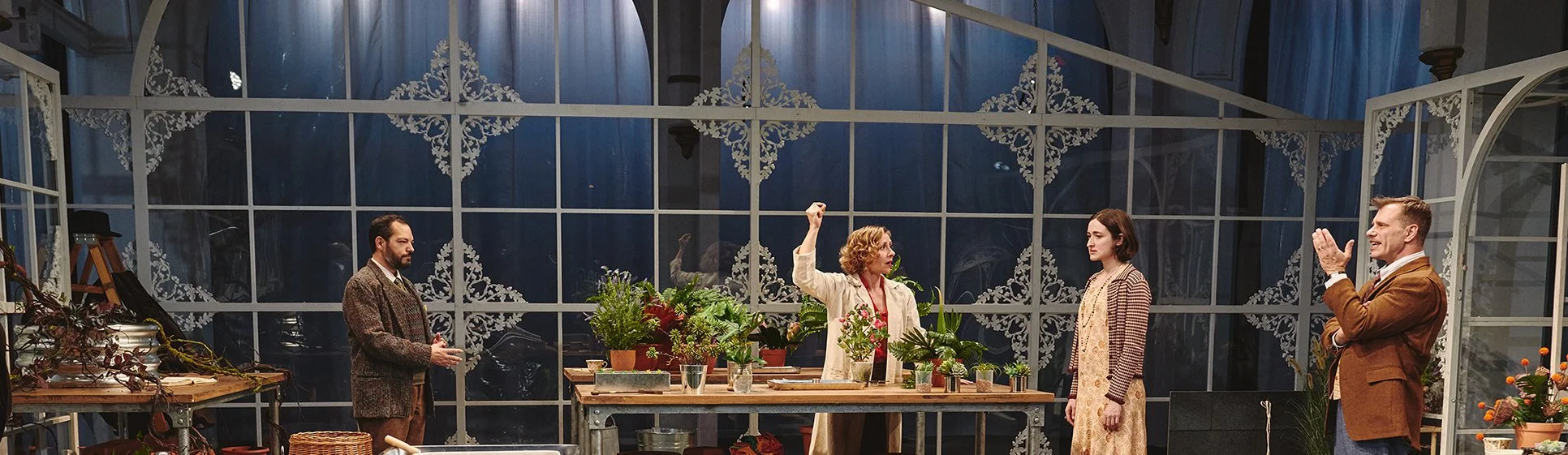
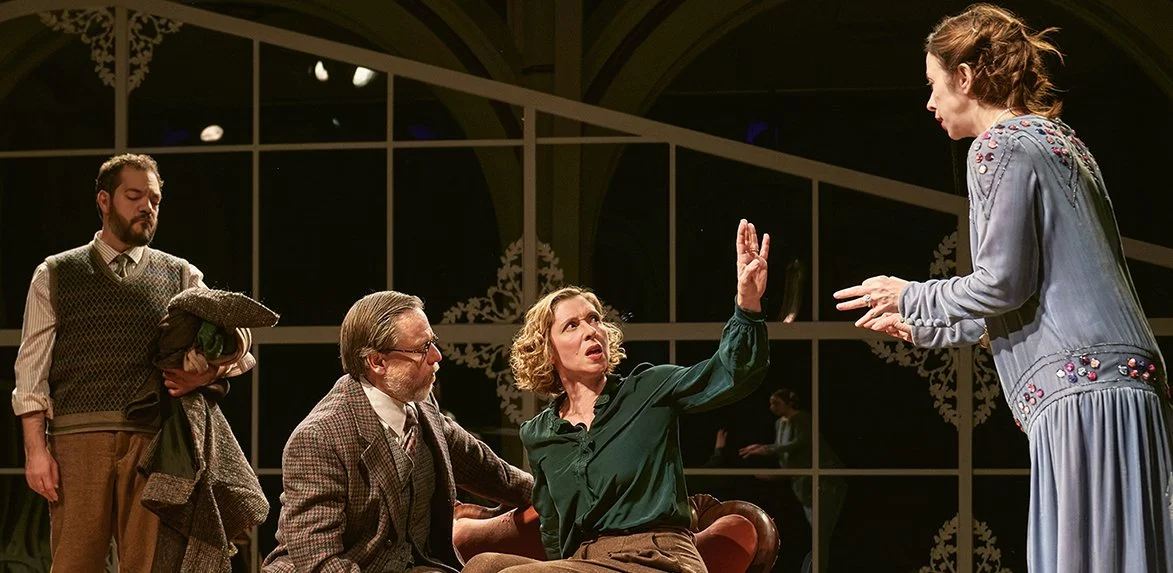
From left: Paco Tolson plays Tom, Paul L. Coffey is Dr. Emmons, Miriam Silverman is Claire, and Emily Young is Adalaide in the Fiasco Theater production of Susan Glaspell’s 1921 play The Verge.
“All I ask is to die in the gutter with everyone spitting on me,” declares Claire Archer, the protagonist of Susan Glaspell’s 1921 drama The Verge. It’s an over-the-top statement that the thwarted heroine has been leading up to in this hothouse play, but it seems appropriate for Claire, a difficult person to like or care about. Fiasco Theater’s resurrection of The Verge is an admirable attempt to look at the theatrical repertoire neglected by most producers (except for the Mint Theater, which has unearthed such discoveries routinely for decades).
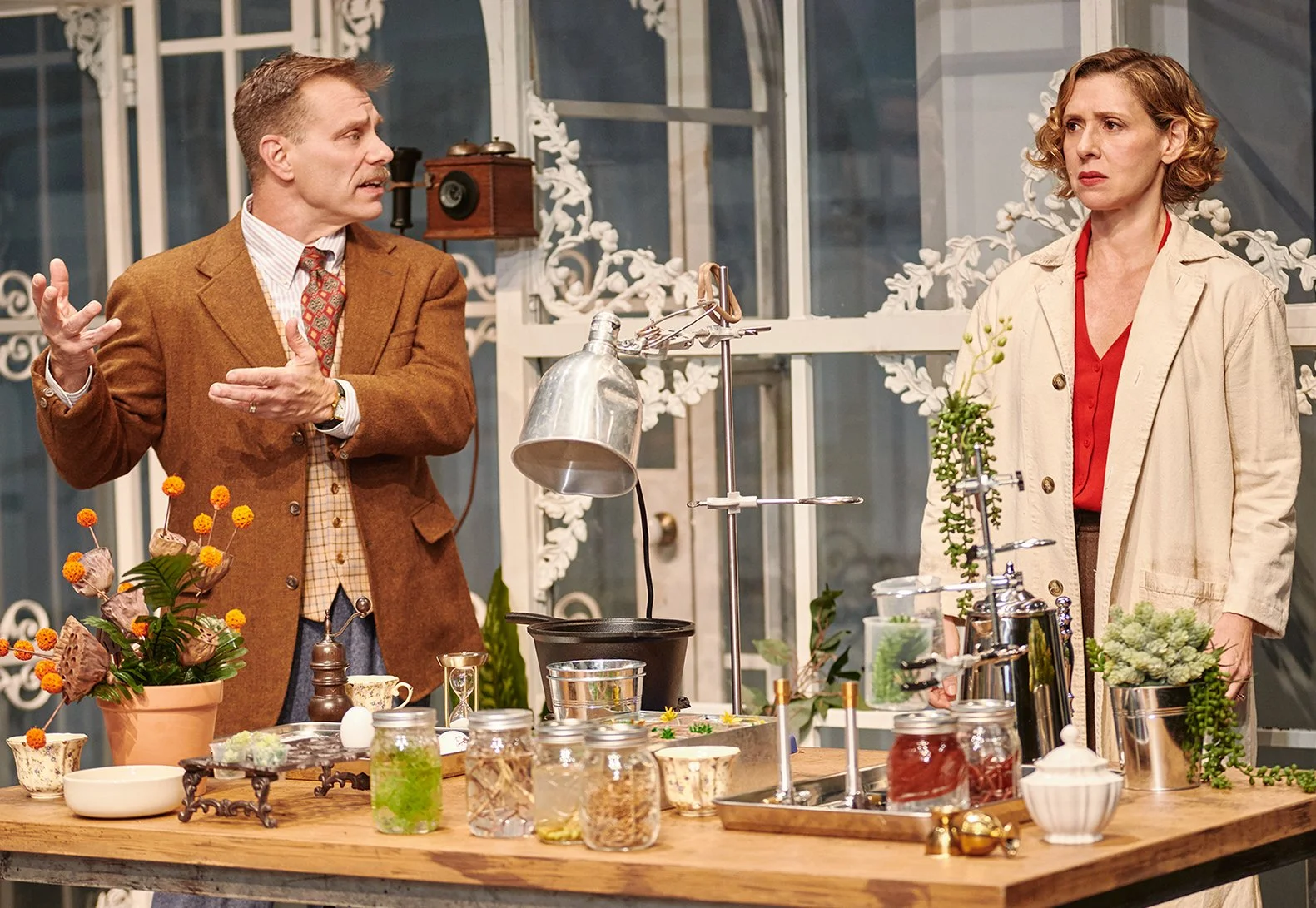
Harry (Noah Brody) tries to get Claire to accept the duties of a hostess with houseguests.
Glaspell is an important historical figure—she and her husband George Cram Cook founded the Provincetown Players, an amateur theater group, in Provincetown, Mass., in 1915 and gave Eugene O’Neill his first production, Bound East for Cardiff. But she has become a theatrical footnote today, and her plays are rarely revived. Although Fiasco deserves kudos for mounting The Verge, director Jessie Austrian’s production doesn’t make a case for the play as a lost gem.
Two of the three acts of The Verge (it’s played with one intermission) are set in a greenhouse during a raging snowstorm. Claire (a terrific Miriam Silverman) is the lady of the house, and she has ordered the heating in the main house diverted to her plants’ residence, where her gardener is helping her cultivate a flower called “Breath of Life,” which she describes nebulously:
I want to give fragrance to Breath of Life—the flower I’ve created that is outside what flowers have been. What has gone out should bring fragrance from what it has left. But no definite fragrance, no limiting enclosing thing.
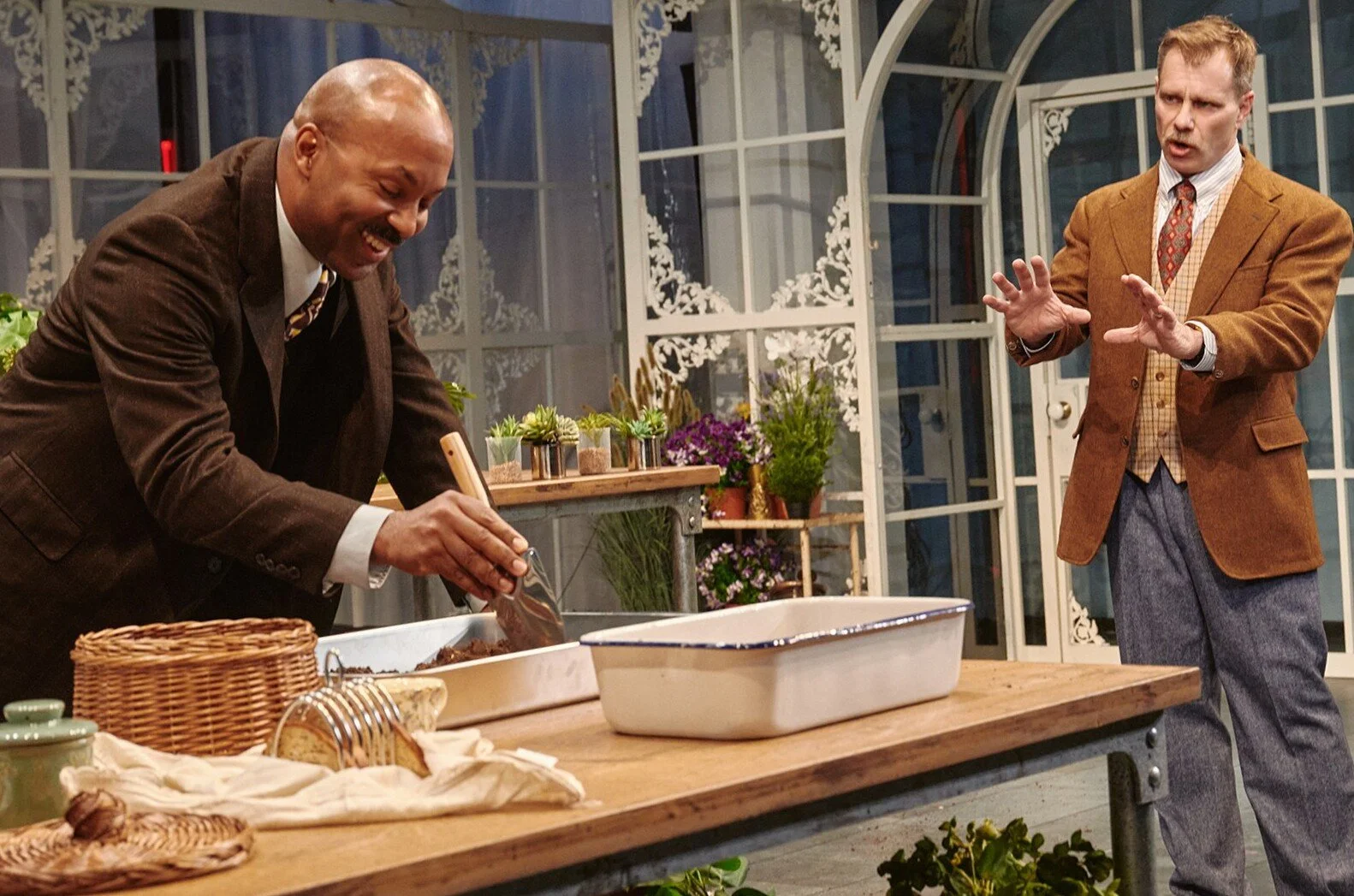
Harry (right) finds that Dick (Devin E. Haqq) is interested in Claire’s work in the greenhouse. Photographs by Valerie Terranova.
Glaspell’s metaphor about an “indefinite fragrance” feels heavy-handed: Claire herself cannot really breathe in the life she is leading; she is being smothered by it—limited and enclosed. She regards her work as more than a hobby, and she struggles against her environment by ignoring hostess duties as well as her guests. And her obstinacy and contempt for others suggest that she is on the verge of madness.
On the order of Claire’s husband Harry (Noah Brody), a maid brings breakfast into the greenhouse because the house is frigid, despite Claire’s ban on eating there. As the storm rages, houseguests Tom Edgewood (Paco Tolson) and Dick Deming (Devin E. Haqq) arrive from the mansion. Claire squabbles about whether Dick should be allowed to get a salt shaker that he has dropped—opening the door to the storm affects the steady temperature in the conservatory.
She has also been having an affair with Dick, and they steal a moment for each other. Tom, meanwhile, adores her, but neither man measures up. Ultimately, no Tom, Dick, or Harry will stop Claire from having her way.
Glaspell’s play has not aged well—certainly not by comparison, for example, with the Mint’s recent discovery of Cicely Hamilton’s Phyl (1911), another play about a woman who refuses to accept society’s norms. Silverman invests Claire’s words with a fiery intensity, but too much is turgid speechifying:
We need not be held in forms molded for us. There is outness—and otherness. … There would be strange new comings together—mad new comings together, and we would know what it is to be born, and then we might know—that we are.
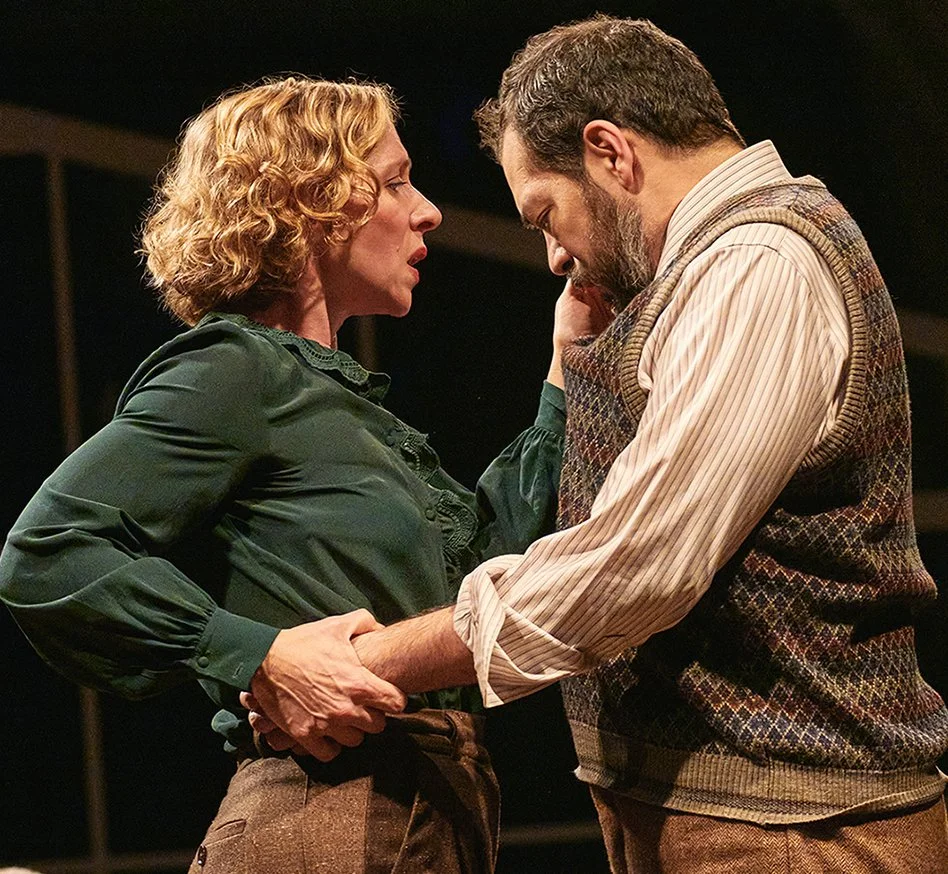
Claire consoles a disappointed Tom, who is in love with her.
Harry is more indulgent than most husbands might be. He buys her anything she wants for her hobby. But Harry is also a hectoring stuffed shirt, and the usually stalwart Brody hasn’t cracked a way to humanize him for a post-feminist era.
Glaspell may want audiences to sympathize with Claire, and to some extent the men in her life aren’t worthy of her. Well into the play, however, the playwright injects a key twist, one that is meant to explain, and perhaps excuse, Claire’s behavior, but it registers as a clumsy theatrical device. Nonetheless, Silverman brings to the subsequent long, poetic monologue great intensity and anguish, though she can’t quite make it feel like a real person is speaking, with language like “I’d rather be the steam rising from the manure than be a thing called beautiful!”
Set designer Lawrence E. Moten III has realistic decor for the two acts in the greenhouse that contrasts starkly with Act II, which takes place high in a sanctuary in Harry’s mansion. Apparently inspired by Thornton Wilder, Moten deftly uses a simple ladder and a platform to serve as imagined winding passageways to Claire’s aerie. Glaspell’s play follows a convoluted path itself, but it’s one that is more baffling than satisfying.
The Fiasco Theater’s production of Susan Glaspell’s The Verge runs through Nov. 29 at the Public Theater (425 Lafayette St.). Evening performances are at 7:30 p.m. Tuesday through Saturday (except Nov. 25 and 26); matinees are at 1:30 p.m. Saturday and Sunday, with an additional matinee at 1:30 p.m. on Nov. 25. For tickets and more information, visit publictheater.org.
Playwright: Susan Glaspell
Director: Jessie Austrian
Scenic Design: Lawrence E. Moten III
Costume Design: Sarita P. Fellows
Lighting Design: Amith Chandrashaker
Sound Design: Bailey Trierweiler
If you enjoyed this review, please click on the Like button below.
