

Alone with Phyl (Lily Ganser, right), Jack Folliott (Anthony Michael Martinez) draws out her anguish over the prospect of following her sister into uncomplaining self-sacrifice in Cicely Hamilton’s 1911 social comedy Phyl.
Cicely Hamilton’s Phyl, a 1911 comedy that challenges the constraints imposed on women of the early suffragist era, is receiving its New York premiere from the Mint Theater Company. This rarely seen work by Hamilton—a leading British women’s rights activist—introduces a spirited heroine determined to break free from isolation and convention. Under Britt Berke’s direction, Phyl reveals the quiet radicalism of its heroine’s determination to pursue the life she desires.
Hamilton’s play mixes poetic fantasy and robust comedy as it follows a young governess whose affair with a wealthy man challenges conventional notions of morality and respectability. When the curtain rises, Brittany Vasta’s handsome, realistic set evokes early 20th-century society. Two well-dressed children, Betty and Olive Ponsonby, appear to be doing their homework. But when Betty asks whether Olive has spelled “toad” correctly, the deception begins to unravel.
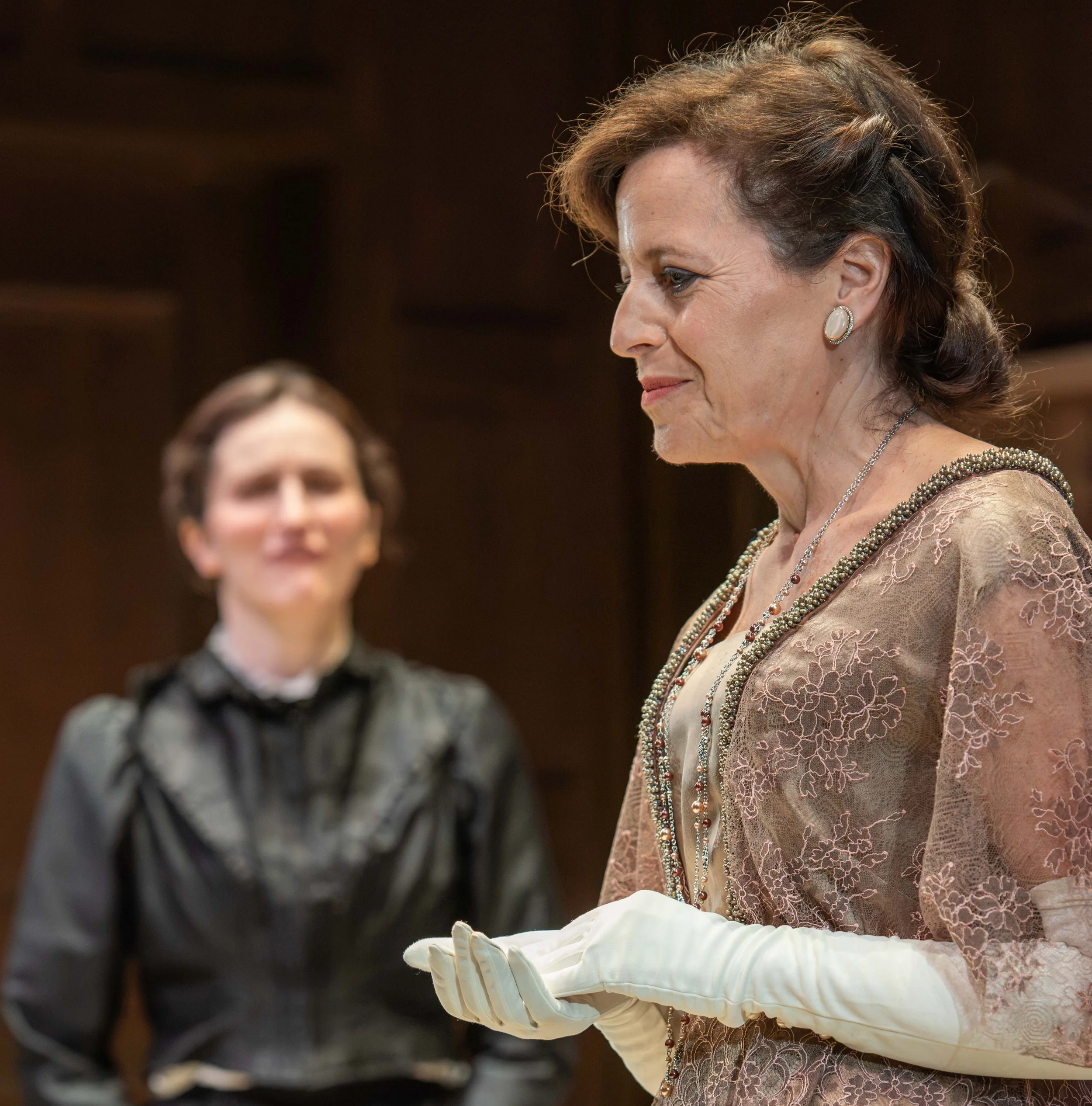
Mrs. Ponsonby (Katie Firth), acting on gossip about Phyl’s relationship with Jack, summarily dismisses her as the governess.
Olive’s observation that “I thought t-o-d-e didn’t look quite right” prompts her to question why her sister would choose such an unpleasant creature for a French exercise. The answer is a mocking poem modeled on Percy Bysshe Shelley’s “Ode to a Skylark.” Instead of celebrating the skylark’s freedom, Betty transforms its song into a venomous attack on her governess:
“Ode to a Governess.”
Miss Chester is a perfect toad;
I’d like to stamp on her in the road!
The exchange establishes the antagonism between Phyllis Chester (Lily Ganser) and her young charges while introducing an ironic parallel between Shelley’s skylark, whose song celebrates freedom, and Phyl, who yearns to escape the social restrictions that confine her.
Hamilton delays Phyl’s entrance in Act I, allowing the children and their elder sister, Mabel, to establish the household’s dynamics. An unexpected visit from Phyllis’s older sister Cathy (Jennifer Blood) exposes the emotional toll of her seemingly inescapable existence. When Cathy probes her unhappiness, Phyl despairs of a future offering little beyond her dreary routine:
Phyl: I see no chance of the future being any different from the present or the past. I’ve been governessing since I was seventeen—and oh, good Lord, the dreariness, the dreariness of it! What have I to look forward to?—what prospects have I? As far as I can see, the only thing to hope for is that in time I shall grow like you.
Cathy: Like me?
Phyl: Resigned. … I suppose I shall someday. Meanwhile … one wants to live and have friends and …
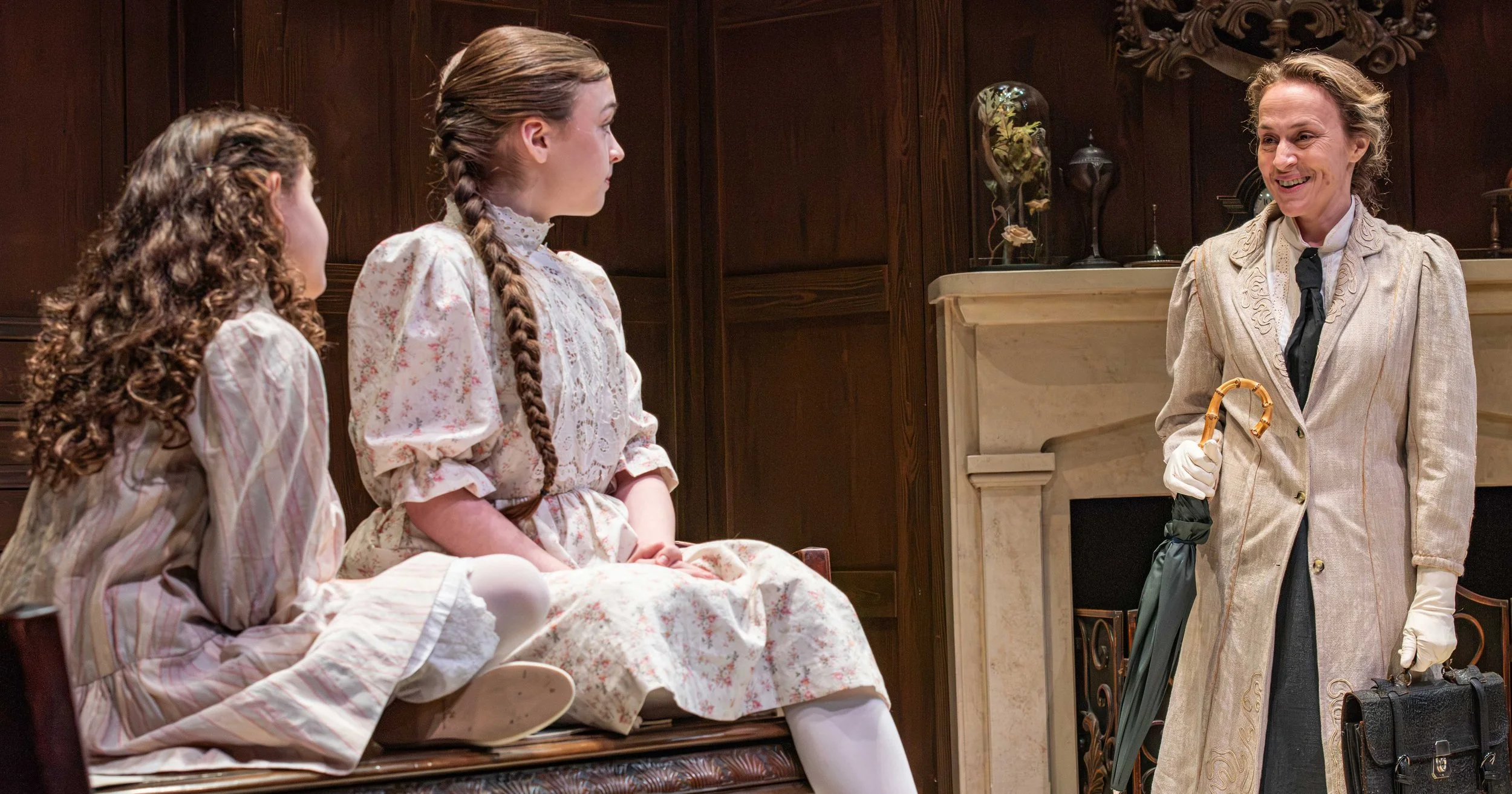
Jennifer Blood (far right), as Cathy Chester, unexpectedly drops in to see her sister Phyl and gets a thorough inspection from Betty and Olive. Photographs by Todd Cerveris.
Cathy’s presence forces Phyl to confront the bleak prospects facing women at that period who had to support themselves while observing society’s conventions. Having seemingly accepted a life of stoicism and self-sacrifice, Cathy serves as a foil to her younger sister, whose longing for independence and pleasure challenges her era’s restrictive morality.
Cathy’s departure precipitates a turning point. Jack Folliott (Anthony Michael Martinez), a wealthy bachelor in Mrs. Ponsonby’s social circle, deftly defuses a potentially job-threatening confrontation after Phyl loses her temper with Betty. His understanding of the children’s mischievous nature suggests his growing concern for their governess. Alone with Phyl, he draws out her anguish over the prospect of following her sister into uncomplaining self-sacrifice. “But I want more than that—I want more!” she cries, recognizing that she cannot reconcile her longing for a fuller life with society’s expectations.
When Mrs. Ponsonby (Katie Firth), acting on gossip about Phyl’s relationship with Jack, summarily dismisses her, that conflict becomes an immediate crisis. Phyl takes the plunge into a romantic relationship with Jack, accompanying him abroad in pursuit of the life she desires. But when he loses his fortune, he offers to make amends by marrying her, forcing Phyl to reconcile her unconventional views on marriage with society’s expectations and consider what she truly wants from life.

Jack’s understanding of the mischief that Betty Ponsonby (Tessa Bilmes, left) and her sister Olive (Charlotte Van Ledtje) are up to helps to defuse a potentially job-threatening confrontation for their governess Phyl.
Berke’s production establishes a unified artistic vision in which performances, set, costumes, lighting, and sound work in concert. Seldom do a production’s elements complement one another so effectively.
The ensemble delivers outstanding performances across the board. In the title role, Ganser displays impressive range, charting Phyl’s evolution from a woman weighed down by resignation to an exuberant free spirit. Playing opposite her, Anthony Michael Martinez brings surprising empathy to the role of Jack Folliott, a rich, dashing bachelor. Tessa Bilmes brings brio to the impish Betty Ponsonby, while Charlotte Van Ledtje captures Olive’s supercilious air. As Cathy Chester, Blood provides a voice of reason without sacrificing the warmth of a deeply caring sister.
Hamilton’s Phyl is a reminder that a woman’s refusal to accept the life prescribed for her can be an act of rebellion in itself. In challenging the conventions that confine her heroine, Hamilton makes the pursuit of personal freedom not a luxury but a necessity.
Cecily Hamilton’s Phyl plays at Theatre Row (410 W. 42nd St.) through Nov. 7. Evening performances are at 7 p.m. Tuesday through Saturday; matinees are at 2 p.m. Wednesday, Saturday, and Sunday. For tickets, visit minttheater.org.
Playwright: Cicely Hamilton
Director: Britt Berke
Scenic Design: Brittany Vasta
Lighting Design: M.L. Geiger
Costume Design: Alicia J. Austin
Sound Design: Jane Shaw
If you enjoyed this review, please click on the Like icon below.
