
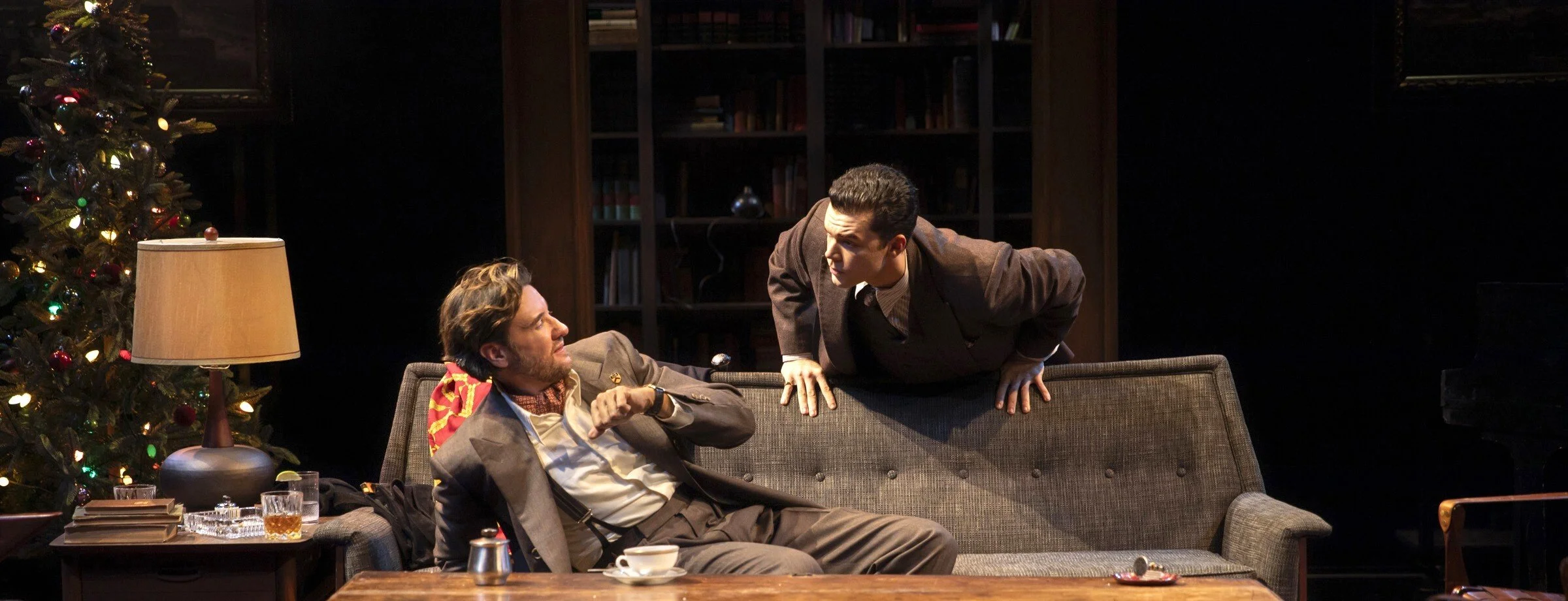
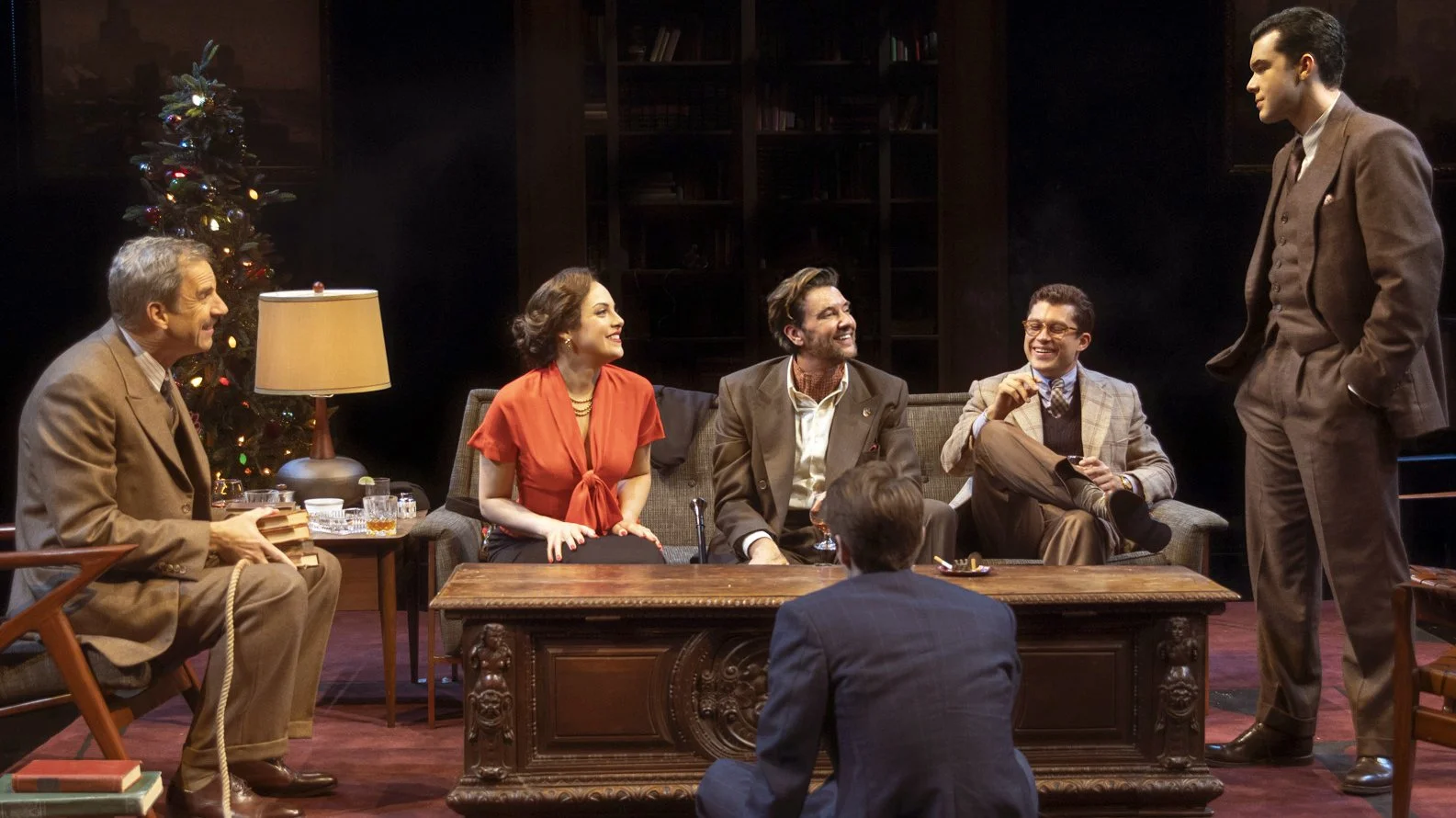
There’s a body in there! Judge Kentley (James Waterston), Leila (Elizabeth Gillies), Rupert (James Butler Harner), Nate (Corey Fogelmanis, back to camera), Dick (Graham Phillips), and Garrett (Cameron Monaghan) at a macabre dinner party in Rope.
The 1948 Alfred Hitchcock thriller Rope is famous for a) seemingly being filmed in one take, so the cameraman has to focus on a large immobile surface every 12 minutes or so to reload, and b) containing a homoerotic undercurrent, something it shares with Hitchcock’s Strangers on a Train and North by Northwest. It’s adapted from a 1929 play by Patrick Hamilton, which fictionalized the 1924 Leopold and Loeb case. In it, two romantically entangled college boys murdered a third boy (Clarence Darrow defended them at trial). Now Gordon Greenberg has rewritten it, and gayed it up. The result is odd.
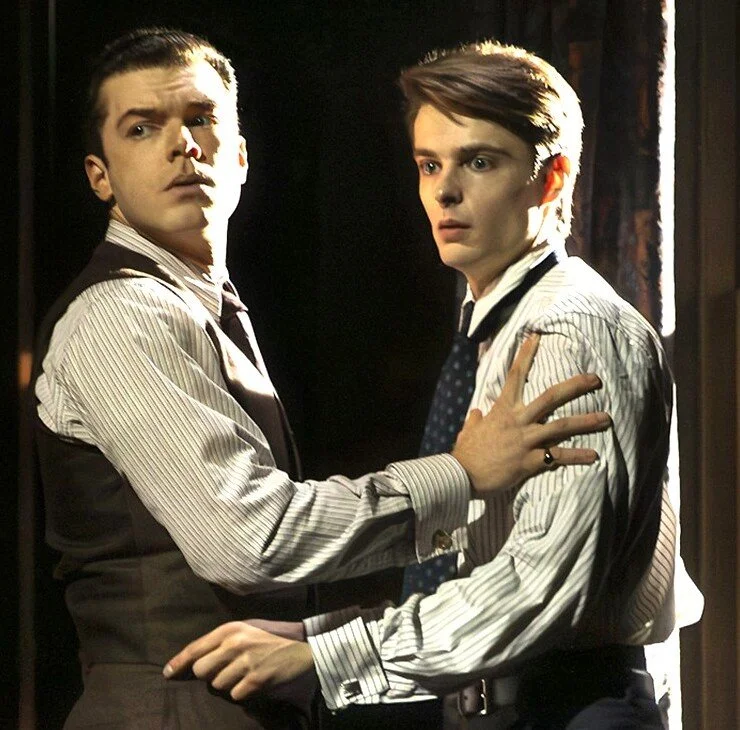
Garrett and Nate are hot for each other and entertain Nietzschean impulses in Scott Elliott’s production.
Much of that oddness may stem from some peculiar choices by director Scott Elliott. Why, as the audience enters, are the two young murderers, Garrett (Cameron Monaghan) and Nate (Corey Fogelmanis), sitting on a dark stage in their underwear, so motionless that they look like mannequins? Why do they then wordlessly assemble Derek McLane’s attractive set, still in darkness? Why are bongos thumping in the background as each of the six characters introduces himself with a fourth wall-breaking biographical sketch? Why are flashbacks played in spotlight? Why does their friend Leila (Elizabeth Gillies) indulge in a well-sung but pointless “Old Cape Cod”?
Those diversions aside, the doings echo Arthur Laurents’s 1948 screenplay, with some startling revisions. For some reason it has been updated to 1957, so Garrett and Nate’s party guests can prattle about Bob Hope, Brigitte Bardot, and Marlon Brando’s performance in Sayonara. Besides Leila, the guest list includes Dick (Graham Phillips), a likably unremarkable Princeton chum; Rupert (Jason Butler Harner), Garrett’s philosophy professor, who instilled in him the Nietzschean impulses that prompted the murder; and Judge Kentley (James Waterston), whose son they offed and dumped in the chest they’re all dining on.
But as to those startling revisions: First, while Hitch had to keep the gayness muffled, Greenberg has overstressed it. Now Garrett and Nate are making out at the drop of a cigarette lighter (there’s much onstage smoking), at least when they don’t think anyone’s watching; and Garrett has had a dalliance with his prof, played in the movie by James Stewart as a paragon of heterosexuality. Rupert, brandishing a cane, claims a war injury; in fact, a Bowery rent boy slashed his leg. Nate is now asthmatic, to amp up his already considerable vulnerability. The movie ends with the police on their way up to arrest the boys; here, some entertaining but preposterous last-minute hijinks result in more bodies, a sour note on which to close.
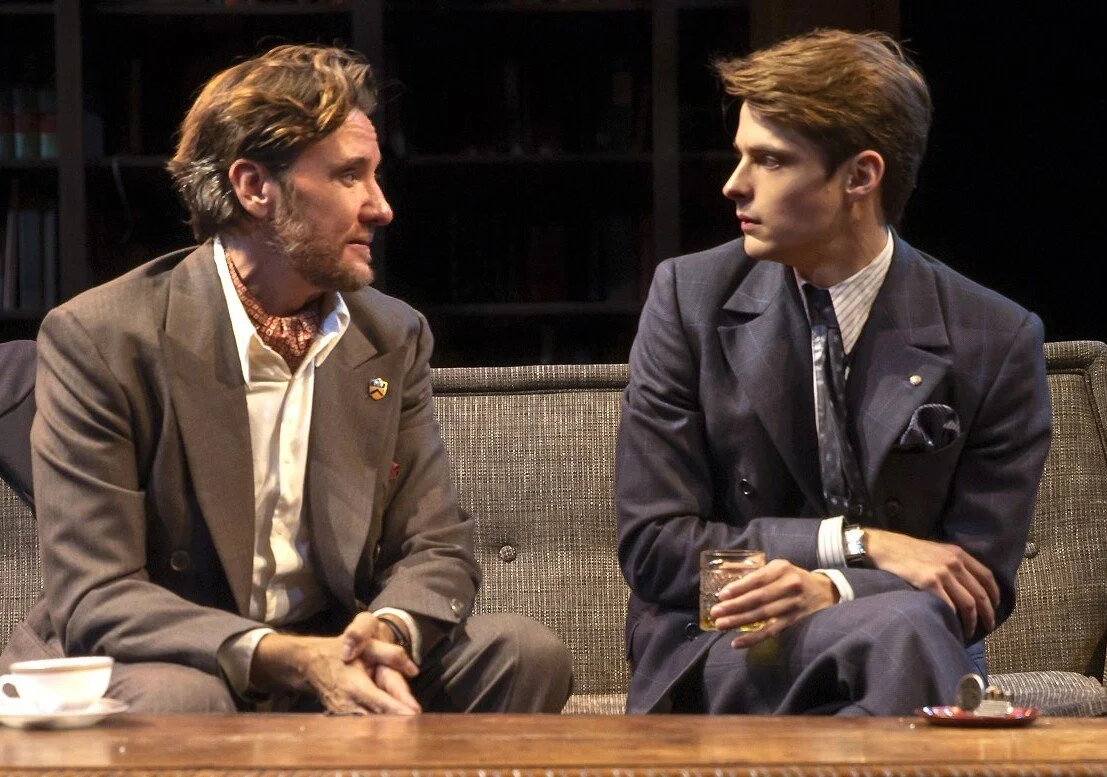
Rupert and Nate have one of many tense moments. Photographs by Monique Carboni.
Greenberg’s dialogue is lively. Leila, played by Gillies with smart sophistication, asking Nate why he’s so anxious: “Are you unwell, in love, or just Jewish?” Rupert to Dick, after Dick agrees with everything Leila says: “Richard, have you considered saving the brain space and letting her operate your mouth?” The cocktail party chatter vs. the corpse they’re dining over is both titillating and gruesome. But the tone keeps shifting uncertainly from one to the other.
Garrett, who describes himself as having “spent his life becoming the person he thinks belongs in the room,” needs to exude charisma, ambition, and ruthlessness; Monaghan doesn’t, he’s just an unpleasant host and a domineering boyfriend. Fogelmanis, meantime, overplays Nate’s nervousness and subservience, quivering, rattling the dishes he’s carrying, displaying bug-eyed horror after dropping a faux pas he fears the others may find suspicious. Waterston’s Judge Kentley is about as interesting as Sir Cedric Hardwicke’s was in the film—not very—and Phillips registers well as an amiable twit. Acting honors go to Gillies and to Harner, who projects Rupert’s intelligence, world-weariness, and superciliousness at just the right levels.
The way Garrett, Nate, and Rupert unashamedly discuss their sexuality, and the way they make out (UnkleDave’s Fight-House is credited with both fight and intimacy direction), don’t feel very 1957. Nor does the barrage of cursing. But McLane’s set and Catherine Zuber’s costumes are spot-on, and Leah Gelpe’s sound design admirably conveys street cries, passing traffic, thunder, and the ’50s pop playing in the phonograph in the next room. The larger question is, why did Greenberg bother to update it at all?
It’s a professional-looking production, well suited to the cozy environs of the Theater at St. Clement’s, and the 90 minutes zip by. But it doesn’t add a lot to the Hitchcock, beyond the in-your-face sexuality and some salty ripostes that the Hays Office would have snipped out. All things considered, you’d do as well to rent the movie.
Rope plays through Dec. 20 at the Theater at St. Clement’s (423 West 46th St.). Evening performances are Tuesday through Sunday at 7 p.m.; matinees are Saturday at 2 p.m. For tickets and more information, visit thenewgroup.org.
Playwright: Gordon Greenberg
Based on a Play By: Patrick Hamilton
Director: Scott Elliott
Scenic Design: Derek McLane
Costume Design: Catherine Zuber
Lighting Design: Jeff Croiter
Sound Design: Leah Gelpe
If you enjoyed this review, please click on the Like icon below.
