
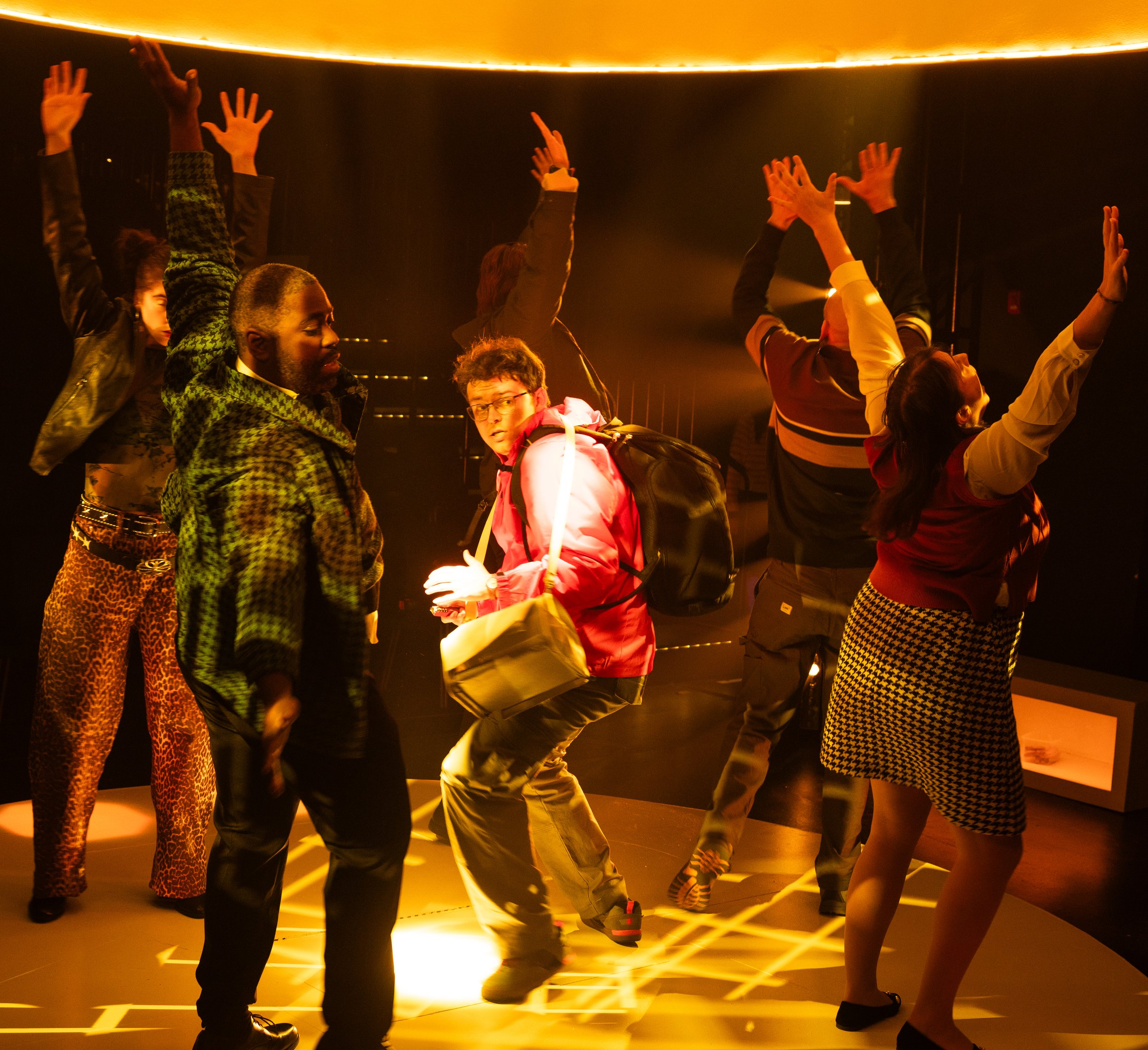
An anxious Christopher (Dominick Mastrodonato, center) sets out alone to visit his mother in London while trying to avoid the touch of fellow travelers (from left: Tess Lancaster, Gerard Riley, Ky Jack Farrell, Mark Shock, and Jordan Boyatt) in Simon Stephens’s stage adaptation of The Curious Incident of the Dog in the Night-Time.
The Curious Incident of the Dog in the Night-Time takes on added resonance in EPIC Players’ production, which places neurodivergent and disabled artists at the center of a story about a young person navigating a world that often misunderstands him. Codirected by Aubrie Therrien and Meggan Dodd, this staging marking the company’s 10th-anniversary season brings unique perspectives to a work that invites audiences to reconsider how they perceive differences in behavior and communication.
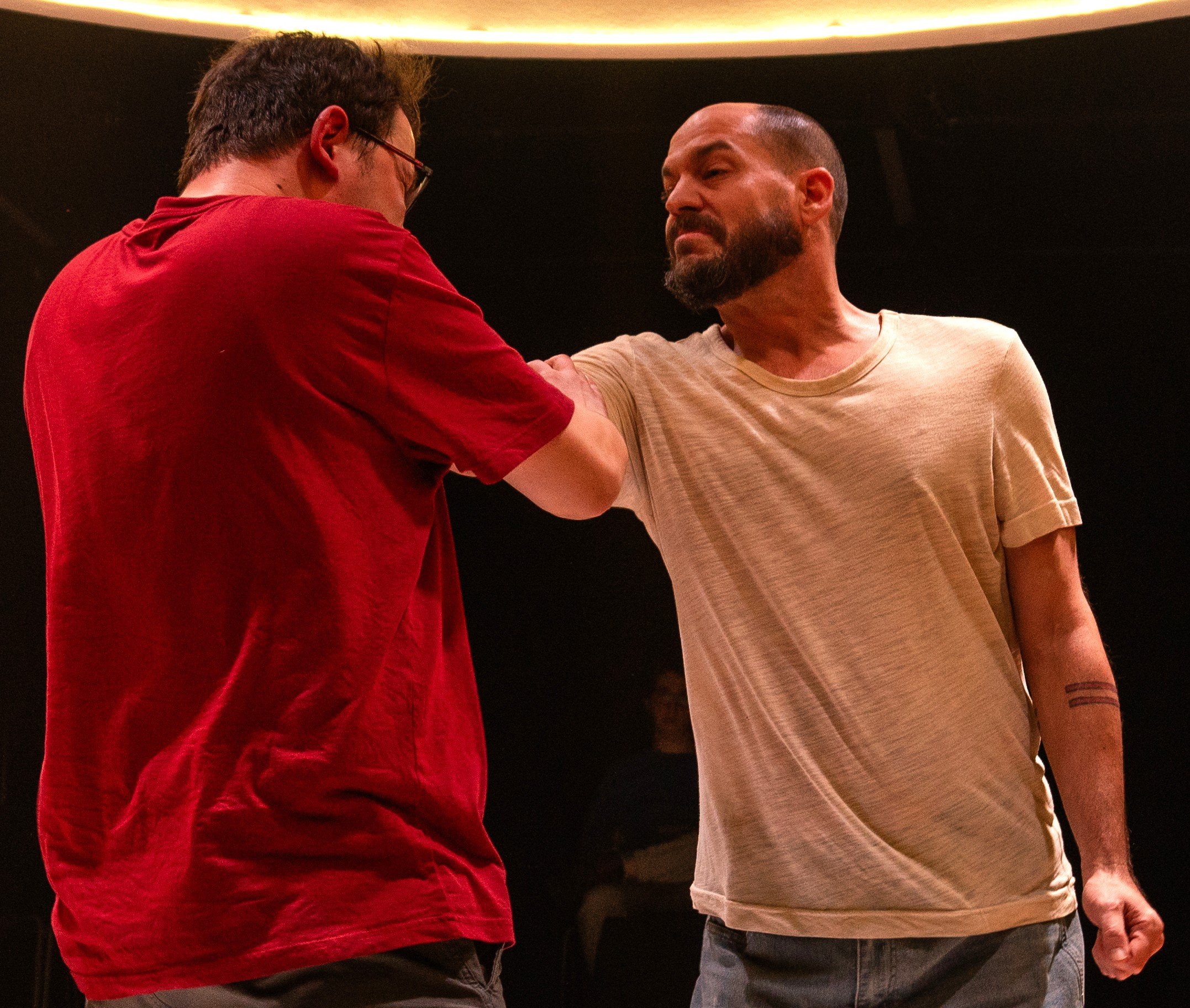
Christopher grows defensive toward his single father Ed (Clay Hedden), whose deep love for his son is complicated by stress, secrecy, and occasional outbursts.
Based on Mark Haddon’s 2003 novel and adapted by Simon Stephens, the play follows Christopher, a 15-year-old mathematics prodigy who struggles with social interactions, cannot bear to be touched, relies on strict routines, and has difficulty understanding metaphors. His investigation into the mysterious death of his neighbor’s dog and the disappearance of his mother, Judy, leads to unsettling discoveries about his family and the world beyond his immediate experience. The play’s greatest triumph, however, may be its ability to capture Christopher’s inner life and give it compelling theatrical expression.
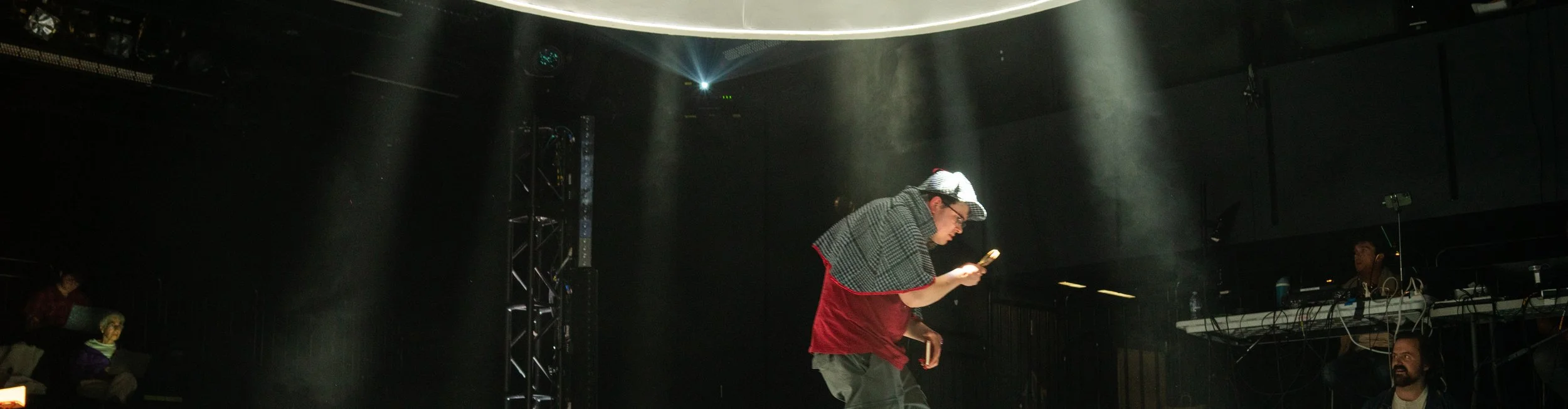
Therrien and Dodd make an inspired choice by staging the production in the round, with audiences seated on all sides. Immersive video projections and layered sound create a multisensory glimpse into Christopher’s mind, drawing audiences into his discoveries and the moments when the world becomes overwhelming.
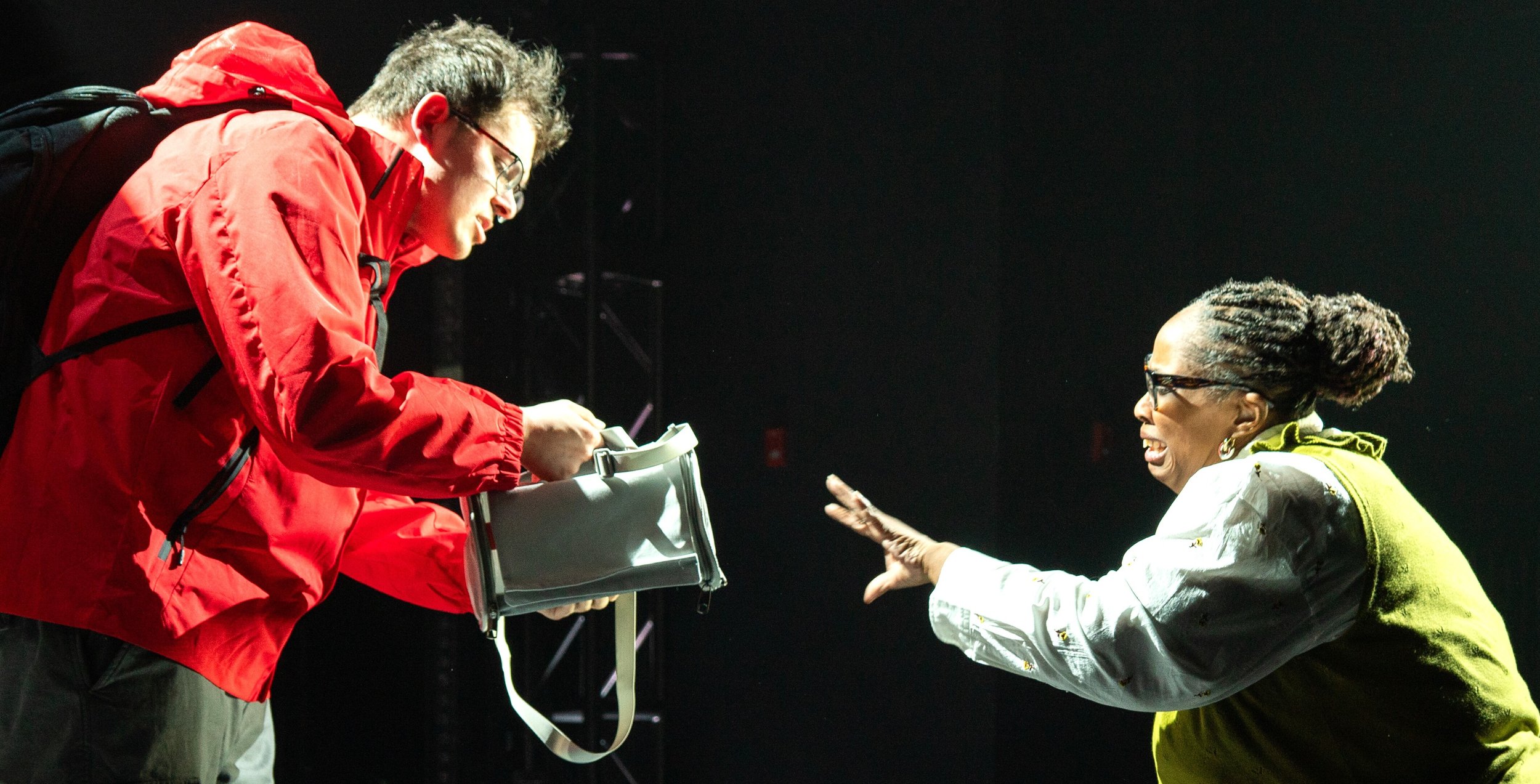
Christopher asks his neighbor Mrs. Alexander (Florence Taylor) to take care of his per rat Toby while he visits his mother in London. Photographs by Zui Gomez.
For those unfamiliar with Stephens’s adaptation, which premiered in London in 2012 before arriving on Broadway in 2014, the storytelling unfolds ingeniously. Christopher’s teacher, Siobhan, reads aloud his account of an investigation modeled on Arthur Conan Doyle’s The Hound of the Baskervilles, as scenes play out physically on stage. This framing device establishes the action while introducing a tension between conventional storytelling and Christopher’s reliance on factual accuracy, forensic evidence and logical reasoning. An early entry reveals his insistence on objective clarity and his extraordinary capacity for memorization:
Siobhan (reading): “My name is Christopher John Francis Boone. I live at 36 Randolph Street, Swindon, Wiltshire. I know all the countries of the world and capital cities. And every prime number up to 7,507.”
Although the investigation begins as a personal project, Siobhan soon suggests turning Christopher’s book into a play. At the beginning of Part 2, she explains that the principal, Mrs. Gascoyne, has proposed a school performance in which everyone can participate. Christopher immediately objects. Siobhan gently challenges his assumptions:
Christopher: No. I don’t like acting because it is pretending that something is real when it is not really real at all so it is like a kind of lie.
Siobhan: But people like stories. Some people find things which are kind of true in things which are made up. You like your Sherlock Holmes stories and you know Sherlock Holmes isn’t a real person, don’t you?
This play-within-a-play structure is one of the production’s most compelling achievements. It grows out of the trusting relationship between Siobhan and Christopher. Her encouragement allows him to approach an unfamiliar form of expression on his own terms, while Stephens’s adaptation demonstrates how storytelling can reveal truths that facts alone cannot fully convey.
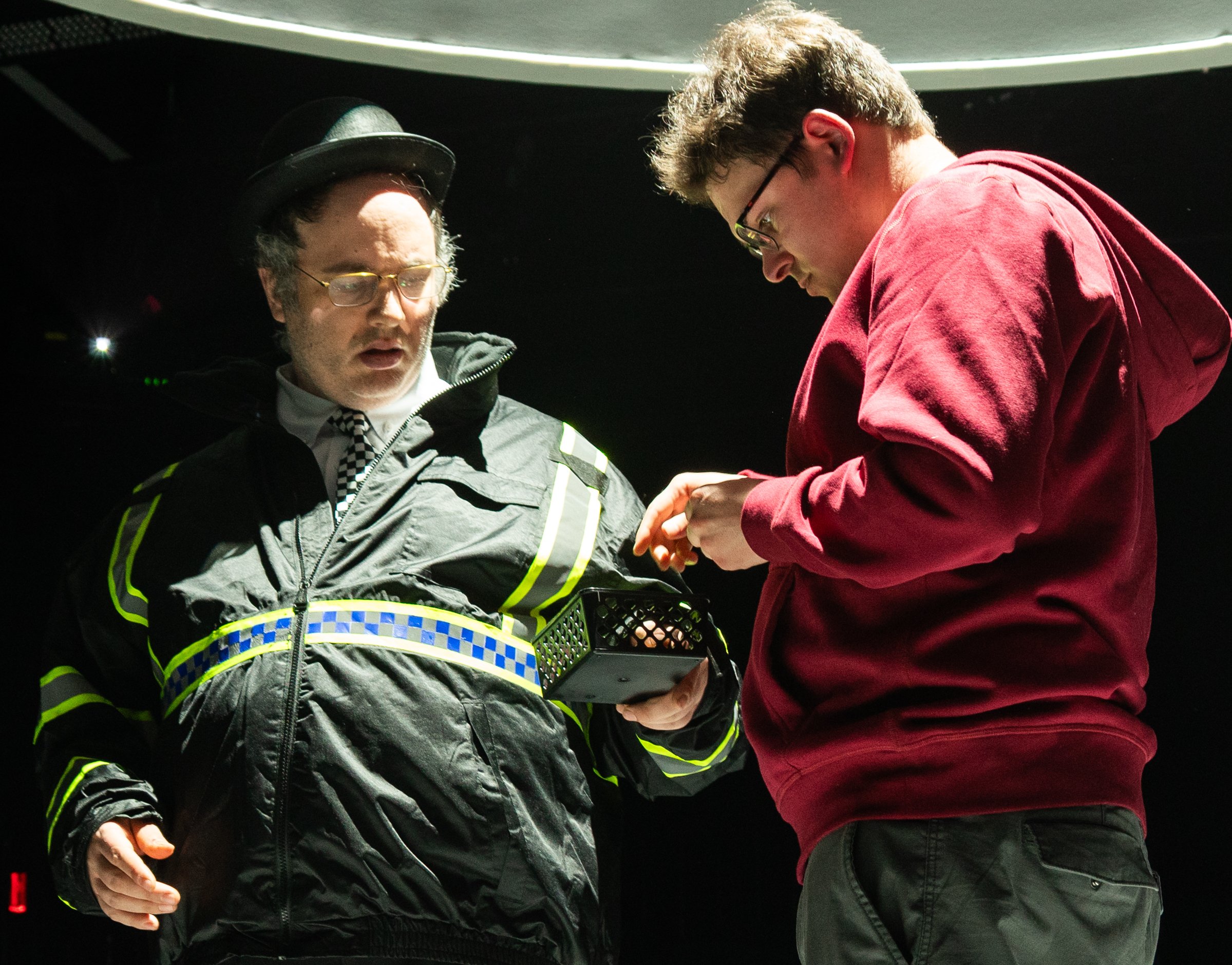
A commuter called Man in Socks (Zachary Lichterman) angrily scolds Christopher for his reckless behavior when rescuing Toby near the rails at a London Underground station.
The production’s projections and sound underscore the distance between Christopher’s orderly explanations and the unpredictable world he must navigate. Rather than asking audiences simply to observe his differences, these theatrical elements draw them into his perspective, making moments of sensory overload and uncertainty part of the shared experience.
Dominick Mastrodonato anchors the production with an impressive performance as Christopher. He captures the protagonist’s zeal, obstinacy and aversion to physical contact, yet makes these qualities emotionally accessible. Jocelyn Ellen Stout and Clay Hedden, as his parents, Judy and Ed, convey the messy, contradictory emotions of their relationship with a son whose world is governed by precise configurations and an unwavering need for order. As Siobhan, Carly Hayes provides a steady, reassuring presence, never betraying exasperation when Christopher becomes overwhelmed, has an outburst or struggles to navigate stressful environments.
EPIC (Empower, Perform, Include, Create) Players’ commitment to accessibility extends to audiences through sensory-safe zones, including a lobby cool-down space; assistive listening devices, headsets and neck loops; ADA-accessible and companion seating; and sunglasses to reduce lighting glare. Through its multisensory staging and the perspectives of its neurodivergent and disabled artists, this production invites audiences to reconsider how differences are perceived and understood. Christopher’s journey reminds us that there is more than one way to experience and make sense of the world.
The Curious Incident of the Dog in the Night-Time plays through Dec. 6 at A.R.T./NY Mezzanine Theatre (502 W. 53rd St.). Performance dates and times are irregular and may be viewed, along with other information, at epicplayersnyc.org.
Playwright: Simon Stephens, adapted from the novel by Mark Haddon
Director: Aubrie Therrien & Meggan Dodd
Scenic Design: Christian Fleming
Lighting Design: Cameron Filepas
Costume Design: Sophie Howard
Sound Design: Chikadibia Ebirim
If you enjoyed this review, please click on the Like icon below.
