
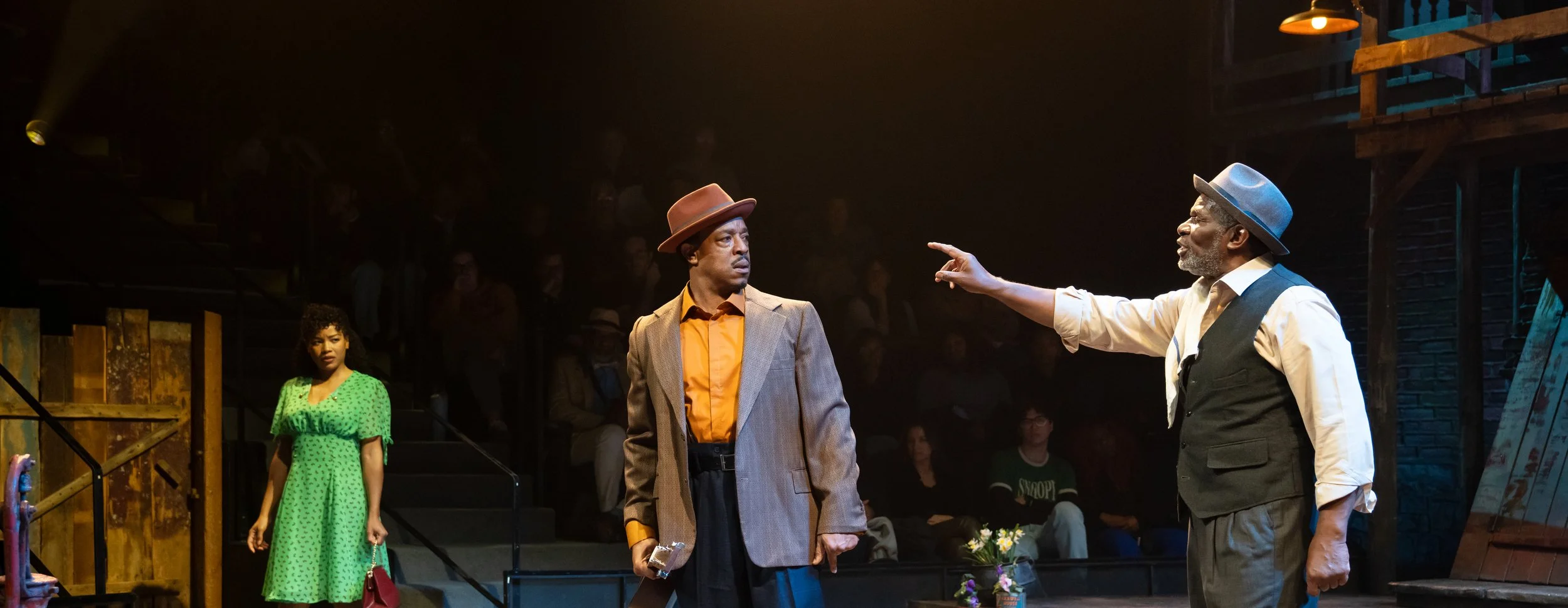
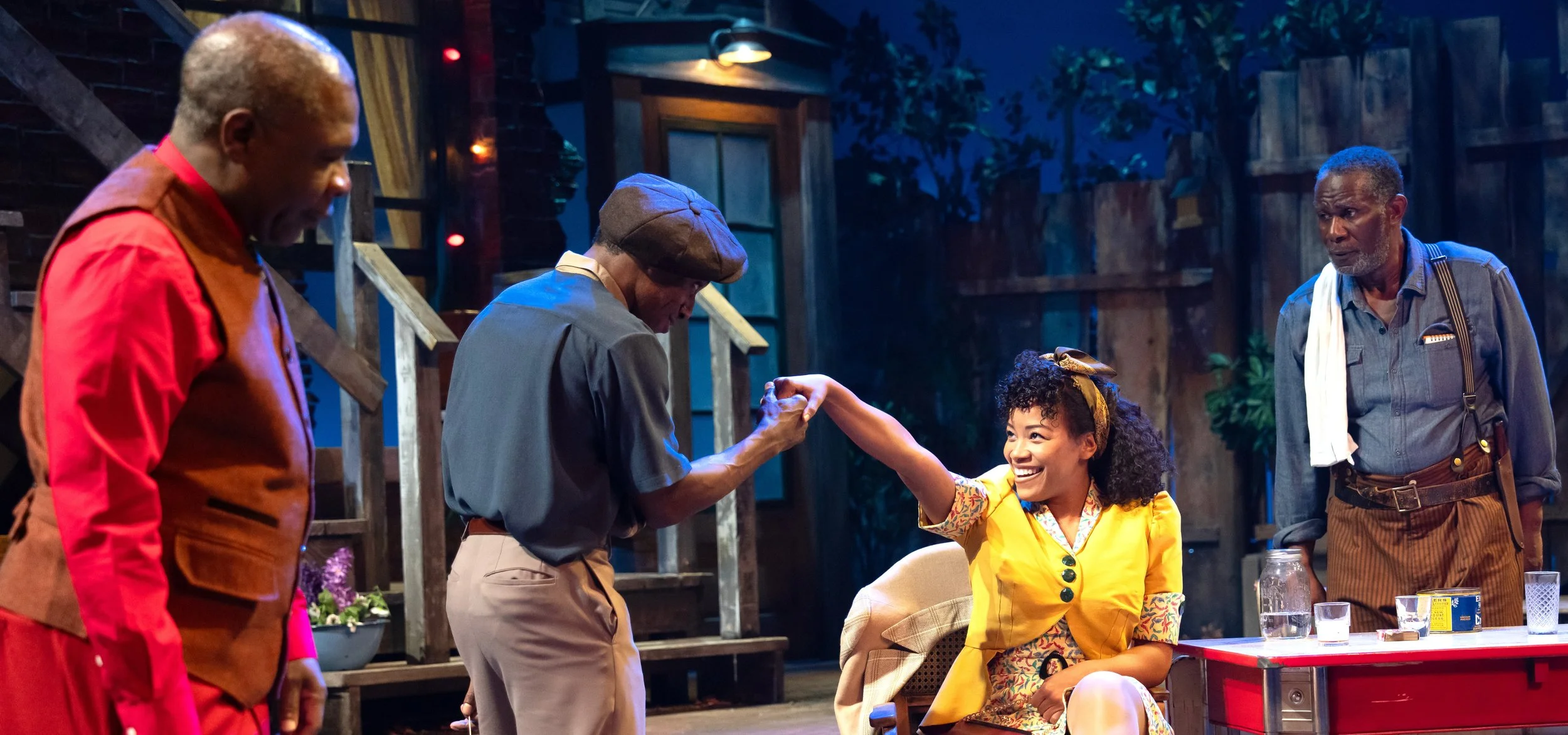
From left: Michael Potts plays Red Carter, Daniel J. Watts is Canewell, Chanté Adams is Ruby, and John Douglas Thompson is Hedley in Lincoln Center Theater’s production of August Wilson’s Seven Guitars.
Theater scholars often describe the plays of August Wilson as operatic. The characters are larger than life, and the dialogue, teeming with musicality, is interspersed with aria-like monologues that plumb the spiritual and mystical elements of the Black experience in America. Working-class struggles are portrayed on an epic scale, with fate intervening in the manner of classical tragedy. The current revival of Seven Guitars, now playing in Lincoln Center’s Mitzi Newhouse Theater, retains the monumental lyricism and shimmering vitality one expects from Wilson, but under Ruben Santiago-Hudson’s virtuoso direction, the play reveals new depths as an intimate chamber piece.
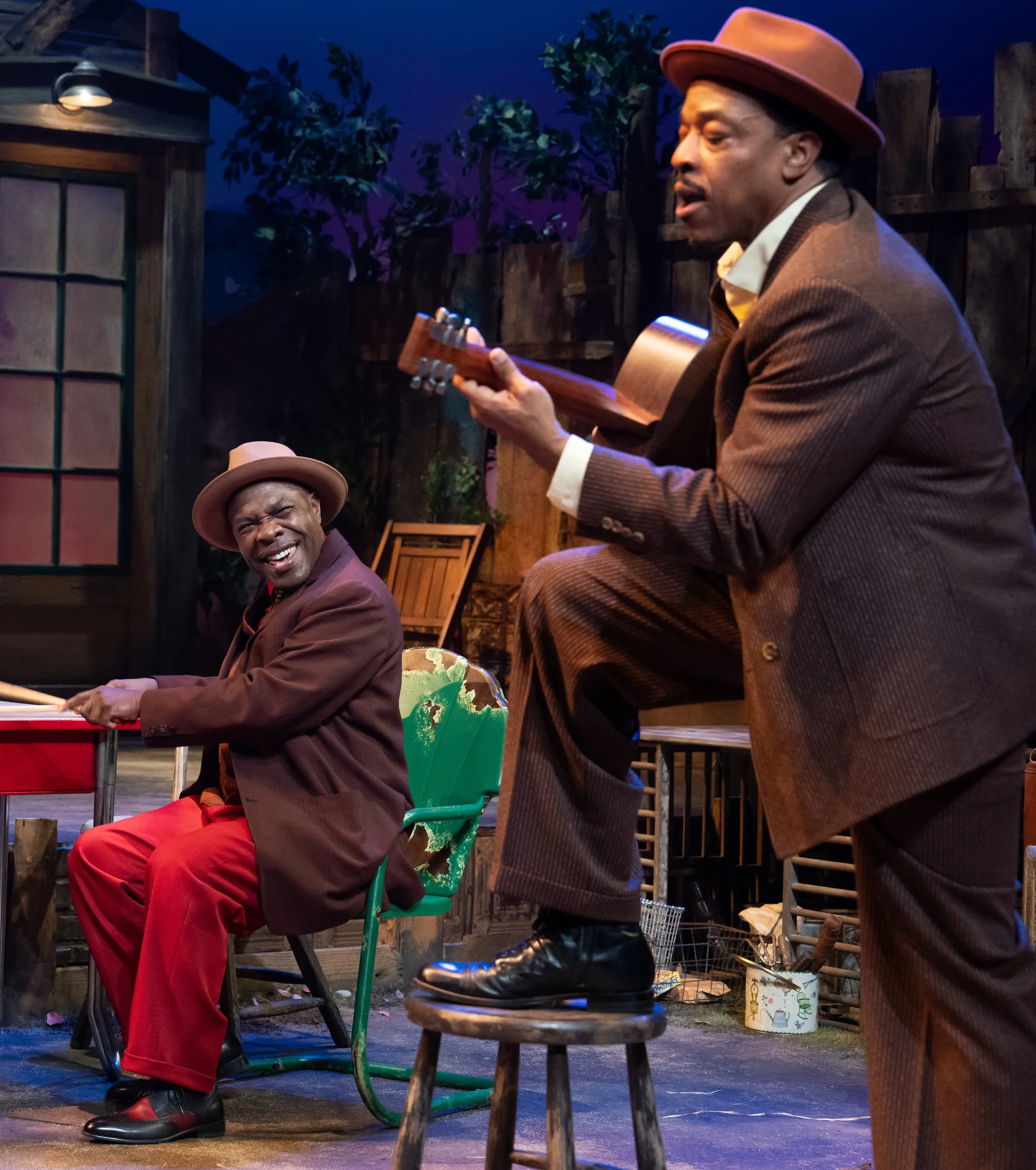
As Floyd “Schoolboy” Barton, Russell Hornsby (right), leads an impromptu jam session with Red Carter providing the percussion.
That quieter register proves especially fitting for a drama rooted in the quotidian lives of seven African Americans in 1948 Pittsburgh. As Wilson wrote in the play’s prefatory note, “I happen to think that the content of my mother’s life—her myths, her superstitions, her prayers, the contents of her pantry, the smell of her kitchen, the song that escaped from her sometimes parched lips, her thoughtful repose and pregnant laughter—are all worthy of art. Hence, Seven Guitars.” The staging leans into these commonplace rudiments, riffing on them like recurring jazz motifs that gradually bind the seven characters into a tight-knit community.
Santiago-Hudson is no stranger to the play, having won a Tony Award for his performance in the original 1996 Broadway version, and he directed the indelible Signature Theatre revival in 2006. Just as a complex melody reveals new layers across decades, his command of the material only grows deeper and more illuminating. For this production, he is working with an impeccable ensemble that understands and embodies the rhythms and souls of Wilson’s creations.
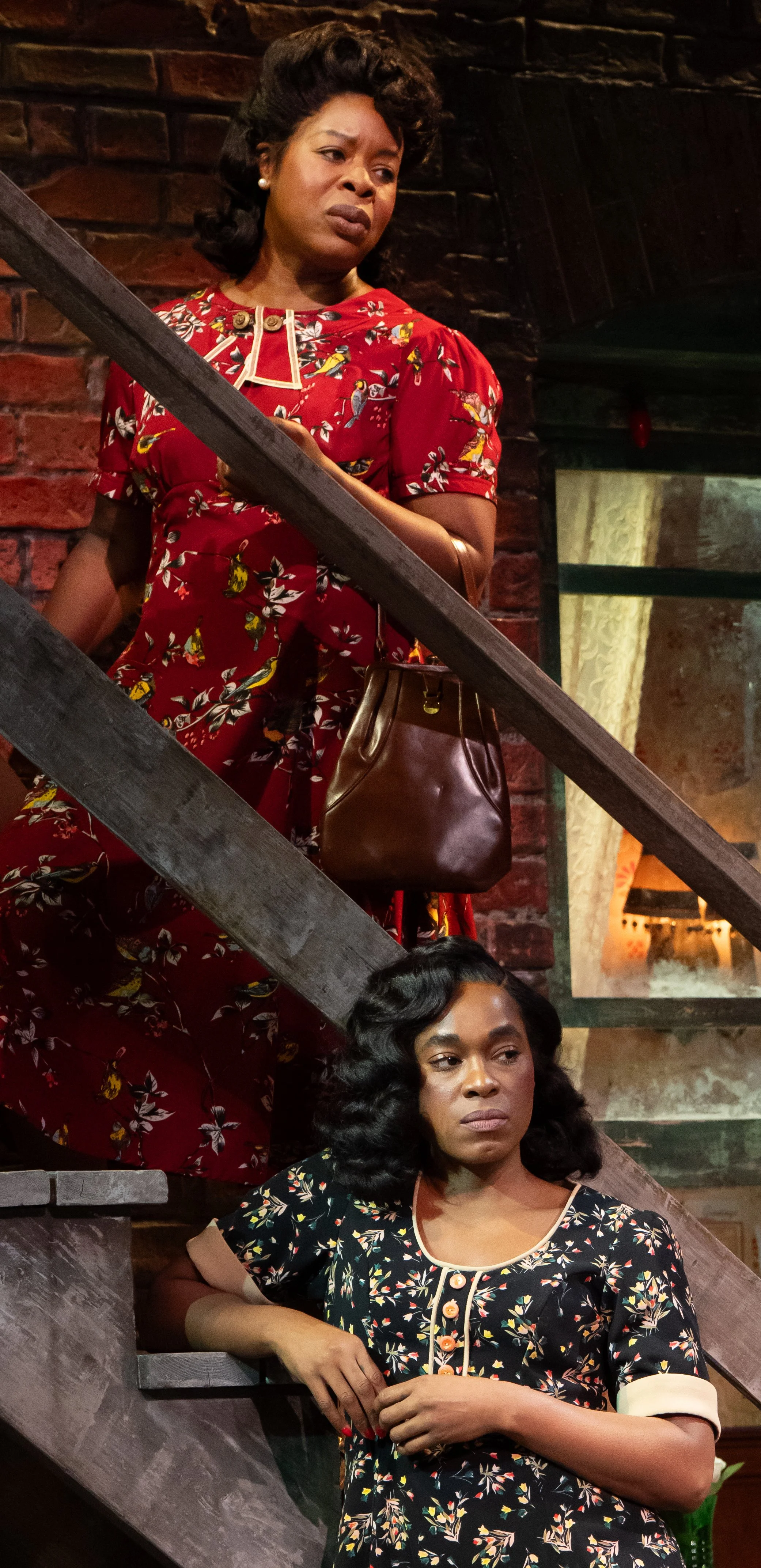
Roslyn Ruff is Louise, a formidable and pragmatic proprietor, and Kristolyn Lloyd is Vera, an emotionally guarded young woman with conflicted feelings for Floyd.
The central character is Floyd “Schoolboy” Barton (Russell Hornsby), a blues musician with a hit record and ambitions of breaking into the big time. Hornsby captures both the man’s seductiveness and his dogged determination in a world intent on holding him back. Kristolyn Lloyd is heartbreaking as Vera, a woman who has fallen under Floyd’s spell but has been hardened by his past betrayals. As Louise, Roslyn Ruff (who was a splendid Vera in the 2006 iteration) brings an earthy sensuousness in addition to tough-minded compassion to her watchfulness over her niece, Ruby, whom Chanté Adams plays with charming insouciance and a mischievous magnetism.
Daniel J. Watts and Michael Potts are wry and affecting as Floyd’s bandmates, Canewell and Red Carter, confronting systemic racism with a blend of pragmatism and sarcasm. In a hilarious monologue, Canewell synthesizes life’s hardships through the story of Lazarus, arguing he would have been better off never raised from the dead. On his second deathbed, Canewell recounts, Lazarus spotted Jesus approaching once more: “Lazarus saw him coming and said, ‘Oh no, not you again!’ See, all Jesus had done by raising him from the dead was to cause him to go through that much more suffering.” Because Lazarus “was suffering the pain of living,” Canewell philosophically concludes, “that’s why the Bible say you supposed to rejoice when somebody die and cry when they come into the world.”
Rounding out the cast is John Douglas Thompson as Hedley, a prophet-like figure awaiting the resurrection of Buddy Bolden to deliver personal redemption. Thompson is remarkably restrained and eerily effective, performing Hedley’s sacrificial bloodletting with a matter-of-fact solemnity that ominously foreshadows the tragedy ahead.
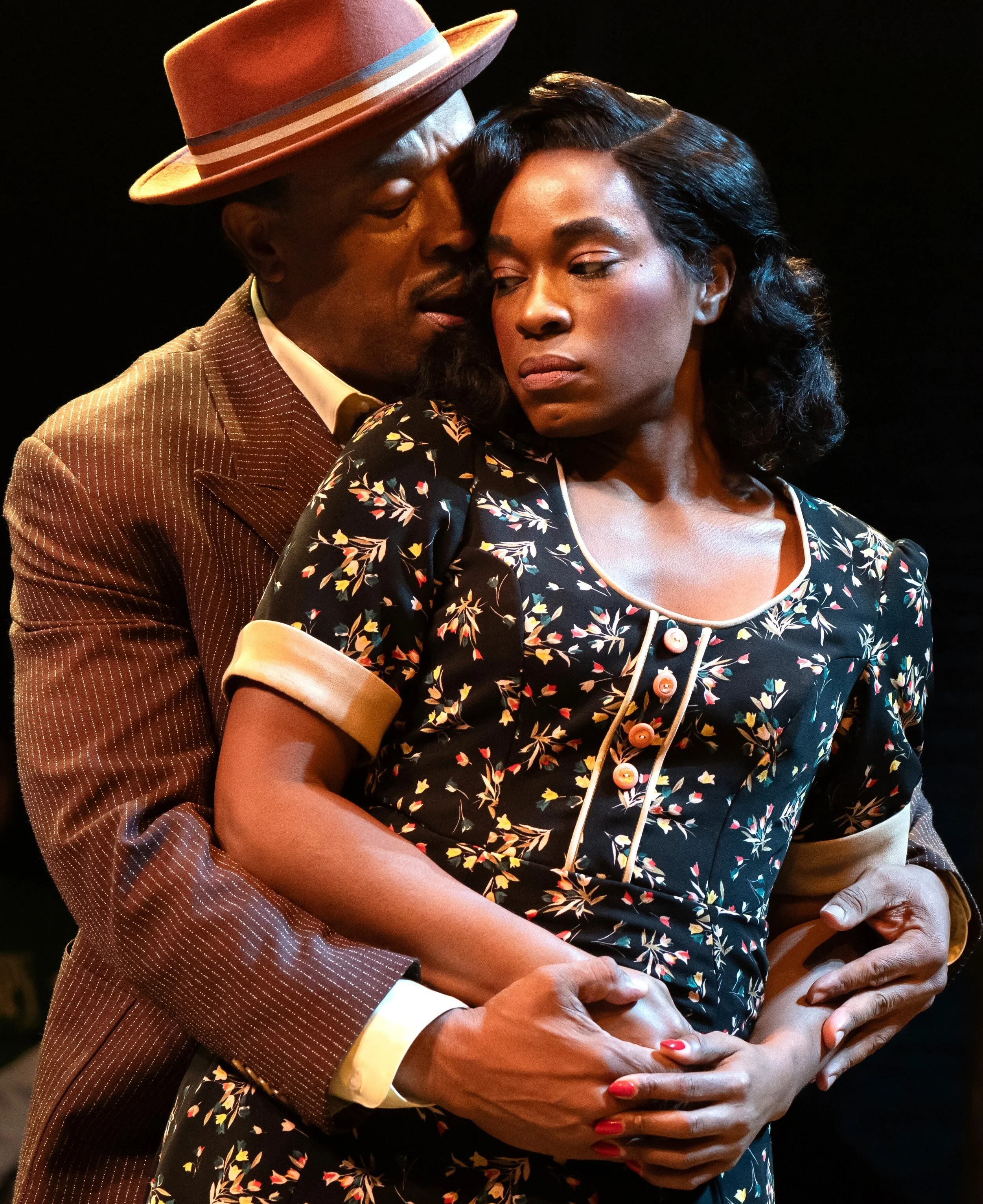
Floyd and Vera share a quiet moment. Photographs by Julieta Cervantes.
Christian allusions permeate Wilson’s script, and the lived experiences of the characters are at odds with the comforting platitudes of scriptural teachings. This spiritual tension extends to Michael Carnahan’s scenic design, which richly evokes the crowded but welcoming environs of Pittsburgh’s Hill District. The boardinghouse backyard offers a communal gathering space for the characters, while a towering telephone pole rising out of the ground like a crucifix on Calvary Hill serves as a grim reminder of the devastation looming over their lives.
Even as death haunts the proceedings (it begins immediately after a funeral), joy and camaraderie pervade the play. Junior Mack’s original music provides a driving underbeat (deftly modulated by Justin Ellington’s sound design), while Karen Perry’s vibrantly colored costumes and Rui Rita’s warm lighting infuse the stage with an undeniable vitality.
During an impromptu blues session, Hedley assembles a makeshift, one-string guitar. When the other musicians scoff at his musical contribution, he replies, “One string make plenty plenty music.” In this transcendent production, Seven Guitars creates an unforgettable and soul-stirring song.
Seven Guitars plays through Jan. 10 at the Mitzi E. Newhouse Theater at Lincoln Center. Evening performances are at 7 p.m. Tuesday, Thursday, and Friday and at 8 p.m. Wednesday and Saturday; matinees are at 2 p.m. Wednesday and Saturday and at 3 p.m. Sunday. For tickets and more information, visit lct.org.
Playwright: August Wilson
Director: Ruben Santiago-Hudson
Scenic Design: Michael Carnahan
Costume Design: Karen Perry
Lighting Design: Rui Rita
Sound Design: Justin Ellington
If you enjoyed this review, please click on the Like button below.
