
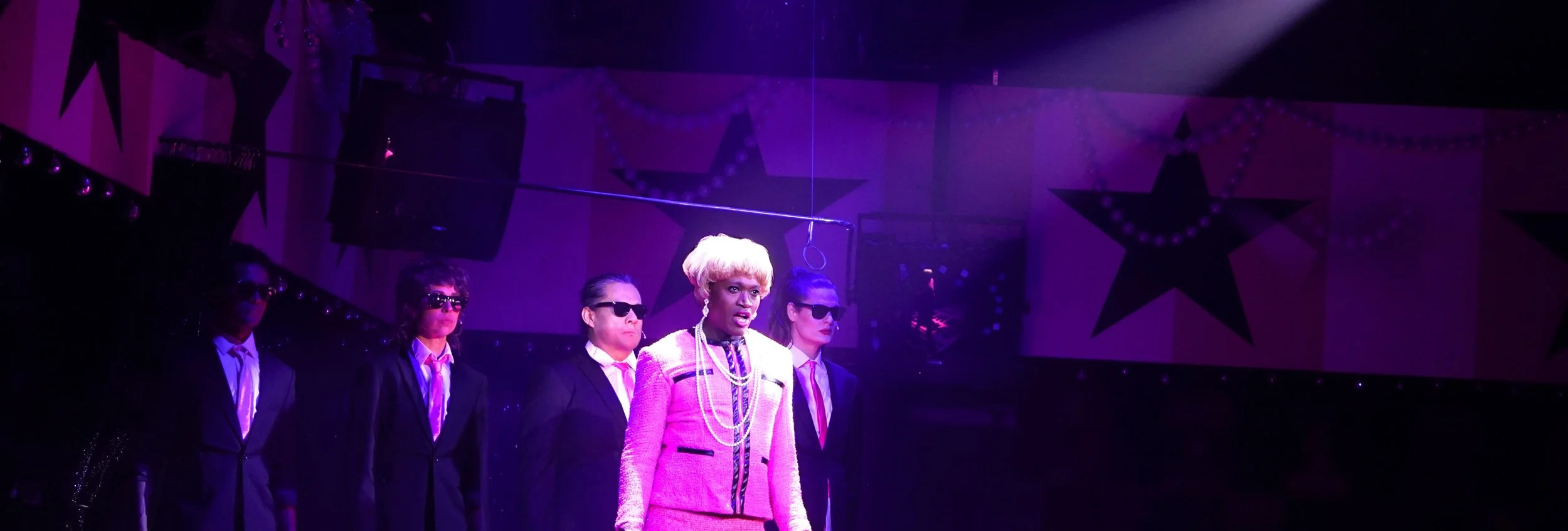
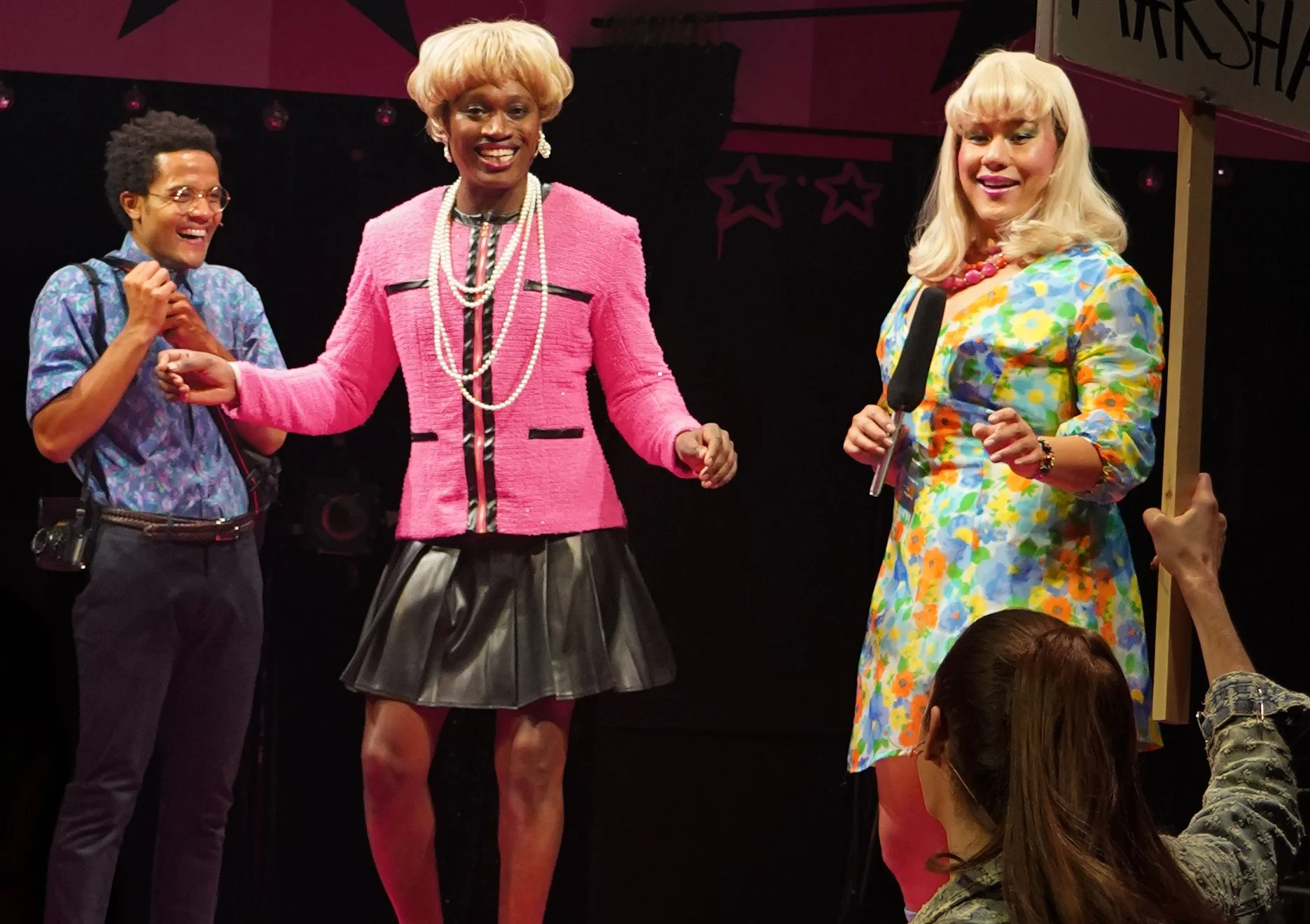
Nic Ashe (left) as political activist JJ, Ato Blankson-Wood (center) as presidential hopeful Joan Jett Blakk, and Kelvin Moon Loh as drag media maker Glennda Orgasm arrive jubilantly at the 1992 Democratic National Convention in Tarell Alvin McCraney and Tina Landau’s Ms. Blakk for President.
Ms. Blakk for President, co-written by Tarell Alvin McCraney and Tina Landau, who also directs, revisits the early 1990s through the story of Joan Jett Blakk, the first Black—and only drag queen—to run for president of the United States. Inspired by, but not strictly adhering to, the life of Chicago drag performer and activist Terence Alan Smith, who adopted the Blakk persona, the production unfolds as a fever dream—part docudrama, part party, part vaudeville, part political campaign—while exploring the demands of acting in good conscience.
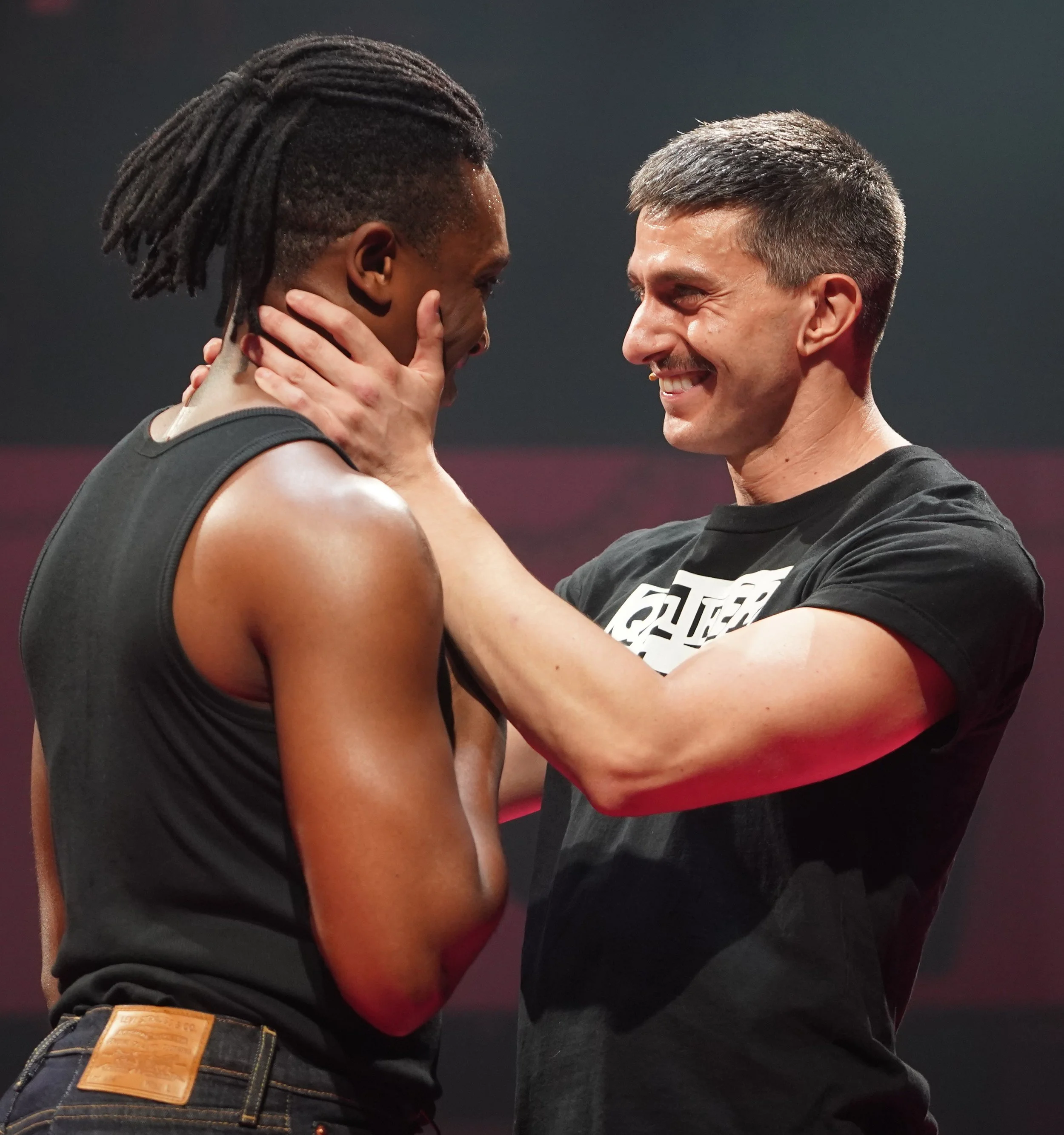
Political co-creators Terence (Blankson-Wood) and Mark (Gideon Glick) together invent the drag persona of Joan Jett Blakk, which becomes Terence’s alter ego in his campaign for mayor of Chicago in 1990 and then for president of the United States in 1992.
The theater becomes an immersive environment, with photographs documenting Queer Nation and ACT UP (AIDS Coalition to Unleash Power), café tables with shaded lamps, raised platforms connected by catwalks, and suspended 1980s television sets. Music videos initially play on the screens before giving way to political tracts. Performers mingle with spectators, ready to draw them into the action.
A six-member ensemble—Nic Ashe, Ato Blankson-Wood, Gideon Glick, Kelvin Moon Loh, Sawyer Smith, and Adina Verson—brings the story to life. Smith/Blakk serves as principal narrator, using the flamboyant patter of a carnival barker and auctioneer, while four performers, identified as Q, L, J, and G, support him in multiple roles, including Queer Nation activists, police officers, and reporters.
The show erupts with raw energy as Terence impersonates Janis Joplin, singing “Piece of My Heart.” The exuberance quickly gives way to a political exchange when Terence stops the live band, breaks the fourth wall, and asks the audience:
Do you want a president? I promise it’s not a trick question. It’s in the title. Do you want a president? Listen, I like to have consent. And we have to elect a president, assuming you want one.
After the audience pledges its support, discordant sounds erupt from the television screens, accompanied by AIDS statistics and footage of presidents Ronald Reagan and George H. W. Bush. Nine years into the AIDS crisis, the shift from entertainment to the nightmare confronting the queer community is jarring. Whenever the epidemic resurfaces, the show’s caricatured theatricality gives way to the devastating reality of a public health tragedy.
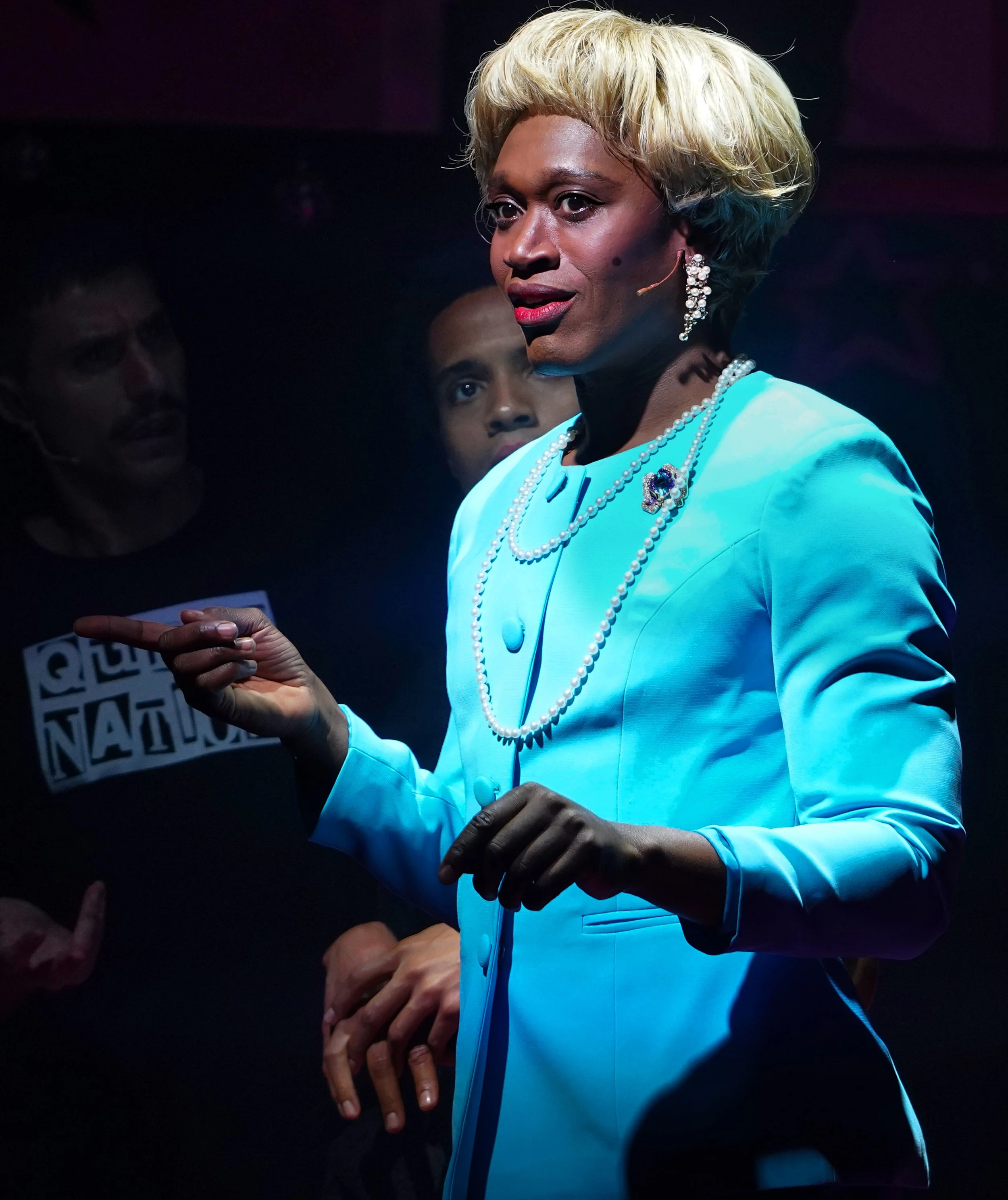
Joan runs for President of the United States on the Queer Nation platform in 1992, daring to challenge the status quo and bring attention to the AIDS health crisis. Photographs by Carol Rosegg.
The play’s first half traces Terence’s path from childhood to political activism. Recalling Catholic school, he quips, “Just me and a bunch of white kids. I sat right in the front row. Teacher’s pet every year!” His teenage obsession with David Bowie becomes an inspiration; as “Starman” plays, Q appears as Ziggy Stardust in shimmering regalia and blazing colors, singing directly to Terence. The reverie ends with Mark’s arrival in a Queer Nation T-shirt. His silent presence prompts Terence to recount his role as a founding member of Queer Nation Chicago and his 1990 mayoral campaign against Chicago Mayor Richard M. Daley. Mark, his future campaign manager, urges him to run as a drag queen:
C’mon, a drag queen candidate for mayor of the toughest American city, the City of Big Shoulders! Think of it, Terence Smith becomes . . .
The ensemble then launches into the Rolling Stones’ “Paint It Black,” recast as “Paint It Blakk.” As Joan works the crowd, performers brandish campaign signs and unfurl a banner bearing one word: “Blakk.” After losing the mayoral race as a write-in candidate, Terence sets his sights on the presidency, noting that he will turn 35 the following January and meet the Constitution’s minimum age requirement. Fleetwood Mac’s “Don’t Stop”—also Bill Clinton’s 1992 campaign theme—underscores the decision.
Audience participation remains central. At a Gay Impact Gala in Chicago, Mark escorts Joan to a woman in the audience, introducing her as Geraldine Ferraro, the Democratic vice-presidential candidate in 1984. Joan greets her with a campaign button: “I supported you last time and now I want you to support me! Quid pro quo, ho.” The exchange captures the production’s irreverent fusion of political theater and audience engagement.
The crackerjack ensemble keeps this 90-minute production entertaining and provocative. Blankson-Wood gives a highly physical yet nuanced performance in the title role, while Glick makes an effective foil as Terence’s savvy, more seasoned campaign manager. Moon Loh is equally engaging as Glennda Orgasm, combining an outsized drag persona with political activism. Filming and interviewing convention-goers, Glennda promotes queer visibility and representation while helping Joan gain access to the Democratic National Convention floor. The character’s efforts underscore the importance of making queer voices visible in political spaces from which they have long been excluded.
Having premiered at Chicago’s Steppenwolf Theatre in 2019, Ms. Blakk for President arrives Off Broadway as an important, if unconventional, chronicle of overlooked LGBTQ history and a tribute to a political trailblazer who dared to challenge the status quo despite knowing the odds were stacked against her.
Ms. Blakk for President plays through Nov. 29 at the Vineyard Theatre (108 E. 15th St.). Performance dates and times are somewhat irregular and may be viewed, along with other information, at vineyardtheatre.org.
Playwright: Tarell Alvin McCraney & Tina Landau
Director: Tina Landau
Scenic Design: David Zinn
Lighting Design: Bradley King
Costume Design: Ari Fulton
Sound Design: Lindsay Jones
If you enjoyed this review, please click on the Like icon below.
