
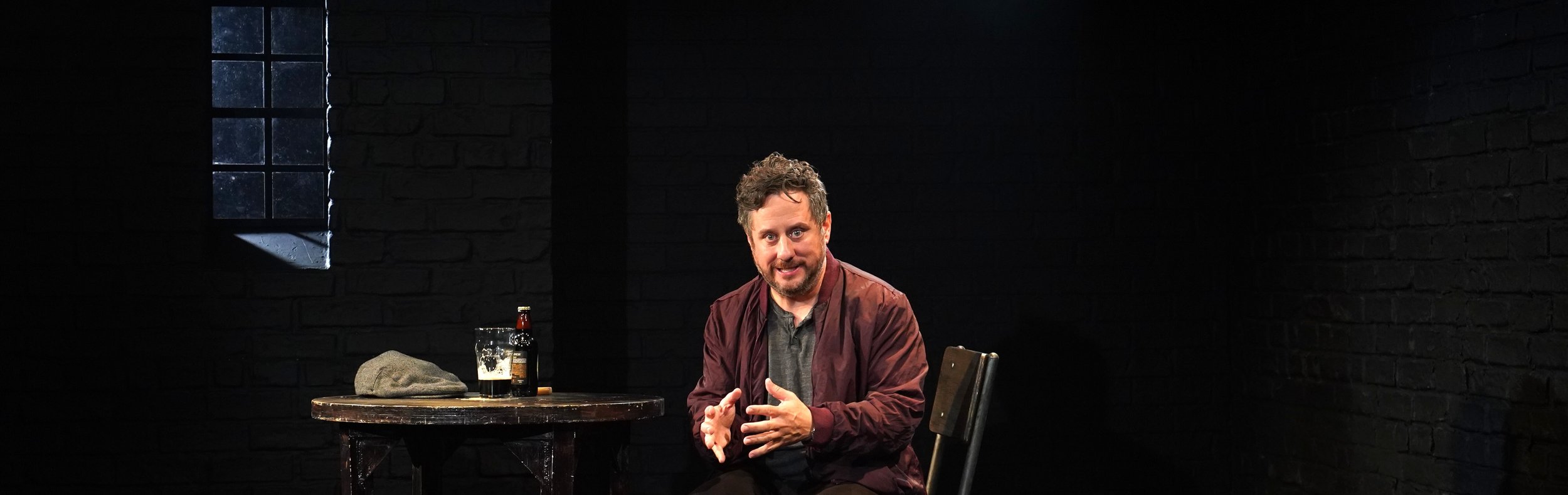
Christopher Fitzgerald plays the unnamed narrator in Conor McPherson’s early career monologue The Good Thief, now being revived at the Irish Rep.
The Good Thief, an early work of the renowned Irish playwright Conor McPherson (it premiered in 1994, when McPherson was 23), is a monologue spoken by a small-time Dublin criminal. The production currently running at the Irish Rep, featuring Christopher Fitzgerald as the protagonist—the “good thief” of the title, a reference to the Gospel of Luke—and directed by Justin Waldman, is a lightly engaging 70 minutes but is unable to tap into the more sinister resonances of the piece. It has the feel of a somewhat melodramatic story told by a harmless barfly, rather than a glimpse into a heart of darkness.
The play bears some marks of a young writer—chiefly, a low-level enforcer is given a poet’s eye, which can come off as affected. But it also contains some signature McPherson characteristics, such as richly detailed writing, haunting imagery, and interesting tonal shifts.

“The good thief” is an allusion to the Gospel of Luke, and one of the criminals crucified alongside Jesus, who asks to be remembered when he enters the Kingdom of Heaven. McPherson’s thief seems to be focused on remembrance from the audience for his sordid tale.
The unnamed protagonist sips a glass of Guinness and speaks directly to the audience in the tight confines of the downstairs W. Scott McLucas Studio Theatre. In the opening, he’s blasé about his profession, with a casual matter-of-factness that elicited laughter: “I was working for Joe Murray at this time as a paid thug. I scared people for him. Set fire to places. Shot people. As warnings.” Yet the laughter continued even as darker specifics followed:
My girlfriend Greta had just left me but I still saw her most days because she had left me for Joe Murray. Power attracts women. Also, I had been beating her up and I knew it was wrong but I’m not the issue here, so let’s leave it. Let’s not. She annoyed me.
These moments should presumably be blood-chilling—just as the “thug” is hovering on the brink of likability, the audience gets pulled back to the stark reality of his violent life. But Fitzgerald and Waldman keep the tone light, which can be a strength but also risks reading as toothless.
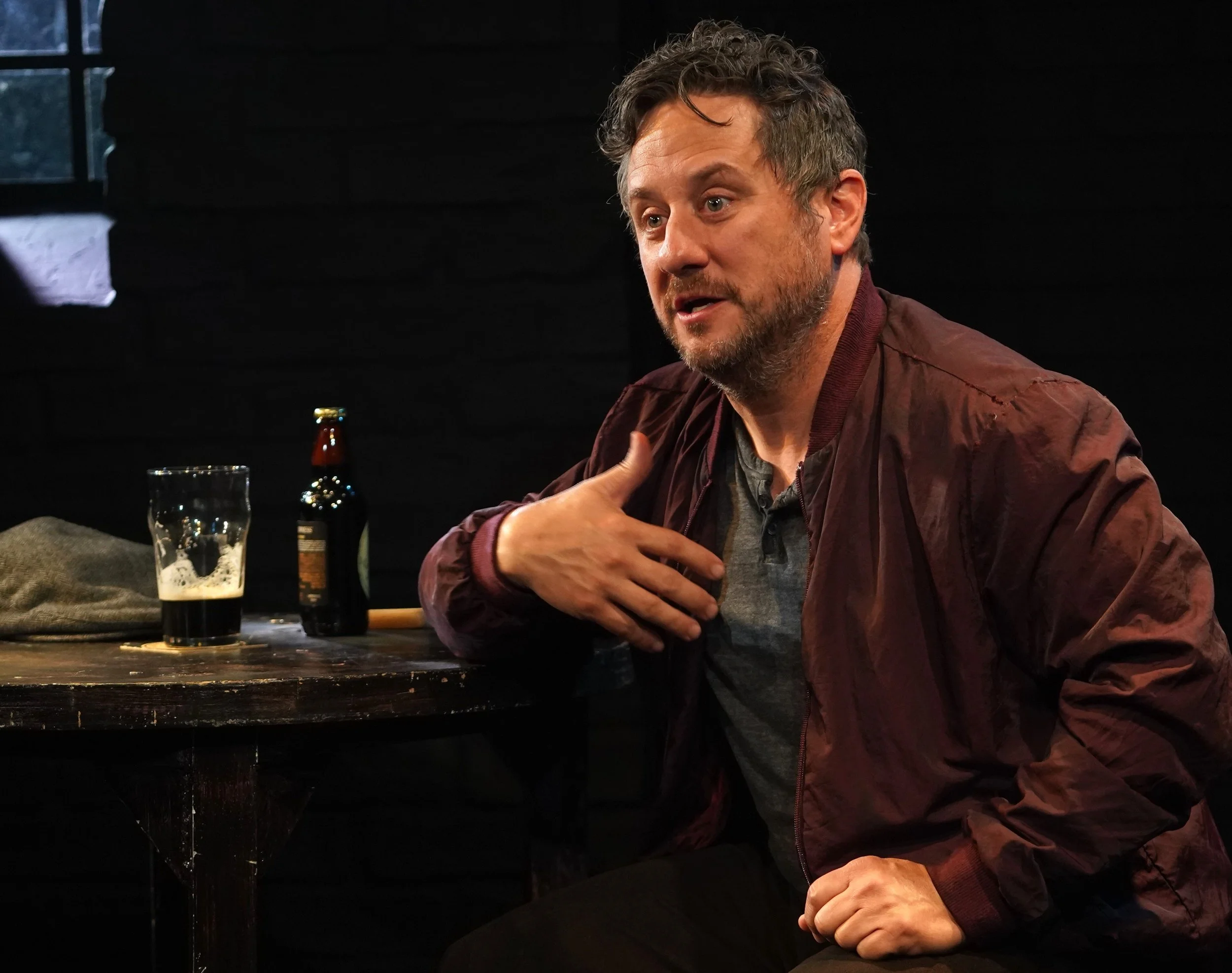
There’s no doubt that Fitzgerald has a gift for the yarn-telling aspect of the play. He speaks clearly and affably with a brogue and is enjoyable to listen to. He alternately sits at a table with his beer and stands to face the audience (scenic design by Wilson Chin, whose set includes a small window behind the table). Unlike many one-person plays, this one doesn’t call for voicing other characters—it’s pure narration. Between scenes, he sits as the lights dim (lighting design by Jen Leno) and music or sound effects play (sound design by Drew Levy).
The narrative relies on the overly familiar crime trope of a seemingly straightforward job gone very wrong. Sent to intimidate a Mr. Mitchell, the protagonist arrives, armed and balaclava-clad, to find Mr. Mitchell accompanied by his wife and her young daughter, as well as two other hoodlums who’ve anticipated his arrival. A shoot-out ensues, followed by the revelation that he’s been double-crossed, and finally the need to escape before Joe Murray’s scariest hired help arrives.
The protagonist flees with Mrs. Mitchell and the 3- or 4-year-old girl, but not before observing, in an implausibly writerly voice, “The kitchen had every modern appliance, and for some reason that made me sad.” Tentative signs of trust and even affection develop between the protagonist and Mrs. Mitchell and Niamh (her daughter). But Mrs. Mitchell never emerges as much of a character, and Niamh feels like a prop—a blank stand-in for innocence in a corrupt, violent world.

Fitzgerald speaks directly to the audience in relaying his tale of a routine crime that goes awry. Photographs by Carol Rosegg.
The story becomes increasingly far-fetched. As media scrutiny heats up, the group needs to lie low, so the protagonist calls on an old friend, Jeff, who works in real estate in Sligo. Jeff not only springs into action by getting them all a remote house, but also invites his wife and children over for a picnic. When the fate of Jeff and his family is revealed, it doesn’t seem to land with either the audience or the protagonist—predictability deflates the shock.
The ending is tragic, though the narrator survives. But what is the takeaway from his journey? Rather than reflecting on Mrs. Mitchell or Niamh, he ends on a tender image of Greta, the woman he’s been casually disparaging on and off during the entire monologue.
In plays like The Weir, McPherson loads every utterance, no matter how seemingly trivial, with meaning. In this production of The Good Thief, however, the lines never add up to more than the sum of their parts. A more probing staging might have compensated for the script’s weaknesses. A story built to have audiences on edge here lacks tension.
The Good Thief runs through Dec. 20 at the Irish Repertory Theatre (132 W. 22nd St.). Evening performances are at 7 p.m. Tuesday through Saturday; matinees are at 2 p.m. Wednesday and Saturday and at 3 p.m. Sunday. For tickets, visit irishrep.org.
Playwright: Conor McPherson
Director: Justin Waldman
Set Design: Wilson Chin
Costume Design: Jess Goldstein
Lighting Design: Jen Leno
Sound Design: Drew Levy
