
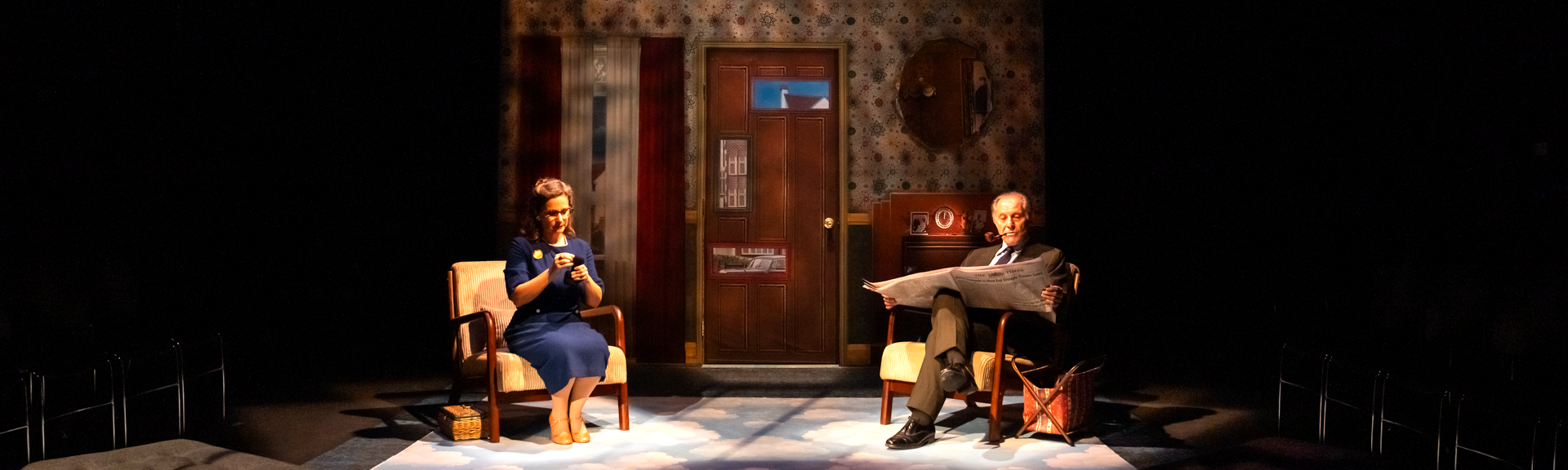
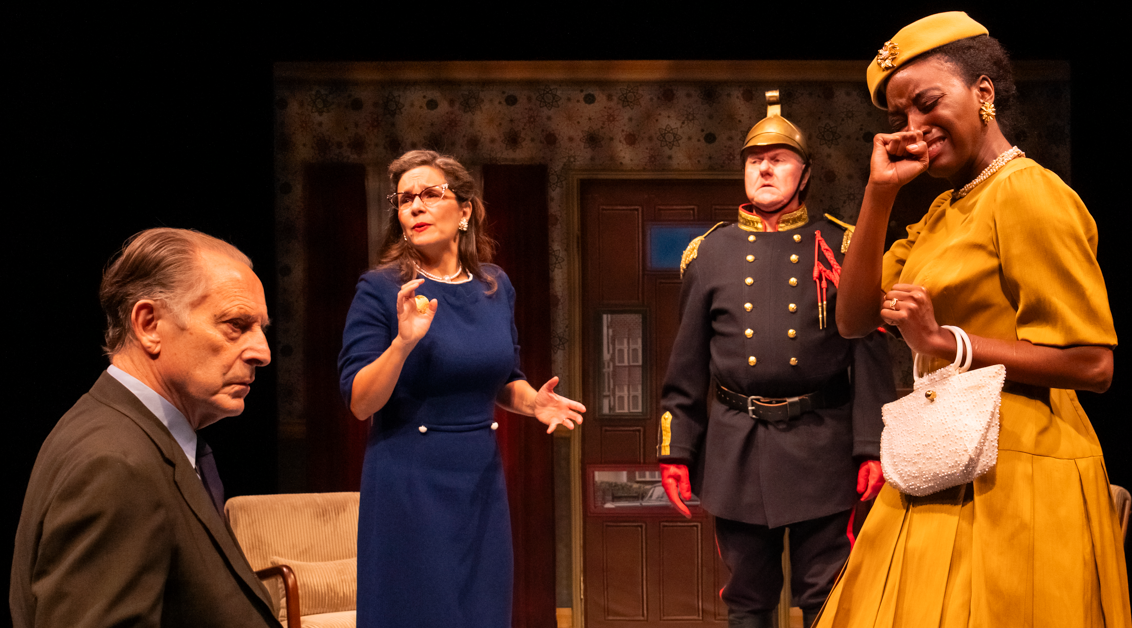
From left: Dominic Cuskern is Mr. Smith, Rachel Botchan is Mrs. Smith, Dan Daily is the Fire Chief, and Anique Clements plays Mrs. Martin in Bradford Cover’s smart new production of Eugène Ionesco’s The Bald Soprano.
Eugène Ionesco’s The Bald Soprano, a landmark of the Theatre of the Absurd, transforms the banalities of everyday conversation into a riotous comedy of linguistic confusion and human folly. Under Bradford Cover’s astute direction, the Resident Acting Company brings out the enduring brilliance of this classic, whose absurdist humor continues to resonate in a world where communication too often gives way to cacophony.
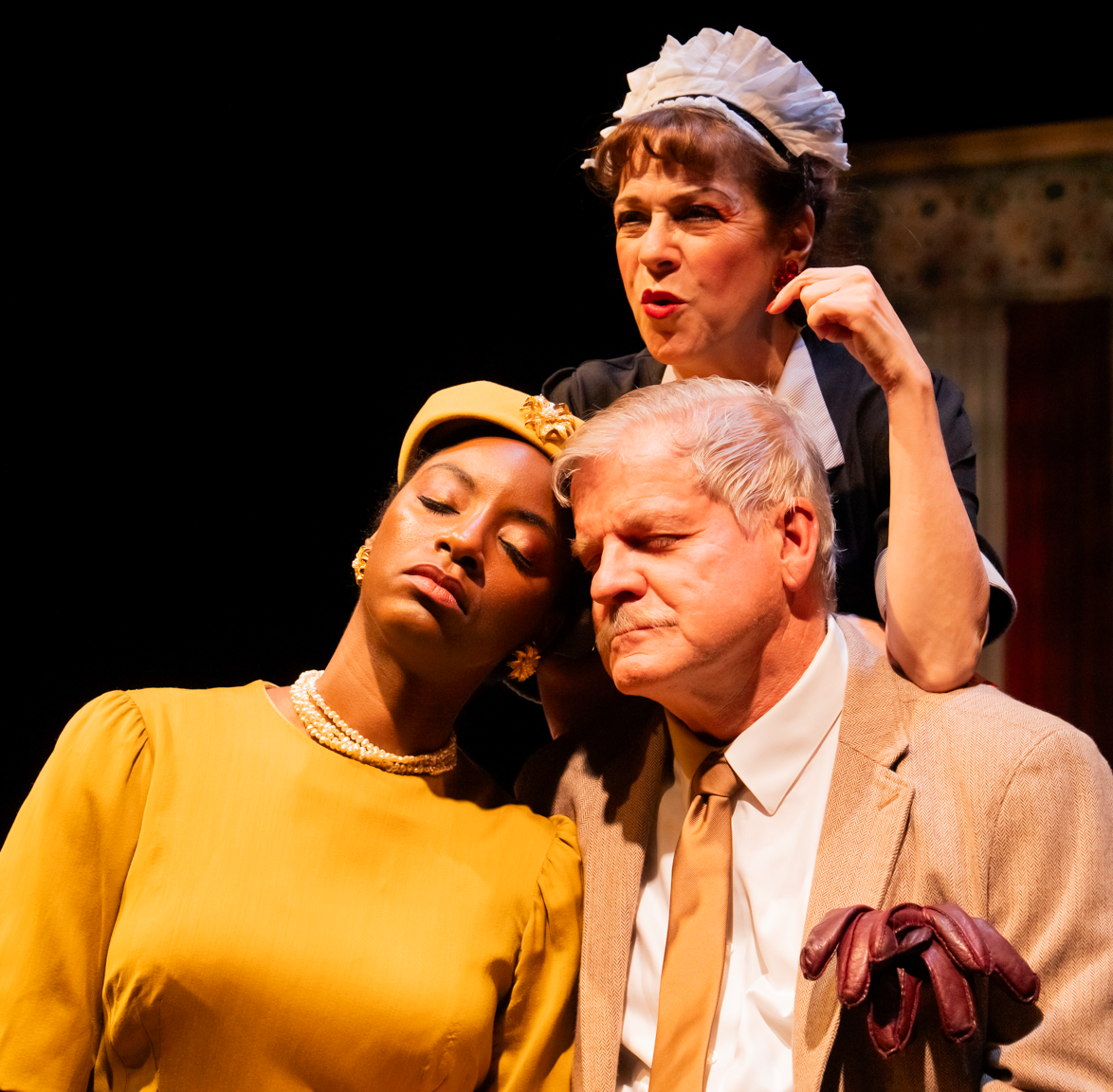
Carine Montbertrand (top), as Mary, the Maid, is seemingly the most grounded character in this absurd world, in which Andy Paterson’s Mr. Martin (right) and Mrs. Martin forget they are husband and wife.
Ionesco dubbed The Bald Soprano an “anti-play,” dispensing with conventional plot and character development to satirize post–World War II bourgeois conformity and the erosion of meaningful communication. In an English suburban home, the Smiths engage in banal exchanges, recount increasingly nonsensical anecdotes about relatives who all bear the name Bobby Watson, and pursue bizarre logical arguments that expose the absurdity of language reduced to empty, circular repetition.
As Martin Esslin recounts in The Theatre of the Absurd, Ionesco conceived The Bald Soprano in 1948 while studying English with a language primer. Its banal dialogues between two married couples began to mutate in his notebook, as familiar clichés and truisms lost their meaning and language itself disintegrated into fragments. Ionesco recalled that the text “began imperceptibly to change before my eyes, and in spite of me,” an involuntary transformation that gave birth to one of absurd theater’s defining works.
Cover makes no attempt to bridge the historical roots of The Bald Soprano with contemporary anxieties about communication, technology, and digital isolation. The Smiths and Martins remain firmly ensconced in the 1950s—no cell phone or computer in sight. But Cover accomplishes something more important: he brings out the rhythms of Ionesco’s play, treating the script like a musical score. The production moves from the painful, awkward silences of its early scenes to the manic collapse of language into raw phonetics and shouting in its final moments, building to a terrifying crescendo.
It is easy to play The Bald Soprano for cheap laughs, but Cover ensures that the comedy retains its bite. The couples’ desperate seriousness, as they stare past one another and deliver their platitudes with almost frozen expressions, exposes the horror of the mundane. Cover brings an added understanding to the work, having played Mr. Smith in the defunct Pearl Theatre Company’s 2011 production.
If Cover succeeds in revealing the existential dread of being trapped in an endless loop of meaningless routine, the acting ensemble gives the characters flesh and blood, bringing this intermissionless drama to life. Rachel Botchan, reprising the role of Mrs. Smith from the same 2011 production, inhabits the character with the confidence and comfort of someone slipping into an old bathrobe.
Embodying the rigid, self-satisfied propriety of a middle-class English housewife in the London suburbs, Botchan sets the tone with a deadpan delivery of the play’s opening absurdity: after the domestic clock strikes 17 times, Mrs. Smith declares, “There, it’s nine o’clock.” Opposite her, Dominic Cuskern’s Mr. Smith is a wonderfully stiff bourgeois automaton, delivering sheer nonsense with the absolute gravity of a Victorian gentleman.
Ionesco’s drama ratchets up its vacuity with the arrival of Mr. and Mrs. Martin, meticulously played by Andy Paterson and Anique Clements, respectively. The recognition scene between this married couple is one of the production’s highlights, as the two painstakingly reason their way to the inevitable conclusion that they are husband and wife. As Paterson’s Mr. Martin solemnly declares: “Then, dear lady, I believe that there can be no doubt about it, we have seen each other before and you are my own wife . . . Elizabeth, I have found you again!”
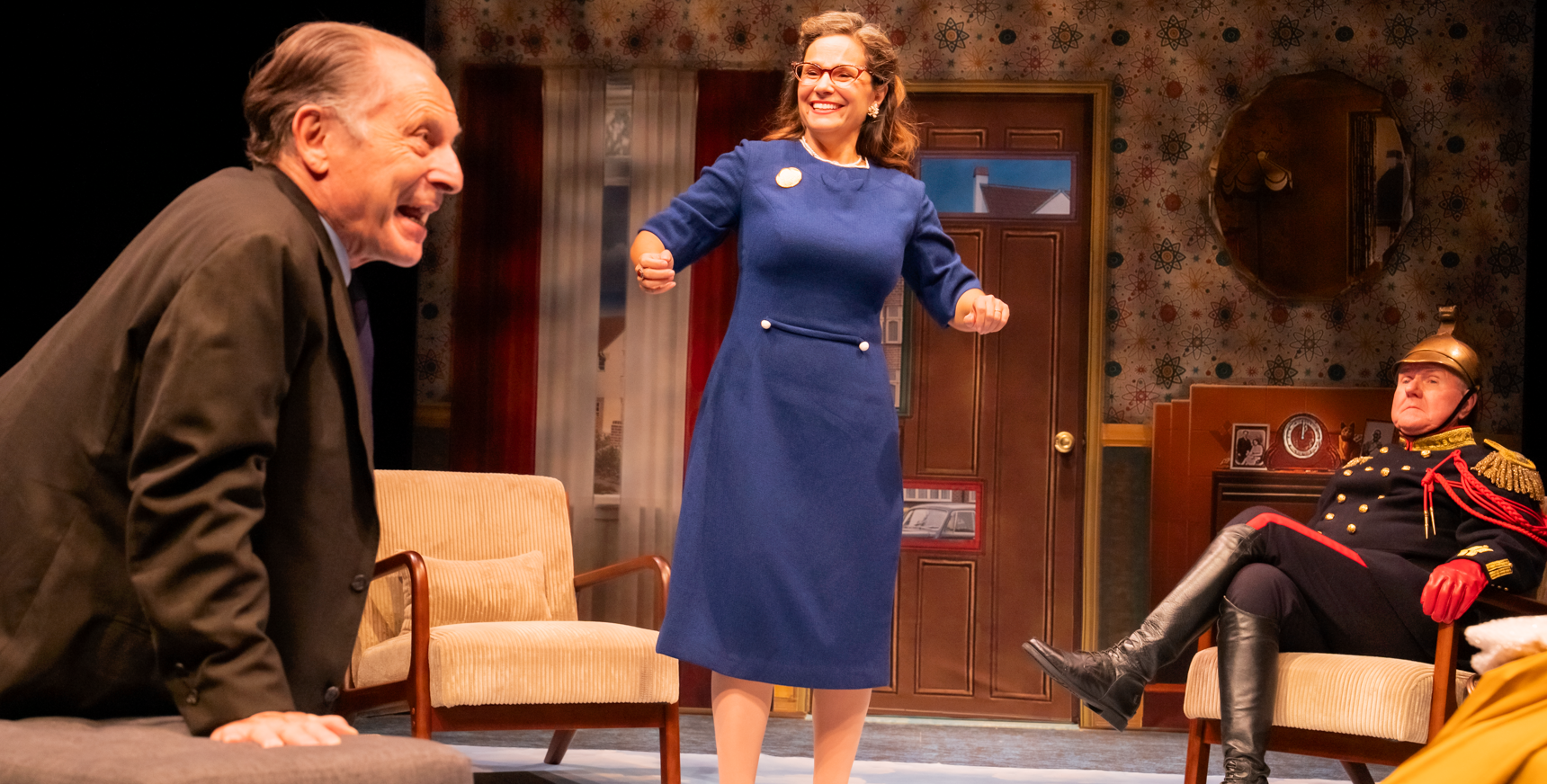
The Fire Chief’s arrival briefly electrifies the room, and the characters eagerly demand that he tell stories from his career. Photographs by Al Foote.
Although the Smiths and Martins have the lion’s share of the dialogue, Carine Montbertrand, as Mary the maid, and Dan Daily, as the Fire Chief, are hardly overshadowed. Mary, seemingly the most grounded character in this absurd world, fancies herself an amateur poet, reciting her poem “The Fire” in striking contrast to the cast’s otherwise dead, mechanical language. Daily (another veteran of the Pearl’s 2011 production), makes the most of the character’s childish prank of knocking on the Martins’ door and hiding before being invited inside. Asked to tell stories, he delivers absurd fables in impeccable grammatical form and with the air of a practiced raconteur, though they contain neither logic nor plot. Just before leaving, Daily’s Fire Chief makes the play’s only reference to its titular bald soprano: “By the way, what about the bald soprano?” After an awkward silence, Mrs. Smith replies, “She always wears her hair the same way.”
Ultimately, The Bald Soprano asks us to consider: Are we actually listening to one another, or are we just making noise while waiting for our turn to speak?
The Bald Soprano plays at the Sheen Center (18 Bleecker St.) through Nov. 1. Evening performances are at 7 p.m. Thursday through Saturday; matinees are at 2 p.m. Tuesday, Wednesday, Saturday and Sunday. For tickets and more information, at www.racnyc.org.
Playwright: Eugene Ionesco
Director: Bradford Cover
If you enjoyed this review, please click on the Like icon below
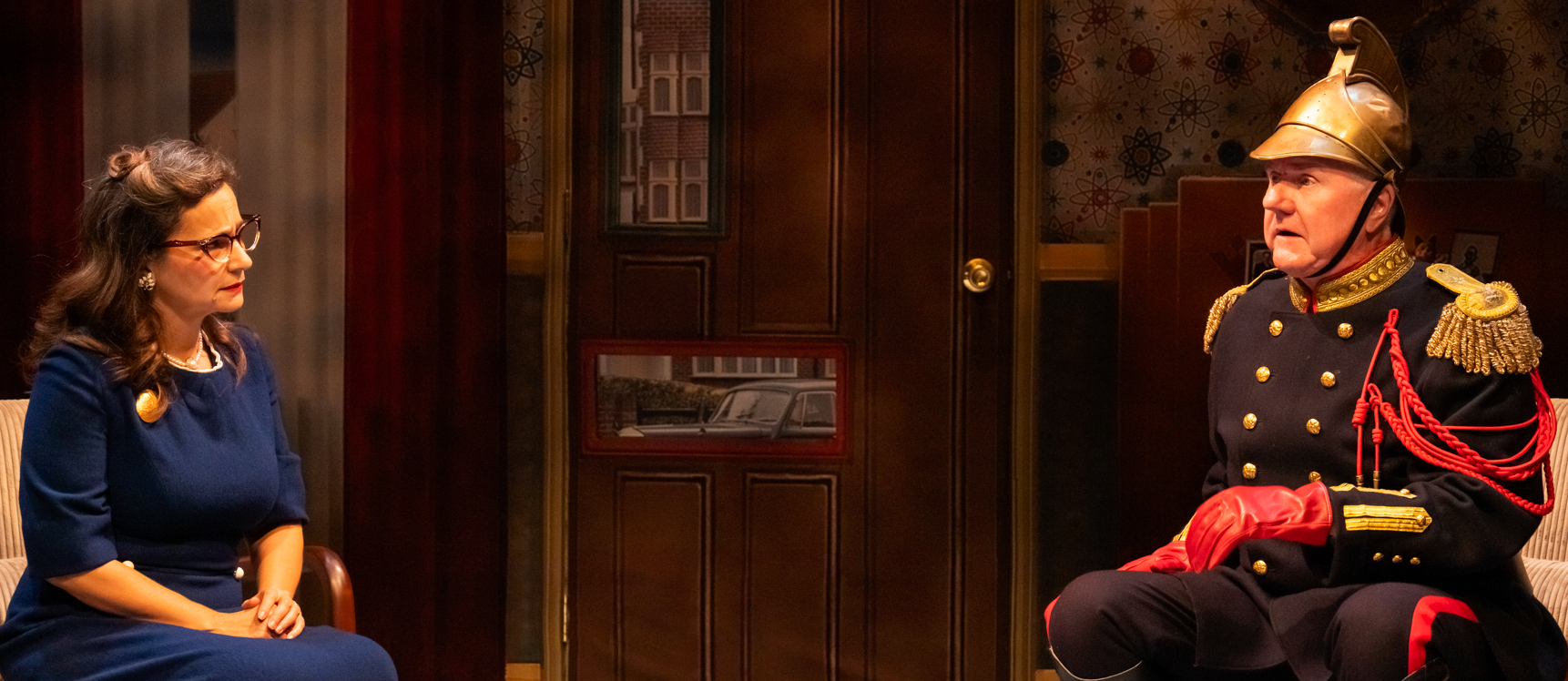
The Fire Chief is treated as an esteemed authority figure and celebrity,
