
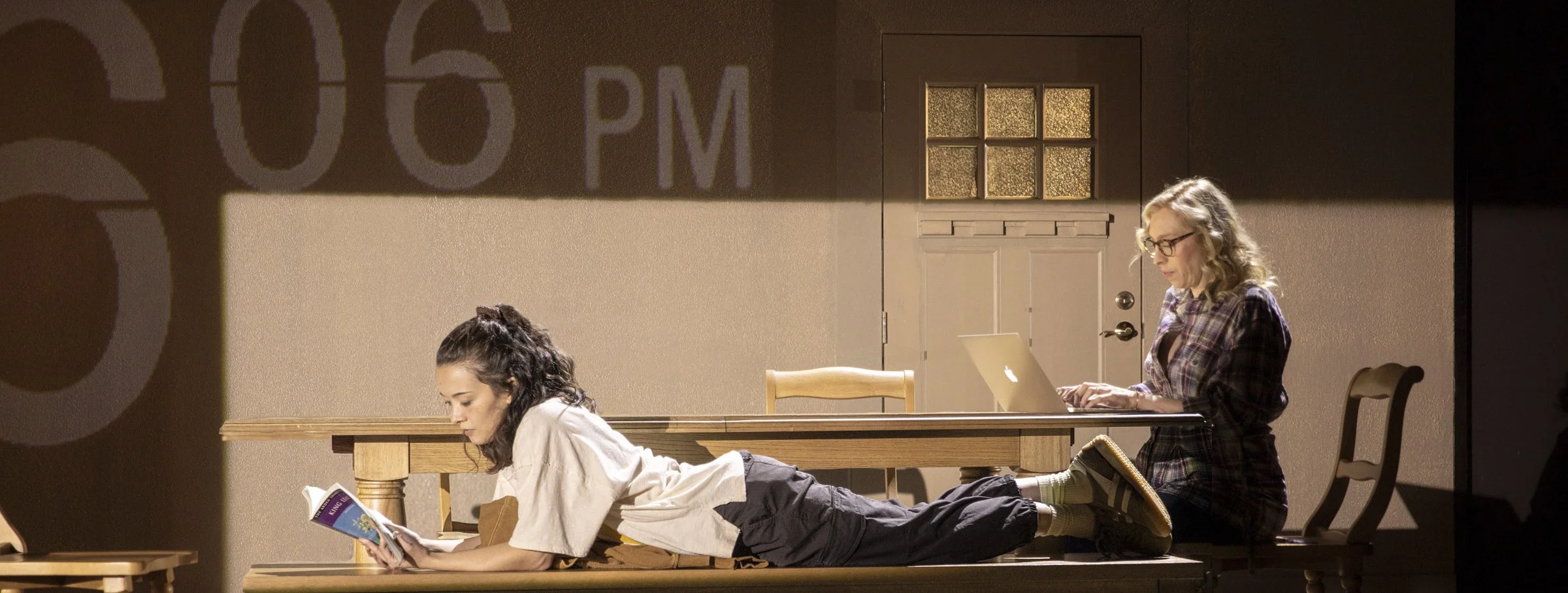
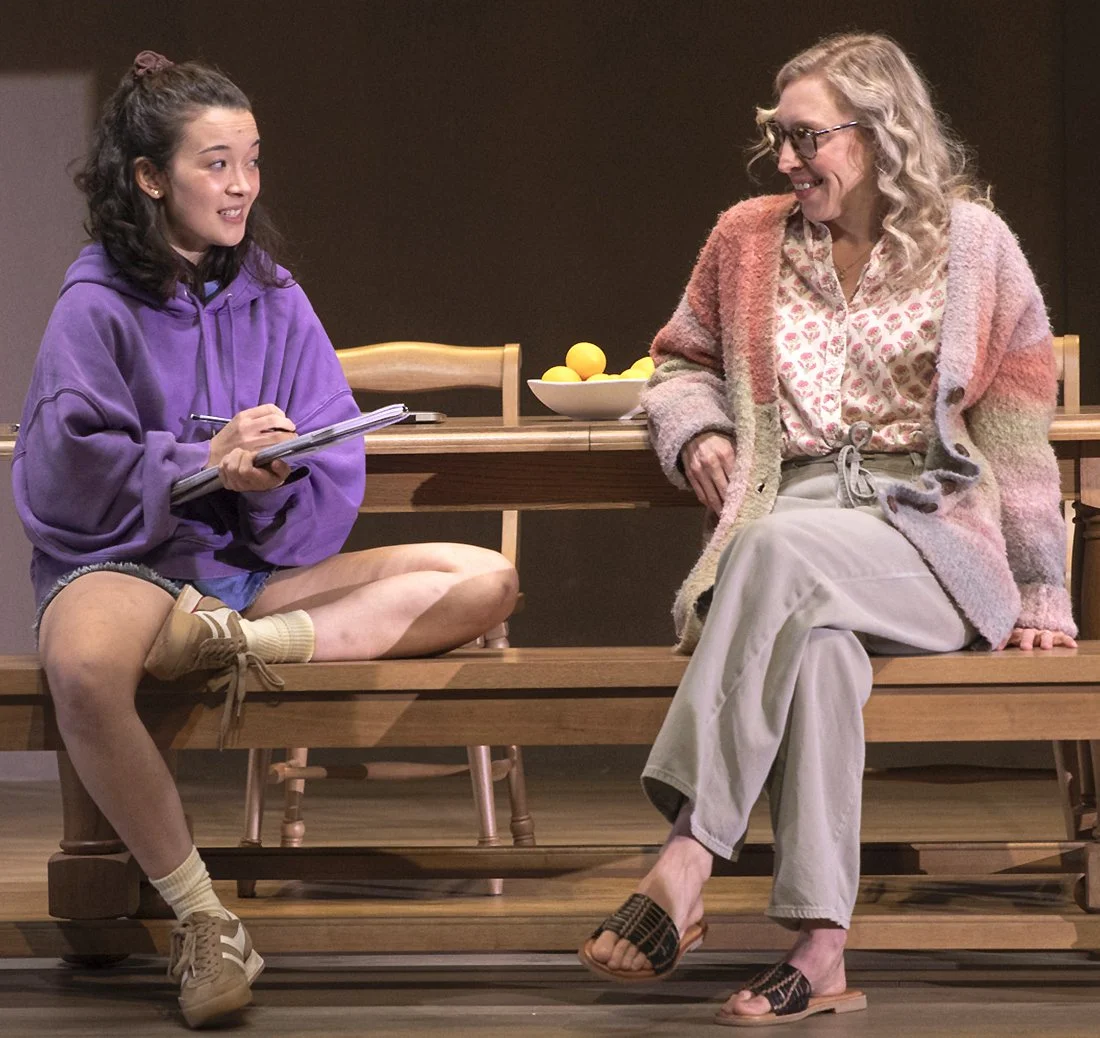
Jeanie (Crystal Finn, right), a QAnon-obsessed suburban mom, sits with her daughter Delia (Izabel Mar) at the kitchen table in Anne Washburn’s new play Anon.
“I thought that was normal MAGA loonie. Is that QAnon?” asks Will (Jeremy Shamos) of his husband, Adam (Jeff Biehl), after they watch a TikTok video by their neighbor Jeanie (Crystal Finn) in the San Antonio suburb they have just moved to. Alas, pretty much everyone is familiar with MAGA looniness these days, but QAnon may be hazier, or merely shorthand for crazy. Anne Washburn tries to illuminate these dark corners of the Internet in Anon. The play is admirably ambitious, overlaying the story of the indoctrinated Jeanie and her family and neighbors with motifs and scenes from Shakespeare’s King Lear, though the results are mixed: ideas and characters feel as though they are still in the process of being worked out.
When the play begins, in fall 2024, Jeanie is already fully immersed in right-wing conspiracies, much to the chagrin of her teenage daughter Delia (Izabel Mar) and her increasingly unhappy husband, Michael (Andrew Garman). Triggered by the Pride flag in front of Will and Adam’s house, she grows more toxic as the story progresses, moving from vaccine fearmongering to Holocaust denial, for example.
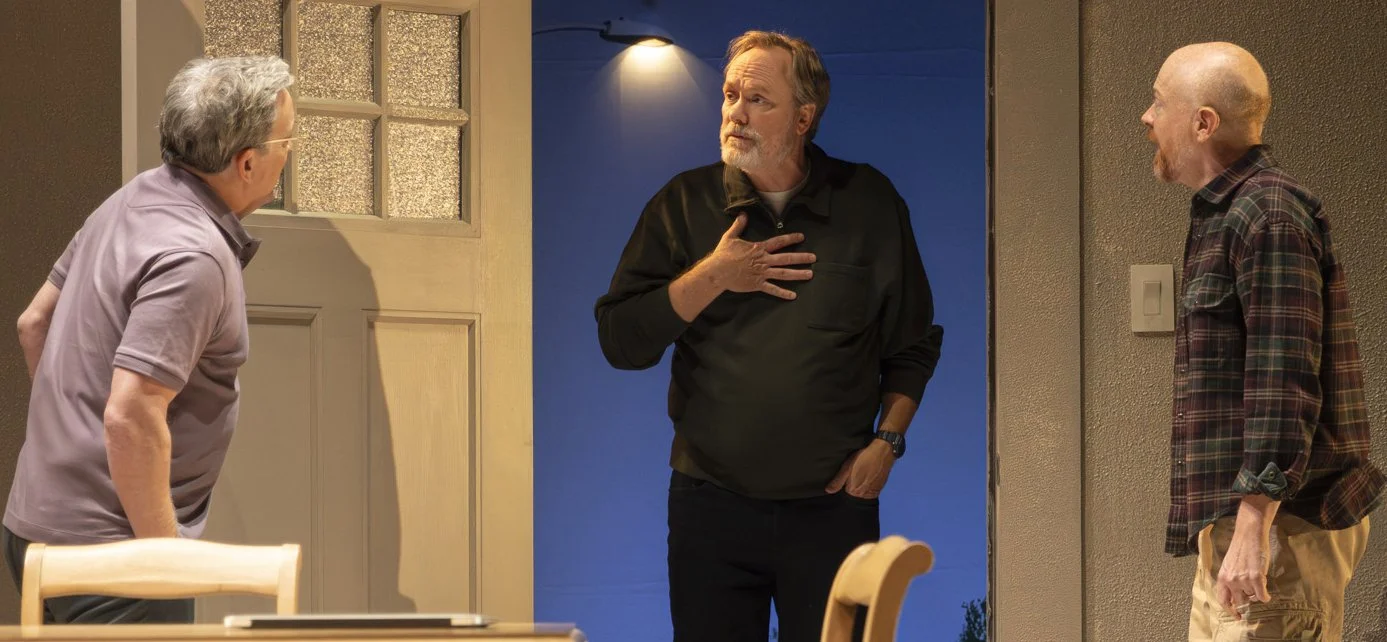
Jeanie’s husband Michael (Andrew Garman, center), reintroduces himself to the new neighbors, married couple Will (Jeremy Shamos, left) and Adam (Jeff Biehl).
The Pride flag—which, ironically, Will is not keen on: “I don’t love Pride events. I don’t take joy in the desperate colorfulness”—becomes for Jeanie a totem of a liberal, secular world that doesn’t care about her. For at the heart of Jeanie’s mania is narcissism: she craves engagement and is constantly lamenting her lost Twitter followers (she doesn’t blame Elon Musk, whom she worships).
Finn gives an infuriating performance—and that’s a compliment. She expertly captures the know-it-all insufferable nature of people who indulge in these theories and yet also finds the real person lurking under Jeanie’s layers of delusion. Her first interaction with Delia is largely mediated through text messages (projections by Jared Mezzocchi). Despite promising not to, Jeanie has mentioned Delia in one of her social media posts. “You talked about my period,” Delia says, now in person, before reading aloud: “‘same for my daughter, she didn’t get her period for three months because of all the vaccine shedders.’” The best Jeanie can offer is that this was a reply and not technically a “post.”
“The central visual image is the laptop glowing on the table as Jeanie absorbs countless hours staring into it. ”
Neighbors Will and Adam (Shamos and Biehl are both excellent) begin in the vein of quippy characters in a smart sitcom. After Jeanie films their house for one of her TikToks, they shift into a darker register, particularly Will, who purchases a handgun and is ready for war. It’s unclear if this character trajectory is meant to mirror Jeanie’s, but it is neither believable nor particularly coherent, despite Shamos’s admirable efforts. Anne Kauffman’s direction navigates the tonal changes but can’t entirely overcome an occasional lack of specificity in the writing.
Everything takes place around the kitchen table—the same kitchen table for each home. The scenic design, by dots, is sparse, even bland, with everything beyond the table pushed to the periphery, including stacked boxes (neither family has fully unpacked). The central visual image is the laptop glowing on the table as Jeanie absorbs countless hours staring into it. The use of audio and projections pervades: there is the podcast that Jeanie listens to while preparing dinner, which tells of JFK Jr.’s faked death and predicted return as president, a scenario that plays out in a video of Jeanie’s fantasy, in which she’s interviewed by Vice President General Michael Flynn and finally recognized for her work.
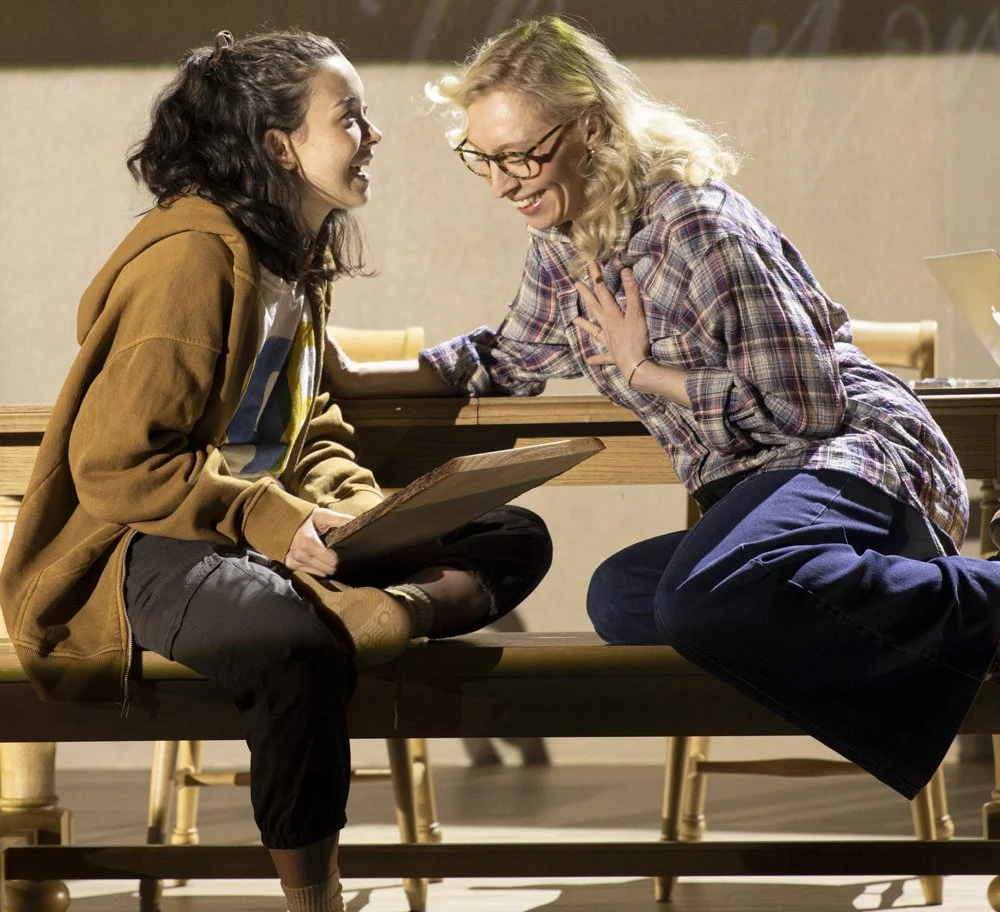
Jeanie and Delia share a moment of levity, though their relationship is otherwise strained by Jeanie’s conspiratorial beliefs. Photographs by Monique Carboni.
And then there’s Lear. The seed is planted by Delia, who, for a school assignment, composes a soliloquy for Goneril, Lear’s eldest daughter. As a storm builds along with the conflict between Jeanie and her neighbors, so do the Lear resonances. Will slips briefly into the role of Kent when describing the storm, “Such sheets of fire, such bursts of horrid thunder / … I never remember to have heard.” Jeanie takes on the mantle of Lear, preparing to desecrate the Pride flag during the storm: “Blow, winds blow and crack your cheeks!”
The parallel, perhaps, lies in people who crave power being powerless—Lear, divested of his kingdom and betrayed by his daughters; Jeanie ignored by the mainstream and her own family. But it is during the storm and his encounter with Poor Tom that Lear, though mad, achieves his greatest insight—that underneath a king’s robes or a beggar’s rags lies the same thing: “Thou art the thing itself; unaccommodated man.”
Anon ends just as it seems to be approaching a climax. And for Jeanie, there is no Lear-like insight, only sound and fury, signifying MAGA looniness.
Anne Washburn’s Anon runs through Nov. 1 at MCC Theater (511 W. 52nd St.). Performances are at 7 p.m. Tuesday through Saturday, with matinees at 2 p.m. on Saturday and 3 p.m. Sunday; there are some Thursday matinees. For tickets and more information, visit mcctheater.org.
Playwright: Anne Washburn
Director: Anne Kauffman
Scenic Design: dots
Costume Design: Brenda Abbandandolo
Lighting Design: Cha See
Sound Design: Tei Blow
Projection Design: Jared Mezzocchi
