
A Slanted Perspective

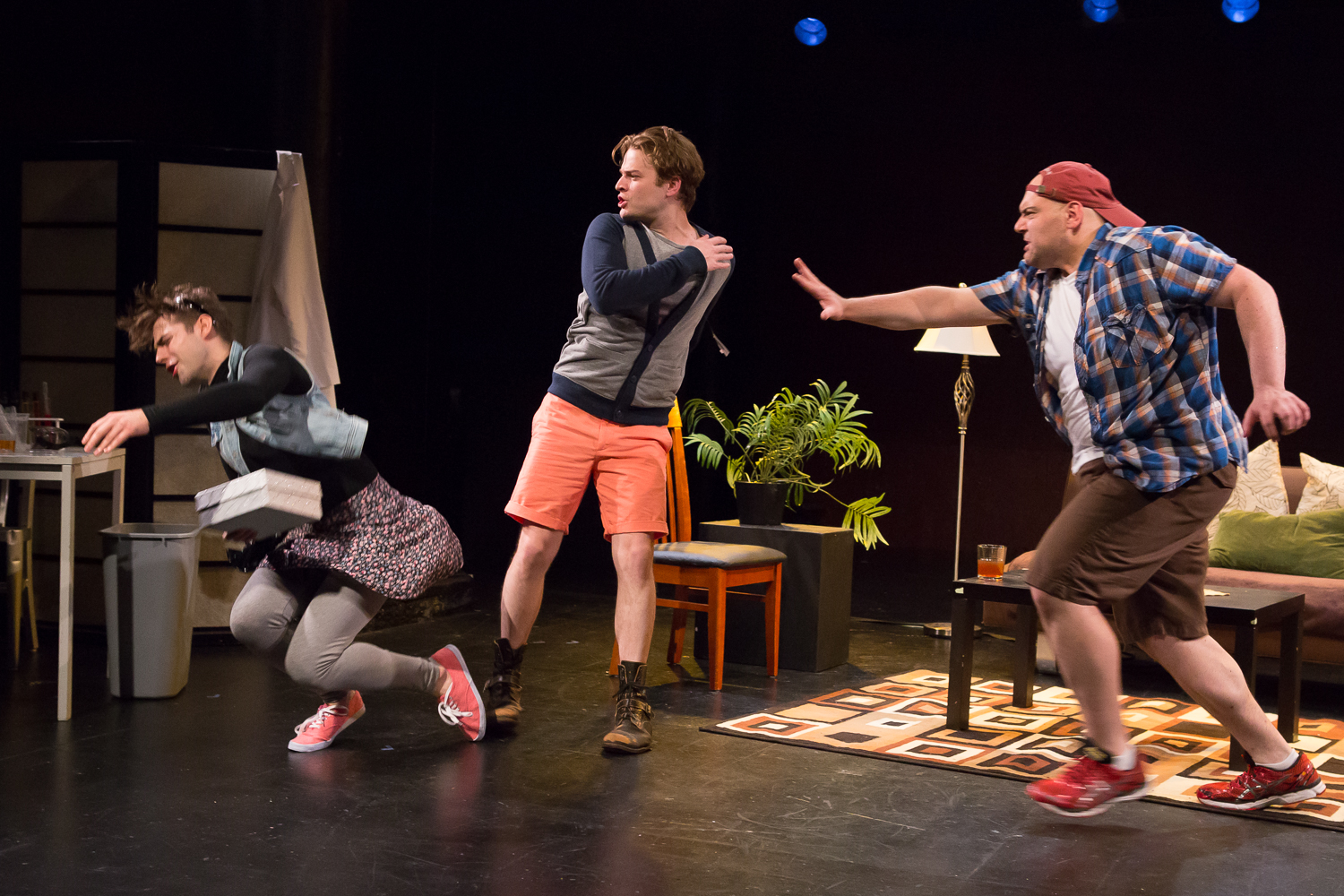
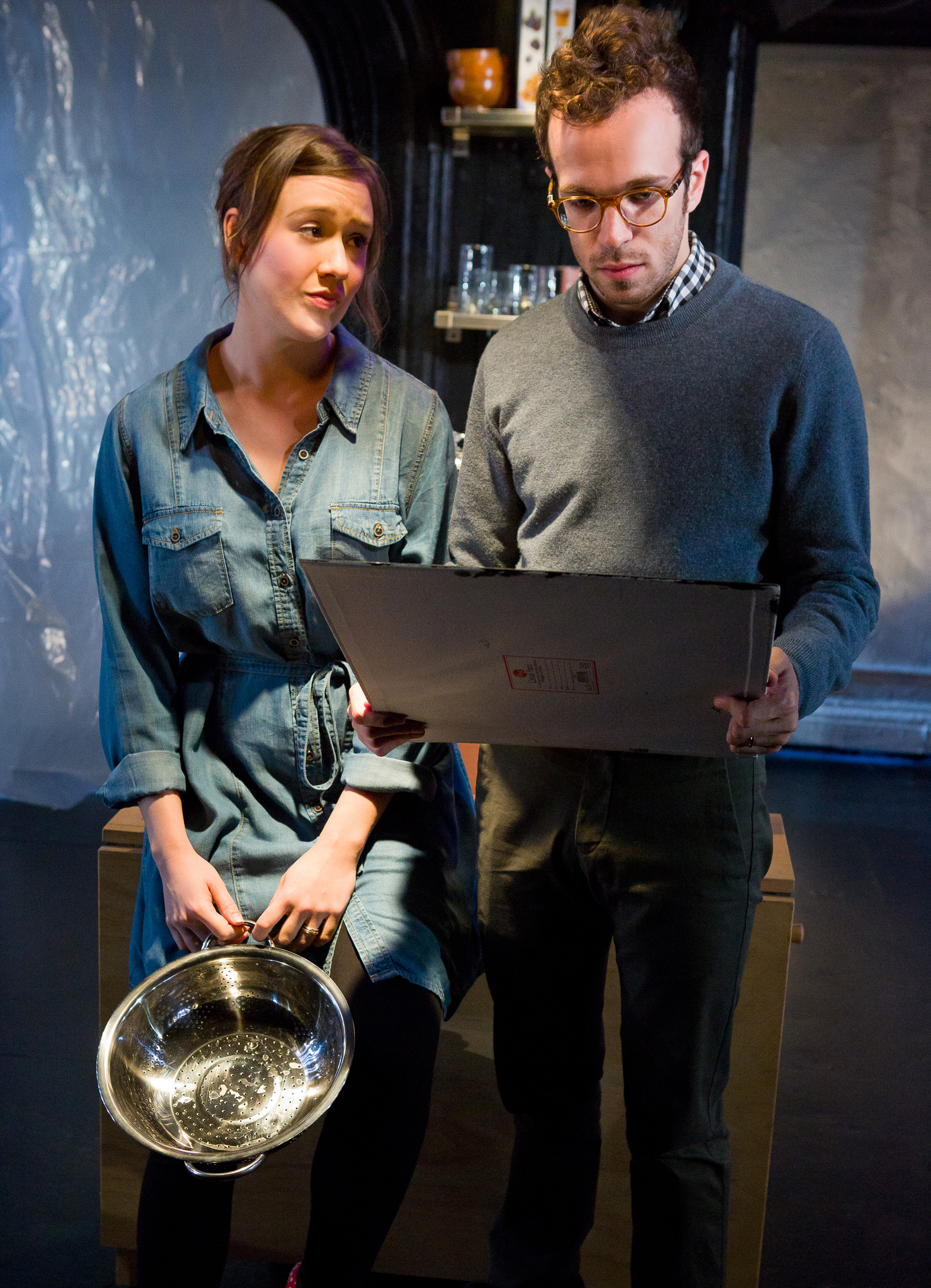
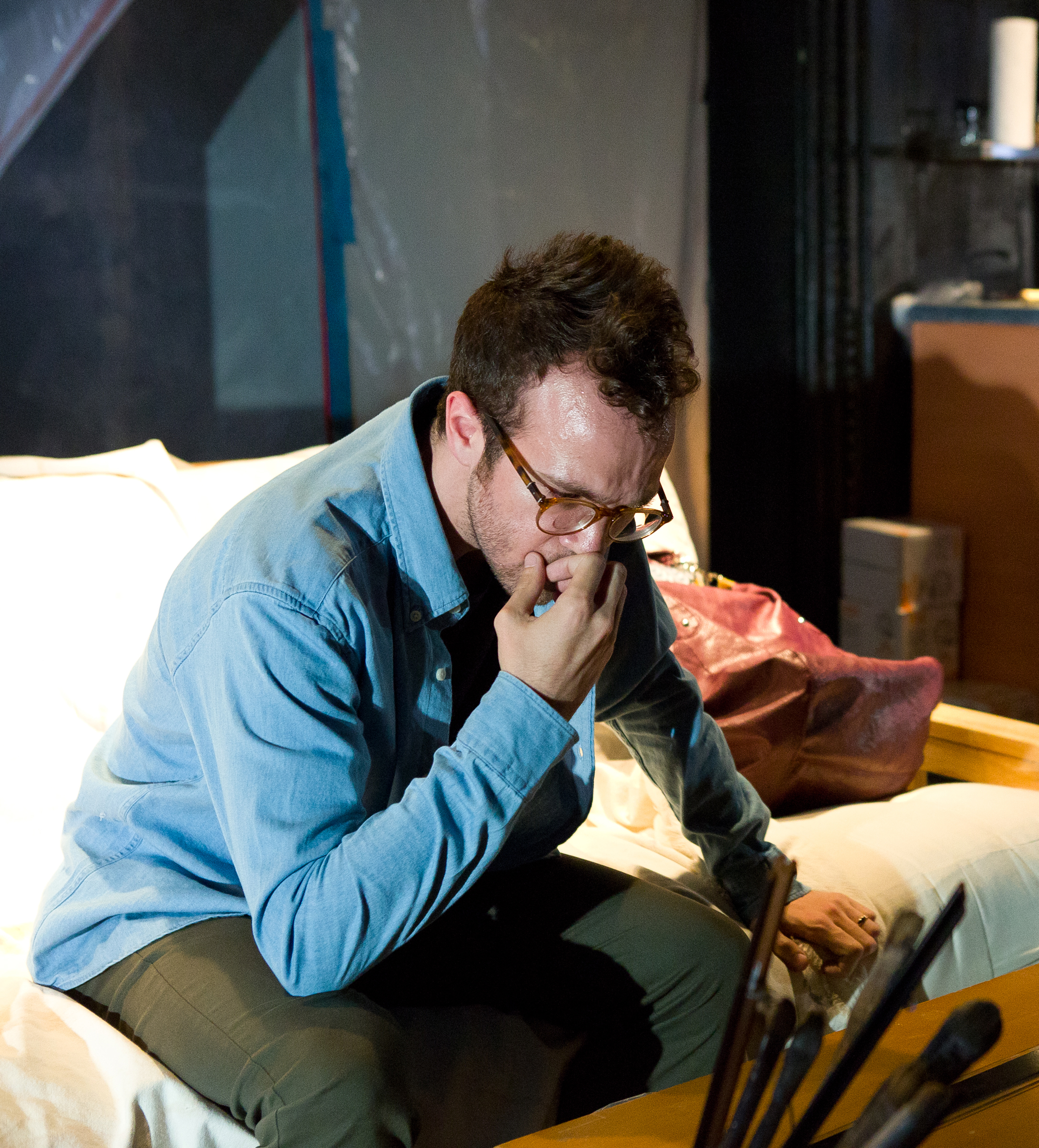
The reality in New York City and the rest of the modern world can seem absurd, morbid and mysterious from one minute to the next. Troy Deutsch’s In a Tilted Place shows just how strange life can really get. The production is a series of nine outlandish short plays, or wild scenes, and opens with a giddy, young woman (Cassandra Stokes-Wylie) retelling her “very, very real” dream. In her dream, she saw herself as a spirited girl, who had faith in God and ate ice cream at her local Dairy Queen. In her small town she “[biked] down Main Street with streamers on [her] handlebars.” Her story starts to take an unexpected turn when she shares about her first love, an “All-American quarterback.” She had group sex with her football player boyfriend and a brown, squirrel mascot who had “actual squirrel fur,” small paws and human eyes.

These creepy twists and turns are consistent throughout In a Tilted Place, and theatergoers wonder what this show is trying to say about the world we live in. The characters are in environments that seem normal at first and then their circumstances become bizarre and surreal. The female characters are often portrayed as controlling, manipulative, sex-crazed maniacs and the men are aloof, unavailable, drunk or driven mad by women. The value of this production is its ability to present ordinary, day-to-day life as uncanny, odd and whimsical. In a Titled Place is able to disgust, enlighten and provoke audience members.

In the second play, Chanel Chance, a lonely, desperate, young woman Ella (Kelsie Jepsen) sits in a cafe and tries to read Donna Tartt’s Pulitzer Prize-winning novel, “The Goldfinch.” Ella catches the gaze of a young man (Ronald Peet) sitting at another table and asks, “Are you someone? I’m sorry. But I noticed… Are you watching me? I’ve been looking over here and…” Their quirky exchange quickly becomes heated and even more awkward when Ella discovers that her own father has been paying this young man to spy on her. Ella forcefully kisses the man and demands, “Just look at me. Just smell me. Smell me. Smell my neck. Smell it. Smell it.” It is like watching a weirder version of an episode from “The Twilight Zone.”

This is Peet’s opening scene and his heavenly voice is abruptly overshadowed by Jepsen’s frenzied performance as she dominates the space. Peet is an exceptional actor from the Bahamas who graduated from the Tisch School of the Arts Drama program at New York University. Directors Ashley Brooke Monroe and Courtney Ulrich could balance out this scene by having Peet speak directly to the audience more often and have Jepsen slow down a bit. In a later play, Glowing Dinoflagellates, Peet plays naive and impressionable Benjamin. Benjamin is seduced by a powerful, horny, middle-aged woman (Pamela Shaw) to stay at her vacant inn on a cliff. Peet and Shaw’s authentic chemistry and first-rate performances complement each other extremely well and create a solid foundation for other actors to shine. Sex slaves (Sean Kazarian and Michael Kingsbaker) generously contribute to heightening this scene by bringing comic relief as they ramble on in unison about their torturous stay at the inn.

This production’s material is too insular and will likely not travel beyond audiences who enjoy fringe theater. In Brown Fish, a young woman sits on a bench in a concrete park and confesses to her male friend about her roommate’s poop cabin. She describes the poop cabin as “A brown, self-induced, feces log cabin. Like from pioneer days. But the logs, instead of wood, were made of poop.”  Wider audiences may not appreciate this production’s unconventional subject matter and style.

The set design by Kate Noll is uncomplicated with a few pieces of furniture and gray, bland walls that look like concrete. Viewers get the sense that these characters exist between a rock and a hard spot. It is like watching a group of people living in an emergency exit hallway in the basement of a skyscraper, and they do not know that the building is on fire. This minimalistic approach is not distracting and allows for audiences to focus solely on the performances. The simplicity works when a mermaid (Rachel Moulton) slowly drags herself across the floor and onto the stage in Call Me Daryl Hannah. Audiences are captivated watching her struggle as she pulls her body and huge fin across the bare, hard surfaces to meet a young, drunk man (Kingsbaker) sitting on a park bench.

In a Tilted Place relies on shocking and unusual subject matter to create tension and mystery. Audience members can turn into distant bystanders who are merely observing. As observers, they can become disconnected from these unique characters and not know how to relate. A clearer overall aim and vision could create a deeper appreciation for this production’s willingness to transcend traditional ideas.

In a Tilted Place runs until Aug. 30 at the IRT Theater (third floor of 154 Christopher St. between Washington and Greenwich Sts. in Manhattan). Evening performances are Monday, Friday and Saturday at 8 p.m. and matinee performances are Sunday at 3 p.m. Tickets are $18 and can be purchased by calling 800-838-3006 or visiting BrownPaperTickets.com.

Click for print friendly PDF version of this blog post

Apocalypse Soon

Societies don’t come much more dystopian than that of Philip Ridley’s brutal and Darwinian Mercury Fur. In this vision of the future, staged in traverse by Scott Elliott for The New Group, Ridley posits a world—specifically New York—in the grip of post-apocalyptic violence. Zoo animals have been gunned down in their cages, riots fill the streets, and drugs are plentiful. 

Lanky Elliot (Zane Pais) and his dim-witted brother Darren (Jack DiFalco) have been sent to prepare a derelict apartment for a party; they are rearranging overturned, tattered furniture—though even “tattered” seems too stylish a description for the squalor designed by Derek McLane. Bits of white plaster and black chunks are strewn over the floor; the furniture is worn with holes, and graffiti is on the windows. 

The preparations are clandestine, and Elliot and Darren are skittish. They are thrown when they discover that one of the apartments in the abandoned building is occupied, by Naz (Tony Revolori, who played the bellboy in the film The Grand Budapest Hotel). Naz has met Elliot, who at one time was known as “butterfly man in the ice cream truck.” Naz traded an artifact he had looted from the Met for some of Elliot’s drugs, peddled in the form of butterflies—and everyone uses them. 

Naz is impressed to hear that Elliot and Darren are working for Papa Spinx, a legendary power broker. Darren pleads with Elliot to let the gentle Naz stay and help them. Elliot reluctantly agrees, but such is the sense of dread, fear, and jangled nerves that director Elliott creates that a tense viewer may want to yell, “Get out of there!”

Yet, other characters soon arrive. They include Lola (Paul Iacono), a drag queen who is Elliot’s lover and has been enlisted to prepare a young Asian boy, known as the Party Piece—for the upcoming event. But things don’t go as planned. The Party Guest has pushed up the date and yet is running late. The light is fading, so that Spinx may have trouble filming. (Splendid work by Jeff Croiter encompasses flashlights and candles, fire and dawn.)

When the gruff Spinx (Sea McHale) arrives, he has with him a blind woman dressed in a ball gown and known as the Duchess. Emily Cass McDonnell invests her with delusion and vulnerability that recall a Tennessee Williams character; a highlight is her attempt to sing “Climb Ev’ry Mountain” from The Sound of Music. (Ironically, Darren earlier recalls a memory of the movie his parents loved—about mountains and “do-re-mi.” But that unalloyed symbol of the triumph of good is a barely perceptible memory.)

Last to arrive is the Party Guest (Peter Mark Kendall), who has promised Spinx a good deal of money to stage a gruesome fantasy of his. Elliot, the most intelligent of the characters, is going along with Spinx only because he has to protect Darren and Lola. Elliot alone remembers history. He reads and he knows the past. “His brains are like the guts of a great white shark,” says Darren, who tells Naz, in a ghoulishly comic yet repellently vulgar rendering, the story of John F. Kennedy and his assassination, but mixes Marilyn Monroe and Hitler into the mangled history.

But, it turns out, Darren’s memory was induced by eating a butterfly, which Elliot presses him to describe. “What did it do to you?” Elliot asks. “Famous people … political leaders … killing them,” Darren answers. And Elliot divines, “Assassination. You ate a red with silver stripes.”

Mercury Fur is strong medicine. Although Ridley has a way with dialogue and description, it’s hard to judge whether his play merely wallows in depravity or is a legitimate assessment of mankind’s capacity for evil. Perhaps it’s so disturbing because the behavior of his characters leaves no doubt that any shred of decency will soon be utter moral desolation.

The New Group production of Mercury Fur plays at the Pershing Square Signature Center (480 West 42nd St. between 10th and 11th Aves. in Manhattan) through Sept. 27. Evening performances are at 7:30 p.m. Tuesday through Friday and 8 p.m. on Saturday. Matinees are at 2 p.m. on Saturday and Sunday. For tickets, visit TheNewGroup.org or TicketCentral.com.

Click for print friendly PDF version of this blog post

Losing the Plot

Of the three plays open to critics at the Ice Factory Festival this summer, Losing Tom Pecinka, staged at the New Ohio Theatre by Morgan Gould & Friends, is most given to playfulness. Even with the story’s grey backdrop of Tom's death (an immediately evident plot point), writer and director Morgan Gould is more intent on good-humored self-mockery. But even with the occasional laugh that this meta-humor elicits, Losing Tom Pecinka struggles to elevate its story, and regularly defuses its own comedic fireworks.

The story surrounds the event of the eponymous character’s passing, and the destructive attempts of his friends in coping with it. The character Tom Pecinka (whose ghost and flashback-version is played by Zack Segel) is named after a real-life founder of Morgan Gould & Friends, and we assume that the title is a play on the actual Pecinka’s move to the Yale School of Drama. Janice (Tommy Heleringer, pretty in a dress) is a guilt-ridden ex-girlfriend, constantly at odds with Kai (Christopher Geary), Tom’s bitter best friend. Ryan Pecinka (Amir Wachterman), brother of the deceased and funniest of the lot, suffers silently in his love for Janice.

Wachterman is the undeniable talent of the show, straining laughter from even the most confused situations. His fairly ingenious dress-up as a sweaty tennis player, complete with a white sweater tied around his shoulders, making love-stricken speeches to Heleringer’s Janice makes for an uproarious incongruity. Heleringer himself is a shrill delight, making do with Janice’s oftentimes puzzling situational comedy to great effect. The entire cast bubbles with an underlying humorous energy, but their fractured dialogue and the intractable intent of Gould to exercise her didacticism, crowd out any real comedy. The plot is threadlike at best; Gould focuses more on unveiling her satiric takes on comedic tropes and stereotypes she has found in theater.

Indeed, the point Gould tries to make is that theater, and entertainment in general, has fallen into dreary, acceptable routines. These are routines from which her audiences need to be jolted out of; hence her lackadaisical attitude towards public relations (as evidenced by the production's promo). But the primary fault of Losing Tom Pecinka resides in its stubborn insistence on such satire. A heated discussion between Ryan and Janice, which held some potential for good drama, devolved into a satirical scientific run-on, the kind Christopher Nolan or Steven Spielberg would be proud of.

Even these scenes struggle to take off. We are left wondering whether the ghostly Tom that appears to Kai after his death is a comedic poke at depictions of the afterlife in traditional theater (perhaps Hamlet’s ghost?) or a product of Kai’s dramatic, psychological breakdown. It is only at the very end of Losing Tom Pecinka that we finally understand Gould’s directorial intent. Since the plot is a bare canvas, only present to hold the entire production together, the ending loses its finality and importance. Even after a seeming resolution to the play (all the characters huddle around Tom's grave in nostalgic remembrance), they all abruptly break into song, in an ineffable attempt at satirizing the musical.

There are moments of real hilarity, however. The ending is a particular delight to watch, since we are now certain that they’ve been making fun of our seriousness all along. Pregnant pauses and audience interactions with the cast produce considerable audience laughter, especially towards the end. Abrupt changes in time and place heftily undercut the sometimes-awkward interactions between actors, and keep us curiously waiting for the next scene. The sexual tension between Heleringer’s Janice and Wachterman’s Pecinka is palpable, but never serious. Even the eponymous character’s death is rendered comical, somehow. Yet, a willful need to jerk its audience out of its seated stupor and be “not boring” makes Losing Tom Pecinka a parody of itself: to be new and exciting might not be so interesting after all.

Losing Tom Pecinka ran from July 8-11 at the New Ohio Theatre (154 Christopher St., #1E) in Manhattan. For more information, visit http://www.NewOhioTheatre.org.

Click for print friendly PDF version of this blog post

Souls Drowning in Sorrow

Dramedy very infrequently serves its stories well. Add to that alloy the well-worn narrative of an unfolding mystery, and one can easily overflow an already full cup. But Sea of Souls is an adamant proponent of such a mixing, so long as they can evoke every audience emotion from terror to laughter. Souls has a swift undercurrent of drama, cast over with ostensible shades of black comedy, all of which crashes together in a series of messy, heart-thumping climaxes. Ion Theater Company's presentation of this Southern-accented, surprisingly action-packed new play, has traveled across the country from it's home in San Diego to an off-Broadway reading at the Peter Jay Sharp Theater. 

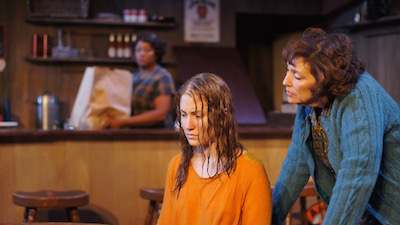
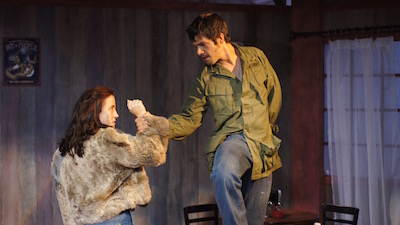
The play is like Picnic, in that its characters struggle to bury themselves under tough, yet brittle, exposures, and then it takes on something of a Tennessee Williams-like series of haunting personal revelations. Set in an unnamed mining town in the South, sometime in the late sixties, suspicions abound when a wandering folk singer from New York arrives at the town's bar (mysteriously named Sea of Souls—the acronymized cry for help is the production's first big clue to its audience) and won't stop asking about where she's from. When she clashes with Casey, the bar's bitter, sharp-tongued owner, Sam proceeds to uncover a series of clues about the small town's unsavory past. 

Perhaps Souls' greatest offering is the formidable Catalina Maynard, whose uncompromising, biting portrayal of the lead character Casey grounds the entire production. Casey's sharp tongue lashes out indiscriminately, and her stiff social graces provide everything from mild comic relief to extraordinarily fierce dramatics. Ms. Maynard's performance elevates Casey's character to that elusive kind of antihero likability, and few middle-aged matriarchs on stage can achieve that. With the potency of Ms. Maynard's presence, the other characters play up to her (with a singular exception), sometimes with affecting results. 

Abby Fields as the aptly-named Joan is the beguiling mystery at the heart of the play. She starts out as the mildly irritating moral center of Souls (she introduces herself by staring eerily at us and saying, prophet-like, "I know things. I have a gift.") But quickly, and quite beautifully, she evolves into a haunting symbol of her small town's deadly past, and it is in this transformation that we find Ms. Fields' strength as a character performer. Her powerful presence on stage is only rivaled perhaps by Ms. Maynard and Evan Jason Heil, the "new-in-town" deputy sheriff Roy whose aw shucks persona has no end to its audience appeal. 

Carl, the mischievous runaway and disillusioned Nam vet, is infected with a Kerouacian wanderlust typical to the sixties. Evan Kendig plays him with an endearing earnestness; it is easier to love the roguish Carl that it is to find commonality with the wandering Sam, played by the sometimes-interesting Rhianna Basore. Sam is something of a blank slate, and it is unclear if Ms. Basore meant to play her that way, or if it is an unforeseen consequence of an occasionally vacant performance. Carl and Sam are the thematic opposites to the dwellers of Souls' small town setting; Casey sets up a unique tension with the "Northerner" Sam who walks into her bar, bristling at the assumptions the former makes about her Southern hometown. Yolanda Franklin is delightful as Lila, the fast-talking foil to Casey's wrath and rage. Ms. Franklin portrays her with delicate intensity, as the only person who can control Casey's lashing tongue. Their banter seems a product of an eons-long friendship-turned-symbiosis, and provides a priming, emotional depth to Souls

In particular credit to the script and its writers, Glenn Paris and Claudio Raygoza, the dialogue manages to synthesize the nearness of an emotional apocalypse that every character on stage seems to be running from: Vietnam, spousal abuse, past murders, an abandoned child. Paris and Raygoza, also artistic directors, are keenly aware of their time period, and dress up speeches and arguments with the colloquialisms of that volatile time, the sixties. The characters take up an inherent residence in the cultural and political fabric of America in the sixties, yet never leave the diner tables and bar stools of their small Southern town. 

The mood of the production alternates seamlessly between sombre remembrances of said town's past, and the brisk diurnal rituals of 'good mornings' and humorous exchanges. The set itself beams with bright oranges, yellows and greens - overhead lamps glisten redly above the bar, and a colored jukebox sings soft folktales between scene changes (songs which happen to be original compositions by the sultry-voiced, and hugely talented, Linda Libby.) Most of the climaxes that clutter the ending (for there are multiple) take place in the dark, and more than one audience member shuddered at the bloodcurdling screams and bangs that suddenly reminded us that we were done laughing at Casey's sarcasm or trying to work out Sam's sorrowful origin story. Sea of Souls isn't realized fully until the explosive ending(s), but that's a good thing - it builds its mysterious stamina over time and sprints to a breathtaking finish. 

Sea of Souls ran until July 11 at Peter Jay Sharp Theater (416 West 42nd Street) in Manhattan. For more information, visit http://iontheatre.com/#ion-home-page.

Click for print friendly PDF version of this blog post

Global Impacts of Genocide

The bodies of about 1,000 dead Muslim men and boys are still missing to this day in the forests of Srebrenica, a small mountain town in Southeastern Europe. During the Bosnian War in April 1993, the United Nations declared Srebrenica a “safe area” in their peacekeeping mission and oversaw a Dutch battalion under Lieutenant Colonel Thom Karremans. In July 1995, commander Karremans failed and approximately 8,000 Muslim males between the ages of 12 and 77 were murdered by the Bosnian Serb Army of Republika Srpska under the "Butcher of Bosnia" Colonel General Ratko Mladić. Today 73-year-old Mladić supposedly suffers from "deception of memory" and struggles with his recollection of past events. At the United Nations, Russia, Britain and the United States are still arguing over if the Srebrenica massacre should be categorized as genocide. This tragedy seems like it happened last week in The International by Irish actor and playwright Tim Ruddy.

Although the Srebrenica massacre inspired the creation of this production and it is loosely based on the actual events, The International is a work of fiction. The United Nations, Srebrenica, Karremans and Mladić are not mentioned anywhere in the script and it takes place during an unspecified armed conflict in Bosnia and Herzegovina during 1995. The International focuses on evoking a greater conversation about the bureaucracy, ineffectiveness and self-righteousness of international peacekeeping efforts. It echoes the characteristics of other historical atrocities like the Armenian and Rwandan genocides.

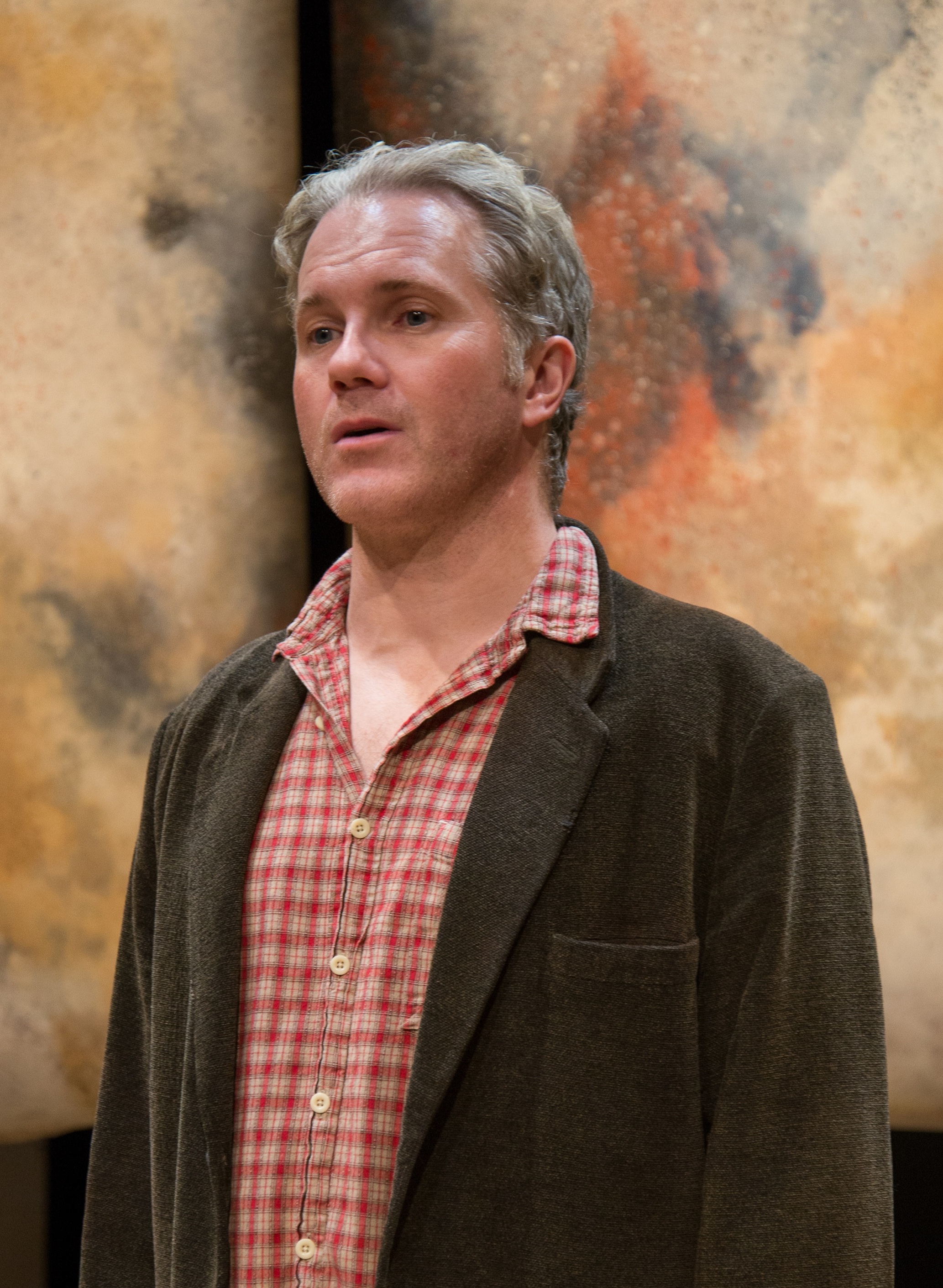
The well-written script, seamless performances, and intentional direction by Christopher Randolph effectively captures the voices of a beautiful farm woman Irene (Carey Van Driest), an aspiring artist Dave (Ted Schneider), and a naive Dutch soldier Hans (Timothy Carter). The three share their experiences next to seven colorful, abstract paintings that transform throughout the story as the lighting by Derek Van Heel is brilliantly manipulated. As specific colors are intensified by the lighting, the paintings take on different images with great subtly.  The characters appear to be visiting a modern art gallery or museum in Los Angeles or New York by themselves.

At first, the production occurs as three separate monologues, but when the story takes a sudden turn, we are thrown into the interweaving of their lives. The issue at hand is rooted in the plot and the characters eventually show where they stand and their true identities. We witness how this armed conflict impacts Irene’s family, Hans’ personal character, and the $800 bet Dave could win if the enemy is successful at annihilating everyone. Dave would use his winnings to finally take his wife Bani, and their 4-year-old daughter Emery to Disneyland.

For those living in the United States, wars in other countries are often experienced by flipping through television channels or social media sites. Dave represents a demographic in America, and Schneider’s portrayal of him is so authentic that audience members will soon realize that they have met someone like Dave before. As an out-of-work sculptor who is struggling to live the dream in Los Angeles while providing for his family, Dave has a lot to lose. When Dave discovers his daughter is watching the news he says, “Not just the news, but the world news on CNN.” In Dave’s world, international affairs are a foreign language compared with the familiar sports and reality shows he watches in bars. The execution of this character is crucial because Dave provides a lens into this story that is instantly relatable.

This production’s value is in its elusive ability to successfully show the effects of war without overtly preaching, passively whining, or trying to persuade people one way or the other. Audiences are left to draw their own conclusions and make comparisons to similar historical events.  The material is not tear-jerking, but it does call for a standing ovation and is a must-see for general theatergoers. To convert audience members from observers of a staged horrific incident into participants, there needs to be greater emotional pull. The Peter Jay Sharp Theatre is modern and airy with light, wooden seats and exposed brick walls.  Do not take a photo of the stage with your cell phone or an usher may try to enforce the house rules by grabbing your phone.

The International does what live theater can do best, and that is to eloquently and magically show us the world that we are living in. It is a story well worth telling. The subject matter is nothing new, but the ingenious presentation and delivery of this production are powerful enough to have people stop and reflect the next time they are going to watch a war on CNN or Fox News. Audiences will leave this play with a different, possibly profound, perspective about the global impacts of warfare than what they originally had in mind.

The International runs until August 2 at the Peter Jay Sharp Theater (416 West 42nd St. between 9th and 10th Aves. in Manhattan). Evening performances are Tuesday-Saturday at 7:30 p.m. and matinee performances are Saturday and Sunday at 3 p.m. Tickets are $45 and $65 and can be purchased by visiting TicketCentral.com or by calling 212-279-4200.

Click for print friendly PDF version of this blog post

When Art and Politics Collide

Potomac Theatre Project (PTP) has opened its annual residency at Atlantic Stage 2, which is to say its annual advocacy for the plays of Howard Barker, one of Britain’s most challenging playwrights. “A good play puts the audience through a certain ordeal,” Barker told a Guardian interviewer in 2012. “I’m not interested in entertainment.” Yet if he has ever written anything close to a crowd-pleaser, then Scenes from an Execution is it, and the PTP production at Atlantic’s Stage 2 is well worth a visit.

Regrettably, Scenes is also notable because of the recent announcement of its star, Jan Maxwell, that she is retiring from the stage. Maxwell is reprising the role of Galactia, a Renaissance painter modeled on Artemisia Gentileschi (1593–1653), that she first played for PTP in 2008. Her fierce performance is typical of everything she does, and if she keeps her promise, it’s theater’s great loss.

The action takes place in the late 1500s in Venice, and the preliminary scenes introduce Galactia, a supremely talented painter in the city-state, with an ego to match, and her younger lover, Carpeta, played by David Barlow with a nice combination of passion and wariness. 

Barker gives his characters names to suggest their qualities. For example, Urgentino is the Doge who has awarded Galactia a major commission and chafes to see it finished. At times, though, they are insufferably cutesy: one critic is named Lasagna and one of Galactia’s daughters is Dementia. One is left to assume that Carpeta is a character who is walked on by everyone, and that fits Barlow’s hapless lover. Carpeta has talent but recognizes it’s not on the order of Galactia's; a running joke is that he is in a rut of painting Christ among the flocks.

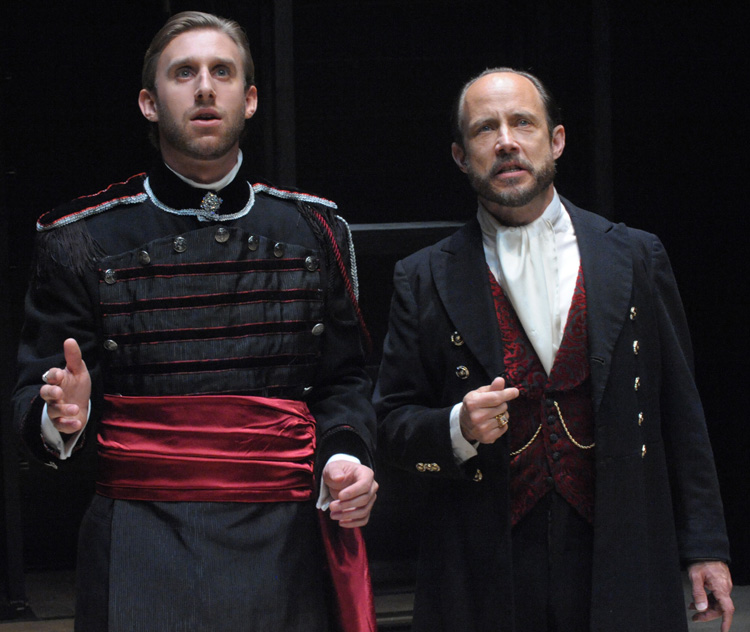
Galactia flourishes partly because she is a talented iconoclast, yet she resists being a leader for other women painters. Maxwell endows her character with intelligence and single-mindedness, but also a strange mix of guile and naiveté. When the arts-loving Doge (Alex Draper) commissions Galactia to depict the Battle of Lepanto (1571), a historical clash in which Venice defeated the Turkish navy and literally changed the course of history, she is determined to show the horror of war, assuming that the truth will not antagonize the establishment. 

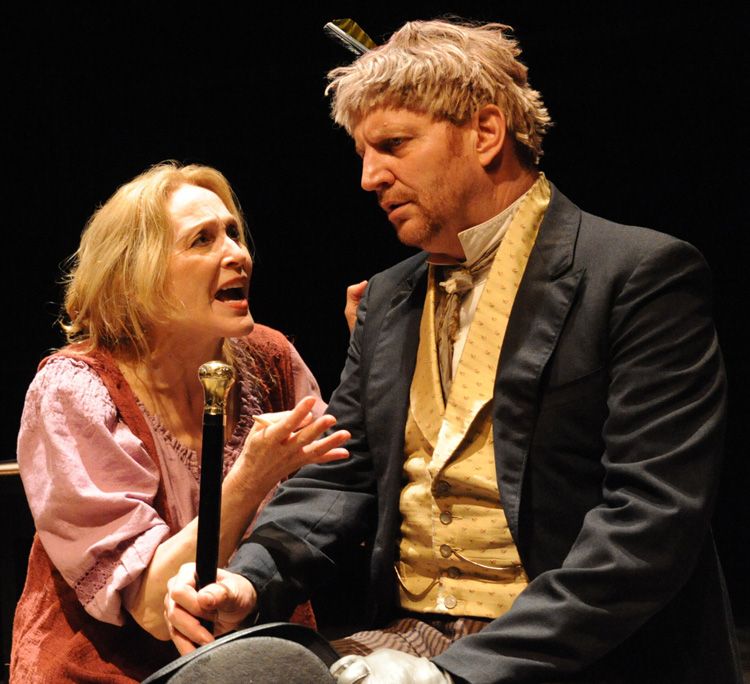
Under Richard Romagnoli's direction, aspects other than feminism receive their due. In keeping with his working-class concerns, the playwright examines the preparation for the painting—mixing colors, sketching and finding models. Galactia interviews a veteran who survives with an arrow stuck in his head, and she uses him in the painting. She is unflinching in her commitment to observe, so she also insists on seeing the open hole that he brags is in his belly. An encounter with an angelic, drunken sailor (Nicholas Hemerling) provides Galactia another visage for the canvas. 

The Doge’s half-brother and the victor in the battle, the Admiral Suffici, poses for her as well, impeccable in his naval uniform. Yet Barker shows that even the most amenable patron has expectations: the Doge objects to his brother’s initial position in the painting: “He is the admiral and he is not big enough.” Says the dumbfounded Galactia: “He is fourteen feet high.” In his first scene, Bill Army invests the Admiral with a smirk and a sanguine sense of honor; a big payoff comes later, when Suffici is apoplectic with horror at Galactia’s portrayal of him. His indifference to carnage leaps off the canvas.

Although Barker also looks at critics and family, the primary struggle is between Galactia and the Doge, played by Draper with a suave reluctance to wield his full power. Ultimately the Doge wins, as governments do, by co-opting his opposition. He hangs the painting: “To have said this work could not be absorbed by the spirit of the Republic would be to belittle the Republic, and our barbarian neighbours would have jeered at us. So we absorb all, and in absorbing it we show our greater majesty. It offends today, but we look harder and we know it will not offend tomorrow.” PTP's production persuades one that Barker’s play is a powerful masterwork.

Scenes from an Execution is playing in repertory at Atlantic Stage 2 (330 West 16th St. between 8th and 9th Aves. in Manhattan) through Aug. 9, with two one-acts, Howard Barker’s Judith and Caryl Churchill’s Vinegar Tom. For dates, times and tickets, call 866-811-4111 or visit OvationTix.com.

Click for print friendly PDF version of this blog post

Winnie and Willie

The Theater of the Absurd is a daunting prospect to the entertainment-seeking theatergoer—it requires the unconscionable appeal of, say, Sirs Patrick Stewart and Ian McKellen, whose season of Absurdist Theater last year brought Samuel Beckett’s Waiting For Godot and Harold Pinter’s No Man’s Land to Broadway. As Beckett decimated man's relationship to God and Pinter eulogized the doomed existence of memories and mind, audiences who had seen the X-Men movies or Lord of the Rings happily received their dose of British strangeness through the familiar faces of their beloved English thespians. Accordingly, this year, the Flea Theater’s production of Beckett’s Happy Days stars husband-wife team Brooke Adams and Tony Shalhoub, and through their familiar faces, they feed us that unfamiliar brand of the absurd.

Happy Days is insistently strange, as is director Andrei Belgrader’s conception of it; the premise of Beckett’s absurdist play holds that Winnie (played by the sparkling Brooke Adams) is stuck waist-deep in the Earth, while her husband Willie (Ms. Adams’ real-life partner Tony Shalhoub) is free to wriggle and struggle in a hole behind her. Sorrowful antics ensue as Winnie eventually reconciles herself to her happy entrapment. Winnie’s seemingly mindless babble—which we come to realize is a kind of coping mechanism, as well as the hidden engine of the play—is what she herself calls a “great mercy,” adding that “what one can bring up, one brings up all.”

Ms. Adams electrifies Winnie’s disillusioned musings on life’s slow passage; the otherwise strange and somber dialogue is rendered alive and active, so much so that even during Winnie’s particularly existentialist speeches, we find commonality in her persistent contentedness. Her pearly, infectious smile and rich, languorous voice hook us to our seats, as does the expressive grayness of her wide, limpid eyes. Her face is a performer all by itself since we only see her from the waist-up, and we rarely, if at all, see Willie’s face; Ms. Adams’ changing features are the only actors on stage that anchor us to Beckett’s dialogue.

Winnie’s props are an umbrella and a black bag that she takes significant comfort in—they are seemingly ordinary personal effects, but they take on a surreal life of their own as she meticulously presents them to the audience and proceeds to use them. She brushes her teeth, wipes her glasses, and shapes her fingernails in front of us, taking great pains in the doing. It is here, in these diurnal little acts of the everyman, that the ordinary theatergoer finds Beckett’s modern-day relevancies. He creates metaphorical meaning in the bland rituals of the everyday, and gives unsuspecting life to our possessions, shaming us for our grasping materialism but also identifying with us. Today’s encroachment of technology into our quotidian conventionalities is much like Winnie’s overweening attention to her lipstick, her toothbrush, her umbrella, her gun, or Willie’s penchant for reading aloud from the newspaper, or looking at erotic postcards (one of the few activities given to Willie, which Mr. Shalhoub soaks with comedy.)

Director Andrei Belgrader makes the production hum with a social and emotional dystopia that portends the end of life in more ways than one. Beckett’s dry observations (“the Earth is tight today” and “there is so little atmosphere”) are bleakly elemental, and even environmentally aware (a reference apropos of modern troubles.) The sun-bright lighting that trains on Ms. Adams’ captured form like many blinding spotlights is “the great heat” that Winnie spiritually beckons with the words “Hail Holy Light!” The set is a positive marvel of minimalist design—the yellow-brown hill that Winnie crowns and crows over slips into a depression behind her, shielding Willie from the sight of his wife, but not the sound of her voice. A panorama of blue skies contributes to the ostensible optimism of the production, all courtesy of scenic designer Takeshi Kata.

Yet, even with the magnitude of her role (Peggy Ashcroft called Winnie “one of those parts that actresses will want to play in the way that actors aim at Hamlet—a ‘summit’ part”), Ms. Adams minimizes her presence cleverly at times, watching the audience perform their laughs and silences just as we watch her slip in and out of her happy tragedies. Mr. Shalhoub, earthy veteran of stage and screen, is a discreet comedic presence, but his wife is the very symbol of theatrical emasculation as Winnie, and we can only pity Willie and laugh at him for his dazed benightedness. The happy days that the two share are peppered with Beckett’s discomfiting (yet deeply personal) existentialism, but the powerful, character-driven performance of Ms. Adams makes this a must-see for any complacently content theatergoer.

The Theater of the Absurd ran until July 18 at The Flea Theater (41 White St. between Church and Broadway) in Manhattan. For more information, visit www.theflea.org.


Click for print friendly PDF version of this blog post

Grade-School Skulduggery

There are wild eyes and grand gestures galore in Ruthless!, the musical that’s being revived at St. Luke’s Theatre on 46th Street. During its long run, the 1993 Off-Broadway creation, with book and lyrics by Joel Paley, who also directs, and music by Marvin Laird, introduced future stars Britney Spears, Natalie Portman and Laura Bell Bundy in the central role of a precocious child performer. The creators have updated their satire on runaway egos and the lust for fame and slimmed it to a 90-minute format that provides plenty of summer laughter.

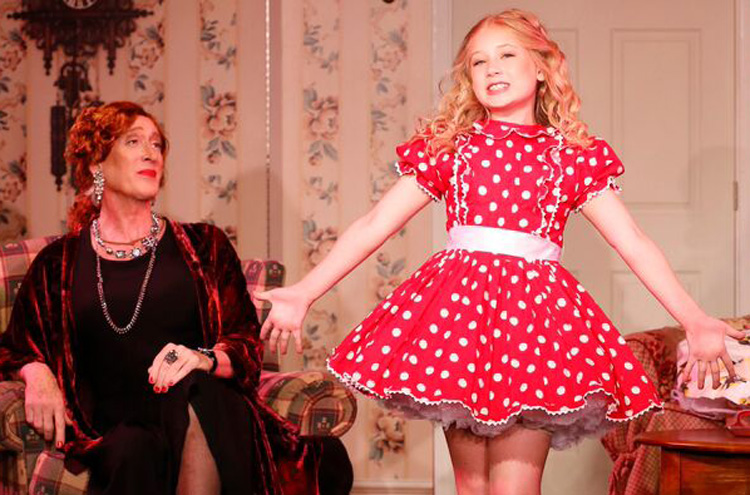
“Where does talent come from?” asks casting agent Sylvia St. Croix in the brief prologue. “Is it a product of one’s environment—something you pick up off the street? Or is talent something you’re born with?” Those ruminations may promise depth of thought, but since Sylvia is played by a towering Peter Land in drag and a red fright wig, don’t expect a scientific analysis to follow. In short order, Sylvia has introduced herself into a chintz-choked parlor (designed by Josh Iacovelli), and is offering to represent little blond cutie Tina Denmark (a darkly determined Tori Murray, who has a terrific belt). Sylvia has spotted Tina’s talent during the kid’s performance at an old-age home.

Tina’s mother, Judy Denmark (Kim Maresca, dressed to resemble any number of 1950s TV housewives: e.g., Father Knows Best or Ozzie and Harriet), is determined that her daughter have a normal childhood. But although Judy is content cooking meals and cleaning house, Tina herself has different ambitions: “I’ve had a normal childhood,” says the third grader. “It’s time to move on.” She adds in typically clever lyrics, “I was born to amuse/From the tip of my nose/To the tap of my shoes.” Sylvia chimes in with her own assessment of Tina’s abilities: “Well, it’s all banana splits when you’ve got talent/You don’t have to show your tits if you’ve got talent….” 

The plot revolves around secrets and complications: Sylvia doesn’t want to talk about whether she’s ever been a mother. Judy’s mother is a notorious critic, Lita Encore, as ruthless in her reviews as some actors are in their ambitions. She once savaged a play by Ruth DelMarco that sent the poor dramatist off a bridge—although DelMarco’s body was never recovered. Happily, Rita McKenzie, who created the role of Lita in the original Los Angeles production way back when, plays the bitchy fireplug with aplomb, and she has the best number—“I Hate Musicals.” Her presence adds a nice boost to the campfest.

The show is packed with sly references to both film and theater, and not always in the words: you might pick up a strain of a film studio’s well-known theme at the start, or a measure or two from Ain’t Misbehavin.’ Early in the show, Land throws back his head and widens his eyes à la Norma Desmond in Sunset Boulevard; late in the show a perky young assistant to a Broadway star appears, and her name is Eve Allabout (Tracy Jai Edwards). For those more deeply steeped in film lore, there’s a truly obscure reference to the Daisy Clover School for Psychopathic Ingenues. Nina Vartanian’s clever costumes—Judy wears a flared skirt, and there’s a prison outfit that works especially well on the performer who wears it—add nice visual humor.

The most crucial role is that of Tina, whom film buffs will recognize as a chip off Patty McCormack in The Bad Seed. Tina goes up for the leading role in the school musical, that of Pippi Longstocking in an adaptation by a teacher, Myrna Thorn (Andrea McCullough’s crypto-lesbian teacher is a walking textbook of tics and grimaces in a pantsuit). Tina isn’t chosen and she doesn’t take it well. She does, however, become the understudy to the girl who got the lead, and she learns the part on the very slim chance—but perhaps not that slim—that she’ll go on. (If you can’t deduce from the title The Bad Seed what happens next, you may be more comfortable at a real school play.)

Land is also persuasive as the manipulative agent with a personal secret. Though drag is not to everyone’s taste, it’s astonishingly effective here. The plot revels in silliness, the voices are uniformly good, and it's a pleasant way to spend a summer evening.

Ruthless! The Musical runs at St. Luke's Theatre (308 West 46th St. between 8th and 9th Aves.). on Mondays and Fridays at 8 p.m., Thursdays at 7 p.m. and Saturdays at 2 p.m. For tickets, call Telecharge at 212-239-6200 or visit www.ruthlessthemusical.com.

Click for print friendly PDF version of this blog post

A Chinese Tragedy in Subtitles

At first glance, Yangtze Repertory Theatre of America's newest experimental production Behind The Mask seems as unapproachable and daunting as the foreign-language category of the Oscars. The entire play is spoken, performed and occasionally sung in that beautifully intimidating language, Mandarin Chinese. One might view it appreciatively from afar, mildly aware that time and effort has been put into presenting a culturally distinctive performance for a largely English-speaking audience. Film has progressed (in more ways than one) beyond that of its centuries-old grudging cousin, the theater. As with Ida, the winner of the Best Foreign Language Film at this year's Oscars, or as with any of the acclaimed films of Akira Kurosawa's pastoral Japan, Francois Truffaut's urban France, or Abbas Kiarostami's childlike Iran, one would expect theater to follow in film's foreign language experiment. But, as Behind The Mask shows us, the medium of theater performance does not always sit well with subtitles. 

Director Chongren Fan gambles with a single, slippery aspect of his audience's attention: that the subtitles running on a screen next to the performers will not distract from the performers themselves. Understandably, most of the audience is of Chinese descent, and the flashing white words do not faze them, but many (including this writer) possess an embarrassingly rudimentary understanding of Mandarin Chinese, and must prepare themselves for a veritable tennis match of reading the dialogue and actually watching the show. During one monologue, an actor mentions "the magic of attention" that first drew her into the world of theater. But the medium she professes to worship struggles to hold onto that magic, at least for English speakers watching an aurally enchanting, yet unhappily remote, Chinese-language performance.

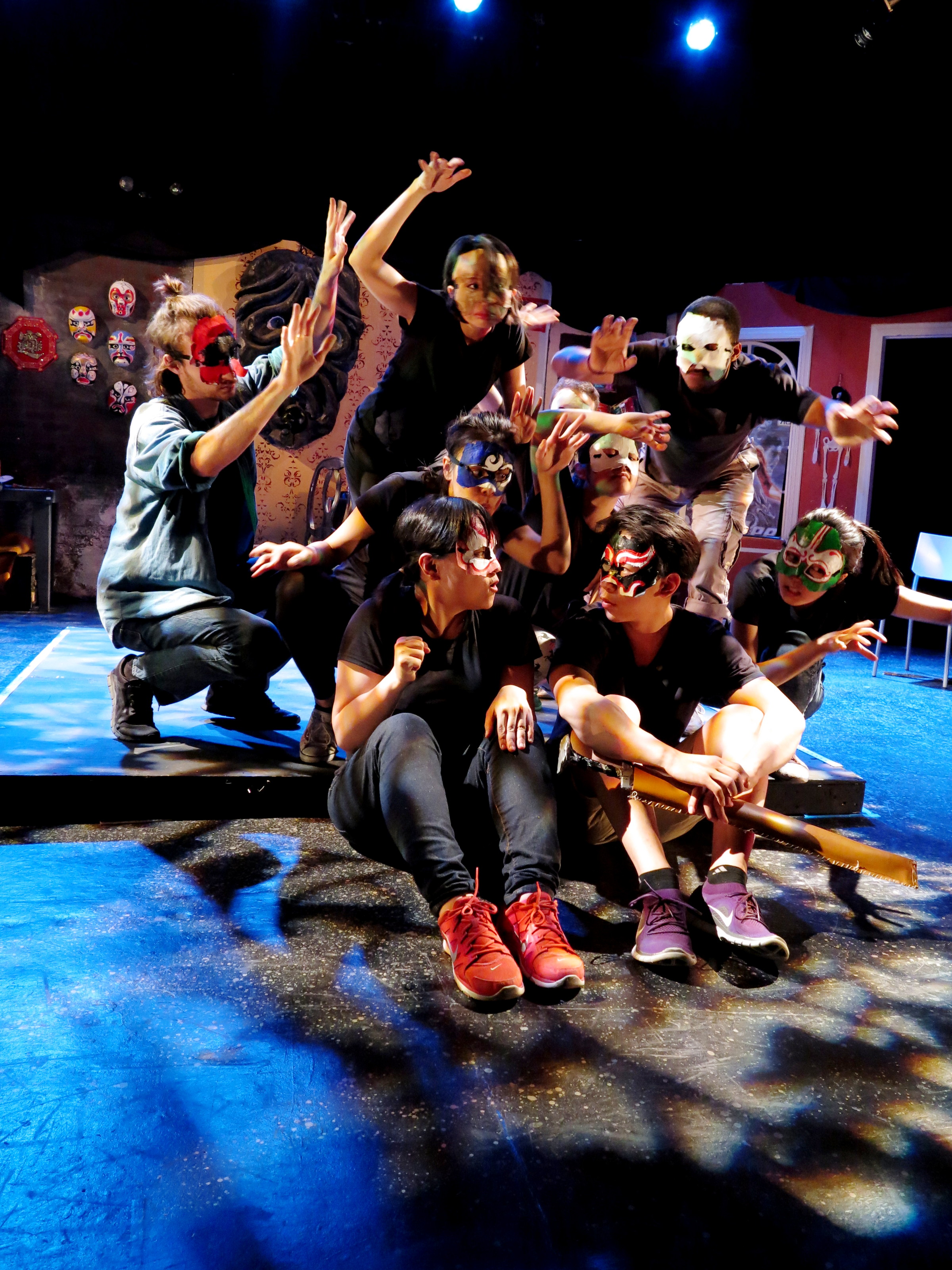
But beyond such technical (and bodily) hardships, everyone in the audience—English or Chinese-speaking—understands that they are watching a play about a rehearsal for a play. A struggling theater troupe somewhere in China is putting on their production of an ancient myth about a tyrannical king who kills his master swordsmiths when he realizes that their blood is required to forge the world's sharpest blades. Sixteen years after the twin deaths, the swordsmiths' son Mei Jian Chi seeks his revenge against the bloodthirsty king, and (with a considerable recalculation of what it means to live and die) offers his decapitated "living head" as part of a deal to kill the ruler. In sporadic, poignant interruptions, the actors rehearsing the play break off into individual monologues, describing their lives as artists in a largely discouraging contemporary environment. 

Fan toys with several peculiar themes in Behind The Mask, but perhaps one is more ubiquitous than we think: life after death. Dead characters regularly walk and talk to living ones; death is signified by the removal of a brightly colored mask covering the actors' faces, and the mask itself becomes a "living head." Behind The Mask's ghosts, both real and cerebral, are as present as the living. Old vendettas and dead generational vengeances thrive in the hearts of the young, as do ancient values. In this respect, there is an organic, moving parallel to be drawn between Mei Jian Chi's quest to find his courage and each individual actor's risky decision to become a performer. Writers Fend BaiMing and Huang WeiRuo have mastered the stumbling, yet stirring, speeches of the sons and daughters of austere Asian parents. There is a controlled rebellion and rapt wonderment in their words as the actors of the theater troupe defend their creative decisions and their all-consuming love for the theater.

It is not difficult to picture any one of this play's actual performers delivering similar addresses to their own parents at some point in their lives. Behind their exuberant dialogue plays a rousing soundtrack, emotive and airy during the monologues, and warlike and drum-heavy during the mythologizing. It's no wonder that the music regulates the pulse of the play; composer Xiren Wang is a self-described "aural magician." More striking to the eye is the red-and-yellow-colored set, with flashy posters of Bruce Lee and eyeless Kabuki masks gazing out at the audience. A giant tragedy mask occupies center stage; it seems to portend an inevitable resolution to the play's tensions between life and death. So although the English speaker, that ever-adaptable breed of audience, finds a vexing inability to fully appreciate Fan's enchanting take on Behind The Mask, strong communal performances and a good deal of affable philosophy serve up a delicious, if neck-cracking, feast for their eyes and ears. 

Presented by the Yangtze Repertory Theatre of America, Behind the Mask—a Play by Chinese authors Feng BaiMing and Huang WeiRuo, ran at Theater for the New City (155 First Ave. between 9th and 10th Sts. in Manhattan) through July 12.  For more information, visit www.yangtze-rep-theatre.org.

Click for print friendly PDF version of this blog post

Memorable Shadows

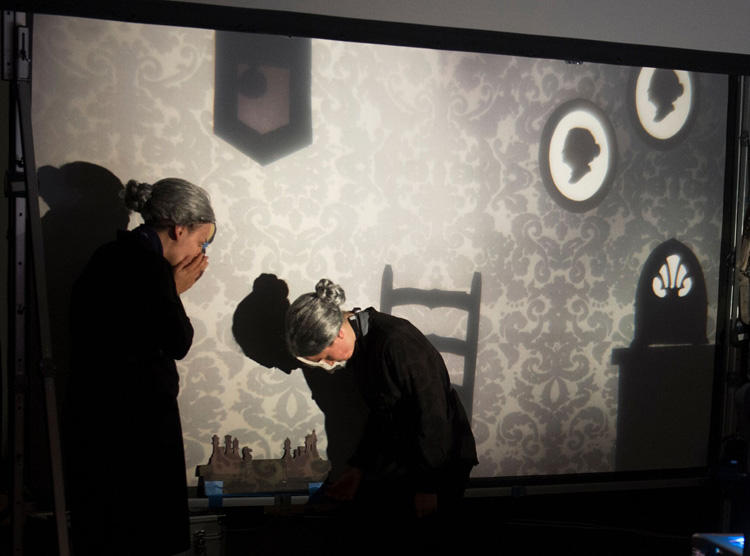
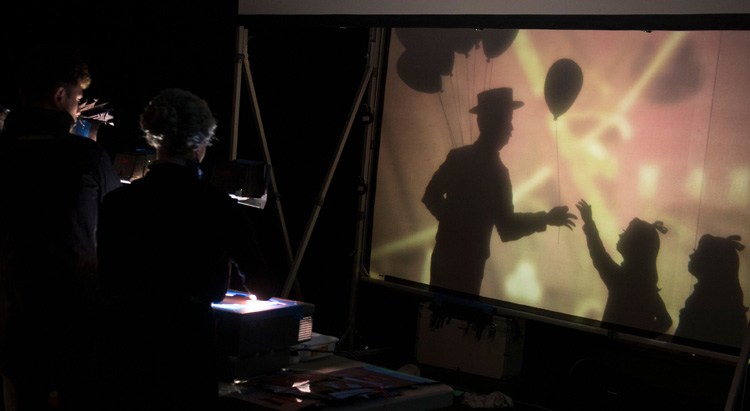
Ada/Ava, the new production of Manual Cinema and The Tank at the 3-Legged Dog Art & Technology Center is hard to pigeonhole, let alone describe. The story it tells is fascinating, but the multimedia whatsis is unlike anything you may ever have seen—in a good way. It’s undertaken by eight talented performers, musicians and technicians, who use five overhead projectors—antique technology—and transparencies with cut-outs to cast shadows against a screen. Also casting shadows are two actresses dressed up as old women. They play the twin septuagenarians of the title, but although we see the actresses, it’s the shadows they cast that are telling the story.

Manual Cinema’s title is in no way a misnomer. This is hands-on “cinema,” prehistoric by Jurassic World standards, as transparencies are slapped by hand onto the projectors, and the actresses’ shadows conform to the background: if chair shadows are shown, the actresses crouch just enough so that the shadows seem to be sitting. Although the actresses are about the same height, they obviously look different, so they wear apparatuses to make their shadow profiles identical.

The twins live next to a lighthouse that they tend. They are responsible for replacing the lights, and during a violent thunderstorm they ascend the spiral of steps to do that. But in short order Ada dies, and Ava tries to carry on alone. There are flashbacks to their childhood, visits to a carnival and a vivid nightmare sequence. Themes of love, loneliness and loss play out with tenderness and anguish, just as if the viewer were watching the Gish sisters in a silent movie.

The production is heavy with technology, but it rarely intrudes, although the “backstage” elements—the “puppeteers” and overhead projectors—actually occupy the foreground between the viewer and the screen, and they provide a strangely compelling frame. The projections are colorful and detailed (the sisters’ history is delineated in a variety of framed silhouettes that hang on the “walls”), and they include montages (extraordinarily “staged” with multiple layers of overlays). To the sides are live musicians to play the eerie score by Kyle Vegter and Ben Kauffman; the pair also designed the sound. The performance is directed by Drew Dir, who also, with Sarah Fornace and Julia Miller, designed the rest of the production. Even the performers, when not in a scene, help out with the labor-intensive projections.

One of the questions that may arise is whether this is theater or cinema. If there are no 3-D characters performing and no text, can it be theater? Balinese shadow puppetry is considered a branch of theater, but Manual Cinema’s own name refers to itself as a film medium. The company also calls its cutouts “puppets,” although they are 2-D. Those are questions to chew on after the show—and the performers gladly invite the audience to step down to chat and take a closer look at the elements of this intriguing production.

Ada/Ava plays at the 3-Legged Dog Art & Technology Center (80 Greenwich St. between Rector and Edgar Sts.) in Manhattan through July 12. Evening performances are at 8 p.m. June 24–27 and July 8; and at both 7 and 9 p.m. on June 30–July 3,  and July 9 and 10; also at 7 p.m. on July 11 and 12. There is also an evening performance on July 5 at 7 p.m. Matinees are at 3 p.m. June 28, July 45, and 1112. For tickets, call 866-811-4111 or visit OvationTix.com.

Click for print friendly PDF version of this blog post

Brittle Steel Magnolias

Immersive performance experiences usually toe the blurry line between smashing through the fourth wall and discomfiting the audience with its intimacy. But when onlookers can cling to the familiarity of a tried and true theme, a delightful complacency settles in, and expectations tend to plateau. In director/choreographer/creator Mary John Frank's production of Debutaunt, five Southern belles conduct their coming-of-age rituals through an “interactive dance-based experience” complete with forehead-to-floor bows and book-balancing posture exercises. 

Click for print friendly PDF version of this blog post

The Devil’s Advocate

Classic Stage Company’s production of Christopher Marlowe’s Doctor Faustus, directed by Andrei Belgrader, doesn’t do away with Marlowe’s mighty line, but his pioneering iambic pentameter has a hard time keeping up with a good deal of lowbrow tomfoolery inserted by Belgrader and his co-adaptor, David Bridel. To be fair, Marlowe larded his play with comic relief, but the CSC production often strains for humorous effect. Early on, when two necromancers visit Faustus, they speak in silly voices for no apparent reason, one of them sounding like a hoarse Munchkin. 

The comedy helps leaven the well-known story of death and damnation for the medieval scholar with encyclopedic knowledge who seeks omnipotence as well. Besides Marlowe’s play, its most notable appearances are in operas by Gounod and Busoni and in a novel by Thomas Mann (the last is not easy reading).

By selling his soul to Beelzebub, Faustus gains the service of Mephistopheles for 24 years, but he fritters away all the advantages he has with childish nonsense. He tweaks the Pope and European rulers; he summons long-dead historical figures (including Helen of Troy, “the face that launched a thousand ships,” in Marlowe’s phrase); and has himself a lot of sexual fun. Initially, Faust demands that Mephistopheles find him a beautiful wife, but Mephistopheles tells him that marriage is a sacrament of God, and because Faustus has renounced God, he must be content with concubines. That’s apparently not a problem.

Bridel and Belgrader have understandably changed a great deal. They have cut whole passages skillfully, dropping many references to classical myths and characters and adding plenty of business that's not in the original, including audience interactivity that’s surely more close-up than Elizabethan actors ever got to their spectators. The changes get down to the nitty-gritty, too, as the adapters substitute individual words for ones they deem too obscure for a modern audience, and update archaic locutions. Thus Marlowe’s

Faustus, begin thine incantations
And try if devils will obey thy hest
Seeing thou hast pray’d and sacrific’d to them.

is streamlined to:

Faustus, begin your incantations
And see if devils will obey your will
Once you have prayed and sacrificed to them.

The reworking is extensive, and only occasionally puzzling. Surely Marlowe’s “The framing of this circle on the ground/Brings thunder, whirlwinds, storm and lightning” not only has better iambic scansion than “The framing of this circle on the ground/Brings whirlwinds, tempests, thunder, and lightning,” but “storm” is also a word more commonly used than “tempest.”

As Faustus, Chris Noth handles the verse with clarity and intelligence, and he shows a troubled, ambitious, scornful spirit. But Faustus’s philosophical musings cannot sustain one’s interest entirely, so besides comedy, Marlowe includes pageantry (the Pope, an emperor, a selection of demons and phantoms) for the eyes. The pageantry here is pretty thin, but Bridel and Belgrader embrace the secondary plots more than that of Faustus, and the imbalance is noticeable. It’s present in the underlings enlisted by Faustus’s own servant, Wagner, who doubles as the Chorus: Lucas Caleb Rooney’s strapping Robin, who swipes Faustus’s books of magic with a barking, raffish energy to teach himself the dark arts; and then Robin’s own protégé, Ken Cheeseman’s idiot peasant Dick, who gives rise to plenty of punning. “I shall be the Devil’s Dick,” he cries exultantly, in just one of a series of Dick jokes that bump vulgarly against the higher-brow issues involving God and the fall of man. 

Zach Grenier brings a weary glumness to Mephistopheles, the devil who remembers longingly the joys of Paradise but who has adapted to the reality that he’ll never know them again. His glances at Faustus show what a fool he thinks the doctor is, and he seems the real tragic figure. Belgrader also includes a good deal of audience participation, as Mephistopheles sniffs out sinners at close quarters, and there is one clever twist as the Seven Deadly Sins are presented, although their forming a kick line as they whinny out a song is just directorial froufrou.

Still, if bumblers and hijinks diminish the tragic effect and Marlowe’s transporting poetry, the production retains integrity. And if Faustus’s final descent to the fiery pit isn’t likely to bring forth any catharsis, that’s partly because Faustus concerns himself with trifling pranks. It's too bad, though, that Belgrader couldn't imbue this production with a bit more gravitas.

Christopher Marlowe’s Doctor Faustus plays at Classic Stage Company (136 E. 13th St. between 3rd and 4th Aves.) through July 12. Evening performances are at 7 p.m. on Tuesday-Thursday and 8 p.m. on Friday and Saturday. Matinees are at 3 p.m. Saturday and Sunday. Tickets may be obtained by calling 212- 352-3101 or visiting www.classicstage.org.


Click for print friendly PDF version of this blog post

Mamet in a Minor Key

The umbrella title Ghost Stories encompasses two David Mamet one-acts that were produced together 30 years ago by Lincoln Center. Now revived by the Atlantic Theater Company for its own 30th anniversary—it was founded by Mamet, William H. Macy, Glenn Close and Kate Winslet—the productions of Prairie du Chien and The Shawl at the Atlantic’s Stage II are miniatures, yet they bear the signs of Mamet’s hand. They are not just for completist fans of the author, however.

The opener, Prairie du Chien, takes place in 1910 on a train traveling through Wisconsin. As two men play cards (Jim Frangione is the older; Nate Dendy the younger, the Dealer), it’s apparent that the older has been losing and is suspicious of the Dealer. Their play, however, is mere window dressing for the story that unfolds in the other half of the car, where a younger man, aka the Listener (Jason Ritter), sits with a child sleeping at his side. In short order, the Storyteller (Jordan Lage, one of Atlantic’s founding members) enters, and he begins to tell the story of a farmer, a black hired hand, and the farmer’s wife. It is a love triangle that ends violently, but it also has elements that are inexplicable unless one believes in the supernatural.

The farmer, it transpires, suspected his wife of infidelity and killed her and the hired hand, then set the house and barn on fire and hanged himself. The sheriff and the Storyteller rode up and saw the flames; the former attended to the house, where the wife was, and the Storyteller rushed to the barn, where he found the hired hand and the wife, in a red dress, dead. But the sheriff claims the wife was in the house and directed him to the barn. The strangeness of the story increases as the red dress takes a crucial role in the bizarre tale of the sheriff’s demise years later.

Under Scott Zigler’s direction, the description of events unfolds in a leisurely manner, slowly building suspense; for both plays Jeff Croiter's atmospheric lighting contributes immeasurably to a mood of dread and uncertainty. Prairie du Chien originated as a radio play, however, and it depends heavily on dialogue, which Lage’s Storyteller delivers in a subdued manner, sometimes bordering on inaudible. Although a burst of violence—the only one in the evening—brings the story to a climax, the reliance on narration mutes some of the interest.

The Shawl is the more successful of the two. In it, a psychic (Arliss Howard) reels in a woman, Miss A (Mary McCann) as he “divines” why she has come to him and what her problem is. Howard plays the psychic beautifully, pausing and seeming to pull images out of the ether, with faraway looks and soothing speech, always using suggestion to help her reveal points about herself. He is assisted by his protégé/lover Charles (Ritter again), who wants to make a quick killing. “It comes down to confidence,” John, the psychic, explains to him. “They’ll test you. And you can do nothing till you have their trust.” John’s power to read clients rivals that of Sherlock Holmes, but Miss A proves particularly tricky.

McCann (also a founding member of the Atlantic) taps into Miss A’s wariness, yet also displays at times a brisk confidence. The table reading scene is particularly effective, as Howard’s bogus diviner plants the seeds of belief and tries to nurture them the trust of his mark. Miss A has a problem that she wants a decision about, and his ability to read her helps him lead her to it. Mamet has a double twist in store, however, that brings the drama to a fascinating, eerie conclusion.

The one-acts fit together nicely, since both are about what one can trust as true and what cannot be trusted. The search for the truth, suggests The Shawl, may lead to it, but in unexplainable ways. The revival of these one-acts are a fitting tribute to the Atlantic and its co-founder.

The Atlantic Stage II hosts Ghost Stories: The Shawl and Prairie du Chien through June 28 at 300 West 16th St. Evening performances are 7:30 p.m. Wednesday-Saturday. Matinees are at 2:30 p.m. on Saturday and Sunday. Tickets may be purchased by calling Ovation Tix at (866) 811-4111 or at ovationtix.com; or by visiting the box office at 336 W. 20th St. or visiting atlantictheater.org.

Click for print friendly PDF version of this blog post

In Persistence of Mediocrity

Francis Newton Souza was an Indian-born visual artist who skyrocketed to the top of the London art scene in the late 1950s. His work at the time was heralded as “uncovering the underbelly of existence,” and the artist himself had “upturned everything.” Soon his fame dwindled, and he struggled to sell even his inoffensive landscapes (over his more emotive, sexually charged nudes). When Souza died a depressed, bankrupt pauper in 2002, his art began to sell at auction houses and museums like ice cream on a hot day. Sam Marks, writer of The Old Masters currently running at The Flea Theater, is particularly fascinated with this phenomenon: that of the "lost artist," the rebel in absentia. As his main character morosely points out, "There have been a few artists… who turned their back on the art world, in one way or another, and then became hot."

The play deals with failed artist and expectant father Ben Schmitt (Rory Kulz) as he fights against what he thinks is a slow descent into suburbia and ordinariness. His beautiful, sharp-tongued, architect of a wife Olive (Alesandra Nahodil) is pregnant, but her desire for a nuclear family is a menacing specter to Ben. His old art school friend Henry Olson has disappeared, but the latter’s paintings arrive at Ben’s door one morning, brought along by Henry’s girlfriend, the prettily mysterious Lara (Adelind Horan). As he shows them to galleries and his friend’s works cast a spell over the art world, Ben seeks to find his own calling, even at the cost of a lost artist’s success. 

The main stage at The Flea Theater is decidedly small (it seats 74 at maximum capacity), yet an even smaller space (seating 40) exists below it. The “joyful hell in a small space” that the Flea seeks to instill through performance is perhaps taken a tad too seriously; walking into this basement-like set is the first jolt of unnerving intimacy we get as the production runs its hour-and-a-half long course. The space itself is a long rectangle, perfect for set designer Andrew Diaz’s vision of an unfinished apartment, complete with piles of sheet rock, scaffolding, and dozens of half-opened cardboard boxes. The program includes a description of a featured artist’s works that hang on the incomplete walls of the set, in a rather ironic stab at publicity for contemporary visual art. 

The production is rife with a high Chelsea dialect, unique to that district’s art scene both in attitude and vocabulary; for instance, here’s Ben talking to a gallerist about Henry’s work: “There are touches of the photorealism. But when comparing them to other neorealists it’s not steely, like Richter, and it’s not candy coated, like Elizabeth Peyton.” But to shield us from our intellectual insecurities, there is Lara, the laid-back, spontaneous manic pixie dreamboat, with her defensive indifference to Rauschenberg and Klee and Richter. The rapid-fire delivery of the lines, particularly between Kulz and Horan, is reminiscent of Hollywood oldies like His Girl Friday and Bringing Up Baby, minus the screwball comedy, but double the erotic will-they-won’t-they. Director Brandon Stock’s “examination of marriage” might have benefited from fewer shouting matches and a greater focus on the couple’s dynamics itself; Horan’s Lara, rather than said dynamics, dominates the production. Yet there is a wry cynicism in Kulz’s performance that slowly progresses to despairing disillusionment, and his character is often brought down to earth by a staunchly realistic wife, played to sympathetic perfection by Nahodil. 

Kulz as a particularly reflective Ben. 

We find it especially difficult to sympathize with the main character; indeed, Ben spends most of the play as the insensitive, pretentious, wannabe-Old-Master who seeks to dethrone his Souza-esque best friend from the “allure of the lost artist” that Henry possesses. But it is in Ben’s temperamental evolution where Marks’ charged, controlled script reaches its dramatic crescendo, in more ways than one. At the tail end of a destructive fight between Ben and Olive, the audience finally understands the extent of Ben’s ambition, and how that ambition isn’t so different from our own. Ben seeks to rise above his forced mantle of mediocrity, and he struggles under the lightness of its weight: “I have tried. For years I have tried to be the guy who teaches a little and works a little and goes out a little and had a little career and fucks a little and has a little family and it doesn’t work. It doesn’t fucking work.” 

It is this passive struggle that seems to be the perennial cause of our own rare, active movements: quitting a dead-end job, abandoning a troubled marriage and ending a toxic friendship. Ben does all of these things, thinking it will give him a chance to soar above the rest of the muddled, mediocre heap of humanity and place him alongside the echelons of the Old Masters. But all he does is join our ranks. So if you don’t mind a few glancing blows to your comfortable existence, or a sudden urge to reshuffle your priorities, Marks’ new play is well worth a visit. 

The Old Masters runs until June 28 at The Flea Theater (41 White Street between Church and Broadway). Performances are Monday-Saturday at 9 p.m. and Sunday at 7 p.m. (Note: there are no performances June 23-26.) Tickets are $15-$35 with lowest priced tickets available on a first-come, first-served basis. For tickets, call 212-352-3101 or visit www.theflea.org.

Click for print friendly PDF version of this blog post

A Thief for Our Hearts

London’s eccentric thief Mary Frith wore men’s clothing and was supposedly known to be a pimp, pickpocket and reseller of stolen goods. She gained the nickname “Moll Cutpurse” after being arrested for stealing purses. Her reputation inspired playwrights Thomas Middleton and Thomas Dekker to create their comedy The Roaring Girl during the Jacobean era (1567–1625). The title is borrowed from young, drunk men who were called “roaring boys,” and they would pick fights on the streets. The Roaring Girl is filled with campy sexual innuendos and manipulative characters who challenge our cultural beliefs about gender roles, marriage and status.

In this fictionalized dramatization of Mary Frith’s life, Sebastian Wengrave (Jacob Owen) attempts to trick his greedy father Sir Alexander Wengrave (Matt Walker) into allowing him to marry his true love Mary Fitzallard (Anna Clare Kerr). Mary’s dowry is too small to meet Sir Alexander’s demands and he threatens to cut Sebastian out of the family. Sebastian tries to outwit his father by pretending to be in love with infamous thief Moll Cutpurse (Malloree Hill) so that his father will eventually prefer to have Mary as his daughter-in-law, and not an outcast. Sebastian’s plot is thwarted when Sir Alexander has whimsical Ralph Trapdoor (Max Hunter) spy on Moll. Sir Alexander unsuccessfully tries to have Moll steal diamonds so that he can frame her. Moll is too savvy and does not take the bait, and later unmasks Trapdoor when he pretends to be a wounded soldier.

Deceit and seduction are also played out in two other parallel stories about marriage. Laxton (Joel DeCandio) and Goshawk (Ryan Mills) both pursue taking advantage of two married women whose husbands eventually get involved. The ploys and subject matter from this era have withheld time and still translate to modern culture. The test of one’s character ultimately holds more weight than appearances and titles in this production.

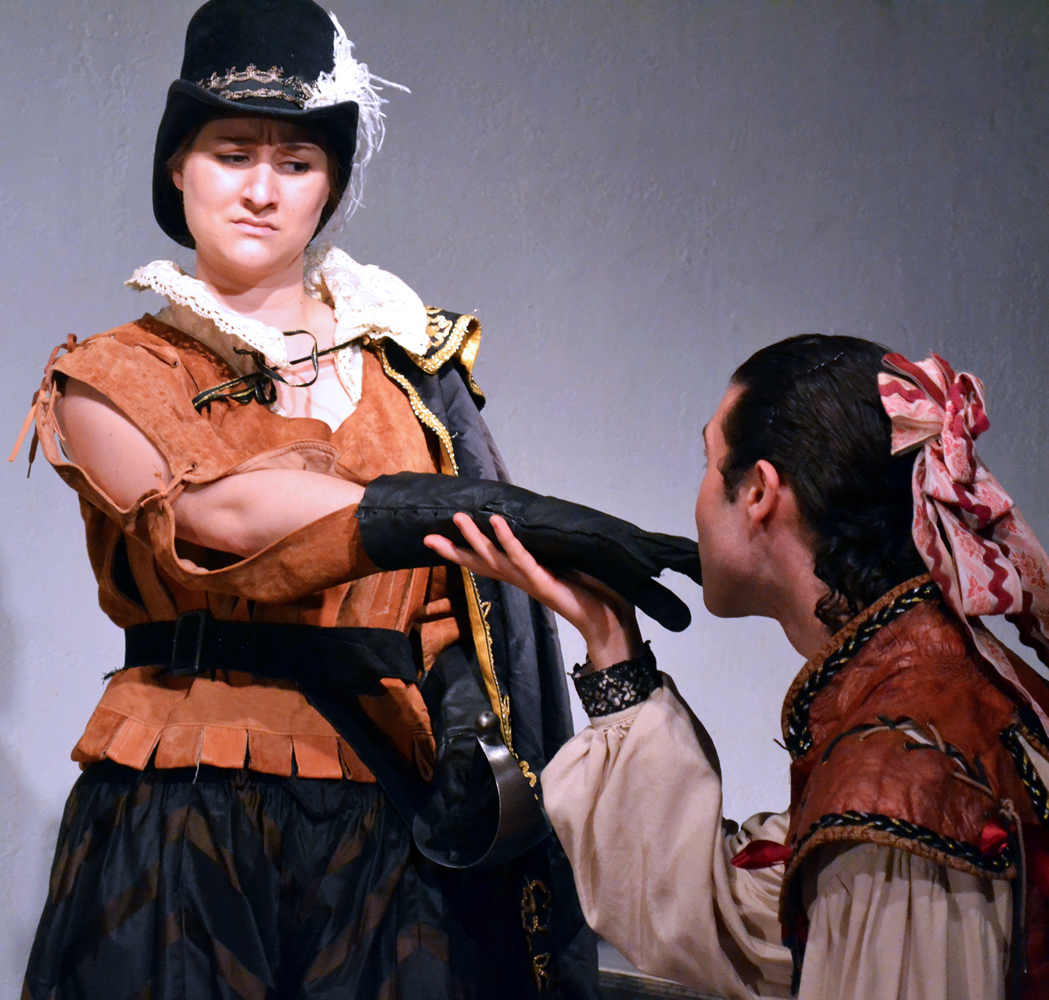
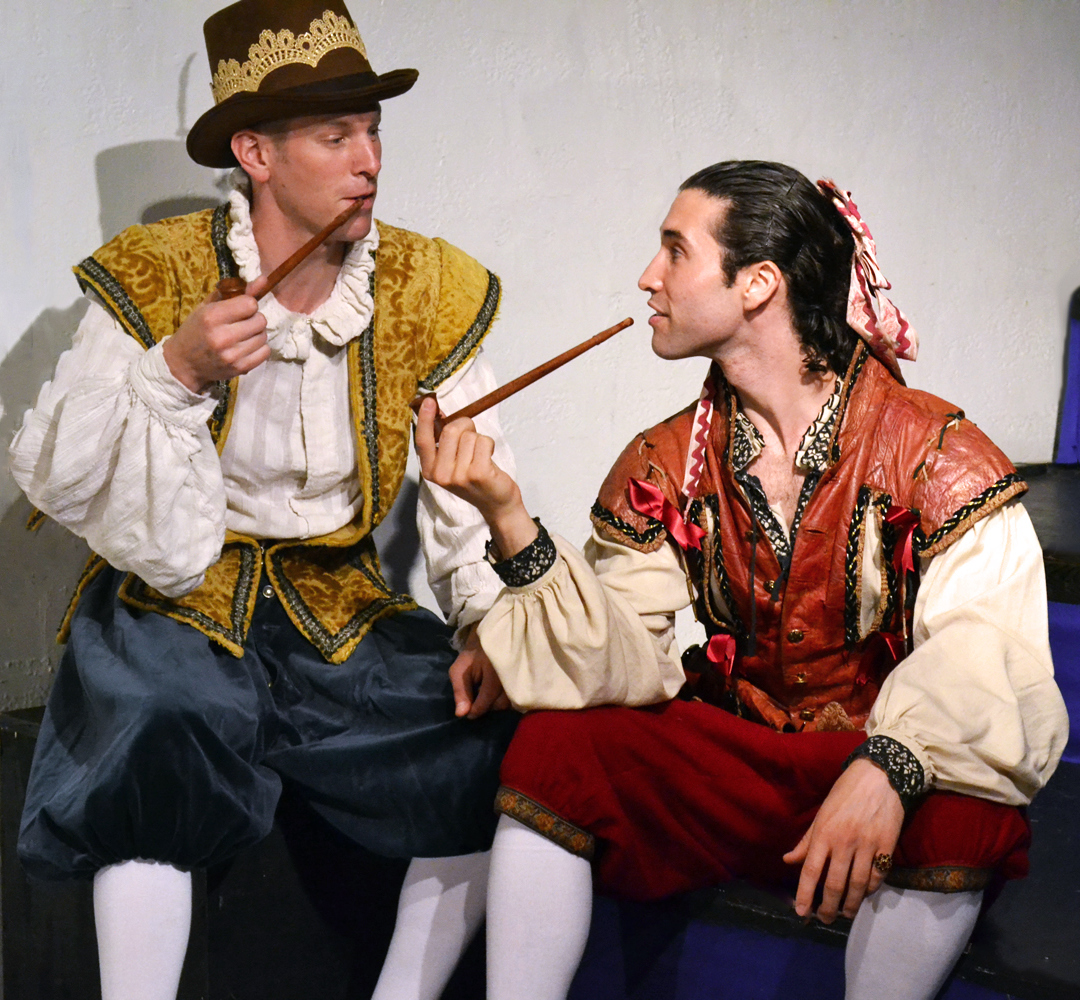
After stepping off of a noisy downtown street and walking up four flights of stairs you will find yourself in a cozy space decorated with a rainbow carnival canopy. The warm hardwood floors are inviting as you find your seat at a red jazz club table and play with colorful feathers in glass bowls. There are amusing table signs with written tips for comprehending a Jacobean joke: “If you think it’s about sex, it is,” and “If you don’t think it’s about sex, it still is.” The actors suddenly appear from behind you and they will even put their feet up at your table without asking first. Director Anaïs Koivisto and this youthful, vibrant cast also bring choreographed sword fights and group brawls in beautiful period costumes.

The show runs for two hours and 15 minutes with a 10-minute intermission and might occur as long at first. There was a slight dead period right before the opening and the audience members were left waiting and wondering. However, the live singing, group dancing, and guitar and drum playing, will keep you entertained throughout the entire show.

Hunter consistently provides the needed stamina and physical comedy required to perform as foolish Trapdoor, and he becomes a guiding light throughout this production. His energy is complimented when he teams up with Gull (Quinn Warren) as a disguised soldier. The spunk and moxie that Warren brings to feisty Gull can be summed up when she says, “I am call'd by those that have seen my valour, Tearcat.” At times, Hill lacks the same level of power as the heroine Moll to carry out this show. She does capture some of the masculine characteristics of Moll, such as her stance, and she maneuvers through the sword fights with ease and grace. When challenged or questioned about Moll's reputation, Hill’s facial expressions appeared quietly surprised and passive. It could be more fitting for Hill to not avoid Moll’s defiant history, and instead own her past. If Moll were alive today, she would probably be living her life as she wished and have little or no regard for laws, social norms or being politically correct.

The Everyday Inferno Theatre Company delivers on their commitment to provide classic material to a wide audience while maintaining low production costs in The Roaring Girl. This production is one of two plays in a rotating repertory called Punks & Provocateurs. For those who appreciate Shakespeare and are interested in a sexy alternative, The Roaring Girl is worth your attention. It is not an everyday occurrence to experience Middleton and Dekker’s witty material performed in an intimate and unimposing downtown setting with an eager ensemble.

The Roaring Girl runs until June 21 at the Access Theater (380 Broadway between White and Walker Sts.) in Manhattan. Evening performances are Tuesday, Thursday and Saturday at 8 p.m. and matinee performances are Sunday at 3 p.m. Tickets are $18 and can be purchased by visiting punksandprovocateurs.bpt.me or by calling 347-291-1805.

Click for print friendly PDF version of this blog post

Great Literary Work Travels

We can instantly access information 24 hours a day on our cell phones about the latest and most exotic places in the world to visit. Our friends and family members share their vacation photos and videos on social media. My younger sister traveled around the world when she graduated from college with her friend from high school, and she inspired me to live in Japan, India, Nepal and Bali. Traveling Papers inspires us to get out and experience the world, or to at least read some great literature about travel. Today we can fly to breathtaking beaches in developing countries, like Costa Rica or Indonesia, and stay at a discounted luxury resort we found online. There are also packaged family cruises to the Bahamas, or one could simply pack their backpack and travel alone through Europe. Our innate curiosity for adventure, exploration and self-discovery can take us to places and cultures we never imagined existed. Creators Barbara Bosch and Martin Tackel take on creating a theatrical journey that reminds us of our innate love for traveling in Traveling Papers.

“Wherever you go, go with all your heart,”—Confucius, and other inspirational quotes from Ralph Waldo Emerson, Blaise Pascal, Henry David Thoreau, and other famous people provide feel-good moments throughout this play. In "The Globetrotter Diaries," photographer Michael Clinton sparks our curiosity to travel to Asia when he shares about being in Nepal and “watching cremations in the tradition of the Hindu religion.” This production is a travel tapestry of literary work from Mark Twain, Edith Wharton, W. Somerset Maugham and Anthony Bourdain. By covering the work of so many profound people within 90 minutes, it does not give the audience enough time to connect with the individual stories. These rich tales touch our hearts and minds and speak to us from the past. It is like recalling the first time you read Robert Frost's "The Road Not Taken." The real brilliance of this production is the weaving of all of these stories throughout time and the deliveries are executed with humor and gratitude.

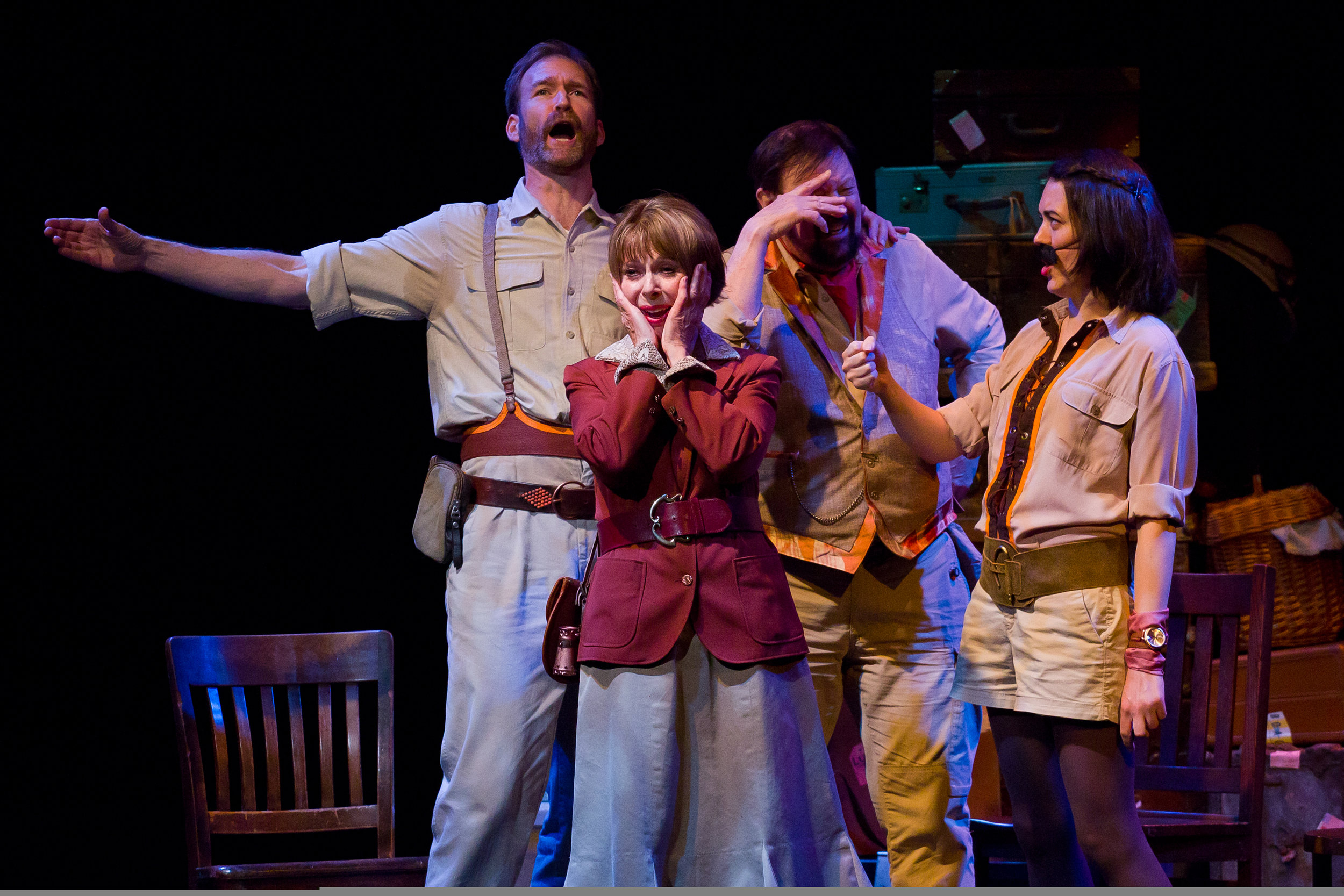
Watching seven actors in beige safari outfits, who are distinguished by their age, gender, weight and hairstyle, lacks the variety to engage the lens of New York theatergoers, and does not represent a universal connection to travel. These similar characters do not speak for the whole population and there is a clear disconnect when the production aims to show how humankind has a deep desire for exploration. The bare, black stage with only wooden chairs and a stack of vintage trunks and suitcases adds to the visual blandness. A more diverse ensemble could add to each character’s unique point of view and create more entertaining contrast.

In scene 15, you will become immersed into the short story, “The Guiding Miss Gowd” by novelist Edna Ferber, and a suspension of disbelief will set in. It takes place in Rome with British guide Mary Gowd (Gwen Eyster) as she attempts to save "Tweetie" Gregg (Jillian Stevens) from being romantically swept away by Italian officer Signor Caldini (Kyle Doherty). Eyster successfully carries this scene with humor and an inner conflict through the mastery of her eyes and facial expressions. Her eye movements are so skillful that the audience is naturally drawn in and instantly curious about the next character she plays.

The ensemble also features Gwen Arment, John Camera, Peter Husovsky and Macy Idzakovich. As one group of actors perform, the others sit silently in chairs along the walls. The performing actors announce their own actions at times, and it can sound redundant. It would be more entertaining if director Bosch instructed the sitting actors to voice the actions of the performing actors.

Traveling Papers does accomplish igniting the kind of unexpected journeys that Wolfgang Amadeus Mozart, Marcel Proust, Marco Polo, and many others have shared throughout time. The value of this production relies heavily on the past great work of other people. For audience members who are already familiar with these stories, there is a natural cultural context and appreciation. The production would have been stronger with more original content and fewer stories to develop the characters. Traveling Papers is recommended for those who love great literature and the art of travel. Flipping through Facebook, Pinterest and YouTube in search of the next vacation can be stimulating, but live theater strokes an inner yearning to travel outside of what we think we already know.

Traveling Papers runs until June 20 at Theatre Row's The Lion Theatre (410 West 42nd St. between 9th and 10th Aves.) in Manhattan. Evening performances are Wednesday-Saturday at 8 p.m. and matinee performances are Saturday at 2 p.m. and Sunday at 3 p.m. There is no performance on Saturday, June 13. Tickets are $17 and can be purchased by visiting Telecharge.com or by calling 212-239-6200.

Click for print friendly PDF version of this blog post

A Lost Family

Middle-aged hippie housewife and Beatles’ fan Anna (Deborah Offner) is at the center of her dysfunctional family as she tests her Catholic faith and battles with the “awful monkey in [her] head” during the days before Christmas. The “monkey” is actually a belittling teenage version of herself as Anna 2 (Catherine Dupont), who recalls Anna’s past abortion and drug use. Her Jewish atheist husband Henry (Larry Cahn) suffers from dementia and sleeps his days away on the couch as their adopted 18-year-old son Jude (Adam Weppler) smokes marijuana and seeks his own identity.

Playwright Nancy Manocherian explores how this family struggles with loss, identity and being incomplete with the past. Anna “had to pay for [her] father’s suicide” because of her abortion and Henry stopped “being a Jew” when he was bullied as a boy. Jude never met his biological Romanian mother and believes the “cockroach will survive, but [humans are] on a path of entropy.” Even when Anna is confronted with a life-altering situation, her denial does not allow her to take responsibility for her actions. Hey Jude attempts to venture beyond a psychological inquiry into socially impaired family dynamics and leaves the audience craving closure with these characters.

Jude’s challenge to grasp his father’s dementia is authentically performed by Weppler. The dynamics between Jude and his retired father reminded me of my younger cousin who struggled to make sense of his father’s multiple sclerosis. Jude is so eager to understand Henry, but he cannot relate because Jude has never had dementia. Jude does his best to care for his father and wants to bond by attending sporting events together. Henry brings comic relief by wearing an adult diaper on his head and then later returns wearing Anna’s church hat. Even though Henry’s dementia is the elephant in the room, Anna’s lunacy does not give Henry the space to develop as a character. Also, instead of being an insanity trigger for Anna, Anna 2 could be a stronger antagonist for Dupont to portray. Offner effectively conveys her character's extreme complexities and subtle need to control everyone in her life. Director Kira Simring has the challenge of creating sufficient room for all of these characters to breath so they are not overshadowed by Anna’s mental illness. Hey Jude could be mistaken for Hey Anna.

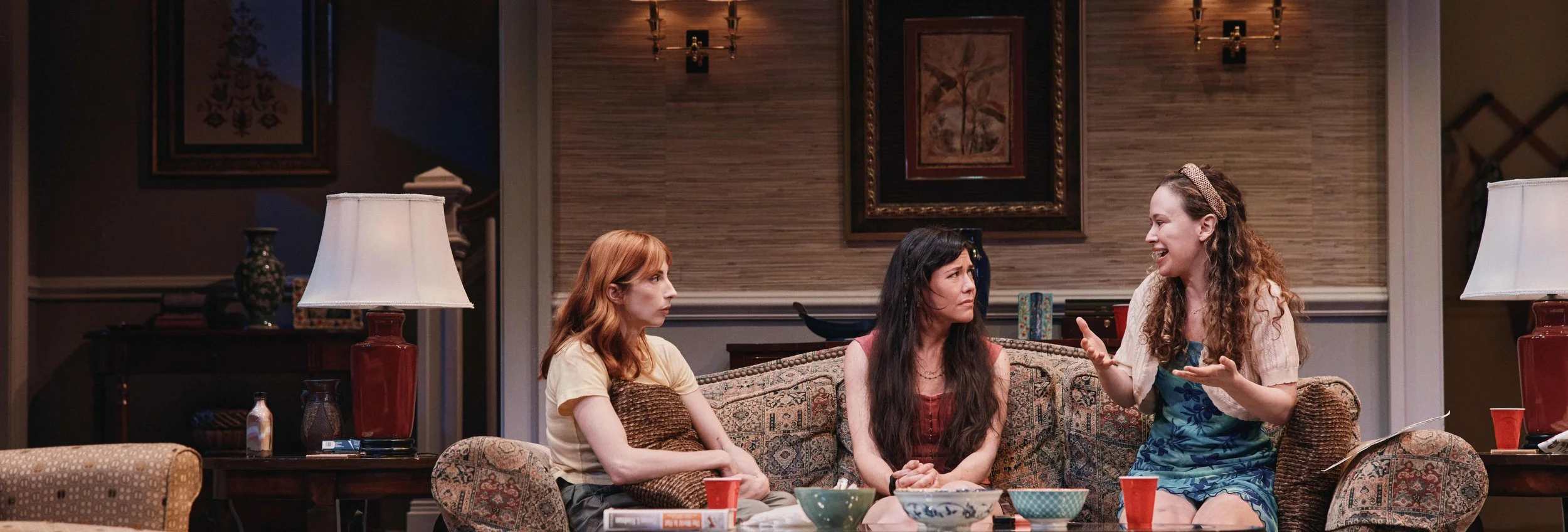
The set design by Peiyi Wong increases this production’s value with an ideal living room outside of New York City in 2007. The light colored walls, shelves, curtains and hardwood floors allow for the decorated Christmas tree to instantly set the holiday tone. Finding Henry asleep on the plush, brown sofa and holding a pillow with the television on is like standing in a neighbor’s living room. This home is a natural representation of many modern households in America. However, the missing wall next to the xylophone is a distracting black hole and when the actors point at cockroaches there are none to be seen. The morning light in the windows by lighting designer Gertjan Houben adds to the ethereal feeling that the audience is waking up with this family, and we get to see how Henry starts his day.

For audience members who did not grow up listening to the Beatles, they might not relate to the Beatles’ nostalgia that Anna shares, or the era that she experienced as a young woman. The generational contrast can be felt when Jude says, “There’s never anything to eat in this house. Unless you’re a vegetarian, and Paul McCartney doesn’t live here.” Likewise, when Henry refers to the song “Rumania, Rumania,” some might not get the cultural reference or know of Yiddish jazz singers, The Barry Sisters, who were popular during the 1950s. Lastly, when Anna sings her version of Shirley Ellis’ “The Clapping Song” from 1965, some might not recognize the original lyrics. If you are not familiar with these songs, they are worth listening to online and reading the lyrics for their stories.

Hey Jude falls short of conveying a clear message and allows a general audience to draw their own conclusions. It is like driving past a fight on the side of the road and later wondering if the police or an ambulance ever came to take anyone to the hospital. We want to know if these characters ever find any peace or if they just continue to cope with their circumstances. The value is seeing aspects of our own family members in these performances. Hey Jude is recommended for those who are not so concerned about a resolution and are entertained by watching a modern family struggle.

Hey Jude runs until June 21 at Urban Stages (259 West 30th St. between 7th and 8th Aves.) in Manhattan. Evening performances are Tuesday and Wednesday at 7:30 p.m., Thursday-Saturday at 8 p.m., and matinee performances are Sunday at 2 p.m. Tickets are $45 and can be purchased by visiting thecelltheatre.org or by calling Brown Paper Tickets at 800-838-3006.

Click for print friendly PDF version of this blog post

A Spoiler in the Room

In her early film career, Bette Davis set herself apart by being willing to play characters who were unsympathetic; her bad women in Of Human Bondage and Jezebel were her tickets to fame and marked her as different from other studio stars. Jesse Eisenberg is equally unafraid to take on characters who are unpleasant—even loathesome. His performance as the cold and arrogant Mark Zuckerberg in The Social Network won him an Oscar nomination. In The New Group’s production of his play The Spoils, he plays Ben, whose social graces are in much worse shape, and whose behavior is often repellent.

The actor's first two plays, Asuncion and The Revisionist, proved he was a promising dramatist. In the latter, he co-starred with Vanessa Redgrave, whose participation suggests she can spot talent, and, indeed, Eisenberg has not only written himself a terrific part in The Spoils, but he performs it with élan.

Eisenberg’s Ben lives in a high-flying modernist apartment (luxuriously designed by Derek McLane) purchased for him by his father; he shares it with a roommate he found online, Kalyan (Kunal Nayyar). Kalyan has come to the United States from Nepal to study business and has written a book; he’s not wealthy and probably couldn’t have come without Ben’s help. Ben, however, disdains capitalism and has altruistically offered Kalyan the apartment rent-free, though Kalyan is reluctant to take charity. When Ben runs into an old childhood acquaintance, Ted, who works on Wall Street and has the ability to help Kalyan, he is persuaded to bring Ted over for an introduction to Kalyan, even as he belittles Kalyan’s ambition to work on Wall Street.

The playwright builds the tension gradually in different ways. Ben badmouths Ted, particularly since Ted is about to marry Sarah Newburg (Erin Darke), a girl Ben has had a crush on since their ages were in single digits. He must, nevertheless, bolster Kalyan in his quest to land a Wall Street job even though Ben, a failed filmmaker, is disaffected and resentful of financial success in others. He talks an artistic game but he lacks inspiration. “I wish the world wasn’t a fucked up string of unfair situations that I seem to be embroiled in,” he declares with self-pitying confidence. He is also physically graceless, pushing his body into others’ spaces and sprawling all over the furniture.

Nayyar’s Kalyan is just a tad wishy-washy, manipulatable by Ben; Kalyan is devoted to his benefactor but not spineless. He is dating Reshma (Annapurna Sriram), a doctor who mistrusts Ben and speaks her mind to his face—another source of tension. Ben nonetheless tries to pull off outrageous gambits—claiming a back injury at one point—although Reshma suspects he’s faking. 

Eisenberg has given the rest of the cast solid parts, and director Scott Elliott has chosen his actors wisely. Michael Zegen’s Ted is a likable, decent guy, not threatening or ruthlessly businesslike but with a blandness that wears thin quickly. Sriram’s impassioned Reshma is often at the side of the stage, texting or making cell phone calls, as any doctor might—Elliott cannily attends to the details. Darke is exceptional as Sarah: mature, sensitive, and yet devoted to Ted. In a crucial scene, Ben confesses a cringeworthy, scatological childhood fantasy to her—one that is prepared for earlier when he tells it to Kalyan. (The playwright gets further mileage out of the story in a re-enactment; three times is a charm.)

In the end, though, Eisenberg’s play is less a portrait of a young generation than a character study of someone who hasn’t found his way and denigrates the paths that others have chosen in order to justify his own failure. The questions that roil underneath it are whether success should be judged on ambition or accomplishments, and whether an artist who cannot make money at his art is really worth anything. Ben attempts to concoct a film, based on the story Kalyan has told him, to impress Sarah; when he presents it to her, she sees immediately how bogus he is.

But Eisenberg’s brief coda highlights another crucial question: Can adults be hamstrung by events in their childhood that they barely remember? If so, he intimates, redemption may be possible. Something good that Ben once did may just help him to redefine himself.

Jesse Eisenberg's The Spoils plays through June 28 at the Pershing Square Signature Center (480 W. 42nd St. between 10th and 11th Aves.). Evening performances are at 7:30 p.m. Tuesday through Friday, and on Sunday, and 8 p.m. on Saturday. Matinees are at 2 p.m. on Saturday and Sunday, with an additional matinee at 2 p.m. on Wednesday, June 24. Tickets may be purchased by calling (212) 279-4200 or visiting ticketcentral.com.

Click for print friendly PDF version of this blog post

A Man Unmade

On the night of a performance, the stained glass windows in the Theatre at St. Clement's are shuttered up, and the fans spin drowsily above the darkened rostrum. The only light filters mutely through a grimy window of an abandoned warehouse on stage. The production company that has chosen the modest chapel to stage its newest play is The Private Theatre, which has a self-described penchant for “staging productions in unexpected venues.” So while St. Clement's might masquerade as a place of worship on Sundays, the dim, churchly setting belies the emotional violence of director John Gould Rubin’s production of A Queen for a Day.

An aging “made man” in the Costa crime family, Giovanni “Nino” Cinquimani (a chameleonic David Proval) is faced with a dilemma when he is told to give up his mob boss brother Pasquale “Pat” Cinquimani (Vincent Pastore) as part of a one-day immunity deal also known as "a queen for a day." Nino’s wary lawyer, Sanford Weiss (David Deblinger) urges his client to take the proffer agreement, but Nino’s loyalty to his brother and the crime family, as well as a lover from the past (in one of the more astonishing plot twists of the production) torment his final decision. Mononymously-named actress Portia plays the biting, disdainful federal prosecutor (Patricia Cole) who pushes Nino’s buttons, resolute in her determination to hear damning evidence against Pat Cinquimani.

David Proval’s blustering depiction of a “made” man slowly brought to pieces by his secretive past easily carries the production. Nino's apprehensions balloon as the primary players (Proval, Portia and Deblinger) triangulate about the stage in choreographic strategy. Rubin plays with the script’s alluring tension between masculinity and effete weakness to great effect, and the almost-bare stage is appropriate for the passions that seize the anguished main character. 

Proval and Pastore’s staccatic, shoulder-shrugging gestures and drawling, Italian-Brooklyn accents are immediately reminiscent of that particular brand of Mean Streets machismo and swear-happy dialogue from The Sopranos. Indeed, Proval brings some of his Sopranos character Richie Aprile’s irascibility to Nino, as does the hugely impressive Vincent Pastore, whose Salvatore “Big Pussy” Bonpensiero was a popular mobster on the HBO show. Even Proval’s respective character histories are striking in their coincidence: Richie Aprile worked for his younger brother, a famed mob boss, as does Nino, who serves as a caporegime under Pat, “the boss of all bosses.” But the presiding influence on this nostalgic play is the Italian-American neighborhood sentimentality that seeps through the mannerisms and the accented confrontations, and it is the result of a series of deliberate choices in the script, written by lawyer-turned-playwright Michael Ricigliano, Jr.

Through Nino, Ricigliano paints a picture of a cohesive Brooklyn community, heavy with Italian-American tradition: “The widows dressed in black for husbands who’d been dead for 30 years. All the old-timers played brisc and raced pigeons… we played stickball all day and parents thought nothing of smacking their neighbors kids like their own.” The famed mafiosi loyalty to blood and crime family kinship are adequately expressed as well: both Nino and Pat have a deep, unfettered love for their mother (who isn’t “crazy” like other Sicilian women), hatred of all things weak, and an ambition for all things "respectable." Consequently, Nino’s eventual breakdown becomes especially pitiful; there is a minute-long scene where the two brothers cry together on stage. Even when the dialogue slips into heavy-handed commentary—the gentrification of north Brooklyn is taken particularly seriously—the performances offset it with careful, nuanced delivery. A lengthy exposition on a Catholic festival’s annual Dance of the Giglio is punctuated beautifully with Proval’s breathy singing voice.

In a splendid cooperation of scenic and lighting design by Andreea Mincic and Isabella F. Byrd, there is a set and light change halfway through this intermission-less drama, but it involves none of your blacking-out, between-scenes music that usually accompanies the scraping of furniture or taps of hurried footsteps across the changing stage. The play ends on an irreverently cinematic note, suitably shocking and Scorsese-esque in its scope. The violence that usually accompanies a tale about mafiosi crime families explodes after an emotional peak, leaving the viewer somewhat distressed as the lights return and the actors take their bow. But genre-lovers will thrive on the conscious nods to wiseguy braggadocio, the darkly humorous jibes at crime culture, and an undeniably potent assembly of old Sopranos stars. Or, if you’ve only watched The Godfather once and think Gotti is a kind of Italian cheese, you get to see a most unusual mob boss sing and weep on stage.

A Queen for a Day is written by Michael Ricigliano, Jr. and directed by John Gould Rubin. It runs through July 26 at Theatre at St. Clement’s (423 West 46 St. between 9th and 10th Aves.). Evening performances are Sunday through Tuesday at 7 p.m. and Thursday through Saturday at 8 p.m. Matinees are held on Saturday at 2 p.m. and Sunday at 3 p.m. Tickets are $20 and available for purchase by phone at 866-811-4111 and 212-352-3101 or online at http://aqueenforadayplay.com/tickets/.

Click for print friendly PDF version of this blog post

Elizabethan Girl Power

Being a woman in a man's world is tough. Being a woman in Shakespeare's world? It's even tougher, as evidenced by Titan Theatre Company's latest offering, a production of the Bard's Othello featuring an all-female cast. In this new age of strong female characters—from film (The Girl with the Dragon Tattoo and The Hunger Games) to television (Orphan Black and Girls)—never has it been better to be a woman in the 21st Century. So, to see a stage fully comprised of women, and so many different women of shapes, colors and sizes, take on one of the Bard's most masculine works is indeed empowering. Since these differences add another layer to what is an already interestingly layered play; just as in Orphan Black (which recently began its third season on BBC America), we are privy to the many different ways in which women think—and ultimately act.

The start of the play finds Venice at war with Turkey. The titular Othello, general of the Venetian forces (also herein known as "The Moor"), has just married the beautiful and fair Desdemona, much to the dismay of her mother Brabantio, a well-respected senator. Meanwhile, as Othello sets off for Cyprus, her ensign Iago is incensed at being passed over for the promotion of lieutenant, a position given to Cassio. At this, Iago famously proclaims, "I hate The Moor," and this sudden anger and struggle for power sparks a fire within her, setting into motion a web of deceit—one which spins out of her control and ultimately entangles her by the play's tragic end.

While definitely not the first all-female production this critic has come across, to see this device thrust and juxtaposed into the dark underbelly and strong ensemble that has since become Titan's calling card, is a whole other experience altogether. It goes without saying that the entire plot of and within the play, rests on Iago's cunning, and Titan resident company actor Laura Frye (last seen as Regan in the company's production of King Lear earlier this season) takes this on with much aplomb. As she schemes her way into the others’ minds, Frye is both completely charming and deliciously devious, making her an Iago you love to hate.

As for The Moor herself, Othello—played by Los Angeles-based actress Leah Dutchin, one of several actresses making their Titan debut—starts the play as a voice of reason, demonstrating that rare combination of both strength and vulnerability, particularly in scenes with Desdemona. Of their love, Othello describes the purity with which they fell for one another: "She gave me for my pains a world of kisses.” This innocence about love gradually starts to wither and once Iago plants the idea of Desdemona's supposed infidelity into her ear, Dutchin’s Othello becomes all-at-once a torn lover driven mad by jealousy. 

Also driven mad are Cassio and Roderigo, played by Abbey Siegworth and Leah Gabriel, respectively. Siegworth’s Cassio proves to be a formidable counterpart to both Frye’s Iago, as well as Dutchin’s Othello.  Meanwhile, Gabriel is at once hilarious and tragic as the bumbling Roderigo, whose love for Desdemona is never reciprocated. For her part, Emily Trask’s Desdemona is a beautiful, perfect portrayal of a character which represents all that is pure and innocent; she is especially heartbreaking in her scenes with Deanna Gibson’s Emilia, wherein she sings. Her soft, angelic voice makes her violent end all the more tragic.  The rest of the ensemble are just as strong, and it is clear in their onstage presence—particularly in the moments where they get drunk and sing, as well as the more action-packed sequences.

With all the intrigues Iago must manage between all the characters, one is reminded of the Mean Girls' culture: something which Jasmine Nicole’s minimalist scenic design—as well as director Lenny Banovez’s staging, use to their advantage. Every whisper of Iago's deceptive plan is heard by the other actors sitting among the audience, and it is this clever device which raises all sorts of feminist issues, including the all-too-familiar one of "girl-on-girl crime," as so famously put it in the Tina Fey-penned film.  Providing a contrast to the estrogen-level—and interestingly heightening the signature masculinity of the play—are the girls’ costumes. Aside from Desdemona, who is draped in flowy blue fabrics to reflect her calm-as-the-sea vibe, most of the cast are decked out in military gear that would not be amiss in a post-apocalyptic dystopia, a la Hunger Games: Iago’s trenchcoat and Othello’s boots are among the looks most coveted by this critic.  While there is no mention of a hair design credit, it must be said that the hairstyles sported by these ladies of the Shakes are certainly worth mentioning. From Iago’s awesomely complicated-looking braided faux-hawk to Desdemona’s cascading red locks, the girls were killin’ it—literally and metaphorically!         

Exploring feminism through one of the Bard's most masculine plays is not daring, or perhaps even new: but it is vital. Why do women want to bring one another down? Such a question still lingers, even in the so-called progressive times we live in. In watching Othello, a play written 400 years ago, it is remarkable to see just how much has changed—and how much hasn't. Men have power; so do women. Men can just as easily fail to use that power; so do women. And it's clear that just as so many male Iagos have had their say, so too, do women.

Othello ran from April 17 to May 2nd at the Queens Theatre (14 United Nations Avenue South in Corona). For more information on this production, visit www.titantheatrecompany.com or www.queenstheatre.org.

Click for print friendly PDF version of this blog post