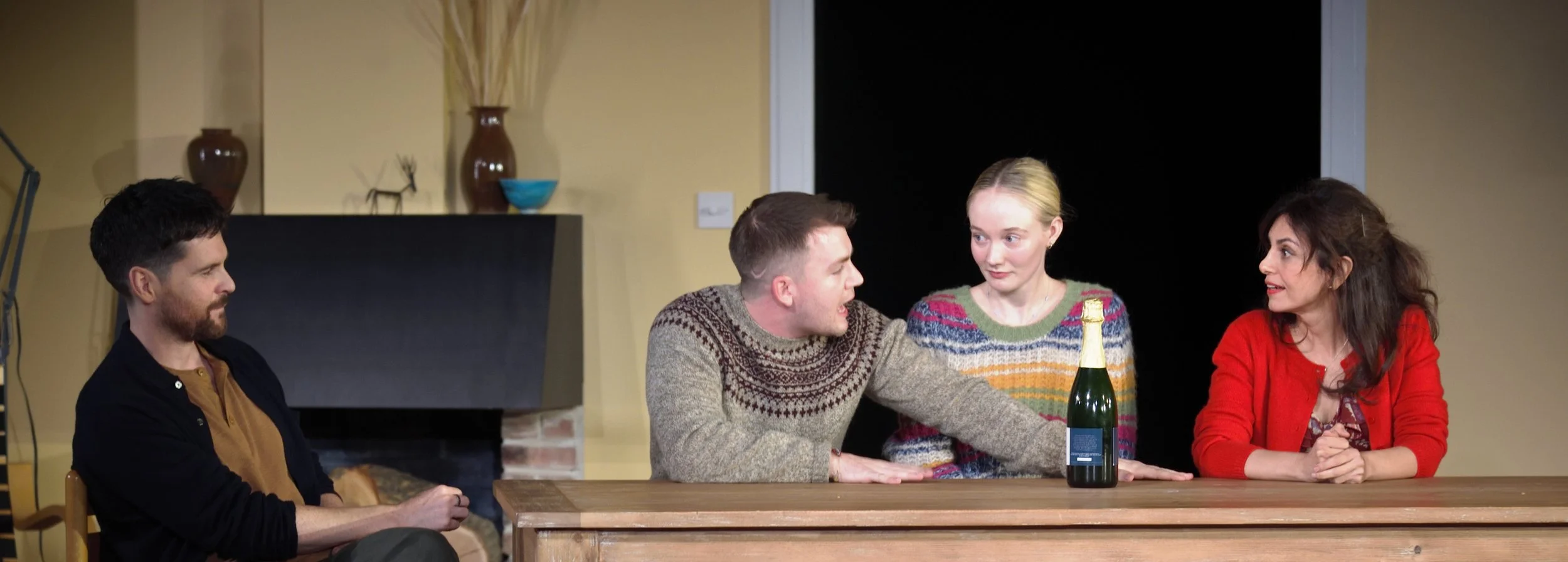

Two for Change

Dr. Du Bois and Miss Ovington, produced jointly by the New Federal and Castillo Theatres, is an historical drama about two people, one African-American and the other Anglo-Saxon, seeking a way to work together to reform an unjust society. Playwright Clare Coss has imagined a Sunday morning in 1915 on which W.E.B. Du Bois and Mary White Ovington, members of the group that founded the National Association for the Advancement of Colored People (NAACP), unexpectedly cross paths — and end up crossing swords — in the suite of offices where, on weekdays, they're accustomed to less emotional exchanges with each other. The production is directed by Gabrielle L. Kurlander and designed resourcefully on an Off-Off Broadway budget by Chris Cumberbatch (sets), Ali Turns (costumes), Antoinette Tynes (lighting), and Bill Toles (sound). It's an admirable contribution to New York City’s observance of Black History Month, though the principal attraction is Kathleen Chalfant as Miss Ovington.

The NAACP has been a forceful proponent of civil rights since its inception in 1909. For almost a quarter century, from 1910 to 1934, Du Bois (1868-1963), the most prominent African-American intellectual of the day, devoted the bulk of his professional effort to that organization, serving on its board and as director of publicity and research. As editor of the NAACP journal, The Crisis, he nurtured new voices among African-American artists and intellectuals. Born in the Berkshires not long after the Civil War, Du Bois earned B.A., M.A. and Ph.D degrees at Harvard, taught at a number of distinguished universities, including the University of Pennsylvania, and wrote numerous books (his most famous being the essay collection The Souls of Black Folk in which he wrote, "The problem of the Twentieth Century is the problem of the color-line").

Mary Ovington (1865-1951) was a Brooklyn-born Unitarian whose forebears were abolitionists. Educated at Radcliffe College, she committed herself to the cause of civil rights after hearing an address by Frederick Douglass. Like Du Bois, she was on the NAACP staff for many years, addressing discrimination in employment, education, housing, public services and voting rights. The producers’ program note describes her as “the first white woman to dedicate her life to anti-racist work in the twentieth century.” Ovington's writings include Half a Man: The Status of the Negro in New York and a history of the NAACP, The Walls Came Tumbling Down.

As depicted by Coss, Du Bois (played by Timothy Simonson) and Ovington display the scrupulous good manners of the Victorian era in which they grew up. Although they share a wholehearted commitment to fighting racism, their personal relationship is tense and volatile. Midway through the play, they acknowledge a mutual attraction that's physical as well as intellectual. That scene, despite some anachronism in the dialogue, is the most arresting part of the script. The characters' shared decision to sublimate a powerful urge for the sake of their common vocation is inherently poignant; Chalfant's performance enhances the moment with a complexity that's true to the text but far beyond what the dramatist has written.

Best known for multiple roles in Tony Kushner’s Angels in America on Broadway and as the dying academic in Wit by Margaret Edson, Chalfant is one of the foremost actresses working on the American stage. It's hard to imagine anyone better equipped to balance the genteel veneer of Coss's Miss Ovington with the substantial passions animating this character's brain and heart.

According to the production's playbill, Simonson has returned to acting after a period in finance. A formidable presence on stage, he resembles photographs of Du Bois in early adulthood. But it's the range and emotional color that Chalfant brings to her role that audiences are likely to recall most vividly about the 90 minutes they've spent at the Castillo Theatre.

Dr. Du Bois and Miss Ovington offers a number of engaging moments; yet it's not so much a play as a series of set pieces in which the characters spar on subjects related to bigotry, civil rights, and social change. Coss hasn't found a way to make the disparate scenes cohere or resolve themselves into a unified drama. Plays seldom spring full-grown from their authors' imaginations; they're more likely to develop in stages. With insights from the intelligent performances in the New Federal/Castillo presentation, the playwright may be ready to take the script to the next level.   

Dr. Du Bois and Miss Ovington runs through Feb. 16 at the Castillo Theatre (543 West 42nd Street). Performances are at 7:30 p.m. on Thursday, Friday and Saturday and 2 p.m. on Saturday and Sunday. Tickets are $25 ($20 for students) and may be purchased from www.castillo.org or 866-811-4111.

Click for print friendly PDF version of this blog post

Expressionism Lightly

In 1922, New York City was in a thrust of urbanization. Women manned the desks of the American workplace for the first time, and the click-clack of their typewriters beat the heart of an emergent labor force. This is the urban landscape of playwright Sophie Treadwell’s expressionistic play, Machinal, which Roundabout Theatre Company has brought back to Broadway's American Airlines Theatre for the first time since its 1928 debut. Based on events in the life of Ruth Snyder, Machinal follows the character of the Young Woman from her tedious stenographer job, to a loveless marriage with her boss, to the birth of an unwanted child, to an illicit love affair, and finally to the trial for her husband's murder.

First, an introduction to the play and its relation to expressionism. Just as a dollhouse mimics a human house, realistic theater mimics reality. Alternatively, expressionism distorts reality from a subjective viewpoint of experience. Though Treadwell may not have intended Machinal to play as straight expressionism, she was one of several American playwrights importing the genre in the 1920s, including Elmer Rice and Eugene O'Neill.  Machinal includes significant trademarks of expressionism, such as monologues expressing heightened intensity and a soundscape that blends human speech with mechanical sounds such as the typewriter. Experienced from the Young Woman’s perspective, Machinal nightmarishly depicts her internal struggle to separate her own desires from societal demands in the realms of labor, marriage and childbirth.

Focusing on the acting in the Roundabout production, it seems as if director Lyndsey Turner has dialed the expressionism way down. While clearly a directorial choice, this may have been at the expense of the production’s effectiveness. Though there were moments when the actors’ vocal rhythms invoked the same industrial throbbing evoked by Matt Tierney’s innovative sound design, their rhythms mostly remained natural and human. While vibrant characterizations such as Suzanne Bertish’s memorable Mother and Ashley Bell’s sassy Telephone Girl demonstrate the actresses' fine chops, they confused the production’s overall style and mood. As the Young Woman, Rebecca Hall’s delivery read as exceptionally realistic. Under Turner’s direction, unfortunately, Hall's character arc is indeterminable; though we see her suffer at several crisis points — a panic attack in the subway, followed by breakdowns in her mother’s apartment, on her honeymoon, and in the hospital after childbirth — each of these instances plays at an equal magnitude, conveyed by a good deal of high-pitched angst. These moments are the play’s sorest loss; in favor of realism, Turner’s direction misses Treadwell’s moments of intensely alienating and telegraphic rhythm.

The one actor refreshingly committed to an expressionistic stylization was Michael Cumpsty, whose caricature of the Husband is delightfully automated. Certain moments of choreography favored expressionism, too, such as one vignette in the hospital in which nurses, doctors, patients and visitors robotically repeat mundane gestures; without the rest of the play supporting it, however, this brief moment fell short of evoking anything more than an interesting transition.

Expressionism heavily influenced many elements of the production's design. The magnificent rotating stage designed by Es Devlin revealed scene after striking scene; its visible machination an obvious yet powerful nod to the play’s title and its expressionistic roots. Lighting designer Jane Cox's innovative technique incorporated hard, bright horizontal lines of light that scanned the set, sometimes lingering on a face, an embrace or an expression. Overall, the design team provided the visual and aural landscape of industrialization that the ensemble largely lacked in stylization.

If you’re looking for a production that really honors the vein of expressionism coursing through Machinal, the stylistically noncommittal performances in Roundabout Theatre Company’s latest production may disappoint you.  Though earnest and well-rehearsed, these deliveries clash with a production design meant to evoke a historical moment when New York City was developing vertically at breakneck speed. Machinal captures a human soul whose body is caught in the cogs of an emerging industrial landscape; while this production's design skillfully evokes the sights and sounds of this phenomenon, the performances fail to evoke a larger emotional experience.

Machinal runs until March 2 at the American Airlines Theatre (227 West 42nd St.). Evening performances are at 8 p.m. on Tuesday through Saturday; matinee performances are at 2 p.m. on Wednesday, Saturday and Sunday. Tickets range from $52-$127 and are available for purchase at 212-719-1300 or www.roundabouttheatre.org.

Click for print friendly PDF version of this blog post

Down the Road and Back Again

If you were born or grew up in the mid- to late-1980s, chances are the names Blanche, Rose, Dorothy and Sophia will strike in you a very nostalgic cord. When the four Miami-based retirees known as The Golden Girls debuted in 1985, they immediately became a hit with their post-menopausal, cheesecake-slicing antics. From the ditzy, air-headed Scandinavian Rose to the wonderfully saucy and sex-driven Blanche, it wasn't hard to laugh along with these Girls. The show ran for only seven seasons (practically a lifetime by today's standards), but it made an indelible mark on American pop culture; Thank You For Being a Friend, which is currently running at the Laurie Beechman Theatre is definitely evident of the sitcom's impact. The musical parody features an all-male cast as the Golden Girls themselves with music and lyrics by director Nick Brennan.

Here, the names are slightly different: Blanche is now Blanchet; Rose is Roz; and Dorothy and Sophia are Dorothea and Sophie. Despite the slight changes, the rest of the show is still in keeping with the original television comedy — from the dialogue to the overall episodic tone. Indeed, at the show's start, we find Blanchette (with binoculars in hand and her booty out to the audience, of course) snooping on the new neighbors next door. The other ladies soon make their entrances into the kitchen, and we learn that their new neighbor is actually none other than Latino pop star Ricky Martin (played by Adrian Rifat).

As dinner theater entertainment goes, Thank You For Being a Friend makes for a super fun night out. Each of the cast members have their share of the stage. Chad Ryan as Blanchet is spot-on, and both Luke Jones and John de los Santos are hilarious as the mother-daughter duo. However, it is Brennan as the naive but sweet Roz and Adrian Rifat as the pop star has-been that completely steal the show. Brennan doing Betty White's "aw shucks" mannerisms and Rifat's entrance with Ricky's signature "prayer hands" were hilarious.

As a group, they complement one another very well and seem to have an intricate knowledge of the others' rhythms, which only further helped the comedy along. Also bringing on the funny were the songs, among which were revampings of old showtunes, as well as originals written by Brennan. Some examples include "All That Jizz," an obviously classy homage sung by Ricky; "Roz's Turn," in which Roz proclaims her right to Shady Oaks fame; "Sex Changing," in which Dorothea goes through some, er...changes; and the oh-so-catchy finale, "Miami."  

Of course, one cannot write about a musical set in the '80s without talking about the clothes. The costumes by Jessa-Raye Court are absolutely fab in all their shoulder-padded glory. At one point, the girls do away with the talent show doldrums with some good old-fashioned retail therapy ("Fab Fads") with...what else? A fashion show with cardboard outfits and sequins. As for the set design, much of which revolved — literally — around a couple of multi-purpose panels, behind which was where all the mind-boggling quick changes took place (seriously, the cast of Broadway's Cinderella would even be impressed). The stagehands even donned as golden-aged girls themselves with wigs and tacky pantsuits.

If you're in for some great food, drink and some raucous laughter, then you'll love Thank You For Being a Friend. It will not only make you pine for the good old days of over-sized blazers and the "Latin Invasion" of '99 (a moment of silence please), but it will make you remember that aside from the fashion blunders and questionable musical taste, not all of it was bad. So head down to the Laurie Beechman Theatre and walk down memory lane — it'll make your life less of a, well...drag!

Thank You For Being a Friend is playing at the Laurie Beechman Theatre (which is located inside West Bank Cafe at 407 West 42nd St.). Evening performances are Wednesdays at 7 p.m., and Fridays, Feb. 28, March 14 and 28 at 10 p.m. with added shows Saturday, March 8 at 7 p.m. and Thursday, March 27 at 7 p.m. Tickets are $20 (plus a $15 food/drink minimum) and available at 212-352-3101 or Spincyclenyc.com.

Click for print friendly PDF version of this blog post

American Terrorist

With plot twists and a story line that would make Jerry Springer jealous; under Melissa Attebery's direction, Dick Brukenfeld’s Blind Angels is a smart, political drama that leaves viewers asking, “would you stand there and take it?”

Inspired by Daniel Pearl, a Wall Street Journal reporter who was kidnapped and killed by Pakistani terrorists in 2002, Brukenfeld gives the audience a story and perspective surrounding terrorism Americans have yet to see. Aaron (Scott Raker) is a news reporter who’s been told he’s about to embark on the biggest story in U.S. history. His college roommate, Sadri (Francesco Campari) and ex-fiancée Danny (Qurrat Ann Kadwani) are Muslims, as well as second cousins, coping with a death in the family. Danny’s mother has been murdered in what is believed to be an American government cover-up. Believing he’s about to pull an all-nighter, Aaron is prepared to stay the night with his friends to cover their story, but is greeted by a stranger, Yusuf (Alok Tewari), and held at gunpoint. He’s forced to give up his computer and any electronic devices, preventing any communication with the outside world. Aaron is now a hostage among his so-called friends.    

The production takes place in Sadri’s New York City apartment where set designer Brandon McNeel, lighting designer Alexander Bartenieff, props/set manager Lytza Colon, and master carpenter Mark Marcante, succeeded in creating an atmosphere that appears comfortable for a hostage situation. Colon must have been an interior designer in her former life; the set was merchandised to a tee.

During a flashback scene, Sadri, a mathematics expert, stresses to the American government how easy it is to obtain nuclear weapons; Senator Kaye Hammond (Cynthia Granville) then labels him as a security threat, slandering his name and credibility. In a more calculated form of revenge for Danny’s mother and to prove Hammond wrong, Sadri, Yusuf and Danny plan a terrorist attack that will wipe out their apartment building and everything within a block radius. 

Purchased from an unknown individual named Eric, the nuclear bomb is housed in the apartment with the ability to go off with the push of a cell phone button. If Aaron even attempts to escape — trying to open a door or window — it will detonate. Aaron plans to write an article that highlights the terrorists as individuals who are concerned about the treatment of Muslims in America, how easy it is to bring nuclear weapons into the country, and to warn their neighbors to evacuate the area. Yusuf and Sadri plan for a suicide bombing, wishing to be the only ones who perish.      

In the midst of a crisis, Brukenfeld gives the audience a look into the individual characters; Yusuf is a “lover of life” that documents weddings, but is so far deep into the plan, his wife and children are in danger if he decides to back out.  There’s a particular scene where Yusuf’s recording his goodbye video, changing the audience’s and Aaron’s view of him from fear to sympathy. The underlining love story between Danny and Aaron sheds light on Aaron’s inability to stick with a decision, but their rekindling is interrupted when Danny tells Aaron she’s pregnant with Sadri’s baby and they plan to get married. Drama!

Blind Angels is full of twists and turns, including a phone call from Eric to Yusuf demanding he kill Sadri; to Aaron and Danny feeling like Yusuf is a threat and poisoning him — the ending is completely unpredictable. The outrageousness of it all does make for light, comedic references, but definitely leaves the audience on the edge of their seats. A mix of race relations, scandal and politics — Steve Wilkos meets MSNBC, Brunkenfeld asks, if the government did something that affected you directly, “would you stand there and take it?”

Blind Angels is running at the Theater for the New City until March 2. Performances are Thursday through Saturday at 8 p.m. and Sunday at 3 p.m. General admission is $15; $10 for seniors and students. For tickets and additional information, visit www.theaterforthenewcity.net, or call 212-254-1109.

Click for print friendly PDF version of this blog post

In Relative Distress

In Relative Distress

Charles Busch’s fizzy new work, The Tribute Artist, is really light summer fare, but since it has shown up to make this brutal winter a lot cheerier for a couple of hours, who’s going to complain? In his latest outing, Busch, who usually plays female characters, is Jimmy Nichols, a gay drag performer—or, as Jimmy prefers, “tribute artist”—who has been canned from his longtime job at a Las Vegas revue. The solid comedy he has constructed is rather like Charley’s Aunt for the 21st century, with nods to Arsenic and Old Lace and Weekend at Bernie’s.

Click for print friendly PDF version of this blog post

Expect the Unexpected

Choreographed by Jody Oberfelder, 4Chambers would be best described as a visual and physical sense of the heart's importance. The core of the performance piece centers around the beating heart — specifically its function, its literal purpose and its emotional capabilities. 4Chambers is both literally and figuratively a piece that will move the audience to feel things in more ways than one.

Click for print friendly PDF version of this blog post

The Black Sheep of the Flock

In an unconventional dramatic monologue, Brian Watkins’s My Daughter Keeps Our Hammer is an intense, yet comedic view at two sisters faced with the decision to hold on to their past or move forward into their future.

Sarah (Katherine Folk-Sullivan) and Hannah (Layla Khoshnoudi) speak directly to the audience; their lines flow seamlessly as if singing a round, expressing why they feel an immense amount of disdain towards each other and the small prairie town of Colorado where they reside. Set designer Andrew Diaz and lighting designer John Eckert place the audience in the middle of their family’s prairie. The theater is completely dark. When the girls are ready to share sacred truths, the room goes black; Sarah and Hannah are only visible. Family secrets are told to a living diary that doesn’t judge, but listens intently, visualizing each narration.

After the death of their father, the siblings become estranged, taking on the responsibly of their mother — Sarah, the eldest, is the unofficial caretaker. Sarah doesn’t know what to do with herself; her loneliness so overwhelming she’s just looking for someone to talk to.  Hannah, on the other hand, desperately wants everyone to shut up. She works at a coffee house and drives an old car that can’t go past 40 miles, dreaming about her dad’s F-150 truck in the garage. However, they both share the same motive: flee the prairie. 

Then there’s Vicky, the only surviving sheep of their family’s flock, a gift from their father to their mother. Since their mom became sick, Vicky and the F-150 are the only things that hold sentimental value and make her happy. Her daughters don’t count. Because of this, she refuses to move the truck and Vicky has been moved inside the house — an unsuccessful attempt to house-train livestock. 

Sarah admits under the spotlight that something came over her and she’d spit and hit Vicky in a moment of frustration. Feeling haunted, she makes a quilt for her mother, only to find she’s ungrateful and full of criticism. Yet, according to Hannah, her mom is so impressed by the gift; she wants to give Sarah the F-150 for Christmas, adding to their grudge and separation. Hiring a coffee house regular and his ram, Hannah has a full-proof plan to get Vicky pregnant. The perfect way to commandeer the F-150.

To avoid giving away an ending that completely blindsides the audience, the sister’s shift their hatred of each other to Vicky — it is the one thing they share. Sarah says she embodies her father for a split second. In one of her confessions, Hannah acknowledges killing a baby chick when she was little and it “made her think twice about killin,” but in the darkness of the theater, she admits Sarah is unrecognizable. They aren’t the girls they thought they were.    

Full of allegory and symbolism, My Daughter Keeps Our Hammer is amazing. It’s dark, a little twisted, intense, but surprisingly witty. Under the direction of Danya Taymor, Watkins’s writing comes full-circle and enters reality; an existence that’s quite difficult to achieve in a monologue. Folk-Sullivan and Khoshnoudi are brilliant; who else could make murder seem like it’s the right thing to do? The fact that they aren’t really sisters is slightly disappointing but the play is definitely worth seeing.

My Daughter Keeps Our Hammer is playing at The Flea Theater (41 White Street) in Tribeca. Evening performances run until Feb. 15. Tickets are $15, $25 and $35. For tickets and showtimes, call 212-352-3101 or visit www.theflea.org.

Click for print friendly PDF version of this blog post

Grandma's Kitchen

As one of three major productions this year, The H.A.D.L.E.Y. Players and New Heritage Theatre Group presented The Kitchen, written by Roger Parris and directed by Arthur French, at The Poet's Den on 309 East 108th Street. Featuring an all-black cast, the play is set during the 1950s in Harlem, where a boardinghouse landlord faces the predicament of allowing an ex-tenant a safe haven while he faces life or death. "Grandma" serves as a mother figure to everyone in the house — her kitchen their meeting place. Originally played by Louise Mike, Johnnie Mae steps in as Grandma after Mike sprained her ankle. Although she reads from a script, even using it as a prop, Mae did an excellent job conveying the message: blood is not always thicker than water.

During the opening scene, Taylor (Craig Anthony Bannister) is the topic of discussion among the tenants Ivan (Albert Eggleston), Muriel (Kimberlee Monroe) and Grandma’s cousin Philip (Ward Nixon) on a Saturday morning.  Taylor, an ex-tenant, is a known gambler. After giving all his winnings to the woman he loved, Taylor aims to get back on his feet after she flees the city with all his loot. During breakfast, Philip and Grandma have a pivotal fall-out, which confuses the audience — there’s really no basis but is the turning point of the play.

That evening, Taylor shows up at Grandma’s covered in blood, seeking refuge from the neighborhood hustler Raymond Peaks (Leopold Lowe). The scene is unseen, but Taylor describes the scuffle at the local bar; gambling, drugs, liquor and the badmouthing of his lover play their parts in Peaks stabbing him. It’s a bit unclear why Peaks is trying to murder Taylor; the story isn’t conveyed, but Grandma harbors him until he can plan an escape from the city. While at the boardinghouse, Taylor reflects to Muriel where he went wrong, acknowledging how he “always liked the fast life,” teaching her how to shoot craps. Muriel, just released from an asylum, conserves Taylor’s location, keeping him company during the day and playing Grandma’s numbers at night.

The show begins to pick up towards the second half where the more interesting scenes ironically happen outside of the kitchen between the male cast members. Over a bottle of whiskey, Peaks, Philip and Ivan are coming from the bar — Peaks hints at stabbing Taylor and tips the gents that he’s after him. The two men still have no idea Taylor’s hiding out in their own home; Ivan is unfazed but Philip is intrigued. Philip and Peaks appear to be in cahoots — Philip is leaving for South Africa and bringing Peaks back diamonds and possibly narcotics. 

In the next scene, Ivan relays the conversation he had with Peaks and Philip to Grandma and Muriel. Taylor is listening in the adjacent room. The girls continue to act aloof while the three of them celebrate Ivan’s birthday over a bottle of bourbon. Ivan tells Grandma she and Philip should reconcile to appreciate the meaning of family.

The next morning, Philip drops by and Grandma apologizes for losing her temper. He accepts but leaves with a piece of paper — a numbers slip with Taylor’s name and the date of a few days prior. The jig is up. He immediately informs Peaks that Taylor’s at the boardinghouse, on a park bench — a rather enjoyable scene with excellent lighting. They begin to conspire how Peaks can get into the house, posing a robbery to kill Taylor. Peaks asks why Philip would set up his cousin and he admits jealousy. 

In the last scene, Philip is able to rig the door for Peaks and leaves for South Africa immediately after, to avoid capture. Peaks holds Grandma, Muriel and Taylor at gunpoint and with an unexpected twist, Muriel stabs Peaks to death; causing her to slip into a mental state that lands her back into the asylum. 

The ending seems a bit rushed as they cut to three months later. Taylor leaves for Washington, D.C. to stay with his brother. Ivan brings Muriel to the house to visit Grandma; she hasn’t spoken since the incident, but after Grandma gives her a pair of dice left by Taylor, she instantly becomes herself again and the lights dim.

This show is very predictable in terms of racial issues and how they trigger thoughts of the time, but there isn’t much happening throughout the play besides the major scenes described. Centered around “the kitchen,” the only reference made is a spiel by Ivan and why it’s his favorite place. The story is good, but difficult to follow; the timing is a bit off and there are a few lines said with no transition, lead-up or explanation. However, the overall production is enjoyable, offering some comic relief and reputable acting. 

Click for print friendly PDF version of this blog post

A Journey Home

What is an American? As children of immigrants, who are we really? And where are we from? Some ancestral homeland or from wherever we were raised? Questions such as these are at the heart of East Towards Home, written by Billy Yalowitz and directed by David Schechter, which recently ended its run at the Theater for the New City. At its best, this show is charming and relatable. At its worst, however, this show is nothing more than self-indulgent. This uneven play presents wonderful musical interludes, but the plot leaves much to be desired.

The story centers around a young man, played by David Kremenitzer, ostensibly our narrator/playwright Yalowitz at a younger age, trying to find his place in folk music and socialist revolution. In order to do so, we all travel back in time to meet him as a small boy, learning to play in his multi-racial neighborhood. We journey with him through the trials and tribulations of childhood, such as baseball tryouts, bullying, summer camp and annoying old neighbors. One such neighbor, Sylvie, portrayed by Eleanor Reissa, proves to be an essential cog in the story; she knew the young man's musical hero, Woody Guthrie, and participated directly in early to mid-twentieth century Communism in America.

When the show focuses on these satellite narrative threads, it is at its best. Sylvie’s story sheds light on a moment in our history often overlooked, bringing out the beauty of Yiddish speech and traditional dance. The highlight of the show comes in the fourth performer — Brian Gunter’s performing of folk music as Woody Guthrie. He is an extremely skilled musician, who brings to life both the sounds and meanings of this music style. The play consists of three interlocking narratives; these two and the play's driving narrative arc. Although this is meant to show the links between Guthrie, Sylvie, and our protagonist, it is often disorienting and left me wondering in which story we find ourselves at any given moment.

The tale of the young man, however, often falls flat. Despite wanting to sympathize with him, I found myself wondering why he felt so lost.  He seemed to have a great understanding of the world and to have been given some incredible opportunities. Yes, he was a victim of discrimination, anti-Semitism, and political oppression, which are no small matters, but he seemed to have the wherewithal to overcome it.  By including himself as an older man as a character, it was always clear he had found his way home. It also made it seem like this production was somewhat of a celebration of itself. He had overcome and lived to make a play of it.

All in all, the notion of a lost young person trying to find his place in the world does seem universal. The music is wonderful and the use of projections and direct audience address work nicely to engage the spectators in active thought about the issues presented.  Unfortunately, the takeaway is diminished by the story being too specific. Ultimately, this is not a play about us, the people bearing witness. It is an individual recitation, meant to show us who this particular person is, not what might be possible if we work together.

Click for print friendly PDF version of this blog post

Voices from the Depths

Stories about illegal crossings reveal the bravery of those who confront innumerable dangers to escape terrible living conditions. Their goal is to ultimately achieve a better life for their families and themselves. Each immigrant has a deeply emotional story to tell about persecution, extreme poverty, sickness, the perils of the crossing, and the discovery that their destination is as filled with problems as their countries of origin. These are the stories that make up Rumore di acque (Noise in the Waters), a melologue, which is a short work created for voice and music, produced by Teatro delle Albe and written and directed by Marco Martinelli. The piece is a collection of all those migrant voices that can be heard along the Strait of Sicily, the 90-mile wide portion of the Mediterranean Sea that divides North Africa and Sicily. Some of their tales are being told for audiences at La MaMa Experimental Theatre Club by a solitary demon on a volcanic island in the Mediterranean Sea.

In the melologue, a bureaucrat working for the Ministro dell’ Inferno (Minister of Hell), a clear reference to the Italian Ministro dell’ Interno (Minister of the Interior), is appointed to a deserted volcanic islet located in the middle of the Sicilian strait. The island is suggested in the bare theatrical space by a spiral of stones on the floor. The narrator stands at the center of the spiral, symbolizing his location within the bowels of the watery and volcanic hell. This figure wears dark sunglasses and a blue military uniform adorned with medals, establishing a physical reference to the now defunct Muammar Qaddafi. The General, magnificently performed by Alessandro Renda, explains in a gravelly voice that his job is to count and record all the African immigrants who have perished on their voyage to Europe. Nevertheless, the narrator never expresses any emotion towards the subjects and only shows outrage for the fish, which make his job harder by eating the flesh of the dead at sea. He is only interested in the numbers, a clear indictment of how Italian and North African governments are indifferent to the plight of immigrants.

Among his deliberations about numbers, his anger with the fish, and a discussion about how inferior bureaucrats should address him, the general tells us the sad stories of four African refugees. The character and his delivery never really lead the audience into an emotional involvement with his stories. The listener rejects everything that the narrator stands for. In this way, Martinelli resists manipulating the audience’s emotions and forces us to think critically about what the character really represents and where we are located in his narrative. Although the general is a representative of power, the refugees are still heard through the painfully beautiful music and vocals of Enzo and Lorenzo Mancuso. While the general is at center stage, the Mancuso brothers play and sing from stage right. They occupy a dreamlike space outside the volcanic islet from where their vocals act out the desperation and pathos of those who have sacrificed themselves for a better life.

Rumore di acque presents stories of refugees from Libya and many communities throughout the Sahara that are as relevant to Europe and Africa as to the United States and Latin America. The writing, direction, performance and music blend harmoniously to make audiences see the plight of immigrants and the indifference of those in power.

Rumore di acque is performed in Italian with supertitles in English. It runs until Feb. 16 at La MaMa's First Floor Theatre (74A East 4th St.). Evening performances are 7:30 p.m. on Thursday through Saturday; matinee performances are 2:30 p.m. on Sunday. Tickets are $18 and $13 for students and seniors. For tickets, call 212-475-7710 or visit www.lamama.org.       

Click for print friendly PDF version of this blog post

Politics with a Side of Queso

Gold, chandeliers and, yes, queso saturate the set (designed by Mimi Lien) for The Rude Mechanicals’ latest piece, Stop Hitting Yourself. Playing at Lincoln Center’s Claire Tow Theater, Stop Hitting Yourself wildly amalgamates participatory theater, performance art, early musicals and bourgeoisie comedy. In form, it defies genre and is entirely unafraid of going on a tangent. Still, Stop Hitting Yourself does manage to follow a plot line. Its strengths, however, lie not in the storyline, but in the talents of the ensemble.

A group of self-obsessed socialites gathers at the Queen’s Palace for the annual Charity Ball, where one charity case is selected as the Queen’s beneficiary. This year, one socialite (Lana Lesley) discovers a tree-hugging Wildman (Thomas Graves) in the forest, and tries to mold him into a member of the upper crust to win the Queen’s favor. 

If you’re reminded of Eliza Doolittle, you’re spot-on. Songs and monologues about society, wealth, privilege, individualism and charity make the production’s big ideas abundantly clear. As a representative of peace and nature, Graves’ Wildman clearly stands for a cleaner, greener way of life — one that clashes with the socialites’ outrageous opulence. Though there are tiny moments of surprise in the script, for the most part, each character reinforces a binary. The rich are so blinded and isolated by their wealth that they are difficult to like. On the other hand, the Wildman’s final renunciation of all material belongings took things to the opposite extreme. This of course, is all part of the fun and irony, but the social and political message hashed out in Stop Hitting Yourself repeats itself tirelessly. 

One strength in Graves’ final renunciation, however, is when he begins listing the prices of the physical objects around the set — not only their purchase cost, but the cost of shipping them to New York City for this premiere. This encourages some interesting thoughts about the labor, time and skill invested in every object on the stage. Self-referential moments of meta-theatre such as this one could have well replaced some of the heavier-handed social commentary.

Though the political conversation behind the piece felt, at times, a little too black-and-white, the production’s real strength lies in the charm and innovation of the ensemble. As the theater-making darlings of Austin, Texas, The Rude Mechanicals have been creating original, ensemble-based theater since 1995. They are no strangers to New York, however; among the shows they’ve toured here include their acclaimed Method Gun and a more recent re-imagining of The Performance Group’s legendary 1968 downtown performance, Dionysus in 69. In Stop Hitting Yourself, The Rude Mechanicals exceed the usual gimmicks in destroying the fourth wall. Bringing the house lights up to reveal us all in the theater together, their relationship with the audience is playful and present. One recurring “game” requires the audience to close their eyes. Though it’s obviously your choice to participate, the game provides some delightful and hilarious visual surprises. And yes, these surprises involve lots of queso.  

The dazzling ensemble of veracious actors definitely makes Stop Hitting Yourself a show worth seeing. Graves’ Wildman seduces with his trademark coolness and his headful of glorious hair while Lesley’s Socialite is brimming with an untapped wildness herself. As the Maid, Heather Hanna slyly panders to Paul Soileau’s Queen, whose tiara and pink lipstick are so grotesque that it's hard to look away. Joey Hood’s Unknown Prince is sleazy yet somehow persuasive; similarly, as the Magnate, E. Jason Liebrecht mesmerizes with his skillful and exaggerated cigar smoking. As the Trust Fund Sister, Hannah Kenah’s verbal delivery and physical comedy left the audience in laughter. While political and social commentaries are a dime a dozen, this ensemble is one in a million.

Stop Hitting Yourself plays at Lincoln Center’s Claire Tow Theater, which is located on the roof of the Vivian Beaumont Theater (150 West 65th St. between Broadway and Amsterdam Ave.) through February 23. Evening performances are at 7 p.m. on Monday, Wednesday, Thursday, Friday, Saturday and Sunday; matinees are Saturday and Sunday at 2 p.m. Tickets are $20 and available at Telecharge.com or www.lct3.org.

Click for print friendly PDF version of this blog post

Disoriented in Wonderland

Only 15 spectators are admitted to each performance of Then She Fell, a site-specific work by the innovative theater company Third Rail Projects, currently playing in an old school building on Maujer Street in Williamsburg. (The show had a previous run in the former Greenpoint Hospital in North Brooklyn.) In order to accommodate such small audiences, Third Rail offers 12 performances a week, with revolving casts drawn from a roster of 30 performers.

Click for print friendly PDF version of this blog post

Side Effects

In The Window, Marta Mondelli makes a compelling debut as both playwright and one-third of the piece’s ensemble. It’s a play that while rooted in the writer’s love for classic cinema is much less a locked-room mystery, and instead becomes more of a study of the time and its effects on women. With shows like Mad Men in the mainstream, we have all been inundated by iconic images of the mid- to late-1950s: a picturesque suburb; housewives in homes decked out with all the modern conveniences; and of course, all the advertising that came along with this new modern lifestyle. Basically, the very product of what was then a new industrial boom. However, while baking apple pies and being a homemaker like Donna Reed on acid may seem like a walk in the park compared to today’s modern-working woman, appearances can often be deceiving, as Mondelli further explores.

At the start of the play, we meet Eva (Cristina Lippolis), a young twenty-something who was recently jilted at the altar and has since spent what was to be her honeymoon working as a taste tester of sorts for a soda company.  As Tester Number 52, we watch Eva read her manual and look up various possible side effects of the experiment.  However, the side effects would ultimately end with not only physical repercussions, but psychological as well.  Throughout the duration of the play, Eva starts noticing suspicious activities outside her courtyard-facing window and begins to believe that a neighbor has been murdered. Skeptical of these supposed strange disturbances is Eva’s aunt Nora (playwright Mondelli), twice-married Park Avenue socialite who is staying in the apartment to keep her niece company.

What's intriguing about The Window was not only the feel of 1950s New York as soon as one enters the Cherry Lane Theatre's performance space (scenic designers Nicholas Biagetti and Pedro Marnoto cleverly put up a laundry line by the aisle seats, which hit you overhead just as find your seat), but also the thematic content itself. While there were certainly cinematic elements such as the use of the fourth wall as the titular window in question, the play felt more akin to some of the great literature that came out of that time — particularly, J.D. Salinger's Franny and Zooey, in which a young girl suffers a breakdown. While Eva is certainly down the road to a breakdown herself, she appears to be holding onto a certain idea of womanhood she has been taught to attain for herself in the form of marriage. Nora, on the other hand, clearly despising the small "window" of time a woman is expected to enjoy her life, often proclaims to leave her wealthy husband for a humble and much younger writer, Bill (Scott Freeman). Thematically, this is effortlessly tackled throughout the play, most notably in Mondelli's dialogue. For instance, when referring to the pair of canaries left behind by Eva's ex-husband-to-be Spencer, Nora says to her: "They're birds: they were never meant to be caged." At this point, one can only wonder if it's only the birds she's talking about.

When a time period serves as another character as it does here, one has to expect it reflected in the look and feel of the entire production. As previously mentioned, the set design appeared historically accurate; short of acquiring an actual vintage Frigidaire icebox (which instead was painted onto a sepia-colored backdrop), the bottles of soda and canned goods handled by Eva seemed right out of the period, which added an authenticity to the production. Also adding a '50s touch are exquisite costumes (Nora's shift dresses and stylish trench coat), but also provided some interesting symbolism (Eva's yellow dress mirroring the yellow of the "caged" canaries.)

As for the actors, Lippolis' Eva moves with the grace of a ‘50s-era starlet, She is more than believable for her character's reserved, polite girl-next-door demeanor. In fact, she is perfect: from the way she moves across the room to the way she sips her soda, to even her diction – everything about her seemed like she jumped out of a black-and-white film and into our own Technicolor world. To think for a second that she might be like every tech-savvy twenty-something out there seems just as unlikely as the murder committed out of her window. As her aunt’s young lover Bill, Freeman too seems a man out of time, exuding a presence that recalls that of a young Marlon Brando a la A Streetcar Named Desire. To say that he holds his own against his female counterparts would be an understatement; he gives more to the character than what he has been given, and it is unfortunate indeed that Bill isn't explored more as a character. However, it is Mondelli herself who steals the show with her feisty and fabulous Nora. She has a dazzling presence onstage, as bubbly as the champagne she laps up and at once witty and surprisingly observant.

If you love old movies just as much as Mondelli does, than you'll delight in the subtle references the play makes. However, for fans who not only enjoy period drama, but love to reflect on its history, The Window is definitely a treat.

Click for print friendly PDF version of this blog post

Human Contact in Internet Age

In the age of Facebook, texting, and Skype, everyone has heard a variation of the following expression at least once: “I prefer to speak to someone face to face rather than through a device.” This statement directly points to the problems of establishing human connections through the use of technology and media. Nevertheless, it is also very common to hear that technology brings the world closer together so that two friends can remain in contact regardless of their years of separation. We Were Nothing!, which was written by Will Arbery (in collaboration with Shelley Fort, Elly Smokler, Emilie Soffe, and Lisa Szolovits) and directed by Lisa Szolovits, avoids a simplistic answer to these judgments. Is that impossibility to communicate or achieve intimacy due to our dependence on technology or to a much deeper human limitation? The play’s references to communication technologies go back to the mid-twentieth century and the use of the telegram, which indicated the end of each sentence with a resounding "stop," and so refuses to accept that this failure to connect is a problem only limited to the Internet age. 

Despite the fact that the separation of the two main characters is at the center of the show, it takes place in a private apartment, managed for the production by Deidre Works (the exact location is confidential until tickets are purchased). The apartment’s living room has a capacity for approximately 30 audience members. This successfully recreates a cozy and intimate space from which to explore the distance between Shelley (Emilie Soffe) and Kelly (Elly Smokler). The comfortable and informal costumes by Clara Fath make the characters belong to that living room, even when they are communicating through technology from distant places. Isabella Byrd's lighting adds to the warmth of the location and at times transforms the living room into a virtual space, such as a switching on of a light which makes an opening on a wall become a computer screen through which the characters are able to Skype. Although the area is small, the actresses’ energetic performance is never restricted by spatial limitations. They jump through a partition opening, reveal a space hidden by curtains, and, one time, leave the performance area for a few seconds. At this point, even if the audience cannot see them, members remain riveted to their vocal presence, a proof of great theater acting.

In the play, Shelley and Kelly are twenty-something women with distinct and truthful personalities, a result of a strong artistic collaboration topped by Arbery’s writing, Szolovits’s direction, and the actresses’ performances.

While Shelley is somewhat insecure, needy, and a bit more open to share her emotions; Kelly is supportive and rather emotionally inexpressive, even when she appears to be outgoing. Both women reveal breakups, discuss a father’s illness, or make fun of past acquaintances by speaking to each other on their cellphones, e-mailing, texting, and Skyping. Yet no matter how many times they “like” one of their photos or comments on Facebook or reveal their fear of growing up through Gchat, each is incapable of effectively responding to the other’s personal questions or observations.  This idea is carried throughout the play and the action leads to their climactic face-to-face meeting. At this point, the play may provide an answer or raise more questions about intimacy and closeness in our world.

Is the inability to connect with each other in the twenty-first century due to the dominating role of technology or because of our human condition? By staging this distance in such a close environment, We Were Nothing! reveals in an entertaining way that the answer to this question may be elusive, yet crucial to each person present in that living room. 

We Were Nothing! will play a four-week engagement from January 17 to February 9, on Fridays and Saturdays at 8:00 p.m. and Sundays at 5:00 p.m. The show will be performed inside a private residence near Union Square. The exact address and directions to the venue will be released only to ticket holders. Tickets are $20.00 and available online at www.artful.ly/store/events/2099.

Click for print friendly PDF version of this blog post

Black Humor Bonanza

Joe Orton’s plays aren’t done as much as they ought to be, so the Red Bull Theater’s staging of Loot, one of his three masterworks, is welcome indeed. The British playwright might today be renowned for a much larger oeuvre if he hadn’t been murdered by his lover, Kenneth Halliwell, in 1967. John Lahr’s superb 1980 biography, Prick Up Your Ears, told the story of Orton’s life and death; in 1987 it was turned into a film, with a screenplay by Alan Bennett, that made stars of Gary Oldman as Orton and Alfred Molina as Halliwell.

Although Red Bull was started a decade ago to explore the vast repertory of Jacobean plays, in recent seasons the company has drifted away from its original focus, staging Jean Genet’s The Maids and August Strindberg’s The Dance of Death. The current mission, notes artistic director Jesse Berger in the program, is to present “great classic plays of heightened language.” That label encompasses Orton, whose epigrammatic dialogue can rival that of Oscar Wilde or Lewis Carroll in its nonsensical sense, as in this exchange between Fay, an attractive hired nurse, and Mr. McLeavy, whose wife has just died. McLeavy is extolling a planned floral tribute:

McLeavy: It will put Paradise to shame.
Fay: Have you ever seen Paradise?
McLeavy: Only in photographs.
Fay: Who took them?
McLeavy: Father Jellicoe. He’s a widely traveled man.

The loot of the title is from a bank robbery pulled off by McLeavy’s son, Hal (Nick Westrate), and his friend and possible lover Dennis (Ryan Garbayo), a mortician. They’ve made it look like Dennis’s funeral home was broken into by robbers at night and a tunnel dug to the bank next door to rob it. Now the police are investigating, and Hal and Dennis are trying to hide the money from Inspector Truscott, a notorious, brutal investigator who masquerades as a representative of the water board. The ruse allows Truscott to interrogate suspects and poke around homes without a warrant, because the water board doesn’t need a warrant. When Truscott arrives, refusing even to give his name, Mrs. McLeavy lies in an open coffin at home, awaiting last rites; Hal and Dennis are trying to abscond with the lucre; and Fay is planning to get McLeavy to propose to her. Pretty quickly the situation spirals into frantic farce, and the black humor just gets blacker.

Berger’s production has a lot going for it. Westrate and Garbayo are a fine, frenzied pair of criminals, and Rebecca Brooksher’s lethal, gold-digging Fay, though occasionally speaking hurriedly, makes a splendid femme fatale. It’s Jarlath Conroy, though, as the disconsolate, troubled Catholic widower, who makes his part a feast here. Whether he’s appalled to hear Fay’s report of his wife’s alleged religious lapses, or kowtowing to authority in any form, his McLeavy is a delight.

Orton always had a problem with both civil and religious authority. In the early 1960s, he and Halliwell went to prison for defacing library books. In Loot, he gets back at the police by creating Truscott, a great comic bully. Rocco Sisto as Truscott has the dominant role, but in an early preview seemed uncomfortable with his lines, and his timing was off; once he settles in, the production should be sharper. Orton had a classical sensibility and the ability to pile laugh upon laugh; a line like “the theft of a Pharaoh is something which hadn’t crossed my mind” requires precision delivery to garner all the laughs it deserves and yet set up the riotous payoff that follows.

If anything has dated, it’s Orton’s notion of bisexuality. Westrate and Garbayo are fine actors, and both inhabit middle-class characters convincingly, but neither manages to persuade one that there’s heat for each other that outweighs the women they talk about. Orton’s pre–gay liberation sensibility doesn’t provide them much help except to have Hal occasionally call Dennis “baby.” Hal plans to have a heterosexual brothel full of a variety of “birds,” and Dennis has fathered five children. Although Orton was operating under the constraints of strict British censorship, those facts muddy the sexual aspects of the story. Still, under Berger’s direction the farce plays swiftly, and the laughs are plentiful. They can only multiply as things smooth out.

Loot plays at the Lucille Lortel Theatre, 121 Christopher St., through Feb. 9. Evening performances are at 7 p.m. Tuesday and Wednesday and at 8 p.m. Thursday through Saturday; matinees are at 2 p.m. on Saturdays and 3 p.m. Sundays. For tickets, call 212-352-3101 or visit redbulltheater.com. Regular tickets are $60; premium tickets are $75.

Click for print friendly PDF version of this blog post

Beach Blanket Bust

Actor-director-writer Chuck Blasius draws on tried-and-true antecedents for his new play, I Could Say More: in the vein of The Boys in the Band, a group of ostensible friends (but not all gay) gather, and in the process a lot of dirty laundry is aired. The bringing together of characters of disparate backgrounds goes back at least as far as Vicki Baum’s Grand Hotel, while the summer house setting (by Clifton Chadick) has been used effectively by Richard Greenberg in Eastern Standard; by Terrence McNally in Love! Valour! Compassion!; and by Chuck Ranberg in the charmingly nostalgic End of the World Party. At the Hudson Guild Theatre, however, a pall of staleness clings to this tedious, overlong production.

Blasius himself plays Carl, a writer facing midlife crisis who is one of the hosts. He has recently married his boyfriend of 15 years, Drew (Brett Douglas), and they have a son, Jason (Brandon Smalls). Carl and Drew are playing host to Drew’s middle-aged slacker brother Phil (Grant James Varjas), for whom Carl carries an inexplicable torch, and Phil’s date for the weekend, an easygoing "himbo" named Dyson (Frank Delessio) — although Phil has a husband who is working back in New York. Also present are Keith McDermott’s Skip, an older gay man of refinement and sensitivity who has worked as a director, and his foreign-born wife of many years, Rakel (Monique Vukovic), with whom he has a child from a heterosexual liaison (rather like La Cage aux Folles). Last to arrive are Lila (Kate Hodge), a hard-drinking longtime friend, and Joe (Robert Gomes), her brand-new, heavily tattooed working-class boyfriend who has a habit of mouthing politically incorrect observations — notably about Jason’s mixed race — but who has a fundamental decency.

Blasius does himself no favors by directing and acting in his own play; at times he drops vowels and his diction is muddy; scenes of overlapping dialogue in which he participates make neither conversation intelligible; and, given that Carl is a shrill, controlling martinet, the role requires an actor of much more charisma than the playwright possesses for an audience to warm to him. Carl’s obnoxiousness may be due to recently giving up drinking and smoking, but without sensing something pleasant in the character, an audience has no reason to care about him.

That lack of empathy strains the believability of the central relationship. Douglas’s Drew is a charming, self-effacing, yet unexpectedly strong partner, and clearly a doting father; it’s baffling that he would stay with Carl, or be attracted to him in the first place.

Much the same problem applies to Phil; Varjas swings between sullenness and recalcitrance. Blasius, however, has at least written some good speeches and scenes for the other cast members, and there’s a strong sense of the frayed fraternal bond between Drew and Phil, who are held together only by an inheritance that hasn’t been processed yet. In a play about gay relationships, one is conditioned to expect a good deal of bitchy humor, but there’s a dearth of it here. Occasionally a line brings a solid laugh, but the dourness of the proceedings overwhelms any lightness.

The complications that arise sometimes strain credibility. Carl hasn't planned dinner, so there are complaints of nothing to eat. (Strangely, the next day he claims to have “all this food from last night.”) Dyson is vegan, which would require that he communicate it in advance to his prospective hosts, not spring it on them. When Phil and Dyson want to go to a nearby gay bar but have been drinking, Drew refuses to give them his car keys. Yet one is expected to believe that Dyson, a complete stranger, steals the keys and goes anyway. 

Fortunately, McDermott, Gomes and Vukovic excel in lending varied dimensions to their characters. In particular, Vukovic brings a sense of painfully won wisdom to Rakel, who is being treated for breast cancer.

Brian Tovar’s lighting is well done, but too much is required of it in the plodding last scenes of the play, as the summer drags on and Carl lingers alone in a funk. In fact, by the time I Could Say More ends, one is relieved that nothing is left to say.

I Could Say More runs through Feb. 1 at the Hudson Guild Theatre, 441 W 26th St., between 9th and 10th Avenues. Performances are at 8 p.m. Thursday through Saturday and at 7 p.m. on Sunday; there is a special Monday performance at 8 p.m. on Jan. 27. Tickets may be ordered by calling 866-811-4111 or 212-352-3101 or visiting othersideproductions.org.

Click for print friendly PDF version of this blog post

Theater of the Mind

Theater allows us to see people at their most vulnerable. In a live performance, anything can happen: lines can be forgotten, injuries can occur and things can always go wrong. Yet Ruff, by Peggy Shaw, reminds us how meaningful that vulnerability can be. We attend the theater to connect on a human level. Shaw invites us into her harrowing experience, giving us the chance to mourn, laugh, and love, along with her. In this, it is precisely what theater should — and even must — be to maintain relevance in an increasingly mediatized world.

In this one-person show, Shaw tells stories about her life, particularly her recent experiences surrounding and as consequence of her stroke. Medical dramas have the potential to be maudlin, but this production is transcendent. She finds not only the profundity but also the absurd humor in her, and our, human condition. At every turn, as witness to her trauma and triumph, it is hard to know whether to life or cry. This feeling is situated precisely at the crossroads of the ridiculous and the sublime, like so much of our experience of being alive.

She links her physical condition to deep philosophical ideas, making poetry out of even her darkest tales. Shaw expertly draws connections between what has happened to her and events that may seem far afield from one person’s stroke.  She muses about family, memory, community and technology. This last thematic element is key; the entire aesthetic of the theater links this intimately personal theatrical piece with our technologized world via television and projection screens.

Shaw does not shy away from her potential problems performing; rather, she brilliantly delights in them, drawing attention to them from the show's start. The choice of Shaw and collaborator Lois Weaver to provide the performer with her text via television screens on stage is brilliant. It works both to guide Shaw through the meandering, stream-of-conscious monologue while acting as subtle commentary on the presence of memory in a world in which everything is digitally recorded.

Shaw allows this theme of mind and memory to evoke the spirits of her great downtown forbears and contemporaries in the space of La MaMa's First Floor Theatre. Facing her own mortality makes Shaw face how many have been lost before her and what traces they have left behind. What is left when a live performance ends? Is a recording of that performance the thing itself or is it only in our untrustworthy memories that the plays of old reside?

This play addresses such grand questions without providing clear-cut answers, as theater is the place to ask, not necessarily explain. In its depth, Ruff is a slap-in-the-face reminder about the brevity and ephemerality of life. However, in its jokes, quips and witticisms, it is proof that it is only through humor that we can truly represent what it means to be human. And, in her bravery of being live in the theater with her audiences and her mind's images simultaneously, Shaw has created a piece of theater not to be missed.

Ruff runs from Jan. 9-26 at the La MaMa First Floor Theater on 74A East 4th Street. Performances are Thursdays through Saturdays at 7:30 p.m. and Sundays at 2:30 p.m. Tickets can be purchased at lamama.org. Adult tickets: $20; Students/Seniors: $15.

Click for print friendly PDF version of this blog post

Spirits of Christmas

Charles Dickens may have resurrected the tradition of telling tales guaranteed to cause fright on Christmas Eve, but RadioTheatre and Dan Bianchi are giving Dickens a run for his money.   

Giving gifts, singing carols and sending generic holiday cards are the norm each year, but it seems the culture of telling ghost stories at Christmas has become lost over several decades. Set in old Manhattan and told during RadioTheatre’s late-night broadcast, Bianchi, and director R. Patrick Alberty awaken imaginations and create a supernatural experience in the most simplistic way with Ghosts of Christmas Past. 

The stage is set for four — the host narrates from tale to tale while three storytellers move seamlessly from character to character. As director of sound and music, Bianchi allows listeners and viewers to imagine a setting fit for six ghostly tales. Frank Zilinyl, R. Patrick Alberty, Adam Segaller and Zoe V. Speas are dressed in all black, lurking in the shadows. Speas’s makeup is beautiful but hauntingly pale.  The snowstorm outside helped to create a dark and drafty theater with a red, gigantic skull as the backdrop, adding the perfect touch.  

As the dial is turned to RadioTheatre, the host’s (Zilinyl) voice is eerie from the outset. “It Happened On Christmas” highlights just how busy and jaded the typical New Yorker can be. Mr. Carter (Alberty) runs into the super, Mr. Beasley (Segaller), while on his way to church on Christmas Day; Beasley’s on his way up to the roof to “check on the pigeons.” Shortly after, Mrs. Cacciatore (Speas) hysterically screams to her neighbors that she’s seen Beasley fall from the roof to his death, everyone laughs and brushes her off.  Why wouldn’t they? His body has disappeared. A man doesn’t get up and walk away, after falling stories to his death. Does he? It isn't until the tenants of the building need their super, that they realize he is in fact dead, and missing…

Written to be a little less dark, “A Wonderful Crazy” begins with the often-unbelievable fact, that most people do not enjoy Christmas. On Christmas Eve, John (Segaller), bombarded with debt and despair, spends his holiday at a bar. An old friend, Mike (Alberty), shows up and offers his checkbook and a chance at love. John is baffled — how does John know Linda (Speas) is his heart’s desire? Why is he offering him a second chance at life? The bartender (Zilinyl) drops a major bomb on John, causing him to evaluate everything that’s happened in his past and what’s in store for Linda and his future, proving not all ghosts are haunting Zilinyl — giving hope that guardian angles do exist.

“The Calling” literally causes chills down the spine. Taking place in 1911, a young man (Segaller) loses his wife after she goes to work at the Triangle Shirtwaist Factory; she leaps to her death after being caught in the infamous fire. Nine months later on Christmas Eve, he sets the table, prepares an elaborate meal and awaits her return. Sound effects paint a mental picture of a spirit entering the hallway as a neighbor’s dog howls at the wind. Horrified by her ghostly presence that is not like that of his wife’s, he cowards away.  The narrator (Speas) has the ability to grasp the audience’s spirit so that they’ll hang on her every word, spinning the fear of the deceased wife, to anger at the uninviting husband; angry that he is gutless and causes his love to flee, when all she wanted was warmth and love. It is absolutely magnificent.

During the conclusion, the host drops a hint that they wish to broadcast every year during RadioTheatre, keeping with the Victorian tradition of celebrating Christmas among the supernatural. Bianchi hopes to return next year with more ghastly folklore. As long as the dead keep on living, New York is sure to tune-in, embracing the paranormal in the East Village.

RadioTheatre's Ghosts of Christmas Past presented by the Horse Trade Theater Group at The Kraine Theater (85 East 4th Street) runs through Jan. 12. The following schedule is current: Sunday, Dec. 29 at 3 p.m., Wednesday, Jan. 8 at 8 p.m., Saturday, Jan. 11 at 6 p.m. and Sunday, Jan. 12 at 6 p.m. General admission is $18 and $15 for students. Tickets may be purchased by calling Smarttix at 212-868-4444 or are available online at www.horsetrade.info.   

Click for print friendly PDF version of this blog post

Stumbling Toward Eternity

The bleakness that often characterizes Irish dramatist Conor McPherson’s work is tempered by the climactic scene in his new play, The Night Alive, which is being presented at the Atlantic Theater Company, a venue during the last decade for his plays Port Authority and Dublin Carol. As fans of the Irish author know, McPherson embraces using supernatural elements that often carry a sense of dread — or worse. In The Weir (1999), a group of people in an Irish pub tell ghost stories to pass the time, but the most vivid one sends chills up the spine. Shining City (2006) featured a scene that had audiences screaming and jumping out of their seats. The hero of The Seafarer (2007) chances an ultimate high-stakes poker game with the Devil.

That sense of real evil in the world is largely subdued in McPherson’s new play, The Night Alive, which has transferred from the Donmar Warehouse in London under the author’s direction. Although the supernatural element is neither so flashy nor so chilling, it is there, but it is used for a very different effect. As usual, too, McPherson portrays modern Ireland with sympathy and clear eyes. Poverty, struggle, drink, stupidity and violence are part of the picture, but so are compassion and unexpected kindness.

As the play opens, the middle-aged Tommy (a scruffy Ciarán Hinds) has brought a young woman named Aimee (Caoilfhionn Dunne) to his home, a room of extraordinary chaos in a rambling old house (superbly designed by Soutra Gilmour, as are the costumes). Aimee's nose is bleeding from a beating; Tommy has rescued her. Soon they are joined by Michael McElhatton’s slow-witted Doc, a chum of Tommy’s who has been tossed out of his sister’s flat where he’s become an unwelcome guest. Doc hopes to bunk at Tommy’s for the night, but Aimee has been offered the extra cot. Though Tommy resists letting Doc stay, he eventually relents.

Tommy finds himself attracted to Aimee, but her past brings him trouble. Doc has heard that she is “on the game,” and Kenneth, her pimp, played with a vicious and unbalanced élan by Brian Gleeson, eventually shows up.

Adding to the pressures on Tommy is his uncle, Maurice, who owns the house and, from his Catholicism, disapproves of Tommy’s friends, slovenliness and separation from wife and children. Jim Norton, an indispensable part of McPherson’s best plays, invests his character, who is alternately bullying and empathetic, with elegance and a flailing loneliness.

McPherson's writing is tight too; it takes only Doc's lingering hand on Tommy's shoulder to raise a suspicion that he's homosexual, and only a couple passing references to cement the fact. As the troubles sort themselves out, there is welcome humor, notably an exchange in which Doc tries to explain to Aimee the evolution of his nickname from “Brian” to “Bri” to “Doc” because the last is shorter than "Bri." There’s nifty low comedy, too, when Maurice, who knows someone is stealing his vegetables from his garden, stumbles across a bag of turnips and overlooks a much more shocking discovery because of his fixation.

Nonetheless, a deep-seated darkness looms throughout. Aimee explains to Tommy that she stayed with Kenneth because she always figured suicide was an option. And the devout Maurice confesses to Tommy: “There’s even days when mass just takes you nowhere, just deposits you back on the pavement, just another invisible man, knowing that the end is sneaking in on you and knowing it’s gonna be the worst part of your life.”

The linchpin of the play is Tommy, and Hinds mines the richness of the character — Tommy tries to cheat Doc and belittles him, but fundamentally cares about his friend and habitually looks after him. It’s a portrait of the way poverty can force decent people to flirt with injustice. But after all the anguish and scrambling and bickering in the characters’ day-to-day existence, McPherson embraces something new for him: a sense that good can win out with perseverance. It's a big step forward for the author, who in the last decade has brought his near-fatal alcoholism under control. As so often in literature, it’s Doc, the “holy fool,” who articulates the truth; his speech in the last moments of the play sets up the surprisingly mundane vision of paradise in McPherson’s brave new work.

The Night Alive plays at the Linda Gross Theater, 336 West 20th St., through Feb. 2. Evening performances are 7 p.m. Tuesday and Sunday and 8 p.m. Wednesday through Saturday. Matinees are at 2 p.m. on Saturdays and 3 p.m. on Sundays. Tickets are $65 and are available by visiting atlantictheater.org.


Click for print friendly PDF version of this blog post

Great Birnam Wood in Harlem

Shakespeare's Macbeth is as topical this month as year-end bonuses and the holiday windows at Saks Fifth Avenue. Ethan Hawke is giving a much-discussed performance in the title role at Lincoln Center. The entertainment press is trumpeting a film adaptation, featuring Michael Fassbender and Marion Cotillard, which begins shooting immediately after New Year's. The Park Avenue Armory has announced that Sir Kenneth Branagh will make his New York stage debut next summer in a highly praised production of the play seen earlier this year at the Manchester International Festival in England. And Punchdrunk's Sleep No More, the "immersive" entertainment inspired by the Shakespearean tragedy, is in the third year of an open-ended run down in Chelsea. 

Less publicized — and somewhat off the beaten path — is another Macbeth, which is being presented by What Dreams May Co. Theatre and features non-traditional casting. (The company appears committed to equal opportunity for women, despite the disproportionate number of male roles in the Shakespearean canon.) This fleet, streamlined production of Shakespeare's most compact tragedy is at the 133rd Street Arts Center in Harlem through Dec. 21.

Macbeth was first performed early in the reign of King James I of England (1603-1625) by The King’s Men, a London troupe of which Shakespeare was a member. Since the King was also James VI of Scotland, his accession, upon the death of Elizabeth I, united the crowns of the two nations. Shakespeare likely intended the play to curry favor with the monarch; his depiction of Banquo, an ancestor of the King, as a virtuous man whose children are destined to be kings appears to be an oblique defense of James's divine right to the thrones of both countries.

Macbeth, in the words of G. Wilson Knight, is "Shakespeare's most profound and mature vision of evil." At the beginning of the play, the title character (Alan Brincks), a near relative of King Duncan of Scotland, encounters a group of witches who predict that he will become king but that the descendants of his friend Banquo (Lindsey Zelli) will ultimately occupy the throne. Spurred by his ambitious wife (Nicole Schalmo), Macbeth kills Duncan (Joshuah Laird) to make the witches' prophecy come true. Murder follows murder as Macbeth tries to conceal his crimes. Hoping to secure the royal succession for his own family, he has Banquo killed. But Banquo’s son, Fleance (Zoe Sjogerman), and Malcolm (Vince Reese), Duncan's rightful heir, flee the country and survive the brief, bloody interregnum of King Macbeth.

In a program note, director Christina Sheehan describes Macbethas “an adrenaline rush of a play”; and her swift-paced direction, utilizing every inch of the auditorium's tiny playing area, keeps the actors on the move and the audience wide awake. The cast — 12 talented Millennials, five of them playing two or three roles — is consistently adept with Shakespearean verse. Brincks and Schalmo, an imposing pair with ample on-stage chemistry, play the Macbeths as besotted with each other and mutually aroused by the prospect of power. As Banquo, Zelli is the embodiment of rectitude and her cross-gender casting works well. Jonathan Emerson is a volcanic Macduff, infuriated by the murder of his king; crushed by the slaughter of his wife and children; determined throughout that justice will be done. The Act IV scene in which Emerson's Macduff goads Reese's Prince Malcolm to avenge his father's death and reclaim the throne for his family is the production's most emotionally powerful point.

Though the playbill lists no credits for scenic, costume, or lighting design, someone has made wise choices in each of those departments. The players work on a largely unadorned stage, furnished with chairs and a few props. A fanciful banner brings Great Birnam Wood "to high Dunsinane hill" simply but with theatrical flair. The theater's lighting equipment, though rudimentary, is deployed to suitably eerie effect. The actors wear street clothes with a few adroitly designed enhancements — spooky hooded cloaks for highwaymen and supernatural figures; richly colored sashes for the royals; and a couple of sheets of silky, scarlet fabric representing battlefield casualties and the blood of murder victims. Reese, doubling as fight director, has choreographed a compelling final scene, and the actors wield their weapons convincingly in all episodes of combat. 

The cast of this Macbeth is mature enough to meet the technical challenges of Shakespeare's text and young enough to lend a hip quality to the proceedings. The entertaining result supports Mary McCarthy’s assertion, half a century ago, that “bloodstained Macbeth, of all Shakespeare’s characters” seems “the most ‘modern’” and the most readily transposed "into contemporary battle dress or a sport shirt and slacks.”

Macbeth by William Shakespeare presented by What Dreams May Co. Theatre, 308 West 133rd Street between St. Nicholas and Frederick Douglas Boulevard in Harlem, runs Fridays and Saturdays at 8 p.m., and Saturdays and Sundays at 3 p.m. through Saturday, Dec. 21. Tickets: $18. Running time is two hoursn including one intermission. Tickets may be purchased by visiting www.brownpapertickets.com/event/495842 or calling 1-800-838-3006. 

Click for print friendly PDF version of this blog post