

Dysfunctional Family Feud

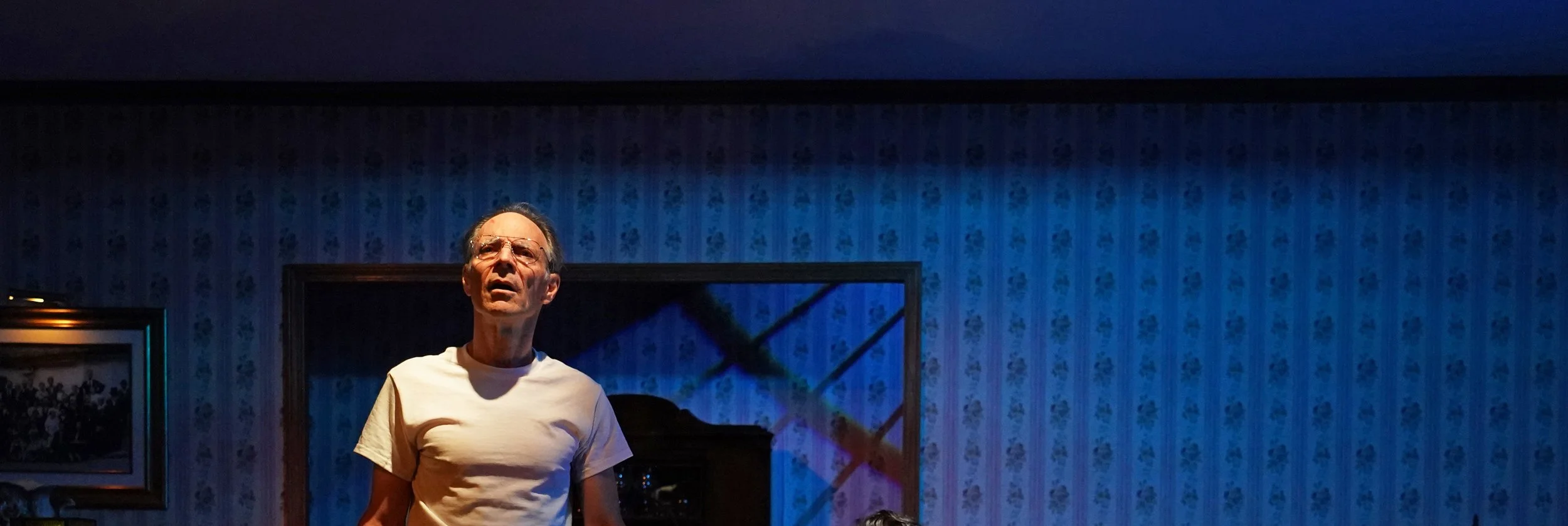
Except for the front two or three rows, the black box seats for Ivanov at The Gene Frankel Theatre are roped off. Audience members sit in chairs along the stage walls, as if they were guests in the parlor of the Lebedev family, where much of this classic Anton Chekhov play takes place. Here’s a brief synopsis of the plot, for those unfamiliar with it. Thirty-two-year-old Nicholas Ivanov owns a large estate, a farm, which has yet to turn a profit. He’s in debt to the Lebedevs, a genteel family who put on airs about their wealth. Five years earlier Ivanov had married a young woman, Anna (Emily Robin Fink), a Jew, who converted to Christianity because of her love for him. Abandoned by her parents, and now dying of tuberculosis, Anna is a double victim: Nicholas has lapsed into an unfathomable and mysterious depression, and has lost his love for Anna and even for life itself. Sasha, the Leberdevs’ 20-year old daughter, is secretly in love with Ivanov, who seems indifferent to her overtures.

Anna looks great—for a consumptive, that is—Anya Klepikov does a fine job with her costuming and makeup. And most of the actors are quite skilled and enthusiastic; I have no doubt we’ll be seeing more of them. Standouts are Brad Lee Thomason as the endearing rascal, Borkin; Tim Martin, who perfectly straddles the line between humor and drama as the preoccupied card player Koshyk; the sassy Avdotia (Emily Jon Mitchell); and the jolly Jonathan David Marballi as George, another guest of the Lebedevs’, who keeps the snarky festivities going. When the entire party teases Sasha for her inexplicable defense of Ivanov, her frustration and embarrassment are palpable.

Yet, main cast members are not uniformly suited for their roles. William Bogert as Shabelski, a down-at-the-heels Count, comes across as alternatively mean-spirited and pathetic, and never quite finds his character’s balance. Matthew Scanlon was, at first, self-conscious in the role of the young doctor, Lvov, but his confidence grew noticeably as the play progressed. The biggest problem, though, is Jeff Barry’s portrayal of Ivanov, the melancholic protagonist of this play. Barry’s Ivanov is less morbid than the rest of the cast—he’s angry, workman-like and in control; ultimately, though, he’s simply neutral. He’s competent when he should be hopeless.

Another problem with this adaptation by Barry and Knoll is that they take unnecessary-—sometimes simply ribald but occasionally even disingenuous-—liberties with the text, almost as if they are deliberately reading too much into the 27-year old’s first play, or worse, attempting to change it. In my translation, Shabelski denounces lawyers and doctors “frauds” and “swindlers” (not the “c” word). Barry and Knoll are going for laughs but what we get is bathos.

Another gratuitous bit is where Chekvov’s “fragile” Martha Babakina (Stephanie Bratnick), plants an extended full on kiss on Sasha’s lips for no reason other than to spice up the script. Nonetheless, Ms. Bratnick is the best actress in the bunch, with great range and emotion. And, at the end of Act II, Chevhov’s Sasha and Ivanov simply kiss. They don’t writhe around on the floor, nearly pre-coitus, as the adaptors have them do. These are not harmless tweaks to the text.

A final problem is Knoll’s direction. It’s as if he has instructed the actors to speak their lines hysterically and turn their loudness knobs to "11." So, everyone screams at each other, all the time. This is not particularly pleasant if you’re an audience member cursed with a seat twelve inches from said screaming. Overall, I cannot recommend this play to either those familiar with Chekhov’s work or those looking to become familiar with it.

Click for print friendly PDF version of this blog post

A Dose of Reality

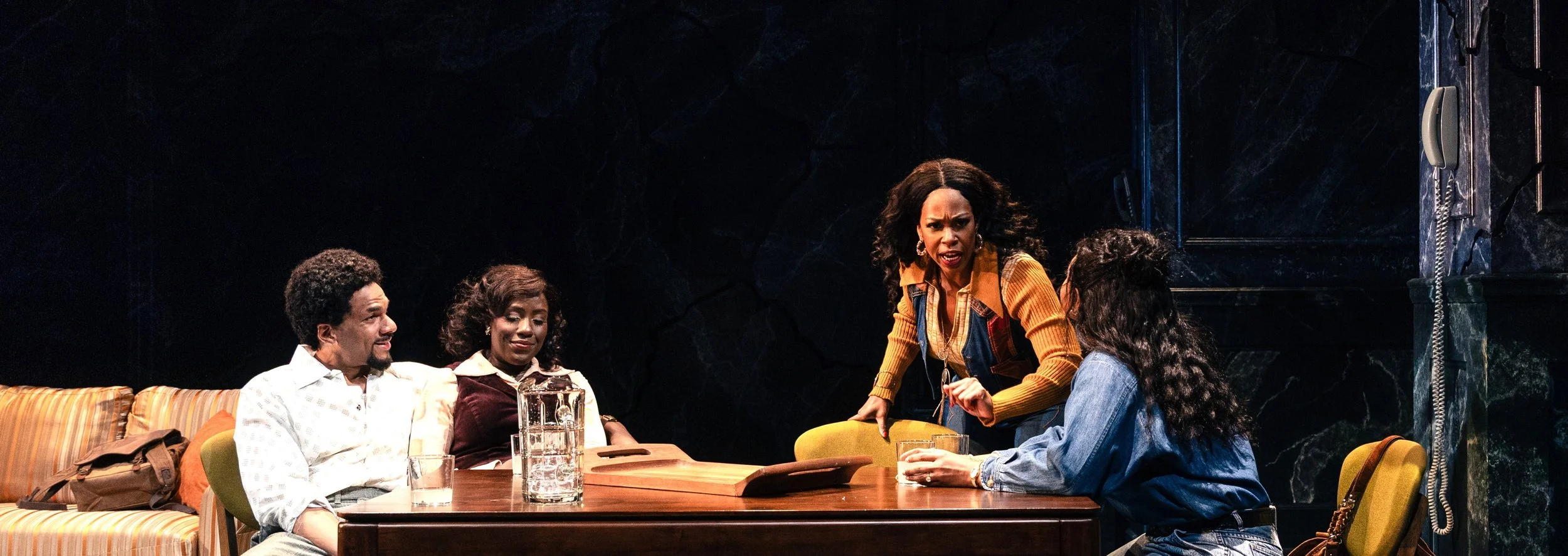
Playwright Theresa Rebeck draws on her vast experience in television—she was a writer/producer on NYPD Blue and Law & Order: Criminal Intent—for her fierce, cautionary satire of television and the distortion it wreaks on American life. Words like “real,” “reality,” “true,” and “fact” spew out of Michael Mayer’s viscerally uncomfortable production like chunks of rock from a volcano, but ultimately Rebeck’s passion is stronger than her dramaturgy. Rebeck intercuts two stories: In the first, the head of a network, Wes (Christopher Evan Welch, masterfully employing his gift for playing distasteful characters), is obsessed about numbers and advertising. He’s also having an affair with svelte, ambitious newscaster Jennifer Ramirez (Morena Baccarin) and is determined to advance her career. More than that, he’s wildly paranoid and pretentious. In a funny early scene he demonstrates to Jennifer what he knows about examining wine as he wafts the odor to his nostrils with his hand: “What is that, pear, some floral, maybe some crushed stone?” One moment he’s lauding Edward R. Murrow—“a great personal hero”—and the next he’s dropping f-bombs on his idol.

Wes assigns Jennifer to host the network’s new reality show, Our House, while she continues as news anchor. His decision appalls his assistant and liaison to the news division, Stu (a fine, intense Stephen Kunken). Wes wants to have Jennifer report on who gets kicked off the reality show. “The news division doesn’t think that what happens on reality television is news,” warns Stu. “It’s reality,” responds Wes. “Why shouldn’t it be news?”

Meanwhile, in a house in St. Louis, a quartet of people share a house. Grigsby (Mandy Siegfried) is a medical intern, Alice (Katie Kreisler) works as a legal secretary, and Vince ( Haynes Thigpen) is a computer troubleshooter. The fourth is Merv (Jeremy Strong), a layabout who has no job, mooches off the others, doesn’t do housework, and is behind on rent. But it’s his addiction to television that particularly irritates Alice, who has lived in a section of Vermont that had no television reception. “It was like freedom … because there was no television,” she tells Merv, who dismisses every criticism she has.

Although the depredations of television have been dramatic fodder for a long time (the Oscar-winning Network, after all, came out in 1976), Our House resonates with Rebeck’s passion on the subject, which lately encompasses reality TV. It’s unfortunate, though, that her characters aren’t terribly sympathetic, and they seem to exist in a vacuum. Wes has impulsive sex with Jennifer in his office, for instance, although Derek McLane’s all-gray set has clouded glass partitions that aren’t so opaque that a secretary couldn’t discern what was happening. Yet there isn’t a sense that anyone else is around. Wes, too, seems to know what the chat rooms say about Jennifer but doesn’t know that people pay for the Internet. Whether Rebeck’s reading of the way executives think, as embodied by Wes, is accurate or exaggerated, Wes’s behavior doesn’t register as authentic.

But Rebeck’s warning that TV is creating a schizophrenic society and that reality is blurring because of it doesn’t let viewers off the hook either. Strong creates a magnificent, if one-note, character in the sociopathic Merv. As he glibly avoids doing anything useful or respecting others’ property, you’ll probably loathe him—but, like the TV shows he’s addicted to, you can’t look away. Is his problem that his housemates are too busy with their lives to engage in conversation with? Is the art of conversation dead in “our house,” i.e., America? Decent people like Grigsby and Vince are manipulated in the house meeting, and one senses they’ve been too busy with their lives to notice the danger in their midst or discuss the problems until they reach a tipping point. Only Alice, shaped by the lack of TV in her recent life, is alarmed by the fraying social fabric.

Act I ends with an act of violence and a hostage situation in the house, and Jennifer is assigned to cover it, though even Wes recognizes that “this isn’t television, this is real.” But Rebeck’s satire becomes too strained thereafter and doesn’t feel real either. The police allow Jennifer access to the house to interview Merv, and even after the situation ends, Wes is permitted a private interview with Merv. There are no cops, no SWAT teams, no hostage negotiators to have a say—the world outside doesn’t really exist, it seems. Even a dark, pact-with-the-devil ending doesn’t achieve credibility, and that’s unfortunate, because Rebeck clearly feels the stakes are high. As Alice says, “There is no liberty here, not to mention intelligence. This is the opposite of the American dream!”

Click for print friendly PDF version of this blog post

The Good Whistleblower’s Mother Wears Out Her Welcome

Theatre Askew’s entry into The Brick’s Antidepressant Festival features an amazingly able company of actors that manages to create a memorable performance with a forgettable script. The Tale of the Good Whistleblower of Chaillot’s Caucasian Mother and Her Other Children of a Lesser Marriage Chalk Circle is an ambitious, musical attempt to meld characters and themes from Brecht, Albee, the musical Mame, Giraudoux and about a dozen other sources with an ironic tirade against the pharmaceutical industry.

Playwright Stan Richardson begins the evening fairly promisingly as we meet a delightfully droll set of family and friends dealing with the overdose of John. John is a character we never meet and find out little about because everyone in his life is amusingly and compulsively self-absorbed. Ensemble members Tim Cusack, Matt Steiner, Sara Alvarez and Brandon Uranowitz make this opening scene one of the highlights of the evening.

The dialogue in this section, and some dialogue sprinkled occasionally throughout the rest of the musical, is sparkling and sharp. But, Richardson wanders off into less impressive comedic landscapes as we get further into his labyrinthine plot.

Reverend Cindy (Joanna Parson) is awkwardly introduced as a guitar playing narrator. The unfortunate Parson valiantly tries to entertain the audience with an extended one-sided conversation with her belligerent guitar which falls depressingly flat. Debbie Troché, who is introduced as John’s Mom, tries desperately to sell an unlikable character who does strange things to an increasingly indifferent audience. Actually, that is not just for the character of Mom, poor Troché does this all night.

Reverend Cindy then begins to sing a nice ballad (written by Rachel Peters, and providing a delicious sense of fun and camp to Parson's otherwise thankless role) about the eponymous whistleblower and his mother. The origins of the evils of the big pharma industry are explored with an 1800’s apothecary, Dennis Courage (Cusak) who runs the largest “medicants” supply company in his native Chaillot and perhaps the world. He is happily giving free drugs to the rich and gouging the poor until a trio of Gods (Steiner, Alvarez and Uranowitcz) visits him and offers to sneak him into heaven if he can only give the poor a break on their rabies and syphilis treatments.

Cusack does an admirable job when called upon to perform an interpretive ballet about tortured lovers to convince the company’s board to show mercy to the poverty-stricken. Then Troché is re-introduced as “Mame Courage,” an uncomfortable meld of the mad woman of Chaillot, Mother Courage and Auntie Mame.

Troché’s character becomes the focus of an increasingly dissolving narrative. She spends long moments taking straining dumps into a large planter on stage (not really defecating, but a soundtrack of dissonant farts helps fool the ear), spouts lines like “By Saint Bab’s quim!” repeatedly, and ends up somehow living with a bear in a cave and bleating like a goat. Troché, a gifted and laudably willing performer, almost succeeds in pulling all this together (believe it or not) but the material is eventually unsalvageable.

Steiner, Alvarez and Uranowitz manage to spin feces-covered straw into gold several times with their appearances as Oopse, Krapp and Fuckk – Dennis’ triplet step-siblings who speak only in unison. There is really no weak link in the fine ensemble of actors. The script, however, lets them down so often, the main dramatic question in the play becomes, “How did they convince these actors to do this?”

The Tale of the Good Whistleblower’s . . . might entertain fans of bizarre scatological humor and the winning cast and inventive musical score are endearing. But though it is certainly a wild ride and an utterly unique journey, it doesn’t really take you any place you want to go.

For tickets and showtimes, consult The Brick Theater’s Antidepressant Festival website at www.bricktheater.com/antidepressant.

Click for print friendly PDF version of this blog post

Earning Their Dough

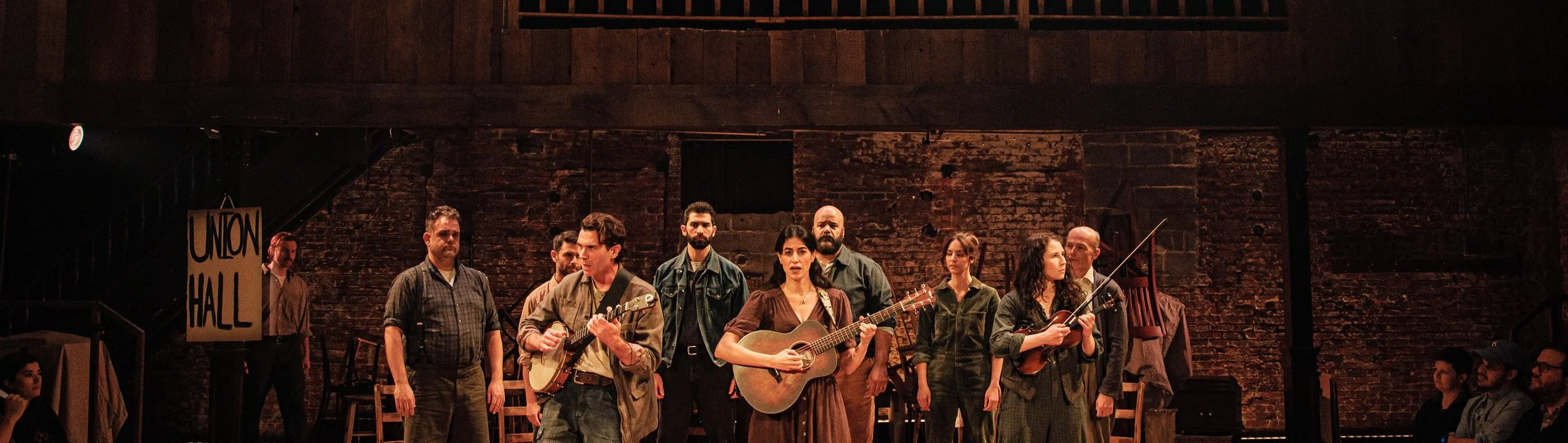
The New York City Food Riot of 1917 is a culturally fascinating, socially significant, but little known blip on the city's historical radar. Occurring in the same period as World War 1, The Food Riot seems to have slipped quietly through the cracks of its time. As the war raged overseas an increasing number of immigrants fled to America. Give Us Bread examines the ones that migrated to Manhattan and populated the growing neighborhoods on the Lower East Side. Location is everything, and The Anthropologists (actresses Jean Goto, Sonja Sweeney, Jennifer Moses and Katy Rubin) along with artistic director Melissa Fendell Moschitto have chosen an ideal venue for their historical drama. Give Us Bread is staged at the CSV Cultural Center, centrally located in the same Lower East Side neighborhood the play's characters inhabit.

In 1917, with the world at war and immigration bursting at the seams, prices for basic food items such as milk, onions, bread and potatoes were inflating faster than the average worker’s wages. Demand far outweighed supply, forcing pushcart peddlers to raise their prices, first steadily, than sharply until items that once cost .11 suddenly cost .19.

These prices were being gouged from a working class that was 80% female with 90% originating from a foreign country. Men were disappearing from the scene, either abandoning families they could no longer support or dying of illnesses associated with poor factory conditions.

Women who could work toiled in sewing factories from daybreak to sundown while those who couldn’t pawned goods or sold handcrafted arts. Unfortunately, with all the diseases spreading through the tightly packed homes, the distribution of handcrafted items was soon banned, leaving many women with little to no means of income.

“What will I do? What will I do?” widowed Irish mother Elizabeth (Jennifer Griffee) asks herself while rocking manically in her chair. This is the question on all the womens’ minds as the prices continue to climb with each new day.

The immigrant women spotlighted in Give Us Bread include a plucky Asian orphan named Jenny (Jean Goto), the aforementioned Elizabeth (Jennifer Griffee), a fiery Italian, Concetta (Shayna Padovano), Rivka (Katy Rubin), a Jewish woman raising her talented daughter, Hannah (Sonja Sweeney) and Marie Ganz (Jennifer Moses), a character based on the real life anarchist and rebel.

The fresh-off-the-boat women are not proficient in English and are often childlike in their attempts to understand their new world. Still, the actresses play their respective roles with strength and intelligence as they work to overcome language barriers and find a common bond.

However, it is not until Marie Ganz’s rousing call to arms that the women are finally stirred to take a unified course of action. Ganz is clever. She plays on America’s gender stereotypes and sympathies. She garners public support, and in a poignant, powerful moment her character stands front and center on a box while a slide show of real faces from the 1917 Food Riot are projected behind her.

Post performance, Hasia Diner, Professor of American Jewish History at New York University, gave a brief background lecture confirming the validity of the historical moods, attitudes and facts touched upon in the narrative. In fact, every performance is followed by a contribution from a guest author or visiting historian.

With an impressive lineup of knowledgeable lecturers, a website filled with research blogs and a playbill crammed with statistics and timelines, The Anthropologists live up to the meaning of their name. The company has effectively resurrected a lost revolution from New York’s past and given it a chance to shine in such a way that it will never be forgotten again.

Click for print friendly PDF version of this blog post

Newsflash from Agincourt

If Warlike Harry was alive today, then he had better be photogenic. While the hero of William Shakespeare's Henry V existed far from the prying eyes of the public, Jessica Bauman's multimedia retelling of the play, Into the Hazard, broadcasts its hero and its politics onto the small screen. The resulting production succeeds as a solid version of Henry V, but fails to make its intended political point. For all intents and purposes, Into the Hazard is a streamlined version of Henry V which uses Shakespeare's text almost exclusively. Like in Shakespeare's play, the newly crowned English monarch, Henry, shakes off his former reputation as a ne'er-do-well and leads a ragtag army to war in France. On the battlefield, the young king proves himself against overwhelming odds, defeating a field of French foes and claiming large swathes of France for himself. Often, Henry V has been staged as uncritically patriotic, such as in Laurence Olivier's 1944 film, but the text itself is far more ambivalent about the justice of Henry's actions. Bauman underscores this aspect of the text, ending her production with the Chorus' lines about England's subsequent bloody loss of all its newly won French lands.

Bauman was inspired to undertake her adaptation of Henry V in response to the relentless media spin which accompanied 9/11 and the subsequent wars in Iraq and Afghanistan. Although Into the Hazard is intended to provoke audiences to question the insidious interplay between the organs of the news and the actions of the state, Shakespeare's play does not lend itself to the reinterpretation.

Bauman's concept places a TV screen center stage. Upon entering the theater, the first thing one notices is a large television set playing a game sequence from a first person shooter set on an urban, Middle Eastern battlefield. With the help of video designer Austin Switser, Bauman has transformed certain scenes and speeches from the play into newscasts, reality shows, and documentaries, which she intersperses between the live-action scenes. Helpfully, she has added a prologue between a stuffy academic and a star-struck reporter which explains the play's complicated backstory. The video interludes are amusingly incongruous, but also occasionally illogical. For example, when a TV newscaster publicly announces the treachery of two of Henry's associates and broadcasts their mugshots, one wonders why the traitors are so shocked when they are apprehended by Henry in the next scene.

The problem is that Bauman has grafted modern assumptions onto an antique work. Speeches that were written to be played out in public (such as Henry's St. Crispin's Day speech to the troops) have been shoved into dark back rooms, drastically reducing their power. Others, which were written for private communication between the Chorus and the audience, are broadcast to the world, slathered with an irony which undercuts their poetry. In the end, the only media sequence which effectively does what Bauman intended – that is, raise questions about media spin and its relationship to war – comes at the end of the play. Immediately after a scene which portrays Henry's attentions to Katherine as akin to rape, a press conference plays in which the King of France announces the couple's marriage. The image of the blank-faced couple standing in the background is truly chilling.

The production is not helped by Nick Dillenburg's performance as Henry V. Although he cuts an appealing figure, his thoughts and motivations are impenetrable and his line delivery flip, no matter what the content of the text. Although this may suffice for playing contemporary leads, it is not satisfying in Shakespeare. Henry's lack of internal conflict and passion make the second act – which contains the king's most rousing speeches – drag. Dillenburg is much better as the callow French Dauphin, slouching, whining, and bragging his way into a disastrous war.

Fortunately, the five actors who share the rest of the roles – Erin Moon, Trevor Vaughn, David McCann, Luis Moreno, and Scott Whitehurst – are all strong. Vaughn as Pistol is both believable and charismatic, while Moreno steals every scene he is in as the garrulous Welshman Fluellen. Moon's performances of both a boy soldier and the Princess Katherine are exceptional.

Bauman has done a fine job directing her ensemble, staging the play cleanly and formally on Christopher Akerlind's spare set. Using nothing more than a metal platform, a door, two chairs, and buckets full of soil, she creates interesting and elegant stage pictures. The ensemble's methodical stacking of dead soldiers' shoes after the battle of Agincourt is particularly moving. Akerlind's simple, warm lighting design is both attractive and understated and Emily Pepper's costumes are effective and clearly delineate the many characters, even when the whole cast changes into desert fatigues for the second act.

Viewers hoping for a radical re-envisioning of Shakespeare will be disappointed. However, although Into the Hazard has not fully succeeded as a retelling of Henry V in a media age, it is a perfectly enjoyable, well-performed and carefully directed production of Shakespeare's play.

Click for print friendly PDF version of this blog post

Happy Talk: The Antidepressant Festival Spreads Cheer at the Brick

"The world financial markets have collapsed," begins the promotional video for the Brick Theater's annual summer play festival, and continues with a litany of current crises. "But you know what? That's great."

Dubbed "The Anti-Depressant Festival," this year's festival aims to cheer. With seventeen fully mounted productions rotating in a month-long repertory, there is much off-kilter escapism to be had. "We wanted to talk about 'the downturn,'" explains Michael Garder, Co-Artistic Director of the Brick, "without calling it The Recession Festival."

Even in a year when securing funding for the arts poses a bigger challenge than it usually does, New York has its standard abundance of summer theater festivals. There's a bevy of free outdoor Shakespeare, most famously the Public Theater's star-studded Shakespeare in the Park, which draws long lines to Central Park's Delacorte Theater. For some reason, Shakespeare festivals seem to concentrate in upper Manhattan: there's also the Inwood Shakespeare Festival, presented by Moose Hall Theater Company in Inwood Hill Park, and the Hudson Warehouse's Shakespeare productions at the Soldiers' and Sailors' Monument on Riverside Drive. Other, non-festival opportunities to catch some free Shakespeare this June include two traveling productions: New York Classical Theatre's King Lear uptown at Central Park West and 103rd Street and downtown in Battery Park, as well as TheaterSmarts' Much Ado About Nothing, performed in parks across Brooklyn, Manhattan, and Queens.

The Bard aside, many summer theater festivals have an emphasis on developing new work. The multitudinous New York International Fringe Festival, with its 200+ productions that range from re-imagined classics to cabaret burlesque, features companies of all stripes performing shows of all genres, subgenres, hybrid-genres, and genres as yet undefined. Other annual favorites include the Ensemble Studio Theater Marathon, which debuts ten-minute plays in Hell's Kitchen this May and June as it has each summer for more than three decades, and the Summer Play Festival, at The Public Theater in July and August, which is devoted to work by early-career playwrights.

One of the great pleasures of a theater festival is the opportunity it provides to see singular work within a larger context. The EST Marathon, for example, celebrates the ten-minute play by showcasing a variety of forms that exist within the time constraint. What sets the Brick's festival apart is its thematic focus; The Antidepressant Festival is as likely to spark audience rumination on subject matter as it is on form.

Theme-based festivals also help curb the tendency of audiences and critics alike to focus on finding the "best" play of festival. Rather than trying to identify, say, the sharpest young playwright, a festival with a thematic focus perhaps better emphasizes the shared energies that accompany putting together a diverse collection of shows. Each of the plays in The Antidepressant Festival has its own, decidedly unique slant, yet functions in a sort of conversation with the rest of the fest.

A lot of ground will be covered by the festival's eighteen productions, in part due to The Brick's affection for the unexpected. In considering prospective plays to showcase in the festival, Gardner notes, "If the application raised the question 'why the hell would you put that in an Antidepressant Festival' it was already tantalizing." Part of the fun that the festival promises will be an opportunity to see many disparate, light-hearted takes on the problems of our age. Two different productions, dance-theater piece WILM 690: Pirate Radio as well as Afternoon Playland, which features sock puppets, address the impending doom said to accompany the end of the Mayan calendar in 2012. Other issues addressed by the fest include amnesia (Cabaret Terrarium), serial killers (Your Lithopedian), and the pharmaceutical industry (The Tale of the Good Whistleblower of Chaillot's Caucasian Mother and Her Other Children of a Lesser Marriage Chalk Circle, a title that will delight competitive charades players everywhere), among others.

Participation in the Antidepressant festival was open to the general public, by application. Although a few companies may have had cheer-up plays already in the works, by setting a prescribed topic, the Brick's festival served as a prompt for artists to create productions that, when performed in repertory, play as variations on a theme. According to Gardner, selecting play submissions for inclusion in the festival is primarily about finding good material, adding that, "anyone who knows us recognizes our affinity for weird and twisted." Such projects are a specialty of the Brick's, which is home to The Baby Jesus One-Act Jubilee, an annual winter festival of new, yuletide-themed short plays and The New York Clown Theatre Festival, an acclaimed festival of (yes, that's right) clown theater in New York.

Of all the festivals at The Brick, it's the annual summer festival, with a new theme each year, which attracts the most attention. The Antidepressant Festival follows last year's cheekily titled The Film Festival: A Theater Festival, which challenged theater practitioners to use film in constructive ways. Though the resulting plays were hardly uniform - in addition a lot of mixed media pieces, there were plays about cinephiles and film scripts performed solely as live theater - the link between the festival's shows fell more heavily on approaches to form. This year The Brick's summer festival returns to the irreverent, content driven themes of The Pretentious Festival in 2007 and The $ellout Festival in 2006. With its acknowledgement of a recession-driven need for escapism, The Antidepressant Festival also marks a return to the politically driven Moral Values Festival of 2005, developed in the wake of so-called "values voters" dominating the polls during the national elections the previous fall.

The Antidepressant Festival opens Friday, June 5th, following the previous evening's kickoff cabaret, and runs through Saturday, July 4th, at The Brick in Williamsburg. Tickets are a helpfully inexpensive $15 per show, in keeping the festival's downturn-inspired, don't-worry-be-happy theme. "It's interesting," says Gardner, "putting on a festival about happiness. You start to realize that every play is about happiness."

For a complete listing of plays in the Antidepressant Festival, the performance schedule and other helpful festival links, visit www.bricktheater.com/antidepressant.

Click for print friendly PDF version of this blog post

Simple Machines

The self-indulgently titled machines machines machines machines machines machines machines is knowingly dim-witted and absurd, but not “deeply profound,” as billed by its creators, rainpan 43. Within 75 minutes, I strenuously fought at least two nearly overwhelming urges to leave the theater. The only thing going for machines… is the maze of clever and sometimes astonishing contraptions that envelop the stage. Ropes, strings, wheels, bowling balls, boxing gloves, and any number of pulleys are employed so that the characters can, with less than aplomb, do things that could be done more simply by just getting up: cooking an egg, for instance, becomes an embarrassingly difficult exercise with a 10-foot long spatula.

“Phineas,” “Liam,” and someone Phineas calls “Your lordship” could pass for three ultra-nerdy college students on the 10-year plan, suffering from severe cases of cannabis-induced paranoia. With far too much time on their hands, even cooking breakfast becomes an excursion into silliness. Coffee is called “black effluvium,” and an egg is a manna-like “ovum” bestowed from a “benevolent goose;” looking into a refrigerator is a gaze into “icy regions.”

machines… is a hybrid of a poor man’s Blue Man Group and one long, bad, Monty Python skit that tries way too hard to please. Liam (Trey Lyford) wears a mechanized mask that makes all of his verbal communications sound like radio dispatches. Like Michael Winslow in Police Academy, he is dubiously gifted with the ability to make all kinds of annoying mechanical noises with his mouth. Phineas (Geoff Sobelle) sports a kilt and World War I pilot’s goggles. The third (Quinn Bauriedel), who we learn is the “Chief Commander,” sounds like a cross between George H.W. Bush and Jimmy Stewart at his dopiest.

Of course, with machines made from rubber bands and boxing gloves, inevitable breakdowns occur. The actors are more than willing and able to ad lib as they struggle to retrieve an egg or use their contraptions to return a bottle of orange juice to an icebox. On the night I saw the production, the egg fell to the floor, and the audience let out a giant, thrilled sigh of frustration.

As if unable to tell their Dungeons and Dragons game from reality, the characters have constructed a hermetically sealed and alarmed world where they gird for an eventual fight against some unseen enemy. Needing to “fortify” themselves for the long battle ahead, they decide to, for instance, eat some cereal and bananas. Of course, if they just got up and got it themselves, there would be no reason for this show. So, with the help of some ropes and chutes, they inexpertly pour their Cheerios from the top regions of the stage into bowls at their table. Crazy, man!

The real stars of this production are machine designers Steven and Billy Blaise Dufala, Technical Director Derek Cook and Marlon Hurt, the Master Electrician. Creating a stage-world of working contraptions and low-tech gadgets is not easy, and their creativity is often staggering. Yet, the performers, left to their own...er...devices…fail to do anything with this world other than weave a trite story around it. machines… would be quite fascinating in a college talent show, and it would probably win. But, I expect more from productions at HERE.

At one point the characters realize that their unseen “enemy” is among them. Phineas interrogates the Chief Commander with a torture machine made from wires and clothespins. The Chief Commander winced as the pins were clamped on his lips and ears. He really did look like he was in pain, perhaps almost as much as I was.

Click for print friendly PDF version of this blog post

I've Got A Secret

Bigger Than I, directed by Nick Sprysenski and currently playing at Under St. Marks, is composed of vignettes centering on the notion of secrets. These short glimpses into the personal lives of certain individuals range from the childish anecdote to the perversely sexual and are presented in varying forms: some performed live, some played over the sound system from canned recordings, and others presented on screen. The filmic presentations are perhaps the most powerful and therefore meaningful. The stories seem to be the confessions of the individuals seen on screen, making their pronouncements come across as deeply intimate. Yet the camera lens only reveals the person’s eyes or lips, or a small corner of his/her face at any given moment, reminding the viewer that no matter how much we share it is virtually impossible to ever fully know another human being.

The mix of multimedia into the performance is an interesting choice, though it is not entirely integrated. It feels almost as if these filmed scenes are part of a related project on a similar theme and not a seamless element of this production. The idea of interviewing and presenting individuals' own stories from their own mouths in their own words also potentially subverts the power of having actors portray the secrets of others. The sense of authenticity that is felt when one tells one’s own story is lost when it is clear that the scene has been interpreted, and thereby altered, by an actor.

The stage scenes vary in effectiveness from the profoundly touching to the tritely over-simplistic. These performed secrets, embodied as deep dark places of the human psyche, are often too preoccupied with surface levels of humor and shock value to really move the spectator. One particularly compelling sequence involves a young Jewish man venturing to confession with a Catholic priest in order to attempt to absolve the guilt he feels over his father’s death. This scene is uniquely touching because both the young man and his confessor come across as fully human – flawed but ultimately sympathetic.

Despite the inconsistencies, the overall effect of the piece – the sum total of its disparate parts – is acutely felt. In light of all the humorous moments in the piece, I found myself leaving the theater in a state of thoughtful sadness. The play addresses real issues about interpersonal relationships, yet offers no solutions to the problems we all face in connecting with others. The play grapples with feelings of loneliness and isolation in light of our increasingly technologically connected world. The play begs the question of how alone we all really are – and not because we all have cell phones and Facebook, but because we all share one fundamental thing in common. We all have secrets. And we can continue to reveal these – be they funny or painful, performative or previously recorded – in order to gain closeness with one another.

What better art form to represent this material than theater? Theater is, after all, live, and built upon the connections between live actors and live audience. Although we may be separated by the infamous imaginary fourth wall, all of us who partake of Bigger Than I can share an experience, unique and profound. Perhaps we can even be moved to begin to disclose some secrets of our own. But maybe not all our secrets.

Click for print friendly PDF version of this blog post

Learning Curve

Forget Juilliard and the Pasadena Playhouse. Why waste your money on an expensive acting program, when you can have the brainwashed members of Theater Mitu guide you through the eight canonical acting philosophies in their inventive, but ultimately off-putting multi-media project Dr. C (Or How I Learned to Act in Eight Steps), now playing at the 3LD Technology Center? Based equally on the written treatises of theater luminaries as disparate as Aristotle, Stanislavski, and Anne Bogart, and the jerky, overexcited gesture acting of the 1920 silent film The Cabinet of Dr. Caligari, Theater Mitu presents an Orwellian machine dance of incredible deft and magnitude. Eight company members (designated to play theater abstractions like “acting,” “audience,” or “critic”) are prodded around by a robotic voice as though they were mere algorithms in a grand computer program, commanded to compute “acting.” Projections of text, lights, music, and movement are used to calculate each theatrical philosopher in his or her own aesthetic idiom, and along the way the troupe of singing actors lament their fate as cogs in a robotic system.

If conceivers Ruben Polendo and Jocelyn Clarke set out to achieve a stimulating new type of sensory experience, they’ve done a laudable job. But if they also hoped to offer some larger comment on the theater, or even “convert” anyone to the joyous practice of theater, they have fallen quite short. This notion of conversion is inescapable – most of piece exudes a perplexing religious air, as though one has stumbled into some strange cult of theater clerics mid-ritual. True, there is some spirituality inherent in the art form, and the question of how artists interact with these “holy” texts is broached well here, as the performers literally commingle with projections of that text. But frankly, this text was never intended to be sung, chanted or shouted. For Peter Brook to suggest “theater is life” in the book The Empty Space is one thing, but to have it intoned repeatedly by eight wildly gesticulating, sweat-drenched actors in close proximity will likely scare off even the most devout theater apostle – case in point, me.

I have been a theater artist and critic for about five years now and I love the theater intensely, but once Eight Steps passed the succinct Aristotle introduction and moved into the more elegiac Adolphe Appia step–singing phrases like “Music is the direct expression of our inner being,” my initial response was one of embarrassment. This is what the normal people think of us, I said to myself: a bunch of self-aggrandizing hippies that roll around on the ground together, orate about how great they are, and then charge admission. Admittedly, this first response is too harsh and probably an unfair reply to what Polendo, Clarke and Theater Mitu aim to accomplish, but nevertheless, I couldn’t shake my feelings of discomfiture until the rousing Bertolt Brecht segment.

Along with the all-too-brief transitory scenes, the explosive, self-aware Brecht cabaret entertains enough to make up for the other flowery mumbo jumbo. Adam Cochran gives an exhilarating performance, swinging from a tangled knob of microphone cords, as hilarious texts such as “be alienated” or “one of the cast members is secretly gay” or “Matt Carlson voted for Bush” are projected around the stage. Here the pretentious mood is shattered, affording, in my opinion, a more honest expression of the theatrical experience.

Polendo, also the director, certainly stages the piece impeccably. The convention of the computer program is expressed clearly and we quickly learn the rules of the operation – an introduction to the philosopher, a frenetic reading/representation of their text, and finally an analysis of video footage. Throughout, Kate Ashton, Alex Hawthorn, and Jake Wilten deliver the mechanized environment faultlessly as respective designers of lights, sound, and projections. Candida K. Nichols' unique costume designs also deserve special notice. The company members are all intrinsically committed to the piece's demands, with Justin Nestor and Cochran leaving particularly lasting impressions of zeal.

In a lot of ways, Dr. C (Or How I Learned to Act in Eight Steps) presents a complete picture of the theatrical world. When I say that I’m embarrassed by the more egotistical “method-y” aspects of this production, it’s certainly not Theater Mitu’s fault – I’m really embarrassed that artists in our medium are sometimes encouraged to take themselves so seriously. It’s hard to blame a brave company for having the ingenuity and courage to dust off our more self-important old texts and have some fun with them. Especially Brecht – that was IMMENSELY FUN.

Click for print friendly PDF version of this blog post

I Dream of Jimmy

Marie Brassard’s New York premiere of her one-person work, Jimmy is an absolute "must see." Short yet potent, it’s a small masterwork— a time, gender and genre bender that exemplifies the best of experimental theater. Imagine existing in another’s erotic dream, coming to life when someone conjures you up, changing form according to that dreamer’s whims and then being dropped into a dormant existence at dream’s end—to be resurrected again only when you are next dreamed of, possibly decades later. Imagine silently pleading that someone dream about you just so that you might fully exist once again, even though you might find yourself in a horrible place. That’s the universe of Jimmy.

The set is sparse, elevated—a non-set, really. As the audience filters in, Jimmy is already sitting, almost cowering on the stage, his back to the audience. He has long hair, is half-dressed and looks as if he has been defiled or violated in some manner. As the play begins, Jimmy rises, dresses and addresses the audience. Special effects are sparse but powerful, and consist mainly of background lighting and voice alteration.

“Jimmy” calls himself a “homosexual hairdresser” who came into existence in the erotic dream of a homophobic general in 1950. Jimmy is not a “person,” but an entity. In the dream, he was about to kiss Mitchell, a salon client, but the dream was interrupted when the General suffered a heart attack at the moment of orgasm. Fifty years later, resurrected in the unwanted dream of an actress from Montreal (Brassard), and stuck in an airplane toilet when she awoke, Jimmy spends his “existence” trying to unite with Mitchell, who himself may be a person or a persona. Jimmy does not know. In Jimmy’s world there are dreamers and those who are dreamed. It’s a kind of death to be dreamed and forgotten, much like how the dead must wait for someone to remember them.

In unskilled hands, this quasi sci-fi premise might veer into the merely silly. Ms. Brassard, however, makes this tale almost plausible, imbuing it with heartbreaking poignancy, poetic lyricism and even humor—a combination so very rare these days. A consummate artist, Brassard, with the assistance of P.S 122’s design team, alters her voice with special effects, deepening, slowing it down and slurring it to play the other-worldly Jimmy, and changing it at other times to sound like the effeminate prepubescent boy that the General had previously dreamed up—Jimmy as a child. At 60 minutes, the show lasts just long enough to sustain the content. Brassard wisely keeps it short, masterfully capturing and guiding us through the illogic and malleability of the dream state.

There has been a springtime spate of impressive plays featuring personas that operate in the fertile ground between being and nothingness; two that immediately come to mind are Nerve Tank’s A Gathering and Christina Campanella and Stephanie Fleischmann’s Red Fly/Blue Bottle. We should now add Jimmy to that distinguished company. Stop daydreaming and go see it.

Click for print friendly PDF version of this blog post

Pots and Pans

A bustling, upscale restaurant may be filled with sunlight and laughter, but beneath the patrons' feet is another world they will never know: a dark, grimy, steam-filled cellar where three dishwashers clutch their sponges and wait for their next shipment of dirty, food-stained plates. Morris Panych’s bleak, yet deeply profound comedy, The Dishwashers, focuses on the lives of these three dishwashers: a terminally ill old man named, Moss (John Shuman), a veteran dishwasher and liaison to the world upstairs, Dressler (Tim Donoghue) and a newbie college drop out, Emmett (Jay Stratton).

The men work through the festivities of Christmas, scraping cigarettes out of mashed potatoes, and through the excitement of New Years Eve, hoping that after the ball drops they will find an unfinished flute of champagne in the bus tray.

Charlie Corcoran compliments the mood with a visually capturing set that pulls the viewer into the cellar with the dishwashers. There is no sign of ventilation – not even a ceiling fan – the paint on the wall is peeling and the wooden stairs leading up to the restaurant are moldy and rotted. Emmett’s outfit is too short; the arms barely come past the elbows and the pants end at his knees.

The setup of the room and the condition of their work clothes gives a clear indication of the dishwashers' status, both in life and in the eyes of the restaurant.

Jill Nagle’s lights also add another layer to the story. When the dishwashers are on their lunch break the lights are sharp and piercing, but when they return to work the room dims. Slivers of light seep through the ceiling, casting stripes on the dishwashers' aprons. The result is an image that eerily resembles three inmates toiling away in prison uniforms.

But is their little corner of the world a prison? That is the question bouncing between Emmett and Dressler with a clueless Moss caught in between. Emmett thinks Moss needs to live a little before he dies. Dressler disagrees. Moss was born for this life and he’ll die in this life.

Saddled with emotional problems of his own, Emmett is unsure of his place in the world and wholly susceptible to Dressler’s hard-nosed mentality that anyone who ends up in this cellar will never have the fortitude to work their way out of it.

Dressler is a difficult character to like but a fascinating one to listen to. While Emmett and Moss openly despise their situations, Dressler embraces his. He loves seeing the silverware sparkle in the morning light, even though no one will ever credit him for its shine. “I love this job,” he tells Emmett proudly. “Not because it’s a good job, but because it’s my job.”

Aside from this passionate declaration, Donoghue reveals little about his character’s true nature. He catches himself before the conversation turns personal and throws in a crude joke if he feels the moment getting too chummy. He also shows no remorse for brainwashing Emmett into accepting a life that he is desperate to get out of.

When Dressler first meets Emmett he asks his name. When Emmett tells him Dressler barks, “Wrong! It’s New Guy. You have to earn the right to be called Emmett.” Dressler believes respect is earned by remaining in the cellar, while Emmett feels it lies at the top of the stairs.

The Dishwashers does not lean to one side or the other. There is no heavy-handedness and no clear resolution. Instead, Panych leaves room for the viewer to decide who is at peace with his place in the world and who will always see himself as a prisoner, trapped in a restaurant cellar.

Click for print friendly PDF version of this blog post

Occupational Hazards

It’s inevitable that some of the more revered works in the theatrical canon will be performed more than lesser-known ones. What theater company that can get its hand on Edward Albee or Sam Shepard work can resist the urge to perform it? It is a blessing, then, when a theater troupe decides to breathe life into a more forgotten work. Such is the case with Project: Theater’s’s current production of The Five Lesbian Brothers’ barbed mid-1990s work, The Secretaries at the 78th Street Theatre LAB. The Five Lesbian Brothers remain a rather well-kept secret from the last twenty years of underground independent theater. Comprised of Maureen Angelos, Babs Davy, Dominique Dibbell, Peg Healey and Lisa Kron (she is perhaps the group’s most famous alumni, having scored a Tony nomination for Well), this Obie-winning group emerged in 1989 at the WOW Café.

Hopefully they will remain a secret no more. The Five Lesbian Brothers’ plays subvert such strong ideas as politics and sexism in a darkly comic structure. Both subject and style have been embraced wholeheartedly by director Joe Jung and the rest of Project: Theater’s immensely talented ensemble.

Patty Johnson (Jessi Blue Gormezano) is new to the secretarial pool at Cooney Lumber Mill. While quickly promoted by enigmatic and intimidating boss Susan Curtis (Tara Franklin, creating a perfect ice queen), Patty finds it takes a bit more work to fit in with her three long-standing administrative colleagues, women who seem to know everything about each other’s secrets, and, as Patty quickly learns, hers as well.

One of the great joys of this production of Secretaries is watching this trio both enact and defy automaton stereotypes. Dawn (Karis Danish), Peaches (Laura Dillman) and Ashley (Jenny Schutzman) may address the audience wide-eyed and speak in unison, and they all may subsist on a diet consisting solely of strawberry diet shakes, but each woman has her own freak flag, and the actresses wave them high.

It’s hard not to laugh, for example, at Danish’s mannerisms, some deliberate, some a bit more subtle, but all sustained throughout the show, as Dawn harbors a hysterical same-sex crush on Patty, one that circumvents Susan’s odd requirement of celibacy among her charges. And who can resist laughing as Schutzman, hair apparently drowned in an Aquanet bath so that she resembles something out of a Whitesnake video, makes her character increasingly duplicitous? Meanwhile, it’s worth the wait as Dillman makes Peaches’ deep-seeded insecurities rise to the surface.

Jung moves Secretaries along at a great pace, with scene changes that are done nimbly without calling attention to themselves, and a great attention to detail (including the song choices playing in the background of the secretaries’ local watering hole). Gormezano perfectly embodies the Madonna-whore complex: she has Patty walk a fine line of immersing herself in some of her cohorts’ behavior, including submitting her tampons to Susan for review (yes, the play is edgy, but it works best when its humor is the most pointed), while carrying on an interoffice romance with lumberjack Buzz (a hilarious Brian Frank).

Eventually, Patty catches on to the fact that her colleagues’ hijinks are more than merely wacky, that they might, in fact, involve a more sinister plan. This comes as no surprise to the audience, however, and, if there is any disappointing element with a show as supremely well-executed as Secretaries, the fault can be traced to its source material. The show may be a suspense comedy, but as irreverent as the Five Lesbian Brothers’ work is, it is lacking in the suspense department. There is no great thrill or twist as the show approaches its climax.

Yes, this is a satire about what the women warriors in a male-dominated working world can be driven to, but it never quite reveals what drives them in the first place. One catches on to what the secretaries have up their starched sleeves early on, but there is no reveal as to what motivates them. Nonetheless, this particular production is great fun, and its excellent cast deserves a lot of credit for keeping the ride a fun one.

And I’d be lying if I said this isn’t a show that somehow gets under your skin: I bought a strawberry shake on my way home.

Click for print friendly PDF version of this blog post

Pale Imitations

I’m not quite sure why some newer playwrights presumptuously put their plays on bills along with even the lesser ones of acknowledged masters, but it’s a bad idea. Even if these playwrights don’t overtly suggest that their plays can stand alongside classics, it nonetheless appears that this is precisely what they’re doing. Almost always, it’s an unequal match. This is so even if the play is “classically inspired,” which is how Eric Parness, Artistic Director of Resonance Ensemble, describes three new plays sandwiched around and between short plays by Beckett and Chekhov. The Ensemble’s Reflections is an evening of five “short plays” that could try the patience of the kindliest of theatergoers. Two of the newer playwrights could learn a thing or two about economy and succinctness from the masters. In Ian Strasfogel’s light and ultimately ingratiating "Compromise," a pretentious producer, annoyingly played by the vampy Christine Verleny, tries to convince a conventional Beckettian director (Bill Fairbairn) to set a production of Happy Days in Rwanda because, she opines, Samuel Beckett never really “got it.” Throughout their exchange, a statue of Beckett makes faces at them: approving ones for the Director and nasty ones for the Producer. In the end the Director agrees, against his better judgment, to mount a production set in Afghanistan, and the statue has something to say about that.

Next up is "Catastrophe," a slight and historically over-analyzed, yet effective later play by Beckett himself, written for Vaclav Havel, and around which "Compromise" has been modeled. In "Catastrophe" a fur-wearing, domineering Director (David Arthur Bachrach) overrules every idea his Assistant (Nicole Godino) has regarding the arrangement of the Protagonist (Grant James Varjas), a mute man on a platform, completely at their mercy. The Director is not satisfied until the shivering man has been nearly stripped. The play is an allegory of totalitarian government, stripping its cowed citizenry of their identities. Yet, the play contains a small and successful surprise: the man looks up at the audience, if only for a moment.

Alvin Eng’s overlong "Their Town" is mostly pointless. Based nominally on Thorton Wilder’s Our Town, it’s the story of Harry Cloud (Todd Butera) and Terry Cave (Bill Fairbairn), two irritating ex-American Communist party members who meet again in the afterlife, replete with heavenly garb. In life they stabbed each others' backs and sold each other out; now they’re trying to find atonement, or “at-one-ment,” as Terry not so cleverly quips ad nauseum. I soon lost interest in this boring and hollow story of Harry and Terry’s karmic debt, and so did the man snoring quietly next to me. Mercifully, a 10-minute intermission followed.

Anton Chekhov’s "Swan Song" comes next. The play is a sketch of a drunk, elderly actor (Bill Fairbairn) who bemoans having dedicated his life to the theater and fears the approach of death with no family to support him. It’s a minor work that still packs a punch as the old man slowly regains his bearings and realizes he had no other mission in life quite as fitting as his chosen profession.

Wrapping up the evening is Michael Feingold’s smart but ultimately ridiculous "What Happened Then," a play which takes place in the early 1700s and tells, or at least attempts to tell, the story of two Englishmen whose tragic lives come together and apart, through unbelievable twists of fate, over the course of two decades. Mr. Feingold has a gift for the era’s vernacular, and his characters are convincing even if their stories are not. As Mr. Feingold piled on the unlikeliest of scenarios with a straight face, some in the audience snickered and I was reminded of the far-fetched tales of Commander McBragg from The Rocky and Bullwinkle Show. Should Mr. Feingold cultivate the obvious comic potential of this story, it might be a better play.

As you might expect, the offerings that come out on top in Reflections are the likely suspects. Short and to the point, the plays by Beckett and Chekhov are perfect examples of economy and conciseness. Those of Mr. Eng and Mr. Feingold are not. Mr. Parness’ direction of these plays is confident and professional, but it can’t help the material. Colleen Kesterson’s costume design is one of the more convincing aspects of this production. Sarah B. Brown’s movable stage design is serviceable and frequently clever. All in all, though, I cannot recommend that readers see this production.

Click for print friendly PDF version of this blog post

2009 Obies - Congratulations

The 54th Annual Village Voice OBIE Awards were presented on Monday, May 18, 2009 at a ceremony held at the newly landmarked Webster Hall in Manhattan.

Co-hosted by former OBIE winners Martha Plimpton and Daniel Breaker, the awards were presented by Anne Hathaway, Brian d'Arcy James, Gavin Creel, John Shea, Karen Olivo, Kate Mulgrew, Marc Kudisch and Nilaja Sun.

Highlights included Anne Hathaway's presentation of the Lifetime Acheivement Award to Earle Hyman, and his touching, humorous acceptance speech, in which he detailed his early obsession with dramatic literature and the playwrights and actors who influenced his choice of profession. Ruined, Lynn Nottage's intense examination of rape in the Congo, was named Best New American Play. Several of the production's actors, Quincy Tyler Bernstine, Saidah Arrika Ekulona, and Russell Gebert Jones, also received performance awards. Stephen Sondheim, whose works have been more commonly seen on Broadway, was awarded a Music and Lyrics Obie for his Off-Broadway musical Road Show and accepted it in person.

The Obie Grants, cash prizes awarded to organizations, went to new Long Island City venue The Chocolate Factory, The Classical Theatre of Harlem and the Lark Play Development Center. HERE Arts Center received the Ross Wetzsteon Award.

A new feature of the ceremony this year was Creative Block, a separate event occuring simultaneously in a separate part of the venue and eventually merging with the Obie after-party, also held at Webster Hall. Tickets to this multidisciplinary arts event were available to the general public for purchase.

Congratulations to all those whose theatrical achievements and contributions were honored this year. We look forward to seeing more of your work.

For more information about the Obie Awards, visit the official website www.obies.villagevoice.com.

The Winners:

Lifetime Achievement Award
Earle Hyman


Best New American Play (includes a cash prize of $1000)
Ruined by Lynn Nottage (Manhattan Theater Club)

Performance
Francois Battiste
, The Good Negro (Public Theater)
Quincy Tyler Bernstine, Ruined (Manhattan Theater Club)
Kevin T. Carroll, sustained excellence of performance
Saidah Arrika Ekulona, Ruined (Manhattan Theater Club)
Jonathan Groff, Prayer for My Enemy (Playwrights Horizons) and
The Singing Forest (Public Theater)
Birgit Huppuch, Telephone (Foundry Theatre)
Russell Gebert Jones, Ruined (Manhattan Theater Club)
Aaron Monaghan, The Cripple of Inishmaan (Atlantic Theater Co.)
Sahr Ngaujah, Fela! (37 Arts)
Lorenzo Pisoni, Humor Abuse (Manhattan Theater Club)
James Sugg, Chekhov Lizardbrain (Pig Iron Theatre Company)
John Douglas Thompson, Othello (Theatre for a New Audience)

Music and Lyrics
Stephen Sondheim, Road Show (Public Theater)

Directing
David Cromer, Our Town (Barrow Street Theatre)
Katie Mitchell, The Waves (National Theatre of Great Britain / Lincoln Center Great Performances <"New Visions Series")
Ken Rus Schmoll, Telephone (Foundry Theatre)

Design
Toni-Leslie James, sustained excellence of costume design (w/special reference to Wig Out, Vineyard Theatre)
David Korins, sustained excellence of set design (w/special reference to Why Torture Is Wrong... Public Theater)

Special Citations
Sarah Benson (director) and Louisa Thompson (set designer), Blasted (Soho Rep)
David Esbjornson (director) and Christian Camargo (actor), Hamlet (Theatre for a New Audience)

The Ross Wetzsteon Award (includes a cash prize of $2000)
HERE Arts Center

OBIE Grants ($10,000 divided equally among three theaters)
The Classical Theatre of Harlem
The Chocolate Factory
Lark Play Development Center

Click for print friendly PDF version of this blog post

One Little Bite Changes Everything

It's difficult to be tempted. One so often gives in to whatever the temptation is. Such was the case with Eve, the (kind of) first woman, when the serpent questioned her about eating the fruit from the tree of knowledge. Of course, it's also difficult to be cast aside by a lover for another, as was the case with Lilith, sometimes thought to be the first wife to Adam. And as they say, hell hath no fury as a woman scorned, and so Lilith, in her rage, transformed into a serpent to tempt Eve and thus bring about the fall of man. Of course, that's not quite the version of the fall of man presented in Genesis. Company XIV, a dance-theater company heavily inspired by Baroque dance, drew from several sources to create their Le Serpent Rouge, including Jean Cocteau's Le Bel Indifferent, poems by Charles Bukowski, and the Bible. Their version of the temptation and the fall is as sensuous, spectacular, and rococo as it can get, with a shiny pressed tin backdrop, a whip wielding, thigh-high boot-clad Ring Mistress narrating events, a large chandelier that doubles as the tree of knowledge, and a fog machine. Lilith, that first, soulless partner to Adam, wears only a few delicately placed sequins while Adam and Eve wear leaves and dangle from gilt trapeze bars.

As it is a piece of dance-theater, the story is told primarily through movement, with the Ring Mistress providing most of the narration. Adam and Eve (John Beasant III and Laura Careless) dance their first dance together as silhouettes in a foggy prelapsarian haze. The Ring Mistress snaps her whip and there is a sharp change in the lights, the sound, the entire experience, as Lilith borrows the costume of the serpent in order to tempt Eve.

What follows as part of the temptation is a walk-through of the Seven Deadly Sins, beginning with vanity. A large gilt-framed mirror is wheeled onstage. Eve is dressed in a baroque-style gown and given a wig topped with a sailboat. Olivera Gajic's costumes are ornate and lush even when they are practically non-existent. The vanity section ends with Lilith pulling the strings of Eve's corset so tight that she screams. And so it is with the fall: it introduced new, previously unfound joy, as well as pain and sorrow. As the Ring Mistress says, after the sins have all been accounted for: "to choose knowledge is to choose to live. . . to fall is to know the intricacies of life’s deepest joys and sorrows."

Le Serpent Rouge almost threatens to be too long. There is a brief second act, separated from the first by an entre-act performance of Eartha Kitt's " A Woman Wouldn’t Be a Woman" by a drag queen. The second act serves as a quick summation and almost feels tacked on to the piece, a quick little bow to tie everything up.

Company XIV has done an excellent job in bringing the first story to life. Le Serpent Rouge is an exciting and unique blend of contemporary and classical versions of the fall of man, done in the way only Company XIV can.

Click for print friendly PDF version of this blog post

Faster, Pussycat!

In Sean Gill’s Go-Go Killers!, we find ourselves in a New York City of the future, a post-apocalyptic landscape (both financial and environmental) into which stomp a legion of rogue go-go chicks, who have created an underworld of their own, in response to the wealthy white male-dominated society which rules them. At once retro and futuristic (like comic books of the 1950s), Rachel Klein’s proficient direction and skilled choreography channel the cult films of Russ Meyer, (largely Faster, Pussycat, Kill! Kill!) complete with cinematic transitions, mod costumes and make-up, and a 1960s-era surf music soundtrack. This is the latest Gill/Klein collaboration, and again, their styles and sensibilities seem to blend together perfectly. We follow one girl gang called the Furies, led by Electra, and played, well electrifyingly, by Elizabeth Stewart, as they seek revenge against their former captors and venture into the “Old Jersey desert.” By her side are a feisty Pam Grier-esque Pandora, played by Reagan Wilson; the romantic Godiva, played by Jillaine Gill; and newbie Marietta, whom we watch earn her new name – Bloody Mary, played by Kari Warchock. With a cock of the hip, a toss of the hair, stomp of a boot, or even taking hits as well as they dish them out, these women are fierce; and moreover, they know it. Much amusement ensues as they attempt to upset the balance, taking two of their blue-blood tormentors, Kevin G. Shinnick’s smarmy Nelson, and the sheltered Eugene (and Marietta’s former fiancé), played by Joe Stipek, captive and into the wilds of old New Jersey.

In this new/old world, the girl gangs are aggressive and competitive, amongst themselves and others, leading to many entertaining dance-off beat-downs along the way. Their main rivals are the sassy Gorgons, appropriately dressed in sparkling sea-green and blue tones, who give them a good run for their money. Featuring Dana Perry as Gypsy, Robyn Nielsen as Ginger, Megan O’Connor as Jezebel, and Marna Kohn as Georgette, the tough Gorgons keep popping up at the most inopportune moments, adding to the conflict at hand. There are also golden go-go’s (led by Dance Captain Michelle Cavallero), silver go-go’s, and even boy go-go’s, played by Preston Burger, Freddy Mancilla, and Brian Rubiano, all dancing with aplomb. These multi-chorus assemblages are also evocative of the cult film genre and are fun to watch as they layer and/or unfold from every direction. Don DiPaolo gives a great, goofy performance as another supporting character, truly earning his “wife-beater,” as The Wop. And for effect there’s also the ubiquitous butler, Godfrey, embodied by the lithe Michael Porsche.

The dialogue is snappy and amusing. Gill’s script sounds equally stylized, even with hints of more emotional depth for the characters than one might suspect. However, by the third act, with the arrival at the Queen’s Lair, the narrative kind of falls apart, as does the kick-ass road movie vibe by way of too-long speeches involving backstory and a certain amount of tidying up, which feels unnecessary. Even the once-fierce main characters seem dulled down. It’s understood that they’re now in the manipulative hands of the reigning underground monarch, but the loss of Electra’s power and strong lead, for example, saps the energy and leaves us hanging. The Queen is played extravagantly by Leasen Beth Almquist, but the character feels more out of a Kenneth Anger film landscape, showing more style than substance. Or maybe it’s just a switch of leads too late in the game.

The go-gos' 60s-style costumes, designed by Emily Dorwart and coordinated by Jillaine Gill and Rachel Klein, and the hair and make-up are all put together wonderfully, with the gangs coded by color and/or theme. The rousing surf music soundtrack, designed by both Klein and Gill, further reveals their “wonder-twin” powers and complements the vibe and motion. The spacious set-up of the Sage Theater, with some nightclub-style seating up in front, nicely frames the stage’s extended runway, to fully exploit the space for dancing and flourished entrances/exits. The minimalist props, designed by Lizz Giorgos and Joey Nova, like the cocktail glasses/serving trays; cacti/tumbleweeds; and scads of flying money, blend well into the choreography, while also providing maximum impact.

The Sage Theater is an interesting venue for this piece, used for off-Broadway theater, comedy shows, and other events since about 2002. Before that time, according to the Cinema Treasures website, it had a bit of a checkered past (as do many theaters in New York City), serving since the 1970s as a Spanish language movie theater, gay porn house, commercial cinema twin, and then back again to a porn theater, before the legendary Times Square clean-up beginning in the late 1990s. Go-Go Killers! brings back a fun and less-naughty shimmy-shake into the once-grimy Times Square, with a strong sense of nostalgia, a simultaneous nod to past and present, and all just a few kick-steps off-Broadway. So what are you waiting for, Pussycat? Go-go!

Click for print friendly PDF version of this blog post

Marriages on the Rocks

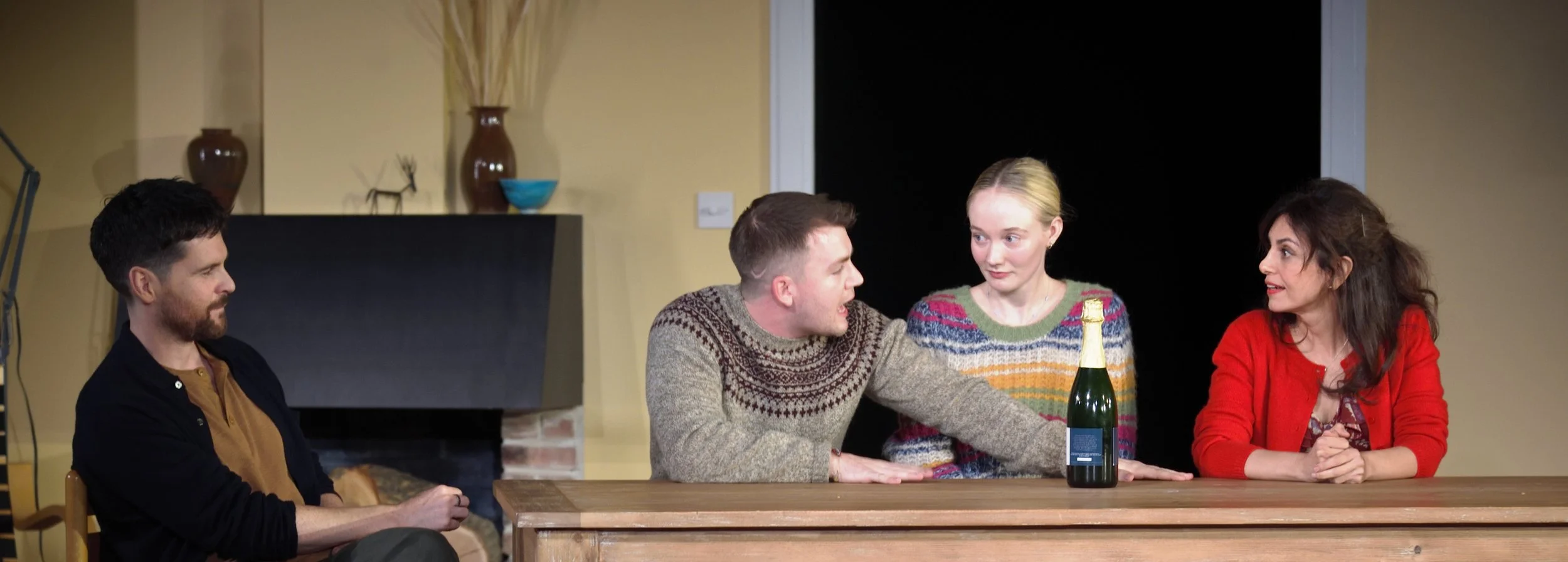
For its inaugural production, InProximity Theatre Company has chosen audaciously. Craig Wright’s 2002 play Orange Flower Water is a no-holds-barred look at two disintegrating marriages. Scenes include the typical recriminations, bitterness, indecision, and uncertainty that such splits spawn—as well as a marital rape (though not one you might expect). It’s emotionally intense, unleavened by humor, yet finally hopeful, and it requires four committed actors. David Calhoun, a pharmacist, and Cathy Youngquist, a choir director, are married, but David is having an affair with Beth, the wife of a video store owner, Brad. Beth is a devout Lutheran: after three years of talking and mooning over each other and declaring their affection, they are about to move to intercourse, at a cabin the Youngquists own. “Cathy … is a mistake that I made,” says David to reassure Beth, “and I am a mistake that she made.” But Beth (Laurie Schaefer) balks at the last minute: “So am I a mistake you’re making? Are you a mistake I’m making?”

Still, Beth has a dream of happiness that includes a daughter named Lily and an incident with orange flower water that Lily spills onto the seat of their car, suffusing the car with its odor. In the end, her dreams win out, and she and David (Brent Vimtrup) move their affair forward.

Brad (Michael Poignand), meanwhile, knows something is up, and he seems to bait David at their sons’ soccer game, asking with relentless machismo about David’s sexual inclinations toward various women around the field. Later, at home, Brad confronts Beth, who is about to leave, and all hell breaks loose. Poignand reaches deep for the raw hurt and resentment, yet he also finds genuine sympathy in Brad, who is very much an insensitive jerk, but also more. When he rushes to the window to see if Beth has driven off yet, hoping that she hasn’t, his shoulders drop defeatedly—it’s a telling physical moment. And his teary recitation of a letter imploring her for another chance is deeply moving.

The other actors do creditable jobs as well, though perhaps Jolie Curtsinger’s Cathy is a bit too chirpy in her first scene, a monologue; however, she’s nicely restrained and confident during an awkward conversation that Cathy has with Beth. Vimtrup and Schaefer make an interesting, exceedingly ordinary couple, fumbling their way toward true intimacy.

One of Wright’s strengths, in fact, is his feeling for ordinary people in small-town America (his latest play, Lady, is about three hunters), and one feels both the suffocation of small-town life—the play is set in Pine City, Minn.—and the yearnings of the characters for something more. “People are always hurting each other and love keeps happening,” David writes in a letter to Lily in the final scene. “It just keeps happening. And the longer you live and the more you notice this, the harder it gets to know what’s right and wrong.”

Director Bryn Boice keeps the tension up throughout most scenes, helped by Amy Altadonna’s mood-sustaining score and sound design. However, a scene when Cathy demands sex from David is staged too coyly. Nudity may not be necessary, but the actors register as self-conscious, fumbling with the sheets for cover when no flesh is ever exposed. (Conversely, it would have been nice if costumer Tescia Seufferlein had provided Schaefer with a costume that covered the numerous distracting tattoos on the actress’s hips.)

Designer James J. Fenton has elaborated smartly on the chairs, bed, and bedside tables that the script calls for. The back wall, painted white, includes rectangles placed as if they were paintings (though they’re empty) and an architectural fantail above the bed. All the paint, however, has been badly weathered, so the wall ingeniously suggests both interior and exterior; it also serves as a visual parallel to the exposed emotions of the characters. Fenton has also scattered pine needles on the floor of the small space, and the audience steps on them to get to their seats.

Orange Flower Water has some unfortunate implausibilities, most notably a scene near the end in which David and Beth scream at each other in a house they’re looking to buy. No real estate agent would leave them alone for the length of time the scene plays, and certainly not when they’re yelling so loudly. But it is a play full of emotional honesty and painful realities, and InProximity’s fine production does it justice. It’s an impressive calling card for the new company.

Click for print friendly PDF version of this blog post

All that Glitters. . .

The truth is a tricky thing. A person can know another person for years, have a deep relationship with them, and still never know what is really going on. What seems to be so often is in fact not. Labeling itself as a "zen exploration of the gap between truth and convenient fiction," Ore, or Or, a new play by Duncan Pflaster (who wrote last summer's delightful Prince Trevor Amongst the Elephants), places in parallel the facts of the story of General Tomoyuki Yamashita and the convoluted love lives of four New Yorkers. Yamashita, a general of the Japanese army during World War II, allegedly buried a fortune in gold in caverns underground somewhere in the Phillipines. In Ore, or Or, Calvin Kanayama, an art historian at the Metropolitain Museum of Art, is attempting to determine whether or not several gold statues found in the Phillipines are in fact some of Yamashita's gold. He's also having dreams about Yamashita, which adds an imaginative element to the play that, unfortunately, does not go very deep. At its heart, Ore, or Or is a story about four self-absorbed and lost people. Calvin meets Debby in a bar on St. Patty's day and they hit it off enough that he goes home with her, and ends up spending the next 10 months dating her. Maybe. What is "dating," anyway? Given that they're relatively hip, young, and live in New York, the characters make a lot of philosophical-ish quips and ruminate on the way society functions. Debby and her roommate Sean live in Spanish Harlem and lament the way it is being gentrified, all while admitting that they are part of the gentrification. The banter and quips could get heavy-handed but manage not to and the actors deliver them with spot-on timing.

The play is set up as a series of vignettes, each occurring on a holiday during each month of the year (starting the day after St. Patrick's day and ending on Valentine's Day). The structure of play prevents it from feeling overextended. There are scene shifts within the scene shifts, giving the two hour plus play a feeling of brevity. A woman dressed as a geisha controls the scene shifts with a disinterested wave of her hands. Rachel Lin, the actress playing the geisha as well as several other roles (a photographer, Calvin's sister, a Halloween party hostess) is a strong performer, shifting from role to role effortlessly. The other actors handle their roles nicely and there is a sense that each actor has settled comfortably into his or her character's skin.

That's important, as it makes the audience feel empathy for the struggles and pains of each one. Without that (and without the Yamashita metaphor), Ore, or Or would feel all to much like any other play written about young people and the troubles of love. With his large imagination and witty dialogue, Pflaster is definitely a playwright to watch. Although the Yamashita element could be deepened and expanded, Ore, or Or offers a nice alternative to the basic romantic comedy.

Click for print friendly PDF version of this blog post

Fly Me to the Moon

Has the state of the world ever seemed so dismal that leaving planet Earth looked like the only practical answer? In Mare Cognitum, a pleasant, but sometimes too gloomy entry in Theatre of the Small-Eyed Bear’s Get S.O.M. repertory merger, three fed-up roommates decide to boldly go where no twenty-somethings have gone before. Faced with the ever-widening precipice of war and full-fledged adulthood, Lena, Jeff and Thomas are immobilized like Beckett’s Vladimir and Estragon, unable to muster up the will to join the protest just outside their window or even to go on a job interview. Jeff has made himself a protest sign that reads “Homo Sapiens Sapiens,” even though the rally is protesting the US government’s imminent bombing of another country, but he has yet to get out of his pajamas. College student Lena distances herself by critiquing the protest, although an unnamed, hipster classmate’s shrewder assessment makes her feel even more academically and politically ineffectual. Thomas the atheist comes to terms with the fact that he has actually been going to confession all these weeks and not to job interviews. Imaginative denial obviously runs high in this apartment, but it takes the depressing news that the bombing has commenced to launch our protagonists into a Quixotic extra-planetary adventure.

Jeff and Lena in particular (played by Kyle Walters and Devon Caraway) show a refined skill in make-believe, staging a “practice” protest in the apartment before unsuccessfully attempting to join the actual one downstairs. In general, playwright David McGee does well to let his characters play with each other and the audience like this; indeed, they seem quite aware when they are reenacting each other’s flashbacks and happily pretend to be secondary characters with enthusiasm. If the tone weren’t perfect, this sort of high style narrative device wouldn’t work, but McGee’s ebullient attitude and lively characters work hard to persuade you that there is nothing weird about it. More importantly, when these three make like Apollo-era astronauts and fly their apartment to the moon, you don’t question it. McGee and director Jesse Edward Rosbrow draw a line between fantasy and reality that is sharp, believable and entertaining.

What does feel out of place, though, are the intensely devastated reactions the characters experience when they return to the same-old, disheartening Earth at the end. McGee obviously intends some reference to the spiritual disillusionment astronauts are said to suffer upon coming back to Terra Firma, but when his high-spirited characters experience heartbreak so totally – like Jeff, who crumples against a wall sobbing – it feels like too much, too quickly. The notion that Lena, Jeff and Thomas are detached enough to pretend to fly to the moon is one thing, but to see them reduced to husks of people when their knowingly make-believe adventure ends is near laughable. In short, things are pretty bad on Earth these days, but they can’t suddenly feel that much worse than before.

Director Rosbrow stages the action convincingly within the confines of a living room, and the world he creates for the characters is particularly accented by a thorough sound design from Jared M. Silver. There is almost always specific environmental noise coming from outside the apartment – the protest, a garbage truck, and later, otherworldly moon noises. Elisha Schaefer’s set design and Wilburn Bonnell’s lighting design satisfy until an underwhelming “Earthrise” on the Moon spoils an otherwise nice moment – though given the level of production and likely budgetary limitations, it almost feels unfair to mention it.

The cast leaps to task as necessary, with Walters giving the most endearing performance as Cowardly Lion-ish Jeff. Caraway’s bossy, inconstant Lena is convincingly vigilant to the point of nuisance, though she softens in some very affecting moments with Jeff. Justin Howard as Thomas is, by design, left out of a lot of the fun, but one of the play’s funniest moments comes when he reluctantly agrees to join the imaginary journey.

Back in the real real world, Mare Cognitum represents another kind of unique escape – the escape from expense. Theatre of the Small-Eyed Bear is actually an amalgamation of Theatre of the Expendable, Small Pond Entertainment, and Cross-Eyed Bear Productions, three theater companies that have banded together to save on theater rental and production costs. A fitting set-up – three companies coming together to play – for McGee’s playful lunar romp.

Click for print friendly PDF version of this blog post

Best Western

In the last major production of Sam Shepard's True West, Philip Seymour Hoffman and John C. Reilly famously alternated performances as Austin and Lee, the play's antagonistic brothers. Nearly a decade later, smartly creative theater company Curious Frog has brought the play back to New York with an equally playful approach: in place of the last production's Broadway house, Curious Frog has staged the production in an East Village apartment. Like the 2000 Broadway production, Curious Frog's quirky treatment of the contemporary classic is much more than an impressive stunt (and it's that, too). Under the solid direction of Isaac Byrne, the production's unique setting and cast -- the family is Asian-American -- bring fresh insight to the familiar work of American drama. Shepard's story of near primal rivalry between estranged brothers is among his least surreal plays, and Curious Frog's staging emphasizes the play's realism. Folding chairs line the walls of the intimate performance space, leaving literally little room for actorly artifice. That staging reveals how skillfully the text accomplishes the unlikely: Austin (Alvin Chan), an Ivy-educated screenwriter who addresses his drunk, drifter brother Lee (Edward Chin-Lyn) with equal parts exasperation and condescension, all but takes his place by the drama's end. A number of Shepard-influenced plays have attempted similar fraternal switches with greater affectation and less success (this season's Three Changes at Playwright's Horizons, last season's American Sligo at Rattlestick), so it's refreshing to see the conceit work.

Anyone seeking to create site specific theater in New York should see Curious Frog's True West, making note of the comprehensive ways in which the production uses design elements in its found space. David Ogle's scenic design doesn't quite transform the East Village sublet into a house in suburban LA, but it need not. He instead capitalizes on the strengths of the space, creating an environment simultaneously homey and claustrophobic, never taking for granted that audiences will be tickled simply at seeing theater in an apartment building. Together with Chelsea Chorpenning's period props, the scenic design lends the space a comfortable familiarity that helps put audiences at ease with their location inside the home, treating audiences less like intruders and more like a part of the design scheme. It also appropriately incorporates Ross Graham's dramatic light design, which smartly locates opportunities for lending the natural setting a powerful theatricality.

If creating a fully-designed production in the sublet apartment poses exciting challenges to the designers, the actors face equally daunting tasks. Over the course of the play, the brothers' interactions turn increasingly violent. Their fight sequences appear tightly choreographed (fight design by Jacob Grigolia-Rosenbaum ), so that while the action is powerfully startling for up-close audience members to witness, it's also safe. And fun. As Lee, the more initially destructive brother, Chin-Lyn exhibits an angry, destitute optimism which frustrates the restrained Austin. In the second half of the play, when Austin's growing sense of futility turns to enraged desperation, Chan comes into his own and the showdown between the brothers takes off. Part of the pleasure of seeing the production is sitting steps away as a typewriter is destroyed by an iron golf club, as the brothers smash potted plants and one another.

The title of True West alludes to the play's insistence on the artifice of both the vanishing American frontier and the false promises of Hollywood. By making the brothers Asian-American, Curious Frog cleverly adds an additional layer. The play's exploration of authenticity and the illusive American dream applies seamlessly to characters of color, making a strong case for nontraditional, race-conscious casting (which is different from colorblind casting, and frustratingly uncommon.) Beyond that, it's neat to see how a True West with Asian-Americans maintains the integrity of the text while adding a new dynamism to particular lines (Lee's image of his brother's success that includes his being chased by blonds; Austin's story about their pathetic father's doggy bag of Chop Suey).

The best revelation of the casting, however, has nothing to do with the brothers. It comes at the end of the play, when their mother returns to find her grown sons wrecking her home. The mother's appearance in the final scene of True West is among the script's more problematic aspects; her uncomprehending reaction to her trashed house, her sons' violence, and even the outside world is inexplicably peculiar. But as played by Mami Kimura, originally from Japan, Mom is not not simply a daffy woman in deep denial. She's also an immigrant. It makes infinitely more sense, in this production, that her sons treat her protectively even as they believe themselves capable of exploiting and misleading her. Kimura's accented English bolsters the mother's general appearance of incomprehension. To her sons, she's literally a foreigner.

"Look at you," Lee asks his brother early in the play "You think yer regular lookin'?" Whatever the answer to that question, Curious Frog's True West is decidedly not; its found space and nontraditional cast give it a facade all its own. At the same time, it's a scrupulously faithful production of a terrific script: a True West defined by conservatism and adventurousness.

Click for print friendly PDF version of this blog post