

Imperfect but Intriguing

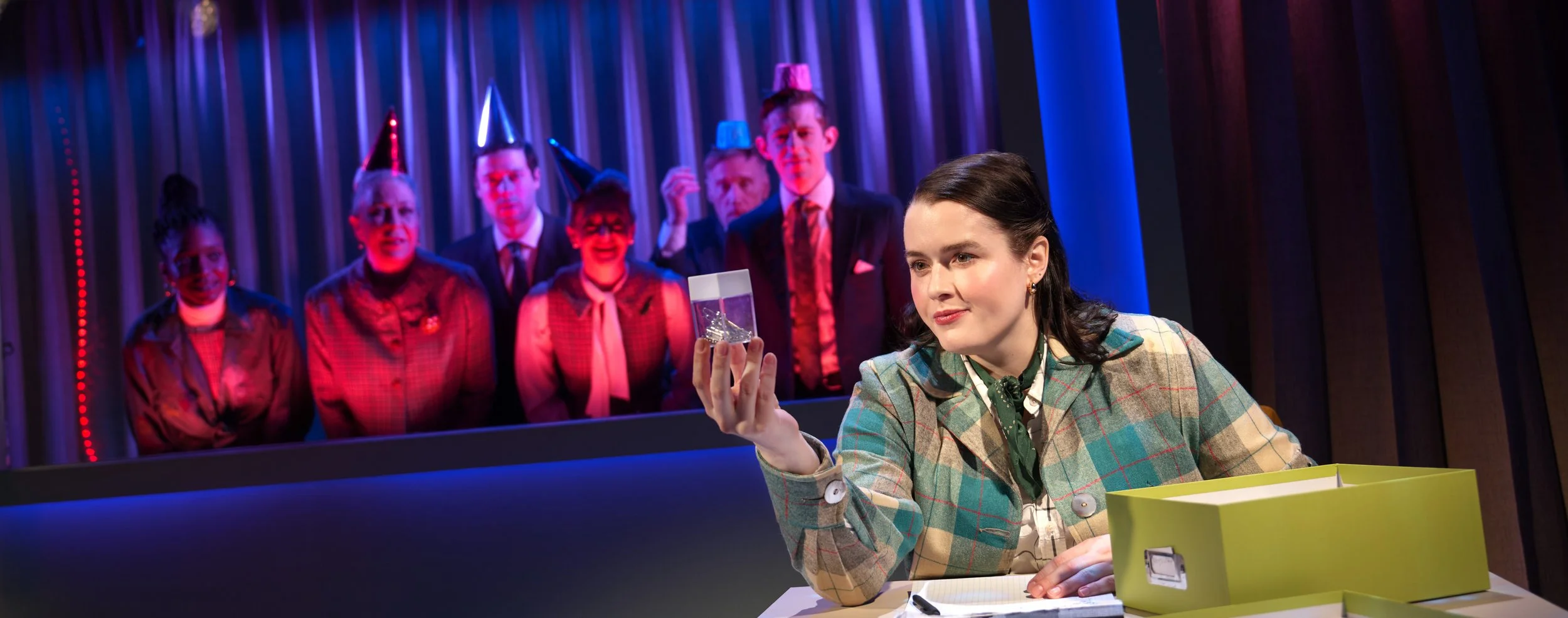
Dr Frankenstein is having a good year. In New York City alone, the past few months have seen the opening of the Mel Brooks spinoff musical Young Frankenstein, a more faithful musical adaptation of Mary Shelley's timeless novel, and even a puppet-theatre version. Now, Tada! has joined the bandwagon by presenting "A Perfect Monster," a new, short, and G-rated musical adaptation, by Tada! founder and Artistic Director Janine Nina Trevens (book) and Deirdre Broderick (music and lyrics), directed by Trevens. A crowd of whimsically costumed and acted monsters, fast-moving plot, and the empathetic performance of talented seventeen-year-old actress Saleema Josey as Sibyl, a mad scientist who is still in primary school, will have the youngest audience members captivated. Meanwhile, Trevens's allusions to many of the fable's most iconic incarnations, from Hollywood to Hammer, will keep adult chaperones reasonably well entertained.

The set is dominated by Sibyl's lab, which includes the requisite paraphernalia, including bottles of strange incandescent liquids on shelves and a Macbeth-style bubbling cauldron that promises to birth many a strange organism. It is all bathed in green and purple light, cheering up the foreboding scene.

Like Frankenstein's creature, "A Perfect Monster" is imperfectly made, yet undeniably impressive. The tale begins with music redolent of monster movies, and quickly introduces Sibyl, an antisocial young girl who has no trouble "making friends" -- out of random objects, such as "moldy french fries / and rhinoceros eyes" combined in the cauldron.

Dressed like a pint-sized Peter Cushing in a pastel frock coat, waistcoat, antique trousers and gaiters, Sibyl lives up to her name. The Roman mythological Sibyl of Cumaea was a mythological female clairvoyant who reportedly lived as a recluse in a cave. (Incidentally, Frankenstein author Mary Shelley resurrected the Sibyl in a later novel, disaster-movie precedent The Last Man).

At school, Sibyl is ignored and mocked by her classmates: the vain, pretty, and vapid Mary (Maya Park, alternating with Sophie Golomb), snotty, preppy jock Preston (Brendan Eapen), and class clown Charlie (Christopher Broughton), who tells stupid jokes that the kids, and apparently the audience, are expected to consider hilarious. When she gives a brilliant report on her "science" hobby -- the monster-making experiments -- they don't bother to listen.

Therefore, it's no wonder that Sibyl prefers to spend time with her menagerie of monsters. Unfortunately, each is a manifestation of Sibyl's own fears, frustrations, and seething self-hatred, from the indecisive three-headed Trio (Gabriela Gross, Sophie Silverstein, and Katie Welles) to the dancer with four left feet (Adam Mandala) and a creature dressed ridiculously in a McDonalds french fries container, who has a fork and spoon for hands. As the monsters explain, when Sibyl has a bad day at school, she comes home and makes a monster, then pours all of her rage onto that unfortunate creature.

Finally, Sibyl makes a "perfect monster" and best friend: a winsome female named Perfection (Jasmine Pervez, alternating with Ariana Sepulveda), who gets even with her classmates by beating them at their own games: respectively in sports, beauty, and joke-telling. Sibyl thinks that Perfection "belongs" to her, but must learn that "to make a friend" in the non-architectonic sense, one must be a good friend to others.

Having set up the fascinating problem of the child-heroine's insecurity and its diabolical manifestations, Trevens solves it rather too facilely and in a manner that seems unintentionally reactionary. When Sibyl finally learns her lesson, and resolves to treat her handmade "friends" as people and not objects, she abandons mad science for cake-baking. Soon, Charlie confesses his attraction to Sibyl, offering her a hand-picked bouquet of flowers, and defying Mary and Preston to befriend her and all her monsters. Problem solved.

I am not saying that this adaptation should have gone the way of the original, with alienation resulting in irrevocable catastrophe, but children can have great nonsense-detectors. An alienated, insecure girl will not be healed overnight by a boy's interest. Or, rather, if that's all that takes to bring the child out of her cave, that might be a problem in itself.

The monsters, with costumes constructed by Cheryl McCarron and the late Shelley Norton from concepts by Trevens, are delightful, and are unlikely to frighten even the most easily rattled youngsters. They are all benevolent. The one evidently based on Godzilla sports jazz shoes laced up with bright ribbons along with her scales and tail. Unlike in the source novel, there is no violence whatsoever, and no monsters are either destroyed or driven from home.

The music is lively enough while it's being performed by the Tada! company, but is immediately forgettable. The Tada! company, whose actors range in age from primary school to age 18, comprises a tightly directed and choreographed ensemble led by some very promising leads, particularly Josey and Perez. Most importantly, the cast appears to be having fun onstage.

Tada! makes certain that kids will never get bored by starting the play with a magic show, which fills the time during which the audience is led to their seats. The program is filled with games and activities for fidgeting young spectators. This is a great idea, but some of it is simply wrong. In a match-the-name-to-the-photo game concerning movie monsters, "Frankenstein" is the match for a photo of Boris Karloff in director James Whale's Hollywood classic Frankenstein: but Karloff played the creature, not his creator, Dr Frankenstein. Likewise, the answer to the question "Which author is responsible for the gothic legend of Dracula?" is arguably not the provided answer, "Bram Stoker," as Stoker adapted his story from a "legend" developed decades earlier, by Gothic writer John-William Polidori in his short story "The Vampyre."

Still, I must admit that I was also somewhat alarmed by the play's description of Sibyl's magical process as "science," and also by her happy abandonment of "science" for cake-baking. Possibly, parents who take their primary-school-age daughters to this show should afterwards have a brief chat about what science is, what it isn't, and how there are plenty of scientists--even girl scientists--who have made great friends, and not in seclusion, nor out of spare parts.

Click for print friendly PDF version of this blog post

Face Value

Wanda looks smaller than her classmates. She walks hunched over and stares at the ground. At lunch she excludes herself before she can be excluded. Her tricks for making friends don’t work. At thirteen years old, young Wanda Butternut (Sandie Rosa) has a unique problem that she won’t outgrow with age—a large purplish birthmark covering the entire right side of her face. Eric H. Weinberger’s touching and energetic tween musical, Wanda’s World is far deeper than its colorful sets and smiling pigtailed characters would have you believe. Beth Falcone composed a clever score with contagious tunes that appeal to adults and tweens alike. Songs such as the malicious lunch room taunt, “She’s So Last Week,” speaks to common tween anxieties while “No One Can Know” pokes fun at their inability to keep a secret for more than ten seconds.

Sandie Rosa is wonderful in the way she evokes Wanda; she commits to this character in mind, body and spirit. Her smile is wide and endearing, her eyes bright and hopeful, but her words tinged with caution, as if one uncool phrase could turn the world against her.

Wanda tries to carry herself with confidence but when the other girls call her Blotchy she instantly deflates. She seeks refuge at home, staring into her bedroom mirror with a long wig that covers most of her face, pretending she has her own talk show where she helps girls like her. She tells her make believe audience to blend in, cater to others, and never arrive anywhere late (people stare at you) lest you make yourself a target in this cruel and unforgiving world.

Campaigning to be the leader of this world is Ty Belvedere (James Royce Edwards). Clean cut, well dressed and reeking of wealth and privilege Ty is the favorite to win the school’s upcoming Student Council President Election. He lists his attributes in a song aptly titled, “What’s Not To Like?”

The school bully, P.J. (Leo Ash Evens) and his lackeys can find several things. Thus far P.J.’s passive aggressive attempts at Ty-hatred have included bopping him over the head with a dangling microphone while he gives his campaign speeches. But this is no longer enough. PJ is planning a cruel prank that will use Wanda as a pawn in ruining Ty’s reputation.

Unfortunately, Wanda is the perfect mark. She will do anything for a chance at acceptance, including interviewing Ty for the school station. Surprisingly, Ty shows some class by not reacting to her birthmark. Encouraged, Wanda lets her guard down and glimpses of her true personality slowly emerge; she is a bright, thoughtful and selfless girl. Such qualities are so rare in Ty’s circle of friends that he becomes intrigued.

This moment is heartbreaking because of what we know is coming. We are hoping that Wanda will build up enough self esteem to endure the impending trick P.J. is going to play on her, but when the moment comes she is at her most vulnerable. At the lowest point in her life Wanda comes to the saddest realization of all: that there is no place in the universe for a face like hers.

Fortunately, there is a voice deep inside that warns Wanda of self-fulfilling prophecies. Her climatic song, “A Face Like Mine,” is one of the saddest tunes a young girl could sing. The song takes you through Wanda’s heart; we feel her struggle to find something positive about herself to cling to when times get bad.

Wanda’s World is smart to not soften this material. This play could have felt like an after-school special, but instead we get a musical character study of an unlikely protagonist; one that you cannot root for enough. Film critic Roger Ebert once observed that audience members are more likely to cry for a character’s goodness than sadness. Young Wanda Butternut’s journey to move from the shadows of life into the spotlight certainly supports this theory.

Click for print friendly PDF version of this blog post

Blind Symbols

Oedipus at Colonus is a play in which the viewer gets the sense that behind every action, object, even emotion, lies a whole world of hidden significance. Even death, the grand subject matter of one of Sophocles’ final dramatic explorations before his own trek to the netherworld, is secret in this play. Handcart Ensemble’s current production of this rarely produced masterpiece represents this symbolic hidden-ness too well, allowing the words of Eamon Grennan and Rachel Kitzinger’s new translation to breathe, while the dramatic juice of Sophocles’ story remains hidden under sleepy layers of symbol. What remains is an aesthetically pleasing meditation on death, family and forgiveness which never translates into emotion. While the depth of feeling available in the writing is largely lost in this production, it is a worthy one in that it provides a sense of what one of the creators of our theatrical sensibilities had to say about three of the themes that continue to permeate our stages.

Oedipus at Colonus tells the story of Oedipus’ final hours. The blind old man has spent his life wandering homeless, and has finally come to a field in front of Athens, led by his faithful daughter/sister Antigone. He has come to terms with his own horrific mistakes (“If someone tried to kill you would you stop to inquire if he was your father, or would you strike back to revenge the blow?”), but still holds pains and grudges against his son and brother-in-law, both of whom make appearances in the play.

While many things take place over the course of the evening - characters come and go, arguments, persuasion and acceptance, a curse or two and some blessings – the drama is set up as the end of a journey, both physical and spiritual, of one of the world’s most pitied men. The action itself as if does not matter. Kreon kidnaps Oedipus’ daughters, and a moment later they return. Antigone (a strong performance by Emily Rogge) convinces her father to give audience to his son Polyneices, during which the blind man stands firm in his stubborn position. Oedipus comes into the play knowing its end, and his own, and the plenty of coming and going is simply a philosophical playground for a great writer to splash around in.

The production emphasizes the symbolic nature of the play, making the costumes, set and even the acting style stand out, thus continually pulling the audience in and out of the story. Director Karen Lordi-Kirkham stresses the ritualistic element of Greek theatre, and of this play in particular, through an imaginative treatment of Sophocles’ Chorus. A prayer bowl, myrtle branches, hand gestures toward the heavens, all remind us time and again that the theater was a religious place for the Greeks.

However, Lordi-Kirkham’s attempt while admirable, is muddied by her need to couple the ancient sensibility with an occasional catering to the aesthetics of a modern audience. As such, in the production certain scenes from the ancient tragedy bring to mind our own generation’s imagery for the future. The big showdown between Kreon and Theseus, for example, could have easily been a Star Treckian intergalactic dispute. The Chorus is transformed from one of elderly citizens of Colonus in the script, into a young female triplet that seem to conjure Buffy the Vampire along with the Furies, the ancient goddesses of the field, in Handcart’s production. The flaming red costume of Kreon, another symbolic choice that leaves its meaning backstage, could have possibly been further enhanced by a pair of Spock ears.

A solid performance by Peter Judd as Oedipus does keep the production grounded. It is a somehow soothing experience to watch nearly two hours of a lead actor in blindfold who seldom moves from his seat. One can almost see a hint of Beckettian minimalism in Sophocles here. One of the evening’s strongest moments comes from a silent, still Judd, angrily listening to his son’s attempts to elicit his support in war.

The sum total of the evening is a pleasantly boring experience of a truly great play in a steady new translation. The opportunity to catch it may not return anytime in the next few decades.

Click for print friendly PDF version of this blog post

Dirty Old Mastermind

The pursuit of sex, and the humor in the pursuit of sex, seem never to go out of style. The scandalous pleasure that Niccolo Machiavelli’s most famous non-political play, The Mandrake , generated among Italian audiences back in 1518 (it is said even Pope Leo X was “intrigued”) can still be found in sections of this Pearl Theater Company production. The bawdiness of the play, translated here by Peter Constantine, operates as both a strength and a weakness in this particular version of the classical sex farce. At its best moments, the show is a well-directed ensemble comedy with brisk pacing and well-researched movement. But, at its worst, the (blue) humor seems stretched and thin, and the actors come off as infantile caricatures.

Machiavelli’s tribute to ancient Greek and Roman comedy, The Mandrake , tells of a young Florentine named Callimaco (Erik Steele) who will go to any means to justify his lusty ends, and to sleep with the beautiful and married Lucrezia. To do so, he hatches a devious plot with the help of an unemployed matchmaker, Ligurio(Bradford Cover), to convince Lucrezia's plodding husband (Dominic Cuskern) that in order for the couple to conceive a child, Lucrezia must drink a mandrake root potion and sleep with a total stranger (who will die shortly thereafter.)

Dominic Cuskern, who plays the soon-to-be cuckolded husband to the wily team of Callimaco & Ligurio (who do their best work off of each other), is the standout actor of the show. Both likeable and a complete comic putz as Messer Nicia, Cuskern's work is real and measured, never over the top, even in the most schticky scenes that have him feigning deafness while Ligurio bribes a money hungry Friar (TJ Edwards) to further persuade Lucrezia to surrender her virtue in accordance with the new plan.

Scenes involving multiple characters proved most funny and effective, as the actors' timing generally worked when in a group. And there was a welcome sense, from many of the actors (including Steele, Cover and TJ Edwards) that small pieces of stage business had been thoroughly explored for effect.

In period costumes by Barbara Bell, the actors made good use of Harry Feiner's set of the town of Florence. In particular, the long-anticipated evening of lovemaking between Lucrezia and Callimaco was inventively staged.

While not without flaws, this Renaissance comedy revived by The Pearl Theater Company merits a viewing for the timelessness of its humor, and some memorable moments created by its actors.

Click for print friendly PDF version of this blog post

Playing Roles While Others Eat Them

Two characters sitting across a café table: anyone who has ever attended a short play festival or worked on partner scenes in an acting class is probably familiar with the format. Etiquette, by Anton Hampton and Silvia Mercuriali of the international Rotozaza company, is undeniably a café play. A ticket to the production requires not watching the performance, however, but enacting it. Of the many diverse offerings in The Public’s Under the Radar Festival, Etiquette perhaps most literally embodies the Festival’s name. Staged at a single table in the East Village’s bustling Veselka Café, Etiquette takes place under the radar of most of Veselka’s patrons. And though the table reserved for the production is next to a window, there is little to alert passersby to the fact that those sitting at it are engaged in anything other than typical café conversation.

A closer inspection would breed suspicion: both patrons wear headphones (separate instructions inform each participant as to what to say and do) and instead of food, the table is lined with a number of unusual miniature objects. If most café plays are staged with bare bones sets and adhere to realism, Etiquette reverses the convention. Set in a live café, the instructions that participants receive at times force them to forgo realism entirely.

Abandoning realism while in a “real” environment enhances the playfulness of the experiment. It also raises serious questions about what constitutes performance, both onstage and in daily life. How formalized need a performance be in order for it to be considered theatre?

That the characters which the production asks participants to play are specific and gendered, with exact lines and precise gestures, provides the project many of its formal elements. But if those around the performance are unaware that it is taking place, then the participants perform their roles solely for one another. Within the play, however, the characters themselves appear to perform for each other as well. In that respect alone, the project engages multiple levels of performativity – and requires participants to engage in them as well.

If everyone around the performance is indeed unaware of it – and that’s a significant if – it certainly does not mean that the participants are unaware of the public sphere of their performance. Staging the play in a setting not traditionally theatrical yet explicitly public is a key aspect of elevating the experiment to a level of theatricality, as opposed to a game of childlike make believe or simple role playing. To what extent does the presence of others affect an intimate moment?

A café is ideally suited to such an experiment in that it provides a unique balance of public and private space. The presence of uninitiated strangers is intimidating and can make participants feel self-conscious. At the same time, the strangers’ close proximity yet lack of attention has the potential to be deeply liberating, even thrilling, for the participants.

Etiquette is influenced by Godard’s 1962 film Vivre sa vie, and Ibsen’s 1879 play A Doll’s House, both groundbreaking works that examine women’s struggles for agency, and familiarity with them will enhance participants’ experience of Etiquette. Yet even participants without knowledge of the source material will find aspects of the play that resonate with them. Anyone who has ever sat across from a stranger in a café – or who has sat in a café and people-watched – will recognize the situation enough to feel comfortable in it.

The only absolutely essential quality for participants to bring to the piece is a willingness to spend half an hour engaged in a quirky performance experiment. For those who are game, the project will be a delightfully unique, entertaining exercise in communication. After half an hour of asking participants to blindly follow instructions and providing them with words to say, Etiquette will leave them with a lot to talk about.

Click for print friendly PDF version of this blog post

Everyday horrors

The British company 1927 has titled its show with an overly familiar phrase that unfortunately gives no clue to the invention, precision, and joyous theatricality of its work. The four principals combine mime, music, film, and narration into an intoxicating mix of 10 twisted stories and some nifty fillers that evoke the gruesome fairy tales of Shockheaded Peter. Evil lurks everywhere in the world that 1927 conjures up, even among the most seemingly innocent and mundane events. There’s no false sentiment here about childhood. If you see a little girl in a pinafore, you’d better run for your life. There are three performers in 1927, all in whiteface and looking like mimes and behaving like silent film creations from Chaplin or Lloyd or the Hal Roach studios. Pianist Lillian Henley, in black and a beret, plays an upright throughout the evening, setting the tone with bright melody or ominous minor chords. Suzanne Andrade, with a black Louise Brooks bob, is writer and director as well as performer. The stories need a dry wit to work, and both she and her co-star, red-haired Esme Appleton, show a devilish sense of humor, as well as a breadth of talent. (During one story Appleton plays a glockenspiel, and the costumes she has designed, almost all in neutrals, suggest an interwar period of boarding houses, aproned mothers, lace-trimmed clothing, and strict social mores).

The two women deliver cautionary tales of actions that have fire-and-brimstone consequences. One is about gingerbread men revolting and attacking a baker with icing guns (“The streets run red with raspberry jam”), and another, which might have been penned by Edward Gorey, focuses on two neighbors in a lethal rivalry over topiary gardening.

Paul Barritt, the fourth and equally crucial collaborator, has created the company’s projections. The fillers are two-dimensional cartoons, variations on a theme: two women see a body lying in a room and try to help it, but as soon as they grab hold of the arms, it turns into the devil, and they are dragged away to hell; at another time they are on a boat, and a drowning man they attempt to save turns into Old Scratch and they end up in the briny. (The latter, presumably, is the source of the title.)

But more often the projections, which have been given the blips and marks of vintage silents, work in tandem with Andrade and Appleton, who have adapted themselves with clockwork timing to the cartoons and tableaux projected behind them. In “The Nine Lives of Choo Choo le Chat,” for instance, the various demises of the cat are catalogued, and score is kept on a projected chalkboard. The loss of one feline life comes amid an Old West attack by Indians. As the doomed cat stands amid arrows arching back and forth, one two-dimensional arrow suddenly pierces her three-dimensional skull in Steve Martin style. At another moment Choo Choo holds a carmine umbrella that attracts projected lightning, and zap! Catastrophe.

Barritt’s brilliant work occasionally includes assemblages of old photographs. In an episode called “The Lodger,” one sees the character’s room through a keyhole; a roach scuttles around; and some kind of liquid seems to run down the front of the picture. Combined with the eerie, underplayed narration of two little girls spying on the lodger, the result is unsettling laughter. “The lodger arrived without warning at an unsociable hour,” one girl intones. “He was a French man who didn’t appear to speak any English, or any French.”

Another episode, “The Grandmother,” includes audience participation, and the audience member who is hijacked disappears into the projection dressed as grandma and endures onscreen ordeals at the hands of the twin girls. It's a tribute to the high order of the live performance, music, and projection that one worries about the fate of the shanghaied participant inside the film. The macabre delights in this show won't surprise anyone who knows the offbeat companies that P.S. 122 presents. Here's another winner.

Click for print friendly PDF version of this blog post

The Tragedy of the Issue Play

When Euripides composed The Trojan Women his play represented a timely criticism of Greek imperialism, as well as a commentary on cycles of fate. In 417 BC Athens had recently emerged from a ten years' war with Sparta, and was preparing to attack Sicily, a move that would prove disastrous. In his contemporary adaptation, Alfred Preisser uses the structure and some of the themes of Euripides’s drama to address modern issues, incorporating the horrific stories of female victims of the civil wars in Sierra Leone and Liberia. The two plays share as their focus the suffering of women at the hands of men, but the neat parallels end there. Preisser’s “radical re-imagining" of Trojan Women introduces many raw emotions, but the varied critiques are unfocused and the ideas are not well connected. The result is a production that has moving material, but ultimately fails to move.

The play attempts to consider the complicity of the powerful in the suffering of the meek at “the bottom of the world." This is but one of many weighty topics addressed, but not fully explored. In addition, the groups producing the piece, the Harlem Classical Theatre and Harlem Stage, claim missions to tackle race issues in art. In creating a piece that tries to reflect these issues and ideologies, the show sacrifices character development and narrative structure.

Even with the show's problems, several elements of the production are still chilling and effective. Troy Hourier’s well-designed post-apocalyptic landscape of industrial wreckage invokes the grand, but fleeting achievements of civilization (Penn Station). In the opening scene, a girl clings to a chain-link fence like an animal. Her bitter speech ignites a chorus of women who chant the terrible fates of their people: rape, death, and destruction. To tell the stories of the African women, Preisser cleverly retools the traditional Greek chorus, giving it many different voices, which makes the suffering experienced seem both exceptional and tragically common.

The dramatic effect of the chorus is enhanced by Tracy Jack's smart choreography. Though the women speak with individual voices, they move as a unit. At first their combined force is brute and animal-like; they gang up on Helen, screaming at her and calling her names. Their hatred echoes that of the men who terrorize them; a parallel they realize too late.

Toward the end of the play, when Hecuba recognizes the blindness of her former perspective, the group of women executes a gentle series of synchronized movements. No longer screaming, they sing and perform hand gestures that seem to mimic the rising and setting of the sun, as well as the rhythmic beat of rowing. One is a metaphor, the other a Cassandra-like envisioning of what is to come.

Unfortunately, the aggressive rants of the women characterize the play’s approach and tone. Certainly, they have cause for such bitterness, but the material would be more affecting if the tone and the performances were more dynamic. This isn’t to say that all of the performances are ineffective. Zainab Jah is calm and confident as the commanding Helen. Although Helen seems to be a selfish manipulator, the subtlety of Jah's performance leaves room for interpretation. Also interesting is the character of Talthybius, played with sly wisdom by Michael Early. The modern interpretation turns the Greek messenger into a wormy bureaucrat, and his “ugly circles" of speech provide the show's comic moments (a welcome turn after the many horrible displays and the moralizing).

There is a lot that Preisser is trying to do with Trojan Women , and the production suffers from its grand, but undefined ambitions. Whereas Euripides moved his play around the central character of Hecuba, this adaptation lacks that kind of central focus, and introduces several different ideas, most of them somewhat obvious criticisms.

Euripides' play is an interesting vehicle for a critique of modern society, but the themes and structure of the adaptation could benefit from some tightening and a stronger, narrower focus on the African women's accounts, or a more specific connection to the civil wars in Africa. When the audience looks through the fence at Troy it might be looking into a distant mirror, brought up close and personal, but the production’s message is too hazy to inspire critical self-assessment, or change.

Click for print friendly PDF version of this blog post

Direst Cruelty?

Since its 2001 premiere, writer-producer-designer-director Frank Cwiklik's Bitch Macbeth has garnered enough interest to be revived twice, with the current revival at Brooklyn's Brick Theater. Cwiklik has made some bold choices. Unfortunately, didactic and wearyingly repetitive dialogue and a one-dimensionally acted, illogically constructed principal role make this second revival conspire against its auteur's best intentions. In Bitch Macbeth Thane Macbeth (Adam Swiderski) is a comparatively sensitive soul ill at ease with the brutality of his dystopian culture. In this culture, naked young women from fallen clans are auctioned as sex slaves, and collective belief in inexorable Fate, personified by a coven of dominatrix “domgidas,” who read the future in men's wounds after whipping them, enables the masters to pity themselves as slaves. Meanwhile, Macbeth's "bitch" or "femme" tries to bury the humiliation and pain of her slave past by pushing Macbeth to kill his way to the top of the oligarchy.

Or, perhaps, to the highest level of the video game. In this world, politics is a competitive sport. Characters fight their way up in accordance with strict rules, and communicate in a limited glossary of commonly understood terms denoting status and competition, such as “challenge,” and “take all.” The "game" even has a referee, as over the slave auctions and other rituals presides "RBiter" (Fred Backus). This RBiter is the Arbiter of all destinies, which R indeed, Bitter.

The cast contains a few standouts, including Swiderski's nuanced, tormented Macbeth and Mercedes Emelina's understated, quixotic Top Domgida. As Femme Macbeth, the driving force of the action, actress Samantha Mason is not a force to be reckoned with. Mason delivers her lines in a soft, squeaky, almost monotone whine. Mason sometimes achieves cloying affectation but never genuine emotion, never showing why Macbeth is so cowed by her. A large part of the problem is in the writing of the role. "I am undone by my sex,” Femme Macbeth explains. “I was sold early. Lucky to land soft, I learned. He taught me. There are men of two types: malleable and intractable. There are two types of women: sold and kept. I swore I would be kept. I am undone by my sex."

Undone also by this repetitive preaching, Femme Macbeth is also the perfect, and perfectly implausible, chauvinist fantasy woman. She uses her sex appeal to wrest power from the most “malleable” of the men who run her society, then blames her pain illogically on her femaleness (“my sex”) -- rather than on the other “sex,” which has “sold”, bought, and hurt her.

Overall, the script of Bitch Macbeth suffers from pretentious verbal haemorrhaging. "I sweat out poisons and rehabilitate my senses," one Small Asbury (David Mills Boynton), the rebellious heir apparent of the "prime clan," tells his lover. "I can't comprehend my own struggle... I am perpetually adolescent... I wonder what you see in me and what that really means. It's like hell on earth."

One of the most famous images of Lady Macbeth is John Singer Sargent's painting of Ellen Terry in the role. Statuesque, decked out like a serpent in a skintight gown of gleaming green metallic scales, Terry's Lady Macbeth exuded power. At the same time, rapturously holding aloft her husband's crown, she worshipped his state-given authority. On the Victorian stage, Terry threw the schizoid nature of this character -- the perfectly cruel lamia and cruelly perfect submissive wife -- into her society's collective face. Had Mason the acting chops that legend ascribes to Terry, and were Cwiklik's script ruthlessly edited so that subtexts are revealed rather than stated and neo-Victorian misogynist phobia does not pass for metaphysics, Bitch Macbeth might be, as Shakespeare's Lady Macbeth begs, filled "top-full with direst cruelty." As is, it's merely dire.

Click for print friendly PDF version of this blog post

Cat Power

"Cabaret." "Burlesque." These are words that can be used to describe the work of performance artist Joseph Keckler. But so can the words "poet" and "storyteller." Mr. Keckler is gifted with that rare ability to pick and choose among multiple talents and media to weave compelling stories that transcend these limiting qualifiers. In the two pieces he performs as part of Joseph Keckler & Friends at Dixon Place, he’s a singer, writer, narrator and all-around performance artist who does what is needed, when it’s needed, and with great aplomb, to deliver pieces filled with humor and pathos. With slight twists of inflection or accent, through narration and song, off-stage and on, and with a liberal and poetic facility with language, he brings a gentle humanity to "Cat Lady," a smart, taut narrative piece.

The subject of "Cat Lady" is Mr. Keckler’s eccentric mother—a former artist who, since her house burned down in 1983, taking all her work with it—has abandoned professional art and now conducts a daily drama of sorts, using her cats as sounding boards. She is their protector, best friend and even psychoanalyst: "Mrs. Gummidge has yet to reconcile herself to other cats. Thus she remains in self imposed exile here in the pantry." Cat Lady’s sister-in-law, Carol, is equally eccentric. Irreparably obsessive about her husband’s philandering, she adopts a Southern accent when discussing her upcoming divorce "trah-uhl," entreating Cat Lady to come to it and "testifah!"

"Cat Lady" is essentially a short story brought to vivid animation by Mr. Keckler who, walking slowly around a living room--at times sitting in an easy chair or pouring himself a cup of coffee--sings his mother’s nutty songs, mimics her baby talk and illustrates her fanatical feline affection: “She spoke as if she simultaneously wanted to be Cubby, to make out with him, and eat him."

Embedded in Mr. Keckler’s work is the theme of alienation, of having been beaten down in the world but struggling to bounce back in some inscrutable way—to regain one’s life or free oneself from a kind of prison. He does this poignantly, describing his mother’s trapped soul in “Cat Lady," and comically, in his opening piece, “Has Been In Michigan," where, inventively utilizing a four-way split projection screen and his own piano skills, he plays characters such as a former boxer turned big rig driver from Detroit and a schmaltzy vaudeville performer—all once semi-prominent, but now coming to terms with the fact that they are, well, has-beens in Michigan. Post-video, Keckler appears and brings it all to life by portraying another such character, slurring through the words of Janis Joplin’s rendition of "Me and Bobbie McGee," repeatedly mispronouncing McGee.

Joseph Keckler is an artist in the truest sense of the word. Working in a boggling array of genres, including opera, Keckler has experimented and found what works. Each Thursday through the remainder of January, he’ll be performing paired with another artist who will perform between his pieces.

The night I attended, Mr. Keckler was teamed up with La John Joseph, a performance artist from Liverpool whose motifs of alienation and marginalization as a man/woman complement Keckler’s themes. Joseph’s piece feels more like a work in progress, in contrast to the crisp tightness of Keckler’s work. Joseph occasionally pauses mid-performance to get an object from backstage and curiously place it on a table, builds questionable interruptions into his piece, or stops to lip synch thematically related songs by Kraftwerk, James and Depeche Mode. Powerful and moving at times, Joseph appears to be finding his way toward an accomplished stand-alone piece.

This polishing process is what experimental theater is all about. Dixon Place, a theater laboratory at 258 Bowery, will be moving to larger digs on Chrystie Street soon. Catch an installment of Joseph Keckler & Friends now at its current location, in a small but comfortable salon-like setting that is perfect for these ambitious and intimate works.

Click for print friendly PDF version of this blog post

Lights! Camera! Achtung!

Leni Riefenstahl was one of the most talented and enigmatic filmmakers of the 20th century. She was handpicked by Adolf Hitler and his propaganda minister, Joseph Goebbels, to film the National Socialist rally at Nuremberg in 1934, and the result, Triumph of the Will, was regarded as a documentary masterpiece as well as a center of controversy her whole life long—and long it was. She died at 101 in 2003. Critics accused her of being a Nazi or at least a criminally naïve filmmaker. Riefenstahl was still eloquently defending her work at 99 in the documentary The Immoderation of Me, insisting that the lack of any narration in the film made it merely a documentary record and not propaganda.

One of Riefenstahl’s unrealized projects was a screenplay based on Heinrich Kleist’s 1808 drama Penthesilea that she was to direct and star in. The heroine is an Amazon queen who leads her one-breasted tribe of women to the Trojan War, where she falls in love with Achilles. Riefenstahl wrote 34 scenes for the film, but it was abandoned when war broke on out Sept. 1, 1939. The screenplay was lost, although her notes survive.

Jordan Harrison’s Amazons and Their Men takes the Kleist project as a jumping-off point to mull the demands of talent on the artist in private and public arenas. His script specifies that some facts are drawn from Riefenstahl’s life, but that the character is not the director. However, if the Frau—a woman famous for her filmmaking abilities and her ties to the Party—is not Riefenstahl, the facts of her career that creep through insist that she is. The film of Penthesilea was a Riefenstahl project, not anyone else’s, and the Frau’s ties to the Party are an unmistakable parallel to Riefenstahl’s.

Ken Rus Schmoll’s production uses a virtually bare stage with only a movable dais and a club chair for scenery. He employs lighting by Garin Marschall and sound by Leah Gelpe effectively, as film scenes are replayed with their titles projected, and the appearance of the Propaganda Minister in silhouette far upstage is superbly sinister. But the sequence of filmic scenes that are interspersed with those about the characters’ relations offstage fluctuate wildly in tone, disorienting the viewer and inhibiting one's response to the material. Schmoll hasn't attempted to address the awkwardness in the script.

The chief irritant is Rebecca Wisocky as the melodramatically wide-eyed Frau. As she stalks the set, she looks like Norma Desmond in a tunic. Riefenstahl, in the 1920s “mountain” films of Arnold Fanck, was not so mannered, and the representation of the Frau as a megalomaniac star and a despotic Teutonic director (she’s always yelling “Cut!”), like von Erich von Stroheim, Otto Preminger and Fritz Lang, feels like parody run amok. But how does one then respond to her unrequited love for her Achilles offstage and her attempt to withstand the Party's pressure. "They will try to make it a film about war, not a film about love," she tells a bewildered extra, who responds with one of the funniest comments in the play: "You are making a film about love?”

The other performers are more human. The Actor (the strapping and wholesome Brian Sgambati is Achilles) is both Jewish and gay, and he is in love with a Gypsy messenger boy (Gio Perez) that the Frau has cast as Patroclus. The Frau, whose offstage smoking of a cigar looks like a signal of liberalism, nonetheless brands their attraction as a violation of God’s design, and ultimately betrays her costar. (Riefenstahl, incidentally, refused to discuss her religion, period.)

The fourth character is the Extra (Heidi Schreck), who takes on a succession of nameless Amazons and is the Frau’s lesbian sister. Riefenstahl didn’t have such a sister, but Kleist’s sister Ulrike traveled in men’s clothes and wore them on occasion even when she wasn’t on the road. The revelation of the family relationship between the Frau and the Extra echoes the concealed history between Norma and her butler (played by von Stroheim) in Sunset Boulevard.

At times Amazons is a meditation on an artist so consumed by her art that she cannot be bothered with what is going on in the world around her. At other moments, especially in the heartfelt tenderness between the Actor and the Boy, and in the quiet confrontation between the Actor and the Extra in which he recognizes her as a fellow sexual outlaw, it promotes a touching advocacy of gay rights. But the way Harrison mingles bits and pieces of truth with fictional references is disorienting and frustrating, as is the schizophrenic seesawing between drama and burlesque. And in the crucial picture of the Frau, it fails to deliver honesty or credibility that might justify appropriating the facts of a great artist's life for the playwright's own attempt at creating art.

Click for print friendly PDF version of this blog post

Get it while it's hot

Now that The L Word has become so predictable that audiences can create their own bingo or drinking games to accompany the characters’ repetitive behaviors (e.g. take a sip when Bette has control problems, notch off B4 when Jenny goes psycho), it’s clear that the plots have grown somewhat tiresome. For fans in need of a jolt, there’s a good chance you’ll find it at the coffee house in Room for Cream, the live lesbian serial now playing at La MaMa. While Showtime’s Sapphic mainstay suffers from a case of taking itself too seriously even when veering into trashy territory, Room for Cream is the kind of self-aware juicy pulp in which a wink seems to chase every line. In the pilot episode, “Welcome to Sappho," which premiered last Saturday, the characters’ problems range from tenderly familiar to comically over-the-top.

With its soap opera style, the show isn’t exactly groundbreaking material, but its light tone and firm grasp on comedy makes for a highly entertaining 40 minutes. Picture Cheers with lesbians and coffee. Everybody knows everybody’s name – and personal business. Inside the café, we have a few archetypes: the gender studies professor, the punky sprite, the voice-of-reason mother figure, the butch, and the lone, shoulder-shrugging straight woman. Unlike most pilots that try to cover too much ground, Jess Barbagallo’s script introduces everyone smoothly and sets up multiple promising plotlines.

However, as with any soap, a recap is bound to sound ridiculously complicated and overdramatic. I’ll try to keep it simple: things open with a forbidden love and end in hot pursuit of kidnappers, with some peeping toms, supply-room trysts, and muffins in between. Who knew the Berkshires could be so action-packed?

Director Brooke O’Harra smartly limits movement when the characters are inside the café. The scenes are propelled by the snappy dialogue and would probably be disrupted by unnecessary action. It doesn’t matter that the actors sit for much of the time: the fantastic one-liners (“Call it ‘youth outreach,’" one character says of her interest in the high school volleyball team) and spot-on references (wondering if someone is straight, or if “she locks herself in her room at night listening to ‘Come to My Window’ on repeat") are legs enough for the scenes to stand on.

The entire cast shares a knack for comic timing, particularly O’Harra as the scholar, Dr. O’Boyle, and Tina Shepard as the middle-aged patron, Beatrice. O’Harra’s professor timidly shifts in her seat, offering a pipsqueak-pitched analysis of every situation. Her spacey, delayed delivery perfectly offsets the character’s academic façade.

While O’Boyle and the rest of the characters are more affectionately drawn – with love interests and cute quirks – Beatrice (so far) just has complaints and a colonoscopy appointment. Still, Shepard peppers her lines with just the right amount of huffy tones and acid-tinged punctuations that she makes Beatrice’s behavior a refreshingly bitter counterpoint to the others’ playful banter.

The live presentation enhances the fun vibe of the show. It’s interesting that both audience and cast should grow more familiar with each other as the series continues (there will be 10 more episodes on a biweekly basis between now and June), rather than the one-way conversation of television. The set furthers this interaction by placing the audience among the actors, seating people at or around the coffee shop where the action takes place. Sometimes, the occasional in-the-way spectator forced the actors to break the fourth wall, which made for unexpected humor.

Mishaps like these, though amusing, also point to one downside of the light nature of the show. It’s a little messy and could stand to be tightened up a bit. Perhaps this will come as the cast and crew settle into the show as it continues. Either way, I’m excited to see what future episodes will bring. It should be noted that the first show was packed. I’d tell you to go see Room for Cream, but with such a strong chance that will happen again, I don’t want to lose my seat.

Click for print friendly PDF version of this blog post

This Magic is Tragic

Phare Play Productions’ The Tempest, by William Shakespeare, is painful to sit through. Disastrous nearly throughout, it’s the worst production I saw in 2007. The best I can say about it is that, for the most part, the actors remembered their lines. Yet, they often spoke them rotely, as if struggling to recall them, or, as in the case of two drunken characters, Stephano and Trinculo, delivered them in such an over the top vaudevillian manner that the result resembled badly done Abbott and Costello. Joan Darling stars as Prospero, the deposed Duke of Milan who, usurped by his brother, Antonio, with the support of Alonso, King of Naples, was cast out to sea with his young daughter, Miranda, some 12 years earlier. Fortunately, Gonzalo, Prospero’s counselor, had seen to it that their rickety boat was fortified and stocked with provisions and Prospero’s magic books. When Prospero, aided by Ariel (gratingly played by Kerry Shear), a spirit in his servitude, divines that Antonio and his other enemies are sailing in a ship near his island, he creates a storm to run them aground and mete out vengeance. The actors did an admirable job making the sparse set approximate a chaotically rocking vessel. Everything went downhill from there.

The program that was handed out consists mostly of actor bios and never explains what the director, Blake Bradford, had in mind when he devised this ill-fated all-female production. And I couldn’t tell, either. It could have been a provocative idea if it signified something. After all, The Tempest, a romance/comedy, is Shakespeare’s most male-focused play. The only female character among more than 20 of them, major or minor, is the 15-year old Miranda, who has lived with her sorcerer-father on the island for most of her life. Yet, the opportunity to comment on Shakespeare’s intentions, the period, or the casting by way of a feminist approach is wholly squandered; most of the characters play their lines straight and strive mightily to be men in both their appearance and actions.

When Ms. Darling first appeared, attempting majesty, silhouetted, in a cape and with her staff flung out in triumph, I was invaded by images of my local librarian under the influence of psychedelics. Darling, an Emmy-award winning sitcom director, cannot command the role of Prospero and comes across as someone who would much rather invite you in for milk and cookies. Nor can the many other actors command their roles, either, with the exceptions of Beth Adler, focused and stern as a conspiring Sebastian, Kim Carlson (Antonio), and Kymm Zuckert who plays a convincing if hammy Caliban, Prospero's grotesque island slave.

The actors’ costumes, shoddy suits from the turn of the century, would have worked in The Little Tramp but lent little grandeur, or even irony, to characters who are supposed to be heads of state. Though the sound system was good, sound effects could have been more generous. Thunder was used far too sparingly; it could have added a real sense of necessity to a scene where Trinculo is compelled by the elements to seek shelter under the not so appealing blanket of Caliban.

Granted, The Tempest is among the most difficult of Shakespeare’s plays to stage, but this effort resembled community theater at its laziest. Steer clear of this production. Even better, steer clear of Christopher Street on the evenings it’s presented, lest Prospero divine that you are nearby and suck you into the audience against your will.

Click for print friendly PDF version of this blog post

Best Friends Forever

I can’t recall the last time a thirty minute piece received the kind hype that Jen & Angie has. Jen and Angie were recently featured in a big story on Pagesix.com, and they’re not even real. Let me explain. Jen & Angie is the latest long-form sketch by the renowned comedy and improv troupe Upright Citizens Brigade. UCB has launched or shaped the careers of several well-known comedians, including Saturday Night Live veterans Horatio Sanz and Amy Poehler. The place is crawling with talented and hard-working comics whose greatest dream is that Lorne Michaels will show up in the audience and pluck them from obscurity. At its theater on the northern edge of Chelsea, UCB showcases an often dizzying array of nightly offerings, presented on a schedule almost military in nature. It’s not uncommon to see a long line of patrons standing in the frigid cold on West 26th Street at 9:00 p.m., patiently waiting for those inside to vacate the 7:30 show. This scenario repeats itself throughout the night. If you have to wait on line, Jen & Angie will be worth it.

The sketch goes like this. Somehow, Brad Pitt (played by a mannequin), Angelina Jolie and Jennifer Aniston find themselves on the same ill-fated airline flight to Antigua. After losing an engine, the plane goes down on a deserted island. Miraculously, there are three completely intact survivors - guess who they are.

Because Brad remains in a persistent vegetative state due to the spell under which Angelina has placed him (and because he’s a mannequin), it all comes down to Jen and Angie, mano a mano. Christina Casa is hilarious as a Morticia-like Jolie and Sara Chase has nailed Aniston’s mannerisms and sugary sweetheart qualities. Jen sings the Friends song, replete with claps, when things become too much for her. Angie, for her part, is oblivious to the festering hatred that Aniston harbors for her.

Together, they are forced to hunt the island’s wildlife for survival. The island becomes the perfect vehicle to send up Jolie’s purportedly exotic lifestyle, and Ms. Casa squeezes out lots of laughs with her aloof and clueless affectations. When a hungry but squeamish Aniston asks a feasting Jolie how a marmot tastes, Angie replies, “It is great. It tastes like condor.” Angie never misses an opportunity to taunt Jen with her motherhood. Because of her endless quest to adopt the planet’s children, Angie can’t even remember the name of her biological child, referring to it as “the white one.”

Obviously, co-writers Casa and Laura Buchholz follow the tabloids. But, you don’t have to be up on the latest Hollywood gossip to enjoy Jen & Angie. If you go, the sketch will be teamed up with another UCB show to provide a good ninety minutes of laughs. The night I went, it was paired with Seven Fights, an entertaining collection of skits by Will Hines and the animated Matthew DeCoster, whose physical brand of ridiculous comedy reminds one of Seinfeld’s Cosmo Kramer.

Click for print friendly PDF version of this blog post

Mommie Dearest

Young Christine, we are informed by her mother, is in tears backstage, paralyzed at the thought of performing in her first ever one-woman show. Her mother, admittedly stalling for time, berates her Filipino-American daughter for having become spoiled by American culture, and entertains the audience with stories of Christine’s childhood. She pauses to check on Christine and we hear her, behind the curtain, reprimanding her daughter for her fragility. In the ironically titled, I Am Nothing Like My Mother, Christine Corpuz, who appears to be only in her mid-twenties, has credibly transformed herself, with little more than a pair of bifocals, a red blazer, a skirt, and a thick Filipino accent, into her own mother.

Her mother’s repeated references to Christine’s nervousness soon ring tediously modest because Christine always eventually emerges, composed and without a hint of distress, from behind the curtain.

Ms. Corpuz deftly transforms herself into a variety of characters who proceed to tell their stories, some poignant, others comic. Some she pulls off; others don’t work, despite valiant attempts. For example, her portrayal of a down-on-his-luck man begging for change at a pay phone is too much of a stretch—she just can’t conjure up a masculine voice. And she is simply too voluptuous to play Chloe, a schoolgirl, dressed in leotards and a Mickey Mouse sweat shirt, struggling to understand her parents’ deteriorating marriage. The cutesy voice and outfit come off, unintentionally, as more creepy than moving.

Fortunately, though, most of Ms. Corpuz’s characters work, particularly her portrayal of a vulnerable twenty-something drunk-dialing her ex-boyfriend only to find out that he has become engaged to someone else. As “Miss California,” Corpuz is asked to deliver a message to today’s college students. She unleashes a blistering political and social tirade that one only wishes a real “Miss California” could muster the courage to rant. The range of emotions this gifted young actress can summon is formidable.

Ms. Corpuz wrote the entire show and her writing skills are promising. I Am Nothing Like My Mother is essentially a showcase for Corpuz, constructed to demonstrate her fierce talents. Forget the fact that we really have no idea who some of the characters are or how they relate to her mother’s affectionate diatribes about Christine. It’s almost as if Ms. Corpuz has assembled all the characters she has portrayed, or perhaps even practiced, in her brief acting career and woven a very loose basket within which to present them. She sometimes repeats the same part in a different voice—docile in this one, aggressive in the next.

Is Ms. Corpuz demonstrating her remarkable range or cobbling material together? Sometimes it’s difficult to tell. And, while the audience hears much of what Ms. Corpuz’s mother thinks of her daughter, I would have loved to hear more of Ms. Corpuz’s views on her mother and culture.

Despite these quirks, however, once I accepted that this is a dramatic variety show rather than a necessarily coherent tale, Ms. Corpuz became a delight to watch, with unmistakable talent. See this show to become acquainted with a fine new actress. Get to know Ms. Corpuz (and her mom) now, since I have no doubt we will see her gracing New York stages for years to come.

Click for print friendly PDF version of this blog post

Brief Beauties

There is a tremendous fusion of talent in this New York Theater Workshop offering of Beckett Shorts. The production, which features four one-act plays by Samuel Beckett (two of which are completely silent), sprouted from a 2006 workshop under the direction of Joanne Aklaitis, and features refined staging and acting. But it is the subtle and inspired choices in set, lighting, sound, video and costume design that transform it into a feast for the senses. Whether, in the made-for television short "Eh Joe," watching split-second thoughts register in the soulful eyes and facial tics of Mikhail Baryshnikov (as Joe) in a video close-up projected onto the curtain (behind which he is visible sitting listlessly on his bed), or listening to the gorgeous voice of actress Karen Kandel, as she narrates Joe’s interior monologue in alternately caressing and accusatory tones, the effect is powerful and minute.

Also eerie but effective are the thin V-shaped rivets of sand that funnel hauntingly over and down from the elevated ridge in “Act Without Words II” to join the beach that is Alexander Brodsky’s stunning set. Lit with implicit bleakness by Jennifer Tipton, it is hemmed in by a sea of surrounding window blinds. All closed, of course.

Who could resist the sly humor of a palm tree descending from the ceiling to open like a beach umbrella? Or the effortless physicality that Baryshnikov displays when falling sideways in the Charlie Chaplin like meditation on thwarted desire that is “Act Without Words I?” There is much left open for individual interpretation in the visual complexity of these silent plays from an author whose view of human nature was so often grim.

What is the meaning, after all, of the ominous Phillip Glass music playing as a giant metal arrow prods two humans pods along the assembly line of time/routine much as an avid spermatazoid would prod an egg? For this reviewer, it seemed an appropriate choice to reflect Beckett's known view of habit and routine as "a cancer of time."

Regardless of what an audience fills into the silences and symbolism of Beckett, one thing about this particular production is certain. Even its smallest design details convey an undercurrent of mortality and claustrophobia that remains consistent throughout the show.

Waning fall foliage is suggested by the earth tones of Kaye Voyce’s spot-on costume design in “Rough For Theater 1,” which first introduces the human voice into the performance. In this play, an old man with one leg who is bound to a wheelchair (a voracious Bill Camp) befriends a blind musician, with questions like, “What befell you? Women? Gambling? God?”

For some, Beckett is an acquired taste, and this production doesn't spare its audience the full impact of arguably depressing themes. Yet the blending together of so many astute and excellent theater elements in doing so, makes it an evening you don't want to miss.

Click for print friendly PDF version of this blog post

In and Out of Time

“Man is man and that is why we had to shoot him.” Well, if that’s the case, why write an anti-war play attempting to prevent man from shooting another man? There is a tremendous tension between human nature, shown at its simplest and worst in the action of Brecht’s Man Is Man, and our attempts to subdue it in favor of a saner world, expressed through the action of writing and staging such a play. This tension gives the play its urgency in times of war and uncertainty such as these, when people struggle with their own passivity in the face of destruction and cruelty. The Elephant Brigade and director Paul Binnerts capitalize on this tension and bring this 1926 play into the present moment. Man Is Man tells the story of Galy Gay (charmingly portrayed by Natalie Kuhn), a poor porter on a simple mission. He wants to buy a fish. But being the gullible, opportunistic man that he is, he quickly finds himself posing as a soldier in exchange for some good words from the troops and a bunch of beer and cigars. Over the course of the play he will lose his identity entirely, and the jolly man we met at the opening will have become a heartless war monger.

So now you know what happens at the end, which could ruin it in some plays. This one, on the other hand, is not about the result, but about the process, about the experience of falling into a war – or that of falling into apathy about it. When Galy Gay’s wife (the excellent Lauren Blumenfeld) ends the first act singing “My Forgotten Man,” it sits in your stomach along with the pain for the hundreds of fresh American widows of the current war, which, you realize, you haven’t even contemplated in quite some time.

In order to better express this experiential component of the script, Binnerts puts the play in what he calls “real time theater,” a technique which is designed for the actors to “function as intermediaries between the play and the audience.” Throughout the two hours of the production the actors are always on stage, either as themselves or as one of the characters. They manipulate video cameras projected onto large screens around the stage, they click on a laptop to create sound effects, they hang scenery and they change costumes. When they speak they do not ignore the spectators but address them often, in what feels like an intermediary zone between self and character. Brecht himself was far from naturalistic with the acting style he employed with his own acting troupe, and it is exciting to witness a contemporary attempt to address both the material and the presentation in a stylized manner that seems like a distant cousin of Brecht’s attitude toward performance. Some of the young Elephants in this new Brigade have a stronger grasp on Real Time acting than others, putting more of themselves into Brecht’s words than what they learned in acting school. When the “acting” appears next to a more sincere presentation in real time by a person being herself onstage, its fakeness throws the spectator out of time, out of story, and back into his mind.

The strengths of this production overtake its weaknesses, and as Brecht would have wanted, the audience walks out thinking about what it means to live in times of war, about the great big machine of recruitment and bombs - Binnerts makes the most of the play’s theme of military recruitment techniques, bringing to the theater a major issue in the American public debate – about the experience of being rolled along by life as if we have no grip on anything, until we become people we once were not, perhaps even people we are not today.

Click for print friendly PDF version of this blog post

Colorful Questions

In his 1988 play M. Butterfly, playwright David Henry Hwang reinvented the opera Madame Butterfly with a meditation on themes of cultural stereotypes of East vs. West, and received a Tony Award for Best Play in the process. His career, although it never again reached the heights of success enjoyed by Butterfly, has continued to focus on the complicated idea of identity. However, some of his choices make his newest work Yellow Face, playing at the Public Theater, a muddled lecture. The publicity reps at the Public misrepresent Yellow Face as focusing on the real-life Hwang’s protest against the hiring of British thespian Jonathan Pryce to play the lead role of Eurasian pimp The Engineer in Miss Saigon. (Pryce received rave reviews and won a Tony for the role.) However, this protest is little more than a jumping-off point for the show, which traces Hwang’s journey in analyzing the blurred line between the role of identity in life and in performance. Hwang addresses some of the issues raised in the Saigon fracas in his 1993 follow-up play, Face Value, which closed during previews on Broadway.

Face Value gives birth to a very important chapter in Hwang’s career. He hires an actor named Marcus to play the lead role, an Asian-American, even though Marcus (Noah Bean, late of FX’s Damages) bears confidently Caucasian features. Hwang himself distorts facts and history to supply Marcus with a partially Asian identity, giving birth to a new persona for Marcus, one which leads to a successful career that includes a stint as the king in The King and I.

This is where Yellow Face gets confusing. Face existed, but Marcus and his dilemma do not. And so, as though it were a Charlie Kaufman script, the character of David Henry Hwang (identified as DHH), as played in a dynamic performance by Hoon Lee, experiences an amalgam of real and imagined events in the playwright’s life. What results is a highly entertaining but sometimes confusing meditation on the creative role of the writer. DHH is essentially the parent to Marcus, and their relationship often (but not consistently) parallels the relationship between DHH and his own father Henry Y. Hwang (played by Francis Jue as HYH).

HYH was the CEO of the Far East National Bank and was the subject of an investigation in the late 1990s regarding money laundering for the Central Bank of China, and this scandal shifts the focus off of Marcus in the second act of Yellow Face, making it more poignant but also more disjointed. Hwang the playwright’s attempt seems to be to address the subject of cultural identity stereotypes (which he does most succinctly in a scene revolving around an interview between DHH and an unnamed reporter for The New York Times (Anthony Torn)). But this thesis emerges too late in the show to feel supported as an academic premise. I wonder if Hwang had either kept the premise lighter or created a more fictional piece altogether, perhaps his message would have been less muddled.

What works better is his ensemble cast, who play a multitude of roles that cross lines of gender and race and often invoke stage in-jokes. Julienne Hanzelka Kim, Kathryn A. Layng and Lucas Caleb Rooney round out a cast that bounces back and forth between lighter and heavier scenes, and makes each small moment count. Bean is outstanding as Marcus, a role that shifts in the audience’s eye the more DHH himself learns about him; I look forward to seeing what this young performer does next onstage. Together, Lee and Jue share the best working relationship; I fully believed that I was watching a father and son act together on stage.

Hwang clearly writes about a subject on which he holds much expert power – he is the lone Asian-American playwright to have been produced on Broadway, and his experiences (both successful and disappointing) have informed his opinions. But his decision to stage a play full of meta-analysis disarms any actual analysis he hopes to achieve.

Click for print friendly PDF version of this blog post

Unleashed

You don’t know what to expect when you first meet Davy and Brad. All you know is, it can’t be good. Their creaky, wooden home near the ocean is dark and dismal. The television set is on the floor, there are crates where chairs should be, beer bottles line every counter top and a Playboy magazine peeks out from beneath the couch. Brad (Ross Patridge), a man with bedraggled hair, long red pajamas and the bottom half of a grisly bear costume, sits on the couch sleeping with a knife under his pillow. He frantically wields the knife when startled by his brother, Davy (Joshua Leonard) who stomps into the room, frustrated with the lack of progress made in training their attack dogs.

Dogs is produced by the Grid Theater Company, recently founded in 2005 with a mission to find stories that focus on raw human emotions. In this respect, Norman Lasca’s intense character study, Dogs, could not have found a better home. His play examines the origins of our emotions, how they are shaped and, more importantly, how they shape us.

We learn that the attack dogs were at one time agreeable household pets. When the brothers purchased them they used a board with nails to instill anger and fury in the once friendly animals. The dogs were not born angry. Neither were the brothers. If they were at one time innocent children, their mother’s abusive boyfriends and currently impoverished living situation have changed that now.

There are many parallels drawn between the brothers and their dogs. Brad and Davy once owned two dogs that their father banished to a corner of the backyard so confined that the brothers remember it as being torturous, although their own surroundings seem just as dreary as the one they are describing. There is also a telling similarity in a soothing song the boy’s mother used to sing to the dogs when they were howling. Later, Brad croons this tune to Davy when he sees his brother doubled over on the floor whimpering like a kicked dog.

Davy’s wrist is wrapped in an Ace bandage due to a wound inflicted by his favorite dog, who bites when he is asked to sit. It is not until Brad points out that Davy’s attack command to, “Hit,” sounds too similar to the general command to, “Sit,” that Davy realizes the error in his training.

At times Davy and Brad are so clueless and idiotic that their antics are humorous, but when a flirtatious young woman named Viv (Jennifer LaFleur) starts hanging around their musty living quarters, their lack of common sense starts to feel more threatening than funny. They openly leer at her, although she seems accustomed to being leered at. When Davy reaches out a shaky hand to caress her cheek she tenses at first, then relaxes, as if resigned to the fact that men feel entitled to touch her without asking.

Leonard, Patridge and LaFleur are superbly nuanced in the way they convey emotion. Their body language says a lot but their weighted glances and glares say more. However, when they stop biting their tongues and start speaking their minds they practically tear the place apart. There is a lot of physical movement in this play and it is not long before the depressing little shack resembles a war zone.

Kenneth Grady Barker’s set lends itself to the undercurrent of hopelessness and depression with which all three characters struggle. They seem lost, both in the world and in themselves. The play's ending doesn’t exactly fill you with hope, but it does warn you to find a way out of your problems before they lead you here - a place where nothing that happens can lead to anything good.

Click for print friendly PDF version of this blog post

Revolutionary romp

In the preface to Three Plays for Puritans, George Bernard Shaw credits his inspiration for The Devil’s Disciple to William Blake’s Marriage of Heaven and Hell, but audiences will probably note more of Gilbert & Sullivan in the topsy-turvy world of his 1897 comedy. Set in America during the Revolution, Disciple contains a Puritan-raised hero with sympathy for the devil, a mother who practices cruelty as piety, and a mild Presbyterian minister who ends up as a swashbuckler. Tony Walton’s sterling production at the Irish Repertory Theatre pulls the laughs from Shaw's use of romantic melodrama to launch a pinwheel of commentary on women’s rights, pacifism, religion, false sentiment, and patriotism. The first act functions as a prologue. In the cold New Hampshire winter of 1777, the long estranged Dick (Lorenzo Pisoni) has arrived in town at a moment of crisis for the Dudgeon family and the colonial army. Dick’s uncle Peter has been hanged as a rebel, and his father has died suddenly, so the Dudgeon family gathers at his mother’s hearth for the reading of his father's will.

Darcy Pulliam’s stern Mrs. Dudgeon is a Puritan whose religion consists of oppressing others. Her self-righteousness has provoked Dick’s rebellion and his embrace of qualities opposite to hers: sympathy and pity. Dick further shows his disdain for her and her mantle of officious rectitude by embracing the nickname "the Devil’s Disciple."

Yet, Shaw also suggests that society's treatment of women is partly to blame for creating the gorgon. Although Mrs. Dudgeon brought all the money to the family, the law gives her husband the right to leave her only an allowance and bequeath the bulk to Dick, who takes his uncle’s illegitimate daughter Essie (a wonderfully slovenly Cristin Milioti) under his wing. But the British are approaching, and the meat of Shaw’s play begins in Act II, when Dick, visiting the Rev. Anthony Anderson’s home, is left alone with the parson’s wife, Judith. There he is arrested by the redcoats, who mistake him for the minister they intend to hang as an example.

As Dick tries to persuade Judith (Jenny Fellner) to keep silent about the mix-up and let him go to the gallows to save her husband, Shaw wades into popular melodrama with a big wink. The Irishman also throws in some digs at British imperialism in the person of General John Burgoyne. The jaded “Gentlemanly Johnny” (played with dry humor by John Windsor-Cunningham, but perhaps a shade too much ennui) is a great creation, and his exchanges with Dick on patriotism and propriety dominate the second half of the play.

“I think you might have the decency to treat me as a prisoner of war, and shoot me like a man instead of hanging me like a dog,” says Dick scornfully. “Now there, Mr. Anderson,” remarks Burgoyne, “you talk like a civilian…. Have you any idea of the average marksmanship of the army of His Majesty King George the Third?”

Walton’s production is crammed with fine performances. As Anderson, Curzon Dobell conveys the sincerity and decency of a cleric as well as the inner passion of the romantic hero that he unexpectedly becomes. Craig Pattison is amusingly dim as Dick’s brother Christy. Even Richard B. Watson’s Lawyer Hawkins, wearing a billowing Hogarthian wig (by Robert-Charles Vallance) and chocolate frock coat (the excellent period costumes are designed by Walton and Rebecca Lustig), etches a nifty portrait of a plain-speaking counsel unbowed by Mrs. Dudgeon in his brief scene.

Most important, Pisoni invests Dick with a bluff masculinity, vibrant athleticism, and charm. He can be indulgent toward Christy at one moment and exasperated with him at another, yet he is always human and humane. His scenes with Burgoyne have verbal crackle, but watch him closely for the flashes of physical dexterity that this dashing former acrobat sneaks into his portrayal. If you haven't the money to check out the devil in The Seafarer on Broadway, his disciple will do just as well.

Click for print friendly PDF version of this blog post

A Spot of Christmas

Like a sweet and spicy shot of eggnog, the Irish Repertory Theatre’s intimate production of A Child’s Christmas in Wales and ‘Twas the Night Before Christmas goes down easy, warms your insides, and leaves you wanting more. This mild and merry show is the perfect festive tonic for this often over-commercialized holiday season. Set in a cozy living room—complete with hearth, stockings, and twinkling trees—the show features five energetic performers who bring spirited life to these classic texts. Director and adapter Charlotte Moore has also cleverly interspersed both new and traditional Christmas music within the stories, showcasing the ensemble’s excellent voices and charming personalities.

Seated on five well-worn easy chairs, the performers share storytelling and singing duties. Justin Packard leads off with an animated retelling of Clement Clark Moore’s ‘Twas the Night Before Christmas, which is followed by Dylan Thomas’ ruminative memoir A Child’s Christmas in Wales.

Thomas, a prolific writer best known for his moody poetry, was born in Wales in 1914 and died suddenly, just days after his thirty-ninth birthday. In this personal work, he chronicles the family’s holiday activities and an eccentric cast of characters and traditions: the tipsy and bawdy aunts, mountains of luscious candy, bratty cousins, the bullies up the road, devious pranks, endless meals, and his uncles' voluminous bellies.

Above all, this text taps into Thomas’ vivid imagination and his overwhelming affection for his childhood. Many of his memories are tinged with a foreboding darkness—an ominous touch from the writer whose own life would come to a tragic and untimely end, making the glimmers of brightness even more poignant.

Together, these nostalgic tales form a lovely collage of a young boy’s sense of Christmas—stories of mischief, mirth, and mayhem. There’s not much narrative arc or suspense, but it’s delightful to hear Thomas’ words set into motion. At times, the carols that interrupt the text are a bit jarring, but they also underscore the joy, hope, and spirit of the season.

Musical director John Bell sits at the piano and has stitched together glorious harmonies for the ensemble, the majority of whom appeared in the Irish Repertory’s revival of Meet Me in St. Louis last December.

Bonnie Fraser played Esther, the Judy Garland role, in that production, and it’s a gift to hear her reprise “Have Yourself a Merry Little Christmas” in another radiant, glowing incarnation. Fraser discovers fresh depth and meaning in the well-traveled ballad, and she brings genuine warmth to the production. In one of the show’s highlights, she joins Kerry Conte, another crystal-voiced singer, to duet on a re-tooled version of “Sleigh Ride,” which features clever percussive touches and integrates a few splashy melodies from Stephen Sondheim’s perky pastiche “You Could Drive a Person Crazy” (from the musical Company).

Ashley Robinson infuses his readings with a little boy’s wide-eyed incredulity, and he offers a sleek and stunning performance of “Oh, Holy Night.” The charismatic Joshua Park adds excellent comic flourishes throughout and is especially winning in “I Don’t Want a Lot for Christmas,” a quirky patter song that describes an impossibly lengthy Christmas list. Packard anchors the production and provides solid support throughout.

At a brief 70 minutes, this show is an irresistible aperitif for the holiday season. The program is filled with lyrics from a handful of songs which will likely stick in your head long after you’ve left the theater. The show is a rare opportunity to experience an oral storytelling tradition that transcends our modern-day electronic isolation. It concludes with poignant lyrics that invite the audience into the convivial atmosphere: “Take my hand, tomorrow’s Christmas / All over the land and cross the sea / Take my hand, we’ll all be together / All of our friends, and you and me.”

Click for print friendly PDF version of this blog post