Reviews

Elements of Oz

Elements of Oz

Such iconic sound bites have infiltrated our collective consciousness, making The Wizard of Oz one of the most beloved feature films in cinematic history. The Builders Association—one of New York’s beloved downtown theater companies—brings to theatrical life the immense web of cultural references to Oz in its latest postmodern performance, entitled Elements of Oz. Using a truly innovative format, the company combines film, theater and an interactive phone app to produce a performance that is both technologically astounding and culturally nostalgic.

Click for print friendly PDF version of this blog post

Death of the Last Black Man in the Whole Entire World...

Death of the Last Black Man in the Whole Entire World...

Signature Theatre, known for year-long retrospectives of the careers of living playwrights, is offering a sensory rich revival of The Death of the Last Black Man in the Whole Entire World AKA The Negro Book of the Dead by Suzan-Lori Parks. This 1990 work from the writer whose Topdog/Underdog won the Pulitzer Prize for Drama in 2002 exists at the crossroads of theater and lyric poetry.

Click for print friendly PDF version of this blog post

This Day Forward

This Day Forward

This Day Forward continues playwright Nicky Silver’s meditation on parent-child relationships that he made a success of with The Lyons. His caustic new play focuses on the damage that parents can inflict on children—it’s a broad canvas of emotional (and sometimes physical) abuse, distilled into two acts set a generation apart.

Click for print friendly PDF version of this blog post

Othello: The Remix

Othello: The Remix

As one of Shakespeare’s most famed tragedies, Othello has seen quite a number of adaptations over the years. The artistic duo Q Brothers take their stab at adapting this timeless play with Othello: The Remix, which discards Shakespeare’s original iambic pentameter in favor of modern rhyme set to rap music. In the spirit of Hamilton and other sung-through and hip-hop-infused musicals, Othello: The Remix is 80 minutes of fast-paced lyricism—spun live by cast member DJ Supernova and with hardly a breath in between. While there are a few questionable production choices, the massive amount of creative energy and impressive talent on display in Othello: The Remix make it hard to resist.

Click for print friendly PDF version of this blog post

Sweet Charity

Sweet Charity

The musical Sweet Charity has good bloodlines—book by Neil Simon, music by Cy Coleman, lyrics by Dorothy Fields, original direction and choreography by Bob Fosse—yet the 1966 show has never occupied the top tier of musicals, such as My Fair Lady, South Pacific, Fiddler on the Roof or Gypsy. It has hardly languished in obscurity—there was a decent Broadway revival in 2005—but the New Group production directed by Leigh Silverman is such a persuasive delight that you may come away thinking it is top-tier after all. The production benefits from a terrific performance by Sutton Foster, a two-time Tony winner (and star of TV Land channel’s popular series Younger) in the title role. Foster is better known for big-budget Broadway shows such as Thoroughly Modern Millie and Anything Goes, but it’s a thrill to see her work magic in close quarters.

Click for print friendly PDF version of this blog post

The Servant of Two Masters

The Servant of Two Masters

There is much to laugh about in Theatre for a New Audience’s (TFANA) production of Carlo Goldoni's raucously entertaining farce The Servant of Two Masters, and boy, do we laugh. Every formula for comedy is either turned on its head or played to its full predictive hilarity. And when the unpredictable moments happen—this archetype of commedia dell'arte requires a fair amount of improvisation and ad-libbing—the risk of going off-script is richly rewarded. Sobering allusions to our current political theater, and maniacally incoherent strings of dialogue chock-full of anachronism, are rendered tolerable and even enjoyable under the guise of farce. Goldoni's capering plot still holds considerable sway over modern theater: Richard Bean's adaptation of this play, One Man, Two Guvnors, was acclaimed on Broadway in 2012 and made a star of James Corden. The genre possesses enough to buoy the weary theatergoer: ostentation, levity and music. But even endless entertainment has its limits, and Goldoni's 1746 story of cross-dressing sisters and miserly fathers hangs by a silken thread.

Click for print friendly PDF version of this blog post

My Name Is Gideon: I’m Probably Going to Die, Eventually

My Name Is Gideon: I’m Probably Going to Die, Eventually

Every now and then a theatrical experience comes around that breaks the mold. It’s no simple task to categorize Gideon Irving’s performance piece running at the Rattlestick Playwrights Theater. Part musical, part stand-up comedy, (very small) part magic act, and part intriguing night in a complete stranger’s living room, My Name Is Gideon: I’m Probably Going to Die, Eventually is far from a one-trick pony. On the contrary, the hour-and-45-minute show is constantly surprising audience members with laughs, gasps, songs and even snacks!

Click for print friendly PDF version of this blog post

Poison

Poison

Dutch playwright Lot Vekemans’ Poison, directed by Erwin Maas for Origin Theatre Company, delicately tells a story of loss, pain and grief with an unspoken complexity. This gnawing two-person play, elegantly translated in to English by Rina Vergaano, unfolds in a nondescript white room with an equally nondescript vending machine, a perfect room for waiting. As the audience arrives, actor Michael Laurence, who plays a character known only as He, is found doing just that—waiting. He is checking his phone, pacing, drawing intrigue by the slightest shake of his foot. Laurence conveys the growing stress on He’s nerves, until the light goes down and the play begins. Soon after, his character is joined by an anxious Birgit Huppuch as She, and the intricate layers of their relationship begin to reveal themselves. After having been separated, without speaking, for nine years, the couple has been brought together to discuss what is to be done about the groundwater poisoning that is seeping into the grave of their deceased young son.

Click for print friendly PDF version of this blog post

Sweat

Sweat

Editor's note: Sweat, which opened on Broadway March 26, was reviewed in November for Offoffonline by Charles Wright. His review is reprinted here:

Lynn Nottage's Sweat is tailored for the current juncture in American political life. This dark, often humorous drama concerns eight Rust Belt factory workers grappling with effects of industrial mechanization and the transfer of blue-collar jobs to other countries, especially Mexico, where operating costs are well below those in the United States.

Click for print friendly PDF version of this blog post

Dead Poets Society

Dead Poets Society

Dead Poets Society, a new play written by Tom Schulman, the screenwriter for the 1989 film that starred Robin Williams, Ethan Hawke and Robert Sean Leonard, is a deft, engaging stage version superbly directed by John Doyle for his first production as the artistic director of Classic Stage Company. The story, set in 1959 in a boys’ prep school, Welton Academy, follows a half dozen young men whose lives are affected by John Keating, an English professor. Keating is the kind of teacher who believably inspires his students and urges them to think for themselves rather than unquestioningly follow the rules adults have set out. In its way, Dead Poets Society is a veiled attack on the dangers of fascism that resonates particularly since the election.

Click for print friendly PDF version of this blog post

Ardor

Ardor

Ardor, the fourth play by playwright and director Matthew Gasda, reflects an impressive literary talent. Gasda has given the actors in his new ensemble drama material that is raw, fresh, honest, poetic, deep, daring and, clearly, a joy to perform. Their conversations are at once innocent and knowing, as well as both painfully cutting and a pleasure to hear.

Click for print friendly PDF version of this blog post

Sagittarius Ponderosa

Sagittarius Ponderosa

MJ Kaufman’s latest play, Sagittarius Ponderosa, tells the story of a young man returning home to help take care of his ailing father. The play, staged by the National Asian American Theatre Company (NAATCO), begins at a Thanksgiving dinner with the young man, his father and mother, and his grandmother expressing what each is grateful for. This opening scene is telling. On one hand, it’s a precursor to many familiar stories: a young person returning home attempting to make his way in the world, and his struggle with sexuality, love, and attachment; a child taking care of an elderly parent; a wife coming to terms with the eventual death of her husband; a grandmother’s struggle with hearing issues, and, more important, her desire to see her grandchild married. Even though Kaufman sets Sagittarius Ponderosa squarely within an Asian-American family, each of these stories is universal.

Click for print friendly PDF version of this blog post

The Resistible Rise of Arturo Ui

The Resistible Rise of Arturo Ui

It’s a turning point in American history when a candidate for President suggests, ominously, that should the election not go his way, he will not go quietly into the good night of a peaceful transition of power. Bertolt Brecht’s sprawling farce The Resistible Rise of Arturo Ui is a piercing look at the rise of a thug and petty tyrant whose lessons will not be lost on viewers in this election season. Written in a mere three weeks in 1941, the play is Brecht’s effort to radically deflate the mystique, worship, and awe that despots typically inspire. Joseph Goebbels, the Nazi Minister of Propaganda, viewed his creation of the myth of the Führer as his greatest achievement, an achievement that made possible Adolf Hitler’s consolidation of power even as he was curtailing civil liberties and murdering real and perceived threats to his power. Brecht’s weapon of choice: humor!

Click for print friendly PDF version of this blog post

Coriolanus

Coriolanus

The playbill for the Red Bull production of Shakespeare’s rarely staged Coriolanus gives the time period as "Rome, 493 B.C.E. Here, now." But, under Michael Sexton’s direction, the latter prevails: military men in camouflage fatigues and dress greens, a First Citizen with a T-shirt that reads “You can’t have capitalism without racism,” and several female soldiers all declare it’s now. There’s virtually nothing identifiable from 493 B.C.E. 

Click for print friendly PDF version of this blog post

tick, tick...BOOM!

For the late Rent composer Jonathan Larson, the “tick, tick, boom” in his head were the sounds signaling the passage of time as he matured and yet struggled to achieve success in the theater. Although Tick, Tick… BOOM! was originally written as a highly autobiographical solo piece, it was reworked after Larson’s death and the success of Rent to include two more characters, a girlfriend and a roommate. Fans of his 1996 hit rock musical are likely to thoroughly enjoy the Keen Company production of Tick, Tick… BOOM!

Click for print friendly PDF version of this blog post

The Healing

The Healing

Samuel D. Hunter is no stranger to writing about people with physical disabilities—or people living in Idaho, where he’s from. His play The Whale (2012), which concerned a morbidly obese man mostly confined to his sofa, won him a special Drama Desk Award. So it makes sense that he’d receive a commission to write a play for Theater Breaking Through Barriers (TBTB), a company that employs actors with disabilities. The result is The Healing, a strange play that fuses religion and faith with the struggle of people who have physical disabilities.

Click for print friendly PDF version of this blog post

Define Liberated

It’s difficult to get excited about six straight, homogeneous women sitting around in a weekly support group in Brooklyn eating Chinese, drinking wine, and going on about work, men, and sex in the age of Tinder. Imagine watching The View—add food, wine, and Zumba but without an ethnically diverse panel or politics and you’ve got a gist of #liberated, playing at the IRT Theater in Manhattan. Conceived and written by Lillian Meredith, who is one of the actors, the play is created by an ensemble of artists known as The Living Room, dedicated to creating work about contemporary American women.

#liberated starts out relatively innocuously. The “Sister Support Group for the Daily Trials of Being a Woman,” a.k.a. W-I-P-E (an acronym which is never explained), meets weekly and begins each meeting with a fast and crazy video on learning Zumba moves. This week one of the members has invited another woman to join them without asking the group first. The women seem to be put off by someone new inhabiting their “safe space,” but they soon acquiesce. They pour her a generous mug of wine as if to symbolize acceptance into the tribe. The topic this evening starts out smartly enough about the sexual exploitation of women in advertising, and the conversation devolves into who watches porn and who doesn’t. Over the next few meetings the women decide to bring samples of porn that each likes to share with everyone, and the reactions to one another’s choices are quite funny. Then they get the idea to create a more feminist version of porn, with each creating a scene to be acted out and videotaped. Realizing that this may actually empower and liberate other women, they upload the finished product to the Internet with one swift click.

The video takes off—like after like, share after share—that is, until the Internet trolls, hiding behind avatars and fake names (probably sitting in the dark in their underwear in their parents' basements) come out of the woodwork. The scene is similar to watching celebrities read mean tweets about themselves. The trolls are horrific, one wishing they would “drink bleach and die” and another spewing, “I’m ready to pump GENIUS level sperm into your football-shaped body.” The women lose focus on their original intent and create a new set of sexual videos trolling the trolls. Nothing good comes of it, and the play turns extremely dark.

#liberated is codirected by Rachel Karp and Jaki Bradley—it’s almost as if one directed the first half and the other directed the second. There are some good comedic moments early on, although not sustained, and it’s easy to see that the women enjoy being with one another. Dancing to Enya with multicolored scarves to simulate an undulating vulva is actually a pretty funny moment. However, there is nothing sexy enough nor hardcore enough to warrant the vitriol foisted on them by the Internet trolls. The sexual scenarios mostly come off as silly and tame, which begs the question, why the backlash? These are women who most likely would have experimented in college. They know of PornHub and Max After Dark, but beyond that the script lacks imagination and daring.

As an ensemble piece, #liberated includes Tamara Del Rosso, Zoë Sophia Garcia, Lillian Meredith, Gabby Sherba, Taylor Shurte, and Madison Welterlen. They are good enough, given a marginal script. The Brooklyn apartment set design by Frank Oliva has an Ikea look, which includes nice lighting credited to Scot Gianelli. The sound design by Ben Vigus is across the board and oddly employs misogynistic rap music between the scenes. Vigus evokes Internet sounds, television newscasts, and lively Zumba-type music.

In the world of oversharing on the Internet, between Facebook and every social media app, #liberated seemed to want to say something profound. Unfortunately, it never says enough. It does not include women of color or create a powerful, lasting conversation. In a year where we may see the first female president in this country, it’s way past time for women to step up and truly make a difference in the world for women. At best the only message here is don’t engage in a battle on the Internet—no one ever wins.

#liberated runs until June 19 at IRT Theater (154 Christopher St., 3 Floor, #3 B) in Manhattan. Performances are Wednesday through Monday at 7:30 p.m. Tickets cost $18 and are available at rttheater.org.

Click for print friendly PDF version of this blog post

Ancient Cradle of Rationalism

The pleasures come out of left field in Nathan the Wise, a 1787 play by Gotthold Ephraim Lessing that most theater aficionados would not expect to see staged—if they had ever heard of it. Even Lessing never saw it produced; the original production, after his death in 1781, flopped. Schiller revised it for a successful 1801 production, and Goethe acclaimed it, and if not for the championship of those two great playwrights, it might still be gathering dust in a library in Deutschland. So artistic director Brian Kulick deserves kudos for choosing this rarity as his valedictory production before handing the reins of Classic Stage Company to John Doyle.

Lessing’s original runs more than four-and-a-half hours, according to adaptor/translator Edward Kemp, who has rendered the verse into prose and made massive cuts. What’s left still reflects Lessing’s Enlightenment respect for Judaism, Christianity and Islam. The conflict of the three great religions is interwoven in Lessing’s plot, which rests on coincidences, but ones that are unforeseen, for the most part.

Lessing’s story involves Nathan (F. Murray Abraham), a kindhearted Jewish merchant living under the rule of Saladin in 1192, after the Sultan has driven out the Crusaders. He has just returned from a trip to buy goods. During his absence, his daughter, Rachel (Erin Neufer), was rescued from a fire by a Knight Templar (for film buffs, the Knights Templar are the same guys who fashioned a falcon on Malta a few centuries later).

The knight, Conrad, was walking the streets after being released from prison by a merciful Saladin (Austin Durant). The Templar, a rarity now that the Crusaders have been driven out, finds himself attracted to Rachel. Meanwhile, Saladin’s unexpected mercy to the Christian soldier is rumored to be due only to Conrad’s resemblance to the Sultan’s brother Assad, who disappeared years earlier. (Lean and pale, Stark Sands doesn’t resemble anyone Middle Eastern, so whatever resemblance one is expected to embrace is a stretch.)

For his part, Nathan is married to a Christian woman, Daya, who was born in Europe and apparently maintains her religion while married to Nathan, although Rachel has been raised as a Jew. Other characters include Saladin’s sister, Sittah (Shiva Kalaiselvan), who keeps her brother company and bails him out financially from the cost of his wars, although he is close to bankrupt and needs to borrow from Nathan. Lastly, there’s a dervish who has become Saladin’s treasurer and has seen how the sultan’s wars have drained the country’s coffers.

Tony Straiges’s simple décor of Oriental rugs, a chessboard and camp chairs for the characters evokes Jerusalem in 1192, shortly after Richard the Lionheart has departed. Indeed, Saladin’s sister Sittah was once considered a possible mate for Richard’s brother Prince John, the same Prince John who persecuted Robin Hood and later signed the Magna Carta—but those are other stories.

Still, Kulick maintains the atmosphere of a fable as Lessing's Enlightenment rationalism shows a society in which characters of different religions figure out how to live in relative harmony. A projection of bombed-out clay homes in the Middle East, with satellite dishes and telephone lines, overlain at times by Arabic script, provides some connective tissue to modern strife, and the characters, though dressed in gorgeous robes—the Jews’ have Hebrew lettering—occasionally appear with modern clothes. But the contemporary touches are subtle, and there’s a gentle, friendly atmosphere. All the characters are so good that it’s just a tad dull. By intermission one questions where the conflict is.

The second half provides it, as Conrad, whose roots are in Swabia, a district of Germany, learns Rachel was born Christian; his heathen-hating Crusader instincts kick in. Danger increases after Conrad approaches an old priest (John Christopher Jones) with a hypothetical situation—Jew raises Christian girl—to seek guidance, but the priest reports him to the patriarch, and Conrad is called on the oriental carpet, as it were. The patriarch wants him to assassinate Saladin, who has learned of Conrad’s relationship to Rachel and has also been befriended by Nathan, who wants to lend him money.

How it all plays out is unexpected, although the twists may become apparent shortly before they occur. But there’s such a pleasant atmosphere of idealism, respect and generosity that one comes away delighted by its virtues.

Brian Kulick’s farewell production, Nathan the Wise, plays at Classic Stage Company (138 E. 13th St. between Third and Fourth Avenues) through May 1. Evening performances are at 7 p.m. Tuesday through Thursday and 8 p.m. Friday and Saturday. Matinees are at 2 p.m. Saturday and 3 p.m. Sunday. For ticket information, call (212) 352-3101 or visit classicstage.org.

Click for print friendly PDF version of this blog post

Henry V

Henry V

Henry V, the capstone of the Royal Shakespeare Company productions at BAM in this 400th anniversary year of Shakespeare’s death, is a robust staging of a play often regarded as excessively jingoistic. Yet in the hands of director Gregory Doran, it proves far more nuanced than that, a lively and fascinating mixture of the heroism and opportunism that war produces. Alex Hassell inhabits the nobility of Henry V more persuasively than he does the callow prince in the two parts of Henry IV; tall and strapping, he bears the weight of duties with confidence and speaks the renowned speeches thrillingly.

Click for print friendly PDF version of this blog post

Henry IV, Parts 1 and 2

Henry IV, Parts 1 and 2 feature image

Shakespeare’s two plays that focus on the reign of King Henry IV are a panoramic view of medieval life. The historical portions, which occur early in the 1400s, take on the question of a monarch’s duty to his country, not least of which is preparing the heir to take over. Ignoring his father’s complaints, Prince Hal (Alex Hassell), Henry’s heir, fritters away his time with lowlifes, notably Falstaff, the fat, rascally knight who is one of Shakespeare’s great creations. The political maneuvering of nobles in rebellion also shapes the narrative about high-born responsibility, leadership and compassion.

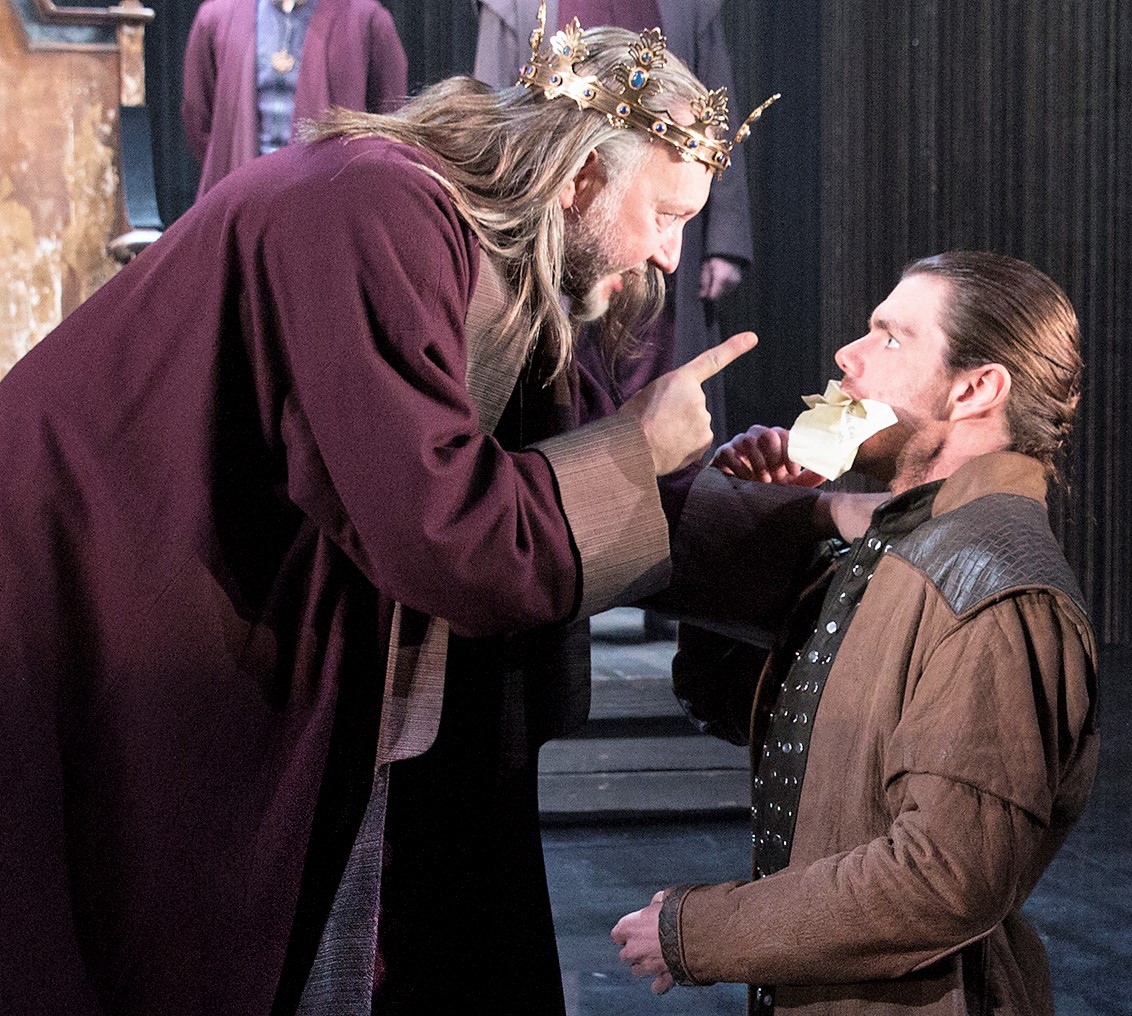
Matthew Needham plays Hotspur in Henry IV, Part 1. Top (from left): Antony Sher as Falstaff, Sam Marks as Poins, and Alex Hassell as Prince Hal.

Matthew Needham plays Hotspur in Henry IV, Part 1. Top (from left): Antony Sher as Falstaff, Sam Marks as Poins, and Alex Hassell as Prince Hal.

Yet in the tavern scenes and, in Part 2, the country scenes with Justice Shallow and Silence that involve conscription of men for war, the life of the common man is portrayed, more closely reflecting Shakespeare’s own time. From the king down to the lowest conscriptee, the plays provide a broad view of issues that touched Queen Elizabeth I and her subjects.

As Henry IV, Part 1 opens, the king (Jasper Britton) announces plans for a crusade to Jerusalem to retake the city from the Saracens—something he promised in his last speech in Richard II, the chronological predecessor (and also part of the RSC’s visit to the Brooklyn Academy of Music). Quickly, however, Henry is advised of rebels gathering against him: the Earl of Northumberland (Sean Chapman), a former ally in deposing Richard II; his brother, the Earl of Worcester (Antony Byrne); Northumberland’s son, and Lady Percy’s brother, Lord Mortimer (Robert Gilbert). Chief among them, though, is Matthew Needham’s stunningly good Hotspur, a fierce, intemperate warrior whose skill at arms is set against the dissipated life of Prince Hal (Alex Hassell). The trip to the Holy Land must be postponed.

Falstaff, the surrogate father to Hal, is embodied by Antony Sher, a great actor who has nevertheless seldom tackled comedy. Anyone who has seen him in classical roles (Massinger’s The Roman Actor, Marlowe’s Tamburlaine, Marston’s The Malcontent) knows he is a master of the language and a powerful stage presence. As Falstaff, though, something is not quite right. Sher growls a lot to sound dissipated and lumbers around to seem overweight. He can nail the wit, but one has the impression of someone giving a grand performance (and Falstaff is an actor at heart) but not completely inhabiting the character. He’s great fun to watch, but his roistering as Falstaff doesn’t feel natural. Yet there are splendid moments: when he’s trying to connect with his cronies in the darkness on Gad’s Hill to rob some pilgrims, he comes on, stepping slowly and whispering loudly, “Poins? Poins?” to find his compatriot.

Needham (right) with Jasper Britton as King Henry IV. Photographs by Richard Termine.

Needham (right) with Jasper Britton as King Henry IV. Photographs by Richard Termine.

In a similar way Hassell is not totally persuasive as Hal. Frivolity and callowness don’t sit naturally on him, but as he assumes the gravitas required of a future king, he becomes more persuasive. He gives the speeches clearly but, perhaps because he’s the centerpiece of three plays, there are times when they’re closer to masterly recitation than insightful characterization.

In Part 1, however, Britton, overshadowed in Richard II by David Tennant’s terrific performance, comes into his own as Henry, the usurping king who struggles with his son’s wastrel ways. His halting first lines, “So shaken as we are, so wan with care,” present a royal whose voice literally trembles. And news of Hotspur’s valor against rebels brings joy until his counselor Westmoreland remarks, “It is a conquest for a prince to boast of”—pointing up that Hal should have been leading the victory. The haunted Henry’s grappling with his son’s fecklessness is an important through line for both parts. Part 2, however, also affords Hassell the opportunity to navigate from Hal’s callowness to something that fits the actor better: nobility and valor.

Looser than Part 1Henry IV, Part 2 also lacks Hotspur. Moreover, the lower-class scenes in it prove a slog. One problem is that Antony Byrne’s Pistol, a swaggering braggart soldier, is a type that may have been funny 400 years ago but grates now. Made up as a yob, with thick black mascara under his eyes and a braid, and dressed in a punkish leather outfit by Stephanie Arditti, he is a tedious figure, offsetting Falstaff’s raillery. Thus, much of the first half of Part 2 is an ordeal, redeemed after intermission by Oliver Ford Davies’ hilarious Justice Shallow, paired with Jim Hooper’s wide-eyed, perplexed Silence.

Hassell as Hal banters with Sher as Falstaff.

Hassell as Hal banters with Sher as Falstaff.

But the most memorable scenes are those with Hotspur. “I can call spirits from the vasty deep,” says Joshua Richards’s Gandalfian Welshman, Owen Glendower, a behemoth in skins and long gray beard, and Hotspur’s in-law. To which Hotspur replies: “Why, so can I, or so can any man/But will they come when you do call for them?” And his scenes with his wife (Jennifer Kirby) are both touching and frustrating; though in love, each tries to connect emotionally with the other and doesn’t always succeed. Other standouts are Sam Marks’s vital Poins and Richards (again) as a red-nosed, dryly comic Bardolph, one of Falstaff’s cronies.

The plays are rich with smart business by director Gregory Doran. With Hotspur on a tear, his father, Northumberland, grabs him by the scruff of his neck and forces him to his knees. Some extended comic business with the serving-boy Francis plays beautifully (and sets up a cameo for Henry V). One clumsy interpolation, however, is Doran’s opening Part 2 with Rumour (Byrne) coming on in modern clothes against a field of projections of #Rumour. It may be intended to parallel gossip on the Internet, but it’s a jarring moment.

Though the first part is the stronger play, together the pair are an indispensable challenge that any lover of Shakespeare’s work will want to experience. They aren’t often done together, and this is an opportunity to hear verse-speaking of a high order and experience outstanding, if not flawless, productions.

The Royal Shakespeare Company’s Henry IV, Part 1 and Part 2 play in repertory with Richard II and Henry V through May 1 at BAM Harvey Theater (30 Lafayette Ave. between Ashland Place and St. Felix Street in Brooklyn). Tickets start at $35. Visit www.bam.org/theater for information.

Click for print friendly PDF version of this blog post