

Reviews

O Most Dread Dane

Austin Jones (left) plays Horatio, and Peter Sarsgaard plays Hamlet and in the Classic Stage Company’s production of Hamlet.

If you have seen Hamlet several times and are likely to be bored with a straightforward rendering, then perhaps the Classic Stage Company’s new modern-dress production, directed by Austin Pendleton, is the one for you. It’s full of bizarre ideas to a fault.

Where to begin? Well, one of the great revenge tragedies no longer has a hero who kills his enemies. This Hamlet is not directly responsible for the deaths of Laertes or Claudius. In the duel between Hamlet and Laertes, the latter cuts Hamlet with the poisoned rapier, then lays it down on the floor. Hamlet charges him like a bull; they wrestle; and Laertes accidentally rolls on top of his sword and wounds himself on the poisoned tip. As for Claudius, the action of Hamlet stabbing the king is omitted. After Gertrude lies dead, Hamlet hands the king the poisoned cup and commands: “Here, thou incestuous, murderous, damnèd Dane/Drink off this potion.” Claudius, berated into suicide, quaffs the drink.
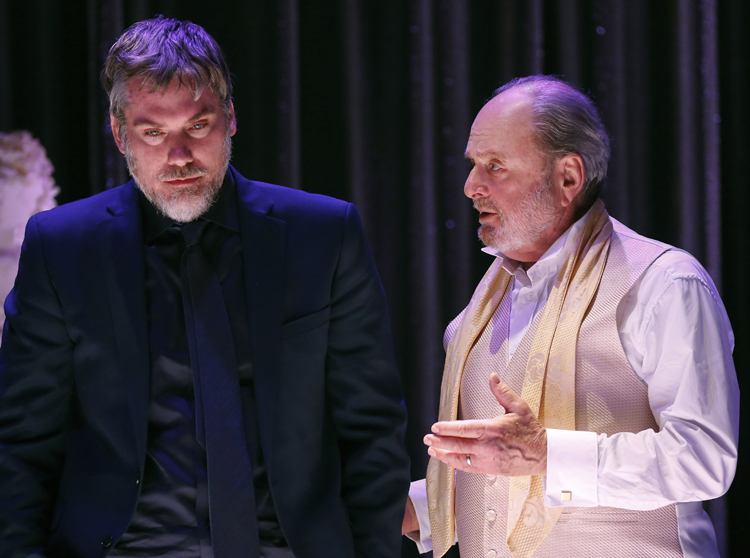
Glenn Fitzgerald (left) is Laertes, and Harris Yulin is Claudius in director Austin Pendleton’s production.

The one person this Hamlet does kill is Polonius, but that’s an accident. Still, weirdness is injected here too. Polonius’s ghost walks out from behind the arras, crosses the stage, and then exits. By comparison, the Ghost of Hamlet’s father—a character who actually has lines—is invisible in this production. Invisible ghosts have been used in tandem with dialogue spoken on tape, but here the Ghost’s words are eliminated as well, as if it were entirely in Hamlet’s imagination (although Francisco, Bernardo, and Marcellus speak of seeing it). And Ophelia’s ghost appears unexpectedly to hover around her own gravesite. So extra-textual ghosts are real, but Shakespeare’s real Ghost doesn’t exist?

If Pendleton has a concept, it appears to be that Hamlet is insane from the get-go, that his imagination is working overtime. That might explain why an uncut, multi-tiered wedding cake sits upstage, some two months after "the funeral meats did coldly furnish forth the marriage table.” Either the clean-up crew has been on strike, or it’s a symbol weighing on Hamlet’s diseased mind.
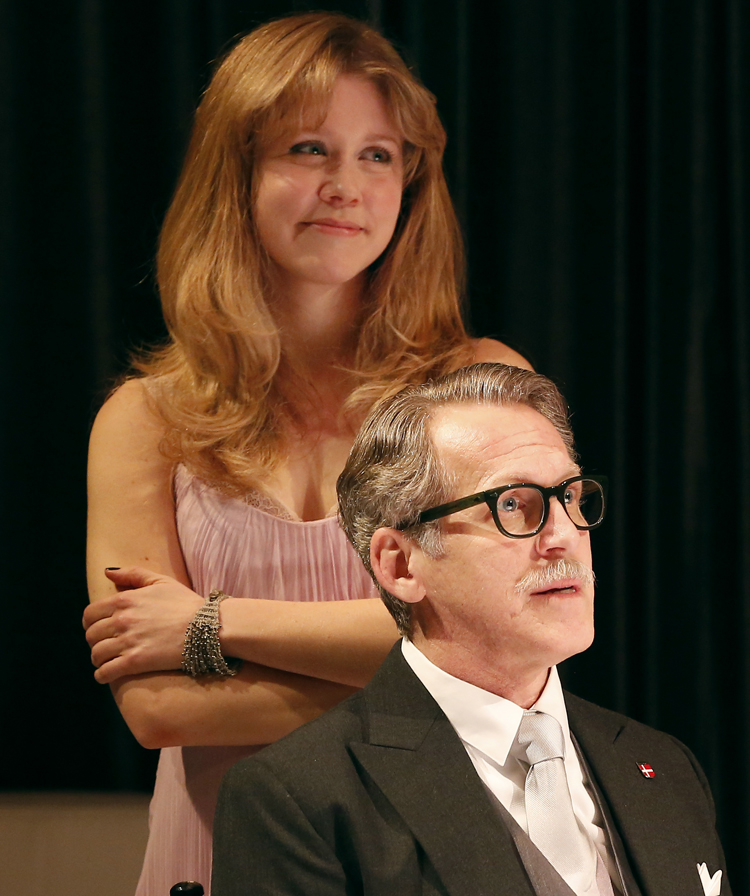
Lisa Joyce is Ophelia, and Stephen Spinella plays her father, Polonius.

Still, troublesome ideas can sometimes be overcome by outstanding acting. But Peter Sarsgaard seems determined to sledgehammer the meter of the verse into little pieces. Actors such as John Gielgud, accounted one of the great 20th-century Hamlets, and directors such as John Barton have advised that if one follows the scansion of Shakespearean verse, it will buoy the actor and the sense will reveal itself. Sarsgaard doesn’t, and he sinks like a stone. He puts in pauses every three words or so. On “a little more than kin … and less than kind,” the delay kills the pun. Moreover, his delivery is so halting throughout that one suspects he hasn’t got the words down. Certainly he’s not letter-perfect in the crucial “To be or not to be,” and lyricism is repeatedly sabotaged.

Gielgud, who directed Richard Burton in the role on Broadway, wrote in Stage Directions that “a Gertrude older than 50 must surely be unconvincing on the stage.” Pendleton has chosen Harris Yulin and Penelope Allen as Claudius and Gertrude. With the Internet at one’s fingertips, it gives nothing away to say that both are in their eighth decade. When Yulin’s skillfully spoken but lethargic Claudius tells Hamlet he wants him to stay at court rather than leave for Wittenberg, you might suspect that it’s because he has his eye on Hamlet as a caregiver.

Sarsgaard as Hamlet confronts his mother, Gertrude (Penelope Allen). Photographs by Carol Rosegg.

Pendleton’s casting repeatedly creates inconsistencies. Hamlet’s school chums, Rosencrantz and Guildenstern, are considerably younger, and Rosencrantz (Scott Parkinson) doubles as the Gravedigger, even though Jim Broaddus, an actor closer to the right age who is superb in smaller parts such as the Player King, would have been more apt. Glenn Fitzgerald as Laertes has a resonant voice and a presence that make one wish he had more to do. Unfortunately, although Hamlet claims to be “fat and scant of breath,” Sarsgaard is clearly in good shape. It’s Fitzgerald’s Laertes, supposedly an athletic and practiced swordsman, who is carrying a few extra pounds.

Ultimately, it’s Stephen Spinella’s Polonius who feels like the best-rounded character. He’s a dapper, instinctively shrewd courtier with warm feelings for his family. Still, the play isn’t called Polonius—though in the hands of Pendleton and Sarsgaard, it’s not so much Hamlet either. 

The Classic Stage Company production ofHamletruns through May 10; evening performances are at 7 p.m. Tuesday through Thursday and Sunday, and 8 p.m. Friday and Saturday. Matinees are at 3 p.m. Saturday and Sunday. Tickets are $65 and may be purchased by visitingwww.classicstage/.org.

Click for print friendly PDF version of this blog post

More Ado in Harlem

The Public Theater presentation of Much Ado About Nothing, with a starry cast performing in the bucolic setting of Central Park's Delacorte Theater, is likely to be among New York City's most sought after tickets. Up at the 133rd Street Arts Center, What Dreams May Co. Theatre and Queens Players are currently offering another Much Ado, hardly publicized but well worth a visit. In a perfectly ordered New York City, the masses of would-be theatergoers who fail to score seats for Much Ado in the Park (and those unwilling to sacrifice a day to waiting in line for free tickets) would find their way to Harlem to see the handiwork of 14 unknown actors, directed by Nicole Schalmo, in a tiny, second-floor auditorium with a minimum of scenery and equipment.

Much Ado About Nothing is a rowdy mixture of the silly and the serious. The central plot comes from classical Greek literature via 16th-century Italian sources — Ludovico Ariosto and Matteo Bandello — and Edmund Spenser's English epic The Faerie Queene. The story concerns Claudio (Gregg Ellson), just home from war, who spurns his bride, Hero (Christina Sheehan), at the altar. Hero is virtuous, but circumstantial evidence, contrived by the toxic Don John (Jonathan Emerson), suggests otherwise; and Claudio has been taken in by Don John's scheme. Hearing Claudio's harsh accusations, Hero faints away; her father, Leonato (Rafael Svarin), claiming she's dead, concocts a plan to clear her name and punish Claudio's arrogance. Things are dire until a band of bumbling rustics — constable Dogberry (Kenny Fedorko), his sidekick Verges (Nathan Beagle), and two officers of the municipal watch (Kate Fallon and Meghan Blakeman) — unwittingly thwart Don John's conspiracy.

There isn't much that's plausible about the misunderstanding between Claudio and Hero or what follows it; and, based on that implausibility, W.H. Auden has declared that Much Ado is "not one of Shakespeare's best plays." Yet throughout the past four centuries, this relatively dark comedy has been a crowd-pleaser. Its popularity is due, in large measure, to the subplot in which Hero's cousin Beatrice (Aimee Marcelle) and Benedick (Gonzalo Trigueros), a military comrade of Claudio, are tricked into falling in love with each other. The opinionated, sharp-tongued Benedick and Beatrice are among Shakespeare's most vivid creations; and Auden aptly describes them as “the characters of Shakespeare we’d most like to sit next to at dinner.”

The youthful cast handles both verse and prose with confidence and brio. Fedorko, adept at low Shakespearean comedy, makes Dogberry a highlight of the proceedings. Emerson, a forceful, nuanced Macduff in the What Dreams May Co. Macbeth last December, does what he can to lend verisimilitude to a one-dimensional role; his Don John is an exuberantly villainous cartoon, enormous fun to watch but inexplicably malevolent.

As in most productions of Much Ado, the evening belongs to Beatrice and Benedick. Shakespeare uses the reluctant lovers as tools to skewer the conventions of courtly love; Marcelle and Trigueros (presumably guided by Schalmo) ensure that Beatrice and Benedick are always emotionally complex and convincing. Marcelle is a striking comedic presence, compellingly vivacious without upstaging her compatriots. She's well-matched in raillery and romantic chemistry by Trigueros's Benedick. The pair navigate a credible, touching transformation from prickliness to devotion. 

In addition to being the production's director, Schalmo is responsible for costumes and, with Emerson, for the lighting design. She has transferred the action of the play from Renaissance Messina to a small town in the American Midwest. This conceit, applied with a light touch, works very well for a story of deception, backbiting and intrigue; and it frees the actors of anxiety about speaking Shakespeare's lines in their natural accents. 

Schalmo and her self-assured cast keep the action moving at a swift, consistent pace and make the most of the modest dimensions of the 133rd Street Arts Center stage. With no design fripperies to distract the audience, the production is focused throughout on the humor and beauty of the Bard's text. The simplicity of this Much Ado turns out to be a formidable asset.

Much Ado About Nothing by William Shakespeare, presented by What Dreams May Co. Theatre, in association with Queens Players at the 133rd Street Arts Center (308 West 133rd St. between St. Nicholas Ave. and Frederick Douglass Blvd. in Harlem), runs Thursdays, Fridays and Saturdays at 8 p.m., and Saturdays and Sundays at 3 p.m. through June 21. Tickets: $18. For tickets, visit www.brownpapertickets.com/event/495842 or call 1-800-838-3006.

Click for print friendly PDF version of this blog post

In Relative Distress

In Relative Distress

Charles Busch’s fizzy new work, The Tribute Artist, is really light summer fare, but since it has shown up to make this brutal winter a lot cheerier for a couple of hours, who’s going to complain? In his latest outing, Busch, who usually plays female characters, is Jimmy Nichols, a gay drag performer—or, as Jimmy prefers, “tribute artist”—who has been canned from his longtime job at a Las Vegas revue. The solid comedy he has constructed is rather like Charley’s Aunt for the 21st century, with nods to Arsenic and Old Lace and Weekend at Bernie’s.

Click for print friendly PDF version of this blog post